

Utilita and British Gas both supply gas and electricity to UK businesses, but their commercial energy propositions have different strengths.
Utilita Business concentrates on relatively straightforward fixed-price contracts, smart metering, real-time consumption information and commercial solar installations. Its fixed deals are available for 12, 24 or 36 months, while its solar division offers battery storage, electric vehicle charging and several funding options.
British Gas has a broader range of energy-supply products. These include conventional fixed contracts, the online-only British Gas Lite service, variable and rolling arrangements, renewable electricity and gas, half-hourly data tools and flexible wholesale purchasing for organisations consuming more than 1GWh annually.
The environmental distinction is also significant. British Gas offers zero-carbon electricity on qualifying fixed contracts and allows eligible customers to choose renewable-only electricity. Utilita does not currently promote a conventional 100% renewable business tariff and is publicly critical of renewable tariffs based principally on separately purchased certificates. It instead emphasises reducing consumption, real-time carbon information and generating renewable power directly at the customer’s premises.
Utilita may suit an SME seeking fixed prices, close account support and commercial solar. British Gas may be more appropriate where the business requires a wider tariff selection, renewable gas, advanced energy procurement or services across a complex multi-site portfolio.
Neither supplier can be declared universally cheaper. An accurate comparison requires written quotations based on the same meter, consumption, contract dates and payment method.
Utilita vs British Gas at a glance
| Feature | Utilita Business | British Gas Business |
|---|---|---|
| Business electricity | Yes | Yes |
| Business gas | Yes | Yes |
| SME supply | Yes | Yes |
| Half-hourly electricity | Yes | Yes |
| Multi-site supply | Yes, including group billing | Yes |
| Standard negotiated prices published | No | No |
| Public pricing information | Deemed and out-of-contract rates | Maximum microbusiness fixed prices |
| Fixed contract lengths | 12, 24 or 36 months | Normally one, two or three years; some published schedules include four years |
| Rolling or variable contract | Business Variable and out-of-contract rates | Variable plans and 30-day Rolling Energy Plan |
| Online-only tariff | No directly equivalent separate product | British Gas Lite |
| Large-user wholesale procurement | No comparable standard product prominently advertised | Flex Advantage above 1GWh and Full Flex above 10GWh |
| Smart meters | Central part of the proposition | Available to eligible businesses |
| Consumption information | My Utilita and real-time insights for compatible accounts | Energy360 DataView |
| Standard renewable electricity | No conventional renewable-only tariff prominently promoted | Renewable-only option available |
| Standard zero-carbon fixed electricity | No | Yes, on qualifying fixed plans |
| Supplier-wide renewable share | 0% in the 2024/25 fuel-mix disclosure | 35% |
| Supplier-wide carbon intensity | 481g CO₂/kWh | 53g CO₂/kWh |
| Renewable business gas | No standard certificate-backed product prominently advertised | Carbon Neutral Gas and Renewable Gas |
| Commercial solar | Yes | Yes |
| Solar funding | Purchase, finance and zero-upfront PPA options | Purchase and funded commercial solutions |
| Published SEG export rate | 3p/kWh | 12p/kWh up to 15kW or 8p/kWh above 15kW for eligible supply customers |
| EV charging | Employee, customer and fleet installations | Commercial and communal charging |
| Best suited to | SMEs wanting fixed supply, smart data and on-site solar | Businesses wanting broad tariff choice and advanced procurement |
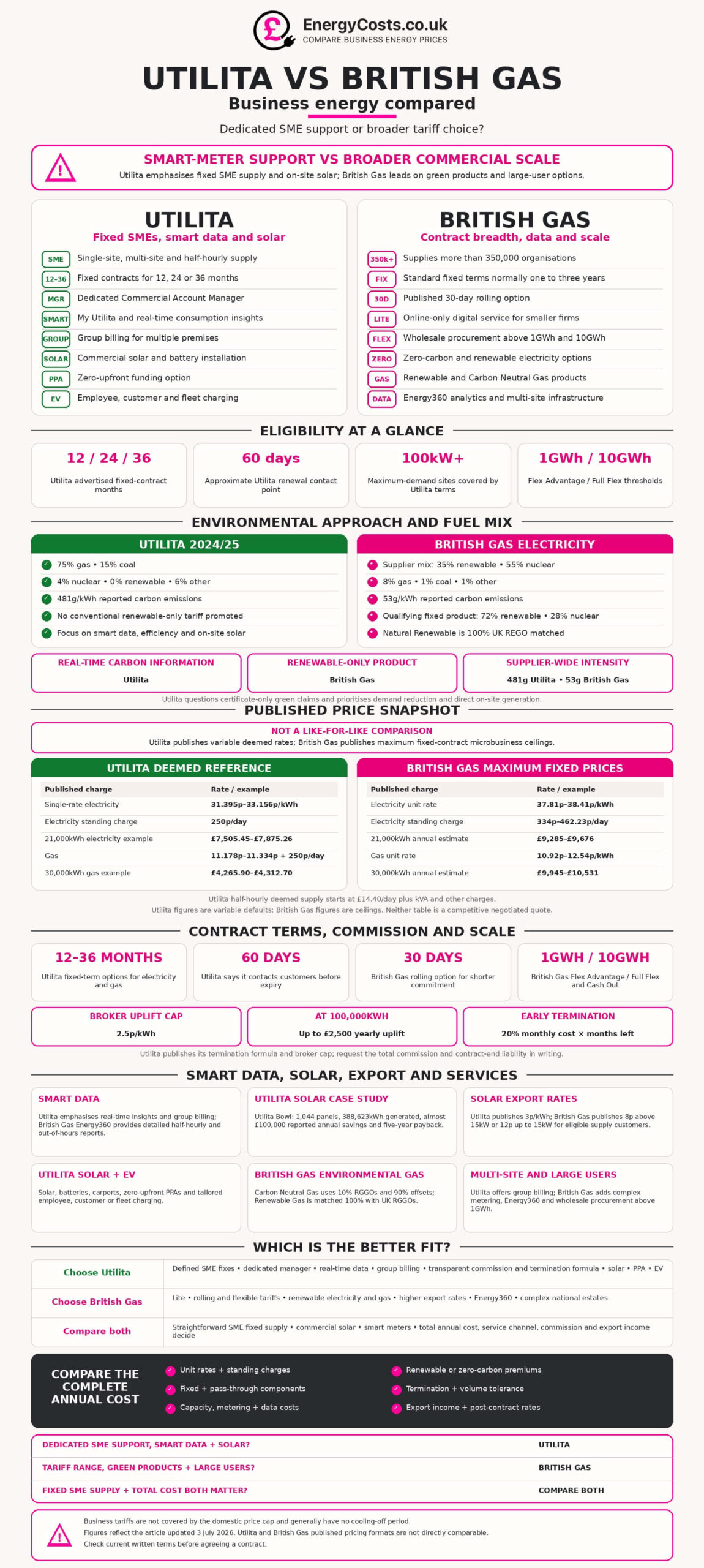
Which businesses can apply?
Utilita Business accepts applications for commercial electricity and gas supply and can support single-site, multi-site and half-hourly customers.
Its public proposition is primarily directed towards SMEs, although its terms and published rates also cover:
- half-hourly electricity supplies;
- sites with maximum demand of 100kW or more;
- profile class 00 meters;
- multiple premises;
- group billing; and
- commercial solar projects with substantial generation capacity.
British Gas serves businesses ranging from sole traders to major industrial groups.
Its options include:
- British Gas Lite for online-managed small-business accounts;
- conventional fixed plans;
- multi-rate tariffs;
- landlord and vacant-property arrangements;
- half-hourly contracts;
- multi-site portfolios;
- Flex Advantage for users above 1GWh; and
- Full Flex for users above 10GWh.
Example suitability by business size
| Example business | Annual electricity use | Potential options |
|---|---|---|
| Independent shop | 12,000kWh | Utilita fixed plan, British Gas or British Gas Lite |
| Small office | 40,000kWh | Fixed quotation from either supplier |
| Restaurant | 100,000kWh | Fixed or multi-rate tariff from either |
| Hotel | 350,000kWh | Bespoke multi-site or half-hourly service |
| Manufacturer | 2GWh | Utilita half-hourly quote or British Gas Flex Advantage |
| Industrial group | 15GWh | British Gas Full Flex likely to be more relevant |
| Sports venue with a large roof | Varies | Utilita or British Gas commercial solar |
| Commercial landlord | Numerous smaller meters | Group billing or specialist landlord services |
A supplier may require a deposit or advance payment or may decline to quote after assessing the company’s credit profile and supply risk.
Which supplier is cheaper?
There is no standard Utilita-versus-British Gas rate for every business.
A quotation can depend on:
- the electricity MPAN or gas MPRN;
- postcode and distribution region;
- meter profile;
- half-hourly consumption pattern;
- annual energy use;
- available electricity capacity;
- number of locations;
- contract start date;
- fixed-term length;
- payment method;
- credit history;
- expected changes in consumption;
- broker commission; and
- wholesale prices when the quotation is issued.
A full comparison should calculate:
- Annual consumption × unit rate
- daily standing charge × 365
- meter and data costs
- capacity charges
- network and policy costs
- pass-through charges
- VAT and Climate Change Levy where applicable
− export income and other credits
A lower unit rate does not necessarily produce a cheaper bill if it is accompanied by a substantially higher daily charge.
How price differences affect annual costs
| Annual consumption | Value of 0.5p/kWh | Value of 1p/kWh | Value of 3p/kWh | Value of 5p/kWh |
|---|---|---|---|---|
| 10,000kWh | £50 | £100 | £300 | £500 |
| 25,000kWh | £125 | £250 | £750 | £1,250 |
| 50,000kWh | £250 | £500 | £1,500 | £2,500 |
| 100,000kWh | £500 | £1,000 | £3,000 | £5,000 |
| 250,000kWh | £1,250 | £2,500 | £7,500 | £12,500 |
| 1GWh | £5,000 | £10,000 | £30,000 | £50,000 |
| 10GWh | £50,000 | £100,000 | £300,000 | £500,000 |
Standing charges can be equally important for low-consumption sites.
| Daily standing-charge difference | Annual cost per meter | Cost across ten meters |
|---|---|---|
| 25p | £91.25 | £912.50 |
| 50p | £182.50 | £1,825 |
| £1 | £365 | £3,650 |
| £2 | £730 | £7,300 |
| £5 | £1,825 | £18,250 |
Utilita fixed business tariffs
Utilita advertises fixed business energy plans lasting:
- 12 months;
- 24 months; or
- 36 months.
The supplier describes these as fixed-rate agreements intended to protect customers from unexpected price increases.
Under Utilita’s principal terms, the contracted charges generally remain unchanged during the fixed period, except for pass-through costs and specific contractual events.
Prices may potentially change where:
- the information supplied during the application was incorrect;
- actual consumption is materially different from the estimate;
- the meter is incompatible with the quoted tariff;
- the business fails to pay on time;
- the business leaves the premises early;
- an act of law or regulation changes the supplier’s costs;
- VAT changes; or
- additional metering or industry costs arise.
Businesses should therefore establish which charges are genuinely fixed and which costs can be passed through separately.
Utilita account support
Utilita’s business proposition includes:
- a dedicated Commercial Account Manager;
- telephone and online support;
- renewal assistance;
- smart-meter installation;
- consumption information;
- My Utilita account access;
- group billing;
- payment by variable Direct Debit; and
- energy-efficiency guidance.
My Utilita is most clearly promoted for compatible single-site customers. Businesses with several premises can use group billing, but should confirm what consolidated consumption reporting is included.
Utilita renewal process
Utilita says it contacts fixed-term customers approximately 60 days before their agreement ends.
If the company does not agree a replacement tariff, it can move onto Utilita’s Business Variable or out-of-contract rates.
Those prices:
- have no fixed end date;
- can change without advance notice under the published terms;
- are normally more expensive than negotiated fixed rates; and
- can be left without paying an early termination charge.
A business should begin comparing options before receiving the 60-day renewal notice, particularly where several meters or a broker are involved.
British Gas fixed business tariffs
British Gas’s principal Fixed Price Energy Plan normally offers contracts lasting:
- one year;
- two years; or
- three years.
Its published maximum-pricing schedule also contains four-year products, although availability should be confirmed during the quotation process.
The standard fixed plan offers:
- fixed unit and standing charges, subject to the contract;
- Direct Debit payment options;
- online account management;
- renewal notifications;
- smart-meter installation where eligible; and
- zero-carbon electricity on qualifying fixed plans.
The total bill remains dependent on consumption even where the rate is fixed.
British Gas Lite
British Gas Lite is a digital-first fixed tariff for small companies.
Its features include:
- online account management;
- electronic bills;
- monthly Direct Debit;
- automatic smart-meter readings;
- dedicated webchat support; and
- no conventional telephone account-management service.
Lite may suit a small company with a straightforward meter and no need for complex support.
It may be less suitable where the business has:
- several sites;
- disputed historic bills;
- complicated meter arrangements;
- frequent tenancy changes;
- a half-hourly supply;
- specialist environmental requirements; or
- a preference for telephone support.
British Gas variable and rolling options
British Gas offers a wider selection of non-fixed contracts.
Its 30-day Rolling Energy Plan can suit businesses that:
- may move premises shortly;
- are being sold;
- expect major operational changes;
- do not want a multi-year commitment; or
- believe wholesale prices may fall.
The tariff provides greater flexibility but less certainty because rates can increase.
British Gas also applies variable and deemed prices where a customer’s fixed agreement expires or a business occupies premises without arranging a contract.
British Gas flexible procurement
British Gas has a significant advantage for high-consumption organisations seeking access to wholesale energy markets.
Flex Advantage
Flex Advantage is intended for businesses consuming more than 1GWh annually.
It allows the customer to:
- purchase electricity or gas in 20% tranches;
- spread procurement decisions across several dates;
- access market-reflective prices;
- monitor its position through an online portal; and
- manage wholesale price risk.
Full Flex
Full Flex is designed for businesses using more than 10GWh annually.
It provides greater control over:
- trade size;
- fixing and unfixing;
- transaction timing;
- the proportion left exposed to market prices;
- multi-year procurement; and
- portfolio risk.
Flex Cash Out
Flex Cash Out can suit a large customer whose actual use varies substantially from its forecast.
Differences between purchased volumes and actual consumption can be settled against market prices.
Utilita does not currently promote an equivalent standard wholesale purchasing service, making British Gas the stronger option for many large industrial or corporate users.
Utilita published deemed electricity rates
Utilita’s current public principal terms include non-half-hourly deemed and out-of-contract rates.
These apply where:
- no fixed contract has been agreed;
- a business moves into Utilita-supplied premises;
- an existing pricing agreement expires;
- a contract is terminated without replacement; or
- Utilita is appointed as a supplier of last resort.
The published single-rate electricity prices are:
| Region | Unit rate | Standing charge |
|---|---|---|
| London, lowest published rate | 31.395p/kWh | 250p per day |
| Swalec | 31.755p/kWh | 250p per day |
| Eastern | 31.961p/kWh | 250p per day |
| East Midlands | 31.982p/kWh | 250p per day |
| Yorkshire | 32.023p/kWh | 250p per day |
| Southern | 32.229p/kWh | 250p per day |
| Norweb | 32.239p/kWh | 250p per day |
| Midlands | 32.291p/kWh | 250p per day |
| Northern | 32.291p/kWh | 250p per day |
| Scottish Power | 32.332p/kWh | 250p per day |
| Sweb | 32.404p/kWh | 250p per day |
| Scottish Hydro | 32.497p/kWh | 250p per day |
| Manweb, highest published rate | 33.156p/kWh | 250p per day |
The daily charge of 250p equates to £912.50 annually.
Utilita day-and-night prices
| Charge | Published regional range |
|---|---|
| Day rate | 31.693p–33.642p/kWh |
| Night rate | 29.283p–30.494p/kWh |
| Standing charge | 250p per day |
The night-time discount is relatively modest in some regions.
For example, where the day rate is 32.5p and the night rate is 30p:
| Proportion used at night | Weighted average rate |
|---|---|
| 10% | 32.25p/kWh |
| 25% | 31.88p/kWh |
| 50% | 31.25p/kWh |
| 75% | 30.63p/kWh |
A two-rate meter is most valuable where a substantial share of the company’s electricity is genuinely consumed during the defined night period.
Illustrative Utilita deemed electricity costs
The following examples use Utilita’s lowest and highest published single-rate regional prices and include the £912.50 annual standing charge.
| Annual electricity use | Lowest regional total | Highest regional total |
|---|---|---|
| 10,000kWh | £4,052.00 | £4,228.10 |
| 21,000kWh | £7,505.45 | £7,875.26 |
| 25,000kWh | £8,761.25 | £9,201.50 |
| 50,000kWh | £16,610.00 | £17,490.50 |
| 100,000kWh | £32,307.50 | £34,068.50 |
These figures exclude VAT, Climate Change Levy and any other applicable charges.
They are not indicative fixed-contract quotations.
Utilita deemed gas rates
Utilita’s public schedule gives regional gas rates of approximately:
| Charge | Published range |
|---|---|
| Gas unit rate | 11.178p–11.334p/kWh |
| Daily standing charge | 250p |
| Annual standing charge | £912.50 |
The resulting illustrative costs are:
| Annual gas use | Lowest regional total | Highest regional total |
|---|---|---|
| 25,000kWh | £3,707.00 | £3,746.00 |
| 30,000kWh | £4,265.90 | £4,312.70 |
| 50,000kWh | £6,501.50 | £6,579.50 |
| 100,000kWh | £12,090.50 | £12,246.50 |
| 250,000kWh | £28,857.50 | £29,247.50 |
These totals exclude VAT and other applicable taxes.
Utilita half-hourly rates
Utilita’s separate half-hourly schedule effective from 1 April 2026 gives the following deemed and out-of-contract prices:
| Half-hourly meter type | Unit or day rate | Night rate | Base standing charge |
|---|---|---|---|
| Unrestricted | 39.095p/kWh | Not applicable | £14.40 per day plus kVA |
| Day and night | 40.078p/kWh | 38.664p/kWh | £14.40 per day plus kVA |
The £14.40 daily base charge alone equals £5,256 annually before the capacity-related kVA component.
Additional costs can include:
- meter operation;
- data collection;
- data aggregation;
- reactive power;
- Climate Change Levy;
- excess capacity;
- excess losses;
- special visits;
- industry levies; and
- taxes.
A half-hourly business should compare a complete annual model rather than only the unit rate.
British Gas maximum microbusiness prices
British Gas publishes maximum prices for microbusiness customers entering or renewing a Fixed Price Energy Plan.
These are upper limits rather than typical or average offers.
The figures below were stated as current on 27 May 2026 and exclude VAT, Climate Change Levy and other applicable charges.
Single-rate electricity
| Fixed term | Maximum unit rate | Maximum standing charge | Published contract cost |
|---|---|---|---|
| One year | 38.41p/kWh | 334p per day | £9,285 |
| Two years | 37.81p/kWh | 379.96p per day | £18,654 |
| Three years | 38.04p/kWh | 428.43p per day | £28,657 |
| Four years | 38.04p/kWh | 462.23p per day | £38,702 |
The estimated contract costs assume annual electricity use of 21,000kWh.
| Contract length | Approximate average annual cost |
|---|---|
| One year | £9,285 |
| Two years | £9,327 |
| Three years | £9,552 |
| Four years | £9,676 |
Day-and-night electricity
| Fixed term | Maximum day rate | Maximum night rate | Standing charge |
|---|---|---|---|
| One year | 40p/kWh | 31.76p/kWh | 334p per day |
| Two years | 39.37p/kWh | 31.17p/kWh | 379.96p per day |
| Three years | 39.61p/kWh | 31.42p/kWh | 428.43p per day |
| Four years | 39.61p/kWh | 31.42p/kWh | 462.23p per day |
Evening-and-weekend electricity
| Fixed term | Evening and weekend | Weekday daytime | Standing charge |
|---|---|---|---|
| One year | 31.66p/kWh | 42.27p/kWh | 334p per day |
| Two years | 31.17p/kWh | 41.20p/kWh | 379.96p per day |
| Three years | 31.48p/kWh | 40.80p/kWh | 428.43p per day |
| Four years | 31.48p/kWh | 40.80p/kWh | 462.23p per day |
Gas
| Fixed term | Maximum gas rate | Maximum standing charge | Published contract cost |
|---|---|---|---|
| One year | 12.54p/kWh | 1,710.28p per day | £10,005 |
| Two years | 11.44p/kWh | 1,784.47p per day | £19,891 |
| Three years | 10.92p/kWh | 1,862.57p per day | £30,223 |
| Four years | 11.07p/kWh | 1,975.41p per day | £42,125 |
The gas illustrations assume annual use of 30,000kWh.
Can the public prices identify a winner?
No. The published figures cover different tariff types.
| Factor | Utilita figures | British Gas figures |
|---|---|---|
| Tariff type | Deemed or out of contract | Fixed contract |
| Customer status | No negotiated tariff | Entering or renewing a contract |
| Price purpose | Current default charge | Maximum price ceiling |
| Regional variation | Yes | National maximum table |
| Price certainty | Variable | Fixed for the agreed period, subject to terms |
| Representative new-customer price | No | Not necessarily |
At 21,000kWh of electricity, Utilita’s published deemed rate produces an illustrative annual total of approximately £7,505 to £7,875 before VAT and CCL.
British Gas’s one-year maximum example for the same published consumption level is £9,285.
This does not establish that Utilita will quote a lower fixed tariff. It compares a Utilita variable default rate with the maximum British Gas fixed price rather than two live offers.
The same issue affects gas. Utilita’s published deemed total at 30,000kWh is approximately £4,266 to £4,313, while British Gas’s one-year maximum fixed example is £10,005.
A direct same-day quote is essential.
Does Utilita offer business tariffs without standing charges?
Utilita is well known in the domestic market for tariffs that place more costs into unit rates rather than charging a traditional standing charge.
Businesses should not assume that this automatically applies to Utilita Business.
Its public commercial deemed schedules include:
- a 250p daily charge for non-half-hourly electricity;
- a 250p daily charge for gas; and
- a £14.40 daily half-hourly charge plus a kVA component.
A negotiated tariff could use a different structure, but there is no prominent standard no-standing-charge business product currently advertised.
Utilita early termination charges
Utilita uses a published formula for ending a fixed contract early.
The termination charge is:
20% of the monthly contract price × number of months remaining
The monthly contract price is based on:
- one-twelfth of estimated annual consumption;
- multiplied by the energy unit rate;
- plus the applicable standing charge.
The calculation begins after the relevant 30-day notice period.
For example, where:
- annual estimated cost is £3,600;
- monthly cost is £300;
- 20% of the monthly cost is £60; and
- eight months remain,
the termination fee is:
£60 × 8 = £480
The fee can also become relevant where the business leaves its premises before the end of the fixed term, although Utilita may allow the agreement to continue at a new property subject to revised pricing.
Utilita broker commission
Where a broker introduces the customer, Utilita’s principal terms allow commission to be included as an uplift to the unit rate.
The published cap is 2.5p/kWh.
The maximum effect at that uplift would be:
| Annual consumption | Maximum annual uplift at 2.5p/kWh |
|---|---|
| 10,000kWh | £250 |
| 25,000kWh | £625 |
| 50,000kWh | £1,250 |
| 100,000kWh | £2,500 |
| 250,000kWh | £6,250 |
Utilita says a customer can request a statement showing commission paid or due.
A company should compare the broker-arranged rate with a direct quotation and ask the broker to disclose the total commission over the full term.
Smart meters and energy information
Smart technology is central to Utilita’s business proposition.
Its compatible business smart meters can provide:
- automatic meter readings;
- fewer estimated bills;
- half-hourly consumption records;
- more up-to-date account information;
- real-time or near-real-time insights;
- information through My Utilita; and
- data that can help identify potential savings.
Utilita generally attempts to replace compatible single-site meters with smart or advanced equipment.
The supplier may terminate a fixed contract and apply a termination fee if a customer unreasonably refuses a required smart-meter installation.
British Gas also offers free smart meters to eligible businesses.
Its Energy360 DataView platform provides:
- half-hourly graphs;
- daily updates;
- historical downloads;
- scheduled reporting;
- out-of-hours analysis; and
- visibility of consumption trends.
Which has the better energy-monitoring service?
| Requirement | Likely stronger fit |
|---|---|
| Simple single-site account and smart data | Utilita |
| Half-hourly visual analysis | British Gas |
| Out-of-hours reports | British Gas |
| Real-time carbon information | Utilita |
| Group billing | Utilita |
| Complex multi-site analytics | British Gas |
| Wholesale purchasing position | British Gas |
| Dedicated account-manager support | Utilita |
Utilita’s approach is closely integrated with its smart-meter proposition, while British Gas offers the more developed public analytics platform for complex reporting.
Comparing environmental credentials
The suppliers take very different approaches to green electricity.
Utilita fuel mix
Utilita’s published 2024/25 electricity fuel mix was:
| Source | Utilita | National average |
|---|---|---|
| Natural gas | 75% | 33% |
| Coal | 15% | 6% |
| Nuclear | 4% | 16% |
| Renewables | 0% | 42% |
| Other fuels | 6% | 3% |
| Reported carbon emissions | 481g/kWh | Not stated in the same table |
The published mix is significantly more dependent on gas and coal than the national average.
Utilita does not attempt to present this supplier-wide mix as renewable. Instead, it publicly criticises the way some energy companies use separately purchased REGOs to market apparently green tariffs.
Its position is that:
- electricity delivered through the grid comes from a mixture of sources;
- REGOs may be separated from the electricity originally generated;
- certificate-only tariffs may not finance additional renewable capacity; and
- directly reducing consumption or generating electricity on site can produce clearer benefits.
Utilita focuses on energy efficiency, smart data, solar and real-time location-based carbon information.
British Gas fuel mix
British Gas’s 2024/25 supplier-wide mix was:
| Source | British Gas |
|---|---|
| Renewables | 35% |
| Nuclear | 55% |
| Natural gas | 8% |
| Coal | 1% |
| Other | 1% |
| Reported carbon emissions | 53g/kWh |
| Zero-carbon proportion | 90% |
British Gas’s general mix has a considerably lower reported carbon intensity than Utilita’s.
However, its standard company-wide figures should be distinguished from its specific environmental products.
British Gas zero-carbon electricity
British Gas says qualifying new and renewed fixed electricity plans are zero carbon as standard.
Its current product backing is described as:
- 72% renewable electricity; and
- 28% nuclear generation.
This can support market-based zero-emission reporting but is not renewable-only because nuclear power is included.
Natural Renewable Electricity
Eligible customers can choose British Gas Natural Renewable Electricity.
Under this product:
- 100% of consumption is matched with UK REGOs;
- sources include wind, solar and hydro;
- it is offered at the same quoted price as standard zero-carbon electricity;
- customers can receive evidence for Scope 2 reporting; and
- British Gas Lite and non-contracted customers are excluded.
Which supplier is greener?
The answer depends on how the business defines green energy.
| Priority | Likely stronger fit |
|---|---|
| Lower supplier-wide carbon intensity | British Gas |
| Higher renewable share | British Gas |
| Renewable-only certificate-backed supply | British Gas |
| Avoiding nuclear-backed electricity | British Gas Natural Renewable rather than its standard zero-carbon product |
| Real-time location-based carbon data | Utilita |
| Direct on-site generation | Compare both |
| Avoiding reliance on conventional green-tariff marketing | Utilita |
| Formal Scope 2 renewable certificate | British Gas |
British Gas provides the stronger conventional renewable product.
Utilita provides the more sceptical and transparent account of the physical grid mix and argues that the strongest action is reducing demand or producing renewable electricity on site.
Comparing business gas
Utilita supplies conventional business gas but does not prominently advertise a standard renewable or carbon-neutral business gas product.
British Gas offers two defined environmental upgrades.
Carbon Neutral Gas
British Gas Carbon Neutral Gas is backed by:
| Mechanism | Proportion |
|---|---|
| UK Renewable Gas Guarantees of Origin | 10% |
| Verified carbon-offset projects | 90% |
The physical gas burned at the premises continues to create direct emissions. The RGGOs and offsets address the environmental claim rather than preventing on-site combustion.
Renewable Gas
British Gas also offers Renewable Gas, under which 100% of the customer’s consumption is matched with RGGOs from UK-produced biomethane.
British Gas is therefore likely to be the stronger choice where the organisation requires certificate-backed renewable gas or evidence for environmental reporting.
Utilita commercial solar
Commercial solar is one of Utilita Business’s strongest features.
Its services include:
- bespoke site surveys;
- solar system design;
- rooftop panels;
- battery storage;
- monitoring;
- installation;
- EV charging;
- solar carports;
- cash purchase;
- loan funding; and
- zero-upfront Power Purchase Agreements.
A PPA allows the equipment provider or funder to own the installation while the business purchases the electricity generated on site over an agreed period.
The company should check:
- PPA duration;
- electricity price and indexation;
- minimum purchase commitments;
- equipment ownership;
- roof or land rights;
- maintenance responsibilities;
- treatment when the property is sold;
- end-of-term arrangements; and
- early termination costs.
Utilita solar case studies
Utilita publishes several commercial project results.
Utilita Bowl
The Utilita Bowl installation includes:
- 1,044 solar panels;
- annual generation approaching 400,000kWh;
- 388,623kWh generated between September 2024 and September 2025;
- approximately 25% of the venue’s annual electricity demand;
- almost £100,000 in reported annual savings;
- approximately 80 tonnes of annual carbon savings; and
- an estimated five-year payback under its loan arrangement.
Pompey in the Community
The Portsmouth project includes:
- 358 panels;
- estimated annual generation of 122,570kWh;
- reported annual energy savings of approximately £33,000;
- a reduction of more than 60% in the site’s energy expenditure;
- approximately 27 tonnes of annual carbon savings; and
- total projected savings presented as approximately £660,000.
These are supplier case studies rather than guaranteed results for every installation.
British Gas commercial solar
British Gas and Centrica Business Solutions also provide commercial solar.
Available services can include:
- rooftop solar;
- ground-mounted systems;
- solar carports;
- battery storage;
- monitoring;
- maintenance;
- direct capital purchase;
- financed projects;
- PPAs;
- microgrids;
- heat pumps;
- combined heat and power; and
- EV charging.
British Gas is likely to have an advantage where solar is one component of a larger multi-technology energy project.
Utilita may appeal more where the company wants a specialist solar proposal combined with close project support and visible case-study data.
Comparing solar export rates
Utilita is a mandatory Smart Export Guarantee licensee and publishes a rate of 3p/kWh.
The tariff:
- is open even where Utilita does not supply the imported electricity;
- covers eligible generation up to 5MW;
- requires recognised installation certification;
- requires a meter capable of half-hourly export readings; and
- covers solar, wind, hydro, anaerobic digestion and micro-CHP.
British Gas publishes different export rates according to capacity and import-supply status.
| Export arrangement | Published rate |
|---|---|
| Utilita SEG | 3p/kWh |
| British Gas Export Premium, up to 15kW | 12p/kWh |
| British Gas Export Extra, above 15kW | 8p/kWh |
| British Gas non-supply customer rate | 3p/kWh |
The higher British Gas rates require British Gas to supply the imported electricity.
Export-income examples
| Annual export | Utilita at 3p | British Gas at 8p | British Gas at 12p |
|---|---|---|---|
| 5,000kWh | £150 | £400 | £600 |
| 10,000kWh | £300 | £800 | £1,200 |
| 25,000kWh | £750 | £2,000 | £3,000 |
| 50,000kWh | £1,500 | £4,000 | £6,000 |
British Gas provides the higher published payment for eligible supply customers.
However, a business generating most of its electricity for its own use may save more through avoided grid imports than it earns through exports.
Electric vehicle charging
Utilita installs tailored EV chargers for:
- employees;
- customers;
- commercial fleets;
- visitor parking;
- leisure venues;
- hotels;
- retail sites; and
- solar carports.
Its services can include custom payment arrangements, allowing the site owner to charge drivers and create an additional revenue stream.
British Gas offers commercial and communal EV charging, particularly for:
- commercial landlords;
- apartment developments;
- shared car parks;
- property developers;
- employees; and
- tenants without private driveways.
Utilita may have the advantage for a solar-linked customer, visitor or fleet installation.
British Gas may be stronger where the principal requirement is communal charging, tenant billing or integration with a wider Centrica infrastructure project.
Multi-site and large-business services
Utilita supports group billing and half-hourly supplies but does not currently promote an extensive wholesale trading platform comparable with British Gas’s flexible contracts.
British Gas offers:
- half-hourly tariffs;
- complex metering;
- commercial connections;
- landlord services;
- multi-site reporting;
- group account management;
- Energy360;
- Flex Advantage;
- Full Flex;
- Flex Cash Out; and
- wider Centrica infrastructure services.
British Gas is therefore more likely to suit a major energy user with an internal procurement team.
Utilita may be preferable for an SME or medium-sized group that values fixed pricing, smart data and dedicated account support over active wholesale trading.
Utilita advantages and disadvantages
Advantages
- Provides business electricity and gas.
- Fixed contracts are available for 12, 24 or 36 months.
- Dedicated Commercial Account Managers are available.
- Smart meters and consumption information are central to the proposition.
- Group billing is available for multiple sites.
- Public deemed and out-of-contract rates are relatively transparent.
- Early termination and broker commission formulas are published.
- Broker commission is capped at 2.5p/kWh.
- Strong commercial solar and battery proposition.
- Zero-upfront PPA funding is available.
- Publishes detailed commercial solar case studies.
- Provides tailored fleet, employee and customer EV charging.
- Offers real-time carbon information rather than relying solely on annual certificates.
Disadvantages
- Negotiated contract rates are not publicly displayed.
- No standard wholesale-flex product is prominently advertised.
- Its supplier-wide 2024/25 mix contained 75% gas and 15% coal.
- Its disclosed renewable share was 0%.
- Reported electricity carbon intensity was 481g/kWh.
- No conventional renewable-only business tariff is prominently offered.
- No clearly defined renewable business gas product is advertised.
- Published deemed tariffs include substantial standing charges.
- Half-hourly standing charges begin at £14.40 per day plus kVA.
- The standard SEG rate is only 3p/kWh.
- My Utilita’s clearest functionality is aimed at compatible single-site customers.
- A fixed contract can carry a significant consumption-based termination charge.
British Gas advantages and disadvantages
Advantages
- Serves more than 350,000 UK businesses.
- Offers fixed, rolling, digital and flexible products.
- British Gas Lite provides a dedicated online-only SME tariff.
- Flex Advantage is available above 1GWh.
- Full Flex and Flex Cash Out support major energy users.
- Qualifying fixed electricity contracts are zero carbon.
- Natural Renewable Electricity is available at the same quoted price for eligible customers.
- Offers Carbon Neutral Gas and Renewable Gas.
- Supplier-wide reported carbon intensity is substantially below Utilita’s.
- Energy360 provides detailed half-hourly reporting.
- Provides commercial solar, battery and EV solutions.
- Pays up to 12p/kWh through its published SEG tariffs.
- Provides specialist multi-site, landlord, metering and connection services.
- PeakSave can provide smart-meter customers with occasional electricity discounts.
Disadvantages
- Maximum published microbusiness standing charges are high.
- The maximum gas standing charges are particularly expensive.
- British Gas Lite offers webchat rather than telephone support.
- Standard zero-carbon electricity includes nuclear generation.
- Renewable-only electricity requires an opt-in and excludes Lite.
- Flexible procurement exposes businesses to market risk.
- Its broad product range can make comparison more complicated.
- Published maximum prices are not typical quotations.
- Carbon offsets do not prevent gas emissions at the customer’s premises.
- Its commercial services may feel less personalised than Utilita’s dedicated-account model.
Which supplier is better for different businesses?
| Business type or requirement | Likely better fit | Reason |
|---|---|---|
| Small business wanting a straightforward fix | Compare both | Both offer fixed SME contracts |
| Business wanting a 12-, 24- or 36-month term | Utilita | Clearly defined fixed-term selection |
| Online-only microbusiness | British Gas Lite | Dedicated digital tariff |
| Company wanting telephone account support | Utilita or standard British Gas | Lite is webchat-only |
| Business seeking wholesale purchasing | British Gas | Flex products begin above 1GWh |
| Company using more than 10GWh | British Gas | Full Flex and Flex Cash Out |
| Business requiring renewable-only electricity | British Gas | Natural Renewable Electricity |
| Business avoiding certificate-based green claims | Utilita may appeal | Focus on physical grid data and on-site generation |
| Company requiring renewable gas | British Gas | Defined RGGO-backed options |
| SME wanting real-time smart-meter insights | Utilita | Central part of its proposition |
| Company needing detailed half-hourly reports | British Gas | Energy360 DataView |
| Business with a suitable large roof | Compare both | Both offer financed commercial solar |
| Venue wanting published solar case studies | Utilita | Extensive sports and community examples |
| Solar exporter up to 15kW | British Gas | 12p/kWh for eligible customers |
| Solar exporter above 15kW | British Gas | 8p/kWh for eligible supply customers |
| Non-supply SEG customer | Either | Both publish 3p/kWh |
| Customer-facing EV charging | Utilita | Custom payment and revenue options |
| Commercial landlord | British Gas | Landlord and communal-charging services |
| Medium multi-site SME | Utilita may suit | Group billing and dedicated support |
| National multi-site corporation | British Gas may suit | Procurement, data and metering breadth |
Final verdict: Utilita vs British Gas
Utilita and British Gas can both supply electricity and gas to UK companies, but they have different areas of strength.
Utilita is likely to be the better fit where the company wants:
- a fixed contract lasting 12, 24 or 36 months;
- dedicated commercial account support;
- smart-meter data;
- transparent termination and broker-commission formulas;
- group billing;
- a tailored commercial solar installation;
- zero-upfront PPA funding; or
- solar-linked EV charging.
British Gas is likely to be the stronger option where the business wants:
- British Gas Lite;
- a rolling contract;
- sophisticated wholesale procurement;
- renewable-only electricity;
- renewable or carbon-neutral gas;
- detailed half-hourly analytics;
- higher SEG payments;
- complex metering and connections; or
- services across a large national estate.
British Gas also has the stronger supplier-wide environmental figures. Its 2024/25 electricity mix had a reported carbon intensity of 53g/kWh, compared with 481g/kWh for Utilita.
Utilita takes the position that certificate-backed green tariffs can provide a misleading impression of the electricity physically delivered. Its alternative proposition is to help customers consume less, understand real-time grid emissions and install generation directly at their premises.
The pricing evidence does not produce a clear winner.
Utilita’s published deemed electricity and gas rates appear lower than British Gas’s maximum fixed prices in several examples. However, one table shows default variable rates and the other shows maximum fixed-price ceilings. Neither represents the best live quotation necessarily available.
Businesses should ask both suppliers to provide:
- unit rates;
- daily standing charges;
- complete annual cost projections;
- fixed and pass-through elements;
- contract duration;
- early termination charges;
- broker commission;
- renewable or zero-carbon credentials;
- meter and capacity costs;
- smart-data functionality;
- solar export rates;
- renewal arrangements; and
- out-of-contract prices.
For most companies, the conclusion is:
- choose Utilita for dedicated SME support, smart consumption information and a strong commercial-solar proposition;
- choose British Gas for broader tariff choice, renewable products and large-user procurement;
- compare Utilita’s direct quote with British Gas Lite where price and online management are the main SME priorities; and
- select the supplier offering the lowest realistic total annual cost after standing charges, commission and pass-through costs have been included.
FAQ
It depends on the live quotations. Utilita publishes deemed rates, while British Gas publishes maximum fixed-contract prices. These different tariff types cannot establish which supplier is cheaper for a particular business.
Yes. Utilita Business supplies commercial electricity and gas and supports single-site, multi-site and half-hourly customers.
Yes. Its current deemed schedules include daily standing charges for electricity and gas. Its half-hourly schedule applies £14.40 per day plus a kVA-related charge.
Yes. Utilita advertises fixed business contracts lasting 12, 24 or 36 months.
Yes. Its main Fixed Price Energy Plan normally offers one-, two- or three-year terms. Some published maximum-price schedules also contain four-year products.
British Gas has the lower-carbon supplier-wide mix and offers renewable-only electricity. Utilita does not promote a conventional green tariff and instead focuses on consumption reduction, carbon transparency and on-site solar.
Utilita does not prominently advertise a conventional 100% renewable business tariff. Its 2024/25 supplier-wide fuel mix reported 0% renewable electricity.
Yes. British Gas offers Carbon Neutral Gas and a Renewable Gas product backed entirely by UK Renewable Gas Guarantees of Origin.
Both support smart meters. Utilita emphasises real-time consumption information and My Utilita, while British Gas Energy360 provides detailed half-hourly graphs and reports.
Both provide commercial solar and funding options. Utilita publishes particularly detailed project case studies, while British Gas offers a broader package of solar, batteries, microgrids and other technologies.
British Gas pays up to 12p/kWh for eligible supply customers with installations up to 15kW and 8p/kWh above 15kW. Utilita’s published SEG rate is 3p/kWh.
British Gas generally has the advantage for major energy users because it offers wholesale flexible contracts, multi-site analytics, complex metering and broader infrastructure services.
The published formula is 20% of the estimated monthly contract price multiplied by the number of months remaining after the notice period.
Utilita’s principal terms state that a third-party introducer’s uplift is capped at 2.5p/kWh. Customers can request a commission statement.