
SSE Energy Solutions and ScottishPower are two of the UK’s largest and most established business energy suppliers. Both provide gas and electricity contracts, renewable power, smart meters, online account management and commercial decarbonisation services.
The main differences concern price certainty, procurement flexibility and customer service.
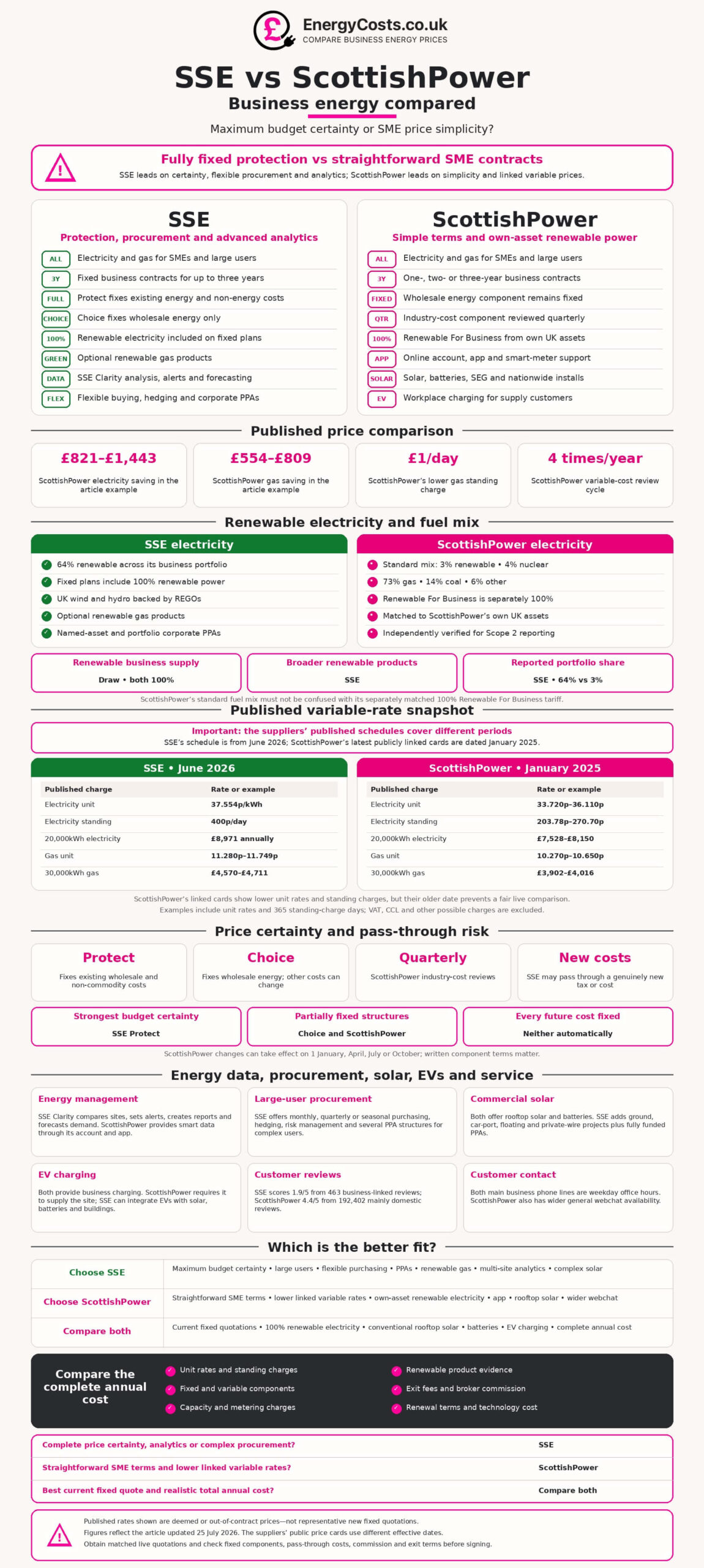
SSE is generally the stronger option for large organisations, complex energy portfolios and businesses that want fully fixed non-commodity costs. Its SSE Protect product fixes existing wholesale and non-commodity charges, while its wider offering includes flexible purchasing, corporate power purchase agreements and sophisticated energy-management tools.
ScottishPower is particularly competitive for small and medium-sized businesses seeking a straightforward one, two or three-year contract. Its Renewable For Business electricity product uses power generated from ScottishPower’s own UK renewable assets, while its commercial offering also includes solar panels, batteries and electric vehicle charging.
The published variable-rate figures suggest ScottishPower can be considerably cheaper than SSE. However, an important limitation applies: SSE’s current published schedule took effect in June 2026, whereas the latest deemed-price cards linked from ScottishPower’s business website remain dated 1 January 2025. These figures therefore provide useful context but are not a perfectly like-for-like comparison.
SSE vs ScottishPower at a glance
| Comparison area | SSE Energy Solutions | ScottishPower |
|---|---|---|
| Business electricity | Yes | Yes |
| Business gas | Yes | Yes |
| Fixed contract lengths | Up to three years | One, two or three years |
| Fully fixed option | Yes, through SSE Protect | No equivalent fully fixed tariff clearly promoted |
| Renewable electricity | Included with SSE fixed plans | Renewable For Business electricity tariff |
| Renewable gas | Optional products available | Standard business gas only |
| Flexible energy purchasing | Yes | More limited for standard SME customers |
| Corporate PPAs | Yes | Available as part of wider green-energy solutions |
| Smart meters | Available without an additional installation charge | Available |
| Energy-use platform | SSE Clarity | Online account and ScottishPower app |
| Multi-site analysis | Included through SSE Clarity | Online account management available |
| Commercial solar | Rooftop, ground-mounted, car-port and floating solar | Rooftop solar and battery systems |
| Battery storage | Yes | Yes |
| EV charging | Yes | Yes |
| Published electricity variable rate | 37.554p per kWh | 33.720p to 36.110p per kWh |
| Published electricity standing charge | 400p per day | 203.78p to 270.70p per day |
| Published gas variable rate | 11.280p to 11.749p per kWh | 10.270p to 10.650p per kWh |
| Published gas standing charge | 325p per day | 225p per day |
| Trustpilot score | 1.9 out of 5 | 4.4 out of 5 |
| Best suited to | Complex procurement and complete price certainty | SMEs, renewable electricity and lower published variable rates |
SSE provides separate fixed products depending on how much price certainty a business needs. ScottishPower’s For Business tariffs fix the energy component, but network, social and environmental charges remain variable and are reviewed every quarter.
Which is cheaper: SSE or ScottishPower?
Neither supplier publishes universal fixed-contract prices because business energy quotations are calculated individually.
The price offered to a business can depend on:
- Annual electricity and gas consumption
- Meter type and profile class
- Distribution region
- Agreed supply capacity
- Contract duration
- Contract start date
- Payment method
- Credit history
- Wholesale market conditions
- Whether third-party charges are fixed or passed through
- The number of sites included in the contract
The published deemed and out-of-contract tariffs offer the clearest public comparison. These tariffs apply when a business occupies premises without agreeing a contract, or when an existing fixed agreement expires without being renewed.
Businesses should normally avoid remaining on variable or deemed prices because both suppliers state that fixed-contract alternatives are likely to be more competitive.
An important pricing-date warning
SSE’s current Variable Business Rate schedule is effective from June 2026.
ScottishPower’s business pricing page still links to deemed electricity and gas price cards effective from 1 January 2025. ScottishPower also states that variable prices are updated regularly, so businesses should confirm the rates applying to their specific premises before relying on the published documents.
The following tables compare the most recent official price cards publicly linked by each supplier, but they do not cover the same effective period.
SSE vs ScottishPower electricity rates
For a standard unrestricted non-half-hourly electricity meter:
| Supplier | Effective date shown | Unit rate | Standing charge |
|---|---|---|---|
| SSE | June 2026 | 37.554p per kWh | 400p per day |
| ScottishPower | January 2025 | 33.720p to 36.110p per kWh | 203.78p to 270.70p per day |
ScottishPower’s linked schedule has both a lower unit rate and a lower standing charge in every electricity region.
The difference in standing charges is particularly significant. SSE’s 400p daily charge equals £1,460 a year before any electricity is consumed. ScottishPower’s published standing charges equal approximately £744 to £988 a year.
The published ScottishPower rates are nevertheless older, and a current ScottishPower fixed or variable quotation could differ substantially.
ScottishPower electricity prices by region
| Electricity region | Unit rate | Standing charge |
|---|---|---|
| Eastern | 34.100p per kWh | 211.09p per day |
| East Midlands | 33.950p per kWh | 222.11p per day |
| London | 33.920p per kWh | 203.78p per day |
| Manweb | 35.810p per kWh | 270.70p per day |
| Midlands | 33.720p per kWh | 229.27p per day |
| Northern | 34.210p per kWh | 231.33p per day |
| Norweb | 35.210p per kWh | 217.02p per day |
| Scottish Hydro | 36.110p per kWh | 231.95p per day |
| ScottishPower | 34.140p per kWh | 242.15p per day |
| Seeboard | 34.110p per kWh | 214.47p per day |
| Southern | 34.090p per kWh | 217.83p per day |
| Swalec | 34.370p per kWh | 228.72p per day |
| SWEB | 34.270p per kWh | 231.65p per day |
| Yorkshire | 33.950p per kWh | 231.98p per day |
Prices exclude VAT and the Climate Change Levy.
Example annual electricity cost
The following example assumes that a business uses 20,000 kWh of electricity annually through an unrestricted meter.
| Supplier | Estimated annual cost |
|---|---|
| SSE | £8,971 |
| ScottishPower – lowest-cost region | £7,528 |
| ScottishPower – highest-cost region | £8,150 |
The SSE calculation uses its June 2026 unit rate and standing charge. The ScottishPower range uses the lowest and highest total annual costs produced by its January 2025 regional schedule.
On these published figures, ScottishPower would cost approximately £821 to £1,443 less per year.
This does not establish that a new ScottishPower contract will necessarily be cheaper. A fair purchasing decision should use live quotations with the same start date, consumption forecast and contract length.
SSE vs ScottishPower gas rates
| Supplier | Effective date shown | Gas unit rate | Standing charge |
|---|---|---|---|
| SSE – monthly billing, bands 1 and 2 | June 2026 | 11.280p per kWh | 325p per day |
| SSE – quarterly billing, bands 1 and 2 | June 2026 | 11.749p per kWh | 325p per day |
| ScottishPower | January 2025 | 10.270p to 10.650p per kWh | 225p per day |
ScottishPower’s published gas standing charge is £1 per day lower than SSE’s, equivalent to an annual difference of £365.
Its linked unit rates are also approximately 0.63p to 1.48p per kWh lower than SSE’s rates, depending on the region and SSE billing frequency.
Example annual gas cost
The following calculation assumes annual gas consumption of 30,000 kWh.
| Supplier | Estimated annual cost |
|---|---|
| SSE – monthly billing | £4,570 |
| SSE – quarterly billing | £4,711 |
| ScottishPower – lowest regional rate | £3,902 |
| ScottishPower – highest regional rate | £4,016 |
On the published schedules, ScottishPower would cost approximately £554 to £809 less per year.
The difference would become larger for a gas-intensive hotel, restaurant, pub, care home, school or manufacturing business.
Once again, the ScottishPower figures are from an older effective period. Businesses should treat the comparison as an illustration of the published tariff structures rather than a substitute for current quotations.
Fixed contract comparison
Both suppliers offer contracts lasting up to three years, but they handle non-energy costs differently.
SSE Protect
SSE Protect is intended for businesses that prioritise budget certainty.
It includes:
- Fixed wholesale energy costs
- Existing non-commodity costs included in the fixed price
- Contract lengths of up to three years
- 100% renewable electricity
- Optional renewable gas products
SSE says it reserves the right to pass through a genuinely new tax or cost outside its control. However, the product otherwise provides stronger protection against changes to existing government and network charges than most partially fixed contracts.
SSE Choice
SSE Choice is designed as its lower-cost fixed option.
It fixes the wholesale energy component for up to three years, but non-commodity costs can change. These include charges set by network operators, government schemes and other industry bodies.
SSE Choice therefore offers less complete price certainty than SSE Protect, but it may start with a lower quoted rate.
ScottishPower For Business
ScottishPower’s standard business contracts last one, two or three years.
The price has two main components:
- A fixed energy component, protecting the business from wholesale price increases
- Variable network, social and environmental costs
ScottishPower reviews the variable component quarterly, with changes taking effect on 1 January, 1 April, 1 July or 1 October.
This means the majority of the price remains stable, but the total unit rate can still rise or fall during the contract.
Which provides better price certainty?
SSE Protect provides the strongest price certainty.
ScottishPower’s contract model is more comparable to SSE Choice because both allow certain third-party costs to change.
Businesses comparing quotations should check whether the supplier is fixing:
- Wholesale energy
- Distribution charges
- Transmission charges
- Balancing costs
- Capacity Market charges
- Renewable Obligation costs
- Metering charges
- New or existing government levies
A tariff described simply as “fixed” does not necessarily mean that every element of the final bill is guaranteed.
Renewable electricity comparison
Both SSE and ScottishPower offer strong renewable electricity products backed by power generated through assets connected to their wider corporate groups.
SSE renewable electricity
SSE’s fixed plans include 100% renewable electricity as standard. The electricity is matched with Renewable Energy Guarantees of Origin from UK wind and hydro assets wholly or partly owned by SSE Renewables.
SSE also offers:
- SSE Next Generation
- SSE Green
- Renewable gas options
- Named-asset corporate PPAs
- Portfolio PPAs
- Direct links to wind, solar or hydro generation
SSE reports that 64% of the electricity supplied across its total business portfolio between April 2024 and March 2025 came from renewable sources. Customers on its dedicated renewable products received electricity matched with 100% renewable generation.
ScottishPower renewable electricity
ScottishPower’s Renewable For Business tariff is available to electricity customers on one, two or three-year contracts.
Every unit is matched with electricity generated from ScottishPower’s own UK renewable resources and supported by Renewable Energy Guarantees of Origin. ScottishPower states that the product is independently verified and compliant with Greenhouse Gas Protocol Scope 2 guidance.
Customers can also receive a certificate confirming that they have chosen a ScottishPower renewable business tariff.
ScottishPower’s wider, non-renewable portfolio fuel mix for 2024/25 was reported as:
| Energy source | ScottishPower standard fuel mix |
|---|---|
| Gas | 73% |
| Coal | 14% |
| Other fuels | 6% |
| Nuclear | 4% |
| Renewables | 3% |
Its dedicated green product is separately reported as 100% renewable.
Renewable energy winner
The renewable electricity comparison is effectively a draw.
Both suppliers offer traceable, REGO-backed renewable electricity linked to generation within their own corporate groups.
SSE has the broader renewable procurement range, particularly for large organisations requiring corporate PPAs or optional renewable gas.
ScottishPower’s Renewable For Business tariff is a straightforward and credible option for SMEs that want to report zero market-based Scope 2 emissions from purchased electricity.
Smart meters and energy management
SSE Clarity
SSE Clarity is included without an additional subscription charge with SSE energy plans and uses smart or automated meter data to provide detailed consumption information.
Businesses can use it to:
- View consumption through graphs and tables
- Compare several sites
- Organise information by site, time or supply
- Set email alerts for unusual energy use
- Create energy reports
- Measure and forecast demand
- Identify possible energy waste
Half-hourly data can be fed into the dashboard, allowing a business to investigate overnight baseload consumption, unusual peaks and changes between different premises.
SSE also offers smart-meter installation without an additional installation charge for eligible businesses.
ScottishPower smart meters
ScottishPower offers business smart meters that send readings automatically and provide near-real-time information about consumption.
Customers can use ScottishPower’s online account or app to:
- Monitor energy use
- Enter meter readings
- View bills
- Make payments
- Manage account information
ScottishPower also works with the Carbon Trust to provide energy-saving guidance for business customers.
Energy-management winner
SSE is the stronger option for detailed energy analysis.
ScottishPower provides useful smart-meter and account-management functions, but SSE Clarity offers more explicit multi-site analysis, alerting, reporting and consumption forecasting.
Commercial solar and batteries
Both suppliers can help businesses generate electricity on their own premises.
SSE commercial solar
SSE offers:
- Rooftop solar
- Ground-mounted solar
- Solar car ports
- Floating solar
- Battery storage
- Private-wire solar farms
- Direct ownership
- Fully funded power purchase agreements
Under a funded PPA, SSE finances, builds, owns, operates and maintains the system. The customer then buys the electricity generated at an agreed rate without funding the installation upfront.
For major energy users, SSE can also develop solar farms on nearby owned or leased land and connect them directly to the business through a private wire.
ScottishPower commercial solar
ScottishPower’s business solar service can include:
- Solar panels
- Battery storage
- Initial proposals
- Site surveys
- Bespoke system design
- Nationwide installation
- Distribution Network Operator applications
- Smart Export Guarantee access
- Options to sell surplus electricity
ScottishPower says a typical solar installation has an expected operating life of approximately 25 to 30 years. Its standard packages can include a 24-month installer warranty, a 12-year panel manufacturer warranty and a 25-year performance warranty, subject to the individual product terms.
Commercial solar winner
SSE has the broader proposition for large and complex projects.
ScottishPower offers a comprehensive end-to-end service for conventional commercial rooftop systems. SSE goes further by offering floating solar, private-wire developments, large ground-mounted projects and multiple ownership and funding structures.
Electric vehicle charging
Both companies provide business EV charging solutions.
ScottishPower requires a business to take its energy supply from ScottishPower before purchasing its workplace chargers. It assesses the site’s available supply, likely vehicle use and number of users before recommending the number and type of chargers.
SSE offers EV infrastructure as part of its wider distributed-energy and decarbonisation services. This can be integrated with solar generation, batteries, building-management systems and local energy infrastructure.
Businesses should compare not only the equipment price but also:
- Installation costs
- Grid-capacity upgrades
- Back-office software fees
- Maintenance
- Employee reimbursement functions
- Payment processing
- Load balancing
- Solar and battery integration
- Charger warranties
Large-business and flexible procurement
SSE has a clear advantage for businesses with complex energy procurement requirements.
It categorises businesses using more than 100,000 kWh of electricity or 293,000 kWh of gas annually as large energy users and offers specialist plans for them.
Services include:
- Fully fixed contracts
- Wholesale-only fixed contracts
- Flexible purchasing
- Monthly, quarterly or seasonal purchasing
- Hedging and risk management
- Named-asset corporate PPAs
- Portfolio PPAs
- Energy-use forecasting
- Half-hourly account management
- Multi-site energy analysis
SSE’s flexible contracts allow customers to purchase wholesale baseload energy in separate increments rather than committing their entire expected consumption at one point in the market.
ScottishPower states that it supports small, medium and large organisations, and it can deliver PPAs and commercial green-energy projects. Its standard online proposition is nevertheless more heavily focused on one, two and three-year contracts than on active flexible procurement.
Large-business winner: SSE
Customer service comparison
Both suppliers’ main business telephone services operate during weekday office hours.
SSE’s new-customer and existing-customer business lines are open from 9am to 5pm, Monday to Friday.
ScottishPower’s small-business contact centre is open from 9am to 5pm, Monday to Friday. Its wider webchat service is available seven days a week between 7am and 11pm, although not every webchat function may be specific to business accounts.
Both suppliers allow eligible unresolved complaints to be referred to the Energy Ombudsman after eight weeks or after a deadlock letter has been issued.
Trustpilot ratings
| Supplier profile | TrustScore | Number of reviews |
|---|---|---|
| SSE Energy Solutions | 1.9 out of 5 | 463 |
| ScottishPower | 4.4 out of 5 | 192,402 |
ScottishPower has the much higher headline rating. However, the scores are not directly comparable.
The SSE Energy Solutions profile is specifically associated with the business supplier. Trustpilot states that SSE has no history of inviting customers to review it, meaning the reviews may not be representative.
ScottishPower’s profile covers the wider supplier and is dominated by domestic customer experiences. ScottishPower actively invites customers to leave reviews, and Trustpilot reports that 60% of its reviews are five-star while 20% are one-star.
Recent criticism on the SSE profile frequently concerns billing administration, account changes, delayed responses and high standing charges. These are individual opinions and should not be treated as verified findings about every customer’s experience.
Customer review winner: ScottishPower, with a significant comparability warning
SSE advantages and disadvantages
Advantages of SSE
- Fully fixed SSE Protect contracts
- Fixed terms lasting up to three years
- 100% renewable electricity included with fixed plans
- Optional renewable gas products
- Sophisticated flexible procurement
- Corporate power purchase agreements
- Strong large-business capabilities
- SSE Clarity energy-management platform
- Detailed multi-site consumption analysis
- Commercial solar and battery storage
- Fully funded solar PPAs
- Private-wire and large-scale solar projects
Disadvantages of SSE
- High published variable standing charges
- Higher published variable rates than ScottishPower’s linked schedules
- Very low business-specific Trustpilot score
- Customer-service telephone lines are limited to weekday office hours
- SSE Choice does not fix all non-commodity costs
- Its wider product range may be unnecessarily complicated for a very small business
ScottishPower advantages and disadvantages
Advantages of ScottishPower
- One, two and three-year contracts
- Lower published deemed rates than SSE
- Lower published standing charges
- Renewable For Business electricity
- Renewable power sourced through ScottishPower’s own UK assets
- Online account and mobile app
- Smart-meter support
- Commercial solar and battery installations
- Smart Export Guarantee options
- Business EV charging
- Wider webchat opening hours
- Strong headline Trustpilot rating
Disadvantages of ScottishPower
- Non-energy industry costs can change quarterly
- No clearly promoted equivalent to SSE Protect’s fully fixed structure
- Standard business gas is not presented as renewable
- Less extensive flexible procurement information
- The latest deemed price cards linked publicly are dated January 2025
- Trustpilot reviews are not specific to business customers
- Workplace EV charging requires ScottishPower to supply the premises
Which supplier is best for different businesses?
| Business requirement | Better choice | Reason |
|---|---|---|
| Small office or shop | ScottishPower | Simpler tariff structure and lower published standing charges |
| Business needing complete price certainty | SSE | SSE Protect fixes existing energy and non-energy costs |
| Renewable electricity | Draw | Both offer power linked to their own renewable assets |
| Renewable gas | SSE | Optional renewable gas products are available |
| Large manufacturer | SSE | Flexible purchasing and risk-management options |
| Multi-site organisation | SSE | SSE Clarity provides cross-site analysis |
| Business prioritising published variable prices | ScottishPower | Lower linked unit rates and standing charges |
| Business wanting a straightforward fixed tariff | ScottishPower | One, two and three-year For Business contracts |
| Corporate PPA | SSE | Wider and more clearly defined PPA options |
| Rooftop solar installation | Compare both | Both provide end-to-end commercial systems |
| Large solar or private-wire development | SSE | Broader project types and funding structures |
| Business prioritising review scores | ScottishPower | Much higher headline Trustpilot rating |
| Business needing weekend online support | ScottishPower | Wider general webchat opening hours |
Final verdict: SSE vs ScottishPower
SSE is the better overall supplier for large businesses, complex procurement and organisations that require maximum budget certainty.
SSE Protect is an important differentiator because it fixes existing wholesale and non-commodity costs. SSE also has the stronger flexible procurement proposition, more sophisticated energy analytics and a wider range of corporate PPAs, solar developments and distributed-energy solutions.
ScottishPower is likely to be the more accessible choice for many small and medium-sized businesses.
Its one, two and three-year contracts are relatively straightforward, its Renewable For Business tariff is backed by electricity from its own UK renewable assets, and its published deemed rates are considerably lower than SSE’s current Variable Business Rates.
The published price comparison must be treated cautiously because the suppliers’ price cards have different effective dates. ScottishPower’s linked cards are dated January 2025, whereas SSE’s current schedule took effect in June 2026.
A business should obtain current quotations from both suppliers and compare:
- Total estimated annual cost
- Unit rates
- Standing charges
- Contract duration
- Fixed and variable cost components
- Pass-through charges
- Renewable-energy evidence
- Metering charges
- Capacity charges
- Exit fees
- Broker commission
- Renewal terms
For a conventional SME fixed contract, ScottishPower may offer the more attractive combination of price and simplicity.
For a larger organisation, or a business wanting fully fixed costs, advanced reporting or flexible energy purchasing, SSE is the stronger choice.
FAQ
ScottishPower’s latest linked deemed schedules show lower electricity and gas prices than SSE’s June 2026 rates. However, the ScottishPower documents are dated January 2025, so current fixed quotations are required for a fair comparison.
Both suppliers offer 100% renewable business electricity backed by REGOs from generation within their wider corporate groups. SSE offers a broader selection of renewable products, including renewable gas and several corporate PPA structures.
Yes. ScottishPower’s Renewable For Business tariff provides electricity matched with 100% renewable generation from its own UK renewable resources. Contracts are available for one, two or three years.
Yes. SSE Protect fixes wholesale energy and existing non-commodity costs for up to three years. SSE Choice fixes wholesale energy, but some third-party charges can change during the contract.
Not completely. ScottishPower fixes the energy component, while network, social and environmental costs remain variable. These costs are reviewed quarterly and may increase or decrease during the agreement.
Yes. Both suppliers provide business gas. SSE also offers optional renewable gas products, while ScottishPower’s standard For Business gas tariff uses mixed energy sources.
Yes. Both suppliers provide business smart meters. SSE customers with compatible meters can use SSE Clarity to analyse consumption, compare sites, create reports and set alerts.
ScottishPower has a Trustpilot score of 4.4, compared with SSE Energy Solutions’ 1.9. However, ScottishPower’s reviews largely concern domestic customers, while SSE’s profile is specifically associated with business services.
Yes. Both provide commercial solar and battery systems. SSE additionally offers floating solar, private-wire projects, solar car ports and fully funded power purchase agreements.
SSE is generally better for large businesses because it offers flexible purchasing, hedging, PPAs, half-hourly account support and detailed multi-site energy analysis.
ScottishPower may be better for businesses wanting a straightforward one, two or three-year agreement. SSE may be preferable where complete price certainty or advanced energy monitoring is more important.
Choose SSE for fully fixed costs, flexible procurement, renewable gas or complex multi-site energy management. Consider ScottishPower for simpler SME contracts, lower published variable rates and renewable electricity from ScottishPower’s own UK generation.