

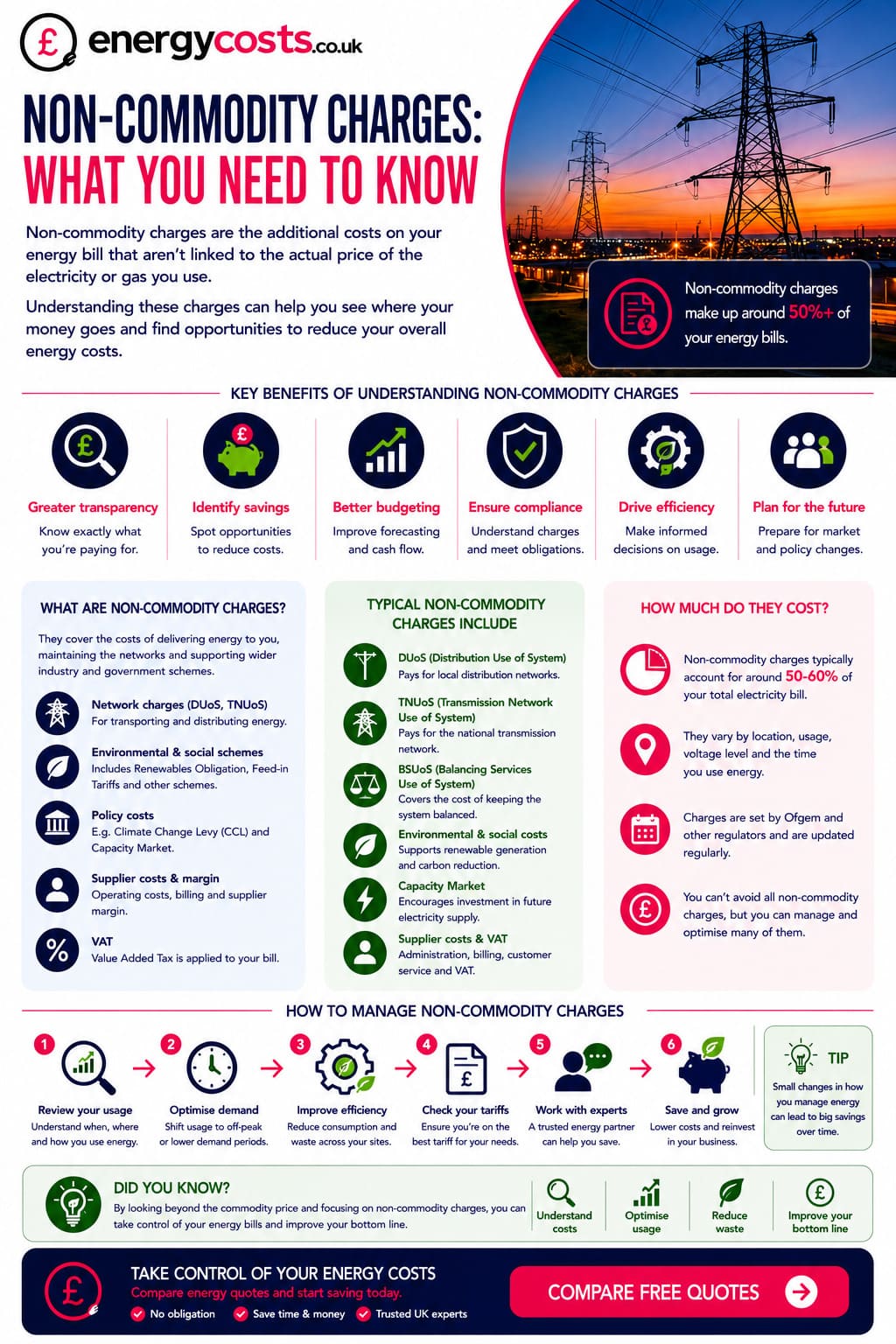
Non-commodity charges are the parts of a business energy bill that are not the wholesale cost of the electricity or gas itself. They cover the cost of transporting energy, balancing the system, supporting low-carbon generation, maintaining security of supply and funding certain government or regulatory schemes.
For many businesses, these charges are now one of the biggest reasons electricity bills are rising, even when wholesale energy prices are lower than they were during the peak of the energy crisis.
The short answer is: non-commodity charges are the network, balancing, environmental and policy costs added to business energy bills on top of the wholesale energy price.
Non-commodity charges explained
A business electricity bill is usually built from two broad types of cost:
| Cost type | What it means | Examples |
|---|---|---|
| Commodity cost | The cost of buying the electricity or gas itself | Wholesale electricity, wholesale gas |
| Non-commodity cost | The other costs needed to deliver, balance, regulate and decarbonise the energy system | TNUoS, DUoS, BSUoS, RO, FiT, CfD, Capacity Market |
Ofgem says business energy prices cover a range of costs, including wholesale energy costs, network costs and environmental costs. It says:
Wholesale costs can typically be around 40% of a business electricity bill and around 60% of a business gas bill, although the exact percentages vary by business, supplier and contract type.
That means the final price a business pays is not simply the wholesale price plus a small supplier margin. A large part of the bill comes from charges that sit around the wholesale price.
Why non-commodity charges matter in 2026
Non-commodity charges matter because they can rise even when wholesale prices fall.
Cornwall Insight forecast that by 2026, non-commodity charges would make up nearly 60% of a typical business electricity bill. It said this was being driven by rising transmission costs, new bill components such as the Nuclear Regulated Asset Base, and the widening of exemption schemes for energy-intensive users.
This is one reason many businesses are confused by their 2026 electricity bills. They may hear that wholesale prices have softened, but still see higher standing charges, higher pass-through costs or higher renewal prices.
Main non-commodity charges on business electricity bills (TNUoS, DUoS, BSUoS, RO, FiT, CfD, or Capacity Market)
| Charge | Full name | What it pays for |
|---|---|---|
| TNUoS | Transmission Network Use of System | The high-voltage electricity transmission network |
| DUoS | Distribution Use of System | Local electricity distribution networks |
| BSUoS | Balancing Services Use of System | Day-to-day electricity system balancing |
| RO | Renewables Obligation | Support for eligible renewable electricity generation |
| FiT | Feed-in Tariff | Support for small-scale renewable generation |
| CfD | Contracts for Difference | Support for low-carbon electricity generation |
| Capacity Market | Capacity Market charge | Payments to ensure enough reliable electricity capacity is available |
| Nuclear RAB | Nuclear Regulated Asset Base | Funding mechanism for new nuclear infrastructure |
| CCL | Climate Change Levy | Environmental tax on business energy use |
Some business energy suppliers and brokers use slightly different terminology. They may call these third-party costs, regulated charges, industry charges, network and policy costs, or non-energy costs.
Are non-commodity charges shown separately?
Sometimes, but not always.
For many smaller businesses, non-commodity charges are bundled into the unit rate and standing charge. The business may simply see one pence-per-kWh rate and one daily standing charge.
Larger businesses, particularly those with half-hourly meters or flexible contracts, may see some charges itemised or passed through separately.
- Fixed SME contract: Usually bundled into the unit rate and standing charge
- Fixed contract with exclusions: Some charges may be fixed, while others are passed through
- Pass-through contract: Third-party charges may be billed at actual cost
- Flexible contract: Wholesale energy may be traded separately from non-commodity costs
- Half-hourly contract: More charges may be itemised or calculated using site-specific data
This matters because a contract can be described as “fixed” but still allow some regulated charges to move during the contract period. Businesses should check whether a quoted rate is fully fixed or whether it excludes some third-party charges.
What is TNUoS?
TNUoS stands for Transmission Network Use of System. It pays for the high-voltage electricity transmission network that moves power around Great Britain.
This includes the cost of building, maintaining and upgrading major transmission infrastructure, such as high-voltage cables, substations and overhead lines.
NESO publishes TNUoS charging information and final tariffs, including the final TNUoS tariffs for 2026/27.
TNUoS is particularly important in 2026 because transmission charges have risen sharply. NESO confirmed a 64% increase in TNUoS charges for 2026/27, with the average residual charge rising from around £15.70/MWh to around £25.70/MWh.
| Annual electricity use | Approximate impact of a £10/MWh increase |
|---|---|
| 10,000kWh | £100 per year |
| 25,000kWh | £250 per year |
| 50,000kWh | £500 per year |
| 100,000kWh | £1,000 per year |
| 250,000kWh | £2,500 per year |
| 500,000kWh | £5,000 per year |
| 1,000,000kWh | £10,000 per year |
This is a simplified illustration. The actual TNUoS impact depends on location, meter type, supply capacity, voltage level, charging band and contract structure.
What is DUoS?
DUoS stands for Distribution Use of System. It pays for the local electricity distribution network that delivers electricity from the transmission system to homes and businesses.
This includes local cables, substations, transformers and other regional network infrastructure.
A simple way to understand the difference is:
| Charge | Network level | Analogy |
|---|---|---|
| TNUoS | National high-voltage transmission network | Electricity motorways |
| DUoS | Regional and local distribution network | Electricity A-roads and local streets |
Distribution charges vary by region because different local network operators have different infrastructure, costs and investment requirements. They can also vary by voltage level, meter type, time of use and agreed capacity.
Ofgem says network companies charge suppliers regulated prices for using the energy networks, and that money goes towards maintaining, running and upgrading the networks.
What is BSUoS?
BSUoS stands for Balancing Services Use of System.
It pays for the day-to-day cost of balancing the electricity system. Electricity supply and demand must be kept in balance in real time. If demand is higher or lower than expected, the system operator has to take action to keep the grid stable.
NESO says the BSUoS charge recovers the cost of day-to-day operation, including the cost of balancing the electricity transmission system.
BSUoS can include costs linked to:
- calling on generators to increase or reduce output
- managing system constraints
- maintaining frequency and voltage
- using reserve power
- responding to forecast errors
- balancing intermittent renewable generation
- keeping the system secure
For businesses, BSUoS is usually not something they can see or control directly. However, it can feed into the unit rate, pass-through costs or supplier pricing.
What is the Renewables Obligation?
The Renewables Obligation, or RO, is a scheme that was designed to support renewable electricity generation.
Ofgem says the RO scheme was designed to encourage generation of electricity from eligible renewable sources in the UK. It places an obligation on licensed electricity suppliers to provide a specified number of Renewables Obligation Certificates per MWh of electricity supplied.
Although the RO closed to new generating capacity in 2017, existing projects can still receive support, so the cost continues to appear in electricity prices.
For business customers, RO costs are usually built into electricity supply prices rather than shown as a separate line on a small-business bill.
What are Contracts for Difference?
Contracts for Difference, or CfDs, are used to support low-carbon electricity generation.
The Government describes the CfD scheme as its main mechanism for supporting low-carbon electricity generation. It is designed to give low-carbon generators more revenue certainty and encourage investment in projects such as offshore wind and other low-carbon infrastructure.
CfD costs can move up or down depending on wholesale prices and the strike prices agreed with generators. When wholesale prices are below strike prices, generators may receive top-up payments. When wholesale prices are above strike prices, generators may pay money back.
For businesses, CfD costs are one of several policy-related charges that can be included in electricity prices.
What is the Capacity Market charge?
The Capacity Market is designed to make sure Great Britain has enough reliable electricity capacity available when needed.
The Government says the Capacity Market ensures security of electricity supply by providing payments for reliable sources of capacity, alongside their electricity revenues.
This means power stations, battery projects, demand-side response providers and other capacity providers may receive payments for being available to support the system.
Businesses may pay for this through Capacity Market charges included in electricity prices.
What is the Feed-in Tariff charge?
The Feed-in Tariff, or FiT, was designed to support small-scale low-carbon generation, such as solar panels and small wind turbines.
Although the FiT scheme is closed to new applicants, the cost of supporting existing accredited installations continues to be recovered from electricity suppliers and passed through to customers.
For many businesses, FiT costs are included in the electricity unit rate rather than shown separately.
What is the Nuclear RAB charge?
RAB stands for Regulated Asset Base. It is a funding model used for large infrastructure projects. In energy, it is relevant to new nuclear projects such as Sizewell C.
The nuclear RAB model allows some project costs to be recovered from billpayers during construction, rather than only once the plant is operational. This is intended to reduce financing costs, but it can add a new charge to electricity bills before the power station starts generating.
Cornwall Insight has identified the Nuclear Regulated Asset Base as one of the new bill components contributing to rising non-commodity electricity costs.
Is the Climate Change Levy a non-commodity charge?
The Climate Change Levy, or CCL, is slightly different. It is a tax on business energy use rather than a network or system charge.
However, businesses often discuss it alongside non-commodity costs because it is another cost added to energy bills outside the wholesale price.
The Government says Climate Change Levy rates for electricity, gas and solid fuels rise in line with the Retail Price Index from 1 April 2026, while the LPG rate remains frozen.
Some businesses can reduce or avoid CCL, including certain low-use supplies, qualifying charitable non-business use and businesses with Climate Change Agreements.
Are non-commodity charges the same for gas and electricity?
No. Electricity has more non-commodity charges than gas.
Business electricity bills include a large set of network, balancing, low-carbon support and security-of-supply charges. Business gas bills still include network charges and some policy or tax costs, but the structure is generally less complex.
| Charge type | Business electricity | Business gas |
|---|---|---|
| Wholesale energy | Yes | Yes |
| Transmission network charges | Yes | Yes, but different structure |
| Distribution network charges | Yes | Yes, but different structure |
| Balancing charges | Yes | Yes, but different structure |
| Low-carbon electricity schemes | Yes | Usually no |
| Capacity Market | Yes | No |
| Climate Change Levy | Yes | Yes |
| VAT | Yes | Yes |
This is one reason electricity often has a higher final pence-per-kWh cost than gas, even when the wholesale energy comparison looks different.
Why non-commodity charges can make bills rise when usage falls
Non-commodity charges are not always directly linked to how much electricity your business uses. Some charges are recovered through fixed daily charges, standing charges, capacity charges or site-specific charges.
That means a business can use less electricity and still pay more overall.
| Scenario | What happens |
|---|---|
| Unit rate falls but standing charge rises | Low-use businesses may not save much |
| Wholesale price falls but TNUoS rises | The final bill may still increase |
| Usage falls but fixed charges rise | Total savings are smaller than expected |
| Contract is fixed but pass-through charges rise | The bill may change during the contract |
| A business has high agreed capacity | Fixed network-related costs may remain high |
For example, a small business could cut electricity use by 10%, but still see the total business energy bill rise if standing charges and TNUoS-related costs increase at the same time.
Example of a business electricity bill build-up
The table below shows a simplified example of how a business electricity bill might be built up. It is illustrative only, because actual prices vary by supplier, location, meter type and contract.
| Bill component | Example cost | Share of bill |
|---|---|---|
| Wholesale electricity | 12p/kWh | 40% |
| Network charges | 6p/kWh | 20% |
| Balancing charges | 2p/kWh | 7% |
| Environmental and policy costs | 6p/kWh | 20% |
| Supplier operating cost and margin | 2p/kWh | 7% |
| Broker commission or service cost | 1p/kWh | 3% |
| Other charges | 1p/kWh | 3% |
| Total before standing charge, VAT and CCL | 30p/kWh | 100% |
This type of breakdown helps explain why a business quote can be much higher than the wholesale electricity price shown in market reports.
How non-commodity charges affect small businesses
For small businesses, non-commodity charges are usually hidden inside the quoted rate.
A small shop, café, office or salon may not see TNUoS, DUoS, BSUoS or policy charges listed separately. Instead, the supplier prices those costs into the offer.
This means the business may only notice non-commodity charges when:
- renewal prices rise
- standing charges increase
- a fixed contract ends
- a supplier changes its pricing structure
- the business moves from a fixed to variable or deemed rate
- a broker explains why quoted rates are higher than expected
Small businesses should therefore compare the total annual cost, not just the headline unit rate.
How non-commodity charges affect larger businesses
Larger businesses are more likely to see non-commodity charges directly.
This is especially true for:
- half-hourly metered sites
- multi-site businesses
- factories and manufacturers
- warehouses and logistics sites
- cold storage facilities
- hotels and leisure facilities
- high-voltage connected sites
- businesses on flexible or pass-through contracts
For these businesses, non-commodity charges can represent a major budgeting risk. A contract with a low wholesale energy purchasing strategy may still become expensive if network or policy costs rise.
Fixed versus pass-through non-commodity charges
A key question for any business electricity contract is whether non-commodity charges are fixed or passed through.
| Contract structure | How it works | Main risk |
|---|---|---|
| Fully fixed | Supplier includes forecast non-commodity costs in the agreed price | Price may be higher because supplier prices in risk |
| Part-fixed, part-pass-through | Some charges are fixed, others move with actual costs | The business may face unexpected increases |
| Fully pass-through | Non-commodity charges are billed at actual cost | More transparent, but less budget certainty |
| Flexible | Wholesale energy is traded separately, with non-commodity charges handled separately | Requires active management and expertise |
A fully fixed contract can offer better budget certainty, but it may cost more upfront if suppliers expect non-commodity costs to rise. A pass-through contract can be more transparent, but it exposes the business to future changes.
How to check your bill for non-commodity charges
Start by reviewing your bill and contract for these terms:
| Term to look for | What it may indicate |
|---|---|
| TNUoS | Transmission network charge |
| DUoS | Distribution network charge |
| BSUoS | Balancing charge |
| CM or Capacity Market | Security-of-supply charge |
| RO | Renewables Obligation charge |
| FiT | Feed-in Tariff charge |
| CfD | Contracts for Difference charge |
| CCL | Climate Change Levy |
| Pass-through | Charges can move with actual industry costs |
| Reconciliation | Supplier may adjust charges later |
| Standing charge | Fixed daily cost, often including network-related costs |
| Agreed capacity | Capacity-based network charging exposure |
| kVA | Measure of supply capacity |
| HH or half-hourly | Metering type that can affect charging |
If these items are not shown, ask the supplier or broker for a cost breakdown.
Questions to ask your supplier or broker
Businesses should ask direct questions before agreeing a contract:
- Are all non-commodity charges fixed for the full contract? Confirms whether the price can change
- Which charges are passed through? Identifies exposure to TNUoS, DUoS, BSUoS and policy costs
- Are charges reconciled later? Shows whether the supplier can issue catch-up charges
- Is the standing charge fixed? Important for low-usage businesses
- Is broker commission included in the unit rate? Helps identify hidden costs
- What happens if industry charges change? Tests whether the supplier has priced the risk
- Can I see the estimated annual cost, not just p/kWh? Makes offers easier to compare
- How do charges differ by meter type and region? Useful for multi-site or half-hourly businesses
The most important point is to avoid comparing contracts using only the unit rate. A lower unit rate may not be cheaper if standing charges or pass-through costs are higher.
Can businesses reduce non-commodity charges?
Businesses cannot avoid most non-commodity charges completely, because they are part of the cost of using the electricity system. However, some businesses can reduce exposure.
| Action | How it can help |
|---|---|
| Reduce total kWh use | Cuts usage-based charges |
| Reduce peak demand | May reduce demand or capacity-related costs |
| Review agreed supply capacity | Can reduce fixed capacity charges if capacity is too high |
| Shift usage to cheaper periods | May reduce time-of-use distribution costs |
| Install solar panels | Reduces imported electricity from the grid |
| Add battery storage | Helps reduce peak import and increase solar self-consumption |
| Improve power factor | May reduce some network-related charges |
| Choose contract structure carefully | Improves budget certainty |
| Check CCL eligibility | May reduce tax costs for qualifying businesses |
| Avoid deemed rates | Prevents expensive default pricing |
The best option depends on the business type. A low-usage office may focus on standing charges and contract structure. A factory may focus on capacity, peak demand, power factor and pass-through exposure.
Example: how non-commodity charges can affect a business
A business uses 100,000kWh of electricity per year.
| Cost change | Extra annual cost |
|---|---|
| TNUoS increase of £10/MWh | £1,000 |
| DUoS increase of 1p/kWh | £1,000 |
| BSUoS increase of 0.5p/kWh | £500 |
| Policy cost increase of 1p/kWh | £1,000 |
| Standing charge increase of £1/day | £365 |
| Broker uplift of 0.5p/kWh | £500 |
Individually, each charge may look manageable. Together, they can add thousands of pounds to the annual bill.
Why non-commodity charges are a bigger issue for electricity than gas
Electricity is central to the UK’s energy transition. More renewable generation, new nuclear capacity, grid reinforcement, battery storage, electric vehicles, heat pumps, AI data centres and industrial electrification all require electricity infrastructure.
That makes electricity bills more exposed to the cost of system change.
Gas bills have their own network, balancing and tax components, but business electricity bills carry more of the policy and infrastructure cost linked to decarbonising the power system.
This is why a business switching from gas to electricity for heating, vehicles or industrial processes should look beyond the unit rate. Electrification can reduce emissions, but it can also increase exposure to electricity network and policy charges.
Summary
Non-commodity charges are the network, balancing, environmental and policy costs added to business energy bills on top of the wholesale price of electricity or gas.
For electricity, they include charges such as TNUoS, DUoS, BSUoS, RO, FiT, CfD and the Capacity Market. Businesses may also see related taxes and levies such as the Climate Change Levy.
In 2026, non-commodity charges are especially important because they make up a large share of many business electricity bills. Cornwall Insight has forecast that they will account for nearly 60% of a typical business electricity bill, which means businesses can face rising bills even if wholesale prices are stable or falling.
The key lesson for business energy buyers is to compare the full contract, not just the headline unit rate. Ask whether non-commodity charges are fixed, passed through or reconciled later, and check how much of the standing charge and unit rate is driven by network and policy costs.
FAQ
Non-commodity charges are the parts of a business energy bill that are not the wholesale cost of the electricity or gas itself. They include network charges, balancing charges, environmental scheme costs and policy-related charges.
No, but they are usually more significant on electricity bills than gas bills. Business electricity bills include more network, balancing, low-carbon support and security-of-supply charges.
They are rising because the UK is investing heavily in electricity networks, low-carbon generation, system balancing and energy security. Transmission charges, in particular, have increased sharply in 2026.
TNUoS stands for Transmission Network Use of System. It pays for the high-voltage electricity transmission network that moves power around Great Britain. NESO publishes TNUoS tariffs and charging information.
DUoS stands for Distribution Use of System. It pays for local electricity networks, including regional cables, transformers and substations that deliver electricity to business premises.
BSUoS stands for Balancing Services Use of System. It pays for the day-to-day cost of balancing the electricity transmission system and keeping supply and demand matched in real time.
Yes, depending on the contract. Some business energy contracts fix these charges, while others pass them through or reconcile them later. Always check the contract wording before signing.
Usually not completely. They are part of the cost of using the energy system. However, businesses may reduce exposure by cutting consumption, reducing peak demand, reviewing supply capacity, installing solar panels or choosing a contract with greater price certainty.