
E.ON and ENGIE both supply electricity and gas to UK businesses, but their strongest offerings target different types of customer.
E.ON Next provides relatively straightforward one, two and three-year fixed tariffs for small and medium-sized businesses. Larger organisations are served through npower Business Solutions, which offers fixed, flexible and renewable energy procurement products. ENGIE serves businesses of different sizes directly, with fixed contracts lasting up to five years, sophisticated pass-through arrangements, renewable gas and advanced energy-management services.
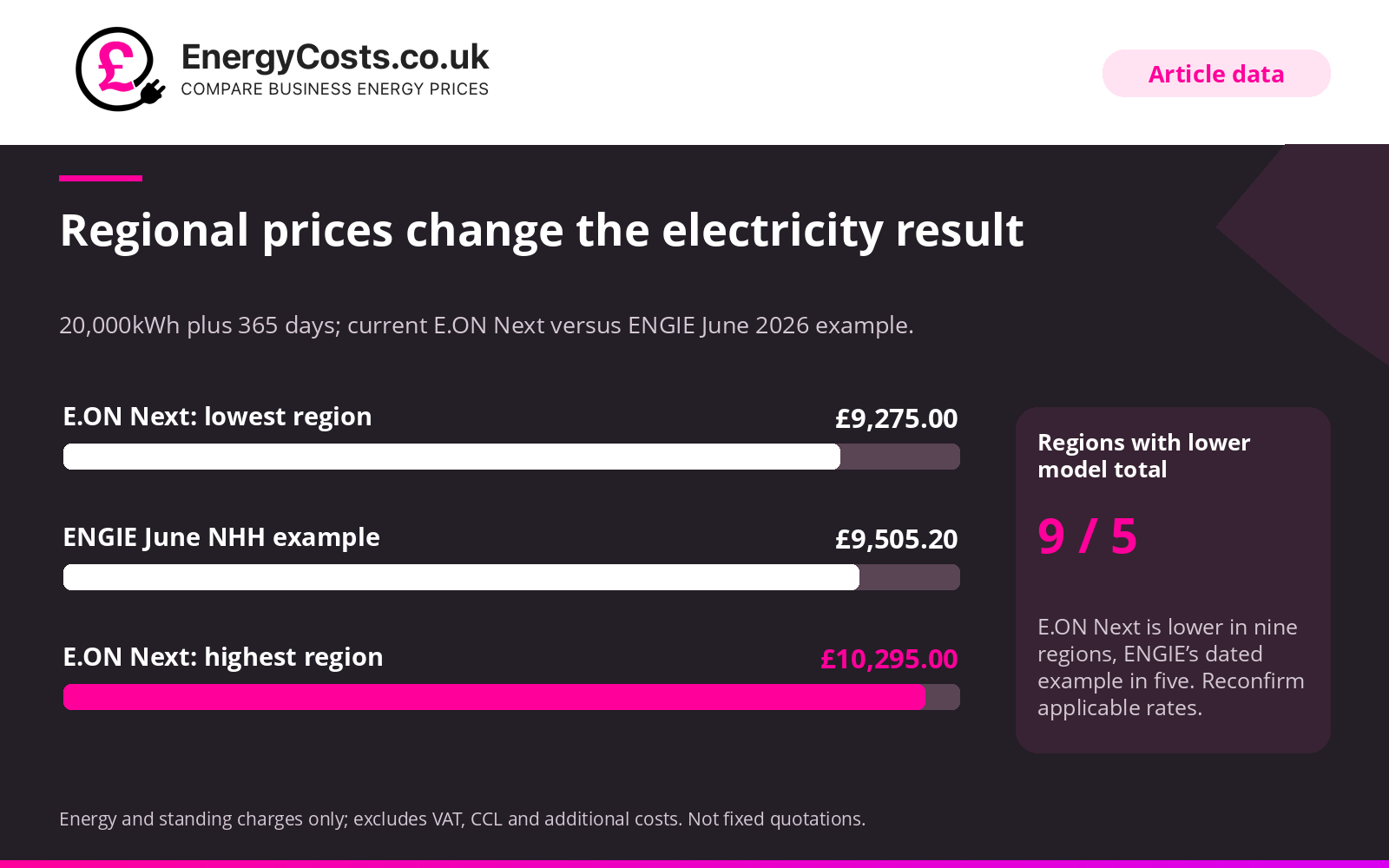
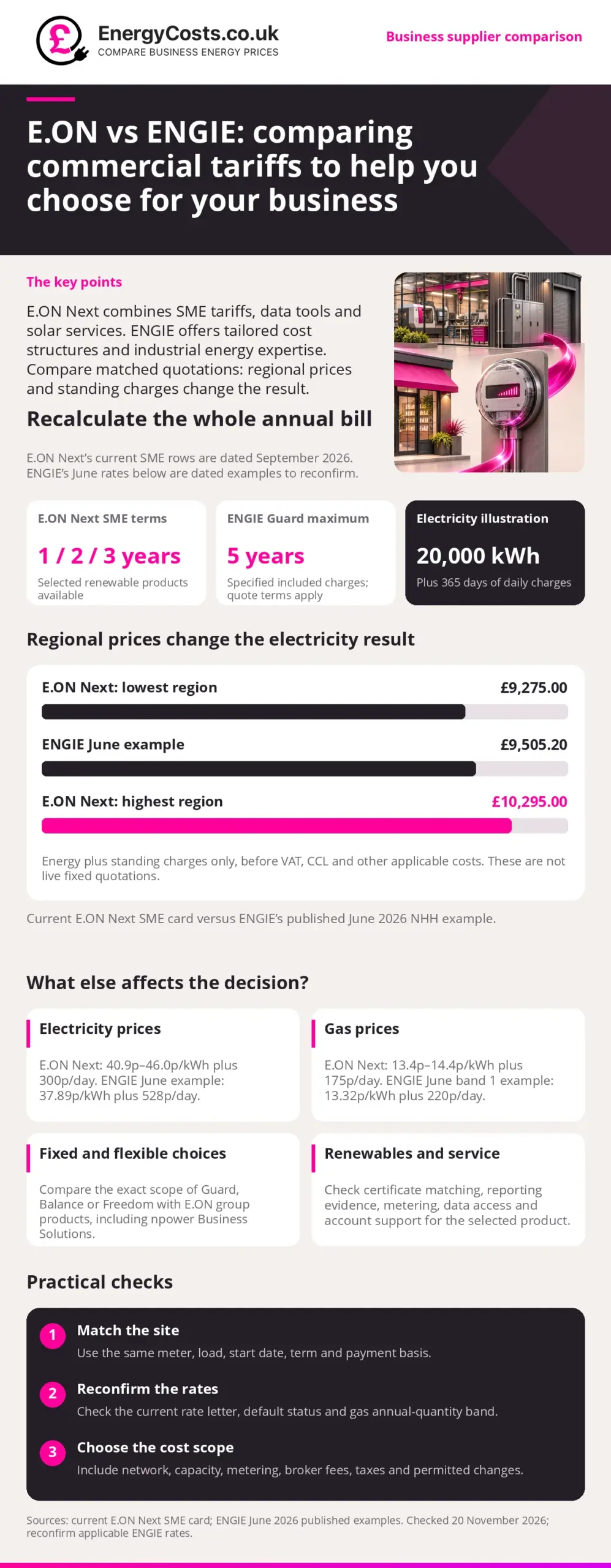
Neither supplier is a universal price winner. E.ON Next’s current SME rates are higher than the older April table. Against ENGIE’s published June 2026 example, E.ON Next is lower in nine of 14 electricity regions at 20,000kWh, while ENGIE is lower in five. Gas also depends on region and usage. These are default-rate illustrations, not matched fixed quotations.
ENGIE is the stronger option where complete price protection, renewable gas, long contract terms or complex procurement is more important. Its Guard product fixes a rate inclusive of third-party charges for up to five years, while its flexible products give large users more control over wholesale purchasing and demand management.
E.ON vs ENGIE at a glance
| Comparison area | E.ON | ENGIE |
|---|---|---|
| Business electricity | Yes | Yes |
| Business gas | Yes | Yes |
| SME fixed terms | One, two or three years | Up to five years |
| Fully fixed product | Fixed SME tariffs and large-user options | Guard, including specified third-party charges |
| No-standing-charge option | Not prominently offered | Simple gas tariff |
| Flexible purchasing | Through npower Business Solutions | Yes |
| Renewable electricity | 100% renewable electricity on selected E.ON Next tariffs | Optional with fixed and flexible contracts |
| Renewable gas | Specialist options through the wider group | Green gas and RGGO options |
| Corporate PPAs | Available through npower Business Solutions | Available |
| Published deemed electricity rate | 40.9p–46.0p/kWh, current unrestricted SME card | 37.89p/kWh, published June 2026 NHH example |
| Electricity standing charge | 300p per day | 528p per day |
| Published deemed gas rate | 13.4p–14.4p/kWh, current SME card | 13.32p/kWh, published June 2026 example |
| Gas standing charge for a small site | 175p per day | 220p per day |
| SME energy dashboard | E.ON Optimum | ENGIE online account |
| Advanced energy management | Through npower Business Solutions | GEMs, asset optimisation and demand response |
| Commercial solar | Packaged solar and battery installations | Bespoke renewable and energy-management projects |
| Public review evidence | 4.5/5, wider-customer profile | No comparable substantial current business-only sample |
| Best suited to | SME support, accessible data tools and packaged solar | Long-term certainty and complex procurement |
E.ON Next defines its conventional SME customers as businesses using no more than 100,000 kWh of electricity or 293,000 kWh of gas annually, or meeting the relevant small-business turnover and staffing criteria. Larger customers are directed to npower Business Solutions. E.ON Next offers one, two and three-year fixed tariffs, while ENGIE’s fixed products can provide price protection for as long as five years.
Which is cheaper: E.ON or ENGIE?
Compare matched fixed quotations for the same site, annual consumption, meter, start date, duration, payment and credit basis. Include network, capacity, metering, broker and renewable costs, and check which components may change. Deemed or default rates can be much higher than negotiated offers and do not establish a fixed-contract winner.
The dates and tariff status matter
E.ON Next’s current deemed-contract page links October 2026 documents whose SME business tables are dated 4 September 2026. Use those business rows rather than the household tables or superseded April SME prices. ENGIE distinguishes move-in deemed terms from default terms after an agreed contract expires; check the actual account status and rate letter.
The ENGIE comparison below uses its published June 2026 schedules: the NHH electricity card lists 37.89p/kWh and £5.28/day, while the identified June gas schedule uses 13.32p/kWh and £2.20/day for the smallest band. The NHH PDF’s first-row year is inconsistent with its June 2026 filename and May 2026 historical row. Reconfirm the applicable rate and date with ENGIE; the June examples are not a guarantee of a new fixed offer or today’s account-specific bill.
E.ON vs ENGIE electricity prices
| Tariff basis | Unit rate | Standing charge |
|---|---|---|
| E.ON Next: current unrestricted aggregated SME deemed | 40.9p–46.0p/kWh | 300p/day |
| ENGIE: published June 2026 NHH deemed example | 37.89p/kWh | 528p/day |
ENGIE has the lower unit price in all 14 regions in this comparison, but its standing charge is £832.20 higher over 365 days. That creates a different crossover in each region. VAT, CCL and other applicable account costs are excluded from the energy-plus-standing models.
E.ON and ENGIE electricity rates by region
| Region | E.ON Next, p/kWh | E.ON: 20,000kWh + 365 days | ENGIE example: same usage | Lower model total |
|---|---|---|---|---|
| Eastern | 41.2 | £9,335.00 | £9,505.20 | E.ON Next |
| East Midlands | 41.1 | £9,315.00 | £9,505.20 | E.ON Next |
| London | 42.0 | £9,495.00 | £9,505.20 | E.ON Next |
| Merseyside and North Wales | 44.3 | £9,955.00 | £9,505.20 | ENGIE |
| West Midlands | 40.9 | £9,275.00 | £9,505.20 | E.ON Next |
| North East | 41.9 | £9,475.00 | £9,505.20 | E.ON Next |
| North West | 42.7 | £9,635.00 | £9,505.20 | ENGIE |
| North Scotland | 46.0 | £10,295.00 | £9,505.20 | ENGIE |
| South Scotland | 41.2 | £9,335.00 | £9,505.20 | E.ON Next |
| South East | 41.3 | £9,355.00 | £9,505.20 | E.ON Next |
| Southern | 41.9 | £9,475.00 | £9,505.20 | E.ON Next |
| South Wales | 42.3 | £9,555.00 | £9,505.20 | ENGIE |
| South West | 42.6 | £9,615.00 | £9,505.20 | ENGIE |
| Yorkshire | 41.2 | £9,335.00 | £9,505.20 | E.ON Next |
At 20,000kWh, E.ON Next is lower in nine regions and ENGIE in five: Merseyside and North Wales, North West, North Scotland, South Wales and South West. E.ON Next’s totals range from £9,275.00 to £10,295.00; ENGIE’s June illustration is £9,505.20. The difference ranges from E.ON Next £230.20 lower to ENGIE £789.80 lower.
When could ENGIE become cheaper?
| Region | Approximate annual crossover, kWh |
|---|---|
| Eastern | 25,142 |
| East Midlands | 25,925 |
| London | 20,248 |
| Merseyside and North Wales | 12,983 |
| West Midlands | 27,648 |
| North East | 20,753 |
| North West | 17,301 |
| North Scotland | 10,261 |
| South Scotland | 25,142 |
| South East | 24,405 |
| Southern | 20,753 |
| South Wales | 18,871 |
| South West | 17,669 |
| Yorkshire | 25,142 |
Below the relevant crossover E.ON Next’s lower daily charge wins; above it ENGIE’s lower example unit rate wins while those same tariff categories apply. The range is approximately 10,261–27,648kWh/year. This calculation does not substitute for a complete current quotation or cover different meter categories.
Electricity price winner: depends on region and use
The previous claim that E.ON was cheaper in every region at 20,000kWh no longer follows from its current SME table. Compare the full annual model for the actual site, and reconfirm ENGIE’s applicable schedule.
E.ON vs ENGIE gas prices
| Tariff basis | Unit rate | Standing charge |
|---|---|---|
| E.ON Next: current SME deemed | 13.4p–14.4p/kWh | 175p/day |
| ENGIE: June 2026 example, AQ up to 73,200kWh | 13.32p/kWh | 220p/day |
| ENGIE: June 2026 example, AQ 73,201–293,000kWh | 13.32p/kWh | 539p/day |
E.ON Next has the lower daily charge; ENGIE’s cited June unit rate is lower. At higher annual-quantity bands ENGIE’s daily charge rises: the June schedule lists £14.11 for 293,001–732,000kWh and £32.84 for 732,001–2,196,000kWh. Confirm the assigned annual quantity and current rate letter before using a band.
Example annual gas cost
| Region | E.ON Next, p/kWh | E.ON: 30,000kWh + 365 days | ENGIE June band 1 example | Lower model total |
|---|---|---|---|---|
| Eastern | 13.6 | £4,718.75 | £4,799.00 | E.ON Next |
| East Midlands | 13.5 | £4,688.75 | £4,799.00 | E.ON Next |
| London | 14.2 | £4,898.75 | £4,799.00 | ENGIE |
| Merseyside and North Wales | 13.9 | £4,808.75 | £4,799.00 | ENGIE |
| West Midlands | 13.8 | £4,778.75 | £4,799.00 | E.ON Next |
| North East | 14.0 | £4,838.75 | £4,799.00 | ENGIE |
| North West | 14.0 | £4,838.75 | £4,799.00 | ENGIE |
| North Scotland | 13.8 | £4,778.75 | £4,799.00 | E.ON Next |
| South Scotland | 14.2 | £4,898.75 | £4,799.00 | ENGIE |
| South East | 13.9 | £4,808.75 | £4,799.00 | ENGIE |
| Southern | 14.4 | £4,958.75 | £4,799.00 | ENGIE |
| South Wales | 13.4 | £4,658.75 | £4,799.00 | E.ON Next |
| South West | 13.4 | £4,658.75 | £4,799.00 | E.ON Next |
| Yorkshire | 14.4 | £4,958.75 | £4,799.00 | ENGIE |
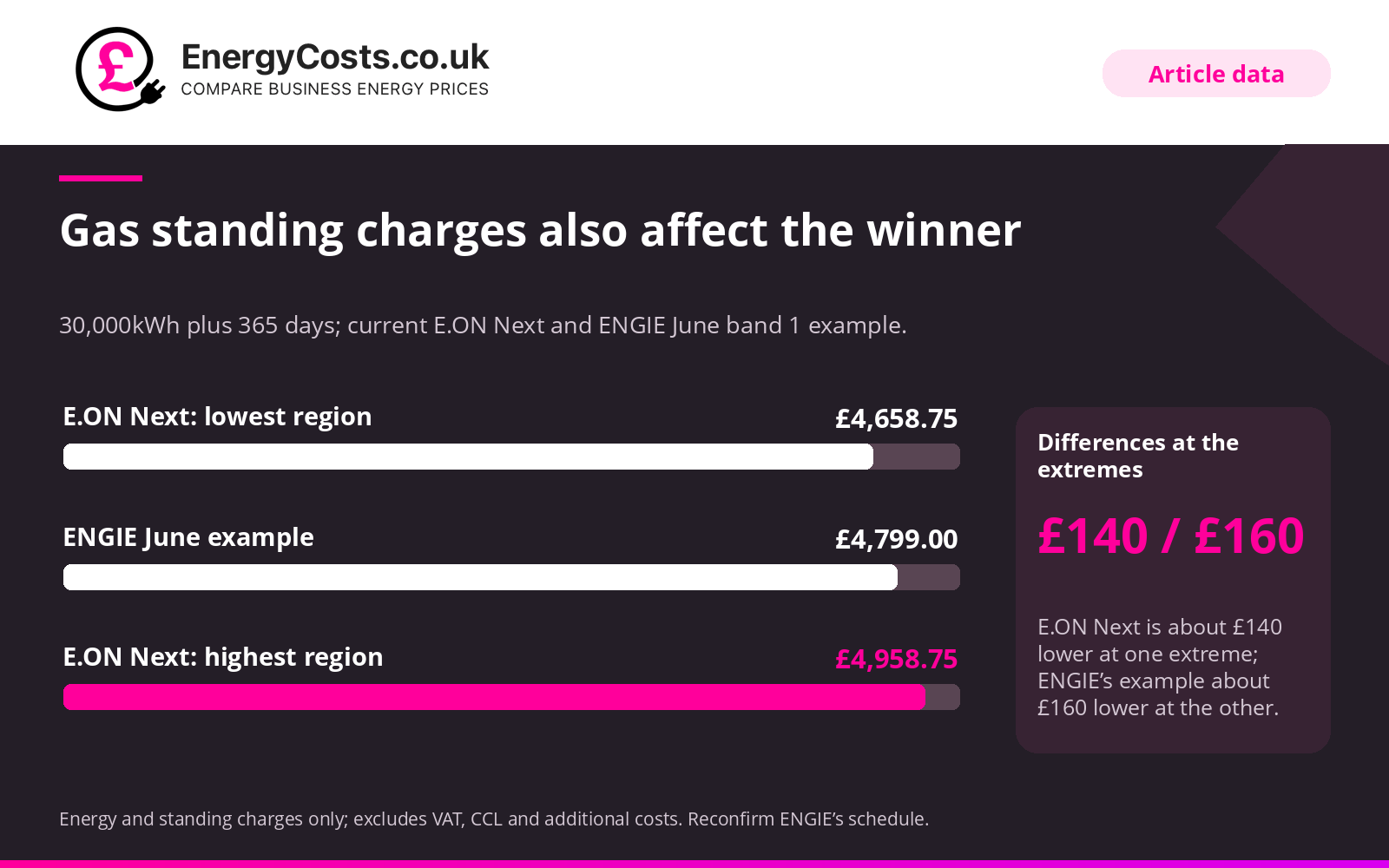
E.ON Next’s model spans £4,658.75–£4,958.75; ENGIE’s June example is £4,799.00. E.ON Next is £140.25 lower at the lowest regional price, while ENGIE is £159.75 lower at the highest. E.ON Next is lower in six regions at this usage and ENGIE in eight. Add applicable VAT, CCL and other account costs on the same basis.
Gas price winner: compare the complete annual bill
There is no longer support for the old claim that E.ON Next has both lower gas unit rates and lower totals everywhere. Usage, regional rates and ENGIE’s annual-quantity band determine the result.
Half-hourly electricity comparison
Half-hourly prices are more difficult to compare because the suppliers structure rates, standing charges, capacity costs and settlement bands differently.
ENGIE’s published June 2026 half-hourly schedule gives the following examples; confirm the current schedule for the exact site and voltage band:
| ENGIE meter category | Day rate | Night rate | Standing charge |
|---|---|---|---|
| LV, LV Sub and HV bands 1–2 | 40.47p per kWh | 26.45p per kWh | £27.85 per day |
| HV bands 3–4 | 40.47p per kWh | 26.45p per kWh | £510.31 per day |
ENGIE passes through additional capacity, excess-capacity and reactive-power costs where applicable. Its schedule also states that its out-of-contract electricity rates are 100% green.
E.ON Next’s current card separates aggregated supplies from site-specific LV, LV-substation and HV accounts. Its London LV/LV Sub band 1 example is 39.9p/kWh plus 852p/day and 6.4p/kVA/day capacity, with a 6.4p/kVA/day excess-capacity rate. These are category-specific figures; half-hourly settlement alone does not imply every small meter has an individual capacity charge.
A half-hourly customer should request a complete annual forecast containing:
- Day and night consumption
- Daily standing charges
- Agreed capacity
- Excess-capacity charges
- Reactive-power charges
- Meter operator costs
- Data collection and aggregation
- Distribution and transmission charges
- Balancing costs
- Broker commission
There is no reliable overall half-hourly winner without a specific meter, regional band and consumption profile.
E.ON contract options
E.ON Next SME contracts
E.ON Next offers bespoke fixed business tariffs lasting one, two or three years. Selected fixed electricity tariffs include 100% renewable electricity.
SME customers also receive online account management and access to dedicated Energy Specialists. Eligible businesses can obtain quotations online, while multi-site customers, landlords and property managers can request bespoke support.
E.ON allows existing customers to discuss a replacement tariff up to 180 days before their current contract ends. Online renewal may be available closer to the termination date, subject to eligibility.
E.ON large-business contracts
Large and corporate customers are served through npower Business Solutions, part of the E.ON group.
Its procurement options include:
- Conventional fixed contracts
- MultiPurchase contracts
- Market Tracker
- Flex Streamline
- Fast Flex
- Flex Innovate
- Renewable fixed and flexible products
- Corporate power purchase agreements
MultiPurchase allows a business to fix separate portions of its expected energy volume at different points. More advanced flexible products provide access to wholesale purchasing, dedicated portfolio management, risk reporting and options for handling non-commodity charges.
ENGIE contract options
ENGIE’s fixed portfolio provides a wider range of approaches to third-party costs.
ENGIE Guard
Guard includes specified third-party charges within a fixed rate. ENGIE states that contracted prices remain consistent and can be guaranteed for up to five years.
The product is available for standard or green electricity and gas contracts. It is likely to suit businesses that prioritise long-term budget certainty and want protection from changes to the charges included in the agreement.
ENGIE Simple
Simple is a fixed gas tariff with no separate daily standing charge. Instead, the relevant costs are incorporated into the unit price.
It may suit low-use or seasonal gas sites, although a tariff without a standing charge is not automatically cheaper because the unit rate may be higher.
ENGIE Balance
Balance fixes network charges while passing government programme costs through at their current rates.
This can remove some of the risk premium associated with fixing uncertain policy costs, but the overall bill can change during the contract.
ENGIE Freedom
Freedom fixes wholesale energy while passing third-party charges through at cost.
The tariff provides transparency and may reward customers that can reduce demand during expensive network periods, but it provides less complete budget certainty than Guard.
Which provides better price certainty?
Both groups offer products that fix specified third-party charges. ENGIE Guard and npower Business Solutions Fixed Certainty should be compared on the quoted cost scope, permitted variations and term, rather than assuming only one group offers that protection.
Guard expressly includes third-party charges in its fixed contracted rate and can run for up to five years. E.ON offers straightforward fixed SME tariffs and large-business contracts with different approaches to non-commodity costs, but the precise protection depends on the individual quotation and contract terms.
Businesses should confirm whether a fixed quotation includes:
- Wholesale energy
- Distribution charges
- Transmission charges
- Balancing costs
- Capacity Market costs
- Contracts for Difference
- Renewable Obligation costs
- Metering and data charges
- New taxes or regulatory levies
“Fixed” does not always mean every element of the final bill is guaranteed.
Flexible purchasing comparison
E.ON’s advanced flexible contracts are provided through npower Business Solutions. A corporate customer can divide volumes into several purchases, follow market-reflective rates or actively trade wholesale energy with support from a portfolio manager.
Its Flex Portfolio Solutions allow businesses to select different levels of market updates, risk reviews and performance reporting. Flex Innovate also removes contractual volume tolerances and prices differences between traded blocks and actual consumption against a published index.
ENGIE offers:
- Simple Flex electricity
- Day Ahead gas
- Fixed Price
- Market Choice
- Daily Flex electricity
- Tailored trading services
Simple Flex is recommended for electricity users consuming more than 10 GWh annually. Market Choice allows customers to select monthly average day-ahead pricing or purchase volumes for months, quarters and seasons when market conditions appear favourable. Daily Flex can contain up to eight separate rates covering seasons, weekdays, weekends and different times of day.
Flexible purchasing winner: Draw
Both companies offer credible flexible procurement. E.ON’s wider group provides a particularly broad choice of portfolio-management structures, while ENGIE combines flexible energy supply with demand response, asset optimisation and market-access services.
Renewable electricity comparison
E.ON renewable electricity
E.ON Next offers 100% renewable electricity on selected one, two and three-year fixed business tariffs.
For larger businesses, npower Business Solutions offers UK Business Renewable and UK Renewable Pure products. UK Renewable Pure uses wind, solar and hydro generation, while both products use REGOs and are designed to support zero market-based Scope 2 reporting. Renewable options can be added to fixed and flexible contracts.
The current E.ON Next fuel-mix disclosure covers 1 April 2025 to 31 March 2026 across its relevant residential and business licences; it is distinct from the npower Business Solutions licence:
| Energy source | E.ON fuel mix |
|---|---|
| Renewables | 27.3% |
| Natural gas | 53.2% |
| Coal | 9.3% |
| Nuclear | 5.8% |
| Other fuels | 4.4% |
E.ON Next reports 322g CO₂/kWh for 2025/26. A selected renewable tariff has its own matching and reporting evidence; the portfolio figure does not describe every customer’s product.
ENGIE renewable electricity
ENGIE offers certified renewable electricity, named-asset and corporate PPA structures, plus renewable gas and RGGO support. Check the offered certificate scheme, matching period, location and reporting assurance. Its official fuel-mix disclosure is a separate portfolio measure; the older 2024/25 figures should not be ranked against E.ON Next’s 2025/26 period.
Renewable-energy winner
ENGIE has a narrow advantage for bespoke renewable procurement.
Both suppliers can provide credible REGO-backed renewable electricity and corporate PPAs. Compare renewable gas, certificate quality, named-asset matching, additionality and reporting assurance in the actual offers. A cross-period portfolio percentage is not a sound basis for choosing a current contract.
E.ON remains highly competitive for businesses wanting a conventional renewable fixed contract, particularly through its independently verified npower Business Solutions products.
Smart meters and energy data
E.ON Optimum
E.ON Optimum is a free energy-management dashboard for eligible SME customers with compatible meters.
It allows businesses to:
- View electricity and gas consumption
- Compare usage year on year for up to three years
- Benchmark consumption
- Receive sustainability and efficiency tips
- Access data remotely
E.ON also offers commercial smart-meter installation without a separate installation charge, subject to eligibility and site suitability.
ENGIE online account and GEMs
ENGIE customers with compatible smart, AMR or half-hourly meters can access yearly, daily or half-hourly consumption information through an online account. Half-hourly data files can also be requested separately.
For more complex customers, ENGIE offers GEMs and other energy-management services combining real-time data, analytics, market expertise, demand response and asset optimisation.
Energy-data winner:
- E.ON for a typical SME, because Optimum provides an accessible, packaged dashboard.
- ENGIE for advanced industrial energy management, because its tools extend into asset optimisation, trading and demand response.
Commercial solar and batteries
E.ON has the more clearly defined small-business solar proposition.
Its commercial systems typically range from 15 kW to 100 kW, although larger systems are available. Services can include:
- Three-dimensional system design
- Structural roof assessments
- Distribution network applications
- Solar and battery installation
- Performance and return-on-investment forecasts
- Monitoring tools
- Multi-site designs
- Solar-only, battery-only or combined installations
E.ON gives general payback estimates of four to six years for solar and battery systems and four to seven years for battery-only projects. Actual results depend on system size, usage patterns, financing, roof orientation and export restrictions.
ENGIE’s published UK proposition places greater emphasis on renewable generation, PPAs, biomethane, energy management, asset optimisation and demand response than on a standard packaged rooftop-solar service for SMEs. For a large or technically complex decarbonisation project, however, ENGIE’s wider capabilities may be more relevant.
Packaged commercial solar winner: E.ON
Customer service comparison
E.ON Next gives business customers online account access and support through telephone, email and WhatsApp. Dedicated Energy Specialists are included in its SME proposition.
ENGIE provides online account management, telephone and email support. Its sales lines normally operate during weekday business hours, and specialist account management is available for tailored energy contracts.
Eligible small and microbusiness customers can refer unresolved complaints to the Energy Ombudsman once the required escalation conditions have been met.
Trustpilot ratings
At the 20 November 2026 snapshot, E.ON Next’s wider-customer profile had a 4.5/5 TrustScore from 251,446 reviews. It includes domestic customers and is not a business-only service measure. The ENGIE.CO.UK profile is associated with the legacy home-energy website, so it is not a suitable current UK business comparison.
A tiny alternative business-profile sample would also be insufficient for a reliable ranking. Read recent business-relevant feedback and assess billing, account support, complaints handling and agreed service levels alongside the contract.
E.ON advantages and disadvantages
Advantages of E.ON
- Lower daily gas standing charge on the cited SME card
- Lower electricity standing charge
- Lower example electricity total in nine of 14 regions at 20,000kWh
- One, two and three-year SME tariffs
- Selected tariffs include 100% renewable electricity
- Free E.ON Optimum dashboard for eligible SMEs
- Commercial smart meters
- Packaged solar and battery installations
- Dedicated Energy Specialists
- Large-business fixed and flexible procurement
- Corporate PPAs and renewable products through npower Business Solutions
- Strong headline Trustpilot score
Disadvantages of E.ON
- Deemed electricity rates vary considerably by region
- ENGIE’s June example has a lower unit price in all 14 regions
- SME contracts do not extend to five years
- Use SME rows dated 4 September inside the current October 2026 documents
- Its large-business offering uses a separate npower Business Solutions brand
- Trustpilot reviews are predominantly domestic
- Renewable electricity applies only to selected E.ON Next tariffs
ENGIE advantages and disadvantages
Advantages of ENGIE
- Guard can fix included third-party charges
- Contract terms of up to five years
- One nationwide non-half-hourly deemed electricity rate
- Zero-standing-charge fixed gas option
- Four distinct approaches to third-party charges
- Sophisticated flexible purchasing
- Corporate PPAs and named-asset options
- 100% renewable electricity available
- Renewable gas and RGGO services
- Advanced asset optimisation and demand response
- GEMs energy-management tools
- Strong capabilities for large industrial users
Disadvantages of ENGIE
- Gas prices and annual-quantity bands need a current matched comparison
- Higher gas standing charge
- High £5.28 daily electricity standing charge
- Gas standing charges rise substantially with consumption
- Higher electricity daily charge can outweigh a lower unit rate at low use
- No substantial representative business-review dataset
- Fixed and flexible products may be overly complex for a very small business
- No equally prominent packaged SME solar proposition
Which supplier is best for different businesses?
| Business requirement | Better choice | Reason |
|---|---|---|
| Small office or shop | E.ON | Lower standing charge and simple SME tariffs |
| Typical SME electricity account | Compare both | Current regional rates and annual use affect the complete bill |
| Gas-heated business | Compare both | Lower unit rates can offset higher standing charges; check the band |
| North Scotland electricity site | Compare both | ENGIE becomes competitive at higher consumption |
| Five-year contract | ENGIE | Guard prices can be guaranteed for up to five years |
| Complete price certainty | Compare eligible products | Guard and npower Business Solutions fixed-cost options have specified scopes |
| Simple one to three-year fix | E.ON | Straightforward E.ON Next SME proposition |
| Zero-standing-charge gas | ENGIE | Simple tariff |
| Renewable SME electricity | Compare both | Both offer 100% renewable products |
| Renewable gas | ENGIE | Green-gas and RGGO services |
| Commercial rooftop solar | E.ON | Clearly packaged SME installation service |
| Large industrial customer | Compare both | Both offer advanced flexible purchasing |
| Demand response | ENGIE | Integrated flexibility and asset optimisation |
| Multi-stage wholesale purchasing | Either | Both offer split-purchase arrangements |
| Corporate PPA | Compare both | Both provide renewable PPA solutions |
| Accessible SME data dashboard | E.ON | Optimum is free for eligible customers |
| Advanced asset analytics | ENGIE | GEMs and energy-management services |
| Public customer-review record | Assess business-relevant evidence | E.ON Next has a larger wider-customer sample, not a controlled business ranking |
Final verdict: E.ON vs ENGIE
E.ON Next is a straightforward SME option for one, two or three-year products, eligible Optimum data tools, Energy Specialists and packaged solar or storage. Larger customers can access npower Business Solutions procurement. ENGIE offers Guard, Simple, Balance and Freedom structures, renewable-gas options and specialist energy management.
The current E.ON Next SME prices change the default-rate comparison. At 20,000kWh, its model is lower in nine regions and ENGIE’s June example in five; at 30,000kWh gas, E.ON Next is lower in six regions and ENGIE’s example in eight. These are dated fallback-tariff calculations, not a recommendation to remain out of contract or a fixed-price ranking.
Get matched current quotations and include standing charges, network and capacity costs, metering, broker fees, renewable evidence, taxes, permitted changes, exit rights and end-of-contract arrangements. Choose the contract whose complete cost and risk allocation fit the business.
FAQ
It depends on region, use and product. At 20,000kWh, E.ON Next’s current SME deemed model is lower in nine electricity regions; ENGIE’s June 2026 example is lower in five. These fallback schedules do not establish a fixed-contract winner.
E.ON Next’s current unrestricted SME deemed rate is 40.9p–46.0p/kWh plus 300p/day. ENGIE’s June 2026 NHH example is 37.89p/kWh plus 528p/day. Lower daily charges matter at low use; reconfirm ENGIE’s current applicable schedule.
E.ON Next’s current SME card is 13.4p–14.4p/kWh plus 175p/day. ENGIE’s June band 1 example is 13.32p/kWh plus 220p/day. At 30,000kWh their modelled totals overlap, so region, use and band matter.
Yes. E.ON Next offers one, two and three-year fixed SME tariffs. ENGIE offers fixed structures including Guard, Simple, Balance and Freedom, with protection lasting up to five years on qualifying contracts.
ENGIE Guard includes specified third-party charges within a fixed contracted rate. Balance and Freedom treat industry charges differently, so businesses should check which product has been quoted.
Yes. E.ON Next offers 100% renewable electricity on selected fixed business tariffs. Larger organisations can access additional renewable products and corporate PPAs through npower Business Solutions.
Yes. ENGIE offers 100% renewable electricity with fixed and flexible contracts. Its renewable products are REGO-backed and can support zero market-based Scope 2 emissions reporting.
ENGIE has the more prominent renewable-gas proposition, including green gas and Renewable Gas Guarantees of Origin. E.ON’s wider group can provide specialist renewable procurement to larger organisations.
Both are credible. ENGIE is strong in Guard pricing, demand response and asset optimisation. E.ON’s npower Business Solutions division provides fixed, MultiPurchase and fully flexible procurement structures.
E.ON Next offers straightforward SME terms, eligible Optimum tools and dedicated support. ENGIE can suit businesses needing specific third-party-cost treatment or renewable-gas options. Compare complete current quotations; the older claim that E.ON is always cheaper no longer holds.
Yes. Both provide commercial smart or AMR meters to eligible sites. E.ON customers can use Optimum, while ENGIE customers can access yearly, daily or half-hourly data through its online account.
On 20 November 2026, E.ON Next’s wider-customer Trustpilot profile scored 4.5 from 251,446 reviews. That includes domestic customers. ENGIE’s legacy home-energy profile and tiny alternative business samples do not provide a comparable current business-satisfaction ranking.
Compare E.ON Next for SME support, data tools and solar, and ENGIE for tailored fixed-cost structures, renewable gas or industrial procurement. Larger users should also compare npower Business Solutions. Decide using complete matched quotations, service requirements and contract risk.