For UK businesses seeking clarity on energy costs, this review breaks down how ENGIE UK approaches business-energy pricing and contract features. We highlight the kinds of tariffs on offer, how much you might expect to pay, the key extras and caveats, and how ENGIE stacks up against market norms.
Who is ENGIE UK and what do they offer?
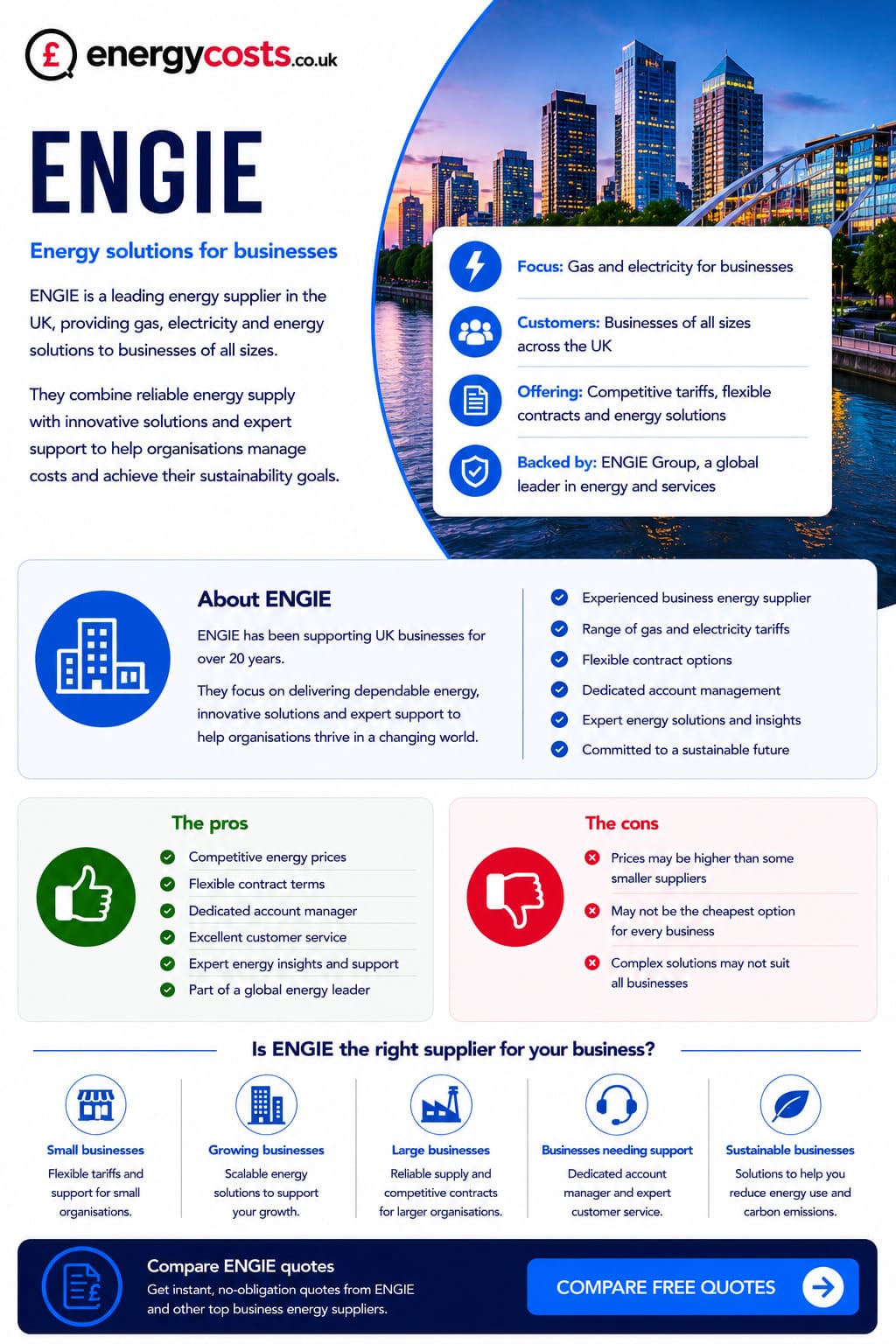
ENGIE UK is part of the broader international ENGIE Group: a multinational energy firm with operations in generation, supply and services.
On the business-supply side they provide:
- Business electricity and gas supply contracts for small businesses through to large/industrial users.
- A range of contract types: fixed-price deals, flexible or index-linked tariffs, “deemed”/default rates for customers without a fixed contract.
- Additional services around energy management, renewables, smart meter support and sustainability.
For a UK business audience this means ENGIE can cater to everything from a small office to a large industrial facility, but the pricing, contract terms and suitability will vary substantially by size, consumption and risk appetite.
Who ENGIE is best for
ENGIE is likely to suit businesses that want more than a basic fixed-price utility contract. Its UK business energy pages highlight fixed and flexible electricity plans, tailored quotes, 100% renewable electricity, green gas contracts and real-time market access options, while also separating out offers for small businesses and micro businesses.
That means ENGIE may be a good fit for micro businesses that want a more straightforward contract route, SMEs that want renewable options, and larger organisations that need more tailored procurement support. ENGIE’s micro business page also highlights dedicated account manager support, while its small business section focuses on personalised support and simpler quoting.
Typical tariff types with ENGIE
Here are the main tariff categories with ENGIE worth knowing:
Fixed-price tariffs
These give you a locked-in unit rate (and sometimes other charges) for a set term (often 1 to 5 years). They offer certainty and budget stability. ENGIE advertises fixedprice business plans.
Flexible or index based tariffs
For larger users or those comfortable with more risk, ENGIE provide model where the unit rate is tied to wholesale or market indices. This can offer savings if the market falls—but you may take more risk.
Deemed/default (out-of-contract) rates
If you don’t have an agreed contract (for example you’ve moved into new premises supplied by ENGIE but haven’t signed an agreement) you are placed on deemed or default rates. These are typically higher.
Green/renewable tariffs
ENGIE also emphasise renewable electricity supply and green credentials. For businesses wanting a “100 % green” supply there are options.
Renewable electricity and green gas options
The supplier states that it offers certified green gas options and 100% renewable electricity for business customers, alongside broader onsite energy solutions such as CHP and battery storage support.
That matters because businesses with carbon reduction targets, procurement requirements or ESG reporting obligations may want more than a standard supply contract. Rather than assuming every ENGIE tariff is green by default, it is worth asking whether the quote includes 100% renewable electricity, green gas, or a standard product without those extras.
ENGIE UK price list and tariffs
| Business size | Annual consumption (kWh) | Tariff type | Unit rate (p/kWh) | Standing charge (£/day) | Estimated annual cost (£) | Notes |
|---|---|---|---|---|---|---|
| Micro business | 10,000 | Fixed 1-year | 17.2p | 0.95 | 1,830 | Best for low-usage offices or shops wanting stability |
| Small business | 25,000 | Fixed 2-year | 16.4p | 1.10 | 4,375 | Slightly cheaper for longer-term contracts |
| Medium business | 50,000 | Fixed 3-year | 15.7p | 1.35 | 8,295 | Longer term gives moderate savings |
| Large business | 250,000 | Flexible/index-linked | 13.8p–16.5p | 2.50 | 35,500–41,000 | Price varies with wholesale energy trends |
| Half-hourly metered | 1,000,000+ | Custom contract | 12.5p–15.0p | 5.00+ | 128,000–154,000 | Individually quoted corporate tariff |
| Out-of-contract (deemed) | n/a | Default | 33.9p | 3.99 | 12,000+ | Should be avoided—often double contract rates |
Key takeaways
- Fixed tariffs between 15–17p/kWh are typical for 2026 ENGIE contracts.
- Larger businesses using flexible contracts can achieve 12–14p/kWh if market rates are favourable.
- Deemed rates can exceed 33p/kWh, so timely renewal or switching is essential.
- Standing charges range from £0.90 to £5.00/day, depending on meter type and size.
ENGIE deemed and default rates explained
One of the more useful things about ENGIE’s UK site is that it separates deemed and default rate information clearly. Its supply information pages include gas deemed rates, gas default rates, non-half-hourly electricity deemed rates, half-hourly electricity deemed rates, and separate electricity default rates for both NHH and HH customers, alongside principal terms and contract documents.
This is important because businesses can end up on these rates if they move into premises without agreeing a contract, or if they continue consuming after a contract has ended. ENGIE’s own deemed electricity and gas contract documents define a “Default Contract Rate” as the published rate payable where the customer continues to consume after the termination date.
Unit rates, standing charges and context
While exact quotes depend entirely on your location, meter type, consumption profile and contract term, here are indicative figures and how they compare to the market:
- According to one source, fixed-price plans with ENGIE are commonly priced between 14.0 and 17.5 pence per kWh, with 3-year deals at the lower end of that range.
- Flexible plans are shown as varying quite a bit: 12.0 to 18.0 pence per kWh depending on market conditions.
- Deemed/out-of-contract rates with ENGIE are much higher and should be avoided if possible. For example one dataset cites non-half-hourly electricity at 33.92 pence/kWh and daily standing charge of £3.99.
- On the broader business market: averages for 2026 show unit rates for electricity of around 21p-26p/kWh depending on business size.
Key implications for UK businesses
- If you can secure a fixed-price tariff in the 14-17p/kWh region with ENGIE you’d be doing reasonably well compared to current market averages.
- Being on a flexible or index tariff offers lower starting rates but more risk.
- Being on a default or deemed tariff is almost certainly sub-optimal—rates jump to 30p+ per kWh in some cases.
- Don’t just focus on unit rate: standing charges (daily fixed fees), capacity charges (for half-hourly meters), and third-party pass-through charges matter greatly, especially for smaller or unusual consumption profiles.
VAT relief and Climate Change Levy
ENGIE states that the standard VAT rate applies by default, but reduced-rate VAT may apply where the supply qualifies as domestic use, charity non-business use or de minimis consumption. ENGIE defines de minimis as an average of no more than 145 kWh a day for gas and 33 kWh a day for electricity across the invoicing period.
ENGIE also says that where reduced-rate VAT applies, Climate Change Levy is not charged. For qualifying domestic or charity non-business use, a VAT Certificate Declaration must be completed for each site, and ENGIE’s FAQ says the form should be returned no later than 10 working days after the contract start date. This could be particularly relevant for mixed-use premises, residential care settings, student accommodation, boarding schools and some charity sites.
Features, strengths and weaknesses of ENGIE’s business offering
Strengths
- Good contract variety: ENGIE provides large-scale tailored solutions and smaller business options alike.
- Renewable/green supply options: businesses with environmental targets can engage with their green supply products.
- Transparency around out-of-contract/deemed rates: ENGIE publish that their deemed/default rates will be higher and encourage contract switch.
- Capability for larger enterprises and half-hourly settlements etc: they have experience with industrial scale businesses.
Weaknesses / caveats
- The “we’ll give you a quote” nature: ENGIE do not publish standard tariffs for all business sizes publicly; many of the rates depend on bespoke negotiation.
- Risk of paying a high rate if you remain on a deemed/default contract. The difference between contract and out-of-contract can be large.
- For smaller businesses: standing charges and ancillary costs may disproportionately raise your total bill even if the unit rate looks competitive.
- Contract length vs flexibility: If you lock in for 3-5 years you may get lower rates—but you also tie yourself into assumptions about future energy prices, consumption and suitability.
Trading and market access for larger businesses
ENGIE looks more distinctive than many suppliers when it comes to larger commercial users. Its business energy pages refer to real-time market access and trading options, and its dedicated Trading Services page says it offers expertise, services and technology to help large businesses implement the best energy-purchasing strategies.
For larger users, that could make ENGIE more attractive than a supplier focused only on standard fixed deals. Businesses with stronger in-house energy knowledge, a higher appetite for wholesale exposure, or more complex buying requirements may find this side of ENGIE’s offer particularly relevant. ENGIE also says its solutions can be tailored around consumption patterns, sustainability goals, risk appetite and in-house energy expertise.
How to decide if ENGIE’s offer is right for your business
When considering ENGIE (or any business energy supplier) for your business energy contract, here are some useful decision-points:
- Know your consumption profile & meter type
- Are you half-hourly metered (HH) or non-half-hourly (NHH)? HH usually applies for larger/industrial.
- What is your annual usage (kWh) and during what times you consume most power.
- If you’re small and use <15-20,000 kWh/year you might have a different cost structure.
- Decide how much price certainty you want vs flexibility
- If you value budgeting and predictability, a fixed price contract with ENGIE could make sense.
- If you are comfortable with market risk and have capacity to monitor consumption, a flexible/index-linked contract might work and result in savings.
- If you find yourself on a deemed or default tariff, you should act quickly because those rates tend to be significantly higher.
- Compare the full cost, not just the unit rate
- Check the unit rate (pence per kWh) and the daily standing charge.
- Understand any capacity or demand charges, especially if you’re meter half-hourly.
- Ask whether the contract includes third-party pass-through charges or whether you pay them separately (network/DUoS, CCL, etc).
- For a fair comparison, benchmark against recent market averages for businesses of similar size.
- Consider contract term & renewal arrangements
- How long is the commitment? 1, 2, 3 or 5 years? Longer term may reduce rate but increases risk if volumes or market move.
- What happens at the end of the term? Are there auto-renewals, exit fees, penalties for early termination?
- Does the contract allow you to add / remove meters (e.g., if you grow or shrink) without penalty? ENGIE mention some flexibility for larger clients.
- Assess value-added services
- Does ENGIE provide tools for energy monitoring, smart meter enablement, optimisation of consumption patterns?
- If you’re serious on sustainability, how credible are their green offerings (e.g., 100 % renewable supply) and do they help meet your corporate carbon / ESG targets?
- Does the supplier’s customer service and reputation align with your expectations (billing accuracy, account management, etc)?
Complaints and escalation
Price is only one part of choosing a business energy supplier. ENGIE’s complaints page says complaints can be raised by emailing its Customer Service Advisers, who will try to resolve the issue at that stage, with complaints transferred to the Customer Complaint team if needed. ENGIE also says that where a complaint cannot be resolved at first contact, it will issue a complaint reference number and acknowledge the complaint in writing.
ENGIE also states that micro business consumers and small business consumers who are unhappy with the outcome can complain to the Energy Ombudsman, and it points customers to Citizens Advice for support as well.
Verdict: is ENGIE a good option for UK businesses?
In summary: yes, ENGIE can be a solid choice for UK businesses, but whether they’re the right choice depends heavily on your specific situation.
- If you have a larger business or industrial site with substantial consumption and want a tailored solution (and perhaps a green supply), ENGIE offers the contract sophistication to match.
- If you are a smaller business looking for a straightforward fixed-price contract and want to lock in predictable costs for 1-3 years, ENGIE also can cater for that.
- But you must avoid being complacent: if you remain on an out-of-contract or deemed rate you may end up paying significantly more. The effort to compare, switch or negotiate pays off.
- As usual, comparing across suppliers is essential: unit rates and contract features move with the market, and the cheapest today might not be the cheapest tomorrow.
Action checklist for your business
- Check your current usage (kWh/year), meter type (HH or NHH), current rate, standing charge and contract end date.
- Ask ENGIE for a quote: both a fixed price contract and a flexible/index option (if suitable), with clearly broken-down unit rate and standing charge.
- Compare ENGIE’s offer with at least one or two other major business energy suppliers.
- If you’re on a deemed/default rate now, prioritise switching, cost savings could be significant.
- Factor in services beyond price: monitoring, green supply, flexibility for growth, exit terms.
- When negotiating term length, balance certainty vs future flexibility (especially if your business is scaling or your consumption profile may change).
FAQ
Engie’s small business electricity rates typically start from around 16.4p per kWh, with daily standing charges of about £1.10. A small office or retail unit using 25,000 kWh per year would spend roughly £4,375 annually, based on current indicative 2026 pricing for fixed-term contracts.
Engie business contracts usually range from 12 to 60 months, with the most common terms being 24- or 36-monthagreements. Longer deals can save up to 5–8 % compared to 1-year options, but businesses should review renewal terms carefully to avoid automatic rollovers at higher rates.
Yes. Engie’s renewable electricity tariffs cost on average 0.3–0.5p per kWh more than their standard fixed rates. A small business using 20,000 kWh per year might pay around £60–£100 extra annually for 100 % renewable supply, which many firms consider a worthwhile sustainability investment.
Engie’s business gas rates are typically between 5.1p and 6.2p per kWh, depending on contract length and region. That’s around 4–7 % below the UK’s 2026 business gas average of roughly 6.5p per kWh, making Engie competitive for firms with steady gas usage.
Engie’s early termination fees usually equate to 10–20 % of the remaining contract value. For example, a small business spending £500 per month with six months left might face a penalty of £300–£600. Always confirm specific terms before signing or cancelling to avoid unexpected costs.
Switching to Engie typically takes 2–4 weeks for non-half-hourly meters and 4–6 weeks for half-hourly or multi-site accounts. Businesses must provide a recent meter reading and supply number (MPAN/MPRN). Engie handles the rest, ensuring no supply interruption during the changeover process.
For larger sites or half-hourly metered users, Engie’s standing charges usually fall between £2.50 and £5.00 per day. Multi-site industrial contracts can reach £7.00 daily when capacity or distribution costs are included, making it important to benchmark total daily charges when comparing suppliers.
Engie’s flexible or index-linked tariffs are reviewed monthly and can adjust by 0.5p–1.5p per kWh depending on wholesale market movements. In volatile periods, rates may change more frequently, but customers are notified in advance and can track market performance through Engie’s digital portal.
Yes. Engie provides portfolio discounts of 2–4 % when multiple sites are combined under one supply agreement. For example, a business operating five offices could save around £500–£800 annually by consolidating their meters, simplifying billing, and receiving aggregated consumption reporting from a single account manager.
If a business doesn’t renew its Engie contract, it automatically moves to a deemed rate—around 33.9p per kWh with a £3.99 daily standing charge. For a user consuming 20,000 kWh annually, that could add over £2,000 per year to energy costs, so renewing on time is essential.