

An empty shop, office, workshop or industrial unit can continue generating energy bills even when nobody is trading there. Standing charges, essential electricity consumption and contractual fees can remain payable throughout the gap between occupiers. Switching everything off is not the same as ending the supply arrangement.
Start by establishing who is responsible for the property and the supplier account during the vacant period. Then compare the cost of keeping supply available on a suitable tariff with the complete cost and practical consequences of meter removal or disconnection. Record the handover dates and readings before making changes.
Who pays when a commercial property is empty?
Responsibility depends on the supply agreement, occupation, ownership and the relevant handover arrangements. A tenant who temporarily stops trading is in a different position from a tenant whose occupation and responsibilities have genuinely ended. A lease allocation between landlord and tenant also needs distinguishing from the supplier’s contractual position.
| Situation | Starting point to investigate | Evidence to keep |
|---|---|---|
| Tenant temporarily closes but retains the premises | Existing customer’s contract and continuing occupation | Lease, contract and closure dates |
| Tenant leaves and landlord takes back control | Outgoing account closure and responsibility during the void | Surrender or expiry documents, keys record and readings |
| Property sold with vacant possession | Completion date and the buyer’s supply arrangements | Completion evidence, meter photographs and supplier notices |
| New tenant is fitting out before opening | Actual occupation and agreed responsibility dates | Lease, access agreement and opening readings |
| Energy is included in rent or service charges | Landlord’s account and the lease’s charging arrangements | Service-charge schedule and underlying billing evidence |
British Gas’s commercial-landlord guidance describes landlords taking responsibility between tenants and recommends arranging an appropriate plan. Use that as a practical prompt to notify the supplier, not as a substitute for checking a disputed lease, contract or date.
If responsibility is disputed, send the supplier a clear chronology and ask it to explain the basis for charging the named customer. Do not simply place a bill in somebody else’s name or assume that returning keys has updated the supplier’s records.
Do standing charges apply with no energy use?
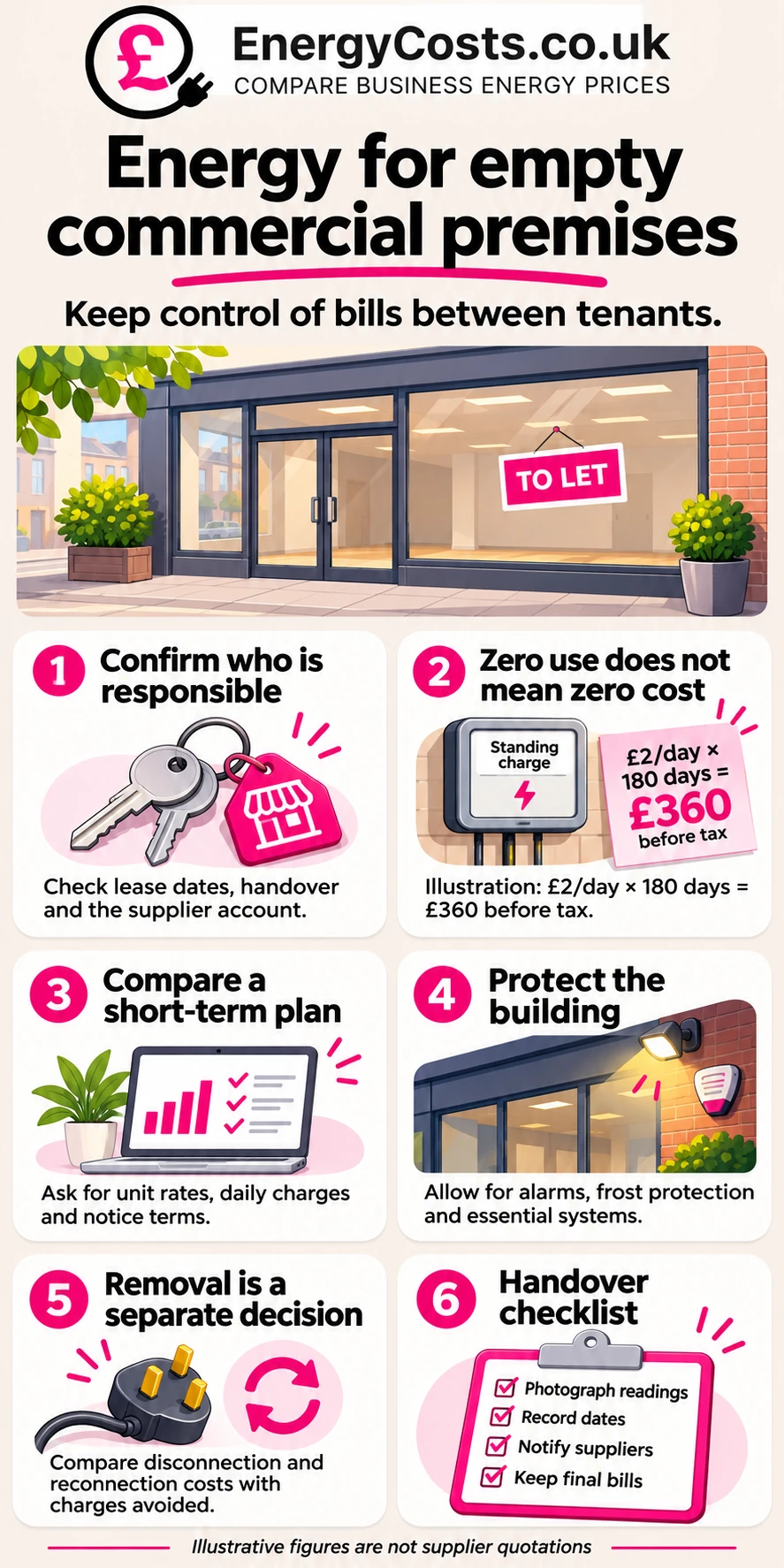
Where the tariff provides for a daily charge, zero consumption does not remove that charge. For an unused meter, the daily amount may be the largest element of the bill. Larger supplies may also retain capacity, metering or other charges.
The following table is an illustration of daily charges only. It excludes consumption, tax and all other fees, and does not represent quotations from any supplier.
| Illustrative standing charge | 30 days | 90 days | 180 days | 365 days |
|---|---|---|---|---|
| 50p/day | £15 | £45 | £90 | £182.50 |
| 100p/day | £30 | £90 | £180 | £365 |
| 200p/day | £60 | £180 | £360 | £730 |
| 500p/day | £150 | £450 | £900 | £1,825 |
For two meters each charging £2 per day, a 180-day vacancy creates £720 of daily charges before any units or tax. Several empty properties can therefore produce a significant portfolio cost even if each site looks insignificant in isolation.
Our guide to business energy with no standing charge explains why a low-use site should compare total charges, rather than assuming a zero-standing-charge product is always available or best.
How much electricity does an empty unit use?
Empty does not necessarily mean electrically inactive. Alarm systems, emergency lighting, security cameras, access controls, communications equipment and frost protection may remain operational. Contractors may also use power during inspections or refurbishment. Identify essential services with a competent person before switching circuits off.
A continuous 100-watt load uses 2.4kWh a day, or 432kWh over 180 days. At an illustrative 30p/kWh, that is £129.60 of consumption. A £2 daily charge adds £360, producing £489.60 before taxes and other charges.
A 2kW heater running for four hours a day across 90 days uses 720kWh. At the same illustrative rate, it adds £216. A thermostat, opening-hours schedule and actual operating conditions determine real use; a heater’s rated power is not proof that it runs continuously.
Take readings at regular intervals and check whether consumption matches the systems you intend to keep on. Unexpected use can indicate equipment left running, a wrongly identified meter or supplies serving another area. Use our energy bill guide to reconcile the meter and account.
Are vacant properties automatically charged deemed rates?
A deemed arrangement can arise where energy is supplied and used without an expressly agreed contract in qualifying circumstances. However, an empty building is not a label that overrides every existing agreement. Establish whether the bill relates to a continuing agreed contract, deemed supply or an out-of-contract arrangement.
Ask the supplier for the applicable terms, start date, rate schedule and legal customer. The deemed rates guidance from British Gas confirms that default supply is distinct from an agreed plan. Our deemed contracts article explains the wider issues.
Do not assume you must accept a multi-year fix to leave an expensive default arrangement. Ask which short-notice plans are available for the expected vacant period.
Which tariff suits a gap between tenants?
There are three practical comparisons: keep the existing eligible agreement, negotiate a rolling plan, or agree a fixed term with clearly understood occupancy and termination provisions. The best answer depends on the expected vacancy and the need to preserve flexibility for the next tenant.
British Gas publishes a 30-day rolling option on its landlord page. Other products may be available after a site-specific assessment. Ask for the unit rate, daily charge, all additional fees and the process when a new occupier takes responsibility. Our short-term business energy guide provides a comparison framework.
| Illustrative 180-day empty-unit comparison | Higher daily charge | Lower daily charge |
|---|---|---|
| Electricity consumption | 432kWh | 432kWh |
| Unit rate | 30p/kWh | 33p/kWh |
| Standing charge | 200p/day | 80p/day |
| Consumption cost | £129.60 | £142.56 |
| Standing-charge cost | £360 | £144 |
| Total before tax and extras | £489.60 | £286.56 |
The lower-daily-charge example saves £203.04 even though its unit rate is 3p higher. It is a worked illustration, not an available offer. Add any extra metering or capacity charges before using the result to decide.
Should you remove the meter or disconnect?
Meter removal, physical network disconnection and ending an account are different actions. Ask which service you are buying, what remains connected, when billing stops and what will be required to restore supply. Removing one item does not establish that every charge disappears.
Consider the property’s alarms, insurance conditions, heating requirements, refurbishment plans and likely tenant demand. Obtain professional advice on building systems and safety where necessary. An inexpensive short-term supply can be preferable to a costly reconnection that delays letting.
For gas-specific steps, see our business gas meter removal guide. For electricity, discuss network work with the appropriate distribution network operator and metering with the supplier.
Calculate the disconnection break-even point
Suppose the combined illustrative cost of removal, subsequent reconnection and associated work is £1,200. If the only avoided charge is £2 a day, the simple break-even period is 600 days, or about 20 months. At £5 a day, it falls to 240 days.
This is only a starting calculation. Include all costs that actually stop, any continuing charges, likely changes in prices and the financial cost of a delayed letting. A future tenant may require a different capacity, so a reconnection estimate should reflect the intended use rather than assuming like-for-like restoration.
| Illustrative combined removal and restoration cost | Avoided charge | Simple break-even |
|---|---|---|
| £600 | £2/day | 300 days |
| £1,200 | £2/day | 600 days |
| £1,200 | £5/day | 240 days |
| £2,000 | £5/day | 400 days |
The table contains decision examples, not published contractor prices. Request written quotations before authorising work.
Check capacity and metering costs at larger sites
A former factory or warehouse can retain a supply designed for much heavier demand than the empty building now needs. Ask the supplier to separate consumption, standing, capacity, metering and pass-through charges. A single daily headline may conceal several different cost components.
Reducing agreed capacity might reduce some charges, but it can also affect the ability to accommodate a new tenant. Establish the technical and contractual consequences before agreeing. Read our maximum demand and import capacity guide and MOP contracts guide.
What if the previous tenant owes money?
Ask the supplier to separate the former occupier’s account from the charges properly attributable to the current customer and period. Provide genuine change-of-occupancy evidence, opening readings and the correct legal entity. Do not assume you must adopt another company’s contract or debt simply to arrange supply.
Equally, a connected business, personal guarantee or disputed continuation of occupation can complicate liability. Obtain advice on the actual documents if the supplier contests the change. Our new business supply guide explains the practical evidence required when taking over premises.
What should landlords record at handover?
- The outgoing and incoming legal entities and their contact details.
- The dates occupation, control and contractual responsibility change.
- Meter serial numbers and the MPAN or MPRN for each supply.
- Clear photographs of every relevant register and reading.
- The equipment remaining connected and any agreed essential loads.
- Notices sent to suppliers and their acknowledgements.
- The tariff and terms applying during the vacant period.
- Final bills, opening bills and any unresolved adjustments.
Keep the records together with the lease or completion paperwork. For multi-unit sites, include a plan showing which meter serves which unit. A submeter is not necessarily a separately switchable supplier account.
VAT and CCL on vacant-property bills
Do not assume that vacancy alone creates a tax exemption. Check the supply’s actual use and the small-supply rules where relevant, including how standing charges are treated. Qualifying electricity and gas can have different current VAT treatment. Our VAT guide and CCL guide explain the checks.
A practical plan for the next vacant period
Before the outgoing tenant leaves, identify the current supplier and collect the documents. On handover, photograph readings and notify responsibility dates. During the vacancy, choose an appropriate tariff, monitor essential consumption and diarise a review. Before the next tenant arrives, agree meter access and the evidence needed for the supplier’s change-of-occupancy process.
This approach turns the energy account into a managed property cost. The largest avoidable mistake is leaving an unfamiliar bill unattended for months while daily charges continue to build.
Frequently asked questions
Yes. Daily charges and any continuing metering or capacity costs can remain payable even with no trading activity. Essential equipment may also consume energy. Check the contract, actual readings and property responsibility dates. Switching off appliances does not by itself terminate the supply agreement or stop every charge.
Landlords often take responsibility during a genuine gap between occupiers, but the contract, occupation and handover arrangements must be checked. A tenant who temporarily closes can remain responsible. Keep lease and surrender evidence, meter readings and supplier correspondence, especially where the account or dates are disputed.
Zero consumption alone does not remove a contractual standing charge. Compare suitable lower-daily-charge products or investigate removal and disconnection if appropriate. Include restoration costs and essential building services in the decision. Ask the supplier to confirm exactly when each charge would stop.
Compare the complete cost of keeping supply with removal, disconnection, restoration and possible letting delays. Consider alarms, frost protection and insurance requirements. Obtain written technical and cost advice before authorising work. A short expected vacancy may make retaining an appropriate tariff more practical.
Some suppliers publish short-notice options suitable for commercial landlords, subject to eligibility and current terms. Obtain a quotation for the actual meter and legal customer. Check daily charges, unit rates, price-change provisions and what happens when a new tenant takes over responsibility.
Ask the supplier to distinguish the former occupier’s charges from your own period and legal account. Provide genuine occupancy evidence and opening readings. Connected entities, guarantees or disputed occupation can complicate matters, so check the actual documents rather than accepting or rejecting liability solely from the address.
Do not assume so. Meter removal, network disconnection and account closure are separate processes. Ask the supplier and network operator which charges cease, what remains connected and what restoration requires. Obtain written confirmation and check the final bill after the work is completed.
Photograph every relevant meter register at each handover and record the meter serial number, date and supply reference. Retain the images with the responsibility documents and send the readings to the supplier. Include communal supplies and confirm which meters serve each unit in a shared building.
Compare business energy prices for the expected vacant period and essential consumption before allowing an empty unit to remain on an unsuitable tariff.