
If your business cannot pay an electricity or gas bill, contact the supplier as early as possible and explain what you can realistically afford. Ask it to check the charges, review payment options and confirm what is needed to prevent further collection action. Waiting for a final notice can reduce the time available to resolve the problem.
A workable arrangement needs to cover ongoing energy as well as overdue amounts. This guide explains how to check the balance, prepare a repayment proposal and respond to a threatened disconnection. It also distinguishes supplier support and good-practice guidance from rights that apply only to particular customers or circumstances.
What to do first if you cannot pay
| Immediate step | Why it matters |
|---|---|
| Contact the supplier using a verified channel | Starts a record of your request for support |
| Check the account holder and responsibility dates | Avoids paying another occupier’s charges |
| Submit accurate meter readings | Helps replace an inflated or outdated estimate |
| Ask for an itemised balance | Separates usage, fees, interest and disputed charges |
| Prepare a short cash-flow forecast | Supports a realistic proposal |
| Identify any notice or hearing date | Shows how urgently action is needed |
| Keep written confirmation | Establishes what the supplier has actually agreed |
Ofgem’s guidance for businesses struggling with bills suggests discussing repayment reviews, payment reductions or breaks, more time and any available hardship support. These are options to ask about; a specific grant, pause or repayment period is not guaranteed for every business.
If the supplier has already issued a disconnection notice, say so at the start of the conversation. Ask which action would stop escalation and by when. A general statement that someone will “look into it” is not the same as written confirmation that a scheduled visit or disconnection has been put on hold.
Check whether the business energy bill is correct
An unaffordable bill can still be accurate, but mistakes need investigating before they become part of a repayment plan. Compare the invoice with your contract, recent readings and payment records. Identify the amount disputed and the reason, rather than treating every charge as wrong because the total is high.
| Possible problem | Check |
|---|---|
| Estimated consumption too high | Current reading against the relevant opening reading |
| Wrong meter or register | Serial number, day/night allocation and meter details |
| Payment missing | Bank reference and supplier allocation |
| Rates do not match the agreement | Contract start date and written unit/standing charges |
| Charges before or after your responsibility | Lease, completion or handover evidence |
| Old previously unbilled consumption | Microbusiness eligibility and back-billing exceptions |
| Unexplained additional costs | Contractual basis and calculation of each fee |
For example, an invoice based on 4,000 kWh at an illustrative 30p/kWh contains £1,200 of energy charges before tax and other items. If the correct consumption for that same period is 2,500 kWh, the equivalent charge is £750: a £450 difference before tax. The supplier needs to validate and correct the reading, rather than simply reducing the payment while leaving the incorrect charge in place.
Use our business energy bill guide to identify the entries. If a correction leaves the account in credit, ask for a reconciliation and review the business energy refund process. A billing complaint and a request for time to pay can run alongside each other.
How business energy payment plans work
A repayment plan spreads arrears over an agreed period. It may sit alongside normal invoices or a separate payment for current consumption. Ask whether the proposed monthly amount includes both, so that paying the plan does not accidentally allow a fresh debt to build up.
Suppose the confirmed arrears are £2,400 and forecast ongoing energy costs are £600 a month. The following illustrative repayment options exclude interest, fees and changes in future consumption. They show the arithmetic; they are not plans that every supplier must offer.
| Assumed repayment period | Monthly arrears payment | Ongoing monthly energy allowance | Total monthly cash needed |
|---|---|---|---|
| 6 months | £400 | £600 | £1,000 |
| 12 months | £200 | £600 | £800 |
| 24 months | £100 | £600 | £700 |
If the business can only afford £650 a month in total, none of these examples is currently workable without another change. That is useful information to give the supplier and an independent adviser. Agreeing £1,000 simply to end a difficult conversation is unlikely to help if the money will not be available.
For seasonal businesses, a flat monthly forecast can be misleading. Check the higher-cost winter months, quieter trading periods and the timing of customer receipts. A review date helps both parties respond if actual consumption or income differs from the assumptions.
What information should you give the supplier?
Prepare the account number, meter details, a short explanation of the difficulty and a cash-flow forecast. Show whether the issue is a temporary delay in receiving money, a billing error or an ongoing gap between income and expenses. The appropriate response can be different in each case.
For example, British Gas business’s payment-support guidance asks customers for the account number, reason for the debt, energy use and evidence that repayments can be met. It explains that plans need to cover outstanding balances and future usage. Other suppliers have their own assessment processes.
Ask for the following points in writing before relying on an agreement:
- The opening arrears balance and any amount still disputed.
- The payment amounts, due dates and method.
- How current consumption will be paid.
- Whether interest, collection costs or other fees continue.
- Whether collection or disconnection action is paused, and on what conditions.
- The review date and what to do if circumstances change.
If you have several meters, establish whether a separate arrangement is needed for each account. Keep a record of the person you spoke to and the reference number, but prioritise the written terms over an informal reassurance.
What if you cannot afford the existing plan?
Contact the supplier before missing a payment where possible. Explain what has changed, provide an updated budget and propose a realistic revision. Ask whether the payment date, period or split between current usage and arrears can be adjusted.
Do not cancel a Direct Debit on the assumption that this ends the contract or removes the balance. It can cause missed-payment action and, under some contracts, loss of a payment-method discount. Discuss alternatives with the supplier and obtain confirmation of any agreed change.
Independent advice is particularly useful where the business cannot cover current energy even before repaying old debt. A longer arrears plan alone does not solve a persistent operating shortfall. Review the wider financial position with an appropriate adviser rather than relying on another payment promise the business cannot meet.
Can a business energy supplier disconnect the premises?
Disconnection for unpaid commercial energy is possible. The applicable process depends on the supply, equipment, contract and circumstances. Do not assume household restrictions or protections apply unchanged to a business-only premises. Conversely, tell the supplier immediately if there is domestic occupation or a shared supply affecting residents.
British Gas business’s published collection process describes reminders, visits, possible warrant action and disconnection as a last resort. It also says a warrant may not be needed for a smart meter. This illustrates why a business should not wait for a physical court-entry process before responding to a serious supply warning.
Ask for the balance, notice, proposed action date and the exact steps needed to prevent interruption. If the bill is disputed, provide the evidence and ask explicitly for the disputed element and associated action to be reviewed. Do not assume that raising a complaint automatically suspends every collection step.
Never interfere with a meter, bypass disconnection equipment or attempt to reconnect the supply yourself. Arrange any restoration through the supplier and appropriately qualified professionals. If work or a safety inspection is required, ask who is responsible and what must happen before the premises can operate again.
What does Ofgem’s debt guidance require?
Ofgem’s non-domestic debt and disconnection guidance, updated in June 2026, sets out good-practice expectations on support, deposits, collection transparency and disconnection-related charges. Ofgem explicitly says the document does not add obligations beyond existing licence conditions.
That distinction matters when making a complaint. You can ask the supplier to explain its approach against the guidance, while identifying any separate licence or contractual breach accurately. Do not describe a suggested practice as an unconditional legal entitlement to a particular repayment term or permanent ban on disconnection.
The June 2026 document also addresses non-domestic supplies serving communal areas of buildings with domestic residents. If that describes the site, tell the supplier how an interruption would affect residents and provide the relevant details. A commercial account label does not make those circumstances irrelevant.
Additional fees and the cost of interruption
Ask for an itemised list of interest, collection charges, warrant-related costs and disconnection or reconnection fees that may apply. There is no single reconnection price suitable for every meter and site. A supplier may also require a deposit or other conditions before supply resumes.
The operational impact can be larger than the account fee. If interruption causes an illustrative £300 a day of lost gross profit for three trading days, the trading impact is £900 before considering spoiled stock, emergency arrangements or reconnection charges. This is a business-continuity example, not a forecast or compensation entitlement.
If supply has already stopped, ask for a written restoration quotation and timetable, including any safety or access requirements. Do not promise customers an immediate reopening until the supplier has confirmed the practical steps and appointment. Keep evidence of losses if you believe the disconnection was made in error and want to raise that issue.
Can switching supplier solve the debt?
A new supplier does not erase an existing balance. Depending on the contract and relevant rules, an old supplier may have grounds to object to a transfer. Ask it to state the reason and what would resolve it. See our guide to blocked business energy switches.
Where a transfer is permitted, compare the future running costs and payment requirements separately from the old debt. A cheaper tariff can help the budget, but a deposit or unsuitable long commitment can create another problem. Our bad-credit business energy guide explains new-account issues, which are different from managing arrears already owed.
Prepayment may be discussed in some cases, but business PAYG availability is limited and top-ups must cover ongoing use as well as any agreed deductions. It is not automatically an affordable solution if the business cannot fund its current consumption.
Is the director personally responsible for the debt?
Start by identifying the legal account holder. A sole trader’s position differs from that of a separate limited company, and a personal guarantee can change an individual’s exposure. National Debtline’s business-debt guidance explains these distinctions for England and Wales. Obtain advice for the applicable jurisdiction and documents.
Moving out, stopping trading or changing a business name does not automatically settle an existing liability. Equally, a new tenant should not simply be charged the previous customer’s arrears. Keep the contract and occupation evidence, and ask the supplier to identify the basis on which it says a particular person or company owes the balance.
If the company cannot pay its debts generally, seek appropriate professional advice about its position. Avoid giving personal commitments or guarantees without understanding their effect. A repayment conversation should accurately identify both the debtor and the person authorised to agree terms.
Where can small businesses get independent help?
Business Debtline provides free, confidential and independent debt support to small businesses and self-employed people, with country-specific information for England, Wales and Scotland. Its budgeting tools can help you prepare for discussions with suppliers and other creditors.
For energy-specific issues, use the Citizens Advice route in Ofgem’s business-bill support guidance. In Northern Ireland, use local consumer and debt-support services because regulation and processes differ from Great Britain.
If you believe the supplier has handled the account incorrectly, use its formal complaints process. Qualifying microbusinesses and small businesses may be able to escalate an unresolved dispute to the Energy Ombudsman after eight weeks or earlier with a deadlock letter, subject to scheme rules. Our microbusiness rights guide covers eligibility.
Reducing the next bill without disrupting the business
Use readings or smart data to identify unnecessary overnight loads, controls left on and equipment running outside trading hours. Prioritise safe changes that preserve refrigeration, security, ventilation and other essential services. Our guide to reducing business energy costs gives practical starting points.
Check grants and support through official sources, but do not base a repayment promise on funding that has not been awarded. Efficiency improvements can help future costs; they do not automatically cancel existing arrears. Keep the immediate payment agreement, billing investigation and longer-term reduction plan clear so each can be followed through.
Frequently asked questions
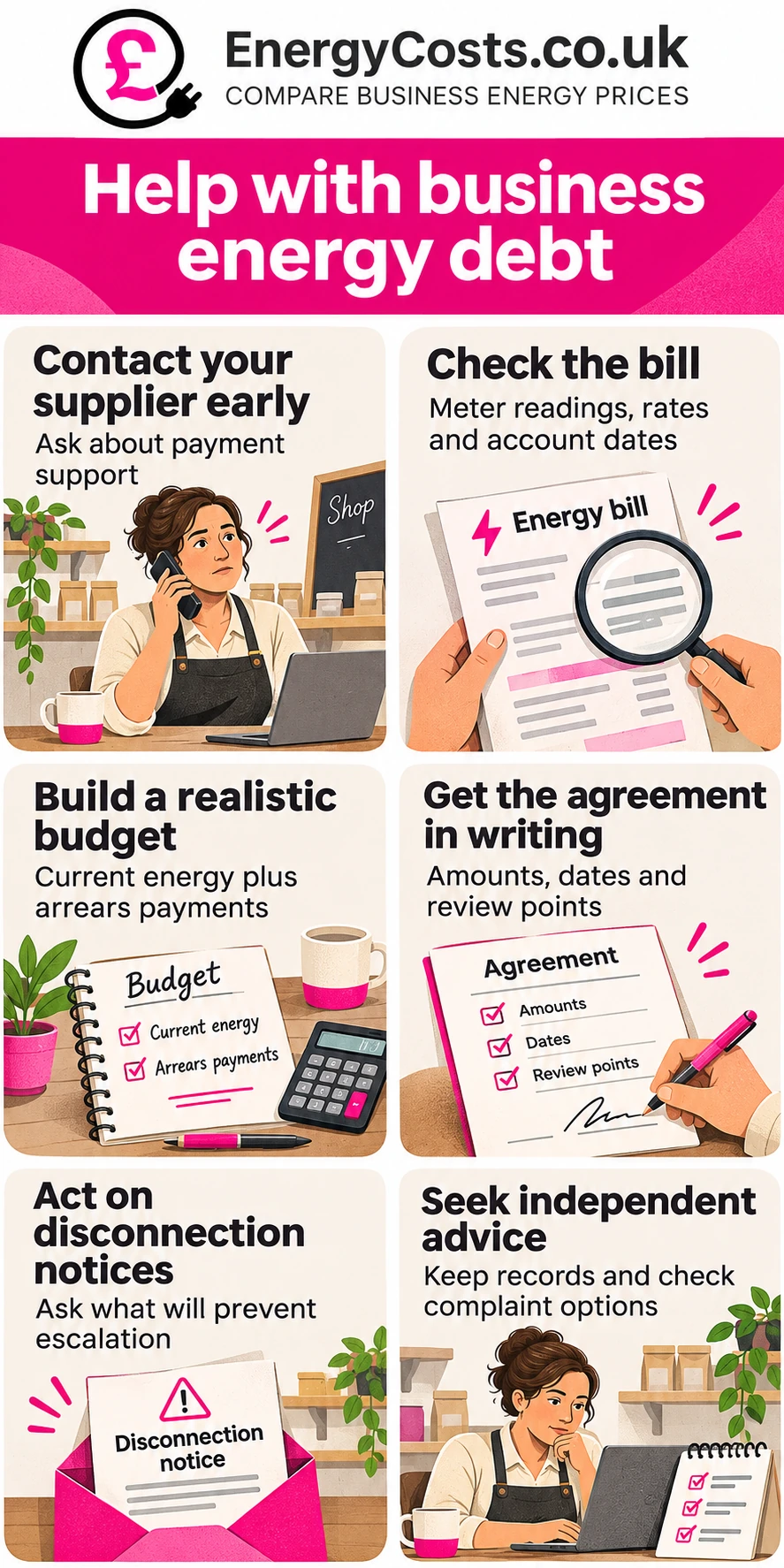
Contact the supplier promptly, explain the problem and ask for the balance and payment options to be reviewed. Submit accurate readings and prepare a realistic budget covering current energy plus arrears. If disconnection is threatened, ask exactly what would prevent escalation and obtain any agreement in writing.
Do not assume a universal repayment period applies to every business. Support depends on the relevant rules, circumstances and supplier assessment. Ofgem publishes good-practice guidance, but it does not itself create additional licence obligations. Ask for an affordable proposal and independent help if you cannot reach agreement.
It might, or current usage may be collected separately. Confirm the arrangement explicitly. A plan that repays arrears while leaving new invoices unpaid can create fresh debt. Check the total monthly cash required, due dates and whether interest, fees or seasonal increases in consumption are included.
Disconnection is possible, subject to the applicable process and circumstances. Respond immediately to notices and ask what action will prevent interruption. Household protections should not automatically be assumed to apply to business-only premises. Tell the supplier if the account also serves homes or communal facilities used by residents.
Do not assume it does. State the disputed amount, supply the evidence and ask explicitly whether collection or disconnection action has been paused. Obtain written confirmation and act on any deadlines. A billing investigation and a request for urgent payment support may both be needed at the same time.
It depends on the contract, debt and applicable transfer rules. An objection may be possible, and switching does not erase an old balance. Ask for the reason for any block and the steps needed to resolve it. Compare future costs separately from arrangements for repaying the existing debt.
The legal account holder, business structure and any personal guarantee matter. A sole trader’s position differs from a separate limited company’s. Do not assume that being a director automatically makes all company arrears personal, or that company status removes every exposure. Get advice using the actual contract and jurisdiction.
Business Debtline offers free, confidential and independent support for small businesses and self-employed people, with country-specific information. Citizens Advice can help with qualifying energy problems. Use the appropriate local services for your jurisdiction and gather bills, readings, payment records and a budget before contacting an adviser.
When the balance and payment plan are under control, compare business energy costs for future supply using realistic consumption, affordable payment terms and an appropriate contract length.