
Ecotricity and British Gas both supply electricity and gas to companies across Britain, but their business energy propositions differ significantly.
Ecotricity is a renewable-focused supplier whose business electricity is sourced entirely from renewable generation. Its wider environmental model involves investing revenue from energy bills in new wind, solar and green-gas projects.
British Gas is one of the country’s largest commercial energy suppliers, serving more than 350,000 businesses. It offers fixed, rolling and flexible contracts, zero-carbon and renewable electricity options, renewable gas, commercial solar, export tariffs, smart-meter analytics and wholesale purchasing services for major users.
A small company seeking a straightforward renewable electricity contract may find Ecotricity’s proposition easier to understand. A larger organisation requiring flexible purchasing, multi-site data, solar installation or a wider selection of gas products may find more options through British Gas.
Neither supplier is universally cheaper. Business tariffs are normally calculated individually according to consumption, meter type, postcode, credit history and contract term.
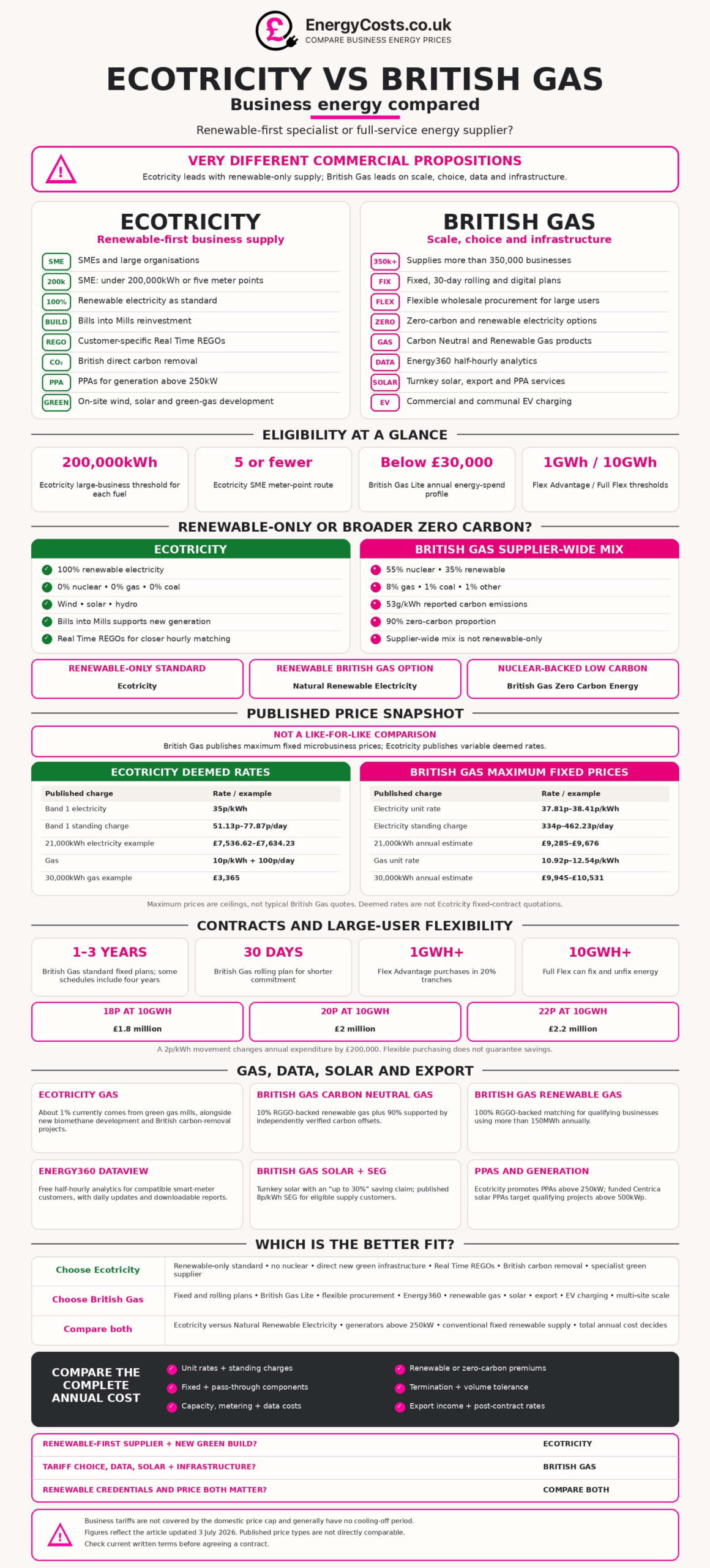
Ecotricity vs British Gas at a glance
| Feature | Ecotricity Business | British Gas Business |
|---|---|---|
| Small-business electricity | Yes | Yes |
| Small-business gas | Yes | Yes |
| Large-business supply | Yes | Yes |
| Published universal contract price | No | No |
| Fixed-price contracts | Available by quotation | Normally one to three years, with some published schedules extending to four years |
| Short rolling contract | No prominent standard SME product | 30-day Rolling Energy Plan |
| Online-only small-business plan | Online quotation and account management | British Gas Lite |
| Flexible wholesale purchasing | Bespoke for larger users | Flex Advantage above 1GWh and Full Flex above 10GWh |
| Standard fixed electricity credentials | 100% renewable | Zero carbon on qualifying fixed plans, using renewables and nuclear |
| Renewable-only electricity | Standard proposition | Optional Natural Renewable Electricity |
| Supplier-wide renewable proportion | 100% | 35% in the 2024/25 fuel mix |
| Nuclear electricity | None in Ecotricity’s disclosed mix | 55% of British Gas’s supplier-wide mix |
| Time-matched renewable reporting | Real Time REGOs | Standard REGO reporting and Energy360 data services |
| Business gas | Sustainable and fossil gas supported by British carbon removal | Conventional, Carbon Neutral and Renewable Gas options |
| Published renewable gas proportion | About 1% of total Ecotricity gas supply currently comes from green gas mills | Carbon Neutral Gas is 10% RGGO-backed; Renewable Gas is 100% RGGO-backed |
| Commercial solar | On-site generation and bespoke support | Turnkey commercial solar services |
| Published solar saving claim | No universal percentage | Up to 30% for suitable installations |
| Business export tariff | Bespoke PPAs for qualifying generators | Published Smart Export Guarantee |
| Published export rate | Not standardised | 8p/kWh for eligible British Gas electricity customers |
| Public PPA threshold | More than 250kW of generation | Fully funded commercial solar PPAs for qualifying projects above 500kWp |
| Smart energy analytics | Consumption information and bespoke reporting | Energy360 DataView |
| Demand-shifting rewards | No directly comparable standard scheme | PeakSave for Business trials |
| Best suited to | Renewable-led SMEs and environmentally focused organisations | Businesses wanting scale, data, flexible procurement and infrastructure services |
Which companies can apply?
Both suppliers serve small companies and larger commercial organisations.
Ecotricity eligibility
Ecotricity defines an SME as a business meeting at least one of the following conditions:
- annual electricity consumption below 200,000kWh;
- annual gas consumption below 200,000kWh; or
- five or fewer meter points.
Companies above these levels can approach its large-business team.
This makes Ecotricity potentially suitable for:
- shops;
- offices;
- cafés and restaurants;
- hotels;
- charities;
- schools;
- workshops;
- warehouses;
- care providers;
- manufacturers; and
- multi-site organisations.
British Gas eligibility
British Gas offers different routes according to the size and complexity of the customer.
British Gas Lite is aimed at smaller companies that:
- spend less than £30,000 a year on energy;
- are prepared to manage the account online;
- pay by monthly Direct Debit; and
- have, or agree to install, a smart meter.
Its standard British Gas Business service covers SMEs and larger companies, including businesses with several premises or half-hourly meters.
Flexible procurement is aimed at larger users:
| British Gas flexible product | Published consumption profile |
|---|---|
| Flex Advantage | More than 1GWh per year |
| Full Flex | More than 10GWh per year |
One gigawatt-hour equals one million kilowatt-hours.
Example eligibility by business type
| Example company | Electricity consumption | Gas consumption | Likely suitable route |
|---|---|---|---|
| Small shop | 12,000kWh | 10,000kWh | Ecotricity SME or British Gas Lite |
| Office | 60,000kWh | 80,000kWh | SME service from either supplier |
| Restaurant | 150,000kWh | 300,000kWh | Ecotricity SME electricity; standard British Gas Business |
| Hotel | 400,000kWh | 1,200,000kWh | Large-business teams |
| Manufacturer | 2,500,000kWh | 4,000,000kWh | Both; British Gas Flex Advantage may be relevant |
| Industrial group | 15GWh | 20GWh | Bespoke large-business service; British Gas Full Flex may be relevant |
Eligibility does not guarantee that either supplier will quote. Credit risk, meter configuration, property use and contractual complexity may also affect acceptance.
Which supplier is cheaper?
No supplier can be declared cheaper without comparing quotations for the same premises.
Business energy prices depend on:
- annual electricity or gas use;
- MPAN or MPRN;
- meter profile;
- half-hourly consumption pattern;
- distribution region;
- residual charging band;
- agreed electricity capacity;
- contract start date;
- contract duration;
- credit rating;
- payment method;
- renewable product selection;
- number of sites; and
- current wholesale prices.
A meaningful comparison should calculate:
- Annual consumption × unit rate
- daily standing charge × 365
- capacity charges
- meter and data costs
- network and policy charges
- renewable product costs
- VAT and Climate Change Levy where applicable
− export income and other credits
A low unit rate may not produce the lowest bill if it is accompanied by a much higher standing charge.
How rate differences affect annual costs
| Annual consumption | Value of 1p/kWh difference | Value of 3p/kWh difference | Value of 5p/kWh difference |
|---|---|---|---|
| 10,000kWh | £100 | £300 | £500 |
| 25,000kWh | £250 | £750 | £1,250 |
| 50,000kWh | £500 | £1,500 | £2,500 |
| 100,000kWh | £1,000 | £3,000 | £5,000 |
| 250,000kWh | £2,500 | £7,500 | £12,500 |
| 1GWh | £10,000 | £30,000 | £50,000 |
| 10GWh | £100,000 | £300,000 | £500,000 |
Standing-charge differences can also accumulate across a multi-site portfolio.
| Daily difference per meter | Annual difference | Difference across ten meters |
|---|---|---|
| 25p | £91.25 | £912.50 |
| 50p | £182.50 | £1,825 |
| £1 | £365 | £3,650 |
| £5 | £1,825 | £18,250 |
| £10 | £3,650 | £36,500 |
British Gas maximum microbusiness prices
British Gas publishes the maximum prices that microbusiness customers may pay when entering or renewing a Fixed Price Energy Plan.
These are price ceilings rather than typical or average quotations. Many businesses may be offered lower rates.
The figures below were stated as current on 27 May 2026 and exclude VAT, Climate Change Levy and other applicable charges.
Single-rate electricity
| Fixed term | Maximum unit rate | Maximum standing charge | Annual standing charge |
|---|---|---|---|
| One year | 38.41p/kWh | 334p per day | £1,219.10 |
| Two years | 37.81p/kWh | 379.96p per day | £1,386.85 |
| Three years | 38.04p/kWh | 428.43p per day | £1,563.77 |
| Four years | 38.04p/kWh | 462.23p per day | £1,687.14 |
British Gas bases its published estimated contract figures on annual electricity consumption of 21,000kWh.
| Fixed term | Estimated annual cost | Estimated full contract cost |
|---|---|---|
| One year | Approximately £9,285 | £9,285 |
| Two years | Approximately £9,327 | £18,654 |
| Three years | Approximately £9,552 | £28,657 |
| Four years | Approximately £9,676 | £38,702 |
The two-year option has the lowest unit rate in this maximum-pricing schedule, but its standing charge is higher than the one-year tariff.
Day-and-night electricity
| Fixed term | Maximum day rate | Maximum night rate | Standing charge |
|---|---|---|---|
| One year | 40p/kWh | 31.76p/kWh | 334p per day |
| Two years | 39.37p/kWh | 31.17p/kWh | 379.96p per day |
| Three years | 39.61p/kWh | 31.42p/kWh | 428.43p per day |
| Four years | 39.61p/kWh | 31.42p/kWh | 462.23p per day |
A two-rate tariff is only beneficial if enough electricity is consumed during the cheaper night period.
For example, using a 39.37p day rate and 31.17p night rate:
| Proportion consumed at night | Weighted average rate |
|---|---|
| 10% | 38.55p/kWh |
| 25% | 37.32p/kWh |
| 50% | 35.27p/kWh |
| 75% | 33.22p/kWh |
The standing charge must still be added to these calculations.
Maximum fixed gas prices
| Fixed term | Maximum unit rate | Maximum standing charge | Annual standing charge |
|---|---|---|---|
| One year | 12.54p/kWh | 1,710.28p per day | £6,242.52 |
| Two years | 11.44p/kWh | 1,784.47p per day | £6,513.32 |
| Three years | 10.92p/kWh | 1,862.57p per day | £6,798.38 |
| Four years | 11.07p/kWh | 1,975.41p per day | £7,210.25 |
British Gas bases the gas example on annual consumption of 30,000kWh.
| Fixed term | Approximate annual cost | Published full contract cost |
|---|---|---|
| One year | £10,005 | £10,005 |
| Two years | £9,945 | £19,891 |
| Three years | £10,074 | £30,223 |
| Four years | £10,531 | £42,125 |
These high figures are maximum pricing limits. They should not be interpreted as British Gas’s normal market quote for every microbusiness.
Ecotricity published deemed prices
Ecotricity does not publish an equivalent maximum fixed-contract table. Negotiated rates require an individual quotation.
It does publish deemed prices for businesses that occupy premises it already supplies without agreeing a contract.
From 1 April 2026, Ecotricity’s non-half-hourly electricity schedule includes:
| Ecotricity category | Unit rate | Daily standing-charge range |
|---|---|---|
| Domestic residual band | 23.80p–26.33p/kWh | 49.63p–75.82p |
| No Residual | 33p/kWh | 51.13p–77.87p |
| Band 1 | 35p/kWh | 51.13p–77.87p |
| Band 2 | 35p/kWh | 86.20p–135.96p |
| Band 3 | 35p/kWh | 152.21p–250.10p |
| Band 4 | 35p/kWh | 375.75p–645.99p |
Prices exclude VAT, Climate Change Levy, government-imposed taxes and government support schemes. Half-hourly sites may also incur capacity, reactive-power, meter-maintenance and data-collection charges.
Ecotricity deemed electricity examples
The following examples use Ecotricity’s 35p/kWh Band 1 price.
| Annual consumption | Consumption charge | Standing-charge range | Total range |
|---|---|---|---|
| 10,000kWh | £3,500 | £186.62–£284.23 | £3,686.62–£3,784.23 |
| 21,000kWh | £7,350 | £186.62–£284.23 | £7,536.62–£7,634.23 |
| 25,000kWh | £8,750 | £186.62–£284.23 | £8,936.62–£9,034.23 |
| 50,000kWh | £17,500 | £186.62–£284.23 | £17,686.62–£17,784.23 |
| 100,000kWh | £35,000 | £186.62–£284.23 | £35,186.62–£35,284.23 |
These are deemed rates, not an indication of the fixed quotation Ecotricity would provide.
They also cannot be directly compared with British Gas’s maximum fixed prices. One table shows variable uncontracted charges, while the other shows the highest price a qualifying microbusiness could pay on a fixed plan.
Ecotricity deemed gas rates
Ecotricity’s deemed gas price from 1 April 2026 is:
| Charge | Published rate |
|---|---|
| Unit rate | 10p/kWh |
| Daily standing charge | 100p |
| Annual standing charge | £365 |
| Annual gas use | Consumption charge | Standing charge | Total |
|---|---|---|---|
| 30,000kWh | £3,000 | £365 | £3,365 |
| 50,000kWh | £5,000 | £365 | £5,365 |
| 100,000kWh | £10,000 | £365 | £10,365 |
| 250,000kWh | £25,000 | £365 | £25,365 |
Again, these prices exclude VAT, CCL and other applicable charges.
Can the published prices identify a winner?
No. The publicly available figures are drawn from different types of tariff:
- British Gas publishes maximum microbusiness fixed-contract prices;
- Ecotricity publishes variable deemed rates;
- British Gas also publishes separate deemed, standard-variable and British Gas Lite variable schedules; and
- both suppliers prepare individual negotiated quotations.
British Gas itself says deemed contracts can cost up to 80% more than fixed plans. A company moving into premises should therefore contact the existing supplier immediately rather than remaining on default rates.
The only reliable test is to request written fixed quotes from both suppliers using identical consumption and contract dates.
British Gas fixed and rolling contracts
British Gas offers several contract structures.
Fixed Price Energy Plan
The standard fixed plan normally provides:
- a fixed unit rate;
- a fixed standing charge;
- one-, two- or three-year terms;
- Direct Debit discounts;
- online account management; and
- advance notification when renewal is due.
Some maximum-price schedules also contain four-year options, so the available terms should be confirmed in the quotation.
A fixed unit rate does not guarantee that the bill remains identical each month. The amount charged still depends on how much energy the company uses.
British Gas Lite
British Gas Lite is a digital-first fixed product for smaller companies.
It includes:
- online account management;
- monthly Direct Debit;
- automatic smart-meter readings;
- webchat support; and
- no conventional telephone customer-service route.
Lite may suit a price-conscious small company comfortable managing everything online. It may be less suitable for a business that wants to discuss complex billing or metering issues by telephone.
British Gas states that Lite is aimed at businesses spending less than £30,000 per year on energy.
Thirty-day rolling plan
The 30-day Rolling Energy Plan provides more flexibility than a long fixed contract.
Rates can rise or fall, but the business is not committed for several years and can normally move to a fixed plan.
This may be useful where:
- the company expects to move premises;
- its future consumption is uncertain;
- it is waiting for wholesale prices to change; or
- it does not want to make a long commitment.
The disadvantage is exposure to rate increases.
British Gas flexible purchasing
British Gas offers more developed wholesale purchasing services than Ecotricity publicly advertises.
Flex Advantage
Flex Advantage is intended for businesses using more than 1GWh annually.
It allows the company to:
- purchase energy in 20% tranches;
- access wholesale market-reflective prices;
- view market data;
- monitor its purchasing position; and
- manage trades through an online portal.
A company could, for example, purchase five separate 20% blocks rather than fixing its entire forecast on one day.
Full Flex
Full Flex is designed for organisations consuming more than 10GWh.
Features include:
- fixing and unfixing energy;
- more flexible trade sizes;
- detailed market data;
- position reporting; and
- support from British Gas’s optimisation specialists.
Flexible purchasing can spread market-timing risk, but it cannot guarantee a lower price.
Consider a company consuming 10GWh:
| Average purchased price | Annual commodity cost |
|---|---|
| 18p/kWh | £1.8 million |
| 20p/kWh | £2 million |
| 22p/kWh | £2.2 million |
A movement of 2p/kWh changes annual expenditure by £200,000.
A flexible contract is therefore most appropriate where the company has a documented risk strategy and people authorised to make purchasing decisions.
Ecotricity business contracts
Ecotricity’s SME proposition is less focused on active wholesale trading.
It emphasises:
- individually quoted prices;
- 100% renewable electricity;
- carbon-neutralised gas;
- straightforward account management;
- assistance with switching; and
- using customer revenue to develop additional green generation.
Larger organisations can request:
- fixed pricing;
- half-hourly supplies;
- multi-site contracts;
- on-site renewable generation;
- Power Purchase Agreements;
- smart-grid support; and
- Real Time REGOs.
Ecotricity may therefore be better suited to a company that wants a conventional renewable supply contract, while British Gas may have an advantage where energy procurement resembles financial risk management.
Comparing renewable electricity
The main environmental distinction is between renewable-only electricity and a broader zero-carbon mix.
Ecotricity electricity
Ecotricity says it supplies 100% renewable electricity generated from sources including:
- onshore wind;
- offshore wind;
- solar; and
- hydroelectric generation.
Its published mix does not include fossil fuels or nuclear power.
Ecotricity also uses customer revenue to support new renewable generation through its Bills into Mills model.
For a company with an environmental policy requiring renewable-only electricity, this provides a relatively simple procurement statement.
British Gas electricity
British Gas offers several levels of environmental backing.
Its supplier-wide fuel mix for 1 April 2024 to 31 March 2025 was:
| Source | British Gas | UK average published alongside it |
|---|---|---|
| Coal | 1% | 6% |
| Natural gas | 8% | 33% |
| Nuclear | 55% | 16% |
| Renewables | 35% | 42% |
| Other | 1% | 3% |
| Carbon emissions | 53g/kWh | 205g/kWh |
| Zero-carbon proportion | 90% | 58% |
British Gas’s supplier-wide mix has a relatively low reported carbon intensity, largely because of its high nuclear proportion.
However, it is not renewable-only.
British Gas product fuel mixes
British Gas’s latest product-level disclosure shows:
| Electricity source | Renewable Energy for Business | Zero Carbon Energy for Business | All other products |
|---|---|---|---|
| Coal | 0% | 0% | 2% |
| Natural gas | 0% | 0% | 13% |
| Nuclear | 0% | 79% | 54% |
| Renewables | 100% | 21% | 30% |
| Other | 0% | 0% | 1% |
| Reported carbon emissions | 0g/kWh | 0g/kWh | 81g/kWh |
| Zero-carbon proportion | 100% | 100% | 84% |
British Gas advertises zero-carbon electricity as standard on qualifying new and renewed fixed-term British Gas Business contracts. This is backed by a combination of renewable certificates and nuclear declarations.
British Gas Lite and non-contracted customers may be excluded from that standard proposition.
Companies requiring renewable-only electricity should select Natural Renewable Electricity rather than relying solely on the term “zero carbon”.
Renewable versus zero carbon
The terms are related but not identical.
Renewable electricity is generated from replenishing sources such as wind, solar and hydro.
Zero-carbon electricity can include renewable generation and nuclear power.
This means:
- Ecotricity’s electricity is renewable and zero carbon under market-based reporting;
- British Gas Natural Renewable Electricity is renewable;
- British Gas Zero Carbon Energy can contain substantial nuclear generation; and
- British Gas’s general fuel mix contains some fossil-fuel generation.
A company should define its requirement before requesting prices.
An organisation seeking to minimise reported Scope 2 emissions may accept either renewable or nuclear-backed zero-carbon electricity. A company whose environmental policy excludes nuclear generation would need a renewable-only product.
Time-matched renewable reporting
Ecotricity offers Real Time REGOs, allowing a business to compare when it consumes electricity with when renewable electricity is generated.
Traditional REGO-backed tariffs normally balance total annual consumption against total renewable generation over the reporting period. They do not necessarily show that renewable generation occurred in the same hour as the company’s demand.
Ecotricity’s service can combine:
- half-hourly consumption;
- renewable generation data;
- REGOs;
- power purchased through Ecotricity’s PPAs; and
- a customer’s own sleeved PPA.
This may be relevant to organisations pursuing:
- 24/7 carbon-free electricity;
- detailed Scope 2 reporting;
- net-zero building standards;
- audited sustainability reports; or
- supply-chain environmental targets.
British Gas provides renewable fuel labels and carbon-reporting support, but its principal data tool focuses on consumption management rather than publicly advertised hourly REGO matching.
Energy360 DataView
British Gas provides Energy360 DataView free to existing business customers with compatible smart meters.
The platform allows users to:
- view half-hourly consumption;
- identify usage trends;
- examine out-of-hours demand;
- access data updated daily;
- download historical information; and
- schedule reports.
This can help identify issues such as:
- equipment left on overnight;
- high weekend consumption;
- inefficient heating schedules;
- avoidable peaks; and
- unexpected changes in site demand.
Ecotricity also provides consumption information to business customers, particularly half-hourly and large users. British Gas nevertheless has the more prominently developed public energy-management platform.
PeakSave for Business
British Gas has run PeakSave for Business promotions that reward eligible smart-meter customers for using electricity during selected lower-demand periods.
The most recent published event ran from 6 May to 10 June 2026. Eligible businesses received half-price electricity between 11am and 4pm on Wednesdays, subject to a maximum £100 credit per smart meter on each event day.
That promotion has ended and should not be treated as a permanent tariff feature.
It nevertheless demonstrates British Gas’s ability to offer smart-meter-based demand incentives. Businesses should check whether a new PeakSave campaign is open when requesting a quote.
Ecotricity does not currently advertise a directly comparable standard SME reward programme.
Comparing business gas
Neither supplier’s ordinary gas service means that every physical unit delivered to the premises is renewable.
Ecotricity gas
Ecotricity states that approximately 1% of the gas it currently supplies comes from green gas mills, with the remainder being fossil gas.
Its environmental approach includes:
- developing biomethane production;
- grass-fed anaerobic digestion;
- British carbon-removal projects;
- enhanced rock weathering; and
- nature-recovery activity.
Ecotricity has moved away from relying entirely on overseas carbon-avoidance credits and now emphasises direct British carbon removal.
The proportion of sustainable gas included in an individual business agreement should be confirmed in the quotation.
British Gas Carbon Neutral Gas
British Gas’s Carbon Neutral Gas product is structured as:
| Component | Proportion |
|---|---|
| Gas backed by UK Renewable Gas Guarantees of Origin | 10% |
| Gas supported by carbon-offsetting projects | 90% |
The 10% renewable element is matched with UK renewable gas. The remaining emissions are balanced using independently verified carbon credits.
Carbon offsetting does not prevent combustion emissions from occurring at the business premises.
British Gas Renewable Gas
British Gas also offers a Renewable Gas product for businesses using more than 150MWh annually.
Under this option, 100% of the customer’s gas consumption is matched with Renewable Gas Guarantees of Origin from UK-produced biomethane.
The physical gas delivered through the network remains mixed with gas from other sources. The RGGOs provide evidence that an equivalent volume of renewable biomethane entered the grid.
Which has the greener gas option?
British Gas provides more clearly defined certificate-backed options:
- 10% RGGO-backed gas plus 90% offsets; or
- 100% RGGO-backed Renewable Gas for qualifying customers.
Ecotricity currently supplies a smaller stated physical green-gas proportion but places more emphasis on developing new gasmills and funding direct carbon removal in Britain.
The stronger option depends on what the business values:
| Priority | Likely stronger fit |
|---|---|
| Published 100% renewable-gas certificate matching | British Gas |
| Clear 10% renewable and 90% offset structure | British Gas |
| Investment in new British green-gas production | Ecotricity |
| British direct carbon removal | Ecotricity |
| Auditable RGGOs for every unit | British Gas Renewable Gas |
| Renewable-only electricity alongside gas | Ecotricity |
Commercial solar
British Gas has the broader turnkey commercial solar proposition.
It says suitable commercial solar installations can reduce electricity costs by up to 30%.
Services can include:
- site assessment;
- system design;
- rooftop or ground-mounted panels;
- installation;
- monitoring;
- maintenance;
- battery integration;
- project finance; and
- export arrangements.
The actual saving depends on:
- roof or land area;
- orientation and shading;
- installation size;
- capital cost;
- daytime electricity demand;
- financing;
- export rate;
- maintenance; and
- future grid electricity prices.
Applying the 30% claim to different annual electricity costs produces:
| Existing electricity expenditure | Illustrative 30% reduction |
|---|---|
| £10,000 | £3,000 |
| £25,000 | £7,500 |
| £50,000 | £15,000 |
| £100,000 | £30,000 |
| £500,000 | £150,000 |
These are mathematical examples, not guaranteed savings.
Ecotricity can support on-site wind and solar generation and arrange purchase agreements for qualifying installations. Its public service is more bespoke and less focused on a standard turnkey SME solar package.
Export tariffs
British Gas publishes a Smart Export Guarantee for businesses.
Its current published supply-customer rate is:
| British Gas SEG feature | Detail |
|---|---|
| Export payment | 8p/kWh |
| Low-capacity category | Below 15kW |
| High-capacity category | Above 15kW |
| Maximum normal SEG capacity | 5MW |
| Micro-CHP limit | 50kW |
| Payment frequency | Every three months |
| Payment timetable | Within 28 days of receiving the export reading |
| Smart meter required | Yes |
Eligible technologies include:
- solar PV;
- wind;
- hydro;
- anaerobic digestion; and
- micro combined heat and power.
At 8p/kWh, indicative export income would be:
| Annual export | Income |
|---|---|
| 5,000kWh | £400 |
| 10,000kWh | £800 |
| 25,000kWh | £2,000 |
| 50,000kWh | £4,000 |
| 100,000kWh | £8,000 |
British Gas also accepts SEG customers whose imported electricity comes from another supplier, although a different non-supply export rate may apply.
Power Purchase Agreements
Ecotricity promotes PPAs for companies generating more than 250kW of renewable electricity on site.
A PPA can provide:
- an agreed export price;
- a route to market;
- certificate management;
- settlement support;
- balancing arrangements; and
- longer-term revenue certainty.
Ecotricity can combine the PPA with its supply service and Real Time REGOs.
British Gas and the wider Centrica group can support large commercial solar and PPA arrangements. Centrica Business Solutions advertises fully funded PPA structures for qualifying solar projects above 500kWp.
British Gas may therefore have an advantage for companies seeking financed large-scale solar, while Ecotricity may appeal to organisations wanting an integrated renewable supply and time-matching arrangement.
EV charging
British Gas promotes commercial and communal EV charging, including solutions for:
- commercial landlords;
- apartment developments;
- shared parking;
- employee charging; and
- business fleets.
Its communal charging service combines equipment, billing and a dedicated energy tariff. British Gas says suitable arrangements may reduce communal charging costs by more than 50%, although results depend on the site and tariff.
Ecotricity developed the Electric Highway public charging network but sold it to GRIDSERVE in 2021. Its current business supply proposition does not offer a directly comparable nationwide commercial EV package.
British Gas is therefore likely to be the stronger option where installation and management of workplace or communal chargers is a priority.
Account management and customer service
Ecotricity
Ecotricity offers:
- an online SME quotation service;
- a dedicated business energy team;
- online account management;
- half-hourly billing support;
- multi-site arrangements; and
- specialist renewable reporting.
Its smaller and more focused proposition may appeal to companies that want a dedicated green supplier.
British Gas
British Gas offers:
- telephone and online service for standard business accounts;
- online-only British Gas Lite;
- smart meters;
- Energy360 DataView;
- multi-site account management;
- metering and new connections;
- flexible purchasing portals; and
- specialist support for major users.
Its scale and range of services may be useful for a national or technically complex business. Smaller Lite customers must be comfortable relying on webchat rather than telephone support.
Contract risks to check
Business energy contracts are not protected by the domestic energy price cap. Most business contracts also have no automatic cooling-off period, including contracts agreed by telephone.
Before accepting either supplier’s offer, check:
- contract start and end dates;
- unit rates;
- standing charges;
- fixed and pass-through elements;
- payment method;
- Direct Debit discounts;
- volume-tolerance provisions;
- early termination costs;
- metering charges;
- capacity charges;
- excess-capacity charges;
- renewable certificate terms;
- security deposits;
- broker commission;
- renewal procedure; and
- post-contract prices.
A quote described as “fixed” may fix the energy rate without fixing every network, regulatory or metering charge.
Ecotricity advantages and disadvantages
Advantages
- Supplies both SMEs and large organisations.
- Business electricity is 100% renewable.
- No nuclear power is included in its disclosed electricity mix.
- Revenue supports new renewable generation through Bills into Mills.
- Provides Real Time REGOs for detailed renewable matching.
- Supports on-site wind and solar generation.
- Offers PPAs for generation above 250kW.
- Invests in British direct carbon-removal projects.
- Develops new green gas production.
- Provides a relatively straightforward environmental proposition.
- Published deemed electricity standing charges can be low for Band 1 supplies.
- Published deemed gas charges are transparent.
Disadvantages
- Negotiated prices are not published.
- Fewer standardised contract choices are described publicly.
- No equivalent to British Gas Lite.
- Less extensive wholesale flex purchasing than British Gas.
- No directly comparable Energy360 platform.
- No prominent permanent demand-shifting reward scheme.
- No standard published SME export tariff.
- Its PPA threshold may exclude small rooftop installations.
- Only about 1% of its current gas supply comes from green gas mills.
- Commercial solar and EV services are less extensively packaged.
British Gas advantages and disadvantages
Advantages
- Supplies more than 350,000 UK businesses.
- Serves companies of every size.
- Offers fixed, rolling and flexible contracts.
- British Gas Lite provides a digital option for small companies.
- Flex Advantage supports users above 1GWh.
- Full Flex serves major users above 10GWh.
- Zero-carbon electricity is included with qualifying fixed contracts.
- A 100% renewable electricity option is available.
- Offers Carbon Neutral Gas and 100% RGGO-backed Renewable Gas.
- Energy360 DataView provides half-hourly analytics.
- Commercial solar, EV charging and export services are available.
- Publishes an 8p/kWh supply-customer SEG rate.
- Can finance qualifying large commercial solar through PPAs.
- Extensive metering and connection services.
Disadvantages
- Standard electricity is not necessarily renewable-only.
- Zero-carbon products can contain substantial nuclear generation.
- Its supplier-wide mix includes gas and coal.
- British Gas Lite provides webchat rather than telephone support.
- Flexible purchasing can expose businesses to wholesale price increases.
- Published maximum microbusiness standing charges are high.
- Maximum gas prices are particularly expensive and should be checked carefully.
- The number of products can make comparison more complicated.
- Some green products require an upgrade or eligibility assessment.
- Offsetting does not eliminate physical gas combustion emissions.
Which supplier is better for different companies?
| Business type or requirement | Likely better fit | Reason |
|---|---|---|
| Small sustainability-led shop | Ecotricity | Straightforward renewable-only electricity |
| Price-focused online SME | British Gas Lite | Digital-first tariff and smart-meter service |
| Business wanting telephone support | Compare standard British Gas and Ecotricity | British Gas Lite is webchat-only |
| Company requiring renewable-only power | Ecotricity or British Gas Natural Renewable | Both can provide renewable-backed electricity |
| Company accepting nuclear electricity | British Gas | Zero-carbon fixed products can include nuclear |
| Business seeking hourly renewable matching | Ecotricity | Real Time REGOs |
| Business using more than 1GWh | British Gas may have an advantage | Flex Advantage |
| Business using more than 10GWh | British Gas may have an advantage | Full Flex |
| Multi-site national organisation | British Gas may have an advantage | Scale, data and portfolio services |
| Company seeking British carbon removal | Ecotricity | Carbon Bank and direct removal investment |
| Company seeking 100% RGGO-backed gas | British Gas | Dedicated Renewable Gas product |
| Business wanting turnkey solar | British Gas | Design, finance, installation and export |
| Rooftop solar exporter | British Gas | Published 8p/kWh SEG rate |
| Generator above 250kW | Compare both | Both can discuss PPAs |
| Solar project above 500kWp | British Gas may have an advantage | Fully funded Centrica PPA option |
| Commercial landlord requiring EV chargers | British Gas | Communal charging package |
| Business with strong anti-nuclear policy | Ecotricity | No nuclear power in its electricity mix |
| Company wanting a smaller specialist supplier | Ecotricity | Renewable-focused business proposition |
Final verdict: Ecotricity vs British Gas
Ecotricity and British Gas can both provide credible business energy contracts, but they are likely to appeal to different organisations.
Ecotricity is likely to be the stronger choice where the main priorities are:
- 100% renewable electricity as standard;
- avoiding nuclear generation;
- directly supporting new renewable infrastructure;
- Real Time REGOs;
- British carbon removal;
- an integrated renewable PPA; and
- using a specialist green supplier.
British Gas is likely to be the stronger choice where the company needs:
- a choice of fixed and rolling contracts;
- an online-only small-business tariff;
- flexible wholesale purchasing;
- half-hourly analytics;
- commercial solar;
- business export payments;
- renewable gas;
- EV charging;
- complex metering; or
- services across a large multi-site portfolio.
The publicly available rates do not provide a fair like-for-like price comparison. British Gas’s numerical table shows maximum fixed-contract prices for microbusinesses, while Ecotricity’s table shows deemed prices for customers without a negotiated agreement.
A business should obtain written quotations from both suppliers and compare:
- the projected annual cost;
- unit rates;
- standing charges;
- fixed and pass-through components;
- contract duration;
- early termination liability;
- renewable or zero-carbon evidence;
- nuclear content;
- gas certificate or offset arrangements;
- metering and data charges;
- solar export income;
- customer-service channels; and
- rates applying after the fixed term ends.
For most companies, the conclusion is:
- choose Ecotricity for a renewable-first contract and direct support for new green infrastructure;
- choose British Gas for broader tariff choice, flexible procurement, smart data, solar, export and EV services;
- compare Ecotricity with British Gas Natural Renewable Electricity where renewable-only credentials are required; and
- avoid deciding from published maximum or deemed prices without obtaining an individual quote.
FAQ
It depends on the individual quotes. British Gas publishes maximum microbusiness prices, while Ecotricity publishes deemed rates. These are different tariff types and cannot determine which supplier will offer the lower negotiated annual cost.
Yes. Ecotricity accepts SME enquiries, while British Gas offers standard business contracts and the online-only British Gas Lite service for companies generally spending below £30,000 a year.
Yes. Both supply larger organisations. British Gas also offers Flex Advantage above 1GWh and Full Flex above 10GWh, while Ecotricity provides bespoke large-business contracts, PPAs and Real Time REGOs.
Not automatically. Its qualifying fixed products are zero carbon, using renewable and nuclear backing. Businesses requiring renewable-only electricity should select its Natural Renewable Electricity option.
Yes. Ecotricity describes its electricity as 100% renewable, sourced from wind, solar and hydro generation. Its disclosed electricity mix contains no gas, coal or nuclear power.
British Gas offers defined 10% and 100% RGGO-backed products. Ecotricity currently obtains about 1% of its gas from green gas mills but invests in new biomethane production and British carbon removal.
British Gas has the stronger public proposition. Flex Advantage is available above 1GWh, while Full Flex is intended for organisations consuming more than 10GWh annually.
British Gas offers a more complete commercial solar package, including installation, financing and an 8p/kWh export tariff. Ecotricity supports on-site generation and PPAs, particularly above 250kW.
British Gas publishes an 8p/kWh Smart Export Guarantee for eligible supply customers. Ecotricity generally negotiates bespoke Power Purchase Agreements rather than advertising one universal business export rate.
British Gas offers Energy360 DataView, providing half-hourly smart-meter graphs and downloadable reports. Ecotricity offers consumption information and stronger time-matched renewable reporting through Real Time REGOs.
Yes. Its standard quotation journey normally offers one-, two- or three-year plans, while published maximum microbusiness schedules also include certain four-year options.
Yes. Ecotricity provides individually quoted contracts for SMEs and large organisations. Companies should confirm which network, metering and policy charges remain fixed.
Most business contracts have no automatic cooling-off period, including agreements made by telephone. Early termination may also generate substantial charges, so obtain and review the written terms first