
Small businesses can still access energy grants and funded support in 2026, but there is no single UK-wide grant that covers every SME. Support is fragmented across national schemes, devolved schemes, local councils, growth hubs, energy suppliers, charities and sector-specific funds.
The short answer is: small businesses may be able to get grants, loans or free support for heat pumps, energy efficiency upgrades, LED lighting, insulation, heating controls, renewable heat, solar PV, energy audits and low-carbon equipment, but eligibility depends heavily on location, sector, building type and whether funding is still open.
Summary answer
| Type of support | Available to small businesses? | Typical support |
|---|---|---|
| Boiler Upgrade Scheme | Yes, in England and Wales for eligible small and medium non-domestic buildings | Up to £7,500 for heat pumps or £5,000 for biomass boilers |
| Business Energy Scotland SME Loan Scheme | Yes, in Scotland | Loans up to £100,000 and cashback grants up to £30,000 |
| Local authority and growth hub grants | Sometimes | Often match-funded grants for energy efficiency, solar, equipment or carbon reduction |
| Invest Northern Ireland energy grants | Sometimes, but some schemes may be paused or restricted | Energy-efficient equipment, renewables, lighting, motors and heating upgrades |
| NISEP business support in Northern Ireland | Yes, through scheme managers where funds remain | Support for energy-saving technologies, including solar PV and heat pumps |
| Supplier hardship or efficiency funds | Sometimes | Payment support, hardship funds or subsidies for efficient equipment |
| Energy Redress Scheme | Not usually ordinary private SMEs | Charities, CICs, co-operatives and community energy groups |
| Industrial Energy Transformation Fund | No longer open to new applicants | Previously supported high-energy-use businesses |
| Free advice and audits | Yes, depending on location | Energy surveys, carbon reduction advice and signposting to grants |
Why energy grants are difficult for small businesses to find
Small business energy grants are not usually delivered through one central national scheme. Instead, they are spread across different organisations.
A business may need to check:
- the UK Government’s grant finder
- Ofgem guidance
- local councils
- local growth hubs
- devolved government schemes
- energy suppliers
- Business Energy Scotland
- Business Wales
- Invest Northern Ireland
- sector bodies
- charities and community energy funds
- local net zero or UK Shared Prosperity Fund programmes
This is why two similar businesses can have very different options. A café in Scotland, a warehouse in Wales, a manufacturer in Northern Ireland and a shop in England may each face different grants, loan schemes and application rules.
Main energy grants and support schemes for small businesses
| Scheme or route | Area | Who it may help | What it can support |
|---|---|---|---|
| Boiler Upgrade Scheme | England and Wales | Property owners with eligible homes or small and medium non-domestic buildings | Heat pumps and biomass boilers |
| Business Energy Scotland SME Loan Scheme | Scotland | SMEs, charities and not-for-profit organisations trading for at least 12 months | Efficiency measures, renewable heat, insulation, glazing, HVAC, LED lighting |
| Local growth hub support | England | SMEs in participating local areas | Grants, advice, energy audits and net zero support |
| Business Wales sustainability support | Wales | Welsh businesses seeking sustainability advice | Green Growth Pledge, consultancy and signposting |
| Green Business Loan Scheme | Wales | Businesses investing in greener operations | Incentivised finance for green investment |
| Invest NI Energy Efficiency Capital Grant | Northern Ireland | Eligible NI businesses, subject to scheme status | Efficient heating, cooling, motors, compressed air, lighting and renewables |
| Northern Ireland Sustainable Energy Programme | Northern Ireland | Businesses and households, depending on scheme | Energy-saving technologies, including heat pumps and solar PV |
| Supplier schemes and hardship funds | UK-wide, supplier-dependent | Businesses struggling with bills or seeking efficiency support | Payment plans, hardship funds, equipment subsidies |
| Energy Redress Scheme | England, Scotland and Wales | Charities, CICs, co-operatives and community energy groups | Projects supporting vulnerable energy users and carbon reduction |
| Hospitality energy tool | England-focused extension | Pubs, restaurants and hotels | Free energy and carbon reduction support |
Boiler Upgrade Scheme
The Boiler Upgrade Scheme is one of the clearest national grant routes for small businesses in England and Wales.
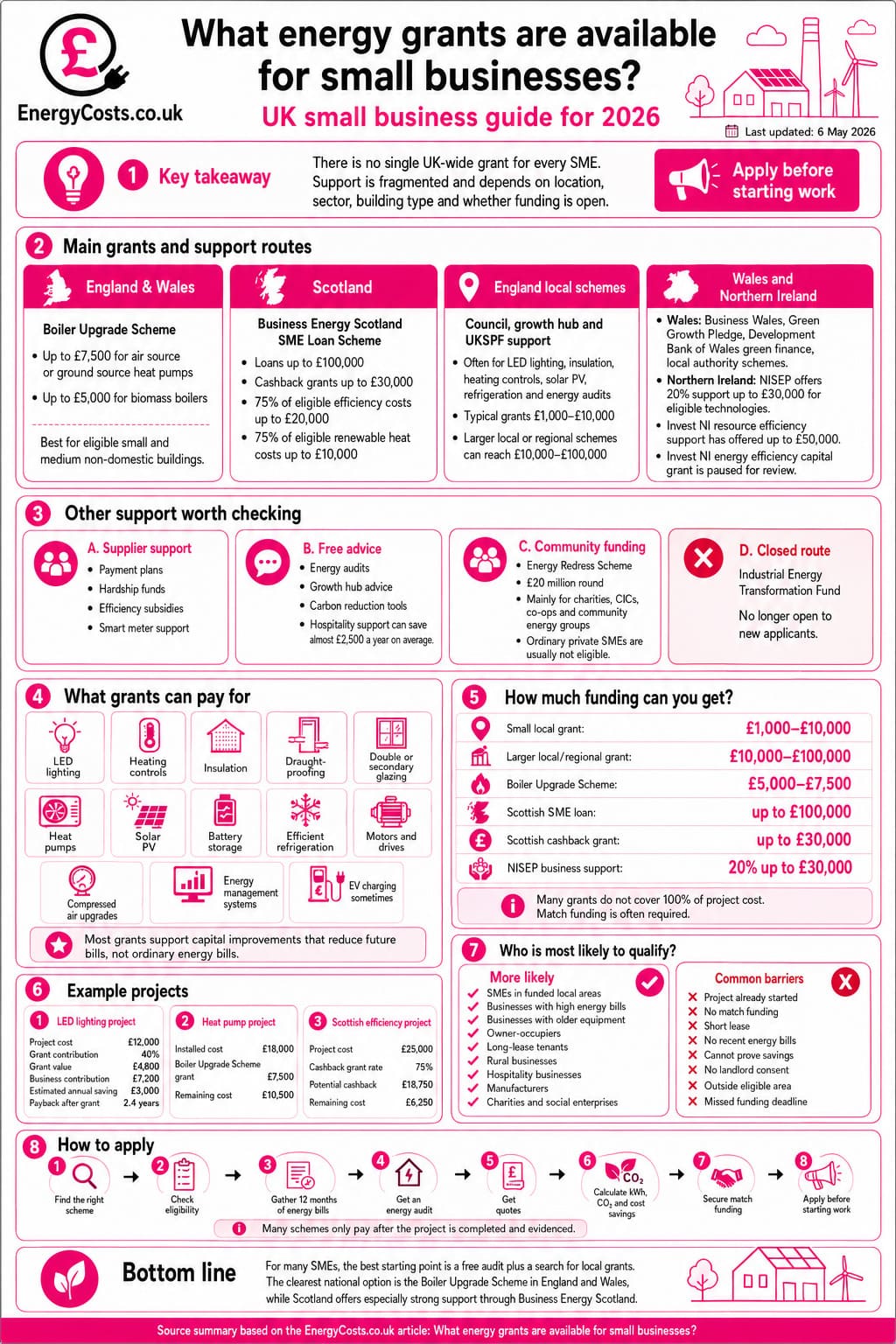
It supports the decarbonisation of homes and small and medium non-domestic buildings. The scheme provides upfront capital grants of up to £7,500 to replace fossil fuel heating with low-carbon heating, including heat pumps and biomass boilers. Current grant values include £7,500 for an air source heat pump, £7,500 for a ground source heat pump and £5,000 for a biomass boiler.
| Measure | Grant available |
|---|---|
| Air source heat pump | £7,500 |
| Ground source heat pump | £7,500 |
| Biomass boiler | £5,000 |
The scheme can apply to a building used for business, but the property must meet eligibility rules. The Government’s grant listing says the property must be a home or small or medium non-domestic building in England or Wales, and that the maximum installation capacity of 45kWth covers the vast majority of these properties. Biomass boilers are only eligible in properties that are both rural and not connected to the gas grid.
Which businesses might use it?
The Boiler Upgrade Scheme may be relevant to:
- small offices
- shops
- cafés
- rural pubs
- guest houses
- small care settings
- clinics
- workshops
- community buildings
- small commercial premises using oil, LPG, gas or electric heating
It is less likely to suit large commercial buildings, industrial sites with high process heat needs, or businesses where the building is too large for the scheme’s capacity limits.
Business Energy Scotland SME Loan Scheme
In Scotland, Business Energy Scotland offers one of the strongest SME energy funding routes.
The SME Loan Scheme offers loans of up to £100,000 to help pay for energy and carbon-saving upgrades. Businesses may also receive cashback grants of up to £30,000. The cashback can include 75% of eligible costs up to £20,000 for energy efficiency measures and 75% of eligible costs up to £10,000 for renewable heat measures such as heat pumps, biomass boilers and solar thermal.
| Support | Amount |
|---|---|
| SME loan | Up to £100,000 |
| Cashback grant for energy efficiency | 75% of eligible costs, up to £20,000 |
| Cashback grant for renewable heat | 75% of eligible costs, up to £10,000 |
| Maximum cashback grant | Up to £30,000 |
Eligible measures include heating, ventilation and air conditioning upgrades, renewable heat technologies, insulation, draught-proofing, double or secondary glazing, LED lighting, solar thermal systems, wind turbines and biomass boilers.
Which Scottish businesses might use it?
The scheme may suit:
- hotels
- care homes
- cafés and restaurants
- small manufacturers
- workshops
- offices
- shops
- farms with eligible business activity
- charities
- not-for-profit organisations
- leisure businesses
The business must normally apply before starting the project, so businesses should not order equipment or begin installation until they have checked the scheme rules.
Local authority and growth hub grants in England
In England, many small business energy grants are local rather than national. They may be run by councils, combined authorities, local enterprise partnerships, growth hubs or UK Shared Prosperity Fund programmes.
The UK Business Climate Hub says local growth hubs in the Business Board Network’s Growth Hub Network provide advice on funding, growth and sustainability across 38 regions in England. It also lists local examples such as carbon advice, business sustainability grants, free energy assessments and match-funded grants in different regions.
Local grants often support:
| Measure | Common grant use |
|---|---|
| LED lighting | Replacing inefficient lighting in shops, warehouses and offices |
| Heating controls | Timers, thermostats, zoning and smart controls |
| Insulation | Roof, wall, pipework and building fabric improvements |
| Solar PV | Rooftop or small ground-mounted installations |
| Battery storage | Often linked to solar or demand reduction |
| Refrigeration upgrades | Efficient chillers, cabinets and cold storage |
| Motors and drives | Variable speed drives and high-efficiency motors |
| Compressed air | Leak reduction, controls and compressor upgrades |
| Energy audits | Professional surveys and carbon reduction plans |
| EV charging | Sometimes included where linked to decarbonisation |
Local grants are usually competitive and time-limited. They may close when funds run out, require match funding, or only apply to businesses in specific council areas.
Business Wales and Welsh funding routes
In Wales, small businesses should usually start with Business Wales, which provides sustainability support and signposting. Business Wales is a government-funded organisation offering specialist sustainability support in regional centres, and it also highlights the Development Bank of Wales Green Business Loan Scheme for businesses looking to invest in going green.
Business Wales also promotes the Green Growth Pledge, which asks businesses to commit to one or more positive actions to reduce their carbon footprint and environmental impact while improving sustainable performance.
Wales-specific options to check
| Route | Best for |
|---|---|
| Business Wales sustainability support | General advice and signposting |
| Green Growth Pledge | Businesses starting a sustainability plan |
| Development Bank of Wales green finance | Businesses needing loan finance for green investment |
| Boiler Upgrade Scheme | Eligible small and medium non-domestic buildings |
| Local authority schemes | Area-specific grants and UKSPF programmes |
| WCVA / voluntary sector funds | Charities and voluntary organisations |
For voluntary organisations in Wales, WCVA’s Energy Efficiency Scheme has offered grants of up to £1,000 towards an energy survey and up to £25,000 towards a maximum of 80% of identified work, although its page states that survey and installation grants are now closed for applications.
Northern Ireland energy grants and support
Northern Ireland has a different energy support landscape from Great Britain. Businesses should check Invest Northern Ireland, the Northern Ireland Sustainable Energy Programme and local scheme managers.
Invest NI’s Energy Efficiency Capital Grant was launched to help Northern Ireland businesses reduce energy costs and build resilience through green efficiency. The scheme supported equipment such as heating and cooling, motors and drives, compressed air, lighting and onsite renewable generation. However, Invest NI states that the scheme is currently paused while it reviews performance and intends to reopen it once a full assessment is complete.
| Invest NI Energy Efficiency Capital Grant | Current position |
|---|---|
| Purpose | Help NI businesses reduce energy costs and emissions |
| Supported measures | Heating, cooling, motors, compressed air, lighting, onsite renewables |
| Current status | Paused for review |
| Likely next step | Sign up for updates and watch for reopening |
Invest NI’s Resource Efficiency Capital Grant has offered grants of up to £50,000 for eligible Invest NI client companies, with support based on company size: up to 10% for large businesses, 20% for medium businesses and 30% for small and micro businesses. The open call listed on the page closed in April 2026, so businesses should check for future rounds rather than assume it is currently available.
The Northern Ireland Sustainable Energy Programme, or NISEP, is also relevant. Action Renewables’ 2026/27 update says NISEP helps homeowners, communities and businesses across Northern Ireland become more energy efficient, with the 2026/27 year running from April 2026 to March 2027 or until funds are allocated. It reports business support offering a 20% grant across energy-saving technologies such as heat pumps, solar PV, solar thermal and boiler replacements, managed by Power NI with support up to £30,000.
Energy supplier grants and hardship funds
Some energy suppliers offer their own support schemes. These are not always advertised as formal “grants”, but they can still help businesses reduce bills or manage arrears.
Ofgem says many energy companies offer schemes or grants to help improve business energy efficiency, such as subsidies for the upfront cost of more energy-efficient equipment. It also says suppliers may offer business hardship funds, payment breaks, reductions, more time to pay or access to hardship funds where a microbusiness is struggling with energy bills.
| Supplier support type | What it may involve |
|---|---|
| Payment plan | Spreading debt over a longer period |
| Payment break | Temporary breathing space |
| Hardship fund | Financial support where available |
| Efficiency subsidy | Help with efficient equipment |
| Smart meter support | Better usage data and fewer estimated bills |
| Account review | Checking whether billing or usage is wrong |
Supplier support is usually case-by-case. It is most relevant if a business is in arrears, struggling with cash flow, or has evidence that energy costs are threatening viability.
Energy Redress Scheme
The Energy Redress Scheme is not normally a grant for ordinary private SMEs buying new equipment for their own premises. It is mainly for charities, community interest companies, co-operative societies, community benefit societies and community energy organisations.
In February 2026, the Energy Redress Scheme opened its fifteenth funding round with £20 million available for charities and community energy groups across England, Scotland and Wales. Eligible projects included support for households most at risk of cold homes and high energy bills, innovative domestic energy products and services, and carbon reduction projects.
| Organisation type | Likely relevance |
|---|---|
| Private SME | Usually not eligible |
| Charity | Potentially eligible |
| Community interest company | Potentially eligible |
| Co-operative society | Potentially eligible |
| Community benefit society | Potentially eligible |
| Community energy group | Potentially eligible |
This can be relevant for social enterprises, local energy groups, charities, community buildings and organisations supporting vulnerable energy users.
Industrial Energy Transformation Fund
The Industrial Energy Transformation Fund was a major grant scheme for high-energy-use businesses, but it is no longer open to new applicants.
The Government says the IETF supported the development and deployment of technologies helping high-energy-use businesses transition to a low-carbon future. However, following the Spending Review, it decided there would be no further extension of the IETF and no successor fund is planned. Existing successful projects remain funded.
This matters because some businesses may still find old references to the IETF online. As of 2026, it should not be treated as an open grant route for new applications.
Free energy advice and audit support
Not all useful support comes as a cash grant. Free advice, energy audits and funded tools can still reduce bills.
Ofgem’s business grants guide points businesses towards free independent energy advice from the National Energy Foundation and resources from the Energy Saving Trust.
For hospitality businesses, the Government announced in March 2026 that more than 525 small and medium-sized pubs, restaurants and hotels would receive free support through an energy and carbon reduction tool. The announcement said businesses were estimated to cut energy bills by almost £2,500 per year on average, following a trial where some operators cut overnight energy use by 66%.
| Free support | Potential value |
|---|---|
| Energy audit | Identifies waste and grant-ready projects |
| Carbon reduction tool | Helps prioritise low-cost savings |
| Smart meter data review | Reduces estimated billing and finds unusual usage |
| Local growth hub advice | Signposts funding and suppliers |
| Sector-specific advice | Gives practical measures for hospitality, retail, offices or manufacturing |
| Supplier review | May identify tariff or billing problems |
For many SMEs, a free audit is the best first step because it creates the evidence needed for a grant application.
What can small business energy grants pay for?
Most energy grants do not pay ordinary energy bills. They usually help with capital improvements that reduce future bills.
| Upgrade | Why funders support it |
|---|---|
| LED lighting | Fast payback and lower electricity use |
| Heating controls | Reduces wasted heating |
| Insulation | Cuts heat loss |
| Draught-proofing | Low-cost reduction in heating demand |
| Double or secondary glazing | Improves building fabric |
| Efficient boilers | Reduces fuel use where low-carbon alternatives are not viable |
| Heat pumps | Replaces fossil fuel heating |
| Solar PV | Generates electricity on site |
| Solar thermal | Supports hot water demand |
| Battery storage | Stores solar electricity and reduces peak import |
| Efficient refrigeration | Cuts a major electricity load |
| Motors and drives | Reduces industrial electricity demand |
| Compressed air upgrades | Cuts leakage and compressor losses |
| Building energy management systems | Improves monitoring and control |
| EV charging | Sometimes funded as part of wider decarbonisation |
The strongest applications usually show a clear saving in kWh, carbon and annual cost.
Which businesses are most likely to qualify?
Eligibility varies, but the following types of businesses often have a better chance of finding support:
| Business type | Why it may qualify |
|---|---|
| SMEs in funded local authority areas | Local grants are often SME-focused |
| Businesses with high energy bills | Savings case is easier to prove |
| Businesses with older equipment | Payback and carbon savings may be stronger |
| Owner-occupiers | Easier to approve building upgrades |
| Long-lease tenants | More likely to meet property control rules |
| Rural businesses | May qualify for heat pump, biomass or local schemes |
| Hospitality businesses | Often targeted due to high energy costs |
| Manufacturers | May qualify for efficiency, resource or industrial support |
| Charities and social enterprises | May access community or voluntary sector funds |
| Community energy groups | May access Energy Redress or local funds |
Businesses that rent premises on short leases may find grants harder to access because funders often want proof that improvements will remain in place long enough to deliver savings.
Which businesses may struggle to get grants?
A business may struggle if it:
- has already started the project
- cannot provide match funding
- has a short lease
- has poor credit or unpaid taxes
- does not have recent energy bills
- cannot prove energy savings
- wants to replace like-for-like equipment without efficiency gains
- is outside the eligible council area
- is applying after funds have closed
- cannot provide quotes
- is not registered for business rates at the site
- does not have landlord consent
- is a home-based business where the scheme excludes home premises
Many grants are reimbursement-based, meaning the business pays first and claims the grant back later. This can create a cash-flow problem for smaller firms.
How much funding can small businesses get?
The amount varies widely.
| Scheme type | Typical support range |
|---|---|
| Small local energy grant | £1,000–£10,000 |
| Larger local or regional grant | £10,000–£100,000 |
| Boiler Upgrade Scheme | £5,000–£7,500 |
| Scottish SME Loan Scheme | Loans up to £100,000 |
| Scottish cashback grant | Up to £30,000 |
| Northern Ireland business schemes | Often partial grants or capped support |
| Community or charity schemes | Can be much larger, but usually not for ordinary SMEs |
A useful rule of thumb is that grants rarely cover 100% of a commercial project. Many require the business to pay a share of the cost.
Example: LED lighting grant
A small warehouse wants to replace old fluorescent lighting with LEDs.
| Item | Example figure |
|---|---|
| Project cost | £12,000 |
| Grant contribution | 40% |
| Grant value | £4,800 |
| Business contribution | £7,200 |
| Estimated annual saving | £3,000 |
| Payback after grant | 2.4 years |
This kind of project is attractive to funders because the saving is easy to understand, installation is relatively simple, and payback can be quick.
Example: heat pump grant
A small commercial property in England or Wales replaces an oil boiler with an eligible air source heat pump.
| Item | Example figure |
|---|---|
| Installed cost | £18,000 |
| Boiler Upgrade Scheme grant | £7,500 |
| Remaining cost | £10,500 |
This does not prove that a heat pump will always reduce bills. Running costs depend on the building, insulation, heat pump efficiency, electricity price and previous fuel cost. The grant reduces upfront cost but does not remove the need for a proper heat-loss assessment and quote.
Example: Scottish SME energy efficiency project
A Scottish SME installs eligible energy efficiency measures costing £25,000.
| Item | Example figure |
|---|---|
| Project cost | £25,000 |
| Cashback grant rate | 75% |
| Cashback grant cap for efficiency measures | £20,000 |
| Potential cashback | £18,750 |
| Remaining project cost | £6,250 |
This simplified example is based on Business Energy Scotland’s stated cashback structure. Actual eligibility depends on the scheme rules, approved measures and application process.
Are there grants to pay business energy bills?
Usually, energy grants for businesses are designed to reduce future energy use rather than pay current bills.
However, businesses struggling with arrears may be able to ask their supplier for payment support, hardship funds, payment breaks, reduced repayments or more time to pay. Ofgem advises businesses to contact their supplier as soon as possible if they are worried about paying their business energy bills.
| Need | Where to look |
|---|---|
| Help paying arrears | Supplier hardship fund or payment plan |
| Help reducing future bills | Energy efficiency grants |
| Help buying equipment | Local grants, devolved schemes, loans |
| Help with disputes | Supplier complaints process, Citizens Advice, Energy Ombudsman routes |
| Help understanding options | Ofgem, growth hubs, Business Energy Scotland, Business Wales, Invest NI |
How to apply for a small business energy grant
Most applications follow a similar process.
| Step | What to do |
|---|---|
| 1. Find the right scheme | Search by location, sector and project type |
| 2. Check eligibility | Confirm business size, premises, lease, sector and project rules |
| 3. Gather energy bills | Many schemes ask for 12 months of electricity or gas bills |
| 4. Get an energy audit | Some grants require a survey or recommendations |
| 5. Get quotes | Funders often require one to three supplier quotes |
| 6. Calculate savings | Estimate kWh, CO2 and annual cost savings |
| 7. Secure match funding | Confirm how the business will pay its share |
| 8. Apply before starting | Starting work early can invalidate applications |
| 9. Wait for approval | Do not order equipment until approved |
| 10. Complete and claim | Many grants pay after evidence of completion |
Invest NI’s Energy Efficiency Capital Grant eligibility criteria show the kind of information funders may request, including 12 months of energy bills, two years of financial accounts, evidence that the business has funds to cover a reimbursement grant and proof of business rates registration for the project premises.
Documents businesses may need
| Document | Why it may be needed |
|---|---|
| Recent energy bills | Proves baseline consumption |
| Meter readings or half-hourly data | Shows when and how energy is used |
| Equipment quotes | Confirms project cost |
| Energy audit | Demonstrates recommended measures |
| Lease or title documents | Proves site control |
| Landlord consent | Required for rented premises |
| Business rates evidence | Confirms commercial premises |
| Accounts | Shows financial viability |
| Carbon saving estimate | Supports net zero case |
| Project plan | Explains timing and delivery |
| Supplier specification | Shows the equipment meets rules |
| Match funding evidence | Shows the business can pay its share |
The more evidence a business has, the easier it is to submit a credible application.
Common mistakes when applying
| Mistake | Why it causes problems |
|---|---|
| Starting work before approval | Many schemes will reject retrospective applications |
| Applying to the wrong scheme | Eligibility is often location-specific |
| Missing match funding | Grants rarely cover the full project cost |
| Weak savings evidence | Funders want measurable energy and carbon reductions |
| No landlord consent | Rented premises often require written approval |
| Poor quotes | Funders may reject vague or non-compliant quotes |
| Ignoring VAT treatment | The business may need to fund VAT upfront |
| Missing deadlines | Funds often close quickly |
| Assuming “green” means eligible | The project must match the scheme rules |
| Not checking state subsidy rules | Some grant aid is limited by subsidy control rules |
Best projects to apply for first
For most small businesses, the best first projects are those with clear savings, low disruption and short payback.
| Priority | Project | Why it works |
|---|---|---|
| 1 | LED lighting | Simple, measurable, often quick payback |
| 2 | Heating controls | Low cost and strong savings potential |
| 3 | Insulation and draught-proofing | Reduces heating demand |
| 4 | Refrigeration upgrades | Strong for food retail and hospitality |
| 5 | Motors and variable speed drives | Strong for manufacturing and workshops |
| 6 | Compressed air improvements | Often high savings in industrial sites |
| 7 | Solar PV | Larger investment but long-term savings |
| 8 | Heat pumps | Strong decarbonisation benefit where suitable |
| 9 | Battery storage | Useful with solar or peak-demand issues |
| 10 | Energy management systems | Helps larger sites control demand |
A grant application is usually stronger if it is based on an audit rather than a guess.
Final verdict
Small business energy grants are available in 2026, but the right option depends on where the business is based and what it wants to install.
For many SMEs in England and Wales, the clearest national grant is the Boiler Upgrade Scheme, which can provide up to £7,500 towards eligible heat pumps and £5,000 towards biomass boilers. In Scotland, the Business Energy Scotland SME Loan Scheme is especially important because it offers loans up to £100,000 and cashback grants up to £30,000. In Northern Ireland, businesses should check NISEP and Invest NI, although some Invest NI schemes may be paused, restricted or between application rounds.
For many businesses, the best route is local. Councils, growth hubs and UKSPF-funded programmes often provide the most relevant grants for lighting, insulation, solar panels, audits and energy-saving equipment. These schemes can open and close quickly, so businesses should check local availability before planning a project.
The most important rule is to apply before starting work. Many schemes will not fund projects that have already been ordered, installed or paid for.
FAQ
Yes. Small businesses may be able to access energy grants, loans or free support through national schemes, devolved schemes, local authorities, growth hubs, energy suppliers and sector-specific programmes.
There is no single universal UK-wide grant for every small business. Support varies by location, sector, building type and project.
Yes, some can. The Boiler Upgrade Scheme supports eligible homes and small and medium non-domestic buildings in England and Wales, with grants of up to £7,500 for eligible heat pumps.
Sometimes. Solar PV is often supported by local authority, growth hub, Northern Ireland or devolved schemes, but availability depends on location and funding rounds. Some businesses may also use solar PPAs instead of grants.
Business Energy Scotland offers SME loans up to £100,000 and cashback grants up to £30,000 for eligible energy efficiency and renewable heat projects.
Welsh businesses should check Business Wales, the Green Growth Pledge, the Development Bank of Wales Green Business Loan Scheme, local authority schemes and the Boiler Upgrade Scheme for eligible buildings.
Northern Ireland businesses should check Invest NI, NISEP and local scheme managers. Invest NI’s Energy Efficiency Capital Grant is currently paused, while NISEP’s 2026/27 programme includes business support through scheme managers where funds remain.
Usually not. Most energy grants fund improvements that reduce future consumption. Businesses struggling with current bills should contact their supplier about payment plans, hardship funds or other support.
Usually no. Many grant schemes require approval before work starts. Ordering or installing equipment before approval can make the project ineligible.
Gather 12 months of energy bills, check local funding, ask for an energy audit and identify projects with clear savings, such as LED lighting, controls, insulation, refrigeration upgrades, solar PV or heating improvements.