

DUoS stands for Distribution Use of System. It is a charge that helps pay for the local electricity distribution network that delivers electricity to homes and businesses.
For businesses, DUoS matters because it is one of the network charges included in business electricity prices. It can affect the unit rate, standing charge, capacity charges and pass-through costs on a commercial electricity contract.
The short answer is: DUoS is the cost of using the local electricity network between the national transmission system and your business premises.
Summary answer
| Question | Answer |
|---|---|
| What does DUoS stand for? | Distribution Use of System |
| What does DUoS pay for? | Local electricity cables, substations, transformers and distribution network maintenance |
| Is DUoS an electricity or gas charge? | Electricity only |
| Is DUoS the same as TNUoS? | No. TNUoS covers the national high-voltage transmission system; DUoS covers local distribution networks |
| Who charges DUoS? | Distribution Network Operators charge suppliers, and suppliers recover the cost from customers |
| Can DUoS appear separately on a bill? | Yes, especially for larger or half-hourly metered businesses |
| Do small businesses pay DUoS? | Yes, but it is usually bundled into the unit rate or standing charge |
| Can businesses avoid DUoS completely? | Usually no, but they may reduce exposure by using less grid electricity, reducing peak demand or changing usage patterns |
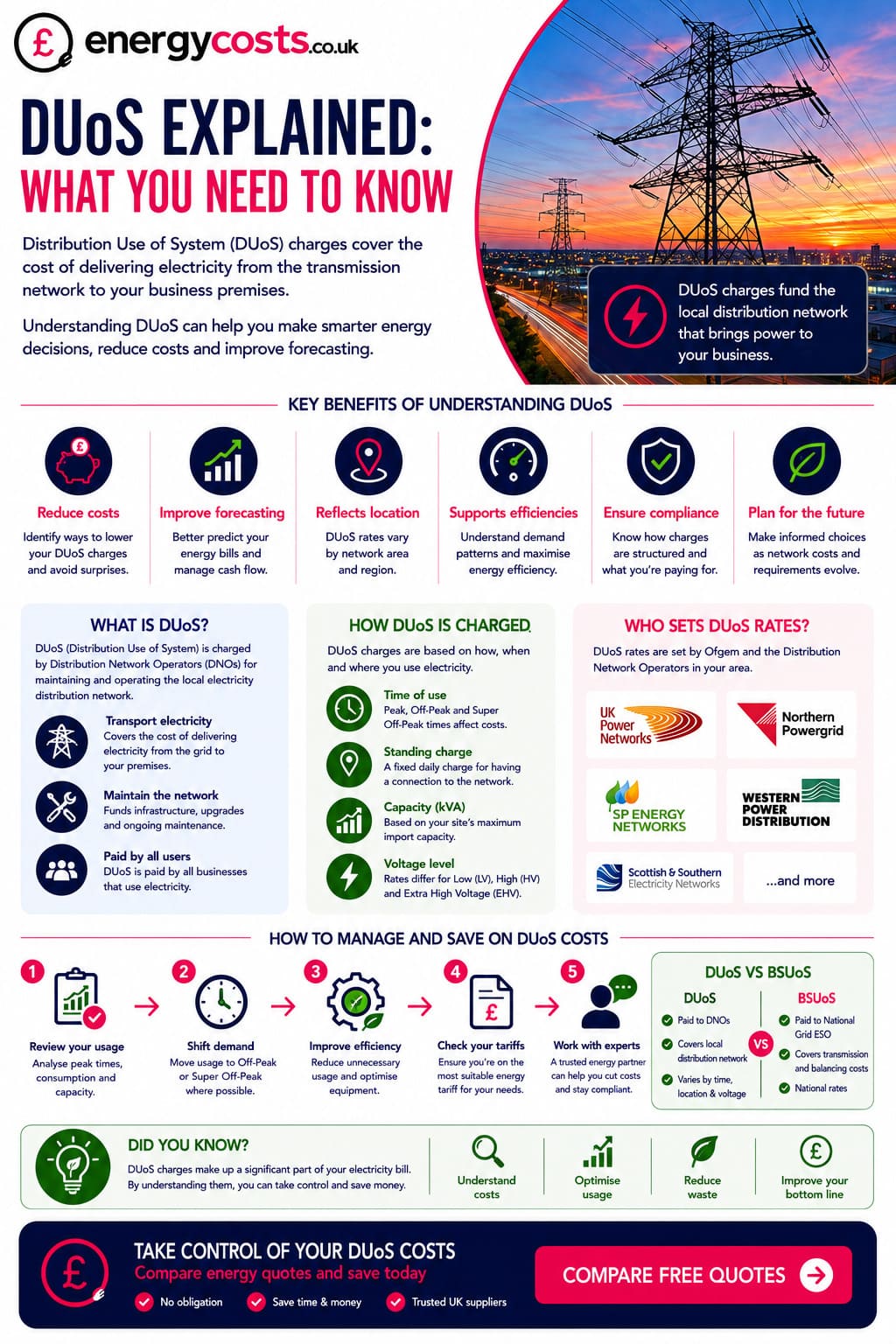
What does DUoS pay for?
DUoS pays for the local electricity distribution network. This is the infrastructure that takes electricity from the wider grid and delivers it to individual premises.
It helps pay for:
- local electricity cables
- substations
- transformers
- network maintenance
- fault repair and resilience
- distribution network upgrades
- local reinforcement for new demand
- network operation and administration
- investment needed for electrification, EV charging, heat pumps and business growth
National Grid Electricity Distribution says DUoS charges cover its costs of maintaining the distribution networks that supply electricity. Ofgem also explains that network companies charge suppliers an Ofgem-regulated price for using energy networks, with the money used for maintaining, running and upgrading those networks.
DUoS versus TNUoS
DUoS is often mentioned alongside TNUoS, but they are not the same thing.
| Charge | Full name | What it covers | Simple comparison |
|---|---|---|---|
| TNUoS | Transmission Network Use of System | The national high-voltage transmission system | Electricity motorways |
| DUoS | Distribution Use of System | Local and regional electricity networks | Local roads |
| BSUoS | Balancing Services Use of System | Real-time system balancing | Traffic control |
A simple way to understand it is this: TNUoS pays for moving electricity around Great Britain at high voltage, while DUoS pays for the local network that gets electricity to your premises.
NESO explains that TNUoS charges recover the cost of installing and maintaining the transmission system, while BSUoS recovers the day-to-day cost of operating the transmission system. DUoS is separate from those transmission charges because it relates to local distribution networks rather than the national transmission system.
Why DUoS affects business electricity bills
DUoS affects business electricity bills because the cost is recovered from electricity customers. Your supplier pays network charges and then includes those costs in the price it charges you.
Depending on your contract, DUoS may appear as:
| How DUoS may appear | What it means |
|---|---|
| Included in the unit rate | The supplier builds DUoS into your p/kWh electricity price |
| Included in the standing charge | Some fixed distribution costs are recovered through a daily charge |
| Shown as a separate pass-through item | Larger businesses may see DUoS itemised |
| Included in capacity charges | Larger sites may pay charges linked to agreed supply capacity |
| Reconciled later | Some contracts adjust DUoS costs after actual charges are known |
For many SMEs, DUoS is invisible. A small shop, café, office or salon may never see the term on a bill, but the charge is still part of the electricity price.
Why DUoS is a non-commodity charge
DUoS is a non-commodity charge. This means it is not the wholesale cost of the electricity itself.
A business electricity bill is usually made up of:
| Bill component | What it means |
|---|---|
| Wholesale electricity | The cost of buying the electricity |
| Network charges | TNUoS and DUoS |
| Balancing charges | BSUoS and related system costs |
| Policy costs | RO, FiT, CfD, Capacity Market and other schemes |
| Supplier costs | Billing, admin, customer service and margin |
| Broker costs | Commission or fees, where applicable |
| Taxes | VAT and Climate Change Levy |
This distinction matters because DUoS can rise or fall independently of wholesale electricity prices. A business might hear that wholesale power prices have softened, but still receive a higher bill because network, policy or balancing costs have increased.
Ofgem says network costs vary year to year, including to reflect usage and how costs need to be allocated across different parts of the network.
Who sets DUoS charges?
DUoS charges are set by Distribution Network Operators, often called DNOs. These are the companies responsible for operating the regional electricity distribution networks.
Your business does not usually choose its DNO. It depends on where the premises are located. You can choose your electricity supplier, but the local network operator is determined by region.
This is why DUoS can vary across the country. A business in London, Scotland, Wales, the Midlands, Yorkshire or the South West may face different distribution network charges, even if its electricity use is similar.
Why DUoS varies by region
DUoS varies because local distribution networks have different costs. Some areas need more investment, some have more rural networks, some have more urban demand, and some face different pressures from new connections, EV charging, renewable generation and electrification.
| Factor | Why it affects DUoS |
|---|---|
| Region | Each distribution area has different network costs |
| Voltage level | Larger sites connected at higher voltages may be charged differently |
| Meter type | Half-hourly and non-half-hourly sites can be treated differently |
| Time of use | Some DUoS charges vary by red, amber and green time bands |
| Agreed capacity | Larger sites may pay capacity-related charges |
| Consumption profile | When a business uses electricity can affect charges |
| Network investment | Reinforcement and maintenance costs vary by region |
This means two businesses using 100,000kWh per year may not have identical network cost exposure.
Red, amber and green DUoS time bands
For some business electricity users, DUoS unit charges are linked to time bands. These are often described as red, amber and green periods.
| Band | Typical meaning | Cost level |
|---|---|---|
| Red | Peak demand periods | Highest |
| Amber | Mid-demand periods | Medium |
| Green | Lower-demand periods, often nights and weekends | Lowest |
The exact time bands vary by distribution region and tariff type. Supplier guidance commonly describes red periods as weekday peak periods, with green periods generally linked to lower-demand times such as late evenings, nights and weekends.
For businesses with flexible electricity use, this can matter. Moving energy-intensive activity away from high-cost periods can sometimes reduce DUoS exposure, although this depends on the tariff and whether the supplier passes these signals through clearly.
Example: why DUoS time bands matter
A business uses 10,000kWh per month.
| Usage pattern | Red band use | Amber band use | Green band use | Likely DUoS impact |
|---|---|---|---|---|
| Office-heavy daytime use | Low | High | Low | Medium |
| Restaurant evening peak | High | Medium | Low | Higher |
| Cold storage 24/7 | Medium | Medium | High | Mixed |
| Warehouse with night operations | Low | Medium | High | Lower |
| Factory shifting load overnight | Low | Medium | High | Potentially lower |
This is illustrative. The actual saving depends on the business’s meter, region, supply contract and how the supplier applies DUoS charges.
DUoS and standing charges
DUoS can affect business standing charges because some distribution network costs are fixed or capacity-related rather than purely linked to electricity consumption.
This is why a business can reduce its kWh usage but still have a high bill. If the daily standing charge, fixed network charges or capacity charges are high, cutting usage does not remove all costs.
| Situation | Why DUoS may still matter |
|---|---|
| Business uses little electricity | Fixed daily charges still apply |
| Business has large supply capacity | Capacity-related charges may remain high |
| Business has reduced opening hours | Standing charges continue every day |
| Business has moved to more efficient equipment | Unit costs fall, but fixed costs remain |
| Business is on a pass-through contract | DUoS changes may be passed through separately |
Low-usage businesses should compare the total annual cost of a contract, not just the unit rate.
DUoS and agreed supply capacity
Larger businesses may have an agreed supply capacity, usually measured in kVA. This is the level of electricity capacity reserved for the site.
If a business has more capacity than it needs, it may be paying unnecessarily high capacity-related charges. If it has too little capacity, it may face excess capacity charges or operational problems.
Businesses where this can matter include:
- manufacturers
- warehouses
- cold stores
- hotels
- leisure centres
- farms
- care homes
- large offices
- food production sites
- EV charging depots
- multi-site retail operations
A capacity review can sometimes reduce costs, but it should be handled carefully. Reducing capacity too far can create extra charges or limit future expansion.
DUoS and half-hourly meters
DUoS is often more visible for businesses with half-hourly meters. These meters record electricity use every 30 minutes, which allows suppliers and network operators to understand when electricity is being used.
Half-hourly data can affect DUoS because distribution costs are partly related to demand on the local network.
| Business type | DUoS relevance |
|---|---|
| Non-half-hourly SME | Usually bundled into the tariff |
| Half-hourly metered business | More likely to see detailed network-cost exposure |
| Large half-hourly user | DUoS can be a significant cost item |
| Flexible or pass-through contract customer | DUoS may be itemised or reconciled |
| Multi-site business | DUoS can vary site by site and region by region |
Businesses with half-hourly meters should review usage patterns, peak demand and whether flexible load can be moved away from expensive periods.
DUoS and pass-through contracts
DUoS is especially important in pass-through business energy contracts.
In a fully fixed contract, the supplier usually estimates DUoS costs and builds them into the agreed price. In a pass-through contract, the supplier may pass actual DUoS charges directly to the business.
| Contract type | How DUoS may be handled |
|---|---|
| Fully fixed | DUoS usually included in agreed pricing |
| Fixed with exclusions | DUoS may still be adjustable |
| Pass-through | DUoS may be charged at actual cost |
| Flexible procurement | DUoS may be forecast, itemised or reconciled |
A pass-through contract may look cheaper at first, but the final bill can rise if DUoS charges increase. Businesses should ask suppliers whether DUoS is fixed, forecast, passed through or reconciled.
DUoS and business electricity renewals
DUoS can affect renewal quotes because suppliers need to forecast network charges for the contract period.
A supplier quote may rise because of:
- higher distribution network charges
- higher standing charges
- higher capacity-related costs
- regional DUoS changes
- revised supplier forecasts
- meter or profile changes
- pass-through risk
- wider non-commodity cost increases
This is one reason businesses should avoid comparing renewal offers using only the headline unit rate. The standing charge and non-commodity treatment can be just as important.
Worked example: DUoS unit-rate increase
A business uses 100,000kWh of electricity per year.
| DUoS-related increase | Extra annual cost |
|---|---|
| 0.25p/kWh | £250 |
| 0.5p/kWh | £500 |
| 1p/kWh | £1,000 |
| 1.5p/kWh | £1,500 |
| 2p/kWh | £2,000 |
This is a simplified example. Actual DUoS costs depend on region, usage time, meter type, capacity and contract structure.
Worked example: DUoS and time shifting
A business uses 20,000kWh per month. It can move 2,000kWh of flexible consumption from a high-cost red period to a lower-cost green period.
| Shifted usage | Illustrative DUoS saving | Monthly saving | Annual saving |
|---|---|---|---|
| 2,000kWh/month | 2p/kWh | £40 | £480 |
| 2,000kWh/month | 4p/kWh | £80 | £960 |
| 2,000kWh/month | 6p/kWh | £120 | £1,440 |
These figures are illustrative. The actual saving depends on the DUoS tariff, DNO area, supplier pass-through terms and whether the business is billed on time-based DUoS charges.
Which businesses are most affected by DUoS?
DUoS can affect any electricity customer, but it is most important for businesses that use a lot of electricity, have high peak demand or operate at expensive times.
| Business type | Why DUoS matters |
|---|---|
| Manufacturer | High usage and machinery loads |
| Cold storage business | Continuous refrigeration demand |
| Warehouse | Lighting, automation, HVAC and EV charging |
| Hotel | Lifts, kitchens, laundry, lighting and HVAC |
| Care home | 24/7 operation and high electricity dependency |
| Restaurant | Peak evening demand and kitchen equipment |
| Leisure centre | Pools, gyms, changing rooms and HVAC |
| Supermarket or food retail | Refrigeration and lighting |
| EV fleet depot | High charging demand |
| Multi-site retailer | Small changes multiplied across many sites |
For a very small office, DUoS may be a hidden part of the bill. For a large half-hourly site, it can be a meaningful cost-management issue.
Can businesses reduce DUoS charges?
Businesses usually cannot avoid DUoS completely, but they can sometimes reduce their exposure.
| Action | How it may help |
|---|---|
| Reduce total electricity use | Lowers usage-linked charges |
| Shift flexible demand | Moves consumption away from expensive periods |
| Review agreed capacity | May reduce capacity-related charges |
| Avoid excess capacity | Prevents penalties or higher charges |
| Use half-hourly data | Identifies high-cost usage patterns |
| Install solar panels | Reduces imported grid electricity |
| Install battery storage | Helps reduce peak import and improve solar self-consumption |
| Improve power factor | Can reduce reactive power-related costs for some sites |
| Compare contract structures | Helps choose between fixed and pass-through exposure |
| Check meter details | Prevents incorrect charging based on wrong data |
The best approach depends on the site. A restaurant may have limited ability to shift evening demand. A warehouse, factory or EV depot may have more flexibility.
Solar panels and DUoS
Commercial solar panels can reduce DUoS exposure because they reduce the amount of electricity imported from the grid.
However, solar does not remove all DUoS-related costs. A business may still pay standing charges, capacity charges and network costs when it imports electricity from the grid.
Solar is most useful where a business has:
- high daytime electricity consumption
- suitable roof space or land
- long-term site occupancy
- high grid electricity prices
- limited shading
- good alignment between solar generation and business demand
Adding battery storage can improve the benefit by storing surplus solar power and reducing peak import from the grid.
DUoS and EV charging
Businesses installing EV chargers should pay attention to DUoS because charging can increase both total electricity use and peak demand.
This is especially relevant for:
- depot charging
- delivery fleets
- taxi fleets
- workplace charging
- logistics sites
- retail car parks
- hotels with guest charging
- motorway or destination charging sites
If many vehicles charge at the same time, the business may increase its local network impact. Smart charging, load management and batteries can help reduce peak demand.
DUoS and business energy bills in 2026
DUoS is part of a wider shift in business electricity bills. Network costs, policy costs and other non-commodity charges now make up a large part of the final price businesses pay.
Ofgem’s DUoS Significant Code Review update says distribution network charges are being considered as part of wider reforms because the use of the electricity distribution network is changing rapidly in the run-up to Clean Power 2030 and the future electricity system.
This matters because local networks will need to support more:
- EV charging
- heat pumps
- solar panels
- battery storage
- data centres
- electrified industrial processes
- local flexibility services
- new homes and business connections
As the distribution network changes, DUoS charging is likely to remain an important issue for business electricity customers.
Questions to ask your supplier about DUoS
Before signing a business electricity contract, ask:
- Is DUoS included in the unit rate? Shows whether the quote is bundled
- Is DUoS included in the standing charge? Helps explain fixed daily costs
- Is DUoS fixed or passed through? Identifies future price risk
- Can DUoS be reconciled later? Warns of possible catch-up charges
- Which DNO region applies to my site? DUoS varies by region
- Are red, amber and green time bands relevant? Useful for half-hourly or time-based billing
- Is agreed supply capacity correct? Avoids paying for unnecessary capacity
- Are excess capacity charges possible? Helps avoid avoidable penalties
- Can I see the total annual cost? Better than comparing p/kWh alone
- Is broker commission included? Prevents misleading quote comparisons
How to check whether DUoS is affecting your bill
Look at:
- Standing charge: Has the daily fixed cost increased?
- Unit rate: Has the p/kWh price risen at renewal?
- Contract notes: Are network charges excluded or passed through?
- DUoS line item: Is DUoS shown separately?
- Capacity charge: Is the site paying for agreed supply capacity?
- Excess capacity charge: Has the site exceeded its agreed capacity?
- Reactive power charge: Is poor power factor increasing costs?
- Meter type: Is the site half-hourly, non-half-hourly, low voltage or high voltage?
- DNO region: Is the correct distribution area being used?
- Consumption pattern: Is usage concentrated in expensive periods?
If your bill increased after a renewal or contract change, DUoS should be checked alongside TNUoS, BSUoS, standing charges and policy costs.
Summary
DUoS is the Distribution Use of System charge. It helps pay for the local electricity distribution network that delivers power to business premises.
It matters because it is part of the non-commodity cost stack on business electricity bills. Small businesses often pay DUoS without seeing it listed separately, because suppliers bundle it into the unit rate or standing charge. Larger businesses, half-hourly sites and pass-through contract customers may see DUoS more directly.
DUoS can vary by region, meter type, voltage level, capacity and time of use. Businesses with high electricity consumption, high peak demand or flexible loads should pay particular attention to it.
Most businesses cannot avoid DUoS entirely, but they may reduce exposure by cutting electricity use, shifting demand away from peak periods, reviewing agreed capacity, installing solar panels or batteries, and checking whether their contract fixes or passes through network charges.
FAQ
DUoS stands for Distribution Use of System. It is an electricity network charge that helps pay for the local distribution network.
DUoS pays for local electricity cables, substations, transformers, distribution network maintenance and upgrades. National Grid Electricity Distribution says DUoS covers the cost of maintaining the distribution networks supplying electricity.
No. TNUoS pays for the high-voltage transmission system. DUoS pays for local distribution networks that deliver electricity to individual premises.
Yes. Small businesses usually pay DUoS as part of the unit rate or standing charge, even if it is not shown separately on the bill.
DUoS varies because each local distribution network has different infrastructure, investment needs, maintenance costs and demand patterns.
They are time bands used in some DUoS charging structures. Red periods are usually the most expensive, amber periods are mid-priced, and green periods are cheaper lower-demand periods.
Yes, depending on the contract. If DUoS is passed through or reconciled, the business may be exposed to changes during the contract period.
Usually not completely. DUoS is part of the cost of using the electricity network. However, businesses can sometimes reduce exposure by using less grid electricity, shifting demand, reviewing capacity or installing solar and batteries.
DUoS is important because network costs are a major part of business electricity bills, and the electricity distribution system is changing rapidly as the UK connects more low-carbon generation, EV charging, heat pumps and flexible demand.
Yes. Ask whether DUoS is fixed, included in the unit rate, included in the standing charge, passed through or reconciled later. This helps you compare contracts properly.