

Many UK businesses are seeing higher electricity bills in 2026, even when their electricity usage has stayed the same or fallen. In many cases, the increase is not caused by one single factor. It is usually the combined effect of higher network charges, higher standing charges, non-commodity costs, contract renewals, pass-through charges, estimated meter readings, and the fact that business customers are not protected by the domestic Ofgem price cap.
The short answer is: your business electricity bill may have gone up in 2026 because the cost of using and upgrading the electricity system has risen, not just because the wholesale price of electricity has changed.
Ofgem says a business energy bill includes wholesale energy costs, network costs and environmental costs. It also says wholesale energy can be around 40% of a business electricity bill, although the exact proportion varies by business and contract type.
Main reasons business electricity bills are rising in 2026
| Reason | What it means | How it affects your bill |
|---|---|---|
| Higher network charges | The cost of transporting electricity through transmission and distribution networks has increased | Higher standing charges, higher pass-through costs and higher overall electricity bills |
| Higher TNUoS charges | Transmission Network Use of System charges increased sharply from April 2026 | Larger increases for half-hourly, high-capacity and larger business sites |
| Rising non-commodity costs | Charges outside the wholesale electricity price now make up a large share of bills | Bills can rise even if wholesale electricity prices fall |
| Contract renewal | A fixed deal may have ended and been replaced by a higher-priced 2026 contract | Higher unit rates, standing charges or pass-through items |
| Deemed or out-of-contract rates | The business may not be on a negotiated contract | Much higher rates can apply after moving premises or missing a renewal |
| Estimated meter readings | The supplier may be billing based on estimated rather than actual usage | Bills may jump when actual consumption is corrected |
| Higher standing charges | Fixed daily charges have increased for many sites | Costs rise even if the business uses less electricity |
| Pass-through contract terms | Some third-party costs may be passed directly to the customer | The bill can change during the contract, even if the energy rate looks fixed |
| More electricity use | The business may be using more power for heating, cooling, EV charging, equipment or longer hours | Higher total kWh use means a higher bill |
| VAT, CCL and broker commission | Taxes, levies and commission can increase the total payable amount | The final bill may be higher than the headline unit rate suggests |
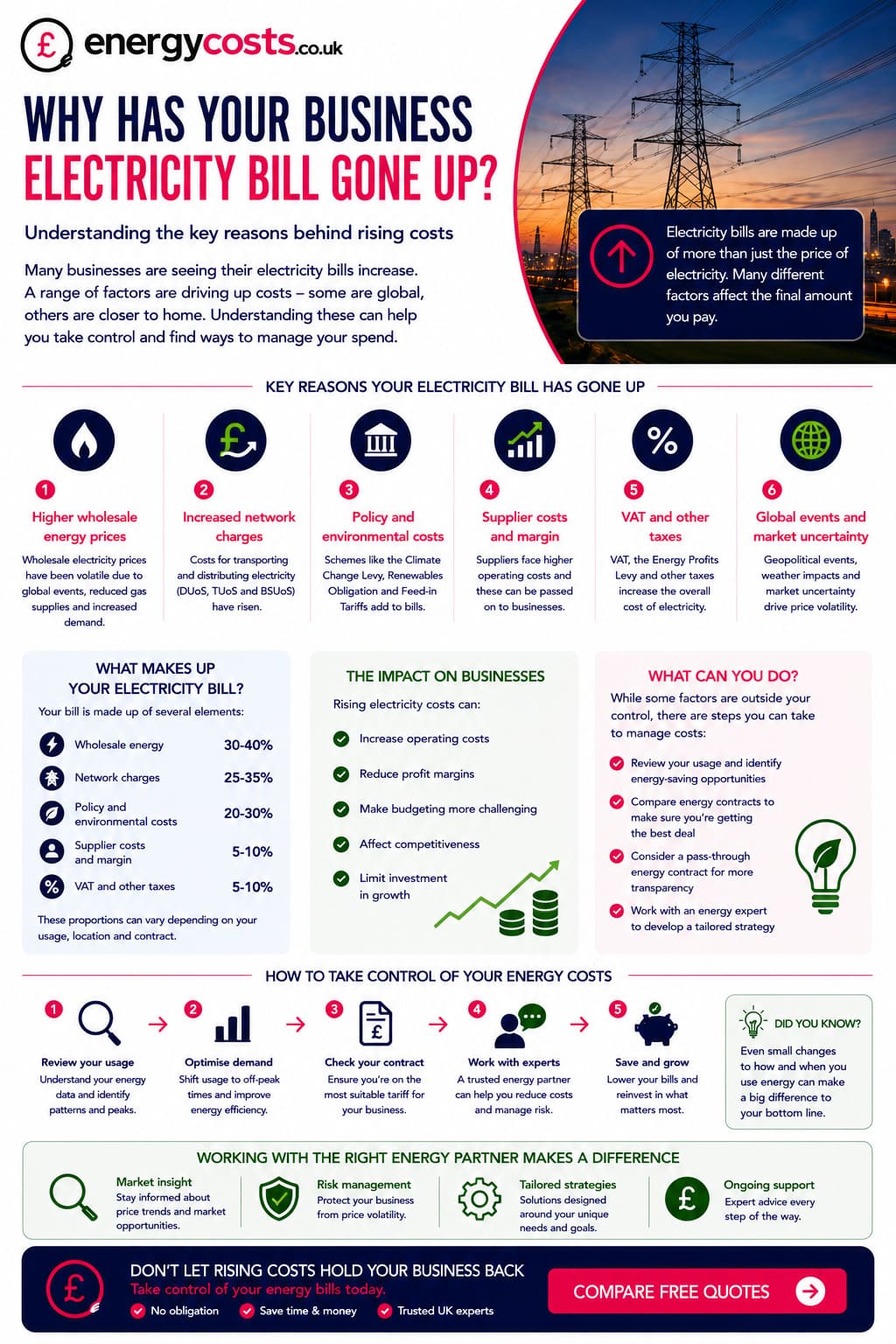
The biggest 2026 issue: non-commodity costs
A common mistake is to assume that a business electricity bill should fall whenever wholesale electricity prices fall. In reality, wholesale energy is only one part of the bill.
Non-commodity costs are the charges that sit around the wholesale price of electricity. They include network costs, balancing costs, policy costs, environmental schemes and other regulated charges.
Cornwall Insight forecast that by 2026, non-commodity charges would make up nearly 60% of a typical business electricity bill. It said this was being driven by rising transmission costs, new bill components such as the Nuclear Regulated Asset Base, and wider exemption schemes for energy-intensive users.
This means a business can reduce its electricity usage and still receive a higher bill if fixed charges, network charges or policy-related costs rise at the same time.
What are non-commodity charges?
| Charge | Full name | What it pays for |
|---|---|---|
| TNUoS | Transmission Network Use of System | The high-voltage transmission network that moves electricity around Great Britain |
| DUoS | Distribution Use of System | Local electricity distribution networks that deliver electricity to business premises |
| BSUoS | Balancing Services Use of System | The cost of balancing supply and demand on the electricity system |
| RO | Renewables Obligation | Support for older renewable electricity generation schemes |
| FiT | Feed-in Tariff | Support for small-scale renewable generation |
| CfD | Contracts for Difference | Support for low-carbon electricity generation |
| CM | Capacity Market | Payments to keep enough electricity capacity available |
| CCL | Climate Change Levy | Environmental tax on business energy use |
| Nuclear RAB | Nuclear Regulated Asset Base | Funding model for new nuclear infrastructure, including Sizewell C-related costs |
Not every business sees all of these charges listed separately. For smaller businesses, many of them are bundled into the unit rate, standing charge or supplier cost. Larger businesses, especially those with half-hourly meters or flexible contracts, may see some charges itemised or passed through more directly.
TNUoS charges rose sharply from April 2026
One of the most important reasons for higher electricity bills in 2026 is the increase in TNUoS charges.
TNUoS stands for Transmission Network Use of System. It is the charge used to recover the cost of building, operating, maintaining and upgrading the high-voltage electricity transmission system.
EDF says NESO confirmed a 64% increase in TNUoS charges for 2026/27, with the average residual charge rising from about £15.70/MWh to about £25.70/MWh, an increase of roughly £10/MWh year on year. EDF also notes that TNUoS residual charges are recovered through standing charges, expressed in £/site/day, although the average £/MWh figure is useful for comparison.
| Annual electricity use | Approximate extra annual cost from a £10/MWh increase |
|---|---|
| 10,000kWh | £100 |
| 25,000kWh | £250 |
| 50,000kWh | £500 |
| 100,000kWh | £1,000 |
| 250,000kWh | £2,500 |
| 500,000kWh | £5,000 |
| 1,000,000kWh | £10,000 |
This table is a simplified illustration. Actual TNUoS exposure depends on location, meter type, voltage level, supply capacity, charging band and contract structure.
Why TNUoS has increased
TNUoS is rising because the UK electricity network needs major investment. More electricity needs to move from where it is generated to where it is used. This includes connecting offshore wind, upgrading ageing infrastructure, reinforcing the grid, and preparing for more electrification of transport, heating and industry.
EDF says the transmission network needs more and larger cables to move electricity from where it is generated to where it is needed. It also says transmission companies indicated a need to spend around £80 billion over five years under RIIO-ET3 business plans, with costs ultimately funded via TNUoS charges on suppliers.
For businesses, the practical effect is simple: the electricity system is becoming more expensive to maintain and upgrade, and some of that cost is being recovered through commercial electricity bills.
Why your standing charge may have increased
A standing charge is the fixed daily amount paid for having access to the electricity supply. It is charged whether you use a lot of electricity, a little electricity or none at all.
In 2026, many business electricity standing charges have increased because more network and residual costs are being recovered as fixed charges rather than purely through the unit rate. That is why a business may see a higher bill even after reducing consumption.
| Example site | Old standing charge | New standing charge | Extra annual cost |
|---|---|---|---|
| Small office | 60p/day | 90p/day | £109.50 |
| Retail unit | 80p/day | £1.30/day | £182.50 |
| Restaurant | £1.50/day | £2.50/day | £365 |
| Small industrial site | £5/day | £8/day | £1,095 |
| Larger half-hourly site | £20/day | £35/day | £5,475 |
These are illustrative examples, not fixed market prices. Standing charges vary significantly by supplier, meter type, region, voltage level, capacity and contract.
Why your bill can rise even if you use less electricity
This is one of the most frustrating features of business electricity pricing in 2026.
A business may reduce consumption by 10%, but still pay more overall if:
- the standing charge has increased
- TNUoS and DUoS charges have increased
- the unit rate has risen at renewal
- pass-through charges have changed
- estimated bills have been corrected
- VAT and CCL are applied to a higher subtotal
- the business is using more electricity at expensive times of day
For example:
| Bill item | 2025 example | 2026 example |
|---|---|---|
| Annual electricity use | 50,000kWh | 45,000kWh |
| Unit rate | 24p/kWh | 27p/kWh |
| Usage cost | £12,000 | £12,150 |
| Standing charge | £1.00/day | £1.80/day |
| Annual standing charge | £365 | £657 |
| Total before VAT and CCL | £12,365 | £12,807 |
In this example, electricity consumption falls by 10%, but the bill still rises because the unit rate and standing charge both increase.
Your fixed contract may have ended
Many businesses were protected from immediate price changes because they were on fixed contracts. However, a fixed contract only protects the business until the contract ends, and even then it may not protect against every pass-through or regulated charge.
Ofgem says many non-domestic customers are currently protected by fixed contracts where energy was bought in advance, but higher wholesale costs may feed through when contracts end or are renegotiated. It also says some regulated costs, such as network charges, may still change depending on contract terms.
If your business renewed in 2026, the increase may be caused by the difference between your old contract and your new one. This can be especially noticeable if your previous deal was arranged when wholesale or non-commodity costs were lower.
Business customers are not protected by the domestic price cap
Another reason business owners feel confused is that they hear news about the domestic energy price cap and assume it applies to businesses. It does not.
Ofgem says the price cap protects certain domestic customers in Great Britain on tariffs where the unit rate can go up or down with the market. It also states that customers with non-domestic energy contracts, including businesses and charities, are not protected by the price cap.
This means your business electricity bill can rise even at a time when domestic price-cap headlines suggest household bills are falling.
You may be on deemed or out-of-contract rates
If your business has moved into new premises, missed a renewal deadline or allowed a contract to expire, you may be paying deemed, variable or out-of-contract rates.
These rates are usually much more expensive than negotiated fixed contracts. They may include:
- higher unit rates
- higher standing charges
- less favourable payment terms
- more exposure to market movements
- limited budget certainty
A deemed contract often applies when a business starts using electricity at a site without agreeing a formal contract with the supplier. This is common when taking over a shop, office, café, warehouse or industrial unit.
Your bill may be based on estimated readings
A bill increase is not always a price increase. Sometimes it is a consumption correction.
If previous bills were estimated too low, the supplier may issue a catch-up bill after receiving an actual meter reading. This can make it look as though electricity has suddenly become more expensive, when the real issue is that the business was underbilled earlier.
Check whether your bill says:
- estimated
- actual
- customer read
- smart read
- supplier read
If your business has not submitted a meter reading for several months, a sudden increase may be caused by corrected consumption rather than a new tariff.
Your business may be using more electricity
Some businesses are using more electricity in 2026 without realising it. This can happen because of operational changes rather than price changes.
| Change | Why it increases electricity use |
|---|---|
| Longer opening hours | More lighting, heating, cooling, equipment and refrigeration |
| More staff | More computers, lighting, appliances and hot water demand |
| New equipment | Machinery, ovens, chillers, compressors, pumps or IT equipment |
| Electric heating | Electricity replaces gas or oil use |
| Air conditioning | Hotter periods increase cooling demand |
| EV charging | Fleet or staff charging adds significant load |
| More refrigeration | Common in food retail, hospitality, care and healthcare |
| Poor equipment maintenance | Motors, compressors and HVAC systems use more energy when inefficient |
| Seasonal trading | A busy period may increase usage compared with the same bill period last year |
The easiest way to check this is to compare kWh usage, not just the total £ amount. If the total bill has risen but kWh use has also increased, the issue is partly consumption rather than price.
Your supply capacity may be too high
Some businesses pay charges linked to agreed supply capacity. This is often measured in kVA. If the agreed capacity is higher than the business actually needs, the site may be paying more than necessary.
This is particularly relevant for half-hourly metered sites, larger retail premises, warehouses, factories, farms, cold stores, hotels and leisure facilities.
A business that once needed high capacity for equipment that is no longer used may still be paying for that capacity. Reviewing agreed supply capacity can sometimes reduce fixed electricity costs, although businesses should avoid reducing capacity too far because excess-capacity charges or operational problems can follow.
Regional electricity charges may have changed
Two businesses with identical electricity use can pay different bills depending on where they are located. This is because distribution and transmission charges vary by region.
DUoS charges are linked to local distribution networks. TNUoS charges also vary depending on site characteristics and the charging methodology. A business in one region may therefore see a larger network-cost increase than a similar business elsewhere.
This is one reason national average prices can be misleading. A small manufacturer in Scotland, a shop in London, a warehouse in Yorkshire and a hotel in Wales may all face different network-cost exposure.
Broker commission may be included in the rate
Many business energy contracts are arranged through brokers or third-party intermediaries. Broker commission is often built into the unit rate rather than shown as a separate invoice.
For example, a supplier might offer a base electricity rate, and the broker’s commission may be added as a small uplift per kWh. This may look minor, but it can become expensive for high-usage businesses.
| Broker commission uplift | Annual use | Annual commission cost |
|---|---|---|
| 0.3p/kWh | 50,000kWh | £150 |
| 0.5p/kWh | 50,000kWh | £250 |
| 1p/kWh | 50,000kWh | £500 |
| 0.5p/kWh | 250,000kWh | £1,250 |
| 1p/kWh | 250,000kWh | £2,500 |
| 0.5p/kWh | 1,000,000kWh | £5,000 |
| 1p/kWh | 1,000,000kWh | £10,000 |
If your bill has gone up after using a broker, check whether the rate includes commission and whether the commission was clearly explained before signing.
Some manufacturers will get help, but not until 2027
The Government has announced support for some manufacturers through the British Industrial Competitiveness Scheme. It says more than 10,000 manufacturers will see electricity bills cut by up to 25% from April 2027, with eligible firms exempted from the indirect costs of the Renewables Obligation, Feed-in Tariffs and Capacity Market, worth around £35–£40/MWh.
This may help some energy-intensive businesses, including sectors such as automotive, aerospace, steel and pharmaceuticals. However, it does not solve 2026 electricity bill increases for most SMEs, and many businesses outside manufacturing will not qualify.
How to check why your bill has gone up
Use this checklist to identify the cause of the increase.
| What to check | Where to find it | What it tells you |
|---|---|---|
| Unit rate | Contract or bill | Whether the p/kWh price has increased |
| Standing charge | Contract or bill | Whether fixed daily costs have gone up |
| kWh usage | Bill and meter readings | Whether you used more electricity |
| Meter read type | Bill | Whether the bill is actual or estimated |
| Contract end date | Contract, renewal letter or supplier portal | Whether you have moved to a new rate |
| Tariff type | Contract | Whether you are fixed, variable, deemed or out of contract |
| Pass-through terms | Contract | Whether network and policy costs can change |
| VAT rate | Bill | Whether VAT is applied at 20% or reduced rate |
| CCL | Bill | Whether Climate Change Levy is being charged |
| Broker commission | Broker agreement or supplier contract | Whether commission is built into the unit rate |
| Supply capacity | Half-hourly bill or supplier records | Whether capacity charges are too high |
| MPAN profile | Electricity bill | Whether your meter type affects charging |
Worked example: why a bill might rise in 2026
A small business used 40,000kWh in 2025 and 40,000kWh in 2026. Usage did not change, but the bill still increased.
| Cost item | 2025 | 2026 | Difference |
|---|---|---|---|
| Electricity use | 40,000kWh | 40,000kWh | No change |
| Unit rate | 24p/kWh | 27p/kWh | +£1,200 |
| Standing charge | £1/day | £1.75/day | +£273.75 |
| Subtotal before VAT/CCL | £9,965 | £11,438.75 | +£1,473.75 |
The business may feel that “nothing changed”, but the price structure changed. The increase comes from a higher unit rate and higher standing charge, even though consumption stayed the same.
What businesses can do to reduce the impact
Compare contracts before renewal
Do not wait until the contract has already ended. Begin comparing business energy prices before the renewal window closes. Out-of-contract and deemed rates are usually expensive.
Check whether your contract is fully fixed
A contract may look fixed but still include pass-through charges. Ask the supplier or broker whether TNUoS, DUoS, BSUoS, RO, FiT, CfD, Capacity Market and other charges are fixed, reconciled or passed through.
Submit regular meter readings
Estimated bills can hide problems for months. Submit regular readings unless your smart or half-hourly meter is working reliably.
Reduce peak demand
For businesses exposed to half-hourly, capacity or time-of-use charges, reducing peak load can help. This may involve staggering equipment start-up times, moving EV charging, adjusting refrigeration cycles or using energy management systems.
Review agreed supply capacity
If your site has more kVA capacity than it needs, you may be paying unnecessarily high fixed charges. A capacity review can be useful for larger sites, but it should be done carefully.
Investigate on-site generation
Solar panels and battery storage will not remove every network or standing charge, but they can reduce imported electricity. They are most attractive for businesses with high daytime consumption, large roof areas and stable long-term occupancy.
Check VAT and CCL treatment
Some charities, low-use sites and qualifying activities may be eligible for reduced VAT or CCL relief. If your bill is being charged incorrectly, this can make a meaningful difference.
Query broker commission
Ask for a breakdown of how the broker is paid. A small p/kWh uplift can become a large annual cost for energy-intensive businesses.
Challenge errors quickly
If the bill looks wrong, raise a complaint with the supplier and keep records. The Energy Ombudsman says small businesses can access its dispute resolution service if they meet eligibility rules, and it can help after deadlock or if the supplier has taken more than eight weeks to consider the complaint.
When should you worry about a bill increase?
A modest increase may simply reflect higher 2026 charges. However, you should investigate urgently if:
- the bill has doubled or tripled without a clear reason
- the meter reading is estimated
- the bill covers an unusually long period
- the standing charge has increased sharply
- you have been moved to deemed or out-of-contract rates
- the supplier is charging for the wrong meter
- the VAT rate looks wrong
- CCL is being charged when you believe you are exempt
- the business has changed premises
- your broker promised a lower rate than the supplier is billing
- your consumption has been allocated to the wrong period
Final verdict
Your business electricity bill may have gone up in 2026 even if you have not used more electricity. The most important reason is that a growing share of the bill is made up of network, policy and other non-commodity charges. These costs are rising as the UK upgrades the grid, funds low-carbon generation, supports energy security and reforms the electricity system.
TNUoS is one of the clearest examples. From April 2026, transmission network costs rose sharply, and many businesses are seeing the impact through higher standing charges or pass-through costs. At the same time, businesses are not protected by the domestic Ofgem price cap, and many firms face increases when fixed contracts end.
The right response is not just to look at the headline unit rate. Businesses should check usage, standing charges, meter readings, pass-through terms, contract end dates, broker commission, VAT, CCL and supply capacity. In 2026, understanding the structure of the bill is just as important as comparing the pence-per-kWh rate.
FAQ
Your bill may have gone up because of higher network charges, higher standing charges, contract renewal, pass-through costs, estimated readings, increased usage or out-of-contract rates. In 2026, non-commodity charges are a major reason many business electricity bills are rising.
Standing charges can increase when suppliers recover more fixed network and residual costs through daily charges. TNUoS increases in 2026 are a major factor, especially for businesses with larger sites, higher capacity or half-hourly meters.
No. The domestic Ofgem price cap does not protect non-domestic energy contracts, including business and charity contracts. Business energy prices are set through commercial contracts rather than the household price cap.
Yes, depending on the contract. Some contracts fix the wholesale unit rate but allow certain regulated charges, network costs or policy costs to be passed through. Always check whether the contract is fully fixed or partially pass-through.
TNUoS stands for Transmission Network Use of System. It pays for the high-voltage electricity transmission network. These charges increased sharply from April 2026 and are one reason many business electricity bills have risen.
Your bill can rise despite lower consumption if standing charges, network charges, unit rates or pass-through costs increase. Fixed charges are payable regardless of usage, so reducing kWh does not always reduce the total bill by the same percentage.
Check your unit rate, standing charge, contract end date, kWh usage, meter reading type and whether the bill is based on estimated or actual readings. Then check whether you are on fixed, variable, deemed or out-of-contract rates.
Yes. You should complain to your supplier first. If the complaint reaches deadlock or the supplier has taken more than eight weeks, eligible small businesses may be able to use the Energy Ombudsman.