

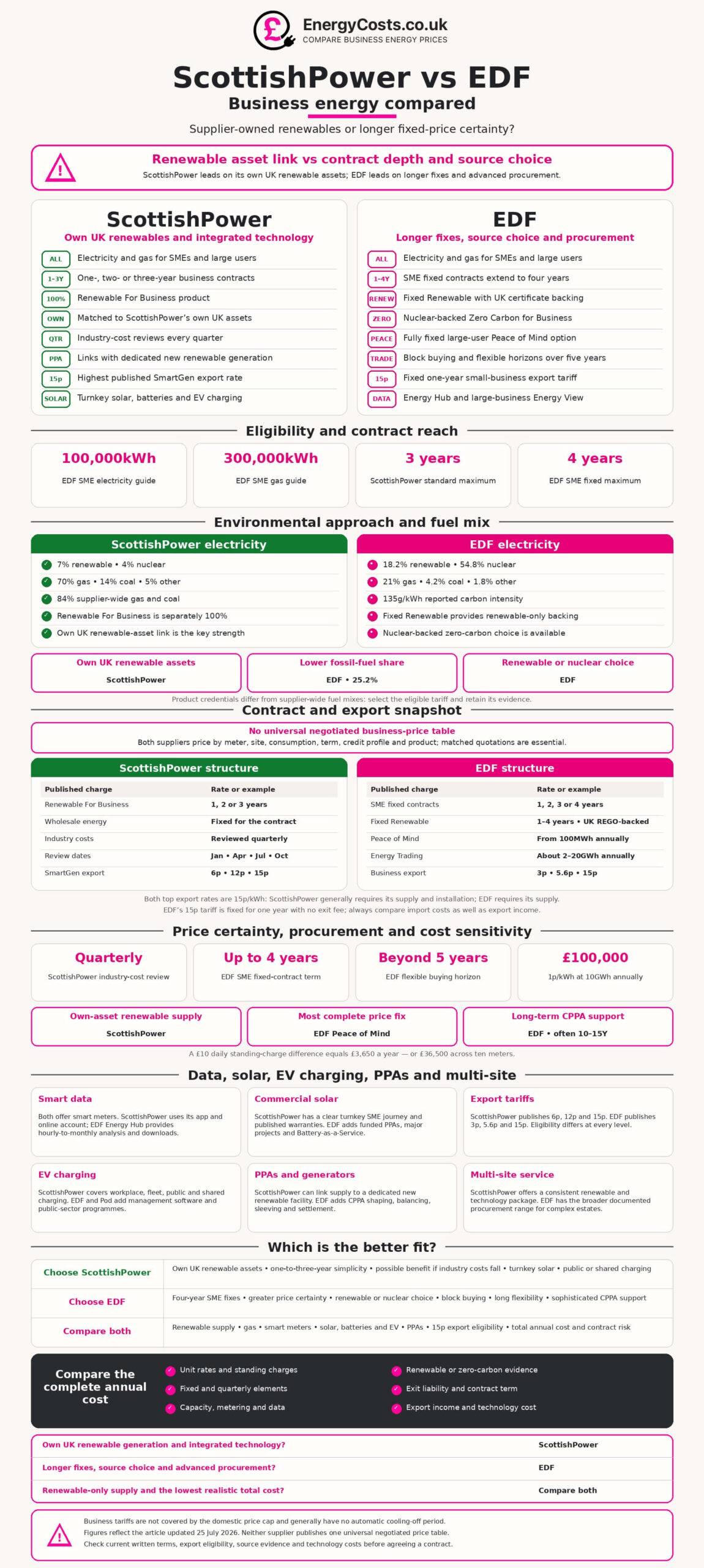
ScottishPower and EDF are two of the UK’s largest business energy suppliers. Both provide gas, electricity, smart meters, renewable-energy products, commercial solar and electric vehicle charging, but their tariff structures differ significantly.
ScottishPower offers one-, two- and three-year contracts. Its Renewable For Business electricity tariff is backed by renewable generation from ScottishPower’s own UK renewable assets. However, only the wholesale energy component is fixed: network, environmental and other industry costs are reviewed quarterly and can rise or fall during the contract.
EDF offers small-business fixed contracts lasting between one and four years. Its Fixed Renewable product matches electricity use with UK Renewable Energy Guarantees of Origin, while larger organisations can choose renewable, nuclear-backed zero-carbon or mixed-source electricity.
EDF also publishes a broader range of conventional fixed and flexible energy procurement structures for large businesses. These include fully fixed contracts, partly fixed agreements, block purchasing and flexible contracts extending beyond five years.
ScottishPower may be the stronger choice for a company wanting electricity matched with renewable power from supplier-owned UK assets, a conventional one- to three-year contract or an integrated solar and EV-charging package.
EDF may be more suitable where the business wants a four-year SME fix, a choice between renewable and nuclear-backed electricity, advanced wholesale procurement or a Corporate Power Purchase Agreement.
Neither supplier is universally cheaper. Business prices depend on the meter, postcode, consumption profile, credit assessment, contract dates and selected environmental product.
ScottishPower vs EDF at a glance
| Feature | ScottishPower Business | EDF Business |
|---|---|---|
| Business electricity | Yes | Yes |
| Business gas | Yes | Yes |
| SME supply | Yes | Yes |
| Large-business supply | Yes | Yes |
| Standard national contract prices published | No | No |
| SME contract terms | One, two or three years | One, two, three or four years |
| Wholesale energy fixed | Yes | Yes on fixed products |
| Industry costs fixed | No; reviewed quarterly | Product-dependent |
| Renewable SME electricity | Renewable For Business | Fixed Renewable |
| Renewable source | ScottishPower’s own UK renewable assets | UK REGOs from qualifying renewable generation |
| Nuclear-backed zero-carbon option | Not a standard SME product | Yes for eligible large-business products |
| Supplier-wide renewable share | 7% | 18.2% |
| Supplier-wide nuclear share | 4% | 54.8% |
| Supplier-wide gas and coal | 84% | 25.2% |
| Reported carbon intensity | Product-dependent | 135g CO₂/kWh supplier-wide |
| Large-business fully fixed option | Bespoke commercial contracts | Fixed + Peace of Mind |
| Partly fixed option | Standard tariff structure | Fixed + Standard |
| Block energy purchasing | Bespoke commercial arrangements | Fixed + Energy Trading |
| Flexible procurement | Available for commercial customers | Extensive published range |
| Flexible purchasing horizon | Bespoke | One to three, three to five or more than five years |
| Corporate PPA | Yes | Yes |
| Free smart-meter information | App and online account | Energy Hub |
| Solar export rates | 6p, 12p or 15p/kWh | 3p, 5.6p or 15p/kWh |
| Highest export rate | 15p/kWh | 15p/kWh |
| Commercial solar | Yes | Yes |
| Commercial batteries | Yes | Yes |
| Business EV charging | Workplace, fleet, public and shared | Workplace, fleet and public-sector solutions |
| Best suited to | Renewable-backed conventional contracts and installed technology | Longer fixes, source choice and sophisticated procurement |
Which businesses can use ScottishPower or EDF?
Both suppliers serve small companies, multi-site businesses and major commercial organisations.
Potential customers include:
- shops
- offices
- cafés
- restaurants
- hotels
- care providers
- schools
- charities
- landlords
- warehouses
- factories
- logistics operators
- public-sector bodies
- national retailers
- large industrial users
EDF generally separates small and large-business customers at approximately:
- 100,000kWh of annual electricity use; or
- 300,000kWh of annual gas use.
Businesses above these levels are normally directed towards EDF Large Business.
ScottishPower offers its general business tariff range to small, medium and large companies, although more complex customers may require a bespoke commercial arrangement.
Eligibility can also depend on:
- meter type;
- half-hourly consumption;
- available electricity capacity;
- creditworthiness;
- previous payment history;
- number of premises;
- business activity; and
- proposed contract start date.
Example suitability by company type
| Example organisation | Annual electricity use | Potentially suitable option |
|---|---|---|
| Independent shop | 12,000kWh | Fixed SME quote from either supplier |
| Medium office | 60,000kWh | ScottishPower Renewable For Business or EDF fixed tariff |
| Restaurant | 120,000kWh | ScottishPower tailored quote or EDF Large Business |
| Hotel | 400,000kWh | Multi-site or large-business contract |
| Manufacturer | 2GWh | Fixed or flexible procurement from either supplier |
| National retailer | 10GWh | Bespoke multi-site contract |
| Company wanting renewable-only electricity | Any suitable level | ScottishPower Renewable For Business or EDF Fixed Renewable |
| Company wanting nuclear-backed zero carbon | Large-business supply | EDF |
| Solar-exporting SME | Project-dependent | Compare both suppliers’ 15p tariffs |
| Company installing workplace chargers | Site-dependent | Either supplier |
| Major company seeking a CPPA | Large consumption | Compare both |
| Business wanting procurement beyond five years | Large user | EDF flexible contract |
Which supplier is cheaper?
There is no universal ScottishPower-versus-EDF business price.
Neither company publishes one national new-customer tariff applying to every business. Quotations can vary according to:
- electricity MPAN;
- gas MPRN;
- postcode and distribution region;
- annual consumption;
- electricity profile;
- half-hourly demand;
- electricity voltage;
- residual charging band;
- agreed supply capacity;
- number of sites;
- payment method;
- credit rating;
- contract start date;
- contract duration;
- renewable-product selection; and
- wholesale market conditions.
A complete annual comparison should include:
- Annual consumption × unit rate
- daily standing charge × 365
- capacity charges
- meter and data costs
- network and policy costs
- environmental-product charges
- VAT and Climate Change Levy where applicable
− solar export income and other credits
The tariff with the lower unit rate can still be more expensive if its standing charge or variable industry costs are higher.
How unit-rate differences affect annual costs
| Annual consumption | Value of 0.5p/kWh | Value of 1p/kWh | Value of 3p/kWh | Value of 5p/kWh |
|---|---|---|---|---|
| 10,000kWh | £50 | £100 | £300 | £500 |
| 25,000kWh | £125 | £250 | £750 | £1,250 |
| 50,000kWh | £250 | £500 | £1,500 | £2,500 |
| 100,000kWh | £500 | £1,000 | £3,000 | £5,000 |
| 250,000kWh | £1,250 | £2,500 | £7,500 | £12,500 |
| 1GWh | £5,000 | £10,000 | £30,000 | £50,000 |
| 10GWh | £50,000 | £100,000 | £300,000 | £500,000 |
A difference of only 1p/kWh changes annual expenditure by £100,000 for a business consuming 10GWh.
How standing charges affect annual costs
| Daily standing-charge difference | Annual difference per meter | Difference across ten meters |
|---|---|---|
| 25p | £91.25 | £912.50 |
| 50p | £182.50 | £1,825 |
| £1 | £365 | £3,650 |
| £2 | £730 | £7,300 |
| £5 | £1,825 | £18,250 |
| £10 | £3,650 | £36,500 |
Standing charges are particularly important for:
- seasonal companies;
- vacant properties;
- landlords;
- low-use premises;
- multi-site organisations; and
- businesses retaining inactive meters.
ScottishPower Renewable For Business
Renewable For Business is ScottishPower’s current electricity tariff for businesses.
Its principal features include:
- one-, two- or three-year contracts;
- electricity backed by 100% renewable generation;
- renewable power from ScottishPower’s own UK assets;
- fixed wholesale energy costs;
- variable industry costs;
- quarterly cost reviews; and
- a choice of payment methods.
Renewable For Business may suit companies that want:
- a simple renewable-energy claim;
- electricity linked with supplier-owned generation;
- no nuclear allocation to the chosen product;
- protection from wholesale-price increases;
- one- to three-year budgeting; and
- certificate evidence for environmental reporting.
The electricity physically delivered to the premises still comes through the national grid. ScottishPower matches the company’s consumption with renewable generation and the associated certificates.
How ScottishPower business pricing works
ScottishPower separates its business price into two broad parts.
Fixed energy costs
The wholesale energy element is fixed for the agreed one-, two- or three-year term.
This protects the business against an increase in the wholesale cost of electricity or gas.
Variable industry costs
The remaining component includes costs such as:
- electricity transmission;
- distribution charges;
- balancing costs;
- Capacity Market charges;
- Contracts for Difference;
- Renewables Obligation costs;
- smart-metering industry costs;
- social and environmental obligations;
- gas transportation costs; and
- new regulatory charges.
ScottishPower reviews these costs every quarter.
Changes can take effect on:
- 1 January;
- 1 April;
- 1 July; and
- 1 October.
A ScottishPower tariff can therefore have a fixed contract term without the complete unit rate and standing charge remaining unchanged.
Advantages of ScottishPower’s pricing model
The structure can provide:
- protection from wholesale volatility;
- potentially lower initial prices than a fully fixed contract;
- a clear distinction between energy and industry costs;
- one- to three-year contract options; and
- the possibility that variable charges fall as well as rise.
It may suit a business that understands pass-through costs and can tolerate some changes during the contract.
Disadvantages of ScottishPower’s pricing model
The main disadvantage is reduced budget certainty.
A company cannot know its exact total energy rate for the full contract period because the variable component is reviewed every three months.
Before accepting a quotation, the business should request:
- the wholesale energy rate;
- the current industry-cost component;
- the current standing charge;
- a list of costs that can change;
- previous quarterly adjustments;
- the calculation methodology; and
- the date of the next review.
EDF small-business fixed tariffs
EDF offers small-business contracts lasting:
- one year;
- two years;
- three years; or
- four years.
Its standard fixed proposition provides:
- fixed unit rates;
- fixed standing charges, subject to the contract;
- electricity, gas or dual-fuel options;
- online account management;
- dedicated small-business specialists;
- Direct Debit options;
- smart meters where eligible; and
- access to Energy Hub.
EDF reviews its available small-business prices regularly, so the quotation can change as market conditions move.
A four-year tariff may suit a company that wants longer protection and does not want to conduct another procurement exercise after one or two years.
Advantages of EDF’s longer fixed contracts
A longer agreement can provide:
- improved budget certainty;
- protection from wholesale-price rises;
- stable unit and standing charges;
- fewer contract renewals;
- easier long-term forecasting; and
- less exposure to short-term market shocks.
The disadvantage is that the customer cannot easily benefit if market prices fall substantially during the term.
An early termination fee may also apply.
ScottishPower versus EDF for price certainty
| Pricing consideration | ScottishPower | EDF fixed SME tariff |
|---|---|---|
| Wholesale energy price | Fixed | Fixed |
| Industry costs | Reviewed quarterly | Normally incorporated into fixed agreed rates, subject to terms |
| Contract length | One to three years | One to four years |
| Exposure to quarterly adjustments | Yes | Lower |
| Ability to benefit if industry costs fall | Yes | Limited |
| Protection if industry costs rise | Limited | Stronger |
| Maximum SME budgeting period | Three years | Four years |
| Best suited to | Business accepting pass-through risk | Business prioritising predictability |
EDF is likely to have the advantage where exact budgeting is the main priority.
ScottishPower may offer a competitive opening quotation where the business is prepared to retain the risk of changing industry costs.
EDF Fixed Renewable
EDF Fixed Renewable matches the customer’s electricity consumption with UK Renewable Energy Guarantees of Origin.
The product offers:
- 100% renewable-backed electricity;
- one-, two-, three- or four-year terms;
- fixed prices;
- market-based zero emissions from purchased electricity; and
- evidence supporting carbon reporting.
It may suit businesses seeking:
- renewable-only certificate backing;
- no nuclear allocation to the selected product;
- longer fixed terms;
- tender or supply-chain evidence;
- a straightforward Scope 2 claim; and
- predictable energy costs.
ScottishPower Renewable For Business versus EDF Fixed Renewable
| Feature | ScottishPower | EDF |
|---|---|---|
| Renewable backing | 100% | 100% |
| Contract term | One to three years | One to four years |
| Renewable source | ScottishPower’s own UK resources | UK renewable generation and REGOs |
| Wholesale cost fixed | Yes | Yes |
| Industry costs fixed | No | Generally incorporated into fixed rates, subject to terms |
| Nuclear allocation | No | No |
| Supplier-owned generation emphasis | Strong | Mixed EDF and third-party sourcing |
| Best for maximum fixed term | — | EDF |
| Best for direct supplier-asset link | ScottishPower | — |
ScottishPower provides the more direct connection with its own UK renewable assets.
EDF provides the longer contract term and stronger conventional price certainty.
ScottishPower business gas
ScottishPower’s For Business gas tariff is available over one, two or three years.
As with its electricity product:
- wholesale gas costs are fixed;
- network and industry charges are variable;
- variable charges are reviewed quarterly; and
- customers can choose from available payment methods.
ScottishPower does not currently foreground a standard SME renewable-gas tariff within its main business tariff range.
Unless the quotation states otherwise, the supply should be treated as conventional network gas.
EDF business gas
EDF offers small and large-business gas contracts.
Its SME tariffs can be fixed for up to four years, while large organisations can obtain Standard Fixed Gas or a tailored dual-fuel arrangement.
EDF’s large-business fixed gas structure can include:
- fixed wholesale gas costs;
- fixed EDF service costs;
- forecast non-energy costs that may change;
- fixed metering-agent charges; and
- support for non-daily-metered customers.
EDF also does not prominently promote a standard small-business tariff matching 100% of consumption with renewable biomethane.
Which supplier is better for business gas?
| Requirement | Likely stronger fit |
|---|---|
| One- to three-year gas contract | Either |
| Four-year SME gas contract | EDF |
| Fixed wholesale with variable industry costs | ScottishPower |
| Greater overall SME price certainty | EDF |
| Dual-fuel large-business arrangement | EDF |
| Renewable business gas | Neither has a prominent standard SME product |
| Simple online account | Either |
Gas burned at the premises produces direct Scope 1 emissions regardless of the supplier.
Businesses seeking major reductions may need to consider heat pumps, electric catering equipment, heat recovery or other alternatives to gas.
Large-business procurement
EDF publishes a more extensive range of large-business contract structures than ScottishPower.
ScottishPower nevertheless provides bespoke commercial supply, renewable PPAs and low-carbon infrastructure to major organisations.
EDF Fixed + Peace of Mind
Fixed + Peace of Mind is designed to provide extensive budget certainty.
It can fix:
- wholesale electricity;
- non-energy costs;
- delivery costs;
- new-generation costs;
- EDF service costs; and
- other eligible contracted components.
The product supports both half-hourly and non-half-hourly meters and is aimed at businesses consuming more than 100MWh annually.
Zero-carbon electricity sources can be added.
EDF Fixed + Standard
Fixed + Standard protects the business from wholesale market changes while leaving some non-energy costs forecast-based.
Its features include:
- fixed wholesale electricity;
- a fixed EDF service charge;
- variable forecast non-energy costs;
- half-hourly and non-half-hourly eligibility;
- availability above 100MWh; and
- zero-carbon electricity options.
It may offer a lower opening rate than Fixed + Peace of Mind, but it provides less certainty.
EDF Fixed + Energy Trading
Fixed + Energy Trading allows a company to purchase blocks of electricity through EDF’s trading desk.
EDF manages the remaining untraded volume.
The product is intended principally for businesses using between 2,000MWh and 20,000MWh annually.
It can provide:
- staged purchasing;
- live or reconciliation billing;
- professional trading support;
- reduced reliance on one fixing date; and
- greater control over wholesale-market timing.
EDF flexible contracts
EDF’s flexible products allow a large business to decide:
- how far ahead to purchase;
- whether to buy in blocks or in full;
- which third-party costs to fix;
- which costs to leave variable;
- how much trading support it needs; and
- what reporting tools it requires.
Purchasing horizons can cover:
- one to three years;
- three to five years; or
- more than five years.
Flexible procurement can reduce the risk of fixing all expected consumption on an unusually expensive day, but it cannot guarantee a lower price.
Illustrative wholesale-purchasing risk
For a business using 10GWh annually:
| Average energy-purchase price | Annual commodity cost |
|---|---|
| 18p/kWh | £1.8 million |
| 19p/kWh | £1.9 million |
| 20p/kWh | £2 million |
| 21p/kWh | £2.1 million |
| 22p/kWh | £2.2 million |
A movement of 1p/kWh changes annual commodity expenditure by £100,000.
Flexible contracts are therefore most suitable where the organisation has:
- defined purchasing authority;
- an agreed risk policy;
- experienced internal staff;
- an energy consultant; or
- support from the supplier’s trading team.
ScottishPower commercial energy and PPAs
ScottishPower offers bespoke commercial services to larger organisations.
Its Corporate Power Purchase Agreement proposition can link the business with a dedicated new renewable-energy facility.
A PPA can provide:
- renewable electricity;
- a link to a specific project;
- long-term pricing;
- greater energy-cost certainty;
- evidence of additionality;
- stronger environmental reporting; and
- support for the construction of new renewable generation.
ScottishPower’s main advantage is its relationship with a substantial UK renewable-generation portfolio, particularly wind power.
EDF Corporate PPAs
EDF also offers Corporate Power Purchase Agreements.
A CPPA links the customer with a named renewable generator while EDF can provide services including:
- balancing;
- shaping;
- sleeving;
- settlement;
- renewable certificates;
- supply-contract integration; and
- generator management.
EDF says CPPA terms commonly last between ten and 15 years.
A CPPA with a new renewable facility can demonstrate additionality by supporting generation that might not otherwise have been developed.
ScottishPower versus EDF for large businesses
| Requirement | Likely stronger fit |
|---|---|
| Fully fixed conventional contract | EDF Fixed + Peace of Mind |
| Fixed wholesale with variable non-energy costs | Either |
| Block energy purchasing | EDF |
| Flexible procurement beyond five years | EDF |
| Large-business dual fuel | EDF |
| Dedicated new renewable facility | ScottishPower PPA |
| Named renewable generator | Either |
| CPPA balancing and sleeving | EDF |
| Link with supplier-owned wind generation | ScottishPower |
| Nuclear-backed zero carbon | EDF |
| Large commercial solar and EV infrastructure | Compare both |
EDF has the more clearly documented conventional procurement range.
ScottishPower may be especially attractive where the primary objective is a long-term relationship with new renewable generation.
Comparing supplier-wide fuel mixes
The suppliers’ 2024/25 total fuel mixes were substantially different.
| Source | ScottishPower | EDF |
|---|---|---|
| Renewables | 7% | 18.2% |
| Natural gas | 70% | 21% |
| Coal | 14% | 4.2% |
| Nuclear | 4% | 54.8% |
| Other fuels | 5% | 1.8% |
| Reported carbon intensity | Not stated in the same public summary | 135g/kWh |
| Radioactive waste | Product-dependent | 0.0038g/kWh |
ScottishPower’s non-green tariffs were reported separately as:
| Source | ScottishPower non-green tariffs |
|---|---|
| Renewables | 3% |
| Natural gas | 73% |
| Coal | 14% |
| Nuclear | 4% |
| Other | 6% |
These supplier-wide figures should not be confused with ScottishPower Renewable For Business, which is matched with 100% renewable electricity.
EDF’s overall mix contains considerably more nuclear power and less gas and coal.
Which supplier has greener electricity?
The conclusion depends on the product and the company’s environmental policy.
| Environmental priority | Likely stronger fit |
|---|---|
| 100% renewable SME electricity | Either |
| Electricity from supplier-owned UK renewables | ScottishPower |
| Renewable tariff lasting four years | EDF |
| No nuclear allocation | Either renewable product |
| Lower supplier-wide fossil-fuel share | EDF |
| Higher supplier-wide renewable share | EDF |
| Nuclear-backed zero-carbon option | EDF |
| Direct link with a new renewable project | ScottishPower or EDF CPPA |
| Choice between renewable and nuclear electricity | EDF |
| Simple renewable product | ScottishPower |
ScottishPower’s Renewable For Business tariff has stronger branding around electricity from its own UK renewable resources.
EDF provides a wider selection of source options, including renewable-only and nuclear-backed zero-carbon products.
EDF Zero Carbon for Business
EDF’s Zero Carbon for Business product uses nuclear-backed electricity.
Nuclear power generates no carbon dioxide at the point of generation, allowing zero market-based emissions reporting when supported by the required declarations.
It is not renewable electricity and creates radioactive waste.
The product may suit organisations that:
- prioritise low operational carbon;
- accept nuclear generation;
- need dependable low-carbon electricity;
- want an alternative to renewable certificates; or
- have a technology-neutral net-zero policy.
ScottishPower does not prominently promote a comparable nuclear-backed SME business product.
Smart meters
Both suppliers provide smart meters to eligible businesses.
ScottishPower smart meters
ScottishPower’s commercial smart meters can provide:
- automatic readings;
- fewer estimated bills;
- more detailed consumption information;
- usage monitoring through the app or online account;
- billing accuracy; and
- improved visibility of energy patterns.
The frequency and quality of data depend on the meter successfully communicating with ScottishPower.
EDF smart meters
EDF’s business smart meters provide:
- automatic readings;
- accurate billing;
- hourly, daily, weekly and monthly information;
- online consumption data;
- access to Energy Hub; and
- support for identifying energy waste.
Eligible customers may be required to accept a compatible smart-meter installation under the terms of certain tariffs.
ScottishPower account tools versus EDF Energy Hub
| Feature | ScottishPower | EDF |
|---|---|---|
| Submit meter readings | Yes | Yes |
| View and pay bills | Yes | Yes |
| Monitor consumption | Yes | Yes |
| Mobile app | Yes | MyAccount and digital tools |
| Hourly consumption data | Meter-dependent | Available through Energy Hub |
| Download smart-meter data | Meter-dependent | Yes |
| Environmental advice | Carbon Trust partnership | EDF advice hub and Energy Hub |
| Advanced large-business reporting | Bespoke | Energy View and market tools |
EDF Energy Hub provides the more clearly described small-business consumption-analysis service.
ScottishPower offers a convenient app-based account-management proposition.
Commercial solar
Both suppliers provide commercial solar and battery services.
ScottishPower solar
ScottishPower offers an end-to-end business package that can include:
- initial proposal;
- site survey;
- system design;
- rooftop solar;
- ground or car-park installations;
- battery storage;
- Distribution Network Operator applications;
- installation;
- export registration;
- monitoring; and
- ongoing support.
ScottishPower installations use products from established manufacturers and can include:
- a 24-month workmanship warranty;
- a 25-year manufacturer product warranty on panels;
- a ten-year inverter warranty; and
- a 25-year power-performance warranty.
The final warranty package depends on the detailed proposal and equipment selected.
EDF solar
EDF provides commercial and public-sector solar through EDF Business Solutions and specialist partners.
Its services can include:
- rooftop solar;
- ground-mounted systems;
- batteries;
- site assessment;
- design;
- installation;
- monitoring;
- maintenance;
- capital purchase;
- funded PPAs;
- export arrangements; and
- integration with EV charging.
EDF also offers Battery-as-a-Service models for suitable organisations. Under this structure, a finance partner owns the equipment while EDF or another specialist operates and optimises it.
Which supplier is better for solar?
| Solar requirement | Likely stronger fit |
|---|---|
| Turnkey SME installation | ScottishPower |
| Published installation warranties | ScottishPower |
| Solar linked with highest export tariff | Compare both |
| Large public-sector project | EDF |
| Funded solar PPA | EDF or ScottishPower |
| Battery-as-a-Service | EDF |
| Solar car park | ScottishPower |
| Solar integrated with EV charging | Either |
| Large corporate renewable project | Compare both |
| One-stop solar, battery and tariff package | ScottishPower |
ScottishPower has the clearer standardised SME installation journey.
EDF has a broader proposition for major solar, battery and public-sector projects.
Solar export payments
Both suppliers publish export tariffs available to eligible businesses.
ScottishPower SmartGen
ScottishPower currently offers:
| Export tariff | Rate | Main condition |
|---|---|---|
| SmartGen | 6p/kWh | Eligible generator |
| SmartGen Premium | 12p/kWh | ScottishPower supplies imported electricity |
| SmartGen Premium Plus | 15p/kWh | ScottishPower supplies the site and installed the solar panels or battery |
The business generally requires:
- qualifying renewable generation;
- half-hourly export metering;
- installation certification;
- grid-connection evidence; and
- ownership or permission documentation.
EDF business SEG tariffs
EDF currently offers:
| Export tariff | Rate | Main condition |
|---|---|---|
| SEG Export Variable | 3p/kWh | Available to eligible non-EDF supply customers |
| SEG Export Variable Value | 5.6p/kWh | Existing EDF electricity customer |
| Export 12M Small Business | 15p/kWh | Existing EDF electricity customer |
EDF Export 12M Small Business is fixed for one year and has no exit fee.
The variable tariffs can change, although EDF provides notice before altering the payment rate.
Export-income comparison
| Annual export | 3p/kWh | 5.6p/kWh | 6p/kWh | 12p/kWh | 15p/kWh |
|---|---|---|---|---|---|
| 5,000kWh | £150 | £280 | £300 | £600 | £750 |
| 10,000kWh | £300 | £560 | £600 | £1,200 | £1,500 |
| 25,000kWh | £750 | £1,400 | £1,500 | £3,000 | £3,750 |
| 50,000kWh | £1,500 | £2,800 | £3,000 | £6,000 | £7,500 |
| 100,000kWh | £3,000 | £5,600 | £6,000 | £12,000 | £15,000 |
Both suppliers offer a headline rate of 15p/kWh, but the eligibility conditions differ.
ScottishPower’s highest rate generally requires the company to buy electricity from ScottishPower and to have purchased its qualifying solar or battery system through ScottishPower.
EDF’s highest small-business rate requires an EDF electricity-supply relationship but does not use the same installer requirement on its main product description.
Which export tariff is better?
| Requirement | Likely stronger fit |
|---|---|
| Highest published rate | Either |
| ScottishPower-installed system | ScottishPower |
| Existing EDF electricity customer | EDF |
| Export without changing import supplier | ScottishPower at 6p or EDF at 3p |
| Existing supply customer without supplier installation | ScottishPower at 12p or EDF at 15p |
| Fixed one-year export rate | EDF Export 12M |
| Export information in mobile app | ScottishPower |
| Larger generator needing a PPA | EDF or ScottishPower commercial team |
The company should compare import costs as well as export income.
A 3p/kWh increase in export payments can easily be outweighed by a higher import price if the business imports much more electricity than it exports.
Electric vehicle charging
Both suppliers provide commercial charging services.
ScottishPower EV charging
ScottishPower offers:
- workplace charging;
- employee charging;
- customer and visitor charging;
- fleet-depot infrastructure;
- public chargers;
- shared or communal charging;
- site design;
- installation;
- access and payment systems; and
- ongoing support.
Its public-charging proposition can allow a business to host chargers and become a destination for EV drivers.
EDF and Pod charging
EDF works with Pod, part of the EDF group, to provide:
- workplace chargers;
- fleet charging;
- customer charging;
- charger installation;
- management software;
- site assessment;
- solar and battery integration; and
- larger public-sector charging projects.
EDF states that Pod has installed a substantial number of commercial chargers and supports a wide range of business sectors.
Which supplier is better for EV charging?
| EV requirement | Likely stronger fit |
|---|---|
| Basic workplace charging | Either |
| Employee and visitor charging | Either |
| Fleet-depot installation | Compare both |
| Public charger hosting | ScottishPower |
| Shared or communal charging | ScottishPower |
| Charging-management platform | EDF and Pod |
| Public-sector EV programme | EDF |
| Solar, battery and charging package | Either |
| Energy supply plus charging | Either |
| Large bespoke fleet project | Compare both |
ScottishPower has a particularly broad public and shared-charging proposition.
EDF may be stronger where the project requires Pod’s charger-management services or integration with a wider public-sector energy strategy.
Multi-site businesses
Both suppliers support companies with numerous premises.
ScottishPower can combine:
- renewable electricity;
- gas;
- app and online account management;
- solar;
- batteries;
- workplace charging;
- public charging; and
- commercial PPAs.
EDF can combine:
- fixed or flexible procurement;
- renewable or nuclear-backed electricity;
- half-hourly and non-half-hourly meters;
- dual fuel;
- Energy View;
- solar;
- batteries;
- EV charging;
- CPPAs; and
- dedicated account management.
EDF may be stronger for a major estate requiring advanced procurement.
ScottishPower may suit a business wanting a consistent renewable-electricity and installed-technology package.
Contract expiry and switching
Businesses should begin reviewing tariffs several months before the contract ends.
Failing to agree a new contract can result in:
- variable pricing;
- deemed rates;
- out-of-contract charges;
- higher standing charges;
- loss of renewable-product benefits; or
- less favourable payment terms.
EDF may move an SME customer onto Freedom for Business or another applicable variable tariff after expiry.
ScottishPower can also apply its relevant standard variable or deemed arrangements when no fixed contract is active.
Contract protections
Business energy contracts are not covered by the household energy price cap.
There is also generally no cooling-off period after a business contract is agreed, including an agreement made by telephone.
Before choosing ScottishPower or EDF, check:
- unit rates;
- standing charges;
- contract length;
- start and end dates;
- fixed and variable components;
- quarterly adjustments;
- network and policy costs;
- meter charges;
- capacity charges;
- early termination liability;
- payment terms;
- broker commission;
- renewable certificates;
- nuclear content;
- export-tariff eligibility;
- renewal procedure; and
- post-contract pricing.
ScottishPower advantages and disadvantages
Advantages
- Supplies SMEs and large organisations.
- Offers one-, two- and three-year contracts.
- Wholesale energy costs are fixed.
- Renewable For Business includes 100% renewable electricity.
- Renewable power is sourced from ScottishPower’s own UK assets.
- The selected renewable product has no nuclear allocation.
- Offers solar panels and batteries.
- Provides clear solar-installation warranties.
- SmartGen export rates reach 15p/kWh.
- Offers workplace, fleet, public and shared EV charging.
- Businesses can manage bills and readings through the app.
- Works with the Carbon Trust on business energy guidance.
- Offers commercial PPAs linked with new renewable facilities.
- Strong UK wind-generation credentials.
Disadvantages
- Negotiated business prices are not published.
- Industry costs are reviewed every quarter.
- Total unit rates and standing charges can change during the contract.
- The maximum standard business term is three years.
- Supplier-wide fuel mix contained 70% gas and 14% coal.
- Renewable claims depend on selecting Renewable For Business.
- No prominent nuclear-backed zero-carbon product is offered.
- No equally detailed public range of large-business procurement products is shown.
- The highest export rate requires ScottishPower supply and installation.
- No mainstream renewable-gas product is prominently advertised.
- Variable industry costs make exact forecasting harder.
EDF advantages and disadvantages
Advantages
- Supplies SMEs and major organisations.
- SME fixed terms extend to four years.
- Fixed Renewable provides renewable-only backing.
- Offers nuclear-backed Zero Carbon for Business.
- Provides renewable, nuclear and mixed-source choices.
- Fixed + Peace of Mind offers extensive budget certainty.
- Fixed + Standard provides a lower-certainty alternative.
- Fixed + Energy Trading supports block purchasing.
- Flexible procurement can extend beyond five years.
- Offers dual-fuel large-business arrangements.
- Energy Hub provides detailed smart-meter information.
- Strong Corporate PPA capability.
- Offers commercial solar and Battery-as-a-Service.
- Export 12M Small Business pays 15p/kWh.
- Provides workplace, fleet and public-sector charging through Pod.
Disadvantages
- Negotiated business prices are not published.
- Supplier-wide renewable share was only 18.2%.
- Supplier-wide nuclear share was 54.8%.
- Overall electricity mix still included gas and coal.
- Renewable-only electricity must be selected explicitly.
- Four-year contracts can become uncompetitive if prices fall.
- Early termination fees can apply.
- Flexible procurement requires expertise.
- The highest export rate requires EDF electricity supply.
- Its strongest environmental product may rely on nuclear power, which some companies exclude.
- No prominent standard renewable-gas tariff is offered.
Which supplier is better for different businesses?
| Business type or requirement | Likely better fit | Reason |
|---|---|---|
| SME wanting a one-year fixed tariff | Compare both | Both offer one-year contracts |
| SME wanting a four-year contract | EDF | Longer standard term |
| Company wanting renewable electricity | Either | Both offer renewable products |
| Company wanting supplier-owned UK renewables | ScottishPower | Core Renewable For Business feature |
| Company seeking maximum price certainty | EDF | Fully fixed structures available |
| Company accepting quarterly adjustments | ScottishPower | Standard pricing model |
| Business wanting nuclear-backed zero carbon | EDF | Dedicated product option |
| Company excluding nuclear | Either renewable product | Both can provide renewable-only backing |
| Large business wanting block purchasing | EDF | Fixed + Energy Trading |
| Business wanting procurement beyond five years | EDF | Flexible purchasing horizons |
| Company wanting a new renewable-facility PPA | Compare both | Strong CPPA propositions |
| Small solar exporter seeking 15p/kWh | Compare eligibility | Both publish a 15p rate |
| Existing EDF customer with third-party solar | EDF may suit | 15p tariff does not depend on EDF installation on the main product page |
| ScottishPower solar customer | ScottishPower | SmartGen Premium Plus |
| Business seeking turnkey solar | ScottishPower | Clear end-to-end proposition |
| Company seeking Battery-as-a-Service | EDF | Current large-business option |
| Commercial landlord requiring shared charging | ScottishPower | Dedicated proposition |
| Public-sector EV project | EDF | Strong EDF and Pod service |
| Complex multi-site estate | EDF may suit | Wider procurement structures |
| Business wanting a simple renewable package | ScottishPower | Supply, solar and EV services |
Final verdict: ScottishPower vs EDF
ScottishPower and EDF are both credible choices for UK businesses, but their main strengths differ.
ScottishPower is likely to be the better choice where the company wants:
- a one-, two- or three-year contract;
- renewable electricity from ScottishPower’s own UK assets;
- a simple renewable-energy proposition;
- a tariff that could benefit if industry costs fall;
- turnkey commercial solar;
- a combined solar, battery and tariff package;
- workplace, public or shared EV charging; or
- a PPA linked with new renewable generation.
EDF is likely to be stronger where the business wants:
- a fixed SME contract lasting up to four years;
- greater overall price certainty;
- a choice between renewable and nuclear-backed electricity;
- extensive large-business fixed and flexible procurement;
- staged wholesale purchases;
- purchasing horizons beyond five years;
- a dual-fuel large-business arrangement;
- sophisticated CPPA support;
- Battery-as-a-Service; or
- an attractive fixed export payment without a supplier-installation condition.
The environmental result depends on whether the comparison is based on the supplier or the chosen tariff.
ScottishPower’s total 2024/25 fuel mix contained:
- 7% renewable electricity;
- 70% natural gas;
- 14% coal;
- 4% nuclear; and
- 5% other fuels.
EDF’s corresponding mix contained:
- 18.2% renewable electricity;
- 21% gas;
- 4.2% coal;
- 54.8% nuclear; and
- 1.8% other fuels.
EDF’s overall portfolio was less dependent on fossil fuels, but much more dependent on nuclear generation.
At product level, both companies can provide renewable-only electricity:
- ScottishPower Renewable For Business uses generation from ScottishPower’s own UK renewable assets.
- EDF Fixed Renewable uses UK renewable certificates and is available for up to four years.
The financial decision can only be made using matched quotations.
A fair comparison should require both suppliers to quote for:
- the same meter and postcode;
- identical annual consumption;
- the same contract start date;
- an equivalent contract duration;
- all standing charges;
- fixed and variable cost components;
- capacity and metering charges;
- equivalent renewable credentials;
- broker commission;
- export income;
- early termination liability;
- renewal and default pricing; and
- the complete projected annual cost.
For most businesses, the conclusion is:
- choose ScottishPower for electricity linked with its own UK renewable generation and a strong integrated solar and EV package;
- choose EDF for longer fixed terms, greater price certainty, wider energy-source choice and advanced procurement;
- compare ScottishPower Renewable For Business with EDF Fixed Renewable where renewable-only electricity is required;
- compare ScottishPower’s quarterly variable-cost structure with EDF’s fully fixed options before deciding which opening quote is genuinely cheaper;
- compare both suppliers’ 15p/kWh export tariffs against the import contract and installation requirements; and
- select the supplier offering the lowest realistic total cost after every variable industry charge and export payment has been included.
FAQ
It depends on the individual quotations. ScottishPower fixes wholesale energy but reviews industry costs quarterly, while EDF offers more conventional fixed-price structures.
Yes. ScottishPower and EDF supply electricity to SMEs, multi-site companies and large organisations.
Yes. Both provide gas contracts to small and large businesses.
EDF offers SME fixed contracts lasting up to four years. ScottishPower’s standard business contracts last one, two or three years.
Renewable For Business is backed by 100% renewable electricity generated from ScottishPower’s own UK renewable resources.
No. Its supplier-wide 2024/25 mix was 7% renewable. The 100% renewable claim applies to its green tariffs.
Yes. EDF Fixed Renewable matches the customer’s consumption with UK renewable certificates.
No. EDF’s supplier-wide renewable share was 18.2%. Its largest overall generation source was nuclear power.
EDF. Nuclear represented 54.8% of its supplier-wide mix, compared with 4% for ScottishPower.
EDF. Gas and coal represented 25.2% of its supplier-wide mix, compared with 84% for ScottishPower.
No. Wholesale energy is fixed, but network, environmental and other industry costs are reviewed quarterly.
EDF generally has the advantage because it offers fully fixed SME and large-business structures.
EDF has the wider published range of conventional fixed and flexible procurement products. ScottishPower remains strong for renewable PPAs and infrastructure.
Both publish a highest rate of 15p/kWh. The eligibility conditions differ, so the import contract and installer requirements must be compared.
Yes. Its standard SmartGen rate is available to eligible generators, while higher rates require ScottishPower supply or installation.
Yes. EDF’s standard SEG Export Variable tariff is available to eligible non-supply customers, but its higher rates require EDF electricity supply.
ScottishPower has a clear turnkey SME service. EDF may be stronger for large, public-sector or funded solar and battery projects.
ScottishPower has strong workplace, fleet, public and communal charging services. EDF and Pod provide workplace, fleet and public-sector charging.