
SSE Energy Solutions and EDF are two of the UK’s largest business energy suppliers. Both serve small companies, major industrial users and multi-site organisations, while also offering renewable electricity, smart metering, commercial solar, electric vehicle charging and sophisticated large-business procurement.
Their strongest features are different.
SSE’s fixed electricity plans include 100% renewable power from SSE-linked UK wind and hydro assets. Businesses can choose SSE Protect for extensive price certainty or SSE Choice for a lower-cost structure where selected non-energy charges can change. Larger users can access staged wholesale purchasing, day-ahead optimisation, named renewable assets and Corporate Power Purchase Agreements.
EDF offers small-business fixed tariffs lasting up to four years, compared with SSE’s maximum of three years. EDF Fixed Renewable provides UK REGO-backed electricity, while larger companies can choose renewable, nuclear-backed zero-carbon or mixed-source power. EDF also publishes a broad selection of fully fixed, partly fixed and flexible energy procurement structures.
SSE may be the stronger choice for a company wanting renewable electricity included automatically, renewable gas, named UK wind or hydro generation and a major solar or EV-infrastructure project.
EDF may be more suitable where the business wants a four-year SME fix, nuclear-backed zero-carbon electricity, a wider selection of conventional procurement structures or a published solar-export tariff paying up to 15p/kWh.
Neither supplier is universally cheaper. Commercial rates depend on the meter, postcode, consumption profile, credit risk, contract start date and precise division between fixed and pass-through costs.
SSE vs EDF at a glance
| Feature | SSE Energy Solutions | EDF Business |
|---|---|---|
| Business electricity | Yes | Yes |
| Business gas | Yes | Yes |
| SME supply | Yes | Yes |
| Large-business supply | Yes | Yes |
| Standard contracted rates published | No | No |
| Maximum standard SME fixed term | Three years | Four years |
| Fully fixed product | SSE Protect | Fixed tariff or Fixed + Peace of Mind |
| Partly fixed product | SSE Choice | Fixed + Standard |
| Staged wholesale purchasing | SSE Shaping | Fixed + Energy Trading and flexible contracts |
| Day-ahead optimisation | SSE Cash Out | Flexibility and asset-optimisation services |
| Renewable electricity on standard fixed plans | Included | Must select an eligible renewable tariff |
| Renewable source | SSE-linked UK wind and hydro | UK REGOs from qualifying renewable generation |
| Nuclear-backed zero-carbon option | No standard equivalent | Yes |
| Supplier-wide renewable share | 64% | 18.2% |
| Supplier-wide nuclear share | 0% | 54.8% |
| Supplier-wide natural-gas share | 36% | 21% |
| Supplier-wide carbon intensity | 138g/kWh | 135g/kWh |
| Renewable business gas | SSE Green Gas and Green Gas Plus | No equally prominent standard SME product |
| Named renewable asset | SSE Next Generation | Renewable and CPPA options |
| Corporate PPAs | Named Asset and Portfolio PPAs | Renewable CPPAs with balancing and sleeving |
| Energy analytics | SSE Clarity | Energy Hub and MyBusiness |
| Published business export tariff | No universal flat rate promoted | Up to 15p/kWh |
| Commercial solar | Rooftop, ground-mounted, carport and floating solar | SME and large-commercial solar |
| Fully funded solar | Ten- to 20-year PPA | Available through funded commercial arrangements |
| Business EV charging | Workplace, fleet, public, bus and HGV | Workplace, fleet and public-sector charging |
| Best suited to | Renewable fixed supply and major infrastructure | Longer fixes and extensive procurement choice |
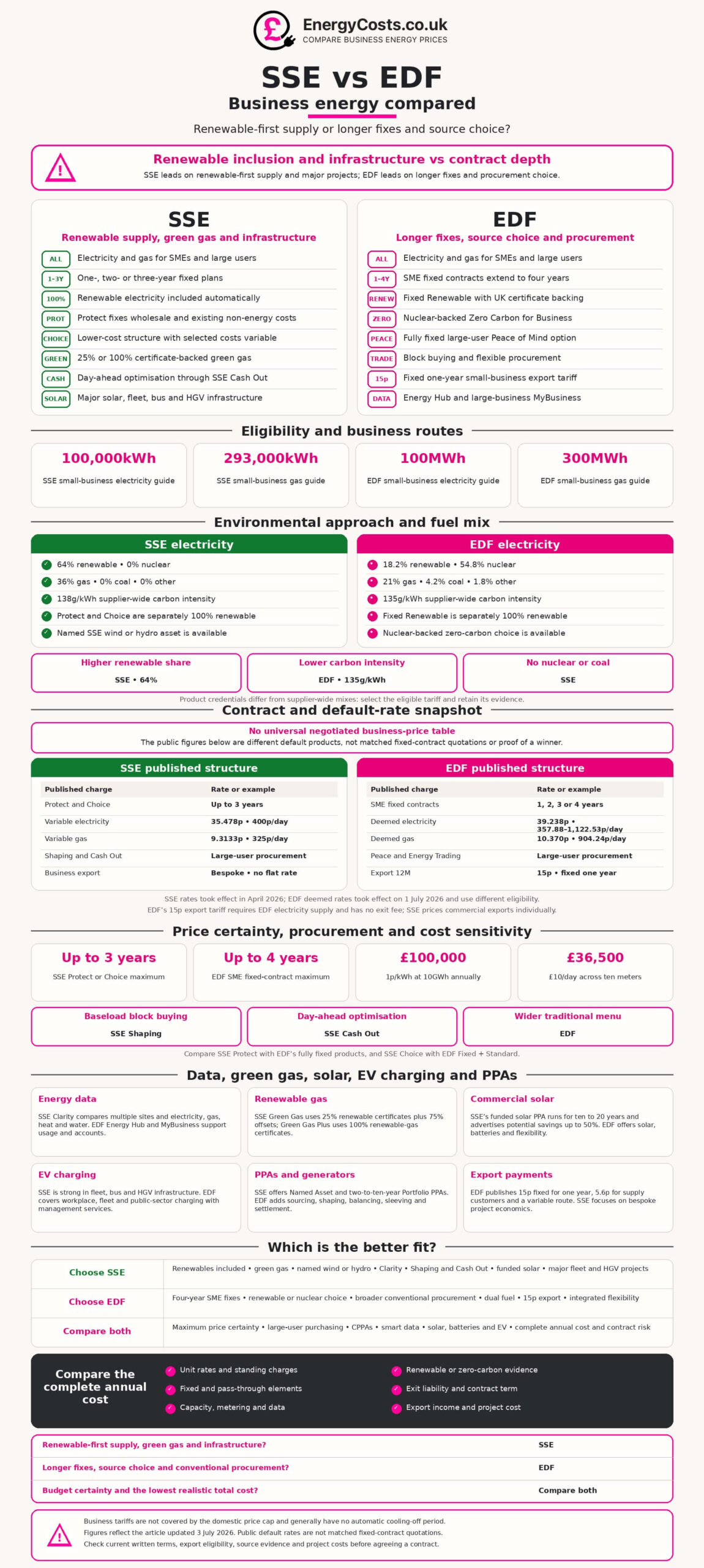
SSE’s fixed SME plans run for up to three years and include renewable electricity, while EDF promotes small-business fixed-price security for up to four years.
Which businesses can apply?
Both suppliers serve ordinary SMEs and larger corporate users.
SSE separates small and large-business enquiries using annual consumption. Its small and medium-business route generally covers electricity consumption below 100,000kWh and gas consumption below 293,000kWh. Businesses above those levels are directed towards SSE’s large-business products.
EDF’s online small-business route is aimed principally at organisations using no more than 100MWh of electricity or 300MWh of gas annually. Higher-use customers are directed to EDF Large Business.
| Example business | Annual electricity use | Potentially suitable route |
|---|---|---|
| Independent shop | 12,000kWh | SSE Protect, SSE Choice or EDF fixed tariff |
| Medium office | 60,000kWh | SME contract from either supplier |
| Restaurant | 120,000kWh | SSE large-business route or EDF Large Business |
| Hotel | 400,000kWh | Large or multi-site contract |
| Manufacturer | 2GWh | Fixed or flexible procurement |
| National retailer | 10GWh | Multi-site fixed, flexible or CPPA arrangement |
| Business requiring renewable gas | Any qualifying level | SSE Green Gas |
| Company wanting nuclear-backed power | Suitable large-business account | EDF Zero Carbon for Business |
| Company installing major solar | Site-dependent | Compare SSE and EDF project proposals |
| Electric HGV operator | High site demand | SSE may have an infrastructure advantage |
A supplier can also consider creditworthiness, meter type, half-hourly data, available capacity, number of locations and payment history before offering a contract.
Which supplier is cheaper?
There is no single SSE-versus-EDF business price.
A quotation can depend on:
- the electricity MPAN or gas MPRN;
- postcode and distribution region;
- annual consumption;
- half-hourly demand shape;
- meter profile;
- electricity voltage;
- agreed capacity;
- residual charging band;
- number of sites;
- contract start date;
- contract length;
- payment method;
- credit assessment;
- renewable-product choice; and
- wholesale market conditions.
A complete comparison should calculate:
- Annual consumption × unit rate
- daily standing charge × 365
- capacity charges
- metering and data costs
- network and policy charges
- environmental-product costs
- VAT and Climate Change Levy where applicable
− export income and other credits
Business energy costs include wholesale, network, environmental and operating components, and Ofgem advises companies to examine the complete contract rather than concentrating only on the headline unit rate.
How unit-rate differences affect annual costs
| Annual consumption | Value of 0.5p/kWh | Value of 1p/kWh | Value of 3p/kWh | Value of 5p/kWh |
|---|---|---|---|---|
| 10,000kWh | £50 | £100 | £300 | £500 |
| 25,000kWh | £125 | £250 | £750 | £1,250 |
| 50,000kWh | £250 | £500 | £1,500 | £2,500 |
| 100,000kWh | £500 | £1,000 | £3,000 | £5,000 |
| 250,000kWh | £1,250 | £2,500 | £7,500 | £12,500 |
| 1GWh | £5,000 | £10,000 | £30,000 | £50,000 |
| 10GWh | £50,000 | £100,000 | £300,000 | £500,000 |
A difference of only 1p/kWh changes annual expenditure by £100,000 for an organisation consuming 10GWh.
How standing charges affect annual costs
| Daily standing-charge difference | Annual difference per meter | Difference across ten meters |
|---|---|---|
| 25p | £91.25 | £912.50 |
| 50p | £182.50 | £1,825 |
| £1 | £365 | £3,650 |
| £2 | £730 | £7,300 |
| £5 | £1,825 | £18,250 |
| £10 | £3,650 | £36,500 |
Standing charges can be especially important for landlords, seasonal businesses, vacant properties and organisations with many lightly used meters.
SSE Protect
SSE Protect is designed for businesses that prioritise budget certainty.
Its principal features are:
| SSE Protect feature | Detail |
|---|---|
| Wholesale energy | Fixed |
| Existing non-energy costs | Fixed |
| Maximum term | Three years |
| Electricity source | 100% renewable |
| Renewable assets | SSE-linked UK wind and hydro |
| Renewable gas | Optional |
| Budget certainty | High |
SSE describes Protect as fixing unit prices and all existing non-commodity costs. Exceptional new taxes, levies or regulatory charges may still be passed through under the applicable terms.
SSE Protect is likely to suit a business that:
- requires predictable budgets;
- cannot respond actively to wholesale prices;
- wants renewable electricity included;
- prefers straightforward forecasting; or
- cannot tolerate changes in network and policy costs.
The greater certainty may produce a higher opening quotation because SSE assumes more of the future cost risk.
SSE Choice
SSE Choice fixes wholesale energy but allows some non-energy costs to change.
Potentially variable elements can include transmission, distribution, balancing, environmental obligations and new regulatory costs.
| SSE Choice feature | Detail |
|---|---|
| Wholesale energy | Fixed |
| Non-energy costs | Can vary |
| Maximum term | Three years |
| Electricity source | 100% renewable |
| Opening-price positioning | SSE’s lower-cost fixed option |
| Budget certainty | Lower than Protect |
SSE describes Choice as its lowest-cost fixed-rate structure, with wholesale prices fixed for up to three years but non-energy prices potentially changing.
Choice may suit a company willing to accept some bill variation in exchange for a potentially lower initial rate.
SSE Protect versus SSE Choice
| Requirement | SSE Protect | SSE Choice |
|---|---|---|
| Maximum conventional certainty | Stronger | Weaker |
| Lower opening quotation | Less likely | More likely |
| Exposure to network-cost changes | Reduced | Greater |
| Renewable electricity | Included | Included |
| Contract length | Up to three years | Up to three years |
| Best for | Stable budgeting | Lower initial pricing with accepted risk |
A company should request both quotations and calculate the premium charged for transferring non-energy-cost risk to SSE.
EDF small-business fixed tariffs
EDF offers fixed small-business electricity and gas contracts lasting one, two, three or four years. EDF says its prices are reviewed weekly, so the available quotation can change as market conditions move.
EDF’s fixed SME proposition can include:
- fixed unit rates;
- fixed standing charges, subject to the contract;
- electricity, gas or dual fuel;
- online account management;
- smart-meter installation where eligible;
- Energy Hub access; and
- dedicated business support.
A four-year contract gives EDF an advantage where the company wants to avoid another procurement exercise for longer than SSE’s maximum three-year term.
The drawback is that a long fixed contract may become uncompetitive if market prices fall.
EDF Fixed Renewable
EDF Fixed Renewable matches every unit consumed with a UK Renewable Energy Guarantee of Origin.
The tariff provides:
| EDF Fixed Renewable feature | Detail |
|---|---|
| Renewable backing | 100% UK REGO-backed |
| SME term | One to four years |
| Market-based carbon emissions | Reportable as zero |
| Nuclear allocation | None within the renewable product |
| Unit and standing charges | Fixed, subject to terms |
| Best for | Renewable-only supply with a long fix |
EDF introduced the current small-business Fixed Renewable proposition in April 2026.
SSE fixed plans versus EDF Fixed Renewable
| Feature | SSE Protect and Choice | EDF Fixed Renewable |
|---|---|---|
| Renewable electricity | Included automatically | Must select the renewable tariff |
| Maximum term | Three years | Four years |
| Renewable source | SSE-linked wind and hydro | UK renewable generation backed by REGOs |
| Fully fixed option | SSE Protect | EDF fixed SME structure |
| Partly fixed option | SSE Choice | Mainly offered through large-business products |
| Nuclear allocation | None | None |
| Named asset upgrade | SSE Next Generation | Bespoke renewable or CPPA structure |
| Renewable gas option | Yes | No equivalent headline SME product |
SSE is stronger where renewable electricity should be standard with every fixed quotation.
EDF is stronger where the business wants a four-year renewable contract.
Published default rates
The public rates below are not normal negotiated quotations. They apply where a business is on variable or deemed pricing without an agreed fixed contract.
They can demonstrate the cost of failing to renew, but they cannot prove which supplier is cheaper for a new customer.
SSE Variable Business Rates
SSE’s latest published Variable Business Rates took effect in April 2026. Prices exclude VAT and levies such as CCL and can change with market conditions.
SSE non-half-hourly electricity
| Meter type | Unit rate | Standing charge |
|---|---|---|
| Profile class 1 or 3 unrestricted | 35.478p/kWh | 400p per day |
| Profile class 2 or 4 day | 36.242p/kWh | 400p per day |
| Profile class 2 or 4 night | 32.312p/kWh | 400p per day |
| Evening and weekend weekday rate | 37.045p/kWh | 400p per day |
| Evening and weekend rate | 33.358p/kWh | 400p per day |
| Off-peak | 32.190p/kWh | 400p per day |
| Profile classes 5–8 unrestricted | 33.653p/kWh | 984.36p per day |
| Profile classes 5–8 day | 34.791p/kWh | 984.36p per day |
| Profile classes 5–8 night | 30.014p/kWh | 984.36p per day |
The 400p daily standing charge equals £1,460 a year.
The profile class 5–8 charge of approximately 984.36p a day equals about £3,593 annually.
Illustrative SSE unrestricted electricity costs
These examples use 35.478408p/kWh and a £4 daily standing charge.
| Annual use | Unit-rate cost | Standing charge | Total |
|---|---|---|---|
| 10,000kWh | £3,547.84 | £1,460 | £5,007.84 |
| 21,000kWh | £7,450.47 | £1,460 | £8,910.47 |
| 25,000kWh | £8,869.60 | £1,460 | £10,329.60 |
| 50,000kWh | £17,739.20 | £1,460 | £19,199.20 |
| 100,000kWh | £35,478.41 | £1,460 | £36,938.41 |
These figures exclude VAT, CCL, metering and other applicable charges.
EDF deemed non-half-hourly electricity
EDF’s current large-business non-half-hourly deemed prices took effect on 1 July 2026.
The unit rate is 39.238p/kWh for profile classes 01–08. Standing charges vary by distribution region and residual charging band.
| EDF TCR category | Published standing-charge range |
|---|---|
| No Residual | 357.88p–385.16p per day |
| Band 1 | 380.51p–414p per day |
| Band 2 | 424.09p–486.42p per day |
| Band 3 | 506.15p–628.76p per day |
| Band 4 | 784.04p–1,122.53p per day |
Illustrative EDF Band 1 costs
The following examples use the published 39.238p/kWh rate and the Band 1 standing-charge range.
| Annual use | Lowest regional total | Highest regional total |
|---|---|---|
| 10,000kWh | £5,312.66 | £5,434.90 |
| 25,000kWh | £11,198.36 | £11,320.60 |
| 50,000kWh | £21,007.86 | £21,130.10 |
| 100,000kWh | £40,626.86 | £40,749.10 |
The figures exclude VAT, CCL and metering costs.
SSE versus EDF published electricity rates
| Factor | SSE | EDF |
|---|---|---|
| Tariff type | Variable Business Rate | Deemed large-business rate |
| Effective date | April 2026 | July 2026 |
| Unrestricted unit rate | 35.478p/kWh | 39.238p/kWh |
| Basic standing-charge example | 400p/day | Region and TCR-band dependent |
| Negotiated fixed quote | No | No |
| Suitable for direct supplier comparison | No | No |
SSE’s published unrestricted rate is lower, but this does not establish that SSE will provide the cheaper fixed contract.
The figures apply to different default products, were introduced on different dates and do not include all charges.
Half-hourly default electricity
SSE’s half-hourly Variable Business Rates vary by voltage, measurement class and time band. Its April schedule includes low-voltage unrestricted rates of approximately 28.28p–30.41p/kWh, standing charges of approximately £18.36–£23.98 per day and capacity charges in addition. Winter peak rates on seven-band products can exceed 70p/kWh.
EDF’s July 2026 half-hourly deemed rates also vary by voltage and region. Low-voltage “all other times” prices range from approximately 38.10p to 41.18p/kWh, while night rates are approximately 35.65p to 36.47p/kWh. Separate capacity and TCR-band standing charges apply.
A half-hourly business should compare costs using actual interval data, agreed capacity and the complete meter-specific charge schedule.
Published gas rates
SSE’s April 2026 monthly billed Variable Business Rate for gas customers in EUC bands 1–2 is 9.3133p/kWh plus 325p per day. Quarterly billed customers pay 9.78264p/kWh plus the same standing charge. EUC band 3 is 8.938053p/kWh plus approximately 962p per day.
EDF’s deemed business-gas rate effective from 1 July 2026 is 10.370p/kWh plus 904.24p per day.
Illustrative gas comparison
The table uses SSE’s monthly billed bands 1–2 rate and EDF’s current deemed gas price.
| Annual gas use | SSE variable total | EDF deemed total |
|---|---|---|
| 25,000kWh | £3,514.57 | £5,892.98 |
| 30,000kWh | £3,980.24 | £6,411.48 |
| 50,000kWh | £5,842.90 | £8,485.48 |
| 100,000kWh | £10,499.55 | £13,670.48 |
| 250,000kWh | £24,469.50 | £29,225.48 |
These are default-rate illustrations rather than fixed quotations. They exclude VAT and CCL.
Can the published rates identify a winner?
No.
SSE’s prices are Variable Business Rates. EDF’s prices are deemed rates for premises supplied without an agreed contract.
A negotiated SSE Protect, SSE Choice or EDF fixed tariff could be materially lower.
The published figures are useful mainly for showing why a business should avoid remaining on default pricing.
SSE large-business plans
SSE’s large-business range includes Protect, Choice, Shaping and Cash Out.
SSE Shaping
SSE Shaping allows the customer to purchase transparent baseload products while SSE fixes or manages the remaining non-baseload volume.
The plan provides:
- access to live market prices;
- a fixed usage shape;
- staged purchasing;
- greater control over wholesale timing; and
- renewable-product options.
It may suit a large user that wants active procurement without managing every element of the demand profile internally.
SSE Cash Out
SSE Cash Out combines real-time consumption with half-hourly prices for the following day.
It can help a business:
- improve demand forecasts;
- move consumption;
- optimise batteries;
- operate on-site generation;
- respond to price changes; and
- sell electricity back where suitable flexible technology is available.
Cash Out is designed for sophisticated organisations rather than ordinary SMEs.
EDF large-business fixed contracts
EDF publishes several named fixed structures.
Fixed + Peace of Mind
This is EDF’s highest-certainty large-business product.
It is designed to fix wholesale and eligible non-energy costs for qualifying electricity supplies.
Fixed + Standard
Fixed + Standard fixes wholesale energy and EDF’s service charge, while forecast non-energy costs can vary.
Fixed + Energy Trading
This structure allows the customer to purchase blocks of electricity through EDF’s trading desk while EDF manages the remaining requirements.
| Requirement | Relevant EDF option |
|---|---|
| Maximum conventional certainty | Fixed + Peace of Mind |
| Lower opening price with variable third-party costs | Fixed + Standard |
| Staged wholesale purchases | Fixed + Energy Trading |
| Electricity and gas under one relationship | Dual-fuel solution |
| Renewable or nuclear-backed electricity | Add eligible energy source |
EDF therefore provides a clearer conventional progression from a fully fixed arrangement to active trading.
EDF flexible contracts
EDF’s flexible contracts allow customers to decide when energy is purchased, how much is fixed and which third-party costs remain variable.
EDF also provides market data and specialist support to help customers manage purchasing risk.
Flexible procurement can reduce the risk of fixing an entire forecast on an expensive day, but it can also leave the company exposed if markets rise before its remaining volume is purchased.
SSE versus EDF for large-business procurement
| Requirement | Likely stronger fit |
|---|---|
| Fully fixed renewable contract | SSE Protect or EDF Peace of Mind with renewable source |
| Wholesale fixed, industry costs variable | SSE Choice or EDF Fixed + Standard |
| Baseload block trading | SSE Shaping |
| EDF trading-desk block purchases | EDF Fixed + Energy Trading |
| Day-ahead consumption optimisation | SSE Cash Out |
| Extensive traditional procurement menu | EDF |
| Named SSE wind or hydro asset | SSE |
| Nuclear-backed zero carbon | EDF |
| Combined fixed and flexible supply | Compare both |
| Virtual power and flexible assets | Compare SSE Cash Out with EDF flexibility services |
SSE has a particularly distinctive day-ahead optimisation proposition.
EDF has the broader published menu of traditional fixed and flexible contract structures.
Comparing fuel mixes
SSE’s 2024/25 total business fuel mix was 64% renewable and 36% natural gas, with carbon emissions of 138g/kWh and no reported radioactive waste.
EDF’s corresponding supplier-wide mix was 18.2% renewable, 54.8% nuclear, 21% gas, 4.2% coal and 1.8% other, with emissions of 135g/kWh and radioactive waste of 0.0038g/kWh.
| Source or impact | SSE Energy Solutions | EDF |
|---|---|---|
| Renewables | 64% | 18.2% |
| Natural gas | 36% | 21% |
| Coal | 0% | 4.2% |
| Nuclear | 0% | 54.8% |
| Other | 0% | 1.8% |
| Carbon emissions | 138g/kWh | 135g/kWh |
| Radioactive waste | 0g/kWh | 0.0038g/kWh |
The supplier-wide carbon intensities are similar, but the generation sources are very different.
SSE relies on a combination of renewable generation and natural gas.
EDF relies heavily on nuclear power, which lowers operational carbon emissions but produces radioactive waste.
Product-level fuel mixes
SSE’s renewable products are 100% renewable and report zero market-based emissions. Its non-renewable plans and Variable Business Rates were 98% gas and 2% renewable, with emissions of 374g/kWh.
EDF’s product disclosure shows:
| EDF product category | Renewable | Nuclear | Fossil and other | CO₂ |
|---|---|---|---|---|
| Zero Carbon | 0% | 100% | 0% | 0g/kWh |
| Renewable | 100% | 0% | 0% | 0g/kWh |
| All other | 0.5% | 53% | 46.5% | 233g/kWh |
A company should therefore compare product-level evidence rather than relying only on each supplier’s overall fuel mix.
Which supplier has greener electricity?
| Environmental priority | Likely stronger fit |
|---|---|
| Higher supplier-wide renewable share | SSE |
| No coal in supplier-wide mix | SSE |
| No nuclear generation | SSE |
| Lowest supplier-wide carbon intensity | EDF, by a small margin |
| Renewable electricity included with fixed plans | SSE |
| Renewable-only four-year tariff | EDF |
| Nuclear-backed zero-carbon option | EDF |
| Named UK wind or hydro asset | SSE |
| No radioactive waste | SSE renewable plans |
| Choice between renewable and nuclear power | EDF |
| Direct connection with SSE generation assets | SSE |
| Technology-neutral low-carbon policy | EDF offers more source choice |
SSE has the stronger renewable-first proposition.
EDF offers greater choice for organisations that regard nuclear electricity as an acceptable zero-carbon source.
SSE Next Generation
SSE Next Generation allocates the customer’s renewable electricity to a named SSE wind farm.
The customer receives supporting evidence and can describe its electricity as linked with a specific UK renewable asset.
This is more tangible than a generic renewable certificate and may be useful in tenders, annual reports and customer communications.
EDF Zero Carbon for Business
EDF Zero Carbon for Business is nuclear-backed rather than renewable.
EDF’s product disclosure allocates 100% nuclear electricity to its Zero Carbon category and reports zero carbon dioxide per kWh under market-based accounting.
This may suit a business that prioritises low operational carbon and accepts nuclear generation.
It will not satisfy an environmental policy requiring 100% renewable power.
Renewable business gas
SSE has a clear advantage where the company requires an environmental gas option.
SSE Green Gas
SSE Green Gas matches:
| Environmental mechanism | Proportion |
|---|---|
| Renewable-gas certificates | 25% |
| Carbon offsets | 75% |
SSE also pledges to plant one UK tree for each Green Gas customer.
SSE Green Gas Plus
Green Gas Plus matches 100% of consumption with renewable-gas certificates.
The physical gas reaching the premises remains part of the mixed national network. The certificates demonstrate that an equivalent amount of biomethane has entered the gas system.
EDF does not currently foreground an equivalent standard SME product with a published renewable-gas percentage.
| Gas requirement | Likely stronger fit |
|---|---|
| Ordinary business gas | Compare quotations |
| 25% renewable certificate product | SSE |
| 100% certificate-backed renewable gas | SSE |
| Carbon-offset option | SSE |
| Conventional large-business dual fuel | EDF or SSE |
| Replacing gas with electrification | Compare wider project services |
Gas combustion still creates direct emissions at the premises, regardless of certificates or offsets.
Energy-management platforms
SSE Clarity
SSE Clarity is available free to eligible SSE customers with smart or AMR meters.
It can:
- display half-hourly data;
- compare multiple sites;
- organise information by meter, supply, time or utility;
- send email alerts;
- identify unusual consumption;
- create reports; and
- analyse electricity, gas, heat and water data.
EDF Energy Hub and MyBusiness
EDF small-business customers with compatible smart or AMR meters can use Energy Hub to inspect and download consumption data.
Large customers can use MyBusiness to view bills, monitor energy and manage account queries.
Which has the better energy-data service?
| Requirement | Likely stronger fit |
|---|---|
| Multi-site comparison | SSE Clarity |
| Email alerts | SSE Clarity |
| Electricity, gas, heat and water data | SSE Clarity |
| Industry benchmarking | SSE advanced Clarity reports |
| Simple SME usage downloads | EDF Energy Hub |
| Large-business billing portal | EDF MyBusiness |
| Procurement and market reporting | EDF |
| Daily operational exception reporting | SSE Clarity |
SSE Clarity has the stronger conventional energy-management proposition.
EDF’s tools integrate closely with its account and procurement services.
Corporate Power Purchase Agreements
SSE CPPAs
SSE offers Named Asset and Portfolio PPAs linked with wind, solar or hydro generation.
Its Portfolio PPA can run for between two and ten years. The company can combine the PPA with SSE’s fixed or flexible energy supply.
EDF CPPAs
EDF provides renewable CPPAs supported by services such as:
- generator sourcing;
- balancing;
- shaping;
- sleeving;
- settlement;
- renewable certificates; and
- integration with the company’s supply contract.
EDF’s wider large-business service may appeal to an organisation requiring complex procurement and settlement support.
| PPA requirement | Likely stronger fit |
|---|---|
| Named SSE wind, solar or hydro asset | SSE |
| Portfolio of SSE assets | SSE |
| Two- to ten-year portfolio PPA | SSE |
| Complex sleeving and supply integration | EDF |
| Renewable-generator sourcing | EDF |
| Combining PPA and flexible procurement | Either |
| Supporting new renewable generation | Compare individual project proposals |
The better provider depends on the asset, term, price formula, balancing risk and credit requirements.
Commercial solar
SSE provides a particularly broad commercial-solar proposition covering rooftop, ground-mounted and other large-site systems.
Its fully funded model includes design, funding, planning, grid connection, installation, operation and maintenance. The customer purchases the electricity through a PPA lasting ten to 20 years. SSE advertises potential savings of up to 50% on electricity purchased through the PPA, although actual results depend on the project.
EDF also supports business solar, batteries and EV integration. Its SME guidance recommends combining solar with batteries or commercial chargers where appropriate, while larger projects can be delivered through EDF’s commercial energy services.
SSE versus EDF for commercial solar
| Requirement | Likely stronger fit |
|---|---|
| Turnkey rooftop solar | Compare both |
| Ground-mounted solar | SSE |
| Floating solar | SSE |
| Fully funded ten- to 20-year PPA | SSE |
| Direct ownership | Both |
| SME solar and export package | EDF |
| Battery integration | Both |
| Solar with large infrastructure project | SSE |
| Solar with flexibility-market optimisation | EDF |
| Public-sector or complex estate project | Compare both |
SSE has the more prominently documented end-to-end infrastructure service.
EDF may be attractive where solar forms part of a wider supply, export and flexibility arrangement.
Solar export payments
EDF publishes three small-business export routes.
| EDF export tariff | Rate | Main condition |
|---|---|---|
| Export 12M Small Business | 15p/kWh | EDF electricity customer |
| SEG Export Variable Value | 5.6p/kWh | EDF electricity customer |
| SEG Export Variable | Variable | Open to eligible non-EDF customers |
The 15p tariff is fixed for one year and carries no exit fee.
SSE does not prominently publish one universal flat commercial SEG rate on its current business-energy pages. Its commercial generation proposition instead focuses on solar PPAs, private-wire arrangements and bespoke project economics. This is an inference from SSE’s current published solar and CPPA materials.
Illustrative EDF export income
| Annual export | Income at 15p/kWh |
|---|---|
| 5,000kWh | £750 |
| 10,000kWh | £1,500 |
| 25,000kWh | £3,750 |
| 50,000kWh | £7,500 |
| 100,000kWh | £15,000 |
EDF has the advantage where the company wants a clearly published off-the-shelf export rate.
SSE may be more suitable where generation is part of a bespoke financed project or large PPA.
Electric vehicle charging
SSE promotes workplace EV charging and provides wider infrastructure for fleets and larger transport projects. Its business proposition includes charging equipment and integration with low-carbon energy services.
EDF supports small-business charger installation and larger fleet or public-sector charging projects. Its May 2026 SME guidance highlights consumption tracking, charging revenue information and smart power management with load-balancing equipment.
| EV requirement | Likely stronger fit |
|---|---|
| Basic workplace chargers | Compare both |
| Major fleet depot | SSE may have an advantage |
| Bus or HGV infrastructure | SSE |
| Public-sector charging programme | EDF |
| Charging revenue and usage management | EDF |
| Solar and charger integration | Both |
| Complex network and site infrastructure | SSE |
| Flexible-asset participation | EDF |
SSE is especially strong for the physical infrastructure around major charging sites.
EDF may be stronger where charging is connected with wider flexibility and energy-management services.
Multi-site organisations
Both suppliers can support national estates and complex meter portfolios.
SSE can combine:
- Protect, Choice, Shaping or Cash Out;
- SSE Clarity;
- renewable electricity;
- renewable gas;
- solar;
- batteries;
- EV charging;
- CPPAs; and
- named renewable assets.
EDF can combine:
- fixed and flexible procurement;
- renewable and nuclear-backed power;
- dual fuel;
- MyBusiness;
- Energy Hub;
- solar;
- batteries;
- EV charging;
- flexibility services; and
- CPPAs.
SSE may be stronger for a renewable-led estate requiring infrastructure and conventional energy analytics.
EDF may be stronger where the organisation wants extensive procurement choice and a mixture of renewable and nuclear-backed products.
Contract expiry and switching
If a business does not arrange a replacement contract, it may move onto deemed, variable or extended-supply pricing.
The published default-rate tables show that these arrangements can carry high unit rates and standing charges.
A company should normally start reviewing its contract several months before expiry and check:
- renewal dates;
- termination windows;
- automatic rollover provisions;
- default prices;
- broker authority;
- early termination charges; and
- whether a new supplier can complete the switch before the existing contract ends.
Business contract protections
Business energy agreements are not protected by the domestic energy price cap. Ofgem also states that there is no cooling-off period after agreeing a business contract, including one accepted over the telephone.
Before accepting an SSE or EDF quotation, check:
- unit rates;
- standing charges;
- contract term;
- fixed and pass-through costs;
- capacity charges;
- metering fees;
- volume tolerance;
- renewable certificates;
- nuclear content;
- broker commission;
- early termination liability;
- moving-premises rules;
- export eligibility;
- renewal procedure; and
- post-contract prices.
SSE advantages and disadvantages
Advantages
- Supplies SMEs and major organisations.
- Offers both fully and partly fixed structures.
- SSE Protect provides extensive budget certainty.
- SSE Choice can offer a lower opening price.
- Fixed electricity includes 100% renewable power.
- Renewable electricity comes from SSE-linked UK wind and hydro assets.
- No nuclear power is allocated to SSE renewable plans.
- SSE Next Generation links the customer with a named asset.
- Offers 25% and 100% renewable-gas products.
- SSE Clarity provides detailed multi-utility analytics.
- SSE Shaping supports baseload purchasing.
- SSE Cash Out supports day-ahead optimisation.
- Offers Named Asset and Portfolio CPPAs.
- Strong commercial-solar proposition.
- Fully funded solar PPAs are available.
- Strong fleet and heavy-transport infrastructure capabilities.
Disadvantages
- Maximum standard fixed term is three years.
- Negotiated contract prices are not published.
- SSE Choice allows non-energy costs to vary.
- Exceptional new charges may still affect SSE Protect.
- Variable default standing charges can be high.
- Non-renewable SSE products were reported as 98% gas.
- Supplier-wide carbon intensity is slightly above EDF’s.
- No nuclear-backed zero-carbon option is prominently offered.
- No universal flat business export rate is published.
- Flexible procurement is complex.
- Long solar and CPPA agreements require detailed legal review.
EDF advantages and disadvantages
Advantages
- Supplies SMEs and major corporate users.
- Small-business fixed terms extend to four years.
- Fixed Renewable provides renewable-only backing.
- Offers nuclear-backed Zero Carbon for Business.
- Provides renewable, nuclear and mixed-source choices.
- Extensive large-business fixed and flexible product range.
- Fixed + Peace of Mind provides strong cost certainty.
- Fixed + Energy Trading supports staged purchasing.
- Flexible contracts include market insight and specialist support.
- Energy Hub and MyBusiness support digital account management.
- Strong CPPA and generator-service capabilities.
- Offers commercial solar and batteries.
- Publishes a 15p/kWh small-business export tariff.
- Provides business EV charging and flexibility services.
- Supplier-wide carbon intensity is relatively low.
Disadvantages
- Negotiated business prices are not published.
- Supplier-wide renewable share is only 18.2%.
- Supplier-wide nuclear share is 54.8%.
- Overall mix includes gas and coal.
- Renewable-only power must be selected explicitly.
- A four-year fix can become expensive if market prices fall.
- Early termination costs can apply.
- Flexible products require procurement expertise.
- EDF’s current deemed electricity and gas rates are high.
- The highest export rate requires EDF electricity supply.
- EDF does not prominently offer a standard renewable-gas product.
Which supplier is better for different businesses?
| Business type or requirement | Likely better fit | Reason |
|---|---|---|
| SME wanting maximum conventional certainty | SSE Protect or EDF fixed | Compare matched quotes |
| SME wanting a four-year fix | EDF | Longer term |
| Business accepting pass-through costs | SSE Choice | Defined lower-cost structure |
| Company wanting renewable electricity automatically | SSE | Included with fixed plans |
| Company wanting nuclear-backed zero carbon | EDF | Dedicated product |
| Company excluding nuclear power | SSE or EDF Fixed Renewable | Renewable-only options |
| Company requiring renewable gas | SSE | Two defined products |
| Business wanting a named wind farm | SSE | Next Generation |
| Large user wanting baseload trading | SSE Shaping | Dedicated structure |
| Large user wanting staged EDF purchases | EDF | Fixed + Energy Trading |
| Company wanting day-ahead demand optimisation | SSE Cash Out | Core product feature |
| Company wanting traditional procurement choice | EDF | Wider published menu |
| Business needing multi-utility analytics | SSE Clarity | Electricity, gas, water and heat |
| Business seeking a published export rate | EDF | Up to 15p/kWh |
| Company wanting fully funded commercial solar | SSE | Clear ten- to 20-year PPA |
| Public-sector flexibility project | EDF | Broad services |
| HGV or major fleet infrastructure | SSE | Strong physical infrastructure proposition |
| Complex national estate | Compare both | Different strengths |
Final verdict: SSE vs EDF
SSE Energy Solutions and EDF are both strong business suppliers, but their main advantages suit different priorities.
SSE is likely to be the better choice where the company wants:
- renewable electricity included automatically;
- a clear choice between fully and partly fixed prices;
- no nuclear allocation;
- renewable gas;
- a named UK wind or hydro asset;
- SSE Clarity;
- baseload purchasing;
- day-ahead optimisation;
- a Portfolio or Named Asset PPA;
- fully funded commercial solar; or
- substantial fleet, bus or HGV infrastructure.
EDF is likely to be stronger where the business wants:
- a fixed SME tariff lasting up to four years;
- renewable-only or nuclear-backed electricity;
- a wider choice of energy sources;
- extensive fully fixed, partly fixed and flexible procurement;
- block purchasing through a trading desk;
- a conventional large-business dual-fuel arrangement;
- a published export tariff paying 15p/kWh; or
- an integrated supply, flexibility and CPPA strategy.
The environmental comparison is nuanced.
SSE has the much higher supplier-wide renewable share:
- SSE: 64% renewable and 36% natural gas;
- EDF: 18.2% renewable, 54.8% nuclear, 21% gas and 4.2% coal.
EDF nevertheless reported slightly lower supplier-wide carbon emissions:
- SSE: 138g/kWh;
- EDF: 135g/kWh.
This is primarily because EDF’s mix contains a large amount of low-carbon nuclear generation.
At product level, both can provide renewable-only electricity:
- SSE includes renewable electricity in Protect and Choice;
- EDF offers Fixed Renewable and renewable large-business products.
The price comparison cannot be settled using the public default rates.
SSE’s Variable Business Rates and EDF’s deemed rates cover different products and effective periods. A negotiated fixed quotation from either supplier may be substantially lower.
A fair comparison should require both suppliers to quote for:
- the same meter and postcode;
- identical annual consumption;
- the same contract start date;
- an equivalent contract duration;
- all standing charges;
- capacity and metering costs;
- fixed and pass-through elements;
- equivalent renewable credentials;
- volume-tolerance rules;
- broker commission;
- export income;
- early termination liability;
- renewal and default pricing; and
- the complete projected annual cost.
For most companies, the conclusion is:
- choose SSE for renewable-first fixed supply, green gas, named assets and major infrastructure;
- choose EDF for longer SME fixes, nuclear-backed zero carbon, extensive procurement choice and published export payments;
- compare SSE Protect with EDF’s fully fixed products where budget certainty matters;
- compare SSE Choice with EDF Fixed + Standard where opening price matters more than complete certainty;
- compare SSE Shaping and Cash Out with EDF’s trading and flexible contracts for large users; and
- select the supplier offering the lowest realistic annual cost after every standing, capacity, metering and pass-through charge is included.
FAQ
It depends on the individual quotation. The published variable and deemed rates are not normal fixed-contract offers and cannot identify a universal winner.
Yes. Both supply electricity to SMEs, multi-site organisations and large industrial customers.
Yes. Both provide commercial gas contracts.
EDF. Its small-business fixed tariffs can last up to four years, compared with three years for SSE.
SSE Protect and Choice include 100% renewable electricity from SSE-linked UK wind and hydro assets.
No. SSE’s total 2024/25 business mix was 64% renewable and 36% natural gas.
Yes. EDF Fixed Renewable and selected large-business products provide 100% renewable-backed electricity.
No. EDF’s overall renewable share was 18.2%. Nuclear power represented 54.8% of its supplier-wide mix.
SSE. Its supplier-wide renewable proportion was 64%, compared with 18.2% for EDF.
EDF reported 135g/kWh, compared with 138g/kWh for SSE. The difference is small and reflects EDF’s high nuclear share.
EDF uses substantial nuclear generation. SSE’s disclosed business mix contained no nuclear power.
SSE. Green Gas matches 25% with renewable certificates, while Green Gas Plus matches 100%.
It is a fixed plan covering wholesale energy and existing non-energy costs for up to three years.
It fixes wholesale energy but permits selected network, government and other non-energy costs to change.
EDF has the broader conventional menu. SSE has distinctive Shaping and Cash Out products for baseload trading and daily optimisation.
SSE has a particularly clear fully funded solar PPA proposition. EDF also provides SME and large-commercial solar and battery services.
EDF publishes an eligible small-business tariff paying 15p/kWh. SSE generally prices commercial export and generation arrangements individually.
SSE is strong in major fleet and transport infrastructure. EDF provides workplace, fleet and public-sector charging with energy-management services.