

Starting a business, opening another site or moving into new commercial premises creates several decisions about gas and electricity. You may need to close an account at your previous address, register a change of tenancy, arrange a new contract, transfer an existing agreement or organise a completely new connection.
The most important point is that business energy contracts are normally connected to a specific electricity or gas supply point. Your existing tariff will not necessarily move with your business, even when you want to remain with the same supplier.
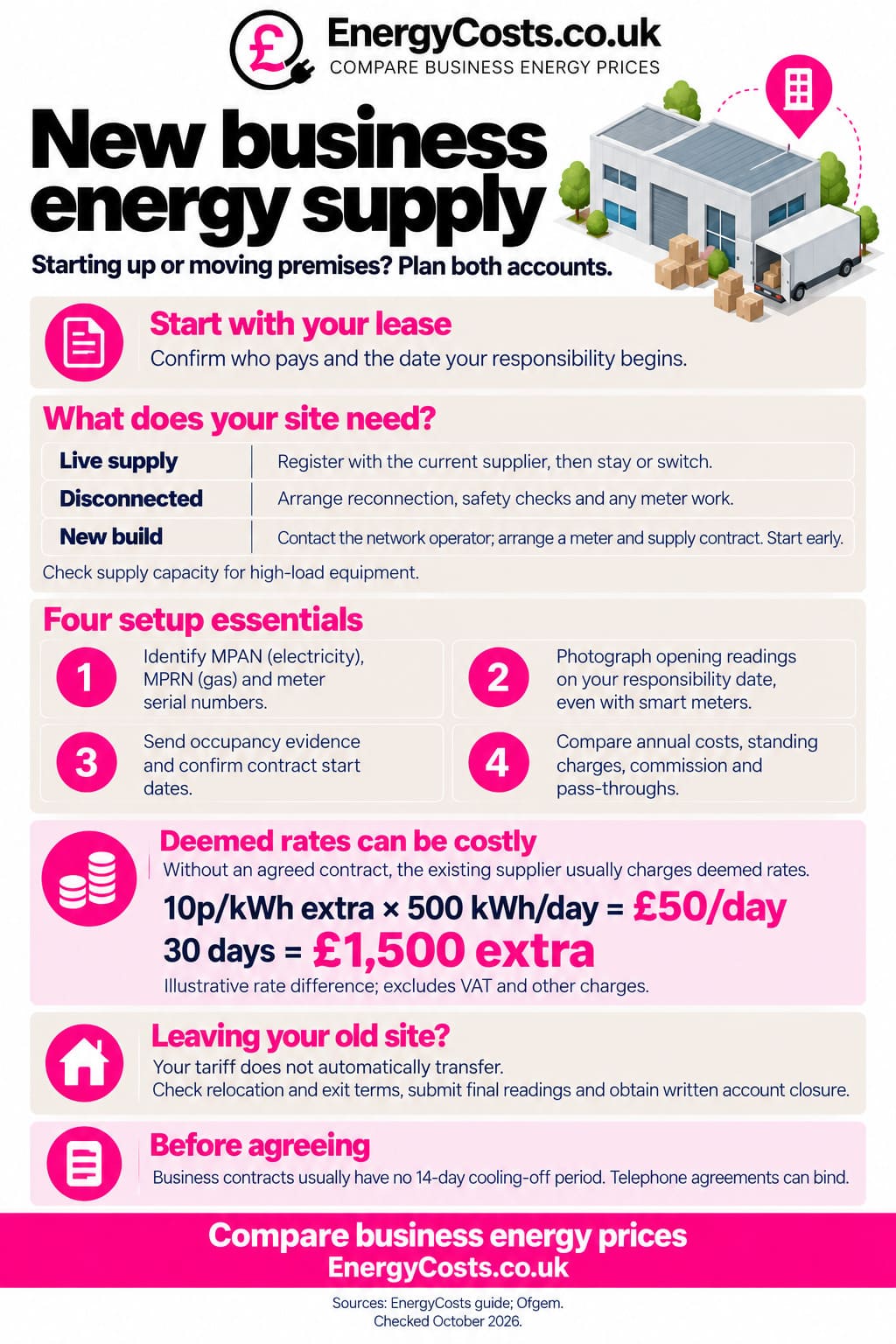
When you enter new premises and start using energy without agreeing a contract, the existing supplier will usually continue supplying the property under a deemed business energy contract. Deemed rates are often considerably less competitive than negotiated business energy prices, so it is usually sensible to arrange a new contract as early as possible.
Businesses can use EnergyCosts.co.uk to compare business electricity prices and compare business gas prices before committing to a new supplier or tariff.
This guide explains every main option, including:
- setting up energy for a completely new business
- moving an existing business to another property
- staying with the existing supplier at the new premises
- switching the new premises to a different supplier
- asking whether an existing contract can be transferred
- ending the account at the old premises
- dealing with deemed and out-of-contract rates
- arranging connections or meters at a new or disconnected property
- using a business energy broker, and
- resolving change-of-tenancy and billing problems
The main options at a glance
| Situation | Main option | Important consideration |
| Starting a business in previously occupied premises | Register as the new occupier and agree a contract | The existing supplier may charge deemed rates until the new contract begins |
| Starting a business in a new-build property | Arrange a connection, meter and supply contract | This can take longer than a normal supplier switch |
| Moving into premises supplied by your preferred supplier | Open a new account and negotiate a contract | Your previous tariff may not automatically carry across |
| Moving into premises supplied by another company | Register with the current supplier, then stay or switch | Complete the change of tenancy before or alongside the switch |
| Leaving old premises | Close the old account and provide final readings | Do not assume the account will close automatically |
| Keeping the old and new sites | Retain the old contract and arrange a separate contract for the new site | Consider a multi-site contract where appropriate |
| Moving during a fixed contract | Check whether the supplier will transfer, replace or terminate it | Charges and available options depend on the contract terms |
| Energy included in rent or service charges | Confirm responsibility with the landlord or managing agent | You may not have a direct supplier account or the right to switch |
| Premises temporarily empty | Tell the supplier who is responsible during the vacant period | Standing charges and other costs may still continue |
First determine who is responsible for the energy
Before comparing tariffs, check the lease, tenancy agreement, purchase documents or serviced-office agreement.
The business occupying the premises will usually be responsible for the gas and electricity account, but there are important exceptions. Energy may be:
- included in the rent
- recharged by the landlord
- included in a service charge
- supplied through a private wire or submeter
- managed centrally in a shopping centre, industrial estate or serviced office, or
- paid directly to a licensed energy supplier by the occupier
Ofgem recommends checking whether energy costs are included in the tenancy agreement before moving. Where the landlord pays the supplier, the occupier may have no direct contract with the energy company and may be unable to choose the supplier independently.
Ask the landlord or agent for written confirmation of:
- who is responsible for the bills
- the date responsibility begins
- whether electricity and gas are separately metered
- whether the meters serve only your unit
- whether any energy is recharged
- the current suppliers
- the MPAN and MPRN
- the current meter readings
- whether a supply has been disconnected
- whether the property has a smart, advanced or half-hourly meter, and
- whether the lease limits or regulates supplier changes
Do not rely entirely on information supplied by the previous occupier. Confirm the supplier, meter and supply numbers independently where possible.
What happens to the existing supply when you move in?
Changing occupier does not normally interrupt the physical supply. Electricity and gas should continue to flow unless the property has been disconnected, the meter has been removed or there is a technical problem.
However, the previous occupier’s negotiated contract does not simply become your contract. You are a different customer and must register your business with the supplier.
The industry process for updating responsibility is usually called a:
- change of tenancy
- change of occupier
- change of ownership, or
- COT or COO process
You should notify the current supplier for the property as soon as possible, even when you intend to switch immediately to another supplier.
The supplier may ask for evidence showing when your responsibility began. Acceptable documents can include:
- a signed lease or tenancy agreement
- a property completion statement
- title deeds
- confirmation from a landlord
- a solicitor’s or estate agent’s letter
- a business rates bill
- mortgage documents
- a bank letter, or
- another document connecting the business to the premises
Under Ofgem’s published change-of-tenancy guidance, the supplier should review the evidence within 10 working days. It should then open the new account, explain why it has rejected the change or specify what additional evidence it needs.
Take opening meter readings immediately
Record every meter reading on the date your lease, ownership or liability begins.
Take clear photographs showing:
- the complete meter
- the meter serial number
- every register displayed
- the reading
- the date, where your device records it, and
- enough of the surrounding area to identify the meter location
Do this even when the premises has a smart meter. Smart meters do not eliminate the possibility of missing data, communications problems, incorrect meter records or a disputed opening reading.
Send the readings to the existing supplier in writing and retain the photographs. This will reduce the risk of being charged for energy used by the previous occupier.
Where there are several meters, create a schedule containing:
| Information | Example |
| Meter type | Electricity |
| Meter serial number | The number printed on the meter |
| MPAN or MPRN | Supply identification number |
| Register | Day, night, weekend or total |
| Opening reading | Reading on responsibility date |
| Reading date | Lease or completion date |
| Meter location | Ground-floor plant room |
| Photograph reference | Image filename or record number |
This is particularly important in buildings where meters are grouped together. Supplying the wrong meter serial number could cause the business to be registered against another unit’s supply.
What is a deemed business energy contract?
A deemed contract normally begins when a business occupies premises, uses gas or electricity and has not agreed a negotiated contract with the existing supplier.
No document has to be signed for the deemed arrangement to apply. The business uses the energy, the supplier provides it and the supplier charges its published deemed rates.
A deemed contract can also arise when an existing contract ends and does not state what will happen afterwards. It is different from an out-of-contract tariff, which applies where the original agreement specifically states which rates will apply after the fixed term ends.
Deemed contracts are useful because they prevent a gap in the commercial relationship while the new occupier arranges a tariff. However, they should generally be treated as a temporary solution because:
- deemed unit rates may be high
- standing charges may be high
- prices may change
- the tariff may not suit the business’s usage pattern, and
- the business may have fewer budgeting protections than under a fixed agreement
A business on a genuine deemed tariff can normally negotiate a contract with the existing supplier or switch to another supplier without waiting for a fixed term to end. Deemed contracts should not normally contain an exit fee.
Option one: agree a contract with the existing supplier
The simplest option can be to remain with the company already supplying the premises.
This avoids changing the registered supplier and can reduce the number of processes happening at the same time. The supplier still needs to complete the change of tenancy and open an account in the correct business name.
Ask the existing supplier for:
- its deemed rates from your occupancy date
- fixed and variable contract options
- unit rates
- standing charges
- contract length
- payment requirements
- broker or commission charges
- additional fees
- renewable energy options
- the proposed contract start date, and
- the complete terms and conditions
Remaining with the current supplier may be useful where:
- energy is needed immediately
- the supplier offers competitive prices
- the site has unusual or complex metering
- a rapid contract start is important
- another supplier will not accept the site
- the business has a limited credit history, or
- you want the change-of-tenancy process completed before considering a switch
However, convenience should not replace comparison. Review the available business energy suppliers and obtain quotations from other companies before committing where time allows.
Option two: switch the premises to another supplier
You are not required to remain on the existing supplier’s deemed tariff indefinitely. Once the change of occupier has been accepted, you can normally switch to a new supplier.
When an incoming business also wants to change supplier, it should notify both the current and proposed suppliers and provide evidence to both. The new supplier starts the switch, while the current supplier can reject it if it does not accept that a genuine change of occupier occurred.
Gas and electricity do not have to be purchased from the same company. A business can use separate gas and electricity suppliers where this provides better prices, terms or service.
Potential causes of delay include:
- incomplete change-of-tenancy evidence
- an incorrect MPAN or MPRN
- the wrong meter serial number
- debt incorrectly attributed to the new occupier
- inconsistent address records
- a disputed occupancy date
- an existing contractual objection
- complex metering arrangements
- a disconnected supply, or
- a credit-check or security-deposit requirement
Where possible, submit the change-of-tenancy evidence and proposed switch together rather than waiting until several weeks after moving in.
Option three: remain temporarily on deemed rates
It is possible to remain on the existing supplier’s deemed contract while you assess the property’s energy requirements.
This may be reasonable for a short period where:
- the business has no reliable consumption estimate
- equipment is still being installed
- opening hours are uncertain
- the property may not be retained
- major refurbishment is taking place
- a permanent meter change is planned, or
- a new company cannot yet pass supplier credit checks
The risk is that any saving achieved by delaying the decision may be outweighed by the additional deemed-rate charges.
Before choosing this option, calculate the likely daily difference between the deemed tariff and the best available contract.
For example, if a deemed electricity rate is 10p per kWh higher and the premises consumes 500kWh per day, the additional unit-rate cost would be:
- 500kWh × £0.10 = £50 per day
This would equal approximately £1,500 over 30 days, before comparing standing charges or other fees.
The figures used in that example are illustrative rather than a statement of current market prices. Our guide to calculating small business energy costs explains how to combine consumption, unit rates, standing charges, VAT and other costs.
Option four: ask to transfer or replace your existing contract
Businesses often describe this as “taking the existing tariff with them”, but the process is not always a simple transfer.
A business energy contract normally identifies a particular supply point, meter or premises. The supplier may therefore need to:
- end the original site agreement
- open a new contract at the new supply point
- novate or vary the existing agreement
- transfer the remaining term subject to new prices
- replace the agreement entirely, or
- decline the transfer
Most suppliers will not allow a customer to switch away from a fixed agreement before its end date, but moving premises can be governed by separate relocation provisions.
Ask the supplier the following questions:
- Does the existing contract end when we legally leave the premises?
- Is there a minimum notice requirement?
- Is a termination fee payable?
- Are there volume, hedging or loss-recovery charges?
- Can the contract be transferred to the new MPAN or MPRN?
- Will the unit rate and standing charge remain unchanged?
- Does the new site’s meter type affect eligibility?
- Must the new premises already be supplied by the same company?
- Will a new credit check be required?
- Will the contract end if the supplier cannot serve the new location?
Do not accept a verbal assurance that a tariff will be moved without obtaining the new terms and prices in writing.
A supplier may be willing to retain your business but offer different prices because network charges, meter type, consumption, capacity and purchasing dates can differ between the two sites.
Businesses facing early-exit charges should read our guide explaining whether you can get out of a business energy contract.
Option five: negotiate a completely new contract
A move can be an opportunity to review the whole energy purchasing strategy rather than simply recreating the previous arrangement.
A new contract may be appropriate where:
- the new property uses substantially more or less energy
- the business is changing its opening hours
- electric heating or air conditioning is being introduced
- new manufacturing equipment is being installed
- electric vehicle charging is planned
- solar panels or battery storage are being added
- the new site uses half-hourly electricity metering
- the previous supplier’s service was poor, or
- the business wants renewable electricity
Business energy agreements can run for several years, although the right term depends on the business’s budget, risk tolerance and future property plans. Our guide to negotiating business energy contracts explains how to compare quotations, charges and contract terms.
Common contract options include:
Fixed-rate contract
The unit rate is fixed for an agreed period. This offers greater budget certainty, although not every component of the bill is necessarily fixed.
Check whether the agreement includes pass-through charges that can change during the contract. A tariff described as fixed may still allow certain third-party or regulatory costs to be adjusted.
Businesses considering a fixed deal can read our guide: Should I fix my business energy prices?
Variable-rate contract
Prices can rise or fall during the contract. This may provide flexibility but exposes the business to market changes.
Our fixed versus variable business energy tariff comparison explains the advantages, risks and budgeting implications of each option.
Fully fixed contract
More of the non-energy and third-party costs are fixed into the quoted rate. Definitions vary between suppliers, so check exactly which charges remain adjustable.
Pass-through contract
Some wholesale, network, government or metering costs are passed through at their actual level. This can make the headline rate appear lower while producing less predictable bills.
Businesses should check whether the quotation includes or passes through non-commodity energy charges, such as network, policy, capacity and system costs.
See our guide to pass-through business energy contracts.
Flexible purchasing contract
Larger users may buy energy in tranches or at different points in the wholesale market. These agreements are normally more complex and may require specialist procurement expertise.
Green or renewable electricity contract
The supplier may match electricity consumption with Renewable Energy Guarantees of Origin or provide a product linked to specified renewable generation. Review the environmental evidence rather than relying only on the tariff name.
Information needed to obtain business energy quotes
Suppliers and brokers may request:
- business name
- registered company name
- company number
- trading address
- billing address
- date the business becomes responsible
- business activity
- number of sites
- MPAN for electricity
- MPRN for gas
- meter serial numbers
- meter type
- annual consumption
- current supplier
- current rates
- contract end date
- maximum electricity demand
- agreed supply capacity
- estimated opening hours
- payment method
- director or authorised-signatory details, and
- consent to carry out credit checks
The MPAN identifies an electricity supply, while the MPRN identifies a gas supply. They identify the supply point rather than the business occupying it.
Read our separate guides explaining how to find your MPAN number and how to find your MPRN number.
Estimating usage for a new business
A startup may have no previous bills. Suppliers will still need a reasonable consumption estimate before quoting.
Useful evidence can include:
- previous usage at the premises
- consumption from a comparable branch
- floor area
- opening hours
- number of employees
- heating fuel
- lighting requirements
- kitchen equipment
- refrigeration
- air conditioning
- server or data equipment
- manufacturing machinery
- pumps, motors and compressors
- electric vehicle charging, and
- seasonal operating patterns
Ask the landlord or previous occupier for historic annual usage where appropriate, but treat it cautiously. A restaurant taking over an old retail unit, for example, is unlikely to reproduce the previous occupier’s consumption.
Avoid deliberately understating estimated usage to obtain a lower quote. Some contracts include volume-tolerance provisions, revised charges or other consequences when actual usage differs significantly from the contracted estimate.
What to compare in an energy quotation
Do not compare quotations using only the unit rate.
Review:
| Contract feature | What to check |
| Unit rate | Price for each kWh and whether it is genuinely fixed |
| Standing charge | Daily charge for maintaining the account and supply |
| Contract term | Start date, end date and total commitment |
| Estimated annual cost | Based on the same consumption for every quote |
| Pass-through costs | Charges that can change during the contract |
| Payment terms | Direct Debit, credit period and late-payment charges |
| Broker commission | Total cost and how it is recovered |
| Early termination | Whether the contract can be ended and at what cost |
| Renewal rules | Notice period and what happens after the end date |
| Volume tolerance | Consequences of using more or less than forecast |
| Capacity charges | Costs linked to agreed electricity capacity |
| Metering charges | Meter operator, data collection or communications costs |
| Green credentials | Evidence supporting renewable energy claims |
| Customer service | Billing, complaint and account-management support |
Business energy bills can incorporate wholesale energy costs, network charges, taxes, environmental levies, metering charges, supplier costs and broker commissions. Examine the complete charging structure, not simply the headline energy price.
Fixed contracts and the lack of a cooling-off period
A significant difference between domestic and business energy contracts is that most business agreements do not have the standard 14-day cooling-off period associated with many consumer contracts.
A business contract can also become binding when agreed verbally over the telephone. A handwritten or electronic signature is not always required.
Before saying yes, confirm:
- the exact legal entity entering the agreement
- every supply number covered
- contract start and end dates
- unit rates and standing charges
- whether the rates include or exclude VAT
- which charges can change
- the broker’s commission
- termination rights
- renewal arrangements, and
- who has authority to agree the contract
Limit the number of employees authorised to enter energy contracts and instruct reception staff not to confirm contracts during unsolicited calls.
Should a startup use a business energy broker?
A broker can compare suppliers, obtain quotations and manage the change-of-tenancy or switching process. This may be useful where the business has multiple sites, complex metering or limited time.
However, brokers are commercial organisations and will normally be paid in one of two ways:
- a direct fee paid by the business; or
- commission included in the supplier’s energy charges.
Ask the broker to disclose:
- the total commission
- the commission per kWh
- any standing-charge commission
- which suppliers it compares
- whether it searches the whole market
- the length of its own service agreement
- whether it can renew contracts automatically
- what authority is granted by its letter of authority, and
- which dispute-resolution scheme it belongs to
Read any letter of authority carefully. It may permit a broker to obtain account information, negotiate prices, submit termination notices or agree contracts. Do not grant broader authority than is necessary.
Our guide to the best business energy brokers compares leading UK brokers, explains how commission works and lists the questions businesses should ask before signing.
What happens to the energy contract at the old premises?
Tell the old supplier you are leaving as soon as the move date is known.
Provide:
- your account number
- the old property address
- electricity and gas supply numbers
- the legal business name
- the date responsibility ends
- the name of the landlord or new occupier, where knows
- a forwarding address
- final meter readings, and
- evidence that the lease or ownership has ended, if requested
On the final day:
- Photograph all meter readings
- Record all meter serial numbers
- Send the readings to the supplier
- Keep evidence that they were submitted
- Switch off equipment where safe
- Check whether the landlord has accepted the keys
- Ask for written confirmation that the account has been closed
Businesses which fail to close the old account could be charged for energy used by the next occupier.
Can you cancel a fixed contract when moving out?
Moving out may bring the site supply contract to an end, but it does not guarantee that every contractual charge disappears.
The outcome depends on:
- the wording of the contract
- whether the business has genuinely ceased occupying the premises
- whether another site is replacing it
- whether the supplier offers a relocation arrangement
- the remaining contract term
- any early-termination provisions
- energy already purchased for the business
- whether the business is retaining liability for the premises, and
- whether the move involves the same or a new legal entity
Ask the supplier for a written breakdown of any proposed termination or relocation charge. If it claims the business remains liable after leaving, ask it to identify the contract clause and explain the calculation.
A change-of-tenancy process must reflect a genuine change of legal responsibility. It should not be used to escape a valid fixed contract while the same business continues occupying and operating from the premises.
What if the old and new premises overlap?
Many businesses retain both properties for several weeks during refurbishment, stock transfer or installation.
During an overlap:
- the existing contract remains relevant to the old supply
- the business may be responsible for energy at both addresses
- separate opening and closing readings are needed
- the new site may initially be on deemed rates
- two standing charges will normally apply, and
- electricity or gas used by contractors must still be paid for
Record the legal responsibility dates rather than relying only on the physical moving day. A business can become responsible for energy when its lease begins, even if staff move in later.
Similarly, responsibility at the old property may continue until the lease ends or the premises are formally handed back.
What if the premises is disconnected?
If the previous occupier was disconnected, arranging a normal supplier contract may not be enough to restore energy.
Possible requirements include:
- confirming why the supply was disconnected
- paying reconnection charges
- completing safety work
- appointing a supplier
- installing or replacing a meter
- arranging a meter operator
- providing access to the premises
- upgrading the connection, or
- resolving a network or metering record problem
Do not accept responsibility for the previous occupier’s debt merely to accelerate reconnection. Provide evidence of the change of tenancy and ask the supplier to separate the previous account from the new business’s liability.
Setting up energy in a new-build property
A new-build property may require more than a supply contract. There are three distinct elements:
- The network connection – the physical cables or pipes connecting the site
- The meter and metering arrangements – the equipment measuring usage
- The supplier contract – the company billing for the energy consumed
If there is no connection to the mains, contact the relevant electricity or gas network operator. Energy suppliers handle contracts and bills, while network operators manage the pipes and wires and deal with new mains connections.
A project may involve:
- an electricity distribution network operator
- an independent distribution network operator
- a gas distribution network
- an independent gas transporter
- an electricity or gas supplier
- a meter operator
- a data collector or data aggregator, and
- electrical or gas contractors
Start this process well before the planned opening date. A normal supplier switch can happen quickly, but a physical connection, capacity upgrade or meter installation can require design work, quotations, site visits and construction.
Our business electricity meter installation guide explains when a new meter may be needed, how installation works and what information the installer will require.
Check the electricity capacity
The new site’s electricity connection must be capable of supporting the business’s maximum demand.
Capacity can become an issue when installing:
- commercial kitchens
- electric ovens
- refrigeration
- machinery
- data centres
- electric heating
- heat pumps
- air conditioning
- rapid vehicle chargers, or
- other high-load equipment
Ask an electrician or energy consultant to calculate the expected maximum demand. Increasing the agreed capacity may involve network charges and lead times.
Some larger electricity customers can also face excess-capacity charges if they exceed the capacity agreed for the site.
Half-hourly and advanced meters
Larger or more energy-intensive sites may have half-hourly energy meters. These record usage in 30-minute intervals and can affect the quotation, metering contracts and data requirements.
When taking over a half-hourly site, ask about:
- the agreed supply capacity
- maximum demand
- meter operator arrangements
- data collection
- communications
- existing metering contracts
- reactive power
- capacity charges, and
- whether separate metering fees apply
Do not assume that every metering agreement ends automatically when the energy supplier changes.
Starting a business from home
Most people running a business from home remain on a domestic energy contract and do not need a separate business supply. The position can depend on how the property and energy are used, however, so check with the supplier where business activity is substantial.
A separate business contract may be relevant where:
- a distinct commercial unit is attached to the home
- the business has a separate meter
- most energy is used for commercial purposes
- significant machinery is installed
- the property has been reclassified
- employees regularly work at the premises, or
- the supplier considers the supply non-domestic
Before changing from a domestic to a business contract, consider the differences in termination rights, cooling-off protection, VAT, CCL, complaint routes and tariff structure.
VAT and the Climate Change Levy
Business energy quotations may be displayed excluding VAT, so make sure all comparisons use the same basis.
Most qualifying business energy is charged at the standard VAT rate, although reduced-rate treatment can apply in certain circumstances, including some low levels of use and certain charitable or mixed-use supplies.
The Climate Change Levy may also be included in business electricity and gas charges.
Our guide to VAT on business energy bills explains the standard and reduced rates, mixed-use supplies, charitable use and how VAT interacts with the Climate Change Levy.
Where eligibility is unclear, obtain advice from the supplier or a qualified tax adviser rather than assuming the previous occupier’s VAT treatment will continue.
Microbusiness and small-business protections
Extra protections apply to businesses meeting Ofgem’s microbusiness or small-business definitions.
A business can qualify as a microbusiness where it:
- has fewer than 10 employees or their full-time equivalent and turnover or a balance-sheet total of no more than £2 million
- uses no more than 100,000kWh of electricity a year, or
- uses no more than 293,000kWh of gas a year
A business can qualify under the small-business category where it:
- has fewer than 50 employees and turnover of no more than £6.5 million or a balance-sheet total of no more than £5 million
- uses no more than 200,000kWh of electricity a year, or
- uses no more than 500,000kWh of gas a year
A business may qualify for one fuel but not the other.
Relevant protections can include broker-commission transparency, access to qualifying dispute-resolution schemes and the ability of micro and small businesses to take eligible supplier disputes to the Energy Ombudsman.
Common mistakes to avoid
- Waiting until after the move: This can leave the business paying deemed rates from its first day of responsibility.
- Assuming the old tariff will transfer: The supplier may offer a relocation arrangement, but it should not be assumed.
- Contacting only the new supplier: The existing supplier for the property still needs to recognise the change of occupier.
- Using the wrong occupancy date: Use the date legal responsibility begins, not merely the date staff arrive.
- Failing to photograph the meters: Opening and closing reading disputes can be difficult to resolve without evidence.
- Comparing only the unit rate: Standing charges, broker commission, metering and pass-through costs can change the overall result.
- Agreeing during an unsolicited call: A verbal business energy agreement can be binding and may not include a cooling-off period.
- Allowing deemed rates to continue unnoticed: A delayed switch can result in avoidable costs.
- Ignoring the old account: The outgoing business could continue receiving bills after leaving.
- Accepting previous-tenant debt: The new business should establish its own account from its responsibility date and challenge charges relating to another occupier.
Recommended moving timeline
Six to twelve weeks before the move
- Review the existing contract
- Confirm the old contract end date
- Check termination and relocation clauses
- Review the new lease
- Identify who pays for energy at the new site
- Obtain MPANs, MPRNs and meter details
- Confirm whether the supplies are live
- Estimate future consumption
- Begin obtaining quotations
- Start connection or capacity work where necessary
Two to six weeks before the move
- Select the preferred supplier or broker
- Notify the existing supplier at the new premises
- Submit change-of-tenancy evidence
- Notify the old supplier of the move-out date
- Agree the new contract start date
- Confirm any security deposit
- Arrange meter or connection work
- Record all supplier reference numbers
On the first day at the new premises
- Photograph all meters
- Record meter serial numbers
- Submit opening readings
- Confirm the account start date
- Check that electricity and gas are working safely
- Confirm the applicable tariff in writing
On the final day at the old premises
- Photograph all meters
- Send final readings
- Provide a forwarding address
- Obtain confirmation that the account is closing
- Retain the lease surrender or completion evidence
- Check that equipment has been switched off where appropriate
After the move
- Check the first bill carefully
- Confirm the opening reading
- Check the contract rates
- Confirm the standing charge
- Check VAT and CCL treatment
- Verify the MPAN, MPRN and meter serial numbers
- Ensure the old account has produced a final bill
- Request repayment of any credit balance
- Challenge incorrect previous-occupier charges immediately
Once the new supply is established, a business energy audit can help identify unnecessary consumption, incorrect operating schedules and opportunities to reduce future bills.
What to do if the supplier rejects the change of tenancy
Ask the supplier to explain in writing:
- why it has rejected the change
- which evidence was reviewed
- which additional documents are required
- the date from which it believes you are responsible
- which tariff it is applying, and
- whether the rejection is preventing a supplier switch
Raise a formal complaint when:
- the supplier exceeds the review period
- it repeatedly asks for the same documents
- it bills for dates before your responsibility began
- it attributes the previous occupier’s debt to your business
- it rejects a switch without a valid explanation
- it applies the wrong meter to the account, or
- its requested evidence appears unreasonable
Micro and small businesses may be able to escalate unresolved supplier disputes to the Energy Ombudsman. Medium and larger businesses may need to pursue contractual disputes through negotiation, mediation or the courts.
Where a supplier says that its complaints procedure has been exhausted, read our guide explaining what a deadlock letter means.
Frequently asked questions
You can normally choose a new supplier, but the property’s existing supplier will initially remain responsible for the supply. Complete the change-of-tenancy process and arrange a contract with the existing supplier or start a switch to another company. A supplier is not necessarily obliged to accept every business. It may consider consumption, meter type, credit history, industry sector and other commercial factors.
Not automatically. Ask the supplier whether it can transfer, novate or replace the contract. The new site may have different prices because it has a different meter, region, capacity and consumption profile.
No. You will initially deal with that supplier because it supplies the property, but you can normally agree a new tariff with it or switch to another supplier.
Responsibility will normally begin on the date specified in the lease, purchase or occupancy arrangement. This may be earlier than the day the business opens.
You should normally be billed only for energy used from the date your business became responsible. Provide tenancy evidence and opening readings if the supplier attempts to charge for an earlier period.
A genuine deemed contract normally does not have the same fixed-term restrictions as a negotiated agreement. Complete the change-of-occupier process and arrange a new contract or switch promptly.
The supplier-switch process should generally complete within five working days once it can proceed, although change-of-tenancy checks, metering problems or objections can extend the overall process.
A fixed business energy contract normally cannot be cancelled simply because you have changed your mind. Ending it early may require the supplier’s agreement and could involve a termination charge. Different provisions may apply when genuinely leaving the premises.
Most business energy contracts do not have a cooling-off period. Telephone agreements can be binding, so review the written prices and terms before agreeing.
Where possible, yes. Arranging the supply before the move can reduce the period spent on expensive deemed rates.
You may need a supplier, network operator, meter operator or installer to arrange reconnection and new metering. Establish what equipment and connection remain before agreeing an opening date for the premises.
Yes, although the available suppliers, prices, payment terms and deposits may depend on the new company’s credit profile and estimated consumption.
Final checklist
Before occupying new business premises, make sure you have:
- confirmed who pays for energy
- identified the electricity and gas suppliers
- found the MPAN and MPRN
- checked that each meter serves the correct unit
- confirmed whether the supplies are connected
- reviewed your existing contract
- notified the old supplier
- notified the supplier at the new property
- submitted change-of-tenancy evidence
- obtained comparable quotations
- reviewed broker commission
- checked the absence of a cooling-off period
- agreed a start date
- photographed opening readings, and
- retained written confirmation of every important instruction
Moving premises does not have to cause an interruption to the energy supply, but it can create expensive billing problems when the change of occupier is not properly documented.
The safest approach is to start early, confirm the supply details, keep photographic evidence, compare the full contract cost and obtain written confirmation of how both the old and new accounts will be handled.
By completing these steps before moving, a business can minimise time spent on deemed rates, avoid paying for another occupier’s energy and select a contract suited to the new premises.
Businesses ready to obtain prices can use EnergyCosts.co.uk to compare business energy quotes from multiple UK suppliers.

1 thought on “Setting up a new business energy supply when starting up or moving premises (and what happens to your old contract)”
Comments are closed.