

Charities, churches and community halls need energy contracts that match how their buildings are used. A hall open for a few sessions each week faces a different pricing problem from a charity office, residential facility or busy community centre. Standing charges, heating schedules and tax eligibility can matter as much as the headline unit rate.
There is no single charity tariff or automatic exemption from every energy tax. Compare suitable supplier quotations, establish the correct legal customer and check the use of the energy before completing declarations. Trustees should be able to explain both the chosen contract and the assumptions behind the budget.
What should charities compare first?
| Building or activity | Common buying issue | Most useful information |
|---|---|---|
| Church or place of worship | Intermittent heating and seasonal demand | Service times, heating hours and winter consumption |
| Community or village hall | Variable bookings and high daily charges relative to use | Booking schedule, meter data and standing charges |
| Charity office | Weekday demand and equipment left running | Annual consumption and overnight load |
| Charity shop or trading activity | Actual commercial use and correct tax treatment | Activity details and supply-level consumption |
| Residential charitable facility | Continuous essential demand and qualifying-use assessment | Occupancy, heating requirements and supplier declarations |
| Multi-building organisation | Different contracts and responsibility across sites | Meter register, renewal dates and legal entities |
Start with twelve months of actual bills where available. Record electricity and gas separately, along with contract end dates and the MPAN or MPRN. A donation-funded organisation still needs accurate meter and account details for a supplier quotation.
How much does energy cost for a charity?
A negotiated tariff depends on consumption, location, meter, credit assessment, contract dates and the supplier’s available products. Charitable status does not create a universal p/kWh price. The budgets below use explicit illustrative rates so you can understand the calculation without mistaking them for current quotations.
For electricity, assume 25p/kWh and a 100p daily charge. For gas, assume 7p/kWh and an 80p daily charge. All figures use 365 days and exclude VAT, CCL and other fees. The consumption figures are scenarios, not measured sector benchmarks.
| Illustrative annual site | Electricity use | Basic electricity cost | Gas use | Basic gas cost | Combined cost before taxes and extras |
|---|---|---|---|---|---|
| Low-use hall | 5,000kWh | £1,615 | 15,000kWh | £1,342 | £2,957 |
| Regularly used community building | 15,000kWh | £4,115 | 40,000kWh | £3,092 | £7,207 |
| Larger busy building | 40,000kWh | £10,365 | 100,000kWh | £7,292 | £17,657 |
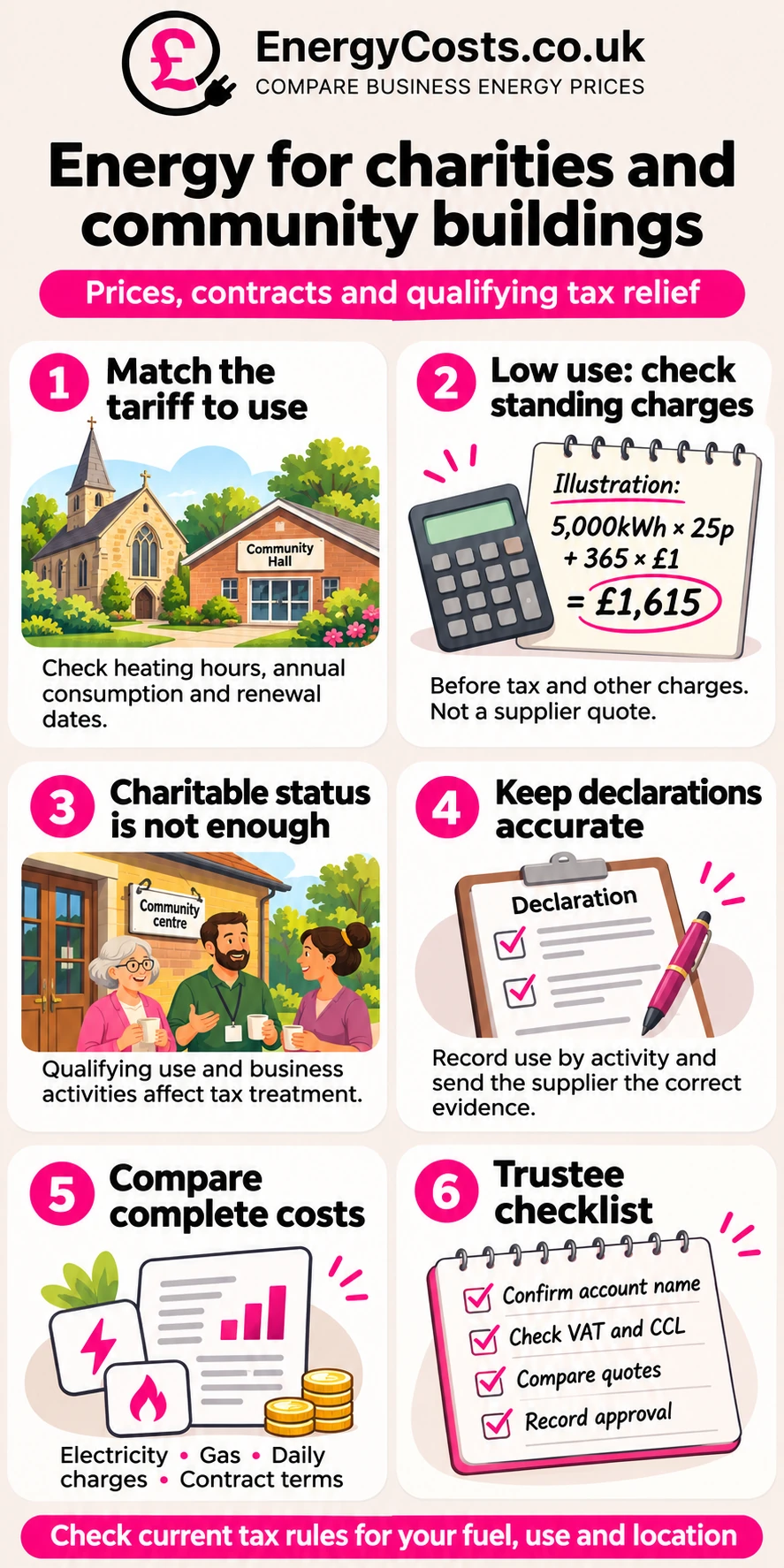
The low-use electricity example is 5,000 × £0.25 + 365 × £1 = £1,615. Replace the consumption and both rates with the values on your quotation. If there are multiple time bands, calculate each band separately before adding daily and additional charges.
Compare business electricity and business gas separately. Matching the supplier or renewal date can simplify administration, but it does not establish the lowest complete cost.
Why standing charges matter for halls and churches
Daily charges continue through periods without services or bookings. A lightly used building can therefore benefit more from a lower daily charge than from a slightly lower unit rate. Calculate the difference rather than ranking offers by p/kWh alone.
The next table contains invented comparison inputs and excludes taxes and other charges. It is not a supplier price list.
| Illustrative annual electricity comparison | Offer A | Offer B |
|---|---|---|
| Consumption | 5,000kWh | 5,000kWh |
| Unit rate | 25p/kWh | 27p/kWh |
| Standing charge | 100p/day | 40p/day |
| Unit cost | £1,250 | £1,350 |
| Standing charges | £365 | £146 |
| Basic annual total | £1,615 | £1,496 |
Offer B is £119 cheaper for this low-use scenario despite its higher unit rate. The break-even consumption is £219 divided by £0.02, or 10,950kWh a year. Above that point, A becomes cheaper on the stated inputs.
Our standing-charge guide explains the wider trade-off, including why a no-standing-charge product should still be assessed using its unit rate and conditions.
Do charities pay VAT on electricity and gas?
Check fuel, use, location and billing period. The general charity relief rules cover qualifying non-business use and certain other supplies. Charitable registration alone does not mean every activity or every supply qualifies. HMRC’s charity VAT overview explains the underlying categories.
There is also a current temporary electricity measure. HMRC’s fuel-and-power notice confirms 0% VAT on qualifying electricity in Great Britain from 1 October 2026 to 30 June 2027. Qualifying electricity in Northern Ireland remains at 5%; qualifying gas remains subject to the applicable reduced-rate rules. Standard-rated supplies remain a separate category.
| Supply treatment to check | Electricity | Gas |
|---|---|---|
| Qualifying supply in Great Britain during 1 October 2026–30 June 2027 | Temporary 0% VAT | Qualifying reduced rate generally 5% |
| Qualifying supply in Northern Ireland | 5% VAT | Qualifying reduced rate generally 5% |
| Standard-rated non-qualifying business supply | Generally 20% VAT | Generally 20% VAT |
Do not simply use an old statement that all charity electricity is charged at 5%. Equally, do not assume that the temporary 0% rate applies to every business activity. Check the supplier’s treatment against the actual supply and relevant dates. Our business energy VAT guide provides additional context.
What counts as qualifying charitable use?
Assess the organisation’s activities and how the energy is used. Free charitable services can differ from activities involving a charge. A charity shop, paid hall hire or café needs a proper business/non-business assessment rather than a blanket declaration based on the organisation’s name.
The general mixed-use VAT rule treats the whole supply as qualifying where at least 60% is qualifying use; below that threshold, an appropriate allocation is needed. Keep evidence supporting the percentage, such as activities, operating hours, floor areas and consumption measurements where suitable. An activity’s actual energy demand may not be proportional to its floor area.
For example, a small kitchen can consume more energy than a large meeting room. A reasoned allocation should reflect the equipment and use rather than simply applying the easiest percentage. Ask the supplier or tax adviser to confirm a defensible approach where activities are complex.
Do small-supply rules help low-use premises?
Small quantities can have their own qualifying treatment. HMRC describes electricity limits of an average 33kWh/day, expressed as 1,000kWh/month, and piped gas limits of an average 145kWh/day, expressed as 4,397kWh/month. Apply the rules to the relevant supply and billing period, not simply an annual total divided by twelve without checking.
A hall with low summer gas use but high winter heating can have different billed-period outcomes. Take actual readings so estimates do not obscure the position. Specific exclusions, including rules for certain EV-charging supplies, need separate consideration.
These are tax thresholds, not tariff bands that guarantee a supplier price. If your declared charitable-use position already qualifies, small-supply treatment is not a reason to submit an inconsistent declaration.
Are charities exempt from Climate Change Levy?
HMRC’s CCL exemptions guidance distinguishes excluded domestic and charitable non-business use, including relevant small-supply rules. Business activity at a charitable organisation can still require an allocation. Do not assume a renewable electricity contract itself removes CCL.
The published main rates are 0.801p/kWh for electricity and gas from 1 April 2026, rising to 0.827p/kWh from 1 April 2027. At the 2026/27 main rate, 20,000 taxable kWh would create £160.20 of CCL before VAT; 50,000 taxable kWh would create £400.50. Those are examples for taxable consumption, not charges automatically owed by every charity.
Use our CCL rates and exemptions guide to check the calculation. A correct tax position and a competitive supplier price are separate sources of potential savings.
What evidence should you send the supplier?
Keep the declaration tied to the correct legal customer, site and fuel. Explain the qualifying percentage accurately and retain the basis for it. Where required, use the supplier’s declaration process and have an authorised responsible person sign it.
- Organisation name, address and relevant recognition or registration evidence.
- Supply address and electricity or gas account reference.
- Description of activities and qualifying-use calculation.
- Evidence supporting any allocation between activities.
- Date, signatory name and authority.
- Copies of supplier acknowledgement and subsequent invoices.
Review the information when use changes. Opening a café, taking on a trading tenant or changing hall-hire arrangements can alter assumptions. Separate supplies and different buildings may need separate assessments.
Which contract suits a charity or community building?
A fixed agreement can help budgeting where the premises and demand are stable. Check exactly which price components are fixed: a fixed core rate does not necessarily freeze every network, policy or tax charge. A rolling arrangement can suit an uncertain lease or a temporary venue, subject to its price and notice terms.
| Option | May suit | Main check |
|---|---|---|
| One-year fixed term | Organisation wanting an early review point | Renewal work and exposure to next year’s prices |
| Two- or three-year fixed term | Stable building with predictable use | Total cost and ability to accommodate changes |
| Rolling agreement | Short or uncertain occupation | Rates, notice and continuing eligibility |
| Multi-site arrangement | Several buildings or meters | Site-level pricing, legal entities and administration |
| Time-of-use tariff | Demand that can realistically move | All time bands and the actual consumption split |
Compare contract lengths, short-term options and multi-site procurement before choosing. Avoid allowing an old agreement to drift onto unsuitable default rates because volunteer responsibilities changed.
How can churches and halls reduce consumption?
Begin with the booking and heating schedule. Record when a room must be comfortable, which zones are occupied and how long systems actually run. Have heating controls, ventilation and building conditions assessed appropriately; savings should not compromise safety, fabric protection or the needs of users.
For a simple electrical example, reducing a genuinely unnecessary 2kW load by three hours on 200 days avoids 1,200kWh. At an illustrative 25p/kWh, that saves £300 before tax. This is an operational calculation, not a guarantee that every building has that opportunity.
Meter data can help identify usage outside bookings. Our business smart-meter guide explains the installation and contract questions. For capital projects, review energy grants and solar panels against the building’s ownership, permissions and actual demand.
A trustee-friendly quotation and approval process
- Collect bills, meter references, contract dates and actual annual usage.
- Check the correct contracting entity and authorised signatory.
- Confirm tax declarations before comparing tax-inclusive budgets.
- Request comparable unit rates, daily charges and all additional costs.
- Model each quotation using the same consumption and duration.
- Check metering conditions, credit or deposit requirements and payment terms.
- Record why the chosen term suits the building’s lease and expected use.
- Retain the accepted terms and approval record.
- Check the first invoices and set renewal reminders.
- Hand the records to the next treasurer or responsible volunteer.
A simple written comparison is easier to audit than a verbal promise of a percentage saving. Record the assumptions, the total cost and the person responsible for checking the next renewal.
Frequently asked questions
There is no universal charity price. Supplier offers depend on the actual supply, usage, location, contract and eligibility. Compare complete costs and check tax relief separately. A supplier describing a product as suitable for charities does not establish that it is the cheapest option for your building.
No. Treatment depends on qualifying use, fuel, location and dates. Qualifying electricity in Great Britain currently benefits from temporary 0% VAT from 1 October 2026 to 30 June 2027. Qualifying gas and Northern Ireland electricity follow their applicable reduced-rate rules; non-qualifying business supplies need separate assessment.
The use of the energy matters. Charitable non-business use and qualifying small supplies can be excluded, but taxable business activities may require allocation. Ask the supplier to confirm the treatment using accurate declarations. A renewable tariff or charitable name does not by itself establish every exemption.
A community building can be supplied under an appropriate non-domestic arrangement, depending on the actual premises and account. Confirm the legal customer, authorised signatory and supplier eligibility. Then compare consumption, daily charges, term and payment conditions, with the correct tax treatment applied separately.
Daily charges continue even when there are no bookings. They can form a large share of a low-use building’s annual cost. Compare the complete bill: a slightly higher unit rate with a lower daily charge can be cheaper, depending on the actual annual consumption.
It can affect the business/non-business assessment, so examine the actual arrangements and seek advice where necessary. Keep a reasoned calculation of qualifying use and provide the supplier with accurate declarations. Do not assume that charitable ownership makes every activity at the building non-business.
Yes, where a supplier offers an eligible arrangement. It may suit temporary occupation or an uncertain lease, but prices and notice terms need checking. Compare its complete cost with fixed options and document why flexibility is needed rather than choosing solely on contract length.
Retain bills, meter references, usage data, tax declarations, quotations, contract terms and the approval record. Record renewal dates and who can act for the organisation. A clear handover helps the next treasurer check invoices and renew on time without relying on one volunteer’s memory.
Compare business energy quotes for your charity, church or community building using actual consumption, complete charges and the correct tax assumptions.