
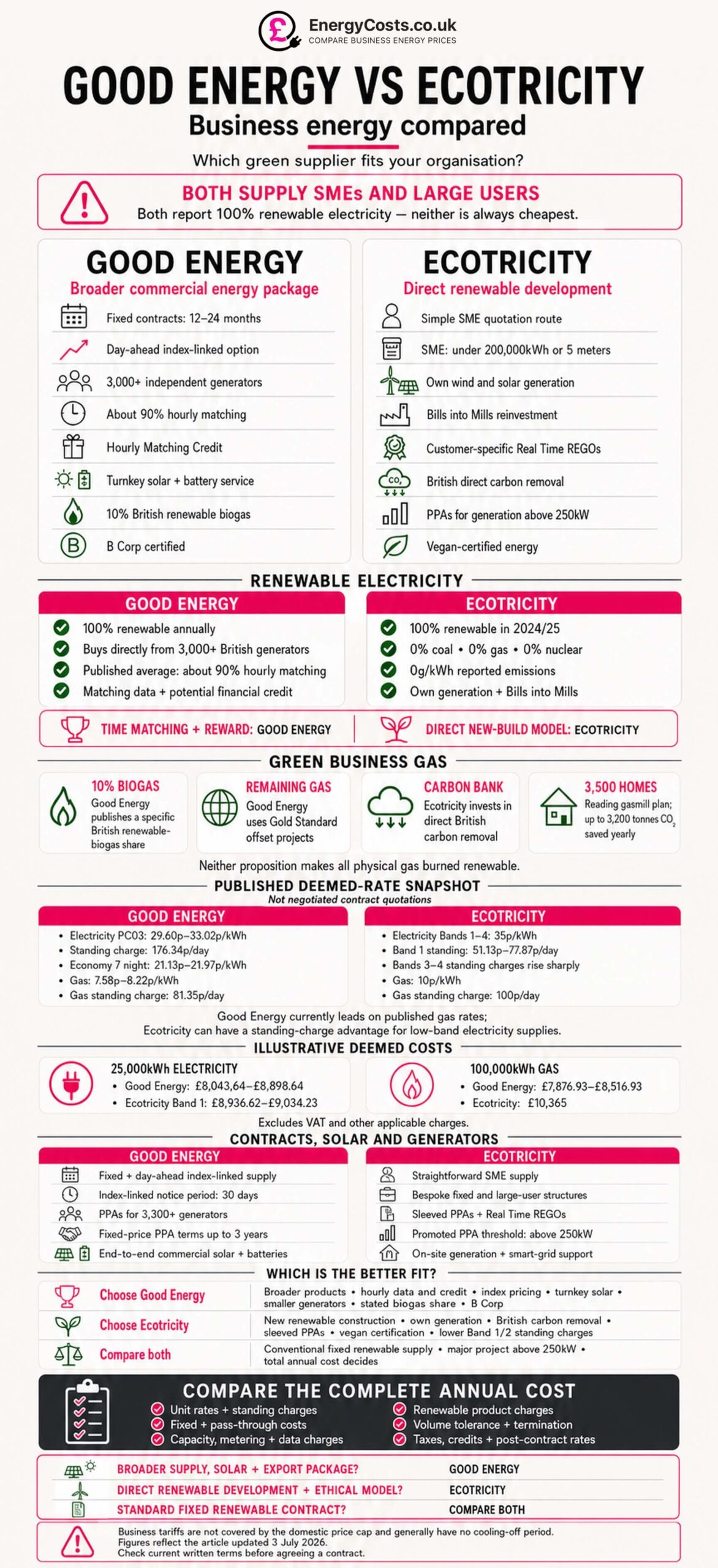
Good Energy and Ecotricity are two of Britain’s longest-established renewable energy suppliers. Both sell business electricity described as 100% renewable, both offer greener gas products, and both support businesses that generate their own electricity.
There are nevertheless important differences between them.
Good Energy has developed a broad commercial energy proposition combining fixed contracts, index-linked pricing, hourly renewable matching, financial credits for matching consumption with renewable generation, commercial solar installation and Power Purchase Agreements for generators of different sizes.
Ecotricity offers a relatively straightforward route for small businesses to purchase renewable electricity and carbon-neutralised gas, alongside more complex arrangements for large users. Its distinctive proposition is its “Bills into Mills” model, under which revenue from energy supply supports the development of new wind, solar and green gas projects.
Neither supplier publishes one negotiated business rate that applies nationally. The cheapest option can only be established by obtaining quotations based on the same meter, consumption forecast, contract dates and payment terms.
However, their published deemed rates and product features provide useful evidence of how their propositions differ.
Good Energy vs Ecotricity at a glance
| Feature | Good Energy | Ecotricity |
|---|---|---|
| Business electricity | Yes | Yes |
| Business gas | Yes | Yes |
| SME supply | Yes | Yes |
| Large-business supply | Yes | Yes |
| Public negotiated unit rates | No, bespoke quotation | No, bespoke quotation |
| Fixed contracts | 12–24 months advertised | Available by quotation |
| Index-linked pricing | Yes, linked to day-ahead wholesale prices | Bespoke options for larger users |
| Renewable electricity | 100% renewable | 100% renewable |
| Renewable sourcing | Bought directly from more than 3,000 independent British generators | Own generation, PPAs and renewable certificates |
| Published hourly matching performance | Approximately 90% | Customer-specific matching through Real Time REGOs |
| Financial hourly matching reward | Hourly Matching Credit | No directly equivalent public credit scheme |
| Business gas proposition | 10% biogas; remaining emissions offset | Sustainable green and fossil gas, supported by direct carbon removal |
| Commercial solar installation | Yes | On-site generation support, but no equivalent prominent turnkey installation service |
| Battery storage installation | Yes | Bespoke smart-grid and generation support |
| Export and generator PPAs | Available to generators of different sizes | Promoted for on-site generation above 250kW |
| Fixed-price generator PPA | Up to three years | Bespoke |
| Multi-site supply | Yes | Yes |
| B Corp certified | Yes | No |
| Vegan-certified energy | No specific proposition | Yes |
| Best suited to | Businesses wanting flexible products, solar and detailed energy matching | Businesses prioritising direct renewable development and a simpler deep-green proposition |
Do both companies supply small businesses?
Yes. Unlike comparisons involving suppliers that concentrate only on major industrial users, Good Energy and Ecotricity can both serve SMEs as well as larger organisations.
Ecotricity publishes a specific definition for its SME service. A company can use its SME route where it meets at least one of these conditions:
- annual electricity consumption is below 200,000kWh;
- annual gas consumption is below 200,000kWh; or
- it has five or fewer meter points.
Companies exceeding 200,000kWh of electricity or gas can use Ecotricity’s large-business service.
Good Energy divides its commercial offering between small-business and large-business customers but does not use one prominent public consumption threshold for every quotation. Its fixed contracts are available for both non-half-hourly and half-hourly metered sites.
This means both suppliers may be suitable for:
- shops and offices;
- restaurants and hotels;
- charities;
- workshops and warehouses;
- care providers;
- schools and colleges;
- manufacturers;
- property portfolios; and
- national multi-site organisations.
A supplier can still refuse to quote following a credit assessment or where the meter, consumption level or contractual risk falls outside its preferred customer profile.
Which supplier is likely to be cheaper?
There is no universal answer.
A negotiated quotation will normally depend on:
- the MPAN or MPRN;
- annual consumption;
- meter profile and voltage;
- half-hourly consumption data;
- electricity distribution region;
- DUoS residual band;
- agreed supply capacity;
- contract start date;
- contract length;
- credit history;
- number of sites;
- payment method;
- renewable product;
- expected consumption pattern; and
- whether network and policy charges are fixed or passed through.
A company should compare the complete estimated annual cost rather than only the unit price.
A useful calculation is:
- Annual consumption × unit rate
- daily standing charge × 365
- capacity and metering charges
- network and policy costs
- environmental product charges
- VAT and Climate Change Levy where applicable
− export payments or other credits
A low standing charge can make a material difference to a small property, while the unit rate usually dominates the bill for a high-consumption site.
Why small unit-rate differences matter
| Annual consumption | Value of 1p/kWh difference | Value of 3p/kWh difference | Value of 5p/kWh difference |
|---|---|---|---|
| 10,000kWh | £100 | £300 | £500 |
| 25,000kWh | £250 | £750 | £1,250 |
| 50,000kWh | £500 | £1,500 | £2,500 |
| 100,000kWh | £1,000 | £3,000 | £5,000 |
| 250,000kWh | £2,500 | £7,500 | £12,500 |
| 1,000,000kWh | £10,000 | £30,000 | £50,000 |
For a small business using 10,000kWh, a high standing charge may offset a lower unit rate. At 250,000kWh, even a difference of 1p/kWh is worth £2,500 annually.
Comparing published deemed electricity rates
Deemed rates are charged when a business uses energy without having agreed a supply contract. This commonly happens when a company moves into premises that are already supplied by the provider.
These rates are normally variable and should not be treated as representative new-contract prices.
Non-half-hourly electricity
The current non-half-hourly Good Energy rate sheet linked from its business deemed-charges page is effective from 1 November 2025.
Ecotricity’s corresponding schedule applies from 1 April 2026.
| Meter or charging category | Good Energy | Ecotricity |
|---|---|---|
| Profile class 03 unit rate | 29.60p–33.02p/kWh | Not classified in the same way |
| Profile class 04 day rate | 31.07p–35.22p/kWh | Not classified in the same way |
| Profile class 04 night rate | 21.13p–21.97p/kWh | Not classified in the same way |
| Good Energy standing charge | 176.34p per day | Not applicable |
| Ecotricity domestic-residual rate | Not applicable | 23.80p–26.33p/kWh |
| Ecotricity no-residual rate | Not applicable | 33p/kWh |
| Ecotricity bands 1–4 | Not applicable | 35p/kWh |
| Ecotricity Band 1 standing charge | Not applicable | 51.13p–77.87p per day |
| Ecotricity Band 2 standing charge | Not applicable | 86.20p–135.96p per day |
| Ecotricity Band 3 standing charge | Not applicable | 152.21p–250.10p per day |
| Ecotricity Band 4 standing charge | Not applicable | 375.75p–645.99p per day |
The classifications are not directly equivalent. Good Energy divides smaller meters between profile classes 03 and 04, whereas Ecotricity’s schedule uses DUoS residual bands and Grid Supply Point regions.
The published comparison nevertheless shows a broad pattern:
- Good Energy generally has a lower deemed unit rate for profile class 03 meters;
- Ecotricity generally has a lower standing charge for Band 1 and many Band 2 supplies;
- Good Energy offers a substantially cheaper night rate for profile class 04 customers; and
- Ecotricity’s standing charges rise considerably for Bands 3 and 4.
Annual standing-charge comparison
| Published category | Daily charge | Approximate annual charge |
|---|---|---|
| Good Energy non-half-hourly | 176.34p | £643.64 |
| Ecotricity Band 1 | 51.13p–77.87p | £186.62–£284.23 |
| Ecotricity Band 2 | 86.20p–135.96p | £314.63–£496.25 |
| Ecotricity Band 3 | 152.21p–250.10p | £555.57–£912.87 |
| Ecotricity Band 4 | 375.75p–645.99p | £1,371.49–£2,357.86 |
A low-consumption company could therefore pay a lower standing charge with Ecotricity, particularly in Band 1.
However, Good Energy’s lower profile class 03 unit rates can outweigh its higher standing charge as consumption increases.
Illustrative deemed electricity costs
The following table compares:
- Good Energy’s published profile class 03 unit-rate range, plus its 176.34p daily standing charge; and
- Ecotricity’s 35p Band 1 rate, plus its published Band 1 standing-charge range.
| Annual electricity use | Good Energy range | Ecotricity Band 1 range |
|---|---|---|
| 10,000kWh | £3,603.64–£3,945.64 | £3,686.62–£3,784.23 |
| 25,000kWh | £8,043.64–£8,898.64 | £8,936.62–£9,034.23 |
| 50,000kWh | £15,443.64–£17,153.64 | £17,686.62–£17,784.23 |
| 100,000kWh | £30,243.64–£33,663.64 | £35,186.62–£35,284.23 |
These figures exclude VAT and any other applicable charges. They are not quotations.
They also do not establish that Good Energy will be cheaper under a negotiated contract. They simply demonstrate how the suppliers’ published deemed structures interact with different consumption levels.
Half-hourly deemed rates
The suppliers allocate half-hourly costs differently, making headline comparisons potentially misleading.
Good Energy half-hourly charges
From 1 April 2026, Good Energy’s published deemed and out-of-contract charges for half-hourly import customers are:
| Charge | Published amount |
|---|---|
| Unit rate | 35p/kWh |
| Daily standing charge | £25 |
| Annual standing charge | £9,125 |
Good Energy says distribution network charges are passed through separately. It may also reconcile Transmission Network Use of System and Capacity Market charges annually.
The £25 daily standing charge should therefore not be viewed as an all-inclusive network price without examining the full cost schedule.
Ecotricity half-hourly charges
Ecotricity publishes several half-hourly categories according to voltage, meter configuration and DUoS band.
For a low-voltage half-hourly supply without a maximum import capacity arrangement, its published figures include:
| Charge | Published amount |
|---|---|
| Unit rate | 33p/kWh |
| Band 1 standing charge | 51.13p–77.87p per day |
| Band 2 standing charge | 86.20p–135.96p per day |
| Band 3 standing charge | 152.21p–250.10p per day |
| Band 4 standing charge | 375.75p–645.99p per day |
Other Ecotricity half-hourly configurations have unit rates of 31p, 33p or 35p and materially different standing charges.
Its schedule excludes:
- VAT;
- Climate Change Levy;
- government-imposed taxes;
- applicable government support schemes;
- DUoS capacity charges;
- excess-capacity charges;
- reactive-power charges;
- meter maintenance; and
- data collection.
A large business should therefore request a full annual-cost model based on its actual half-hourly data rather than comparing 33p with 35p in isolation.
Comparing published deemed gas rates
Good Energy’s current linked non-domestic gas rate sheet applies from 1 November 2025. Its rates vary by region.
Ecotricity’s gas deemed rate is the same throughout its published regional table.
| Charge | Good Energy | Ecotricity |
|---|---|---|
| Unit rate | 7.58p–8.22p/kWh | 10p/kWh |
| Daily standing charge | 81.35p | 100p |
| Annual standing charge | £296.93 | £365 |
Good Energy is cheaper on both the published gas unit rate and standing charge.
Illustrative deemed gas costs
| Annual gas use | Good Energy range | Ecotricity |
|---|---|---|
| 25,000kWh | £2,191.93–£2,351.93 | £2,865 |
| 50,000kWh | £4,086.93–£4,406.93 | £5,365 |
| 100,000kWh | £7,876.93–£8,516.93 | £10,365 |
| 250,000kWh | £19,246.93–£20,846.93 | £25,365 |
These examples exclude VAT, Climate Change Levy and other charges where applicable.
They indicate that Good Energy’s currently published deemed gas prices are lower. A negotiated Ecotricity contract may nevertheless be priced differently.
Good Energy contract options
Good Energy offers a wider publicly described selection of commercial procurement structures.
Fixed-price contracts
Its fixed business contracts are advertised for periods of 12 to 24 months and are available for both half-hourly and non-half-hourly sites.
They may suit companies that value:
- predictable budgets;
- a stable unit price;
- simpler financial forecasting; and
- less exposure to short-term wholesale movements.
Good Energy currently describes these contracts as having no volume-tolerance charges. The individual commercial terms should still be checked because additional metering, network or early cancellation costs may apply.
Index-linked contracts
Good Energy’s index-linked product tracks the day-ahead wholesale electricity market.
Features include:
- prices that change with wholesale market conditions;
- availability for half-hourly sites;
- a variable contract structure; and
- a 30-day notice period.
This may suit a company that can tolerate price volatility or actively change consumption in response to market conditions.
It is less suitable for a business that needs to know its precise annual energy expenditure in advance.
Corporate PPAs
Good Energy also supports Corporate Power Purchase Agreements.
A CPPA can allow a large business to purchase renewable electricity linked to a particular generator over a longer period. This can provide stronger traceability and may support the financing of additional generation.
However, a CPPA can create risks involving:
- long contract periods;
- generation shortfalls;
- imbalance costs;
- profile mismatch;
- credit requirements; and
- exposure if market prices fall below the agreed price.
Ecotricity contract options
Ecotricity promotes a fair and simple tariff for SMEs, alongside bespoke services for major users.
Its small-business proposition centres on:
- 100% renewable electricity;
- carbon-neutralised gas;
- straightforward quotations;
- no hidden fees;
- support during the switch; and
- an online quotation journey.
Larger organisations can discuss:
- fixed supply agreements;
- multiple sites;
- half-hourly metering;
- Power Purchase Agreements;
- on-site generation;
- load management;
- smart-grid services; and
- Real Time REGOs.
Ecotricity publishes fewer details about standardised index-linked business products than Good Energy. Its strength lies more in bespoke renewable supply and direct support for the construction of additional green generation.
Comparing renewable electricity
Both suppliers report 100% renewable electricity, but their procurement models and public messaging differ.
Good Energy renewable electricity
Good Energy says it buys electricity directly from more than 3,000 independent renewable generators in Britain.
Its portfolio includes technologies such as:
- solar;
- onshore wind;
- hydroelectricity; and
- anaerobic digestion.
The corresponding REGOs are bought alongside the electricity rather than being purchased separately simply to relabel fossil-fuel-heavy wholesale power.
Good Energy matches the total electricity its customers consume with renewable generation over the year. It also reports an average hourly matching performance of around 90%, meaning much of its customer demand coincides with generation in its renewable portfolio during the same hourly periods.
Ecotricity renewable electricity
Ecotricity’s published 2024/25 fuel mix was:
| Electricity source | Ecotricity | UK average shown by Ecotricity |
|---|---|---|
| Coal | 0% | 5.9% |
| Natural gas | 0% | 33.3% |
| Nuclear | 0% | 16.2% |
| Renewables | 100% | 42.1% |
| Other | 0% | 2.5% |
| Reported carbon emissions | 0g/kWh | 154g/kWh |
| Reported radioactive waste | 0g/kWh | 0.007g/kWh |
Ecotricity operates its own wind and solar generation and purchases additional renewable power. Its “Bills into Mills” model is intended to channel revenue from customer bills into the development of more renewable infrastructure.
Which electricity is greener?
There is no simple numerical winner because both suppliers disclose a 100% renewable annual electricity mix.
Good Energy may have an advantage where the company values:
- direct purchasing from a large community of independent generators;
- a published 90% hourly matching performance;
- access to consumption-matching data;
- financial incentives for improved matching; and
- a B Corp-certified supplier.
Ecotricity may have an advantage where the company values:
- the supplier building and operating its own renewable generation;
- reinvestment through Bills into Mills;
- a long-standing campaigning role in renewable energy;
- direct British carbon-removal investment; and
- a vegan-certified energy supply.
The best environmental choice depends on whether the business prioritises traceable procurement, time matching, supplier-owned generation, additionality or wider ethical policies.
Good Energy hourly matching
Good Energy provides hourly energy-matching information that shows when a company’s consumption coincides with electricity from its renewable portfolio.
Its published average matching performance is approximately 90%. Any remaining annual shortfall is balanced with renewable electricity over the wider reporting period.
For larger or half-hourly metered organisations, this can provide better evidence for:
- Scope 2 reporting;
- sustainability reports;
- net-zero strategies;
- customer procurement questionnaires;
- carbon disclosure projects; and
- environmental audits.
Hourly Matching Credit
Good Energy also offers Hourly Matching Credit, a no-cost opt-in scheme for qualifying business supply customers and renewable generators.
When business electricity use overlaps with eligible renewable generation during the same half-hour, certain third-party subsidy charges can potentially be avoided and returned as credits.
The three customer versions are:
| Product | Credit structure | Budget certainty |
|---|---|---|
| HMC Variable | Variable credit based on actual matching | Lower |
| HMC Secure | Guaranteed rate with monthly payments and end-of-term adjustment | High |
| HMC Fix | Fixed credit through consistent monthly payments | High |
This is an important distinction between the suppliers. Good Energy does not merely provide matching data; it can also provide a financial reward where consumption aligns with renewable production.
Ecotricity Real Time REGOs
Ecotricity offers Real Time REGOs to improve the accuracy of renewable energy reporting.
Its hourly product can combine:
- REGOs bundled with a customer’s sleeved PPA;
- generation from Ecotricity’s PPAs;
- additional REGOs;
- hourly or half-hourly consumption data; and
- available renewable generation information.
The resulting reports show how closely the customer’s consumption corresponds with renewable production. Official certificate numbers are added when available to complete compliance reporting.
This may particularly suit a large organisation that already has a sleeved PPA or wants a more tailored renewable procurement structure.
Compared with Good Energy:
- Good Energy publishes an overall matching score and provides a customer platform;
- Ecotricity focuses on customer-specific matching through supply, PPAs and certificates;
- Good Energy offers a direct financial matching credit; and
- Ecotricity’s product may integrate particularly well with a bespoke sleeved PPA.
Comparing greener business gas
The environmental distinction is more complicated for gas because burning gas at the customer’s premises creates direct emissions.
Good Energy green gas
Good Energy states that:
- 10% of the gas it supplies is renewable biogas produced in Britain; and
- emissions associated with the remaining gas are balanced through Gold Standard carbon-offset projects that improve access to renewable energy.
Good Energy explains that 10% reflects its assessment of the proportion of UK gas demand that could sustainably be supplied by British biomethane.
This is a relatively transparent proposition because the supplier publishes a specific biogas percentage.
Ecotricity gas
Ecotricity says its gas supply is a mixture of:
- sustainable green gas; and
- fossil gas.
It invests in direct carbon-removal projects in Britain through the Carbon Bank. Its current projects include nature-based activity and enhanced rock weathering.
Ecotricity is also developing green gasmills intended to manufacture biomethane from grass. Its Reading project is planned to produce sufficient gas for the equivalent of approximately 3,500 homes and save up to 3,200 tonnes of carbon dioxide annually.
However, Ecotricity does not prominently publish one fixed percentage of sustainable gas that applies to every business contract.
Which gas proposition is stronger?
Good Energy provides greater quantitative transparency because it states that 10% is renewable biogas.
Ecotricity may appeal more to businesses that prefer:
- direct British carbon removal;
- investment in new domestic green-gas production;
- grass-derived rather than animal-waste-derived biomethane; and
- a supplier seeking to replace more fossil gas over time.
Neither proposition means that all physical gas burned by the business is renewable. Companies should distinguish between biomethane, fossil gas, certificates, carbon offsets and direct carbon removal when preparing emissions reports.
Power Purchase Agreements and export services
Good Energy has the broader publicly advertised service for renewable generators.
Good Energy PPAs
Good Energy says it supports more than 3,300 renewable generators and offers export tariffs and PPAs for generators of different sizes.
Its products include:
Standard Fixed Price PPA
- intended for small-to-medium generators;
- fixed-price certainty;
- terms of up to three years;
- protection from wholesale price movements; and
- access to Hourly Matching Credit.
Bespoke PPA
- flexible market access;
- control over pricing and volume scheduling;
- greater exposure to favourable or unfavourable market movements;
- suitability for experienced generators and project owners; and
- potential access to Hourly Matching Credit.
Good Energy may therefore be particularly suitable for a small solar, wind, hydro or anaerobic-digestion generator that would not meet a high minimum export threshold.
Ecotricity PPAs
Ecotricity says it can arrange a PPA where a business generates more than 250kW of green electricity on site.
It can help the company obtain a route to market and establish a price for exported generation. More complex arrangements can combine:
- renewable generation;
- electricity supply;
- sleeved PPAs; and
- hourly-matched REGOs.
This is more likely to suit a sizeable commercial or industrial installation than a small rooftop array.
Which is better for generators?
| Generator type | Likely better fit |
|---|---|
| Small commercial solar installation | Good Energy |
| Generator seeking a fixed price for up to three years | Good Energy |
| Generator wanting flexible wholesale exposure | Good Energy or Ecotricity |
| On-site generation above 250kW | Compare both |
| Company seeking a sleeved PPA with hourly REGOs | Ecotricity may be attractive |
| Generator seeking hourly matching credits | Good Energy |
| Major renewable project | Compare bespoke proposals from both |
Price per MWh should not be the only consideration. Generators should compare:
- PPA duration;
- payment timetable;
- route-to-market fee;
- REGO ownership;
- imbalance costs;
- volume commitments;
- credit strength;
- metering requirements; and
- termination provisions.
Commercial solar and battery storage
Good Energy has a clear advantage for a company seeking an end-to-end commercial solar installation.
Its service includes:
- site assessment;
- system design;
- commercial solar installation;
- monitoring;
- battery storage;
- maintenance-oriented system design; and
- integration with electricity supply and export services.
Battery storage can increase self-consumption by retaining surplus solar electricity for use later. It can also help reduce peak-time imports and provide some resilience during supply interruptions, depending on system design.
Ecotricity supports on-site generation and can arrange PPAs for qualifying systems. It also has experience with smart grids and load management, but it does not currently promote an equivalent nationwide turnkey commercial solar installation service as prominently as Good Energy.
A company wanting one provider to install the system, supply imported electricity and purchase exports is therefore more likely to favour Good Energy.
Ownership and company structure
Good Energy was acquired by smart-grid technology company Esyasoft in April 2025.
Good Energy says it has retained:
- the Good Energy name;
- its Chippenham headquarters;
- its existing team;
- its renewable supply model; and
- support for its B Corp certification.
The new ownership may provide greater access to capital and smart-grid technology, although businesses entering long-term contracts should always check the identity and credit position of the legal entity signing the agreement.
Ecotricity remains a privately held British renewable energy company headquartered in Stroud. Its commercial proposition continues to be closely associated with its founder, its renewable generation portfolio and its wider environmental campaigning.
Contract terms to compare carefully
Business energy contracts are not protected by the domestic energy price cap. A contract agreed by telephone may also become legally binding without the standard domestic cooling-off rights.
Before choosing either supplier, check:
- contract duration;
- unit and standing charges;
- whether prices include non-commodity costs;
- pass-through charges;
- meter operator fees;
- data collection costs;
- capacity charges;
- excess-capacity charges;
- volume-tolerance provisions;
- early termination fees;
- payment period;
- security deposits;
- credit requirements;
- renewal terms;
- broker commission;
- deemed and out-of-contract rates; and
- conditions for adding or removing sites.
Good Energy’s current industrial and commercial terms can calculate early cancellation costs using the difference between wholesale forward prices and the estimated volume remaining.
Ecotricity’s published business terms also allow early termination charges under specified circumstances. The precise formula and liability should be confirmed in the current supply agreement rather than relying on a general supplier summary.
Good Energy advantages and disadvantages
Advantages
- Supplies both small and large businesses.
- Offers 100% renewable electricity.
- Purchases power directly from more than 3,000 British renewable generators.
- Publishes an average hourly matching performance of approximately 90%.
- Hourly Matching Credit can reduce costs for qualifying customers.
- Fixed contracts are available for 12 to 24 months.
- Index-linked pricing is available for half-hourly sites.
- Offers CPPAs and generator PPAs.
- Supports generators of different sizes.
- Provides turnkey commercial solar and battery installations.
- Publishes the precise 10% biogas proportion in its green gas.
- Current published deemed electricity and gas rates are competitive in several categories.
- B Corp certification provides external assessment of wider corporate impact.
Disadvantages
- Negotiated rates are not available publicly.
- Its non-half-hourly deemed standing charge is relatively high for a small meter.
- Its half-hourly deemed standing charge is £25 per day before separately passed-through distribution costs.
- Index-linked prices can rise as well as fall.
- Fixed contracts can create early termination liabilities.
- The remaining 90% of its gas is not renewable biomethane.
- Carbon offsetting does not prevent on-site combustion emissions.
- Good Energy has been under new ownership since April 2025, which some long-term customers may wish to consider during due diligence.
Ecotricity advantages and disadvantages
Advantages
- Supplies SMEs and large organisations.
- Provides 100% renewable electricity.
- Operates its own wind and solar generation.
- Revenue supports new renewable projects through Bills into Mills.
- Offers a simple SME quotation route.
- Real Time REGOs support granular renewable reporting.
- Can combine supply, PPAs and time-matched certificates.
- Invests in direct carbon removal in Britain.
- Developing domestic green gas production using grass.
- Offers PPAs for qualifying on-site generation above 250kW.
- Many Band 1 and Band 2 deemed standing charges are lower than Good Energy’s non-half-hourly charge.
- Energy supply is vegan certified.
Disadvantages
- Negotiated business rates are not published.
- Its 35p/kWh deemed electricity rate can be expensive for a commercial non-half-hourly meter.
- Published deemed gas rates are higher than Good Energy’s current rates.
- Band 3 and Band 4 deemed standing charges can be substantial.
- It does not publish one clear sustainable-gas percentage applying to all business contracts.
- No directly comparable Hourly Matching Credit is advertised.
- Its publicly promoted PPA threshold of more than 250kW excludes many small commercial generators.
- It does not promote as broad a turnkey commercial solar installation service as Good Energy.
- Fewer standardised index-linked contract details are published.
Which supplier is better for different companies?
| Type of company or requirement | Likely better fit | Reason |
|---|---|---|
| Small shop or office | Compare both | Both accept SMEs; quoted annual cost will decide |
| Low-consumption Band 1 meter | Ecotricity may benefit | Lower published deemed standing charge |
| Higher-consumption profile class 03 meter | Good Energy may benefit | Lower current published deemed unit-rate range |
| Business with Economy 7-style consumption | Good Energy may benefit | Published night rates are approximately 21p/kWh |
| Business needing gas | Good Energy currently looks stronger | Lower published deemed gas rates |
| Business seeking fixed-price certainty | Compare both | Both can quote fixed supply |
| Half-hourly user wanting index pricing | Good Energy | Public day-ahead index-linked product |
| Company prioritising new renewable construction | Ecotricity | Bills into Mills and supplier-owned generation |
| Company requiring detailed hourly data | Good Energy | Published platform and 90% average matching |
| Company with a sleeved renewable PPA | Ecotricity may be attractive | Real Time REGOs can integrate customer PPAs |
| Business able to align demand with renewables | Good Energy | Hourly Matching Credit can provide a financial reward |
| Company seeking commercial solar installation | Good Energy | Turnkey solar and battery service |
| Small renewable generator | Good Energy | PPAs and export services for generators of different sizes |
| Generator above 250kW | Compare both | Both may provide competitive PPAs |
| Business seeking a stated biogas percentage | Good Energy | Publishes a 10% renewable biogas figure |
| Business prioritising British carbon removal | Ecotricity | Carbon Bank projects are based in Britain |
| Vegan business | Ecotricity | Vegan-certified energy proposition |
| Business prioritising B Corp suppliers | Good Energy | Certified B Corp |
Final verdict: Good Energy vs Ecotricity
Good Energy and Ecotricity are both credible options for a company seeking 100% renewable electricity, but Good Energy currently offers the broader range of commercial products.
Good Energy is likely to be the stronger choice where a business wants:
- fixed or index-linked contract options;
- detailed hourly energy data;
- a financial reward for matching renewable generation;
- commercial solar and battery installation;
- export services for a smaller generator;
- a published 10% biogas proportion; or
- B Corp certification.
Ecotricity is likely to be the stronger choice where the priorities are:
- directly supporting the construction of new wind, solar and green-gas infrastructure;
- purchasing from a supplier with its own renewable generation;
- British direct carbon-removal projects;
- bespoke PPA and Real Time REGO structures;
- vegan-certified energy; or
- a lower standing charge for certain low-band deemed supplies.
The published deemed-rate comparison currently favours Good Energy for gas and for many higher-consumption non-half-hourly electricity examples. Ecotricity can have a standing-charge advantage for smaller Band 1 and Band 2 supplies.
These figures do not predict the result of a negotiated quotation. Either supplier could be cheaper for an individual company once location, metering, credit, contract duration and pass-through costs are included.
The most reliable approach is to request quotations from both suppliers on the same day and require each to provide:
- the unit rates;
- all daily and monthly charges;
- the projected annual cost;
- fixed and pass-through components;
- metering and data costs;
- capacity charges;
- environmental product details;
- termination liabilities;
- renewable reporting evidence; and
- the rates that apply after the contract expires.
For most companies, the decision can be summarised as follows:
- choose Good Energy for a wider package of supply, solar, export and energy-matching services;
- choose Ecotricity where direct renewable development and its wider environmental model carry greater weight;
- compare both for a conventional fixed renewable electricity contract; and
- judge the result using total annual cost rather than the headline unit rate.
FAQ
It depends on the company’s quotation. Good Energy currently has lower published deemed gas rates and lower profile class 03 electricity rates, while Ecotricity has lower standing charges for many Band 1 and Band 2 meters.
Yes. Good Energy and Ecotricity both describe their business electricity as 100% renewable. Their purchasing, generation and hourly matching approaches differ.
Good Energy publishes a specific mix of 10% renewable biogas with remaining emissions offset. Ecotricity combines sustainable and fossil gas with direct British carbon removal but does not publish one universal green-gas percentage.
Both accept SME enquiries. Good Energy offers broader contract and solar services, while Ecotricity provides a simple renewable supply proposition. The better option depends on the written quotation.
Both can offer fixed contracts. Good Energy publicly advertises fixed periods of 12 to 24 months. Ecotricity provides fixed and bespoke arrangements by quotation.
Good Energy advertises an index-linked half-hourly tariff tracking day-ahead wholesale prices. Ecotricity can create bespoke arrangements for larger users but publishes less detail about a standard index product.
Good Energy publishes approximately 90% hourly matching and offers customer data plus Hourly Matching Credit. Ecotricity offers customer-specific Real Time REGOs that can incorporate a sleeved PPA.
Good Energy has the clearer turnkey proposition, covering system design, solar installation, batteries, supply and export. Ecotricity supports on-site generation and PPAs but does not prominently advertise an equivalent installation service.
Good Energy supports generators of different sizes and offers fixed PPAs for up to three years. Ecotricity promotes PPAs where on-site generation exceeds 250kW.
No. Deemed rates apply when energy is consumed without an agreed contract. They are variable and are commonly more expensive than negotiated business tariffs.
No. The domestic energy price cap does not cover non-domestic energy contracts. Businesses must check the quotation, contract terms and future out-of-contract rates.
Possibly, but an early cancellation fee may apply. The supplier may calculate its loss using remaining estimated consumption, contract charges or wholesale forward-market movements.
Yes. A company can buy electricity from one provider and gas from another. Separate contract dates and bills may create more administration but can produce a lower combined cost.
Research notes
Business products: Good Energy currently advertises fixed contracts of 12–24 months, index-linked contracts tracking the day-ahead market, and Corporate PPAs. Its business page also states that its current contract options have no volume-tolerance charges.
Ecotricity eligibility: Ecotricity defines its SME route as annual electricity or gas consumption below 200,000kWh, or no more than five meter points. It provides a separate service for larger users.
Good Energy deemed prices: Its current linked non-half-hourly schedule lists profile class 03 rates of 29.60p–33.02p/kWh, profile class 04 day rates of 31.07p–35.22p, night rates of 21.13p–21.97p and a 176.34p daily standing charge. Gas is 7.58p–8.22p/kWh with an 81.35p daily charge.
Half-hourly Good Energy rates: Good Energy’s current business page gives half-hourly deemed and out-of-contract charges of 35p/kWh and £25 per day from 1 April 2026, with distribution charges passed through separately.
Ecotricity deemed prices: Ecotricity’s schedule from 1 April 2026 lists non-half-hourly commercial band rates of 35p/kWh, no-residual rates of 33p/kWh and gas at 10p/kWh with a 100p daily charge. It also explains the excluded taxes, capacity, metering and data costs.
Renewable electricity: Good Energy says it buys directly from more than 3,000 independent British generators and achieves average hourly matching of about 90%. Ecotricity’s 2024/25 disclosed electricity mix was 100% renewable, with no coal, gas or nuclear power.
Hourly products: Good Energy’s Hourly Matching Credit is a no-cost opt-in product with Variable, Secure and Fix structures. Ecotricity’s Real Time REGOs combine consumption data with generation and certificates, including those from sleeved PPAs.
Green gas: Good Energy states that its gas is 10% British renewable biogas, with remaining emissions addressed through Gold Standard projects. Ecotricity describes its gas as a mixture of sustainable and fossil gas supported by direct British carbon-removal investment.
PPAs and solar: Good Energy offers PPAs to more than 3,300 generators, including fixed-price terms of up to three years, and provides commercial solar and battery installation. Ecotricity promotes PPAs for businesses generating more than 250kW on site.
Ownership: Good Energy has been owned by Esyasoft since April 2025. The supplier says its brand, headquarters, team and renewable approach have continued under the new ownership.
Business contract protections: Ofgem says non-domestic customers are not protected by the domestic price cap. It also warns that business agreements made by telephone can be binding and that customers should review deemed, fixed and out-of-contract terms carefully.