

Octopus Energy and Utilita both supply gas and electricity to UK businesses, but their commercial propositions have developed in different directions.
Octopus Energy for Business combines conventional supply with smart electricity tariffs, multi-site account management, commercial export payments and renewable-energy services. Its Shape Shifters tariffs reward businesses that move consumption away from expensive periods, while Panel Power pays a fixed rate for exported solar electricity.
Utilita Business focuses on locked energy rates, compulsory smart metering, real-time consumption information, dedicated business support and commercial solar installations. Its solar division provides batteries, EV chargers and several financing options, including long-term Power Purchase Agreements with no initial capital expenditure.
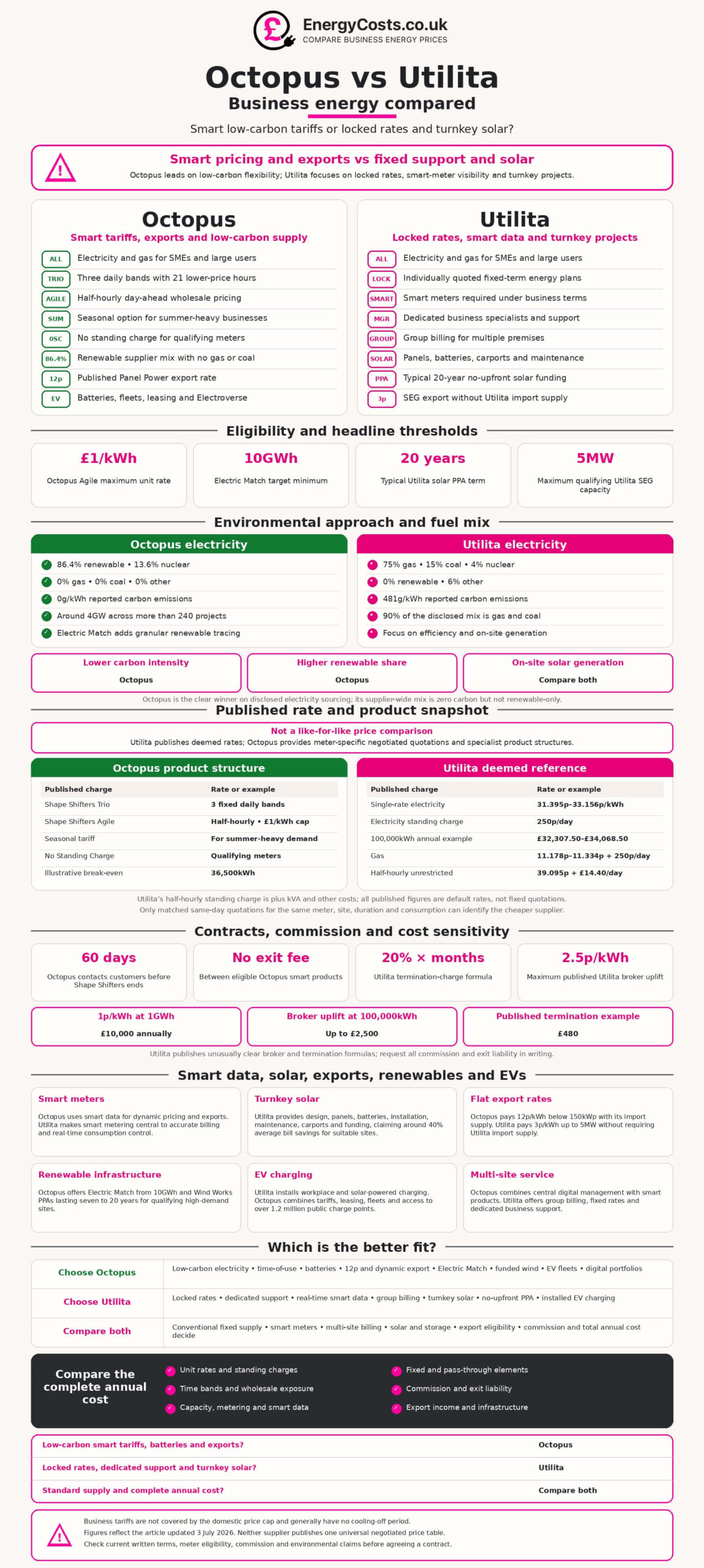
The environmental difference is substantial. Octopus’s disclosed 2024/25 electricity mix was 86.4% renewable and 13.6% nuclear, with no gas or coal. Utilita’s mix was 75% gas, 15% coal, 4% nuclear, no reported renewable generation and 6% other fuels.
Octopus is therefore likely to be the stronger choice for businesses prioritising low-carbon electricity, time-of-use pricing, batteries and solar exports.
Utilita may be more suitable where the company wants a straightforward fixed contract, dedicated account support, smart-meter visibility and an integrated commercial solar or EV-charging project.
Neither supplier is automatically cheaper. The answer depends on a matched quotation for the same premises, meter, consumption and contract period.
Octopus Energy vs Utilita at a glance
| Feature | Octopus Energy for Business | Utilita Business |
|---|---|---|
| Business electricity | Yes | Yes |
| Business gas | Yes | Yes |
| SME supply | Yes | Yes |
| Half-hourly electricity | Yes | Yes |
| Multi-site supply | Yes | Yes, including group billing |
| Standard national contract prices | Not published | Not published |
| Fixed-rate contracts | Individually quoted | Individually quoted locked-rate plans |
| Smart time-of-use tariff | Shape Shifters Trio and Agile | No directly comparable public tariff |
| Seasonal business tariff | Summer Saver | No prominent equivalent |
| No-standing-charge tariff | Available to qualifying businesses | No prominent equivalent |
| Smart-meter requirement | Required for smart tariffs | Required under Utilita’s business terms |
| Supplier-wide renewable share | 86.4% | 0% |
| Supplier-wide nuclear share | 13.6% | 4% |
| Supplier-wide gas and coal | 0% | 90% |
| Reported carbon intensity | 0g CO₂/kWh | 481g CO₂/kWh |
| Flat commercial solar export | Panel Power at 12p/kWh | SEG at 3p/kWh |
| Dynamic business export | Shape Shifters: Export | No prominent equivalent |
| Commercial solar installation | Available through bespoke low-carbon projects | Major turnkey installation service |
| Solar funding | Bespoke funded projects and Wind Works | PPA, hire purchase and other funding |
| Business EV services | Smart charging, fleet services and Electroverse | Installed workplace, visitor and solar-carport chargers |
| Large-business renewable matching | Electric Match | No direct equivalent |
| On-site funded wind generation | Wind Works | No prominent standard offer |
| Broker distribution | Octopus says it normally sells directly | Broker partnerships supported |
| Best suited to | Flexible, low-carbon and exporting businesses | Fixed supply, smart meters and commercial solar |
Which businesses can apply?
Both suppliers serve small and medium-sized businesses and can support half-hourly electricity customers.
Octopus offers:
- standard SME electricity and gas;
- fixed contracts;
- smart tariffs;
- multi-site portfolios;
- solar and battery export tariffs;
- half-hourly supplies;
- Electric Match for large users; and
- bespoke renewable projects.
Utilita offers:
- commercial electricity and gas;
- fixed-rate plans;
- smart-meter installation;
- real-time consumption information;
- dedicated support;
- group billing;
- half-hourly supply;
- commercial solar;
- battery storage; and
- business EV charging.
Example suitability by company type
| Example business | Annual electricity use | Potentially suitable option |
|---|---|---|
| Small shop | 12,000kWh | Fixed quotation from either supplier |
| Office | 50,000kWh | Octopus fixed tariff or Utilita fixed plan |
| Seasonal visitor attraction | 100,000kWh | Octopus seasonal or fixed tariff |
| Restaurant | 120,000kWh | Compare fixed and time-of-use structures |
| Workshop with flexible equipment | 250,000kWh | Octopus Shape Shifters |
| Business wanting close account support | Any suitable level | Utilita |
| EV fleet depot | 500,000kWh | Octopus smart supply or Utilita charging project |
| Company installing rooftop solar | Varies | Utilita turnkey installation |
| Existing business solar generator | Below 150kWp | Octopus Panel Power |
| Company with solar and batteries | Below 150kWp | Octopus dynamic export |
| Major corporate user | 10GWh or more | Octopus Electric Match |
| Industrial site suitable for wind | High consumption | Octopus Wind Works |
A successful quotation can also depend on:
- meter configuration;
- postcode;
- annual consumption;
- available electricity capacity;
- payment history;
- company creditworthiness;
- property use;
- number of sites; and
- proposed contract dates.
Which supplier is cheaper?
Neither supplier publishes one business rate applying nationwide.
A commercial quotation normally considers:
- the electricity MPAN or gas MPRN;
- postcode and distribution region;
- annual usage;
- meter profile;
- half-hourly demand;
- electricity capacity;
- residual charging band;
- contract start date;
- contract duration;
- payment method;
- credit risk;
- number of sites; and
- wholesale prices when the quote is issued.
A complete comparison should calculate:
- Annual consumption × unit rate
- daily standing charge × 365
- capacity charges
- meter and data costs
- network and policy charges
- VAT and Climate Change Levy where applicable
− export income and other credits
A lower unit rate does not necessarily mean a lower bill if the tariff has a substantially higher standing charge.
How unit-rate differences affect annual costs
| Annual consumption | Value of 0.5p/kWh | Value of 1p/kWh | Value of 3p/kWh | Value of 5p/kWh |
|---|---|---|---|---|
| 10,000kWh | £50 | £100 | £300 | £500 |
| 25,000kWh | £125 | £250 | £750 | £1,250 |
| 50,000kWh | £250 | £500 | £1,500 | £2,500 |
| 100,000kWh | £500 | £1,000 | £3,000 | £5,000 |
| 250,000kWh | £1,250 | £2,500 | £7,500 | £12,500 |
| 1GWh | £5,000 | £10,000 | £30,000 | £50,000 |
| 10GWh | £50,000 | £100,000 | £300,000 | £500,000 |
A difference of only 1p/kWh changes annual expenditure by £10,000 for a business using 1GWh.
How standing charges affect costs
| Daily standing-charge difference | Annual difference per meter | Difference across ten meters |
|---|---|---|
| 25p | £91.25 | £912.50 |
| 50p | £182.50 | £1,825 |
| £1 | £365 | £3,650 |
| £2 | £730 | £7,300 |
| £5 | £1,825 | £18,250 |
Standing charges can be especially important for:
- low-consumption premises;
- seasonal businesses;
- vacant properties;
- commercial landlords;
- multi-site organisations; and
- businesses retaining inactive meters.
Octopus conventional business tariffs
Octopus provides fixed and variable business quotations based on the company’s individual meter and property.
Its standard business proposition includes:
- electricity and gas;
- fixed-rate supply;
- zero-carbon electricity;
- online account management;
- monthly billing;
- smart meters;
- multi-site portfolios; and
- commercial export tariffs.
Octopus says its standard business tariffs are sold directly, rather than through the conventional broker-distribution model, to help ensure customers receive its direct rates.
A conventional Octopus fixed tariff may suit a company that wants the supplier’s environmental credentials but cannot alter when it uses electricity.
Octopus Shape Shifters
Shape Shifters is Octopus’s main smart electricity product for businesses.
Eligibility requires:
- a working smart meter;
- an active Direct Debit;
- an account that is up to date; and
- no overdue energy debt.
There are two versions.
Shape Shifters Trio
Trio divides the day into three fixed-price periods:
- night;
- daytime; and
- the more expensive 4pm to 7pm peak.
The prices within each period remain consistent, meaning the business does not need to check the wholesale market each day.
Octopus describes Trio as providing 21 hours of lower-priced electricity outside the evening peak.
It may suit:
- EV fleets;
- laundries;
- workshops;
- refrigeration businesses;
- commercial kitchens;
- charging hubs;
- companies with batteries; and
- manufacturers able to reschedule equipment.
Shape Shifters Agile
Agile changes its unit price every half hour in line with wholesale energy costs.
Prices for the following day are published through:
- the Agile portal;
- the customer’s online account; and
- Octopus’s application programming interface.
Octopus normally releases the following day’s prices between 4pm and 8pm. The unit rate cannot exceed £1/kWh, but there is no lower limit.
Agile may suit businesses with:
- battery storage;
- automated energy management;
- flexible industrial equipment;
- overnight vehicle charging;
- controllable heating or cooling;
- refrigeration;
- solar panels; or
- staff able to respond to changing prices.
It is considerably riskier for a company that must consume large amounts of electricity during expensive periods.
Potential value of moving demand
Suppose a company uses 100,000kWh annually and can move 20% of its demand from expensive periods.
The flexible consumption would be 20,000kWh.
| Difference between higher and lower prices | Illustrative annual saving |
|---|---|
| 3p/kWh | £600 |
| 5p/kWh | £1,000 |
| 10p/kWh | £2,000 |
| 15p/kWh | £3,000 |
| 20p/kWh | £4,000 |
These figures are mathematical examples rather than guaranteed savings.
A business should examine at least 12 months of half-hourly data before choosing a smart tariff.
Switching between Octopus smart tariffs
Octopus allows eligible businesses to move:
- from Shape Shifters Trio to Agile;
- from Agile to Trio; or
- from Shape Shifters to a fixed product.
The current Shape Shifters terms do not impose an exit fee for these changes. Octopus contacts customers around 60 days before the end of the contract and does not renew it automatically.
This flexibility is a significant advantage over many conventional fixed business contracts.
Octopus seasonal and no-standing-charge tariffs
Octopus has also developed specialist products for businesses whose consumption does not fit a standard pattern.
Its seasonal tariff can favour companies using most of their electricity during the summer.
A no-standing-charge option is available to qualifying businesses in selected residual charging bands. The network and policy costs normally recovered through the standing charge are instead placed into the unit rate.
This can benefit a lightly used or seasonal meter, but may be more expensive for a high-consumption business.
Break-even example
Suppose a conventional tariff has:
- a standing charge of £2 per day; and
- a unit rate 2p/kWh below the zero-standing-charge tariff.
The annual standing charge is £730.
The break-even consumption is:
£730 ÷ £0.02 = 36,500kWh
Below 36,500kWh, the no-standing-charge option may cost less.
Above that level, the lower unit rate on the conventional tariff may outweigh the standing-charge saving.
Utilita fixed business energy
Utilita promotes locked business energy rates designed to protect customers against unexpected price increases.
Its standard business service emphasises:
- individually quoted fixed-term prices;
- smart metering;
- real-time usage information;
- accurate billing;
- dedicated business specialists;
- proactive account support;
- energy-efficiency guidance; and
- an online quotation process.
This may appeal to businesses that prefer a conventional contract and do not want to monitor half-hourly wholesale electricity prices.
Are Utilita’s prices completely fixed?
Utilita’s principal terms state that contracted charges normally remain unchanged during a fixed term, except for pass-through costs and specified contractual events.
Charges can potentially change because of:
- legislation or regulation;
- VAT changes;
- incompatible metering;
- materially different consumption;
- non-payment;
- early departure from the premises;
- supply-registration problems; or
- other circumstances permitted by the contract.
The business should therefore obtain a written list of:
- fixed elements;
- pass-through elements;
- standing charges;
- meter charges;
- network charges; and
- circumstances permitting a price adjustment.
Utilita smart meters
Smart metering is a central part of Utilita’s business proposition.
Utilita states that business energy customers are required to have a smart meter installed in accordance with its terms. The meters provide actual consumption information rather than relying on estimated bills.
Potential benefits include:
- automatic meter readings;
- fewer estimated invoices;
- real-time consumption information;
- visibility of unusual usage;
- easier budget management;
- support for energy-efficiency decisions; and
- improved data for solar or EV projects.
A smart meter does not automatically save energy. The business must act on the information it receives.
Octopus smart meters versus Utilita smart meters
| Requirement | Octopus | Utilita |
|---|---|---|
| Smart meter with ordinary fixed tariff | Product-dependent | Required under business terms |
| Smart meter for time-of-use tariff | Yes | No equivalent public tariff |
| Real-time consumption visibility | Yes | Core proposition |
| Next-day half-hourly price visibility | Agile | No equivalent |
| Accurate automatic readings | Yes | Yes |
| Dynamic export support | Yes | No equivalent |
| Primary purpose | Smart pricing and automation | Billing accuracy and usage control |
| Best for active price optimisation | Octopus | Limited |
| Best for conventional real-time monitoring | Either | Utilita emphasises this strongly |
Utilita published deemed electricity rates
Utilita’s February 2026 principal terms contain non-half-hourly deemed and out-of-contract prices.
These apply where:
- no fixed contract has been agreed;
- a company moves into Utilita-supplied premises;
- an agreed price expires; or
- the business remains supplied without renewing.
The published single-rate electricity prices are:
| Region | Unit rate | Standing charge |
|---|---|---|
| Lowest published region | 31.395p/kWh | 250p per day |
| Highest published region | 33.156p/kWh | 250p per day |
Its day-and-night schedule provides:
| Charge | Published regional range |
|---|---|
| Day rate | 31.693p–33.642p/kWh |
| Night rate | 29.283p–30.494p/kWh |
| Standing charge | 250p per day |
The £2.50 daily standing charge equals £912.50 annually. Rates exclude VAT and can be changed or withdrawn.
Illustrative Utilita non-half-hourly costs
| Annual electricity use | Lowest regional total | Highest regional total |
|---|---|---|
| 10,000kWh | £4,052.00 | £4,228.10 |
| 25,000kWh | £8,761.25 | £9,201.50 |
| 50,000kWh | £16,610.00 | £17,490.50 |
| 100,000kWh | £32,307.50 | £34,068.50 |
These examples include the standing charge but exclude VAT, Climate Change Levy and other possible costs.
They are deemed or out-of-contract figures, not representative fixed-term quotations.
Utilita published gas rates
The same Utilita schedule shows regional gas prices of:
| Charge | Published range |
|---|---|
| Gas unit rate | 11.178p–11.334p/kWh |
| Standing charge | 250p per day |
| Annual standing charge | £912.50 |
Illustrative totals are:
| Annual gas use | Lowest regional total | Highest regional total |
|---|---|---|
| 25,000kWh | £3,707.00 | £3,746.00 |
| 30,000kWh | £4,265.90 | £4,312.70 |
| 50,000kWh | £6,501.50 | £6,579.50 |
| 100,000kWh | £12,090.50 | £12,246.50 |
| 250,000kWh | £28,857.50 | £29,247.50 |
These figures exclude VAT and CCL and should not be treated as new-customer fixed quotations.
Utilita half-hourly rates
Utilita issued a separate half-hourly deemed and out-of-contract schedule effective from 1 April 2026.
| Meter type | Day or unit rate | Night rate | Standing charge |
|---|---|---|---|
| Unrestricted | 39.095p/kWh | Not applicable | £14.40 per day plus kVA |
| Day and night | 40.078p/kWh | 38.664p/kWh | £14.40 per day plus kVA |
Additional charges can include:
- meter operation;
- data collection and aggregation;
- reactive power;
- Climate Change Levy;
- excess capacity;
- excess losses;
- special visits; and
- other industry costs and levies.
The £14.40 daily charge alone equals £5,256 annually before the kVA and other costs are included.
A half-hourly customer should therefore compare a complete annual model rather than the unit rate alone.
Can the published prices identify the cheaper supplier?
No.
The Utilita figures are deemed and out-of-contract rates for businesses without a negotiated fixed price.
Octopus does not publish one equivalent current national rate applying to all business meters.
A negotiated Utilita tariff could be lower than the published default rates, while an Octopus quotation will vary by region, meter and contract date.
The only fair comparison requires same-day fixed quotations for the same supply.
Comparing environmental credentials
The suppliers’ fuel mixes are dramatically different.
Octopus fuel mix
Octopus’s disclosed 2024/25 electricity mix was:
| Source | Octopus |
|---|---|
| Renewables | 86.4% |
| Nuclear | 13.6% |
| Natural gas | 0% |
| Coal | 0% |
| Other fuels | 0% |
| Reported carbon emissions | 0g/kWh |
Octopus invests in renewable generation and manages approximately 4GW across more than 240 large-scale green-energy projects in ten countries, according to its published information.
The supplier-wide mix is zero carbon but not renewable-only because it includes nuclear electricity.
Utilita fuel mix
Utilita’s corresponding disclosure was:
| Source | Utilita |
|---|---|
| Natural gas | 75% |
| Coal | 15% |
| Nuclear | 4% |
| Renewables | 0% |
| Other fuels | 6% |
| Reported carbon emissions | 481g/kWh |
| Radioactive waste | 0.00028g/kWh |
Utilita’s electricity mix was therefore 90% gas and coal combined.
Utilita’s position on green tariffs
Utilita is openly critical of electricity tariffs based primarily on separately purchased Renewable Energy Guarantees of Origin.
Its argument is that:
- REGOs can be traded separately from the electricity originally generated;
- the electricity physically delivered through the grid remains mixed;
- certificate-only products can give customers an incomplete impression; and
- reducing consumption or installing generation can produce clearer environmental benefits.
Utilita instead emphasises:
- smart meters;
- consumption reduction;
- live carbon information;
- commercial solar;
- batteries; and
- EV charging.
This provides useful transparency, but it does not change the fact that Utilita’s disclosed supplier mix is considerably more carbon intensive than Octopus’s.
Which supplier has greener electricity?
| Environmental priority | Likely stronger fit |
|---|---|
| Lower supplier-wide carbon intensity | Octopus |
| Higher supplier-wide renewable share | Octopus |
| No gas or coal in supplier-wide mix | Octopus |
| Avoiding nuclear power | Neither automatically |
| Time-of-use pricing supporting grid flexibility | Octopus |
| Granular renewable matching | Octopus Electric Match |
| Transparency about physical grid electricity | Utilita’s public commentary |
| On-site solar generation | Compare both |
| Reducing demand through smart-meter data | Both |
| Formal zero-carbon electricity proposition | Octopus |
Octopus is the clear winner on disclosed electricity sourcing.
A company with a strict renewable-only requirement should still confirm the product-level evidence, because Octopus’s overall mix contains nuclear generation.
Octopus Electric Match
Electric Match is designed for large companies wanting traceable electricity linked with specific renewable generators.
The service:
- links the business with selected solar, hydro and wind generators;
- measures consumption and generation half-hourly;
- identifies the location and source;
- provides granular carbon reporting; and
- can sit alongside an existing Octopus business tariff.
Its published target customer uses at least 10GWh annually and has meters capable of sending half-hourly readings.
Utilita does not currently promote an equivalent large-business renewable-matching product.
Comparing business gas
Both companies supply conventional business gas.
Neither supplier currently promotes a mainstream business gas product clearly matching 100% of consumption with renewable-gas certificates.
A business seeking a lower-carbon gas arrangement should ask:
- whether biomethane certificates are available;
- what percentage of use is matched;
- whether carbon offsets are used;
- which verification standards apply;
- what premium is charged; and
- what evidence is provided.
Burning gas at the premises will still create direct Scope 1 emissions.
Commercial solar
Utilita has the clearer turnkey commercial-solar proposition.
Its services include:
- site consultation;
- system design;
- solar panels;
- battery storage;
- installation;
- monitoring;
- maintenance;
- EV charging;
- solar carports;
- reporting; and
- several funding structures.
Utilita advertises average energy-bill savings of around 40% from suitable installations. This is a supplier claim rather than a guaranteed result and will depend on the site, financing, electricity consumption and amount of solar energy used on site.
Utilita solar funding
Utilita’s funding options include a solar PPA.
Under its published PPA structure:
- no initial capital investment is required;
- Utilita installs and maintains the panels;
- the company buys the generated electricity at an agreed rate;
- the rate is adjusted annually for inflation;
- the typical term is 20 years; and
- the customer may extend, acquire or remove the panels when the term ends.
Hire purchase and other payment arrangements are also available.
A business should review:
- PPA duration;
- inflation formula;
- roof or land rights;
- property-sale provisions;
- minimum purchase commitments;
- maintenance obligations;
- end-of-term ownership; and
- early termination costs.
Utilita solar case studies
Utilita says its installation at Utilita Bowl includes 1,044 panels and is expected to generate nearly 400,000kWh annually.
It also reports projects for organisations including Pompey in the Community and AFC Bournemouth, whose training-ground project involves 642 solar panels.
Case-study savings should not be treated as forecasts for a different property.
Octopus renewable infrastructure
Octopus’s commercial proposition is particularly strong for businesses that already own solar panels or batteries and want to optimise them through:
- Panel Power;
- Shape Shifters: Export;
- smart import tariffs;
- Electric Match;
- multi-site allocation; and
- bespoke commercial contracts.
Octopus also offers Wind Works, under which it can fund, build, operate and maintain on-site wind or combined renewable generation.
Wind Works uses PPAs lasting between seven and 20 years. Octopus says suitable businesses commonly spend more than £20,000 per month on energy and have average power demand above 200kW.
Utilita is likely to offer the simpler commercial-solar installation journey.
Octopus is more distinctive where the project includes flexible tariffs, dynamic export or funded wind generation.
Comparing export tariffs
Octopus Panel Power
Panel Power pays:
12p per exported kWh
The main eligibility requirements include:
- commercial solar panels;
- capacity below 150kWp;
- a smart or other export-compatible meter;
- no Feed-in Tariff export payments; and
- imported electricity supplied by Octopus Energy for Business.
Utilita Smart Export Guarantee
Utilita pays:
3p per exported kWh
The Utilita SEG:
- is available without requiring Utilita import supply;
- covers qualifying generation up to 5MW;
- requires half-hourly export readings;
- requires appropriate installation certification; and
- covers solar, wind, hydro, anaerobic digestion and micro-CHP.
See our guide to current SEG rates.
Export-income comparison
| Annual export | Octopus at 12p/kWh | Utilita at 3p/kWh | Difference |
|---|---|---|---|
| 5,000kWh | £600 | £150 | £450 |
| 10,000kWh | £1,200 | £300 | £900 |
| 25,000kWh | £3,000 | £750 | £2,250 |
| 50,000kWh | £6,000 | £1,500 | £4,500 |
| 100,000kWh | £12,000 | £3,000 | £9,000 |
Octopus provides the substantially higher published flat rate.
Utilita offers broader capacity eligibility and does not require the generator to buy its imported electricity from Utilita.
Octopus Shape Shifters: Export
Shape Shifters: Export changes its rate every half hour with wholesale electricity prices.
It is designed for companies with:
- battery storage;
- solar panels;
- controllable generation; or
- the ability to delay exports until more valuable periods.
The product may allow a battery to:
- charge when electricity is relatively cheap;
- store solar generation during the day; and
- export during higher-priced periods.
It requires an Octopus business import account and qualifying generation or storage below 150kWp.
Utilita does not currently advertise a directly comparable dynamic business export tariff.
Which is better for solar?
| Solar requirement | Likely stronger fit |
|---|---|
| Turnkey commercial installation | Utilita |
| Solar PPA with no upfront capital | Utilita |
| Hire-purchase funding | Utilita |
| Solar carport with EV charging | Utilita |
| Highest published flat export rate | Octopus |
| Export without changing import supplier | Utilita |
| Export from systems above 150kWp | Utilita SEG may qualify |
| Dynamic battery exports | Octopus |
| Smart import and export optimisation | Octopus |
| Funded on-site wind and solar combination | Octopus Wind Works |
| Long-term maintenance within PPA | Utilita |
| Granular renewable allocation | Octopus |
Electric vehicle charging
Utilita
Utilita offers installed EV charging for:
- employees;
- visitors;
- customers;
- commercial fleets;
- car parks; and
- solar-powered charging canopies.
Its process covers:
- consultation and site assessment;
- a proposal and quotation;
- installation and integration;
- testing and activation; and
- maintenance, software updates and support.
Optional software can provide charging tracking and billing.
Octopus
Octopus’s wider business EV ecosystem includes:
- time-of-use electricity through Shape Shifters;
- EV salary-sacrifice leasing;
- charge-point installation;
- fleet management;
- public charging through Electroverse;
- a business payment card; and
- downloadable fleet charging reports.
Octopus’s current group proposition combines vehicle leasing, charge points, specialist tariffs and access to more than 1.2 million public charge points globally.
Which is better for EVs?
| EV requirement | Likely stronger fit |
|---|---|
| Installed workplace chargers | Utilita |
| Solar-powered charging canopy | Utilita |
| Visitor and customer charging | Utilita |
| Ongoing charger maintenance | Utilita |
| Overnight time-of-use electricity | Octopus |
| Dynamic charging prices | Octopus |
| EV salary sacrifice | Octopus group |
| Public charging access | Octopus Electroverse |
| Fleet charging reporting | Octopus |
| Solar, battery and charger installation | Utilita |
| Battery and electricity-price optimisation | Octopus |
A business could install chargers through Utilita while buying its electricity from Octopus, provided the contractual and technical arrangements permit this.
Multi-site businesses
Octopus provides joint multi-site portfolios covering:
- switching;
- contract renewals;
- billing;
- central account management;
- one online login;
- customer support; and
- smart products.
Electric Match can also link consumption with selected renewable generators.
Utilita offers group billing and can manage payments across several sites through a single or group variable Direct Debit.
Octopus is likely to be stronger for a technology-led portfolio using smart tariffs, exports or renewable matching.
Utilita may suit an SME group wanting consolidated billing, fixed rates and dedicated support.
Early termination and broker commission
Utilita publishes unusually detailed information about termination charges and broker commission.
Early termination
Utilita’s fixed-contract termination charge is calculated as:
20% of the estimated monthly contract price × remaining contract months
The remaining period starts after the applicable 30-day notice period.
The monthly contract price is based on:
- one-twelfth of expected annual consumption;
- multiplied by the energy rate;
- plus the standing charge.
The published example produces a £480 fee where the annual contract cost is £3,600 and eight months remain.
Broker commission
Where a third-party intermediary such as a broker introduces the customer, Utilita allows commission to be included as an uplift to the unit rate.
The published uplift is capped at 2.5p/kWh, and the customer may request a statement showing commission paid or due.
The maximum annual effect would be:
| Annual consumption | Cost of 2.5p/kWh uplift |
|---|---|
| 10,000kWh | £250 |
| 25,000kWh | £625 |
| 50,000kWh | £1,250 |
| 100,000kWh | £2,500 |
| 250,000kWh | £6,250 |
Octopus’s standard public proposition emphasises direct sales, reducing the likelihood of a conventional hidden broker uplift in a direct Octopus quote.
A company using an independent consultant should still establish whether a separate fee or commission applies.
Contract protections
Business energy contracts are not covered by the household energy price cap.
There is also no automatic cooling-off period after a business agrees a contract, even where the agreement is accepted over the telephone.
Before accepting an Octopus or Utilita quotation, check:
- tariff name;
- unit rates;
- standing charges;
- contract start and end dates;
- fixed and pass-through costs;
- time-of-use periods;
- meter requirements;
- Agile’s £1/kWh ceiling;
- electricity-capacity charges;
- early termination formula;
- payment requirements;
- broker commission;
- environmental credentials;
- export eligibility;
- renewal procedure; and
- deemed or out-of-contract rates.
Octopus Energy advantages and disadvantages
Advantages
- Supplies gas and electricity to businesses.
- Offers conventional fixed and innovative smart tariffs.
- Shape Shifters Trio provides predictable daily time bands.
- Shape Shifters Agile follows half-hourly wholesale prices.
- Prices are available approximately one day ahead.
- Agile has no lower price limit.
- Businesses can switch between Shape Shifters tariffs without an exit fee.
- Supplier-wide electricity contains no gas or coal.
- Supplier-wide electricity reports zero operational carbon emissions.
- Multi-site portfolios are available.
- Panel Power pays 12p/kWh.
- Dynamic business exports are available.
- Strong fit for solar panels and batteries.
- Electric Match provides granular renewable tracing.
- Wind Works offers fully funded on-site generation.
- Strong EV salary-sacrifice and fleet ecosystem.
- Electroverse supports public charging and fleet reporting.
Disadvantages
- Standard negotiated contract rates are not publicly displayed.
- Shape Shifters requires a working smart meter.
- Agile prices can reach £1/kWh.
- An inflexible business may save little through time-of-use pricing.
- Supplier-wide electricity includes 13.6% nuclear power.
- Its general fuel mix is zero carbon rather than renewable-only.
- Panel Power requires Octopus import supply.
- Panel Power and dynamic export are restricted to systems below 150kWp.
- Electric Match is primarily aimed at users consuming at least 10GWh.
- Wind Works requires a long-term PPA and suitable premises.
- Octopus has a less prominent standard turnkey commercial-solar service than Utilita.
- Standard business gas does not include a prominent renewable-gas product.
Utilita advantages and disadvantages
Advantages
- Supplies business gas and electricity.
- Provides locked fixed-term prices.
- Dedicated business specialists are available.
- Smart meters are central to the service.
- Real-time consumption information supports energy management.
- Group billing is available.
- Publishes deemed and out-of-contract prices.
- Publishes its early termination formula.
- Caps broker uplifts at 2.5p/kWh.
- Customers may request broker-commission statements.
- Strong turnkey commercial-solar proposition.
- Offers battery storage and solar carports.
- PPA funding requires no initial capital payment.
- Hire purchase and other funding are available.
- Provides installed business EV charging.
- Charger monitoring, billing software and maintenance are available.
- SEG does not require Utilita import supply.
- SEG can cover qualifying generation up to 5MW.
Disadvantages
- Negotiated fixed rates are not publicly displayed.
- Its disclosed electricity mix contained 75% gas and 15% coal.
- Its reported renewable share was 0%.
- Reported carbon intensity was 481g/kWh.
- No prominent renewable-only business tariff is offered.
- No smart time-of-use tariff comparable with Shape Shifters is advertised.
- No seasonal business tariff is prominently offered.
- No no-standing-charge business product is prominently offered.
- Half-hourly default standing charges are substantial.
- The published SEG payment is only 3p/kWh.
- No dynamic export tariff is prominently offered.
- Fixed contracts can carry a consumption-based termination charge.
- Broker commission may increase rates by as much as 2.5p/kWh.
- A typical solar PPA lasts 20 years.
- Standard business gas does not include a prominent renewable-gas product.
Which supplier is better for different businesses?
| Business or requirement | Likely better fit | Reason |
|---|---|---|
| Small business wanting a conventional fix | Compare both | Both provide individual fixed quotations |
| Business wanting dedicated support | Utilita | Strong account-specialist proposition |
| Company with flexible machinery | Octopus | Shape Shifters |
| EV fleet charging overnight | Octopus | Smart time-of-use tariffs |
| Company requiring installed EV chargers | Utilita | Turnkey installation and maintenance |
| Business with battery storage | Octopus | Dynamic import and export prices |
| Company prioritising low-carbon electricity | Octopus | Zero fossil generation in disclosed mix |
| Company avoiding nuclear electricity | Neither automatically | Product-specific evidence is needed |
| Seasonal or lightly used meter | Octopus may suit | Specialist tariff options |
| Company wanting real-time meter information | Either | Core feature of both propositions |
| Business wanting turnkey solar | Utilita | Design, funding, installation and maintenance |
| Solar exporter below 150kWp | Octopus | Panel Power pays 12p/kWh |
| Solar exporter not changing import supplier | Utilita | SEG does not require import supply |
| Generator above 150kWp | Utilita may suit | SEG eligibility extends to 5MW |
| Solar and battery exporter | Octopus | Dynamic export tariff |
| Business wanting a solar PPA | Utilita | Published no-upfront-cost structure |
| Site suitable for funded wind generation | Octopus | Wind Works |
| Major user seeking traceable electricity | Octopus | Electric Match |
| Business using a broker | Compare carefully | Utilita may include an uplift |
| Multi-site SME wanting group billing | Utilita | Consolidated payment arrangements |
| Technology-led multi-site business | Octopus | Smart tariffs and renewable matching |
Final verdict: Octopus Energy vs Utilita
Octopus Energy and Utilita can both provide competitive business energy services, but they appeal to different types of customer.
Octopus is likely to be the stronger choice where the company wants:
- low-carbon electricity;
- smart time-of-use pricing;
- exposure to half-hourly wholesale prices;
- flexible EV charging;
- battery optimisation;
- dynamic export payments;
- a flat solar export rate of 12p/kWh;
- multi-site smart management;
- granular renewable matching; or
- funded wind generation.
Utilita is likely to be stronger where the business wants:
- a conventional locked-rate contract;
- dedicated business specialists;
- smart-meter consumption visibility;
- group billing;
- transparent termination and broker-commission formulas;
- a turnkey commercial-solar installation;
- no-upfront-cost PPA funding;
- solar-powered EV charging; or
- installed chargers with ongoing support.
The environmental comparison clearly favours Octopus.
Octopus’s disclosed electricity mix contained:
- 86.4% renewable electricity;
- 13.6% nuclear power;
- no gas;
- no coal; and
- reported emissions of 0g/kWh.
Utilita’s disclosed electricity mix contained:
- 75% natural gas;
- 15% coal;
- 4% nuclear;
- no reported renewable electricity;
- 6% other fuels; and
- reported emissions of 481g/kWh.
Utilita argues that conventional certificate-backed green tariffs can be misleading and instead concentrates on efficiency and on-site generation. That position may appeal to some businesses, but it does not overcome the substantial difference between the suppliers’ reported fuel mixes.
The solar comparison is more balanced.
Utilita has the stronger installation and funding operation, while Octopus offers substantially higher and more sophisticated export payments.
The pricing question can only be answered with matched quotations.
A fair comparison should require both suppliers to quote for:
- the same meter and postcode;
- identical annual consumption;
- the same contract start date;
- an equivalent contract duration;
- all standing charges;
- capacity and metering costs;
- fixed and pass-through components;
- broker commission;
- time-of-use savings based on actual data;
- solar export income;
- early termination liability;
- renewal and default rates; and
- the complete projected annual cost.
For most companies, the conclusion is:
- choose Octopus Energy for smart tariffs, low-carbon electricity, batteries, EV fleets and export payments;
- choose Utilita for dedicated fixed-contract support and turnkey solar or charging infrastructure;
- compare Octopus Panel Power with Utilita SEG where export revenue is important;
- compare Utilita’s solar PPA with Octopus Wind Works or other funded generation where upfront capital is limited; and
- select the supplier offering the lowest realistic annual cost after standing charges, broker commission and operational flexibility have been included.
FAQ
It depends on the individual quotation. Octopus smart tariffs may reward flexible consumption, while Utilita provides conventional locked rates.
Yes. Octopus Energy and Utilita both supply electricity to UK businesses.
Yes. Both provide commercial gas contracts.
Octopus. Its 2024/25 mix was 86.4% renewable and 13.6% nuclear, with no gas or coal. Utilita’s mix was mainly gas and coal.
No. Octopus’s supplier-wide mix included 13.6% nuclear electricity. It was zero carbon but not renewable-only.
Utilita does not currently promote a conventional renewable-only business tariff. Its disclosed renewable share was 0%.
It is a smart business electricity tariff. Trio applies three fixed daily periods, while Agile changes prices every half hour.
Utilita provides smart meters and real-time usage information but does not advertise a business tariff directly comparable with Shape Shifters Agile.
Yes. Prices change every half hour and can reach £1/kWh. It is best suited to companies able to control their electricity demand.
Both use smart meters extensively. Octopus uses the data for dynamic pricing, while Utilita focuses strongly on real-time monitoring and accurate billing.
Octopus Panel Power pays eligible businesses 12p/kWh. Utilita’s published SEG rate is 3p/kWh.
Yes. A business does not need to buy its imported electricity from Utilita to apply for its SEG.
Octopus has the advantage because it provides half-hourly import and export tariffs designed for batteries.
Utilita has the clearer turnkey installation service, including panels, batteries, funding, maintenance and EV charging.
Octopus is stronger for smart charging, leasing and public-network access. Utilita is stronger for installed workplace and solar-powered charging equipment.
Yes. Its terms cap the broker uplift at 2.5p/kWh and allow customers to request a commission statement.