
SSE Energy Solutions and Utilita Business both supply gas and electricity to UK businesses, but their propositions differ considerably.
SSE is the stronger all-round option for organisations wanting renewable electricity, sophisticated energy procurement or support for multiple and high-consumption sites. Utilita focuses more heavily on straightforward fixed contracts, smart-meter data, account management and commercial solar installations.
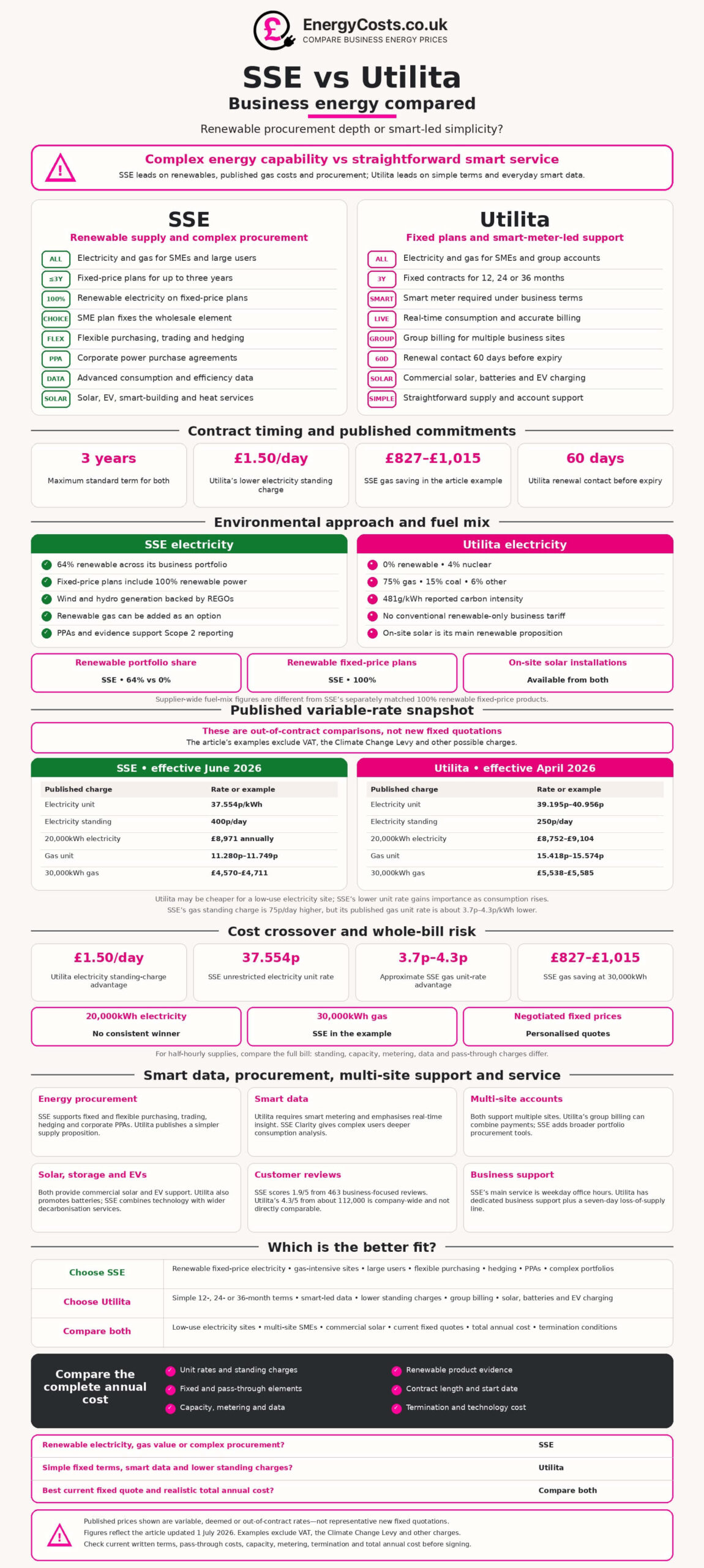
Published out-of-contract rates also show an important difference. Utilita generally has the lower daily standing charge, while SSE currently has lower published gas unit rates and broadly competitive electricity costs. However, neither supplier publishes standard fixed-contract prices, so businesses must obtain personalised quotations before deciding.
SSE vs Utilita at a glance
| Comparison area | SSE Energy Solutions | Utilita Business |
|---|---|---|
| Business electricity | Yes | Yes |
| Business gas | Yes | Yes |
| Fixed contracts | Up to three years | 12, 24 or 36 months |
| Flexible purchasing | Yes, particularly for large users | Limited information published |
| Renewable electricity | 100% renewable electricity on fixed-price plans | Does not market conventional green tariffs |
| Smart meters | Available | Required for business energy customers |
| Online account management | Manage My Account and SSE Clarity | My Utilita Business |
| Multi-site support | Yes | Yes, including group billing |
| Commercial solar | Yes | Yes |
| Large-business procurement | Fixed, flexible, hedging and corporate PPAs | Primarily straightforward business supply and solar |
| Published electricity variable rate | 37.554p/kWh for a standard unrestricted meter | 39.195p to 40.956p/kWh, depending on region |
| Published gas variable rate | 11.280p to 11.749p/kWh | 15.418p to 15.574p/kWh |
| Business Trustpilot rating | 1.9 out of 5 | No directly comparable business-only score |
| Best suited to | Renewable energy and complex procurement | Smart-meter-led SME energy management |
SSE’s fixed-price plans for smaller and medium-sized organisations include renewable electricity as standard. Its wider offering includes flexible purchasing, corporate power purchase agreements and energy-management services for larger organisations. Utilita offers fixed rates, real-time consumption information, dedicated business support and a growing commercial solar proposition.
Which is cheaper: SSE or Utilita?
There is no single answer because contracted business energy prices depend on:
- Annual electricity and gas consumption
- Meter type and profile
- Distribution region
- Contract length
- Credit history
- Start date
- Wholesale market conditions
- Whether non-commodity charges are fixed or passed through
Neither SSE nor Utilita publishes a nationwide list of fixed-contract prices. The most transparent comparison therefore uses their published variable, deemed and out-of-contract rates.
These rates are normally charged when a business moves into premises without agreeing a contract or remains with the supplier after a fixed agreement expires. They should not be treated as representative quotations for a new fixed contract.
SSE vs Utilita electricity rates
The following comparison uses published non-half-hourly unrestricted electricity rates. Prices exclude VAT, the Climate Change Levy and any additional pass-through charges.
| Supplier | Effective date | Electricity unit rate | Standing charge |
|---|---|---|---|
| SSE | June 2026 | 37.554p per kWh | 400p per day |
| Utilita | April 2026 | 39.195p to 40.956p per kWh | 250p per day |
SSE charges the lower unrestricted unit rate, but Utilita’s standing charge is £1.50 per day lower. This creates a crossover point: Utilita may cost less for a relatively low-consumption site, while SSE becomes more competitive as consumption increases.
Utilita’s exact unit rate depends on the regional electricity network. Its lowest unrestricted rate is 39.195p per kWh in London, while its highest published rate is 40.956p per kWh in the Manweb region. SSE publishes a single 37.554p unrestricted rate, although its 400p daily charge is comparatively high.
Example annual electricity cost
For a business using 20,000 kWh of electricity annually:
| Supplier | Estimated annual electricity cost |
|---|---|
| SSE | £8,971 |
| Utilita | £8,752 to £9,104 |
The calculation includes the published unit rate and standing charge but excludes VAT, the Climate Change Levy and other possible charges.
At this consumption level, neither supplier is consistently cheaper. Utilita is cheaper in some regions because of its lower standing charge, while SSE is cheaper than Utilita’s higher-priced regional tariffs.
SSE vs Utilita gas rates
| Supplier | Effective date | Gas unit rate | Standing charge |
|---|---|---|---|
| SSE – monthly billing, bands 1 and 2 | June 2026 | 11.280p per kWh | 325p per day |
| SSE – quarterly billing, bands 1 and 2 | June 2026 | 11.749p per kWh | 325p per day |
| Utilita | April 2026 | 15.418p to 15.574p per kWh | 250p per day |
SSE’s standing charge is 75p per day higher, equivalent to £273.75 over a full year. However, its gas unit rate is approximately 3.7p to 4.3p per kWh lower.
That difference means SSE’s published variable rate is likely to be cheaper for most businesses using a meaningful quantity of gas.
Example annual gas cost
For a business using 30,000 kWh of gas annually:
| Supplier | Estimated annual gas cost |
|---|---|
| SSE – monthly billing | £4,570 |
| SSE – quarterly billing | £4,711 |
| Utilita | £5,538 to £5,585 |
On this example, SSE is between approximately £827 and £1,015 cheaper per year.
This is only an out-of-contract comparison. A personalised fixed quotation from Utilita could still beat an SSE quotation, particularly where Utilita is actively seeking customers with a particular meter type, region or consumption profile.
Half-hourly electricity rates
SSE and Utilita also publish rates for larger half-hourly electricity supplies.
| Supplier | Example unrestricted unit rate | Published standing charge | Other charges |
|---|---|---|---|
| SSE – LV or LVS, measurement class C or E | 33.669p per kWh | £23.98 per day | 158p per kVA per month |
| SSE – LV or LVS, measurement class F or G | 31.547p per kWh | £18.36 per day | Depends on supply |
| Utilita – unrestricted half-hourly | 39.095p per kWh | £14.40 per day plus kVA | Metering, data collection, data aggregation, reactive power and excess capacity passed through at cost |
The figures are not directly interchangeable because the suppliers structure capacity and associated industry costs differently. A half-hourly customer should compare the entire projected annual bill rather than focusing on the unit rate alone.
SSE tariffs and contract options
SSE divides its business proposition between smaller organisations and larger energy users.
Its SSE Choice plan is intended for small and medium-sized businesses and fixes the wholesale element of the price for up to three years. SSE describes businesses using less than 100,000 kWh of electricity or 293,000 kWh of gas annually as part of its smaller and medium-sized segment.
Larger organisations can access services including:
- Fixed-price procurement
- Flexible purchasing
- Trading and hedging
- Corporate power purchase agreements
- Renewable electricity and gas options
- Energy-use analysis
- Smart buildings
- Solar installations
- Electric vehicle infrastructure
- Heat and cooling networks
This range makes SSE more suitable for manufacturers, property portfolios, public-sector organisations and businesses with dedicated energy procurement teams.
SSE’s fixed-price plans come with 100% renewable electricity as standard, while renewable gas can be added as an option. Flexible contracts are available for larger users that want to purchase energy in separate increments rather than fixing their entire volume at one point in the market.
Utilita tariffs and contract options
Utilita offers fixed business energy agreements lasting 12, 24 or 36 months. The supplier says it contacts customers 60 days before their contract end date and provides renewal options before variable rates apply.
Its business proposition focuses on:
- Fixed energy rates
- Smart meters
- Real-time consumption information
- Accurate billing
- Dedicated account management
- Group billing for multiple sites
- Energy-efficiency advice
- Commercial solar panels
- Battery storage
- Electric vehicle charging
Utilita Business customers are required to have a smart meter under its published terms. This could be beneficial for organisations that want automated readings and more detailed usage information, but it may be less attractive to businesses that cannot easily accommodate a meter exchange.
Group billing allows businesses to combine payments across multiple sites using a single or group variable Direct Debit. This can simplify administration for smaller property portfolios, retail chains and hospitality businesses.
Renewable energy comparison
This is one of the clearest differences between SSE vs Utilita.
SSE renewable energy
SSE reports that 64% of the electricity across its business energy supply portfolio came from renewable sources between April 2024 and March 2025.
Customers on SSE Green, SSE Next Generation and SSE corporate PPA products receive electricity matched with 100% renewable generation. SSE says this electricity is generated by its wind and hydro assets and backed by Renewable Energy Guarantees of Origin.
This makes SSE the stronger choice for a business that needs:
- Market-based Scope 2 emissions reporting
- Renewable electricity evidence
- Support for ESG reporting
- A corporate power purchase agreement
- A supplier with direct renewable generation interests
Utilita renewable energy
Utilita takes a different approach. It does not promote a conventional REGO-backed green tariff and argues that some green energy tariff claims can be misleading.
Its company-wide fuel mix for April 2024 to March 2025 was reported as:
| Energy source | Utilita fuel mix |
|---|---|
| Natural gas | 75% |
| Coal | 15% |
| Other fuels | 6% |
| Nuclear | 4% |
| Renewables | 0% |
The corresponding reported carbon intensity was 481 grams of carbon dioxide per kWh. These figures relate to Utilita’s total electricity purchasing rather than solely its business division.
Instead of selling a labelled green tariff, Utilita concentrates on carbon transparency, smart-meter information and helping businesses generate electricity through on-site solar.
Utilita says its commercial solar projects have installed more than 2,000 panels and that its solar and battery projects are saving customers more than £3 million. It claims businesses can reduce electricity bills by an average of around 40%, although actual savings will depend on the site, system size, electricity consumption and financing method.
Renewable energy winner: SSE
SSE is the clear choice where renewable electricity procurement and reportable emissions reductions are priorities. Utilita may appeal to businesses that prefer direct investment in on-site solar rather than purchasing a certificate-backed green tariff.
Smart meters and energy management
Both suppliers provide smart-meter and online account services.
SSE customers can use Manage My Account to:
- View and download bills
- Make payments
- Submit meter readings
- Check account information
- Monitor energy consumption
- Access tools such as SSE Clarity
SSE Clarity provides more detailed consumption information and can help businesses identify unusual usage patterns or possible efficiency improvements.
Utilita places smart metering at the centre of its business offering. Its system is intended to provide real-time insights, automatic readings and more accurate bills. Customers can also submit readings through My Utilita, by telephone, text message or an online form.
Smart technology winner: Utilita for smaller businesses
SSE offers more advanced tools for complex energy users, but Utilita’s standard proposition is more explicitly designed around smart meters and accessible real-time information.
Customer service comparison
SSE provides a dedicated business energy customer service number, open from 9am to 5pm, Monday to Friday. Its complaints procedure includes escalation to a specialist Complaint Management Team and access to the Energy Ombudsman after eight weeks or following a deadlock letter.
Utilita provides a dedicated business telephone number and email address. It also operates a separate loss-of-supply line between 8am and 10pm, seven days a week.
Trustpilot ratings
| Supplier profile | TrustScore | Number of reviews |
|---|---|---|
| SSE Energy Solutions | 1.9 out of 5 | 463 |
| Utilita company-wide profile | 4.3 out of 5 | Approximately 112,000 |
These scores should be treated cautiously. SSE’s profile relates specifically to SSE Energy Solutions and is heavily weighted towards business-energy experiences. Utilita’s much larger profile covers its wider company and appears to contain predominantly domestic customer reviews.
Trustpilot also states that Utilita invites customers to submit reviews, whereas SSE Energy Solutions has no history of asking for reviews. The different customer populations and collection methods mean the scores are not directly comparable.
Nevertheless, SSE’s low business-specific rating is a concern. Recent reviews frequently mention billing, account administration, estimated readings and difficulty resolving problems. Utilita’s overall score is substantially stronger, although its domestic-heavy review base provides limited evidence about the experience of business customers.
Customer review winner: Utilita, with an important comparability warning
SSE advantages and disadvantages
Advantages of SSE
- 100% renewable electricity on fixed-price business plans
- Lower published variable gas rates
- Broad range of contracts for SMEs and large organisations
- Flexible purchasing and hedging services
- Corporate power purchase agreements
- Strong renewable generation credentials
- Advanced energy-management and decarbonisation services
- Suitable for complex and multi-site organisations
Disadvantages of SSE
- High published variable standing charges
- Poor business-specific Trustpilot rating
- Customer service is primarily limited to weekday office hours
- Large range of products may be unnecessarily complex for a very small business
- Fixed prices are not published online
Utilita advantages and disadvantages
Advantages of Utilita
- Lower published variable standing charges
- Fixed contracts available for 12, 24 and 36 months
- Strong emphasis on smart-meter data
- Real-time energy-use information
- Group billing for multiple sites
- Dedicated business account management
- Commercial solar, battery storage and EV charging
- Stronger company-wide Trustpilot score
Disadvantages of Utilita
- Higher published variable gas unit rates
- Published variable electricity unit rates are generally higher than SSE’s
- Smart-meter installation is required
- No conventional 100% renewable business tariff
- Company-wide fuel mix reported 0% renewable electricity for 2024/25
- Less extensive large-business procurement information than SSE
Which supplier is best for different businesses?
| Type of business | Better choice | Reason |
|---|---|---|
| Small office with low consumption | Compare both | Utilita’s lower standing charge may help |
| Gas-intensive business | SSE | Lower published variable gas unit rates |
| Business needing renewable electricity | SSE | Renewable electricity included with fixed-price plans |
| Manufacturer or large energy user | SSE | Flexible purchasing, hedging and PPAs |
| Business wanting detailed smart-meter data | Utilita | Smart-meter-led proposition |
| Multi-site SME | Either | SSE has broader procurement tools; Utilita offers group billing |
| Business considering commercial solar | Compare both | Both offer solar, with Utilita placing greater emphasis on installations |
| Business needing Scope 2 reporting | SSE | Renewable products and REGO-backed reporting |
| Business prioritising public review scores | Utilita | Higher overall rating, although not business-specific |
| Business wanting the simplest fixed contract | Utilita | Straightforward 12, 24 and 36-month options |
Final verdict: SSE vs Utilita
SSE is the better overall business energy supplier for renewable electricity, gas-intensive sites, large organisations and businesses with complex procurement requirements.
Its fixed-price plans include renewable electricity as standard, and its wider range of flexible contracts, corporate PPAs, hedging tools and energy-management services goes well beyond basic gas and electricity supply.
Utilita is a credible alternative for SMEs that want straightforward fixed terms, smart meters, real-time consumption information and commercial solar support. Its lower variable standing charges can also benefit low-consumption electricity customers.
Published out-of-contract prices suggest that SSE is clearly more competitive for gas. Electricity is more finely balanced: Utilita’s lower standing charge offsets some of its higher unit rate, particularly for smaller users.
Businesses should obtain quotations from both suppliers and compare the estimated total annual cost. The comparison should include unit rates, standing charges, capacity costs, metering fees, pass-through charges, contract length and termination conditions—not simply the headline pence-per-kWh figure.
FAQ
SSE currently publishes lower variable gas rates and a lower standard electricity unit rate. Utilita has lower standing charges, so it can be cheaper for some low-consumption electricity sites. Fixed-contract prices are personalised, meaning neither supplier is always cheaper.
Yes. SSE states that its fixed-price business plans include 100% renewable electricity as standard. Renewable gas is optional, while larger organisations can also access renewable flexible contracts and corporate power purchase agreements.
Yes. Utilita supplies gas and electricity to non-domestic customers. Its published variable gas rates effective from April 2026 range from 15.418p to 15.574p per kWh, with a 250p daily standing charge.
Utilita states that its business energy customers are required to have a smart meter installed under its terms and conditions. The meter provides automatic readings and more detailed information about energy consumption.
Yes. SSE offers fixed-price plans for small and medium-sized businesses. It identifies customers consuming less than 100,000 kWh of electricity or 293,000 kWh of gas annually as part of its smaller-business segment.
SSE is the stronger choice for purchased renewable electricity. Its renewable plans are matched with 100% renewable generation. Utilita does not promote conventional green tariffs and instead focuses on consumption reduction, carbon transparency and on-site solar generation.
Early termination conditions depend on the contract. Utilita states that an early termination fee may apply where a customer leaves before a fixed term ends. Businesses should review both suppliers’ principal terms before signing.
Choose SSE for renewable electricity, competitive published gas rates or sophisticated large-business procurement. Consider Utilita for smart-meter-led account management, simple fixed terms, lower standing charges or an integrated business solar project.