
Utilita Business and E.ON Next both supply electricity and gas to UK businesses, offer fixed contracts lasting up to three years and provide commercial solar and battery solutions. However, there are significant differences in their prices, renewable-energy propositions and suitability for larger organisations.
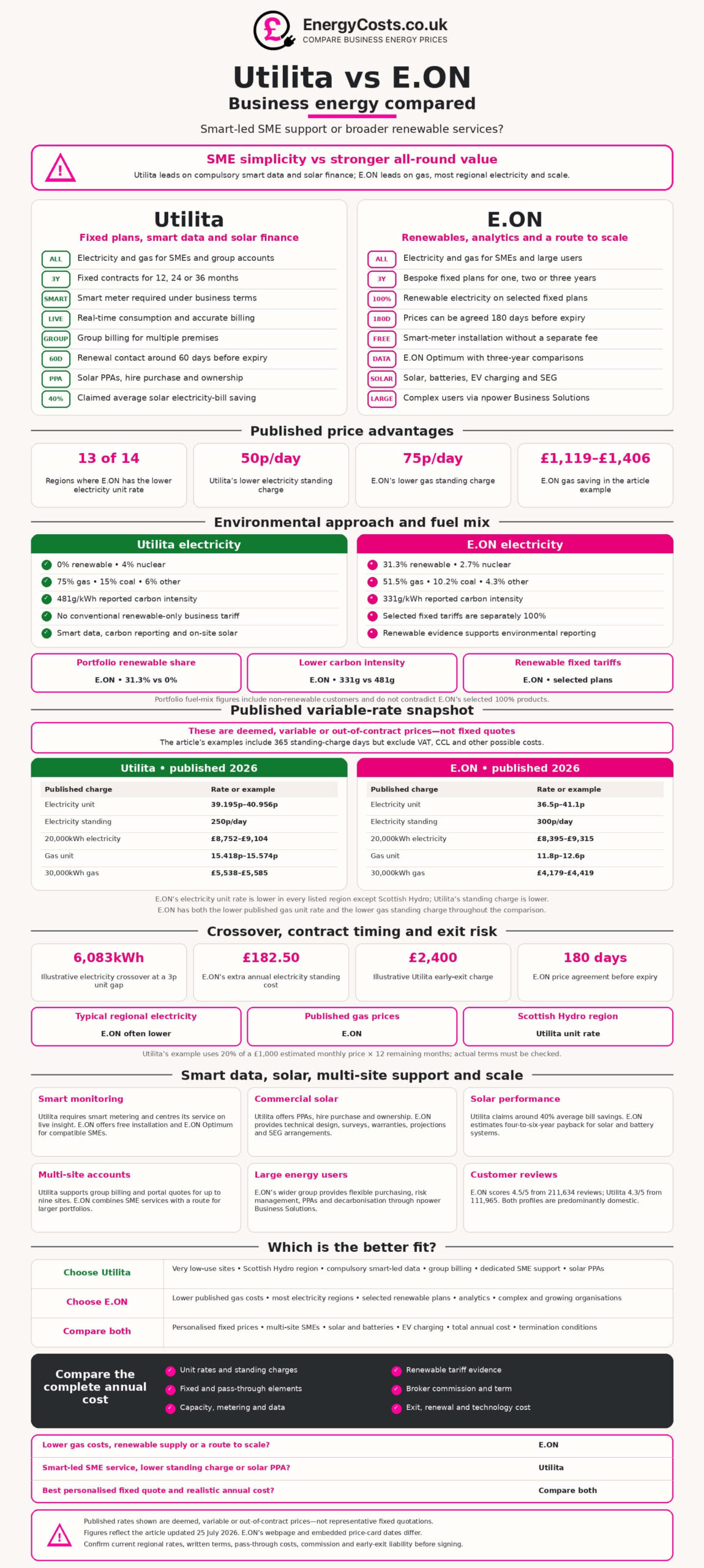
E.ON Next is generally the stronger all-round supplier. Its latest published deemed gas rates are substantially lower than Utilita’s business variable rates, while selected fixed electricity tariffs are backed by 100% renewable electricity. E.ON also provides more extensive support for larger and more complex energy users through npower Business Solutions.
Utilita may still appeal to smaller businesses that prioritise smart-meter data, dedicated account management, group billing or a commercial solar installation. Its published electricity standing charge is lower than E.ON’s, which can partly offset its higher electricity unit rates.
Utilita vs E.ON at a glance
| Comparison area | Utilita Business | E.ON Next |
|---|---|---|
| Business electricity | Yes | Yes |
| Business gas | Yes | Yes |
| Fixed contract lengths | 12, 24 or 36 months | One, two or three years |
| Renewable electricity | No conventional renewable tariff promoted | 100% renewable electricity on selected fixed tariffs |
| Published variable electricity rate | 39.195p to 40.956p per kWh | 36.5p to 41.1p per kWh |
| Published electricity standing charge | 250p per day | 300p per day |
| Published variable gas rate | 15.418p to 15.574p per kWh | 11.8p to 12.6p per kWh |
| Published gas standing charge | 250p per day | 175p per day |
| Smart meters | Required for business customers | Available without installation charge |
| Energy-use dashboard | Real-time smart-meter insights | E.ON Optimum for compatible SME meters |
| Online account management | My Utilita Business | E.ON Next online account and app |
| Multi-site billing | Group billing available | Multi-site services available |
| Commercial solar | Solar, batteries and PPAs | Solar and battery systems |
| EV charging | Available | Available |
| Large-business services | Primarily focused on SMEs | Provided through npower Business Solutions |
| Overall Trustpilot score | 4.3 out of 5 | 4.5 out of 5 |
| Best suited to | Smart-meter-led SMEs and solar projects | Renewable supply, lower gas rates and wider energy services |
E.ON Next offers bespoke fixed prices for one, two or three years, online account management and dedicated Energy Specialists. Utilita offers 12, 24 and 36-month fixed deals alongside smart meters, consumption insights and dedicated business support.
Which is cheaper: Utilita or E.ON?
Neither supplier publishes standard fixed-contract prices that apply to every business. Quotations depend on factors such as:
- Annual consumption
- Meter profile and type
- Distribution region
- Contract start date
- Contract duration
- Credit history
- Payment method
- Whether charges are fixed or passed through
- The wholesale market when the contract is agreed
The most transparent comparison therefore uses the suppliers’ published deemed, variable and out-of-contract prices.
These are normally more expensive than negotiated fixed-contract rates. A business should not deliberately remain on them, but they provide a useful basis for comparing how each supplier treats customers without an active fixed agreement.
Utilita vs E.ON electricity prices
For a standard non-half-hourly unrestricted electricity meter, the suppliers publish the following prices excluding VAT and the Climate Change Levy.
| Supplier | Electricity unit rate | Standing charge |
|---|---|---|
| Utilita Business | 39.195p to 40.956p per kWh | 250p per day |
| E.ON Next | 36.5p to 41.1p per kWh | 300p per day |
Utilita’s unit rate varies by electricity distribution region, but its 250p daily standing charge is the same throughout the country. E.ON charges a higher 300p daily standing charge, while its unit price varies more widely between regions.
Electricity rates by region
| Electricity region | Utilita unit rate | E.ON unit rate | Lower unit rate |
|---|---|---|---|
| East Midlands | 39.782p | 36.7p | E.ON |
| Eastern | 39.761p | 36.8p | E.ON |
| London | 39.195p | 37.5p | E.ON |
| Manweb | 40.956p | 39.6p | E.ON |
| Midlands | 40.091p | 36.5p | E.ON |
| Northern | 40.091p | 37.4p | E.ON |
| Norweb | 40.039p | 38.1p | E.ON |
| Scottish Hydro | 40.297p | 41.1p | Utilita |
| Scottish Power | 40.132p | 36.8p | E.ON |
| Seeboard | 39.978p | 36.9p | E.ON |
| Southern | 40.029p | 37.5p | E.ON |
| Swalec | 39.555p | 37.8p | E.ON |
| Sweb | 40.204p | 38.1p | E.ON |
| Yorkshire | 39.823p | 36.8p | E.ON |
E.ON has the lower unit rate in 13 of the 14 electricity regions. Utilita is cheaper per unit only in the Scottish Hydro region, although Utilita’s standing charge is 50p per day lower everywhere.
E.ON’s deemed-contract webpage identifies its latest schedules as effective from 1 July 2026. The SME price cards embedded in the downloadable documents are dated 10 April 2026, so businesses should confirm the applicable rate directly with E.ON before relying on it for billing.
Example annual electricity cost
The following calculation assumes annual consumption of 20,000 kWh and an unrestricted meter.
| Supplier | Lowest regional annual cost | Highest regional annual cost |
|---|---|---|
| Utilita | £8,752 | £9,104 |
| E.ON | £8,395 | £9,315 |
The calculations include the unit rate and 365 days of standing charges but exclude VAT, the Climate Change Levy and other possible costs.
E.ON is cheaper in most regions at this consumption level. However, its high Scottish Hydro rate means it can cost more than Utilita in that particular area.
Electricity crossover point
E.ON’s standing charge costs £182.50 more per year:
- E.ON: 300p × 365 = £1,095
- Utilita: 250p × 365 = £912.50
In a region where E.ON’s unit rate is approximately 3p per kWh lower, the standing-charge difference is recovered after roughly 6,083 kWh of annual consumption.
This means:
- A very low-consumption business may benefit from Utilita’s lower standing charge.
- A typical office, shop or hospitality site is more likely to benefit from E.ON’s lower unit rate.
- The exact outcome depends heavily on the regional price.
Utilita vs E.ON gas prices
The difference between the suppliers is much clearer for gas.
| Supplier | Gas unit rate | Standing charge |
|---|---|---|
| Utilita Business | 15.418p to 15.574p per kWh | 250p per day |
| E.ON Next | 11.8p to 12.6p per kWh | 175p per day |
E.ON has both the lower unit rate and the lower standing charge. Its unit rate is approximately 2.8p to 3.8p per kWh below Utilita’s, while its standing charge is 75p per day lower.
Example annual gas cost
For a business using 30,000 kWh of gas annually:
| Supplier | Lowest regional annual cost | Highest regional annual cost |
|---|---|---|
| Utilita | £5,538 | £5,585 |
| E.ON | £4,179 | £4,419 |
Based on these published variable prices, E.ON would be approximately £1,119 to £1,406 cheaper per year.
The saving would become larger for a gas-intensive restaurant, hotel, care home, manufacturing business or other organisation with substantial heating and hot-water demand.
Gas price winner: E.ON
Half-hourly electricity prices
Larger electricity supplies can be settled half-hourly and may include capacity, metering, data collection and reactive-power charges.
Utilita’s published half-hourly unrestricted rate is:
| Charge | Utilita rate |
|---|---|
| Unit rate | 39.095p per kWh |
| Standing charge | £14.40 per day plus kVA charges |
| Additional costs | Metering, data collection, data aggregation, reactive power, CCL and excess capacity |
E.ON divides its half-hourly deemed customers into several aggregated, low-voltage and high-voltage bands. Its published unit rates range from approximately 30.8p to 49.4p per kWh, with standing charges and capacity costs depending on the region and supply band.
The headline rates should not be compared in isolation because the suppliers structure their charges differently. A half-hourly customer should request a projected annual cost that includes:
- Standing charges
- Agreed capacity
- Excess capacity
- Meter operator charges
- Data collection and aggregation
- Reactive power
- Distribution charges
- Transmission charges
- Other pass-through costs
E.ON is more likely to suit a complex half-hourly supply because its wider group also provides flexible procurement and risk-management services for large businesses. Utilita’s proposition is more focused on standard fixed contracts and straightforward SME account management.
Utilita contract options
Utilita offers fixed business energy contracts lasting:
- 12 months
- 24 months
- 36 months
Prices normally remain fixed unless the information supplied by the customer was incorrect or the business’s energy requirements change.
Utilita contacts fixed-contract customers approximately 60 days before their end date. Businesses that do not renew move onto its business variable rates.
An important consideration is Utilita’s early termination calculation. Its published guidance states that the charge can equal 20% of the estimated monthly price multiplied by the number of months remaining.
For example, if a business had an estimated monthly price of £1,000 and 12 months remaining:
£1,000 × 20% × 12 = £2,400 termination fee
This can make leaving a Utilita fixed contract early expensive, particularly for a high-consumption customer.
E.ON contract options
E.ON Next also offers bespoke fixed business contracts lasting one, two or three years. Prices can be agreed up to 180 days before the existing agreement ends.
Selected fixed electricity tariffs are backed by 100% renewable electricity. E.ON also states that its fixed business plans do not automatically roll over into another fixed agreement. A customer that fails to renew is instead moved onto a flexible contract, which is usually more expensive.
E.ON Next’s SME proposition includes:
- Fixed electricity and gas tariffs
- Online quotations for eligible businesses
- Dedicated Energy Specialists
- Online account management
- Free smart-meter installations
- E.ON Optimum energy insights
- Commercial solar and batteries
- Business EV charging
- Smart Export Guarantee payments
Businesses with larger or more complex requirements are directed to npower Business Solutions, which is part of the E.ON group. E.ON defines this route as suitable where a business uses more than 100,000 kWh of electricity or 293,000 kWh of gas, has turnover of at least £2 million or employs more than ten people.
Contract flexibility winner: E.ON
Both suppliers offer the same broad choice of fixed durations, but E.ON has a wider range of services once a business grows beyond a conventional SME contract.
Renewable energy comparison
Renewable electricity is one of the most significant differences between Utilita and E.ON.
E.ON renewable electricity
E.ON offers 100% renewable electricity on selected fixed business tariffs. This means the electricity consumed is matched with renewable generation through the relevant contractual and certification arrangements.
E.ON’s overall disclosed electricity fuel mix for residential, small-business and corporate customers between April 2024 and March 2025 was:
| Source | E.ON fuel mix |
|---|---|
| Natural gas | 51.5% |
| Renewables | 31.3% |
| Coal | 10.2% |
| Other fuels | 4.3% |
| Nuclear | 2.7% |
Its reported carbon intensity was 331 grams of carbon dioxide per kWh. These portfolio-wide figures include customers who were not on a renewable tariff, so they do not contradict the 100% renewable claim for selected products.
Utilita renewable electricity
Utilita does not promote a conventional 100% renewable business tariff. It is openly critical of tariffs that rely on separately purchased Renewable Energy Guarantees of Origin, arguing that certificates do not necessarily finance additional renewable generation.
Utilita’s company-wide fuel mix for April 2024 to March 2025 was:
| Source | Utilita fuel mix |
|---|---|
| Natural gas | 75% |
| Coal | 15% |
| Other fuels | 6% |
| Nuclear | 4% |
| Renewables | 0% |
Its reported carbon intensity was 481 grams of carbon dioxide per kWh. The figures relate to Utilita’s total purchased electricity rather than only its business customers.
Utilita instead concentrates on:
- Real-time carbon reporting
- Smart-meter consumption data
- Energy-efficiency advice
- On-site solar generation
- Battery storage
- Commercial power purchase agreements
Renewable electricity winner: E.ON
A business requiring renewable electricity evidence for environmental reporting is likely to find E.ON’s selected fixed tariffs more suitable.
Smart meters and energy monitoring
Both companies support smart meters, but they apply different policies.
Utilita smart meters
Utilita requires its business energy customers to have a smart meter installed in accordance with its terms. Its proposition centres on real-time consumption information, automated readings and more accurate billing.
Potential benefits include:
- Fewer estimated bills
- Faster identification of unusual usage
- Real-time consumption information
- Easier comparison between trading periods
- Better evidence for energy-saving measures
The compulsory requirement may be inconvenient where a meter exchange is technically difficult, landlord consent is required or a business uses unusual metering equipment.
E.ON smart meters
E.ON offers business smart-meter installation without a separate installation charge. Its E.ON Optimum service is free to SME customers with compatible meters and provides:
- A digital consumption dashboard
- Up to three years of year-on-year comparisons
- Energy-saving and sustainability tips
- Online access to usage information
E.ON customers can also use their online account to view bills, submit readings, check balances, make payments and manage Direct Debits.
Energy monitoring winner: Draw
Utilita integrates smart meters more firmly into its standard offering, while E.ON provides a capable dashboard without making a new meter an absolute condition for every business customer.
Commercial solar comparison
Both companies have developed substantial commercial solar propositions.
Utilita business solar
Utilita offers:
- Solar photovoltaic panels
- Battery storage
- EV charging
- Power purchase agreements
- Hire-purchase finance
- Outright ownership
- Systems for hospitality, manufacturing and public-sector sites
The company claims that its existing installations save customers an average of 40% on their electricity bills and have generated more than £3 million of aggregate customer savings. These are Utilita’s marketing figures rather than guaranteed results.
A Utilita power purchase agreement can fund the installation without the customer paying the full upfront cost. The business instead agrees to purchase the electricity produced by the system at a fixed rate for a long-term period.
E.ON business solar
E.ON offers bespoke systems typically ranging from 15 kW to 100 kW, with larger installations considered where appropriate. Its service includes:
- Initial system design
- A structural roof assessment
- Distribution network applications
- Solar and battery installation
- Performance and return-on-investment projections
- Monitoring tools
- Product and workmanship warranties
- Multi-site designs
- Smart Export Guarantee arrangements
E.ON gives a general payback estimate of four to six years for solar and battery systems and four to seven years for battery-only installations. Actual performance depends on consumption, system size, export limitations, roof orientation and financing.
Commercial solar winner: Draw
Utilita has a particularly prominent commercial-solar offering and flexible finance models. E.ON provides detailed technical planning, warranties and integration with its wider business energy services.
Multi-site and large-business services
Utilita offers group billing that allows several sites to be managed through one or more variable Direct Debits. Its broker portal can produce multi-site quotations for up to nine premises, with larger requirements handled by its sales team.
E.ON Next supplies SMEs directly, while larger organisations can access npower Business Solutions. The wider E.ON group can therefore support:
- Large electricity and gas portfolios
- Half-hourly meters
- Flexible purchasing
- Wholesale market risk management
- Renewable procurement
- Corporate power purchase agreements
- Energy management
- Decarbonisation projects
Large-business winner: E.ON
Utilita can accommodate multi-site SMEs, but E.ON has the more developed route for major industrial, commercial and public-sector organisations.
Customer service comparison
Utilita’s business customer-service team can be contacted by telephone, while its renewal team operates from 8.30am to 5pm, Monday to Friday. Customers receive dedicated account management and can use My Utilita Business for payments and account administration.
E.ON’s business telephone lines operate:
- 9am to 5pm, Monday to Thursday
- 9am to 4pm on Friday
Businesses can also contact E.ON through email and WhatsApp. Emergency meter support remains available outside its normal business hours.
Trustpilot ratings
| Supplier | TrustScore | Reviews |
|---|---|---|
| E.ON Next | 4.5 out of 5 | 211,634 |
| Utilita | 4.3 out of 5 | 111,965 |
E.ON has the higher score, although both ratings are based predominantly on domestic rather than business customers. They should not be treated as a definitive measure of the experience a commercial customer will receive.
Both suppliers invite customers to submit reviews and reportedly respond to 99% of negative reviews, usually within 24 hours.
Customer review winner: E.ON
Utilita advantages and disadvantages
Advantages of Utilita
- Lower published electricity standing charge
- Fixed contracts lasting 12, 24 or 36 months
- Real-time smart-meter consumption information
- Dedicated business account support
- Group billing for multiple premises
- Strong commercial solar proposition
- Solar PPAs and hire-purchase options
- Battery storage and EV charging available
- Competitive electricity price in the Scottish Hydro region
Disadvantages of Utilita
- Higher published variable gas rates
- Higher gas standing charge
- Higher electricity unit rates in most regions
- Smart-meter installation is required
- No conventional 100% renewable business tariff
- Company-wide fuel mix reports 0% renewable electricity
- Potentially substantial early termination charges
- Less extensive support for very large energy users
E.ON advantages and disadvantages
Advantages of E.ON
- Lower published electricity rates in most regions
- Substantially lower published gas prices
- Lower gas standing charge
- One, two and three-year fixed contracts
- 100% renewable electricity on selected fixed tariffs
- Free smart-meter installation
- E.ON Optimum energy-use dashboard
- Commercial solar, batteries and EV charging
- Dedicated Energy Specialists
- Large-business services through npower Business Solutions
- Higher overall Trustpilot rating
Disadvantages of E.ON
- Higher electricity standing charge
- Particularly high deemed electricity rate in the Scottish Hydro region
- Renewable electricity is only included on selected tariffs
- Fixed prices are bespoke and not fully published
- More complex group structure for businesses that move from SME to large-corporate services
- Customer-service telephone hours are limited to weekdays
Which supplier is best for different businesses?
| Business requirement | Better choice | Reason |
|---|---|---|
| Low-consumption electricity site | Compare both | Utilita has the lower standing charge |
| Typical SME electricity account | E.ON | Lower unit rates in most regions |
| Gas-intensive business | E.ON | Lower unit rate and standing charge |
| Renewable electricity | E.ON | 100% renewable electricity on selected fixed tariffs |
| Smart-meter-led account management | Utilita | Smart metering is central to its proposition |
| Business that cannot change its meter | E.ON | Utilita requires a smart meter |
| Multi-site SME | Compare both | Utilita offers group billing; E.ON has broader services |
| Large industrial customer | E.ON | Access to npower Business Solutions |
| Commercial solar project | Compare both | Both offer comprehensive systems |
| Solar PPA without upfront capital | Utilita | PPA finance is prominently offered |
| Energy-use analytics | E.ON | E.ON Optimum provides three-year comparisons |
| Scottish Hydro electricity region | Utilita | Lower published variable unit rate |
| Business concerned about exit costs | E.ON may be preferable | Utilita publishes a potentially significant termination formula |
Final verdict: E.ON vs Utilita
E.ON is the better overall business energy supplier for most UK companies.
Its published deemed electricity rate is lower than Utilita’s in 13 of the 14 regions, and its published gas rates are substantially cheaper throughout the country. E.ON also offers selected fixed plans with 100% renewable electricity, a free SME energy dashboard and a clearer path to sophisticated large-business services.
Utilita remains a credible option for smaller businesses that value real-time smart-meter insights, personalised account management, group billing or commercial solar finance. Its lower electricity standing charge can benefit very small sites, and its rate is competitive in the Scottish Hydro region.
The comparison changes once personalised fixed quotations are obtained. A Utilita fixed offer could be cheaper than an E.ON quotation even where its published variable prices are higher. Businesses should therefore compare the projected annual cost rather than choosing solely on the unit rate.
The quotation should clearly show:
- Unit rates
- Standing charges
- Contract length
- Total estimated annual cost
- Broker commission
- Pass-through charges
- Metering and capacity costs
- Renewable-energy terms
- Early termination charges
- Renewal and end-of-contract arrangements
FAQ
E.ON’s published electricity unit rate is lower in most regions, while Utilita has a 50p-per-day lower electricity standing charge. E.ON’s published gas unit rate and standing charge are both substantially lower. Personalised fixed quotations may produce a different result.
Both Utilita and E.ON offer fixed business contracts. Utilita offers 12, 24 and 36-month agreements, while E.ON offers one, two and three-year tariffs. The actual rates are calculated individually for each business.
E.ON is the stronger option for purchased renewable electricity because selected fixed business tariffs include 100% renewable electricity. Utilita does not promote a conventional renewable tariff and instead focuses on energy efficiency, carbon reporting and on-site solar.
Utilita requires its business energy customers to have a smart meter installed. E.ON offers smart-meter installation without a separate charge but does not state that every business customer must accept one as a universal condition.
Yes. Both Utilita and E.ON supply business gas. E.ON’s published deemed rate is 11.8p to 12.6p per kWh, compared with Utilita’s variable rate of 15.418p to 15.574p per kWh.
Yes. Utilita and E.ON both install commercial solar panels and battery storage. Utilita offers options including power purchase agreements and hire purchase, while E.ON provides bespoke designs, technical surveys, warranties and ROI projections.
E.ON Next has a Trustpilot score of 4.5 out of 5, compared with Utilita’s 4.3. However, both profiles primarily represent domestic customers and should not be interpreted as business-only customer-service ratings.
E.ON is generally more suitable for large businesses because high-consumption and complex customers can use npower Business Solutions. Utilita is primarily positioned towards SMEs, although it can support multiple sites and commercial solar projects.
A business may face termination charges when leaving either supplier before the contract end date. Utilita states that its charge can equal 20% of the estimated monthly price multiplied by the number of remaining contract months.
Choose E.ON for lower published gas prices, renewable electricity and extensive large-business services. Consider Utilita for smart-meter-led management, lower electricity standing charges, group billing or a financed commercial solar installation.