
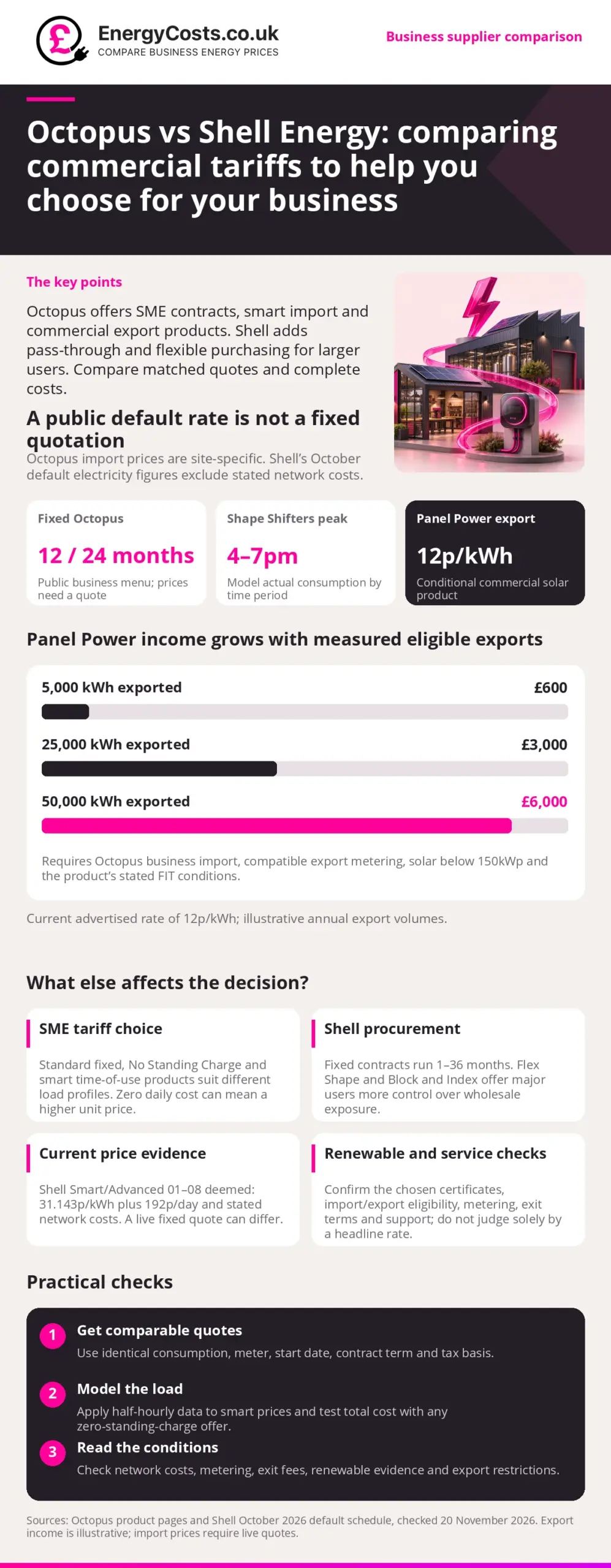
Octopus Energy for Business and Shell Energy UK both supply gas and electricity to British businesses, but their strongest products target different parts of the market.
Octopus is particularly well suited to small and medium-sized businesses that want straightforward fixed pricing, innovative smart tariffs, zero-standing-charge options or strong customer service. Its Shape Shifters products reward organisations that can move electricity consumption outside the expensive 4pm to 7pm period, while its Panel Power export tariff pays businesses with solar panels a flat rate for surplus generation.
Shell Energy has a broader proposition for large, energy-intensive and multi-site organisations. In addition to conventional fixed contracts, it offers pass-through pricing, direct wholesale-market purchasing, renewable gas, corporate power purchase agreements and integrated energy infrastructure.
The overall verdict is:
- Octopus is likely to be the better choice for most small businesses. Its standard and no-standing-charge products are comparatively simple, its smart tariffs are among the most innovative available to SMEs, and it has the stronger business-specific customer-review score.
- Shell Energy is the stronger option for complex procurement. Its pass-through and flexible products provide large organisations with greater control over commodity and non-commodity costs.
- There is no defensible current price winner without matched written quotations. Octopus’s standard business import prices are site-specific. Shell’s public October 2026 default rates have a different purpose and exclude stated electricity network costs. Compare equivalent fixed offers before choosing a supplier.
Octopus vs Shell Energy at a glance
| Comparison area | Octopus Energy for Business | Shell Energy UK |
|---|---|---|
| Business electricity | Yes | Yes |
| Business gas | Yes | Yes |
| Domestic energy supply | Yes | No; former household customers transferred to Octopus |
| Conventional fixed contracts | Commonly 12 or 24 months | One to 36 months |
| Zero-standing-charge tariff | 0p/day option listed; check site and fuel eligibility | No equivalent standard product prominently offered |
| Smart time-of-use tariff | Shape Shifters Trio and Agile | Flexible wholesale products for larger users |
| Flexible purchasing | Limited SME smart tariffs | Flex Shape and Block and Index |
| Pass-through contracts | Charges depend on the selected product | Customer can choose which non-commodity costs pass through |
| Renewable electricity | Green and zero-carbon electricity products | 100% renewable electricity options |
| Renewable gas | Not a prominent standard SME product | RGGO-backed renewable gas available |
| Corporate PPAs | Direct generator and traceable-energy options | Bespoke corporate PPAs |
| Business solar export | Panel Power pays 12p per kWh | Bespoke export and generation arrangements |
| Dynamic export tariff | Shape Shifters Export | No comparable public SME product |
| Published electricity example | Site-specific current quote required | 31.143p deemed plus 192p/day for Smart/Advanced 01–08; network costs extra |
| Published gas example | Site-specific current quote required | 7.991p deemed plus 452p/day, band 1 |
| Business Trustpilot score | 4.9 out of 5 | 4.7 out of 5 |
| Business Trustpilot reviews | 1,421 | 179 |
| Best suited to | SMEs, smart tariffs and solar exporters | Large users, renewable gas and complex procurement |
Octopus’s public business proposition emphasises direct sales, transparent tariffs and products for small, medium-sized and complex organisations. Shell’s range progresses from fixed contracts for smaller businesses to pass-through and flexible purchasing for major commercial and industrial customers.
Does Shell Energy still supply businesses?
Shell Energy continues to supply electricity, gas and related services to UK businesses.
The former Shell Energy household operation was sold to Octopus Energy, and its domestic customers were transferred to Octopus. That transaction did not close Shell Energy UK’s commercial supply business.
The Shell business operation remains active and offers fixed, flexible and pass-through gas and electricity contracts. This article therefore compares two separate active suppliers:
- Octopus Energy for Business
- Shell Energy UK’s commercial supply operation
Shell’s continued business offering includes renewable electricity, renewable gas, flexible wholesale purchasing and energy infrastructure.
Which is cheaper: Octopus or Shell Energy?
There is no universally applicable fixed rate from either supplier.
Business energy prices depend on:
- Annual electricity and gas consumption
- Meter profile and settlement type
- Electricity distribution region
- Agreed supply capacity
- Number of sites
- Contract start date
- Contract duration
- Payment method
- Credit history
- Load profile
- Renewable-energy requirements
- Treatment of network and policy costs
- Broker commission
Octopus requires a postcode and business information before displaying the tariffs available to a particular site. Its tariff page can include current and historical products, but it does not provide one simple national business price card.
Shell publishes national deemed and extended-supply schedules. However, the electricity rates exclude several distribution and transmission charges, which are added separately.
The available price examples must therefore be interpreted carefully.
Current business pricing: compare the same contract basis
Prices and product information were checked on 20 November 2026. Octopus Energy for Business provides site-specific import quotations rather than one current national rate card. Its public business tariff menu lists 12- or 24-month Fixed Octopus, a 12-month No Standing Charge product and Shape Shifters. The current unit rate and daily charge must come from a quote for the relevant premises, meter and start date.
Shell’s published schedule from 1 October 2026 supplies current default-rate evidence. A deemed tariff applies when a new occupier consumes energy without agreeing terms. Extended supply can apply after a fixed contract ends without renewal or a completed transfer. These prices should not be presented as Shell’s negotiated fixed offer or compared with an old Octopus quotation to declare a present-day saving.
Octopus vs Shell Energy electricity prices
| Supplier and pricing basis | Unit rate | Standing charge | What to compare |
|---|---|---|---|
| Octopus fixed business import | Current site quote required | Current site quote required | Use the same meter, consumption, start date and term as Shell |
| Octopus No Standing Charge | Current site quote required | 0p/day on eligible product | Check the higher unit rate and every other applicable charge |
| Shell deemed: Smart/Advanced 01–08 | 31.143p/kWh | 192p/day | Stated network charges remain additional |
| Shell extended: Smart/Advanced 01–08 | 38.305p/kWh | 192p/day | Stated network charges remain additional |
| Shell deemed: Traditional 01–08 | 31.143p/kWh | 280p/day | Different meter-segment daily charge |
| Shell extended: Traditional 01–08 | 38.305p/kWh | 280p/day | Different meter-segment daily charge |
Shell also publishes distinct class 00, MHHS, unmetered and EHV arrangements. Advanced/Smart class 00 and MHHS rows use 30.570p/kWh deemed or 37.732p/kWh extended, with a 192p/day daily charge; Traditional MHHS uses 31.143p or 38.305p with 280p/day. Match the supply’s exact segment and any capacity charge. The headline examples exclude VAT and CCL.
Shell electricity pass-through charges
Shell explicitly excludes distribution capacity, reactive-power and fixed charges, plus transmission charges, from its displayed default electricity prices; those are passed through at prevailing network rates. Its unit and standing charges therefore do not constitute the complete bill. For either supplier, obtain the full schedule of network, capacity, exceeded-capacity, metering, data and other costs and establish which are bundled, fixed or variable.
Example annual electricity cost
At 20,000kWh/year and 365 days, the current Shell Smart/Advanced 01–08 example is £6,929.40 on deemed supply: £6,228.60 energy plus £700.80 standing charges. Extended supply is £8,361.80: £7,661.00 energy plus £700.80 standing charges. VAT, CCL and the stated network pass-throughs are extra. A Traditional 01–08 meter instead has £1,022 a year in standing charges, £321.20 more.
A current Octopus fixed total cannot be calculated responsibly until its applicable unit, standing and other charges are known. A 1p/kWh difference alone is worth £200 a year at 20,000kWh; a £1/day standing-charge difference is £365 a year. Use both components and the same tax and network-cost basis.
Electricity price assessment
Neither the public product menu nor Shell’s default schedule establishes a current fixed-contract winner. Ask both suppliers for a written annual forecast for the same site. For smart tariffs, apply actual half-hourly consumption to each time period rather than using an undated average unit price.
Octopus vs Shell Energy gas prices
Octopus business gas import is also quote-based. The Shell table below contains current published deemed and extended rates, not a fixed-contract quotation. Prices exclude VAT and CCL; use the annual quantity held for the specific gas supply point.
Shell gas prices by consumption
| Shell tariff | Annual quantity | Unit rate | Standing charge |
|---|---|---|---|
| Deemed band 1 | 1–73,200kWh | 7.991p/kWh | 452p/day |
| Deemed bands 2 and 3 | 73,201–732,000kWh | 8.096p/kWh | 1,618p/day |
| Deemed band 4 and above | More than 732,000kWh | 8.086p/kWh | 2,699p/day |
| Extended band 1 | 1–73,200kWh | 11.552p/kWh | 554p/day |
| Extended bands 2 and 3 | 73,201–732,000kWh | 11.658p/kWh | 1,720p/day |
| Extended band 4 and above | More than 732,000kWh | 11.648p/kWh | 2,801p/day |
The band 1 deemed standing charge is £1,649.80 over 365 days, before any energy is used. Extended band 1 standing charges are £2,022.10. A band change can materially alter the total even if the headline unit rate looks similar, so verify the recorded annual quantity and band.
Example annual gas cost
At 30,000kWh/year, Shell band 1 deemed energy is £2,397.30 and standing charges £1,649.80, giving £4,047.10 before VAT and CCL. Extended energy is £3,465.60 plus £2,022.10 standing charges, giving £5,487.70. A matched current Octopus gas quote is needed to calculate a valid supplier-to-supplier difference.
Gas price assessment
Obtain fixed gas quotations from both suppliers and compare the complete annual cost. Current default rates are useful for measuring the risk of remaining without a negotiated agreement; they are not evidence that the same supplier’s fixed offer is uncompetitive.
Octopus fixed business tariffs
Octopus offers conventional fixed business contracts, although the exact durations and prices displayed depend on the site.
Its current business documentation refers specifically to:
- 12-month fixed tariffs
- 24-month fixed tariffs
- No Standing Charge tariffs
- Standard variable and deemed supply
- Smart time-of-use products
Octopus’s standard business exit-fee guidance describes a fee of 25% of the remaining contract balance. Its exemptions guidance includes moving out, the last 30 days of the term and an ended contract. Confirm the applicable supply summary: a bespoke or half-hourly agreement may have different termination provisions.
A fixed contract can protect the business from wholesale-price movements during the agreed term, but customers should still check:
- Whether the entire unit price is fixed
- Which network charges are included
- Capacity charges
- Metering costs
- Exit fees
- Volume tolerances
- Circumstances allowing the supplier to vary prices
Octopus No Standing Charge tariff
Octopus’s current business menu lists No Standing Charge with 0p/day and a unit rate fixed for 12 months. This removes the separate daily supply charge on the eligible product; it does not remove the underlying network costs, which are recovered through the unit rate or other contractual charges.
Its launch guidance describes eligibility for electricity bands 2, 3 and 4 and says lower-use businesses within a band are more likely to benefit. Check current site and fuel eligibility rather than assuming an identical zero-standing-charge gas product is available.
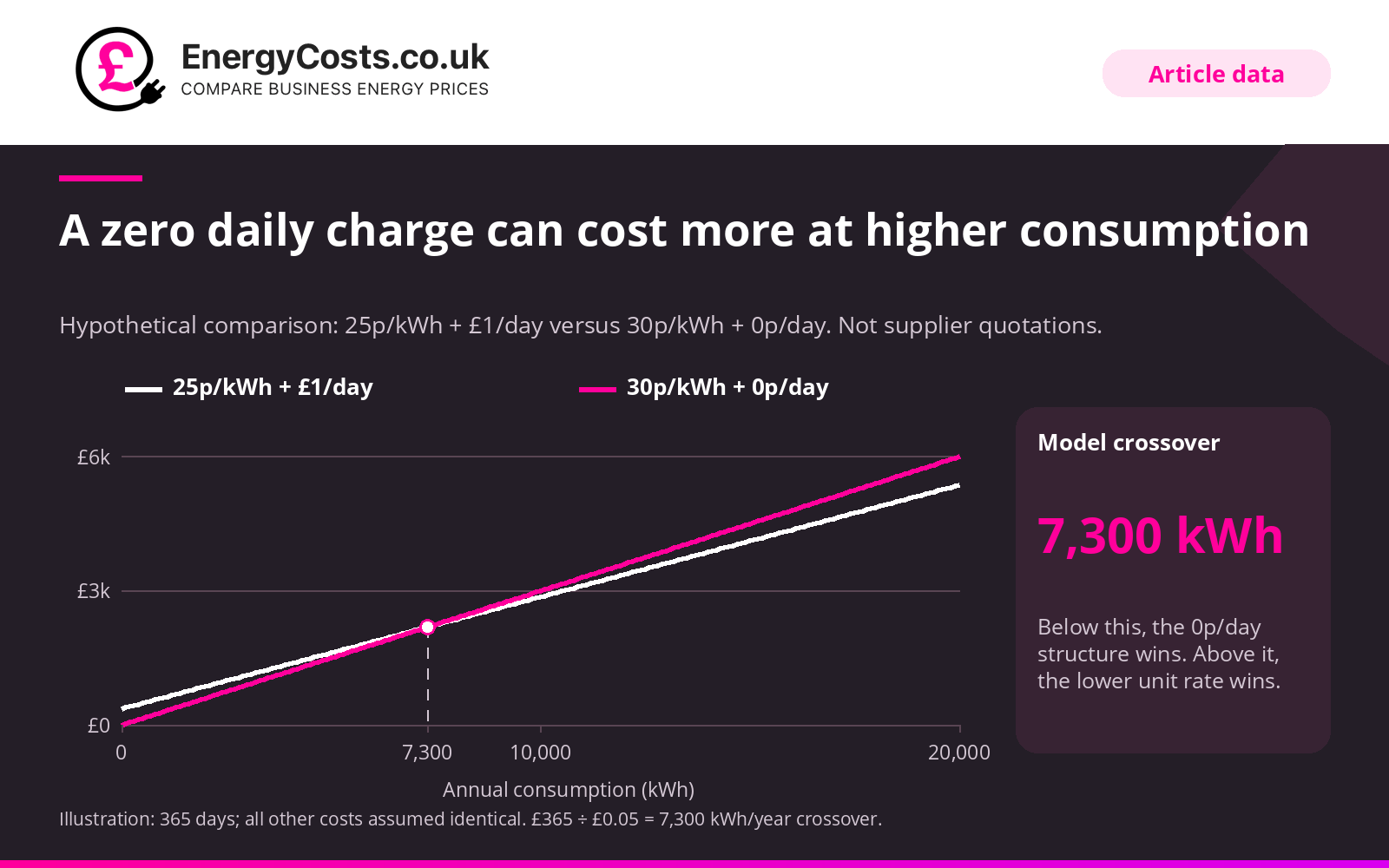
The correct crossover calculation is: annual standing charge saved ÷ increase in unit price, using pounds consistently. For illustration only, compare 25p/kWh plus £1/day with 30p/kWh and no daily charge. These are hypothetical inputs, not Octopus or Shell prices. The crossover is £365 ÷ £0.05 = 7,300kWh/year.
| Annual use | 25p/kWh plus £1/day | 30p/kWh with 0p/day | Cheaper structure |
|---|---|---|---|
| 2,000kWh | £865 | £600 | No daily charge: £265 lower |
| 7,300kWh | £2,190 | £2,190 | Equal in this model |
| 20,000kWh | £5,365 | £6,000 | Daily-charge option: £635 lower |
This model assumes 365 days and the same treatment of every other cost. Substitute the complete live quotation, including taxes, network and capacity costs, fees and exit terms. Seasonal or low-use premises may benefit from a zero daily charge, while a higher-use site can pay more overall.
Octopus Shape Shifters
Shape Shifters is Octopus’s distinctive smart electricity proposition for businesses.
It comes in two versions.
Shape Shifters Trio
Trio applies three predetermined unit rates:
- Night rate
- Day rate
- Peak rate
The expensive peak window runs from 4pm to 7pm. Octopus says businesses receive 21 hours of cheaper electricity each day, provided their usage is moved away from that peak.
Trio can suit businesses that can schedule:
- Electric vehicle charging
- Battery charging
- Refrigeration cycles
- Water heating
- Machinery
- Laundry
- Pumping
- Manufacturing processes
Because the time bands remain consistent, the business does not need to check a new wholesale-linked rate every day.
Shape Shifters Agile
Agile prices electricity in half-hourly periods in line with wholesale costs.
Customers receive the following day’s prices in advance and can schedule energy-intensive operations for cheaper periods. Octopus caps the Agile unit price at £1 per kWh.
Agile offers greater potential savings than Trio when wholesale prices are low or negative. It also exposes the business to greater volatility.
A business considering Agile should assess:
- How much consumption can genuinely be moved
- Whether staff can react to daily price signals
- Whether automated controls are available
- Exposure to expensive evening periods
- Battery capacity
- Operational disruption
- The financial effect of the £1-per-kWh maximum price
Shape Shifters eligibility
Both versions are 12-month products requiring the business to:
- Have a working smart meter
- Pay by Direct Debit
- Keep its account payments up to date
Exact prices vary according to the premises and meter arrangement.
Smart-tariff winner: Octopus
Shell offers much more advanced wholesale purchasing for major businesses, but it does not publish a comparable automated time-of-use product aimed at ordinary SMEs.
Shell fixed-price contracts
Shell’s fixed-price business contracts can last from one to 36 months.
The supplier tailors the quotation around expected consumption and offers renewable options and different payment arrangements. Shell promotes these contracts as providing budget certainty, but its terms allow prices to change in certain circumstances beyond its control.
Possible adjustments can arise from:
- Regulatory changes
- Changes to law
- Altered third-party charging structures
- Meter or supply changes
- Incorrect customer information
- Breaches of the contract
- Material changes in consumption
Businesses should review the contract data sheet to identify exactly which costs are guaranteed.
Shell pass-through contracts
Shell offers pass-through electricity contracts to businesses spending more than £50,000 annually on energy.
These products allow a customer to fix the commodity price while choosing which non-commodity costs are charged at prevailing rates. Potential pass-through categories include distribution and transmission costs.
Potential advantages include:
- Avoiding some supplier risk premiums
- Greater visibility over bill components
- Potential savings if network or policy charges fall
- More control over how third-party costs are treated
- Bespoke renewable options
- Flexible billing arrangements
Potential disadvantages include:
- Less predictable bills
- Exposure to increases in network charges
- More complicated invoices
- Greater internal procurement requirements
- A need to understand non-commodity cost forecasts
Pass-through winner: Shell Energy
Octopus’s business contracts can contain separate wholesale and non-wholesale charges, but Shell provides the more explicit and configurable pass-through proposition.
Shell flexible purchasing
Shell offers two principal flexible electricity structures.
Flex Shape
Flex Shape lets a business purchase expected electricity requirements in blocks while Shell manages the difference between the purchased volume and the actual shape of consumption.
The product offers:
- Electricity purchases aligned with business requirements
- An agreed shape fee
- Reduced exposure to non-commodity risk premiums
- 100% renewable electricity
- Options for non-half-hourly and half-hourly meters
Block and Index
Block and Index allows the business to buy blocks of electricity in advance while settling residual consumption against an agreed market index.
Its features include:
- Access to market pricing
- Control over the timing of purchases
- No volume-tolerance penalties under the promoted structure
- Renewable electricity options
- Greater exposure to wholesale-market movements
Shell’s advanced flexible contracts can extend to 60 months and are mainly intended for organisations with substantial electricity expenditure and procurement expertise.
Large-business procurement winner: Shell Energy
Octopus’s smart tariffs are innovative for smaller users, but Shell’s wholesale procurement products are more suitable for major industrial and commercial portfolios.
Which offers greater price certainty?
For a conventional SME, Octopus generally offers the simpler proposition.
A standard fixed Octopus quotation sets out the applicable unit rate, standing charge and any other charges in the supply summary. No-standing-charge customers can remove the separate daily fee entirely, although the corresponding unit rate is higher.
Shell offers fixed-price contracts, but its wider product range creates more possible cost structures:
- All-inclusive fixed pricing
- Pass-through network costs
- Flexible wholesale purchasing
- Deemed supply
- Extended supply
A business must identify which Shell product it is comparing and which charges can vary.
SME price-certainty winner: Octopus
Customised large-user pricing winner: Shell
Renewable electricity comparison
Both suppliers have substantial renewable-energy credentials.
Octopus renewable electricity
Octopus markets green and zero-carbon business tariffs and invests directly in renewable generation.
Octopus Energy Generation’s current portfolio disclosure reports 5.7GW of capacity and £8.5 billion of assets under management, with figures calculated in May 2026. Separately, Octopus’s green-energy page describes direct PPAs with more than 700 UK renewable generators. These are group-level figures, not the fuel mix or physical electricity delivered to one business.
The No Standing Charge business tariff guarantees 100% zero-carbon electricity, while Octopus’s wider business proposition includes traceable and smart renewable products.
Octopus’s approach includes:
- Direct PPAs with renewable generators
- Octopus-owned and managed renewable assets
- Community energy agreements
- Time-of-use tariffs that encourage consumption when renewable output is abundant
- Export tariffs for commercial solar
- Generator-matching products
Shell renewable electricity
Shell offers 100% renewable electricity products backed by Renewable Energy Guarantees of Origin, alongside other business supply arrangements. Specify the renewable product and matching evidence in the contract rather than assuming every Shell supply is automatically 100% renewable.
Customers can also request more specific generation-technology or location options, subject to the contract. Shell’s fixed, pass-through and flexible products can all incorporate renewable electricity.
The current Shell business fuel-mix disclosure covers 1 April 2025 to 31 March 2026. Its portfolio-wide figures are:
| Energy source | Shell Energy business mix |
|---|---|
| Renewables | 56% |
| Natural gas | 32% |
| Coal | 6% |
| Other fuels | 3% |
| Nuclear | 3% |
The portfolio-wide mix includes customers and products outside Shell’s dedicated 100% renewable arrangements. Shell evidences renewable supply through schemes including REGOs and the Green Gas Certification Scheme.
Renewable electricity winner
Draw for conventional renewable electricity.
Both suppliers can offer electricity matched with renewable generation. Compare the specific contract, certificate ownership, generator matching and reporting method. Portfolio investment, total supplier fuel mix and a dedicated renewable tariff are different measures; none guarantees that the physical grid supply is renewable at every moment.
Renewable gas comparison
Shell has the clearer renewable-gas proposition.
Its products can be supported by Renewable Gas Guarantees of Origin under the Green Gas Certification Scheme. These certificates match business gas consumption with an equivalent quantity of biomethane injected into the gas network.
Octopus supplies conventional business gas and offers fixed and no-standing-charge options, but it does not promote an equivalent standard renewable-gas product as prominently within its SME range.
Renewable gas winner: Shell Energy
Business solar export tariffs
Octopus has a major advantage for businesses that already generate solar electricity.
Panel Power
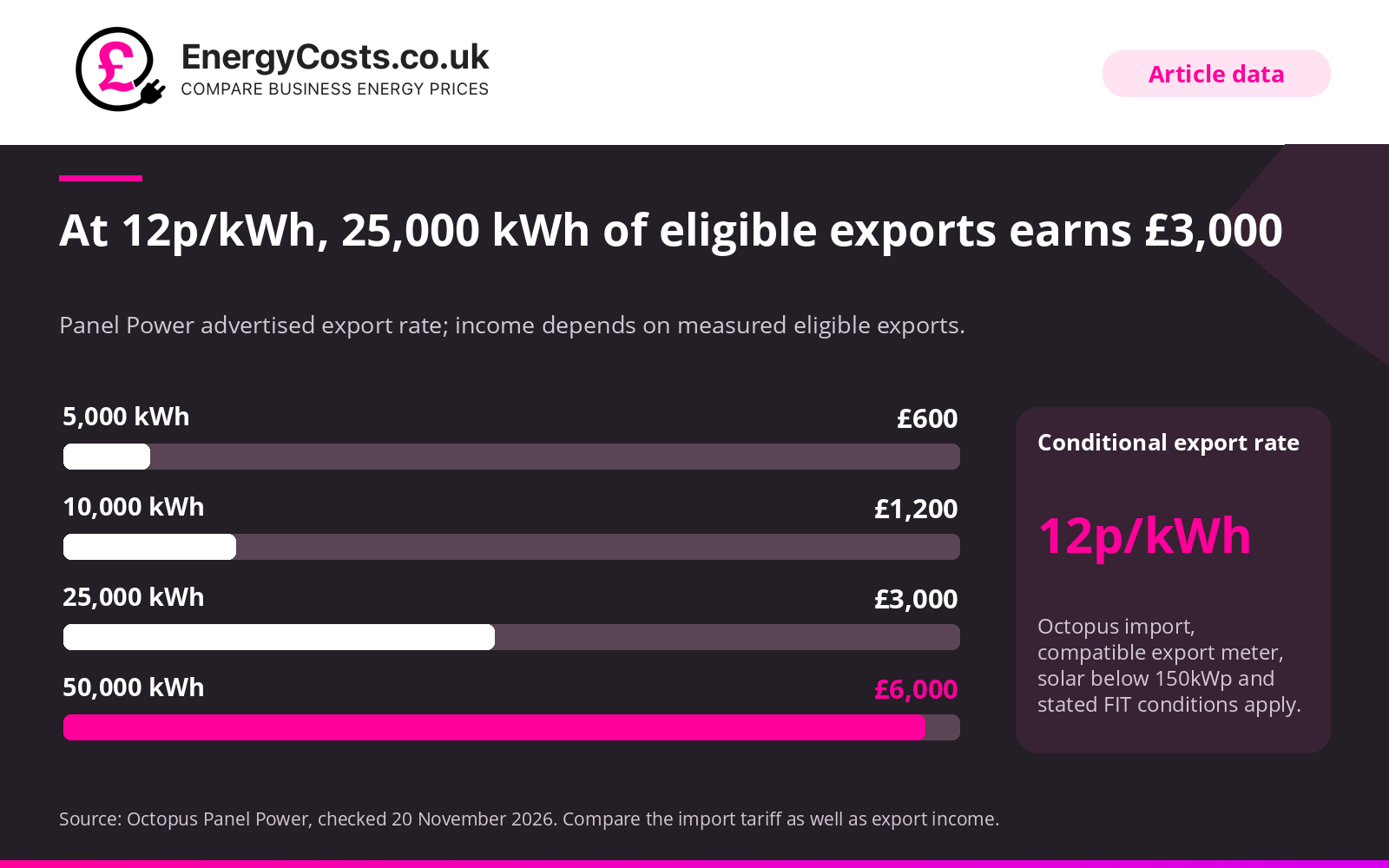
Panel Power pays businesses and charities a flat 12p per kWh for electricity exported to the grid.
The current Panel Power page requires Octopus business import supply, solar capacity below 150kWp and a working smart or export-compatible meter. Its stated conditions exclude Feed-in Tariff payments. Confirm all eligibility and import terms in writing; the 150kWp product ceiling is narrower than the statutory SEG scheme limit.
At different annual export levels, the gross payment would be:
| Electricity exported | Annual Panel Power payment |
|---|---|
| 5,000 kWh | £600 |
| 10,000 kWh | £1,200 |
| 25,000 kWh | £3,000 |
| 50,000 kWh | £6,000 |
Shape Shifters Export
The Shape Shifters Export product uses half-hourly prices linked to wholesale conditions. Its published conditions include Octopus business import supply, capacity below 150kWp, compatible export metering and no Feed-in Tariff payments. A battery can help shift exports but is not compulsory under the product FAQ.
It may be suitable for a business with battery storage because the organisation can export when prices are high rather than accepting the same price throughout the day.
The tariff creates both opportunity and risk:
- Exporting at expensive times can produce more than a flat tariff.
- Exporting during low or negative market prices can generate less.
- Battery losses and degradation must be considered.
- Automated controls may be required.
Shell can support commercial generation, PPAs and bespoke export arrangements, but it does not publish an equivalent universal 12p-per-kWh SME export tariff.
Solar-export winner: Octopus
Smart meters and energy monitoring
Octopus smart meters
Octopus can communicate with compatible Secure SMETS1 and SMETS2 meters. Where an incompatible SMETS1 meter cannot be enrolled in the national smart-meter network, Octopus says it may replace it without an additional charge.
Business smart-meter customers can use an online dashboard to monitor consumption, while a working smart meter is essential for Shape Shifters and other time-sensitive products.
The principal advantage is not merely automatic readings. Octopus uses half-hourly data to support:
- Time-of-use import tariffs
- Dynamic wholesale pricing
- Commercial solar export
- Battery optimisation
- Consumption shifting
- Automated charging
Shell smart meters and My Account
Shell gives smart and advanced-meter customers free access to half-hourly consumption data through My Account.
The portal can provide:
- Up to 12 months of historical data by default
- Half-hourly gas and electricity information
- Downloadable datasets
- Charts showing trends and consumption patterns
- Data across multiple business sites
- Access for authorised third parties
- Bespoke reports
- Invoice and contract information
Meter-data arrangements depend on the meter, settlement rules, contract and privacy rights. Under MHHS, relevant supplies move to half-hourly settlement, so historical daily or monthly data-collection options must not be assumed to remain available for every business meter.
Energy-data winner
Octopus for using data to reduce costs automatically.
Shape Shifters, Panel Power and dynamic export pricing turn smart-meter data into direct tariff incentives.
Shell for conventional multi-site reporting.
Its portal provides a detailed set of reporting, invoice, query and contract-management functions, particularly for organisations with several meters.
Multi-site business energy
Both suppliers support businesses with multiple premises.
Octopus offers dedicated multi-site services and promotes centralised management through its business platform. Its direct-sales model may suit smaller retail, hospitality or property portfolios that want one supplier without using a broker.
Shell’s multi-site strengths include:
- Group billing
- Aligned contract end dates
- Fixed and pass-through structures
- Flexible payment terms
- Multi-site consumption reporting
- Large-user procurement
- Integrated generation and infrastructure
Shell is likely to be the stronger choice for an energy-intensive national portfolio, while Octopus may provide the simpler service for a smaller group of sites.
Commercial solar, batteries and energy infrastructure
Octopus’s most clearly defined commercial proposition concerns tariffs for importing and exporting electricity rather than a universal packaged installation service for every business.
Its advantages include:
- Panel Power
- Shape Shifters Export
- Smart import tariffs
- Direct renewable-generator relationships
- Battery-friendly time-of-use pricing
- Wider Octopus solar and battery expertise
Shell offers more bespoke energy infrastructure for larger organisations, including:
- On-site solar generation
- Battery storage
- Microgrids
- Low-carbon heat
- Electric vehicle infrastructure
- Flexible generation
- Asset optimisation
- Operation and maintenance
- Route-to-market services
Shell is therefore likely to be more suitable for a major integrated energy project, while Octopus is especially attractive to a business that already has solar or storage and wants an innovative tariff.
Customer service comparison
Both companies have dedicated business Trustpilot profiles.
| Supplier | TrustScore | Reviews |
|---|---|---|
| Octopus Energy for Business | 4.9 out of 5 | 1,421 |
| Shell Energy for Business Customers | 4.7 out of 5 | 179 |
The Octopus business profile showed 4.9/5 from 1,421 reviews, while Shell’s business profile showed 4.7/5 from 179 reviews on 20 November 2026. The different sample sizes, invitation methods and posting activity limit a direct customer-satisfaction comparison.
Both profiles invite reviews. Examine recent detailed feedback and complaint themes that match your circumstances; avoid treating a score as a prediction of the service your own business will receive.
Both samples remain small compared with the suppliers’ total customer numbers. Review scores can also be affected by invitation methods, recent campaigns and the types of customers most likely to leave feedback.
Customer-review winner: Octopus
Its 4.9 score is higher and its profile has received much more recent review activity.
Octopus advantages and disadvantages
Advantages of Octopus
- Site-specific fixed business contracts
- 12 and 24-month fixed products
- Zero-standing-charge option for eligible sites
- Shape Shifters Trio
- Half-hourly Shape Shifters Agile pricing
- Smart-meter-led cost reduction
- Panel Power pays 12p per kWh
- Dynamic business export tariff
- Strong direct renewable-generator relationships
- Significant renewable-generation investments
- Simple online account management
- Dedicated multi-site service
- Highest relevant Trustpilot score
- Direct sales rather than a broker-led model
- Products designed specifically for SMEs
Disadvantages of Octopus
- Exact business prices require site details
- No simple national current rate card
- The available public price examples may become outdated quickly
- Smart products require a compatible working meter
- Agile prices can become expensive at peak times
- Fixed tariffs can include early exit fees
- No Standing Charge tariffs have higher unit rates
- Less extensive public information about fully flexible industrial procurement
- Renewable gas is not as prominent as Shell’s product
- Fewer bespoke infrastructure services for major industrial sites
Shell Energy advantages and disadvantages
Advantages of Shell Energy
- Fixed terms from one to 36 months
- Flexible contracts extending to five years
- Fixed, pass-through and indexed structures
- Flex Shape and Block and Index
- Choice over non-commodity pass-through costs
- 100% renewable electricity options
- Renewable gas supported by RGGOs
- Corporate PPAs
- Strong proposition for major energy users
- Multi-site and group-billing support
- Free half-hourly consumption data
- Bespoke reports through My Account
- Solar, batteries and microgrids
- Integrated commercial energy infrastructure
- Large international energy-trading capabilities
Disadvantages of Shell Energy
- High published gas standing charges
- Standing charges increase sharply by gas-consumption band
- Extended-supply rates are considerably higher than deemed rates
- Deemed electricity prices exclude major network costs
- Headline electricity rates are not the complete bill
- Procurement structures can be complicated for SMEs
- No standard zero-standing-charge product
- No flat published SME solar-export rate
- Lower business Trustpilot score
- Limited recent review activity
- The household-business sale can create brand confusion
Which supplier is best for different businesses?
| Business requirement | Better choice | Reason |
|---|---|---|
| Small office or shop | Octopus | SME fixed and smart options; compare matched quotations |
| Very low-consumption premises | Octopus | No Standing Charge option |
| Seasonal business | Octopus | Zero-standing-charge option, subject to eligibility |
| Business able to move consumption | Octopus | Shape Shifters |
| Business with electric vehicles | Octopus | Cheaper off-peak smart pricing |
| Business with battery storage | Octopus | Dynamic import and export products |
| Existing commercial solar panels | Octopus | Panel Power pays 12p per kWh |
| Straightforward 12-month contract | Octopus | Clear SME focus |
| Renewable electricity | Draw | Both provide renewable products |
| Renewable gas | Shell | RGGO-backed supply |
| Business spending more than £50,000 | Shell | Pass-through options |
| Major industrial electricity user | Shell | Flexible wholesale purchasing |
| Five-year procurement strategy | Shell | Block and Index can extend to 60 months |
| Corporate PPA | Shell | Bespoke large-user structures |
| Multi-site industrial portfolio | Shell | Group billing and sophisticated procurement |
| Integrated solar and microgrid project | Shell | Broader infrastructure services |
| Simple smart-meter dashboard | Octopus | Accessible SME platform |
| Complex multi-site reporting | Shell | Detailed reports and data exports |
| Highest customer-review score | Octopus | 4.9 compared with 4.7 |
Final verdict: Octopus vs Shell Energy
Octopus is the better overall business energy supplier for most small and medium-sized organisations.
Its current tariff menu gives SMEs several structures to consider, including standard fixed, zero-standing-charge and time-of-use products. Whether any of them is cheaper depends on a matched live quote and the site’s actual consumption profile:
- No Standing Charge for eligible sites
- Shape Shifters Trio
- Shape Shifters Agile
- Panel Power
- Shape Shifters Export
These products provide genuine choices for low-use premises, flexible businesses, electric vehicle fleets, battery owners and commercial solar generators.
Octopus also has the stronger relevant customer-review record, with a 4.9 TrustScore from 1,421 business reviews compared with Shell’s 4.7 from 179.
Shell Energy is the stronger supplier for large and complex energy users.
Its fixed, pass-through and flexible products allow an organisation to decide how much price certainty it wants and which non-commodity charges should remain variable. Renewable gas, corporate PPAs, microgrids and integrated infrastructure further strengthen its proposition for industrial and multi-site customers.
The current public pricing information does not establish a cheaper supplier. Keep these distinctions clear:
- Octopus fixed import prices require a current site-specific quotation.
- Shell’s displayed default schedule applies from 1 October 2026.
- Compare fixed-contract offers on the same start date and consumption basis.
- Shell’s public figures are deemed and extended-supply rates, not negotiated fixed offers.
- Shell adds electricity network costs separately.
The practical conclusion is:
- Choose Octopus for an SME fixed contract, zero standing charges, smart time-of-use pricing or commercial solar export.
- Consider Shell for renewable gas, pass-through contracts, flexible wholesale purchasing, a corporate PPA or an integrated industrial energy project.
- Compare live fixed quotations before deciding which supplier is cheaper.
A complete comparison should include:
- Unit rates
- Standing charges
- Estimated annual cost
- Distribution charges
- Transmission charges
- Capacity costs
- Metering and data fees
- Contract duration
- Exit fees
- Volume tolerances
- Renewable certificates
- Broker commission
- Price-adjustment provisions
- End-of-contract rates
FAQ
Current site-specific fixed quotations are needed from both suppliers. Shell’s public October 2026 rates are deemed and extended-supply prices with stated electricity network costs additional. They cannot establish a cheaper current fixed offer.
A current Octopus site quote is required. Shell’s October deemed rate for Smart/Advanced profile classes 01–08 is 31.143p/kWh plus 192p/day and stated network charges. Traditional meters have a 280p/day standing charge; compare the correct segment and complete bill.
A current matched quote is required. Shell’s October band 1 deemed gas is 7.991p/kWh plus 452p/day, excluding VAT and CCL. At 30,000kWh and 365 days that is £4,047.10 before those taxes; its negotiated fixed quotation can differ.
Most Octopus business tariffs include a daily standing charge. Eligible businesses can choose a No Standing Charge tariff where the fixed costs are incorporated into a higher unit rate.
Shell does not prominently offer an equivalent standard zero-standing-charge business product. Its fixed, deemed and extended-supply prices normally include daily charges or other site-specific costs.
Shape Shifters is a smart business electricity tariff. Trio uses fixed night, day and peak rates, while Agile changes prices every half-hour in line with wholesale costs.
A Shell pass-through contract fixes the electricity commodity price while billing selected network and policy costs at prevailing rates. It can reduce risk premiums but exposes the business to changing third-party charges.
Yes. Octopus offers green and zero-carbon business products, buys electricity from hundreds of UK renewable generators and manages a major international renewable-generation portfolio.
Yes. Shell offers 100% renewable electricity options backed by Renewable Energy Guarantees of Origin. Specify the chosen product and certificate evidence; its overall 2025/26 business fuel mix was 56% renewable.
Shell has the stronger product. It offers renewable gas supported by Renewable Gas Guarantees of Origin through the Green Gas Certification Scheme.
Yes. Panel Power advertises 12p/kWh; Shape Shifters Export is wholesale-linked. Both have product conditions, including Octopus import supply, compatible export metering, capacity below 150kWp and the stated Feed-in Tariff restriction.
Shell can arrange bespoke generation, export and PPA structures, but it does not publish an equivalent universal flat-rate SME export tariff.
Both support business smart meters. Octopus requires a working compatible meter for Shape Shifters. Shell provides smart and advanced-meter customers with free access to half-hourly data.
Shell is generally stronger for major users because it offers pass-through pricing, flexible wholesale purchasing, renewable gas, PPAs and integrated energy infrastructure.
Octopus Energy for Business has a Trustpilot score of 4.9 from 1,421 reviews. Shell Energy for Business Customers has 4.7 from 179 reviews. Both companies invite reviews.
Choose Octopus for SME pricing, no-standing-charge tariffs, smart time-of-use products or solar export. Consider Shell for renewable gas, flexible procurement, pass-through pricing or large industrial energy projects.