

For UK businesses seeking clarity on energy supply, this article examines the offering from Yorkshire Gas & Power (YGP), a business-only supplier of gas and electricity. We’ll review who they are, what tariff types they offer, typical pricing and contract features, key pros and cons, and what you should check before signing.
Yorkshire Gas and Power at a glance
- Supplier type: Independent business energy supplier
- Fuel supplied: Electricity and gas (dual fuel available)
- Target customers: Small to medium enterprises (SMEs) and larger commercial users
- Tariff types: Fixed, flexible and bespoke contracts
- Sustainability focus: Renewable electricity matching with REGOs
- Best suited to: Businesses seeking a balance of competitive pricing, dual-fuel simplicity and sustainability options
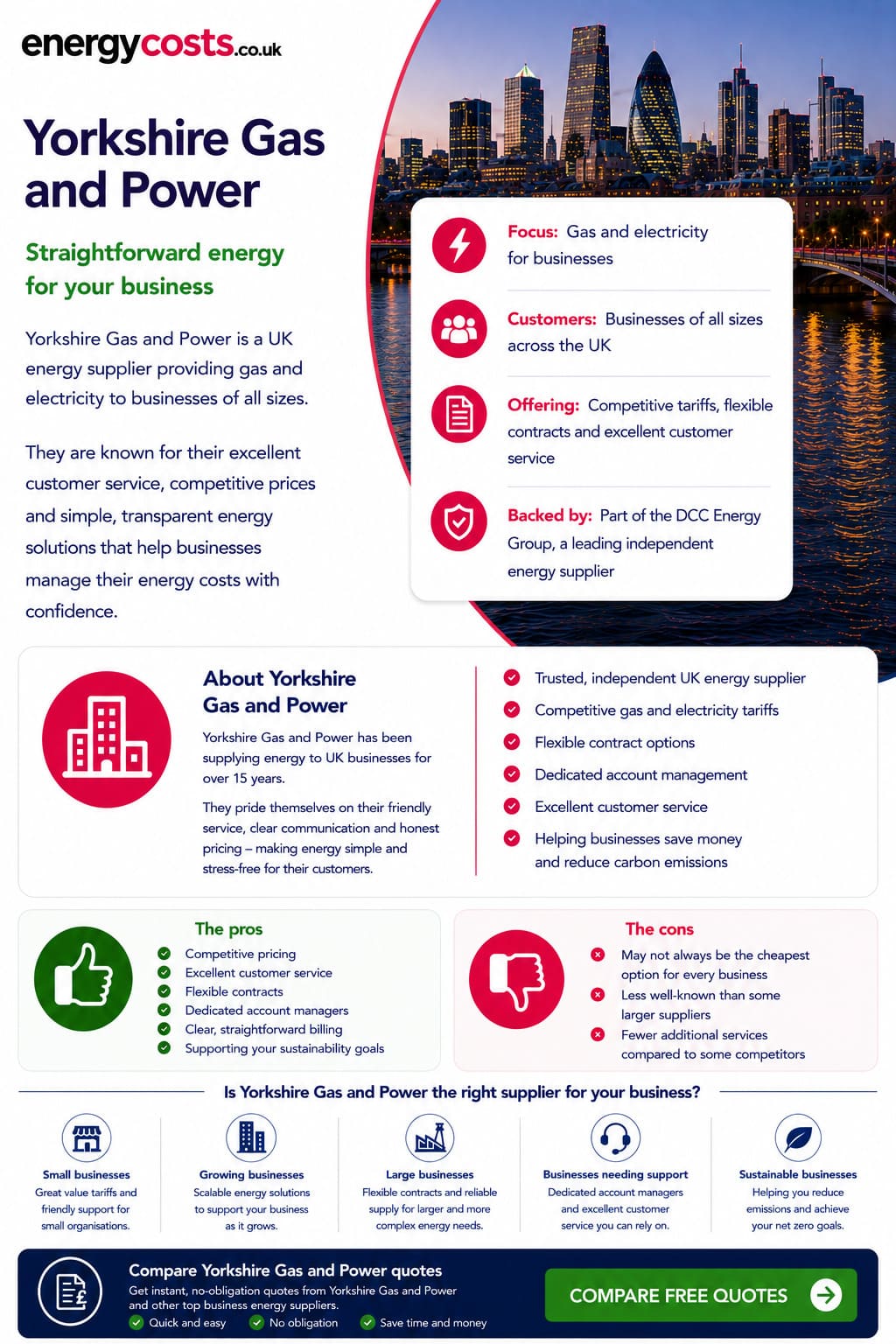
Yorkshire Gas and Power offers a range of tariff options tailored to business usage levels and procurement preferences. It serves customers from small enterprises to larger organisations and provides both electricity and gas, allowing businesses to consolidate energy procurement with a single supplier if desired.
The supplier often highlights its simpler, transparent pricing and personalised support for business customers, which can appeal to organisations that prefer straightforward contracts and clear communication.
Who is Yorkshire Gas & Power?
YGP was founded in 2009 and is focused exclusively on supplying business energy (gas and electricity) in England, Scotland and Wales. Some key points:
- They position themselves as a business-only supplier, meaning their offers are tailored for commercial energy rather than domestic.
- Their website emphasises straightforward billing and a “refreshingly different” approach to how business customers should be treated.
- They support a range of contract types (fixed, flexible, pass-through) and also cater to multi-site businesses.
So, for a UK business looking to supply energy to one or multiple sites, YGP is a credible option — but as always it depends on how well the tariff suits your usage profile and contract management.
Who Yorkshire Gas & Power is best for
Yorkshire Gas & Power is likely to suit businesses that want a supplier focused entirely on the commercial market rather than households. YGP describes itself as a licensed commercial gas and electricity supplier serving England, Scotland and Wales, based in Leeds since 2009. It also highlights fixed business energy contracts, dual fuel contracts and Direct Debit discounts.
That makes YGP potentially a good fit for SMEs that want a business-only supplier with straightforward contract structures, monthly billing and practical account support tools. It may also appeal to businesses that want a supplier with a visible customer portal, app, meter-reading tools, renewal support and moving-premises support, rather than just a quote form and a helpline.
Tariff types and contract features
When reviewing YGP’s offering, several tariff types and contract features stand out:
Fixed-price contracts
YGP offers fixed-price deals for business electricity and gas, typically over 12–36 months.
Benefits:
- Budget certainty: your per-unit cost is locked in (for the commodity portion) for the contract term.
- Protection from short-term market price spikes.
Things to check:
- Are all elements fixed (commodity plus non-commodity charges, standing charges etc)? YGP claims “fixed all elements” in some cases.
- What happens at contract end? Are you automatically rolled over? YGP notes rollover terms if no notice given.
Multi-site contracts
If your business has multiple premises, YGP offers the option to have all sites under one supply contract or consolidation for ease of management. This can simplify billing, contractual end dates, and may reduce administrative overhead.
Flexible / pass-through contracts
YGP also offers more “open” contract types where part of your cost is tied to market pass-through or variable indices.
Note: these carry more risk, since prices may vary for your business. Suitable only if you’re comfortable with that exposure.
Out-of-contract / deemed rates
If you don’t renew your contract or give notice, YGP’s default (deemed) rates can apply — these tend to be significantly more expensive. For example: for electricity non-half hourly: 40.00 p/kWh and standing charge 196 p/day; for half-hourly 40.00 p/kWh and standing charge £13.00/day. Gas: unit rate 15.28 p/kWh and standing charge £240.23/day under certain circumstances.
The message: avoid being rolled into default rates unsafely.
Yorkshire Gas & Power business energy price and tariffs list: commercial rates per kWh
| Business size | Energy type | Contract type | Unit rate (p/kWh) | Standing charge (p/day) | Estimated annual cost* | Notes |
|---|---|---|---|---|---|---|
| Micro business | Electricity | 1-year fixed | 28.5 p | 65 p | £3,250 | Based on 11,400 kWh annual use |
| Small business | Electricity | 2-year fixed | 26.9 p | 70 p | £5,650 | Based on 21,000 kWh annual use |
| Medium business | Electricity | 3-year fixed | 25.8 p | 75 p | £10,500 | Based on 40,600 kWh annual use |
| Large business | Electricity | Flexible / pass-through | 24.2 p (avg) | 80 p | £24,500 | Based on 101,000 kWh annual use |
| Micro business | Gas | 1-year fixed | 9.6 p | 45 p | £1,450 | Based on 15,000 kWh annual use |
| Small business | Gas | 2-year fixed | 8.9 p | 50 p | £3,600 | Based on 40,000 kWh annual use |
| Medium business | Gas | 3-year fixed | 8.2 p | 55 p | £6,600 | Based on 80,000 kWh annual use |
| Large business | Gas | Flexible / pass-through | 7.5 p (avg) | 60 p | £13,800 | Based on 180,000 kWh annual use |
| Default (out-of-contract) | Electricity | Deemed | 40.0 p | 196 p | £14,000+ | Non-contract rate – avoid if possible |
| Default (out-of-contract) | Gas | Deemed | 15.3 p | 240 p | £18,000+ | Non-contract rate – avoid if possible |
*Estimated annual costs assume typical business usage patterns (non-half-hourly metering for smaller sites). Prices exclude VAT and Climate Change Levy (CCL).
Typical pricing and how that stacks up
Because business energy pricing is highly dependent on size of usage, meter type (standard profile vs half-hourly), region, contract length and whether you are fixed vs flexible, we can only look at indicative figures.
Some recent published rates
- YGP’s out-of-contract default rates (see above) highlight how high charges can be when you’re unmanaged.
- An example of YGP’s business energy web summary: “We deliver highly cost effective business energy … our Electricity and Gas products are the perfect choice for your business”.
- YGP is listed by aggregation sites as offering fixed contracts for 1-2-3 years across both gas and electricity and emphasises multi-site and monthly payments.
Comparison with market context
- Some micro businesses are seeing electricity rates broadly in the region of 25-30p/kWh with standing charges around 30-80p/day (depending on size) in recent years.
- YGP’s default rates of ~40p/kWh plus standing charges (for some categories) are clearly much higher than competitive fixed rates, reinforcing the risk of rolling into default.
What this means for a business user
- If you lock into a well negotiated fixed deal with YGP you might achieve sub-market or market-competitive unit rates.
- If you lapse into default/out-of-contract terms your unit and standing charges may blow your budget.
- Standing charges (fixed / daily charges) can become significant, especially for businesses with lower consumption, where the fixed component looms larger.
Moving premises and change of tenancy
If your business is moving in or out of premises supplied by Yorkshire Gas & Power, it is worth dealing with the account early. YGP says that once it has received all required information and documents, it aims to process a change of tenancy within only five working days.
YGP’s change-of-tenancy guidance is more detailed than many supplier pages. It lists proof of ownership or occupancy, proof of end of tenancy, proof of identity, proof of business registration, and opening or closing meter readings among the documents it may require. It also asks for photos of the meter showing the reading, serial number and meter location where relevant.
For businesses, the practical message is simple: take readings on the day of the move, keep documentary proof, and complete the process as quickly as possible. That reduces the risk of billing disputes, estimated charges or delays in setting up the correct account.
Fuel mix and sustainability credentials
Yorkshire Gas and Power positions itself as a business energy supplier with a strong focus on renewable electricity and carbon transparency. The electricity supplied to customers is generally matched with Renewable Energy Guarantees of Origin (REGOs), meaning the amount of electricity a business buys is backed by renewable generation on paper, helping with environmental reporting and net-zero goals.
For companies with ESG commitments and Scope 2 reduction targets, choosing a supplier that transparently reports its fuel mix and actively sources green electricity can support sustainability strategies. Yorkshire Gas and Power typically shows a renewable-heavy fuel mix relative to the UK grid average, although businesses should always check the latest published figures or certificates at the point of contracting.
If your business also uses gas, note that although Yorkshire Gas and Power can supply gas, gas is inherently a higher-carbon fuel than electricity from renewables, so any environmental claims should be interpreted accordingly.
Renewable electricity and fuel mix clarity
YGP’s sustainability messaging needs a little more context than the current page provides. A 2020 YGP post says the company offers 100% renewable electricity, but its current fuel mix disclosure for the period 1 April 2024 to 31 March 2025 shows a disclosed mix of 72.12% natural gas, 14.29% coal, 3.77% nuclear, 3.74% renewables and 6.08% other.
Because of that, businesses with sustainability targets should not assume every YGP contract is renewable by default. It is better to ask whether the specific tariff being quoted includes renewable-backed electricity and what evidence supports that claim. That is especially important for businesses with ESG reporting, procurement rules or carbon-reduction targets.
How wholesale energy prices affect Yorkshire Gas and Power tariffs
Like all energy suppliers, Yorkshire Gas and Power builds its business tariffs around movements in the UK wholesale electricity and gas markets. Understanding this helps business customers see why unit rates and standing charges can change over time.
- On a fixed contract, unit rates and standing charges are agreed upfront for the term of the agreement, giving budgeting certainty and protection against short-term market volatility.
- On flexible or market-linked contracts, prices can move in line with changes in wholesale costs. These wholesale prices are influenced by global fuel markets, supply and demand dynamics, network conditions and policy changes. Businesses with smart metering or operational flexibility can take advantage of lower price periods to reduce costs under these contracts.
Yorkshire Gas and Power’s approach blends market responsiveness with tailored contract terms. Businesses that understand their own consumption patterns (and choose the right tariff type) are often better placed to manage energy risk and reduce costs over the long term. For organisations prioritising simplicity, fixed tariffs provide predictable charges regardless of market fluctuations.
Billing, meter readings and payment
YGP says it currently offers monthly billing only, rather than quarterly billing. It also says meter readings are reflected in bills where actual reads are submitted, but estimates will be used if no actual read is available. For half-hourly sites, it says estimated consumption is usually linked to a communication issue between the meter and the data collector.
The supplier’s customer FAQ also says the quickest way to submit readings is through its customer portal, and that the best time to send a reading is the day before the bill is produced. It adds that customers can register for its self-service portal to manage their account online.
Metering and service standards
YGP gives a reasonable amount of detail on metering and service standards through its customer and GSOP pages. It says it aims to communicate with smart meters where possible, and that half-hourly customers will have their data generated and sent each month via the data collector.
Its GSOP page also sets out microbusiness appointment standards. YGP says that if it misses a qualifying appointment, it will credit the business energy account with £40 within 10 working days, with another £40 if that timescale is missed. The same page publishes 2025 microbusiness appointment statistics, including electricity appointment breach rates by quarter.
Key advantages and drawbacks
Here’s a summary of what to like and what to watch when considering YGP for your business energy supply.
Pros
- Business-only supplier: all their focus is on commercial rather than domestic, which may mean the product mix is tailored for business needs.
- Range of contract types (fixed, flexible, multi-site) giving some flexibility.
- Transparent contract end-date and termination notices are emphasised in some commentary about YGP.
- Ability to spread payments monthly to smooth cost across the year.
Cons / watch-outs
- Whilst fixed contracts exist, the specifics vary. One must check whether all charges are fixed.
- If you miss the termination window you may be rolled into unfavourable rollover terms (e.g., 12 months fixed or 36 months) or default rates.
- For those who want advanced online account management, the feedback is mixed (some commentary says portal features are limited).
- Because pricing is bespoke for many business customers, it demands due diligence (meter type, profile, consumption, contract length).
- The default (out-of-contract) rates for YGP appear high compared with some competitive fixed deals in the market — so managing renewal/termination is critical.
Customer tools and day-to-day support
One of YGP’s stronger points is that its customer section is built around practical account management rather than just sales information. Its current customer pages include a customer portal, app, renewal page, meter-reading submission page, payment options, change-of-tenancy support, new connections, metering and smart meter information, and a glossary of common energy terms.
That matters because for many businesses the quality of the ongoing account experience is just as important as the opening quote. A supplier that makes it easy to view bills, submit reads, renew contracts and handle site changes can be much easier to manage over time than one with a thinner customer-support structure.
What to check before committing
For a UK business looking at YGP (or any business energy supplier) here are the key questions and checks:
- Contract length & fixedness – Confirm whether your commodity unit rate, standing charge and other pass-through/non-commodity charges are fixed for the term.
- Meter type and consumption profile – Are you under standard profile or half-hourly? Half-hourly tends to have different tariff elements.
- End-date and termination/rollover terms – When does the contract expire? What notice do you have to give? What happens if you don’t? YGP emphasises notice windows of 90 days or so.
- Default / out-of-contract rate exposure – Understand how high the default unit and standing charges would be if your contract lapses. As we saw, YGP’s default rates are notably higher.
- Multi-site billing / consolidation (if applicable) – If you operate multiple sites, can you group them under one contract? Do you get unified billing? YGP offers this.
- Payment terms and cash flow – Is there a monthly payment plan? Are there deposit or credit checks? Are you required to pay monthly direct debit or upfront? YGP offers monthly plans.
- Switching process and support – How easy is it to switch to YGP? YGP states that once you sign up they manage the process (quote, switch) for you.
- Renewables / green credentials – If your business has sustainability credentials, check whether the electricity supplied is from renewable sources. (Note: some commentary suggests YGP’s fuel mix in older data wasn’t 100% renewables).
Complaints and escalation
YGP has a dedicated complaints page, which is useful to mention because it gives readers a clearer sense of what happens if something goes wrong after signing. The page says customers with a problem on their account, or where service has not met expectations, can follow the supplier’s complaints process. It also lists direct contact details including 0113 856 0056, [email protected] and its Leeds postal address.
The same page includes Energy Ombudsman contact details, which is useful for microbusiness readers who want to understand the possible escalation route. YGP also publishes historical microbusiness complaints statistics on that page, including 2021 data for complaints received, resolved and resolved within eight weeks.
Is YGP right for your business?
Putting all the above together, here’s how to decide whether Yorkshire Gas & Power is a good fit:
- If your business wants a fixed-price contract, wants a supplier that handles multi-site, wants monthly smoothing of payments and is comfortable managing contract end-dates, then YGP is a viable option.
- If your business has larger consumption, half-hourly metering, requires advanced digital platform / portal features, or high flexibility, you may want to compare YGP with other suppliers and ensure the exact terms are competitive.
- If you’re already with YGP and you are approaching contract end, ensure you give notice well ahead of the deadline and seek renewal quotes to avoid default/unfavourable rollover.
In essence: YGP offers the standard features you’d expect of a business energy supplier, but success depends on how well you manage the contract lifecycle (especially renewal/termination) and compare actual rates, not just the brand.
New connections and new sites
YGP is not just a supplier for businesses that are switching. It also has a dedicated new-connections section for businesses opening or fitting out new premises. YGP supplies both commercial gas and electricity meters, works with customers to find the right solution for their business needs, and provides competitive pricing and day-to-day operational support.
Its step-by-step guide says that once the completed new-connections application form is received, YGP will issue a quote and timescales by email. It also says that it takes approximately 15 working days from receipt of the completed contract to meter fitting, assuming the necessary network infrastructure is already in place.
Final thoughts: Yorkshire Gas & Power pricing review
For a UK business evaluating energy supply contracts, the name Yorkshire Gas & Power deserves consideration. They bring clarity in billing, a business-only focus, and a broad set of contract options. However, the devil is in the detail: unit rates, standing charges, contract terms, meter types, and renewal/rollover mechanisms all matter significantly.
Key takeaway: Locking into a good fixed contract with YGP could be cost-effective; allowing the contract to roll into default or unnoticed rollover may significantly increase your costs. Budget planning, contract management and regular market review remain essential.
FAQ
Yorkshire Gas & Power may request a security deposit equal to roughly 15% of your estimated annual consumption value. For instance, a small business using £4,000 of energy per year could be asked for a deposit of around £600, refundable after consistent payments across 12 months.
Yorkshire Gas & Power typically bills monthly, with statements generated around the 10th of each month. Payment is due within 14 days of the invoice date, and late payments may incur a daily charge of 0.5% of the overdue balance if not cleared within the agreed window.
If a Yorkshire Gas & Power direct debit fails, a £25 administration fee applies. After three failed attempts within six months, YGP may move you to manual invoicing, increasing your standing charge by around 10p per day to offset the higher payment management cost.
Yorkshire Gas & Power generally requires a 90-day renewal notice before your contract end date. Missing this period can trigger a 12-month rollover. For example, a customer using 40,000 kWh annually could face an additional £800 cost if rolled onto a higher fixed-rate tariff.
Yes, Yorkshire Gas & Power allows early contract termination for a fee, typically 15% of your remaining contract value. For a business paying £500 per month with six months left, that equates to a £450 early exit charge if you wish to switch before renewal.
Yorkshire Gas & Power performs credit checks on all new customers. Businesses with a credit score below 50 may face a £500 deposit or be limited to 12-month fixed contracts. Those above 70 can access longer 24- or 36-month deals without additional financial guarantees.
Yorkshire Gas & Power typically completes business energy switches within 21 to 28 working days. However, if your meter requires upgrade verification or data correction, it can extend by 10 days. Overall, 90% of YGP switches finalise in under five weeks from signing.
Yes. Yorkshire Gas & Power offers discounts of roughly 0.3p per kWh when three or more meters are grouped under a consolidated contract. A retailer running five locations using 120,000 kWh annually could save approximately £360 per year through this aggregated billing structure.
Yorkshire Gas & Power reviews pass-through elements (such as network and environmental charges) every six months. These adjustments can change total bills by 2–4%. For instance, a medium site paying £10,000 per year could see a £300 swing following mid-year regulatory charge updates.
Yorkshire Gas u0026 Power sets standard payment terms at 14 days, but larger clients on flexible contracts can extend to 21 days with pre-approval. For example, a manufacturing business spending £20,000 annually could negotiate this grace period, improving cash flow management across monthly billing cycles.