

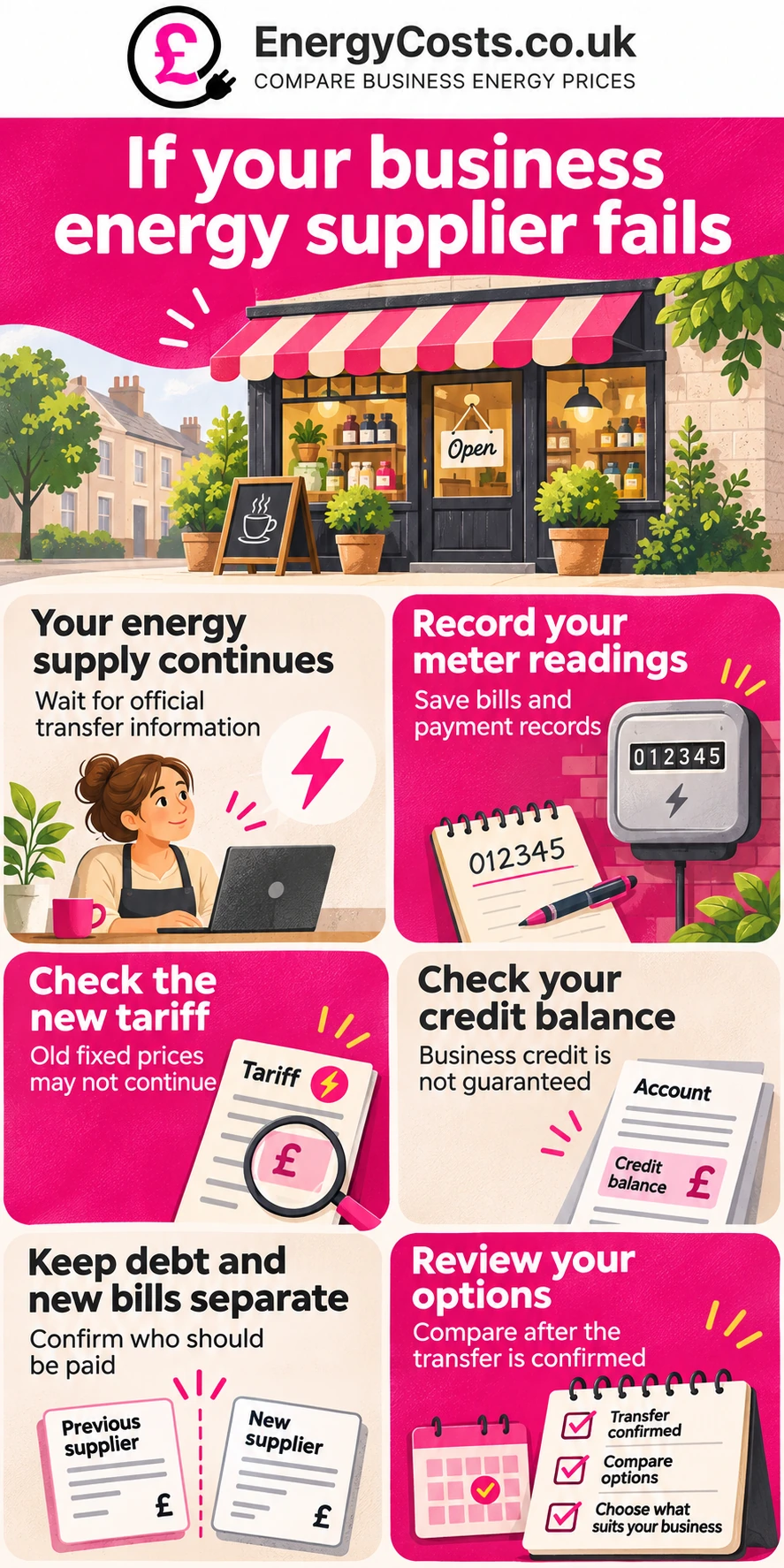
If your business energy supplier goes bust, the supplier’s failure does not mean that gas and electricity suddenly stop reaching your premises. In Great Britain, Ofgem’s arrangements provide for continued supply while a replacement supplier is appointed or the business is managed through an appropriate administration process.
Your priorities are to preserve account records, establish the replacement prices and check what happens to money already paid. Business credit balances do not have the same guaranteed protection as household balances. Supply continuity, the price of future energy and recovery of an old credit balance are three separate issues.
What happens to your business energy account?
| Issue | What to establish | Immediate action |
|---|---|---|
| Physical energy supply | The official arrangements for continued supply | Keep operating normally unless a separate network or safety issue occurs |
| New account | Which supplier is appointed and its start date | Verify the announcement and contact details |
| Future prices | The replacement unit rates and standing charges | Request a written tariff schedule |
| Credit with the failed supplier | Whether any amount will be honoured or claimed in the insolvency | Download statements and payment evidence |
| Unpaid old bills | Who is entitled to collect the balance | Keep old debt separate from new consumption |
| A planned switch | Whether the registration is proceeding | Ask for confirmation rather than submitting duplicate requests |
Ofgem’s current supplier-failure guidance explains the safety net and the important distinction for business credit. It normally advises customers to wait for transfer information rather than immediately starting another switch or cancelling their Direct Debit. Northern Ireland has its own regulatory framework.
What is a supplier of last resort?
A supplier of last resort, often shortened to SoLR, is an energy supplier appointed through Ofgem’s process to take over the affected supply. That is different from the local network operator, which operates the cables or gas pipes. A change in the company billing you does not itself require a replacement physical network connection.
The electricity supply licence conditions, condition 8, provide for notice identifying the old supplier’s end date, the new supplier’s start date and the deemed supply arrangement. Ask for these dates so your finance team can allocate charges to the correct account.
In some circumstances, a special administrator may run the existing supplier while a longer-term solution is arranged. Follow the specific official notice: an administrator continuing to run the energy supplier and an administrator collecting an old insolvent company’s debts are not automatically the same operating situation.
What should you do as soon as failure is confirmed?
Create an account file for each electricity and gas supply. A single company can have several meters, more than one supplier and different responsibility dates. Centralising the records reduces the chance of accepting a duplicate bill or overlooking a credit at one site.
- Record the date, meter serial number and all relevant readings, taking clear photographs where possible.
- Download recent invoices, statements, credit notes and payment history.
- Save the existing contract and the most recent price schedule.
- Keep the official failure and transfer announcements.
- Record the new supplier’s account number and supply start date when issued.
- Allocate responsibility for checking old balances and future tariffs.
For smart or half-hourly sites, retain the available consumption data too. A meter reading records a point in time, while interval data helps explain usage across a billing boundary. If access to an old portal later disappears, locally retained records can be valuable evidence.
| Record | Why it helps |
|---|---|
| MPAN or MPRN | Identifies the electricity or gas supply rather than just the postal address |
| Meter serial number | Checks that the invoice relates to the correct equipment |
| Dated readings | Supports closing and opening account reconciliation |
| Bank payment references | Traces money missing from the supplier’s account history |
| Legal customer name | Establishes which company or individual owns a credit or owes a debt |
| Contract and principal terms | Shows the former arrangement and any disputed charge |
Our MPAN and MPRN guides explain the supply identifiers. Do not rely on an address alone where a building contains several units or meters.
Will your old fixed business tariff continue?
Do not assume that an old fixed price carries over to the replacement account. Obtain the new unit rates, daily charges, start date and terms. The domestic energy price cap is not a general cap on commercial tariffs, so a household price announcement is not a quotation for your business.
Ask whether you are on the initial deemed arrangement or have expressly agreed a new fixed or rolling contract. These are different decisions. Receiving an account number from the appointed supplier is not the same as choosing a multi-year agreement with it.
When the new supplier has confirmed the transfer, compare its available offers with suitable alternatives. Ofgem’s takeover guidance advises waiting until the new supplier has been in touch before initiating a new switch. Check the actual transfer position if an earlier application was already underway.
Worked example: the cost of a replacement tariff
The following uses invented tariff inputs to illustrate budgeting over 60 days with 6,000 kWh of electricity. These are not current supplier offers, a market average or predicted failure tariffs. All figures exclude VAT, CCL and other charges.
| Illustrative arrangement | Unit rate | Daily charge | Energy cost | Fixed charges for 60 days | Total |
|---|---|---|---|---|---|
| Former tariff, for comparison only | 28p/kWh | £1 | £1,680 | £60 | £1,740 |
| Replacement default arrangement | 40p/kWh | £1.50 | £2,400 | £90 | £2,490 |
| Alternative negotiated quotation | 30p/kWh | £1.20 | £1,800 | £72 | £1,872 |
The replacement example costs £750 more than the former price over the same period. The hypothetical negotiated offer is £618 cheaper than the replacement example. This shows why promptly reviewing the new tariff matters even when the continuity arrangements work smoothly.
Use the actual period you expect to remain on the interim arrangement. A £618 comparison over 60 days is not automatically a £3,759.50 annual saving: consumption and the alternative contract may differ over a full year. Compare business electricity prices using your real forecast and confirmed transfer date.
Is business credit protected if a supplier fails?
Business credit is not guaranteed in the same way as household credit. The appointed supplier may agree to honour some or all of it, but you need confirmation of the specific arrangement. Otherwise recovery may depend on a claim in the failed supplier’s insolvency.
Do not treat a balance displayed before failure as the final amount owed. There may be unbilled consumption, reversed invoices or a final payment still to allocate. Ask for the account to be reconciled and keep the calculation behind the amount claimed.
| Illustrative reconciliation | Amount |
|---|---|
| Payments and opening credits available for the period | £3,000 |
| Valid charges already invoiced | −£2,400 |
| Further valid consumption not previously invoiced | −£350 |
| Reconciled credit before any other adjustment | £250 |
The example produces a £250 claim, not a guaranteed £250 refund. If an insolvency distribution were hypothetically only 10p for each £1 of an admitted unsecured claim, £250 would produce £25. That is a calculation illustrating the risk, not a forecast of any administrator’s payment.
Our guide to business energy refunds covers ordinary account-credit requests. Supplier insolvency is a different situation, so do not assume the supplier’s normal refund policy can still be delivered unchanged.
How do you pursue money owed by the failed supplier?
First ask the appointed supplier whether the particular balance is included in its undertaking. If it is, request the evidence requirements and process. If it is not, obtain the verified contact details for the insolvency practitioner handling the failed company and follow that case’s claim instructions.
Prepare the account number, supply address, legal customer name and evidence of the reconciled amount. Keep bank payments and supplier statements together. Where a formal proof of debt is requested, use the correct legal entity and avoid submitting duplicate claims through several departments of your business.
GOV.UK’s creditor-registration guidance explains that registering a claim in a bankruptcy or liquidation does not guarantee payment. Administration has its own case-specific instructions, so ask the appointed practitioner which process and documents apply rather than assuming every insolvency uses the same form or deadline.
Track the claim separately from new supplier invoices. The business may need to pay for current consumption while waiting for a decision on old credit. Ask your accountant how to record a disputed or potentially unrecoverable balance in the company’s accounts.
Does an unpaid old bill disappear?
A supplier’s failure does not automatically cancel a valid debt. Establish who is entitled to collect it and how the balance has been calculated. Depending on the arrangements, collection may sit with the new supplier or the failed supplier’s administrator. Keep evidence of amounts already paid so the same charge is not settled twice.
If a debt is wrong, explain the disputed invoice, reading or responsibility period and request a correction. A request from an administrator does not make every historical estimate accurate. Our business energy bill guide helps you identify the entries to challenge.
For example, if an old account claims £1,200 but a £400 bank payment is missing, ask for the payment to be traced before accepting a £1,200 repayment schedule. Correcting that allocation would leave £800, assuming all other entries are valid. This is separate from whether the new supplier’s own current invoice is payable.
Should you cancel your Direct Debit?
Check the official instructions rather than cancelling automatically. Ofgem’s general advice is normally to leave it in place while the transfer is clarified. Review the account, the originator and the purpose of any collection, and query a duplicate or unexplained payment promptly through verified channels.
If you have already cancelled, tell the new supplier and arrange the appropriate payment method. Stopping a bank instruction does not itself settle earlier usage or terminate every supply obligation. Make sure the finance team knows which supplier should collect future bills and which old balances remain under review.
Never change payment details solely because an unexpected email says the supplier has failed. Independently verify the announcement and the receiving account through an official website or a contact already established as genuine. Supplier transfers can create an opportunity for fraudulent payment requests.
What about prepayment, landlord supply and separate suppliers?
If your business has a supplier-operated prepayment meter, follow the official top-up instructions and keep a sensible balance. Do not replace payment details or equipment on an unsolicited caller’s instructions. Our business prepayment guide explains the practical differences between commercial PAYG and a credit account.
If your landlord holds the main contract, the replacement supplier may contact the landlord rather than each tenant. Ask how any tariff change affects your onward bill and how readings and credit will be reconciled. A commercial submeter does not by itself mean the tenant is a direct customer of the failed supplier.
Gas and electricity can be with different companies. A failure affecting one does not automatically mean both accounts are transferring. Check each supply separately, particularly where a group invoice or a trading name has made the underlying supplier less obvious.
Resolving complaints during the transfer
Keep a short chronology showing which company handled each event. Ask the new supplier about errors in its own account and the administrator about claims or balances remaining with the old company. A promise of compensation by the failed supplier is not automatically a commitment by the replacement supplier.
Where a current supplier complaint remains unresolved, check the appropriate complaint and redress route. Our microbusiness rights guide explains eligibility for business protections. Insolvency claims and supplier-service complaints should not be confused as interchangeable ways to recover the same money.
After the transfer: review the full cost
Compare unit rates, standing charges, payment terms, meter compatibility and the length of any new commitment. Keep the final old-account reconciliation alongside the opening new-account statement. Set reminders for any credit claim and the end of any interim pricing arrangement.
If the replacement cost creates payment difficulty, contact the supplier early and use our business energy debt guide to prepare a realistic budget. Continuity gives you time to make decisions; using that time to organise records and review prices helps control the financial consequences.
Frequently asked questions
Supplier failure does not itself mean electricity or gas stops reaching the premises. In Great Britain, Ofgem’s arrangements provide for continued supply through a replacement supplier or another appropriate process. Follow official notices and distinguish this situation from a separate network fault, safety issue or disconnection dispute.
No. Business balances do not have the same guaranteed protection as household credit. The appointed supplier may agree to honour some or all of the balance, but confirm the specific undertaking. Otherwise recovery may depend on an insolvency claim, with no guarantee of full repayment.
Do not assume the former tariff continues. Ask for the replacement unit rates, standing charges, start date and terms in writing. Identify whether you are on an initial deemed arrangement or have expressly accepted a new agreement. Compare suitable alternatives once the transfer position has been confirmed.
Ofgem generally advises waiting until the appointed supplier has been in touch before starting another switch. If a transfer was already underway, ask what stage it has reached rather than submitting duplicate requests. Once the account position is clear, compare the available terms and confirmed transfer dates.
A valid unpaid balance is not automatically cancelled. Establish who is authorised to collect it and check the calculation against your bills and payments. Keep old debt separate from the replacement supplier’s new invoices. Challenge errors with specific evidence and retain confirmation of amounts already settled.
Do not cancel automatically without checking the official instructions. Confirm how future payments and any old balance will be handled, and query unexplained collections. If you have already cancelled, tell the appointed supplier. Stopping a payment instruction does not itself remove charges for energy already used.
Keep dated readings, meter serial numbers, supply identifiers, invoices, statements, payment references and the old contract. Record the new supplier’s start date and account details when available. These documents help reconcile closing and opening bills and substantiate any credit claim if the old portal becomes unavailable.
The landlord or site operator may be the direct customer contacted by the replacement supplier. Ask how the change affects your onward charges and credit. Review your agreement and submeter readings. A tenant’s internal meter does not automatically create a direct supplier account or identical recovery rights.
Once your transfer is confirmed, compare business energy quotes using the replacement rates, accurate consumption and the contract flexibility your business needs.