
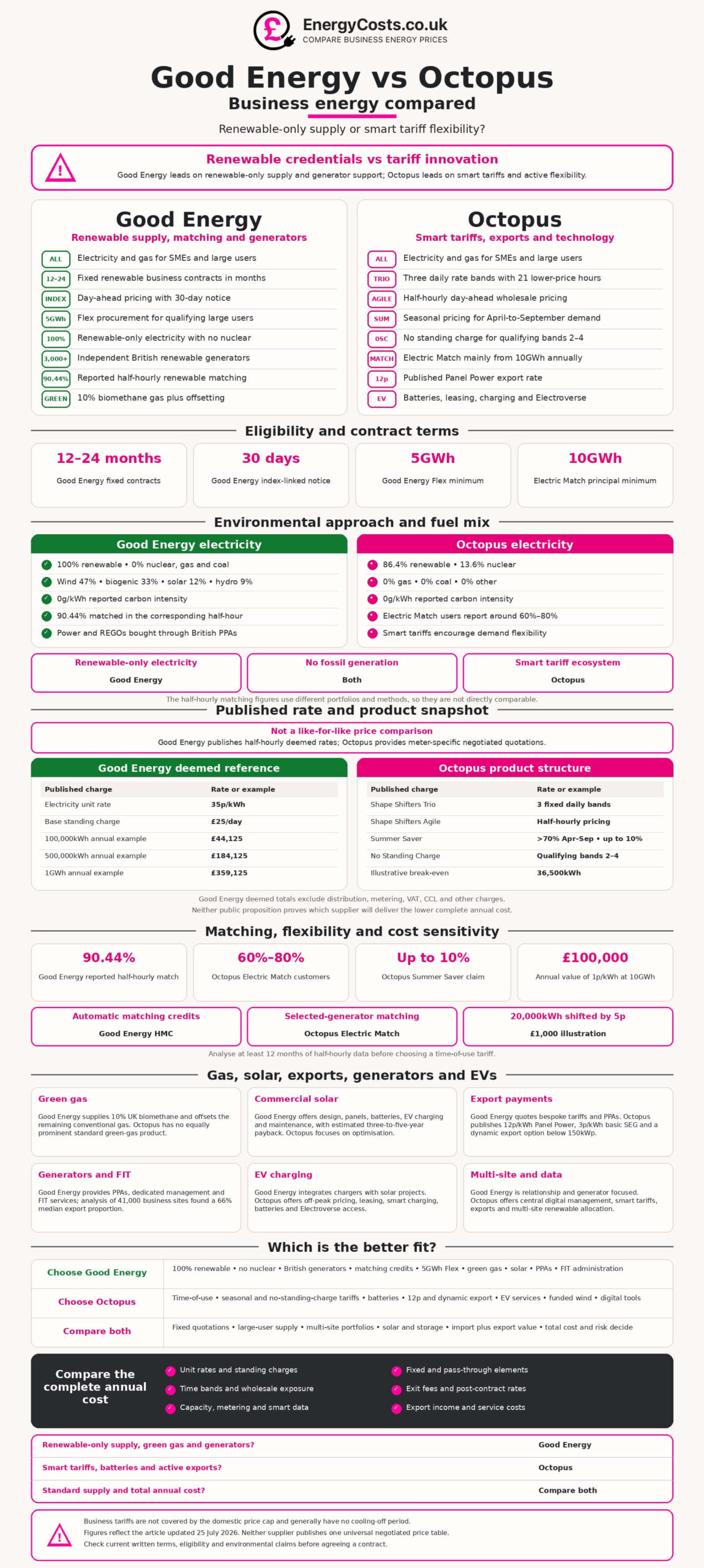
Good Energy and Octopus Energy are two of the UK’s best-known renewable energy suppliers, but their business services follow different models.
Good Energy supplies businesses with 100% renewable electricity sourced through Power Purchase Agreements with more than 3,000 independent British generators. Its business contract range includes fixed, index-linked, flexible and Corporate Power Purchase Agreement options, while its Green Gas product contains 10% biomethane with the remaining emissions offset.
Octopus Energy for Business combines conventional energy supply with a wider selection of technology-led tariffs. Shape Shifters Trio and Agile reward companies that move electricity use away from peak periods, Summer Saver targets seasonal organisations, and a No Standing Charge Tariff is available for qualifying meters. Octopus also operates flat-rate and dynamic commercial export tariffs.
Good Energy may be the stronger choice where a company wants renewable-only electricity, direct support for independent British generators, green gas and transparent half-hourly renewable matching.
Octopus may be more attractive where the business has flexible equipment, electric vehicles, solar panels, batteries or multiple sites that can benefit from smart pricing and active energy management.
Neither supplier is automatically cheaper. The final cost depends on the individual meter, postcode, annual consumption, demand profile, credit assessment and contract structure.
Good Energy vs Octopus at a glance
| Feature | Good Energy for Business | Octopus Energy for Business |
|---|---|---|
| Business electricity | Yes | Yes |
| Business gas | Yes | Yes |
| Small-business supply | Yes | Yes |
| Large-business supply | Yes | Yes |
| Standard national contract rates published | No | No |
| Fixed contract terms | Generally 12–24 months | Individually quoted; specialist smart tariffs are commonly 12 months |
| Renewable electricity | 100% renewable across the supply portfolio | Supplier-wide mix is 86.4% renewable and 13.6% nuclear |
| Nuclear-backed electricity | No | Yes, within the supplier-wide mix |
| Fossil-fuel electricity | None in the disclosed Good Energy mix | None in the disclosed Octopus mix |
| Fixed business tariffs | Yes | Yes |
| Index-linked business tariff | Yes, for half-hourly meters | Agile provides half-hourly wholesale-linked pricing |
| Flexible procurement | Good Energy Flex from 5GWh | Bespoke large-commercial services |
| Time-of-use SME tariff | Hourly Matching Credit rewards matched use | Shape Shifters Trio and Agile |
| Seasonal business tariff | No prominent equivalent | Summer Saver |
| No-standing-charge option | No prominent equivalent | Available for qualifying meter bands |
| Half-hourly renewable matching | Good Energy Hourly Matching | Octopus Electric Match |
| Business matching incentive | Hourly Matching Credit | Lower smart-tariff prices and matched-generation products |
| Flat business export rate | Bespoke export and PPA rates | Panel Power at 12p/kWh |
| Dynamic business export | Bespoke/index-linked options | Shape Shifters: Export |
| Feed-in Tariff administration | Major FIT portfolio service | Available but less central to business proposition |
| Commercial solar | Installation, batteries, EV charging and export support | Smart exports, batteries and bespoke renewable projects |
| On-site wind funding | PPA and generator services | Wind Works |
| Business EV support | Charging can form part of commercial installations | Smart tariffs, charging, leasing and Electroverse |
| Green gas | 10% biomethane, remaining emissions offset | Standard business gas; no equally prominent business green-gas product |
| Best suited to | Businesses prioritising renewable-only supply and generator support | Businesses prioritising smart tariffs, flexibility and exports |
Which businesses can apply?
Both suppliers serve SMEs and larger commercial organisations.
Good Energy’s renewable supply service is available to businesses of different sizes and meter types. Fixed contracts can cover half-hourly and non-half-hourly sites, while its index-linked product is designed for half-hourly meters. Large users consuming at least 5GWh annually can consider Good Energy Flex.
Octopus supplies small businesses, charities, multi-site companies and larger half-hourly portfolios. Specialist products have additional eligibility requirements: Shape Shifters requires a working smart meter and an account paid by Direct Debit, while Electric Match is primarily aimed at businesses using at least 10GWh annually.
Example suitability by company type
| Example business | Annual electricity use | Potentially suitable option |
|---|---|---|
| Independent shop | 12,000kWh | Good Energy fixed tariff or Octopus fixed quote |
| Office | 50,000kWh | Fixed renewable contract from either supplier |
| Seasonal attraction | 100,000kWh | Octopus Summer Saver |
| Restaurant | 120,000kWh | Good Energy fixed tariff or Octopus quotation |
| Workshop with flexible machinery | 250,000kWh | Octopus Shape Shifters |
| Business wanting renewable-only supply | Any qualifying level | Good Energy |
| Company with batteries | 500,000kWh | Octopus Agile and dynamic export |
| Multi-site renewable portfolio | Several GWh | Good Energy Hourly Matching or Octopus portfolio services |
| Large industrial user | 5GWh | Good Energy Flex or Octopus bespoke supply |
| Business seeking granular matching | 10GWh or more | Good Energy Hourly Matching or Octopus Electric Match |
| Renewable generator | Project-dependent | Good Energy PPA or Octopus commercial export arrangement |
| Site suitable for wind generation | High demand | Octopus Wind Works or a bespoke Good Energy PPA |
Both suppliers can consider the company’s:
- meter configuration;
- annual consumption;
- half-hourly demand data;
- credit history;
- payment record;
- business activity;
- number of premises; and
- proposed contract start date.
Which supplier is cheaper?
Neither Good Energy nor Octopus publishes one universal business unit rate.
A quotation normally depends on:
- the electricity MPAN or gas MPRN;
- postcode and distribution region;
- annual consumption;
- meter profile;
- half-hourly usage pattern;
- electricity capacity;
- residual charging band;
- contract length;
- contract start date;
- payment method;
- number of sites;
- credit risk;
- renewable-product structure; and
- wholesale prices when the quotation is prepared.
The full projected cost should be calculated as:
- Annual consumption × unit rate
- daily standing charge × 365
- meter and data charges
- capacity charges
- network and policy costs
- environmental-product charges
- VAT and Climate Change Levy where applicable
− export income and contractual credits
A lower unit rate does not guarantee a cheaper contract where the standing charge, capacity charge or pass-through costs are higher.
How unit-rate differences affect annual costs
| Annual consumption | Value of 0.5p/kWh | Value of 1p/kWh | Value of 3p/kWh | Value of 5p/kWh |
|---|---|---|---|---|
| 10,000kWh | £50 | £100 | £300 | £500 |
| 25,000kWh | £125 | £250 | £750 | £1,250 |
| 50,000kWh | £250 | £500 | £1,500 | £2,500 |
| 100,000kWh | £500 | £1,000 | £3,000 | £5,000 |
| 250,000kWh | £1,250 | £2,500 | £7,500 | £12,500 |
| 1GWh | £5,000 | £10,000 | £30,000 | £50,000 |
| 5GWh | £25,000 | £50,000 | £150,000 | £250,000 |
| 10GWh | £50,000 | £100,000 | £300,000 | £500,000 |
A difference of only 1p/kWh is worth £100,000 annually to a company consuming 10GWh.
How standing charges affect costs
| Daily standing-charge difference | Annual difference per meter | Difference across ten meters |
|---|---|---|
| 25p | £91.25 | £912.50 |
| 50p | £182.50 | £1,825 |
| £1 | £365 | £3,650 |
| £2 | £730 | £7,300 |
| £5 | £1,825 | £18,250 |
| £10 | £3,650 | £36,500 |
Standing charges are especially important for:
- seasonal properties;
- vacant premises;
- landlords;
- multi-site businesses;
- low-use meters; and
- companies retaining inactive supplies.
Good Energy fixed business tariffs
Good Energy offers fixed-price contracts lasting between 12 and 24 months to businesses with half-hourly and non-half-hourly meters.
The supplier describes these contracts as providing a set price throughout the fixed period and positions them for businesses wanting predictable costs and stable budgeting. All electricity is matched with renewable generation.
A Good Energy fixed contract may suit:
- shops;
- offices;
- schools;
- charities;
- surgeries;
- care providers;
- hotels;
- restaurants; and
- businesses whose operating hours cannot easily change.
The company should still review which components are fixed. Good Energy’s industrial and commercial terms allow costs not expressly described as fixed in the commercial agreement to be recovered from the customer.
Advantages of a Good Energy fixed tariff
A fixed contract can provide:
- predictable unit rates;
- protection from wholesale-price increases;
- more reliable budgeting;
- renewable-only electricity;
- no need to monitor half-hourly wholesale prices; and
- a straightforward Scope 2 market-based claim.
The main disadvantage is that the company may remain committed to its contract if market prices subsequently fall.
An early cancellation charge can reflect the difference between the wholesale price when the contract was fixed and the market price when the contract ends, multiplied by forecast consumption remaining in the agreement.
Good Energy index-linked pricing
Good Energy offers index-linked contracts to businesses with half-hourly meters.
Prices are calculated using day-ahead wholesale markets, while industry costs such as transmission, distribution and Climate Change Levy are passed through separately. The product has a 30-day notice period.
Index pricing may suit a business that:
- wants exposure to falling wholesale prices;
- accepts changing daily costs;
- has a half-hourly meter;
- can monitor market conditions;
- exports as well as imports electricity; or
- does not want to lock in a long fixed term.
Unlike Octopus Shape Shifters Agile, Good Energy’s index-linked proposition is presented mainly as a commercial energy procurement structure rather than an SME smart tariff designed around a consumer-facing app.
Good Energy Flex
Good Energy Flex is available to businesses consuming at least 5GWh of electricity annually.
It allows the organisation to purchase energy in:
- monthly tranches;
- quarterly tranches;
- seasonal tranches;
- fully fixed volumes; or
- a combination of fixed and index-linked volumes.
Customers receive market information from Good Energy’s trading desk and can spread procurement decisions over time. Contracts are available for 12 to 36 months and retain 100% renewable electricity backing.
For a business consuming 10GWh:
| Average purchased unit price | Annual commodity cost |
|---|---|
| 18p/kWh | £1.8 million |
| 19p/kWh | £1.9 million |
| 20p/kWh | £2 million |
| 21p/kWh | £2.1 million |
| 22p/kWh | £2.2 million |
A 1p/kWh movement changes annual expenditure by £100,000.
Flexible purchasing spreads the risk of fixing the entire expected volume on one date, but it does not guarantee a saving.
Octopus conventional business tariffs
Octopus provides individually quoted fixed and flexible business tariffs.
On a conventional fixed Octopus tariff, the quoted unit rates and standing charge remain fixed for the contract period. Businesses can obtain prices by submitting their postcode and supply information through the supplier’s direct quotation process.
Octopus emphasises direct customer acquisition rather than relying on the usual broker-distribution model.
A fixed Octopus tariff may suit a business that likes the Octopus service but cannot benefit from a time-of-use product.
Octopus Shape Shifters
Shape Shifters is Octopus’s principal smart electricity tariff for SMEs.
A business normally requires:
- a working smart meter;
- payment by Direct Debit;
- an account without overdue debt; and
- compatible metering arrangements.
There are two versions.
Shape Shifters Trio
Trio divides the day into three periods:
| Time period | Hours |
|---|---|
| Night | Midnight to 7am |
| Day | 7am–4pm and 7pm–midnight |
| Peak | 4pm–7pm |
The three prices remain fixed, providing 21 hours each day at rates below the evening peak.
Trio may suit:
- EV fleets;
- laundries;
- workshops;
- cold stores;
- commercial kitchens;
- businesses with batteries;
- charging hubs; and
- manufacturers able to avoid the 4pm–7pm period.
Shape Shifters Agile
Agile changes its electricity price every half hour in line with wholesale costs.
The rates are published approximately one day in advance, enabling the business to plan its demand.
Agile may suit businesses with:
- automated energy controls;
- battery storage;
- flexible machinery;
- overnight EV charging;
- controllable heating and cooling;
- refrigeration;
- on-site generation; or
- staff able to respond to daily price changes.
Its prices can increase sharply during expensive wholesale periods, so it is unsuitable for companies that must consume heavily regardless of the time.
Potential value of moving demand
Suppose a business consumes 100,000kWh annually and can move 20% of its use away from high-price periods.
The flexible load is 20,000kWh.
| Difference between higher and lower rates | Illustrative annual saving |
|---|---|
| 3p/kWh | £600 |
| 5p/kWh | £1,000 |
| 10p/kWh | £2,000 |
| 15p/kWh | £3,000 |
| 20p/kWh | £4,000 |
These figures are mathematical illustrations rather than guaranteed Octopus savings.
A company should examine at least 12 months of half-hourly data before selecting a time-of-use tariff.
Good Energy Hourly Matching Credit
Good Energy introduced Hourly Matching Credit to reward businesses whose electricity use overlaps with renewable generation during the same half-hour.
It is a no-cost, opt-in programme. Where qualifying consumption and generation match, some third-party subsidy costs can be avoided and returned to the customer as credits.
The three business options are:
| Product | Credit calculation | Payment structure | Budget certainty |
|---|---|---|---|
| HMC Variable | Based on actual matching performance | Quarterly | Lower |
| HMC Secure | Guaranteed p/kWh | Monthly payments plus end-of-term top-up | High |
| HMC Fix | Guaranteed p/kWh | Consistent monthly payments | High |
Good Energy automatically calculates the credit rather than requiring the customer to trade electricity or monitor wholesale prices manually.
This makes Hourly Matching Credit different from Octopus Agile:
- Good Energy rewards alignment with eligible renewable generation;
- Octopus Agile changes the imported electricity rate according to wholesale prices;
- Good Energy can provide a guaranteed credit structure;
- Octopus potentially offers larger savings but greater volatility.
Good Energy’s half-hourly matching performance
Good Energy reported that 90.44% of its supplied electricity volume was matched with renewable generation in the corresponding half-hour during 2024/25.
Its overall fuel mix remained 100% renewable because any unmatched half-hourly demand was covered through annual REGO matching.
This creates two separate environmental measures:
- Annual renewable matching: 100% of consumption is matched with renewable REGOs.
- Time-based matching: 90.44% was matched with renewable generation during the corresponding half-hour.
The distinction matters because annual certificates do not necessarily show whether renewable power was being generated when the business used electricity.
Octopus Electric Match
Electric Match is Octopus’s more advanced renewable-matching service.
It is mainly aimed at businesses consuming at least 10GWh annually and using half-hourly meters. Customers can select participating generators and examine how renewable output matches their own consumption over time.
Octopus says Electric Match customers are currently achieving matching levels of approximately 60% to 80%, depending on weather and demand.
Electric Match can identify:
- the renewable generator;
- its location;
- the time electricity was produced;
- the customer’s demand;
- the proportion matched; and
- the resulting carbon-free electricity evidence.
The reported percentages are not directly comparable with Good Energy’s 90.44% figure:
- Good Energy’s percentage covers its wider supply volume;
- Octopus’s figure refers to Electric Match customers;
- the generator portfolios differ;
- customer demand shapes differ; and
- matching methods and commercial arrangements may not be identical.
Good Energy versus Octopus for hourly matching
| Requirement | Good Energy | Octopus |
|---|---|---|
| Annual renewable backing | 100% | Product-dependent |
| Published wider time-match figure | 90.44% for 2024/25 | Electric Match customers generally 60%–80% |
| Customer dashboard | Granular Energy platform for eligible customers | Electric Match dashboard |
| Direct financial reward | Hourly Matching Credit | Product pricing and matched-generation arrangements |
| Guaranteed matching credit | HMC Secure or Fix | No directly equivalent standard product |
| Large-user minimum | Product-dependent | Electric Match principally from 10GWh |
| Independent British generators | More than 3,000 | Selected generator portfolio |
| Matching interval | Half-hourly | Half-hourly |
| Best for | Renewable-only supply with automatic credits | Bespoke selection and multi-site matching |
Good Energy has the stronger whole-portfolio renewable claim.
Octopus provides a highly customisable matching proposition for qualifying large businesses.
Octopus Summer Saver
Summer Saver is intended for organisations that consume more than 70% of their annual electricity between April and September.
It applies:
- a cheaper summer unit rate; and
- a higher winter unit rate.
Octopus says qualifying consumption patterns could produce annual savings of up to 10%.
Potential users include:
- campsites;
- holiday parks;
- outdoor attractions;
- seasonal cafés;
- wedding venues;
- summer events businesses;
- visitor centres; and
- seaside hospitality companies.
A business using more winter electricity than expected could pay more than it would on a conventional tariff.
Good Energy does not prominently advertise an equivalent seasonal tariff.
Octopus No Standing Charge Tariff
Octopus offers a No Standing Charge Tariff to qualifying businesses in residual bands 2, 3 and 4.
The costs usually recovered through the daily charge are incorporated into the unit rate. Octopus says companies at the lower end of their assigned consumption band are more likely to benefit.
The tariff may suit:
- seasonal sites;
- low-use meters;
- properties closed for extended periods;
- multi-site businesses with lightly used supplies; or
- companies expecting consumption to fall.
Break-even example
Assume a conventional tariff has:
- a £2 daily standing charge; and
- a unit rate 2p/kWh below the no-standing-charge option.
The annual standing charge is:
£2 × 365 = £730
The break-even point is:
£730 ÷ £0.02 = 36,500kWh
Below 36,500kWh, avoiding the standing charge may save money.
Above 36,500kWh, the higher unit rate may cost more than the standing charge saved.
Good Energy does not prominently advertise an equivalent business product.
Published default and deemed rates
Neither supplier publishes a complete national table of ordinary new-customer contract prices.
Good Energy currently publishes deemed and out-of-contract charges for half-hourly meters of:
- 35p/kWh; and
- £25 per day.
These rates took effect on 1 April 2026. Distribution charges are billed separately, while Good Energy may reconcile transmission and Capacity Market charges annually.
The £25 daily charge alone equals:
£25 × 365 = £9,125 a year
Illustrative totals before distribution, metering, VAT, CCL and other charges are:
| Annual electricity use | Unit charges | Base standing charge | Total |
|---|---|---|---|
| 100,000kWh | £35,000 | £9,125 | £44,125 |
| 250,000kWh | £87,500 | £9,125 | £96,625 |
| 500,000kWh | £175,000 | £9,125 | £184,125 |
| 1GWh | £350,000 | £9,125 | £359,125 |
These figures do not represent a negotiated Good Energy contract.
Octopus has previously published half-hourly out-of-contract schedules, but no equivalent current national June 2026 table is prominently presented alongside its main business quotation service. A direct public price comparison is therefore not possible.
Comparing renewable electricity
Good Energy and Octopus both have unusually low-carbon fuel mixes, but they are not identical.
Good Energy fuel mix
Good Energy’s independently assured 2024/25 mix was:
| Renewable source | Proportion |
|---|---|
| Wind | 47% |
| Biogenic sources | 33% |
| Solar | 12% |
| Hydro | 9% |
| Total renewable | 100% |
| Gas | 0% |
| Coal | 0% |
| Nuclear | 0% |
| Reported emissions | 0g/kWh |
| Reported radioactive waste | 0g/kWh |
The rounded component figures total 101%, but the assured overall fuel mix is reported as 100% renewable. Good Energy holds REGOs obtained through PPAs with generators based in Great Britain.
Octopus fuel mix
Octopus’s 2024/25 fuel mix was:
| Source | Proportion |
|---|---|
| Renewables | 86.4% |
| Nuclear | 13.6% |
| Gas | 0% |
| Coal | 0% |
| Other | 0% |
| Reported emissions | 0g/kWh |
| High-level radioactive waste | 0.0010g/kWh |
Octopus therefore had an entirely zero-carbon disclosed supply mix, but it was not renewable-only because nuclear generation accounted for 13.6%.
Which supplier has greener electricity?
| Environmental priority | Likely stronger fit |
|---|---|
| 100% renewable-only electricity | Good Energy |
| No nuclear generation | Good Energy |
| No gas or coal | Both |
| Zero reported carbon emissions | Both |
| Direct support for independent British generators | Good Energy |
| Larger technology-led renewable investment portfolio | Octopus |
| Wider supplier-owned renewable assets | Octopus |
| Published wider half-hourly matching percentage | Good Energy |
| Bespoke customer-selected matching | Octopus Electric Match |
| Automatic matching credits | Good Energy |
| Smart tariffs encouraging flexible demand | Octopus |
| Avoiding annual certificate-only sourcing | Good Energy has the stronger direct-PPA claim |
Good Energy has the clearer renewable-only proposition.
Octopus offers the broader technology and smart-energy ecosystem but uses some nuclear power within its supplier-wide mix.
Good Energy’s generator model
Good Energy purchases power directly from more than 3,000 independent British renewable generators.
Its stated approach is to obtain the associated REGOs through the same PPAs rather than purchasing the electricity and certificates separately.
Generators include:
- wind farms;
- solar arrays;
- hydro schemes;
- anaerobic-digestion facilities;
- farms;
- community-energy projects; and
- smaller independent producers.
This may appeal to businesses wanting their electricity purchasing to support decentralised renewable generation rather than only large utility-owned assets.
Octopus’s renewable investment model
Octopus Energy Generation manages approximately 4GW of renewable capacity across more than 240 projects in multiple countries, with a stated asset value of around £6 billion.
Octopus also purchases electricity through PPAs with hundreds of UK renewable generators.
Its model combines:
- major investment funds;
- wind and solar ownership;
- PPAs;
- community projects;
- smart tariffs;
- batteries;
- electric vehicles; and
- digital energy-management technology.
Good Energy’s model is more closely associated with independent British generators.
Octopus’s model is larger, more international and more technology-driven.
Comparing business gas
Good Energy has a clearly defined Green Gas product.
It contains:
- 10% UK renewable biomethane; and
- 90% conventional gas whose emissions are offset using certified projects.
The 2024/25 assurance report confirms that Good Energy retired renewable-gas certificates for at least 10% of demand and carbon credits covering the calculated emissions from the remaining conventional gas.
Burning the gas at the customer’s premises still creates direct emissions. Good Energy’s assurance report states that the product retains the standard natural-gas emissions factor for reporting purposes despite its carbon-neutral promise.
Octopus provides ordinary business gas but does not currently promote an equally prominent standard commercial product with a defined biomethane percentage.
Good Energy therefore has the clearer proposition for businesses that still require gas but want:
- a biomethane component;
- renewable-gas certificates;
- carbon offsetting; and
- externally assured environmental claims.
Commercial solar installations
Good Energy offers commercial solar through Empower, part of Good Energy Solar.
Its services include:
- bespoke system design;
- rooftop solar;
- battery storage;
- EV charging;
- monitoring;
- annual maintenance;
- renewable import tariffs;
- export tariffs; and
- PPAs for larger generators.
Good Energy advertises typical commercial solar payback periods of approximately three to five years and a levelised generation cost around 7p/kWh, compared with illustrative grid supply prices of 20p–30p/kWh. These are supplier estimates rather than guaranteed results.
Octopus’s business proposition is especially strong where the company already has solar or batteries and wants to optimise import and export pricing.
For new projects, Octopus can also support bespoke renewable installations and longer-term on-site generation through services such as Wind Works.
Solar export payments
Good Energy does not currently publish one universal flat commercial export rate equivalent to Octopus Panel Power on its principal business pages.
Instead, it offers:
- bespoke commercial export tariffs;
- Power Purchase Agreements;
- enhanced rates for commercial solar-installation customers;
- Smart Export for Feed-in Tariff portfolios;
- Hourly Matching Credit; and
- generator account management.
Good Energy’s standard fixed-price PPAs can provide price certainty for up to three years, while longer terms may be negotiated.
Octopus Panel Power
Panel Power pays qualifying businesses:
12p per exported kWh
The business must normally:
- have solar panels;
- have installed capacity below 150kWp;
- have a working smart or compatible export meter;
- not receive Feed-in Tariff export payments; and
- buy its imported electricity from Octopus Energy for Business.
Illustrative income is:
| Annual export | Octopus Panel Power income |
|---|---|
| 5,000kWh | £600 |
| 10,000kWh | £1,200 |
| 25,000kWh | £3,000 |
| 50,000kWh | £6,000 |
| 100,000kWh | £12,000 |
Octopus also offers a basic business Smart Export Guarantee rate of 3p/kWh for eligible generators that do not use Panel Power.
Octopus Shape Shifters: Export
Shape Shifters: Export changes its payment every half hour according to day-ahead wholesale prices and region-specific grid charges.
It is designed for companies with:
- battery storage;
- solar panels;
- wind generation;
- controllable exports; or
- the ability to charge when prices are low and export later.
The product has no upper or lower limit on its half-hourly export price. It is restricted to eligible systems below 150kWp and requires an Octopus business import account.
A solar-only business may prefer the certainty of Panel Power.
A company with battery storage may achieve more through dynamic export by selling electricity during valuable periods.
Good Energy versus Octopus for generators
| Generator requirement | Likely stronger fit |
|---|---|
| Simple published flat export rate | Octopus |
| Solar system below 150kWp | Octopus Panel Power |
| Dynamic battery export | Octopus |
| Existing Feed-in Tariff portfolio | Good Energy |
| Large generator requiring a PPA | Good Energy |
| Dedicated generator account manager | Good Energy |
| Fixed-price PPA for up to three years | Good Energy |
| Payment linked with half-hourly matching | Good Energy HMC |
| Commercial solar installation and export package | Good Energy |
| Import and export optimisation | Octopus |
| Generator portfolio services | Good Energy |
| Customer wanting a known rate before applying | Octopus |
Good Energy has the broader generator-services proposition.
Octopus has the clearer off-the-shelf export tariffs for a smaller commercial solar or battery system.
Good Energy Feed-in Tariff services
Good Energy is a major voluntary administrator of business Feed-in Tariff portfolios.
Its Smart Export service replaces the traditional deemed assumption that 50% of generation is exported with actual export readings from compatible smart meters.
Good Energy’s analysis of 41,000 business FIT sites found a median export proportion of 66%, potentially increasing revenue for portfolios that export more than the deemed amount.
This may make Good Energy particularly suitable for:
- housing associations;
- property portfolios;
- public-sector solar estates;
- landlords;
- community-energy schemes; and
- organisations managing hundreds or thousands of FIT installations.
Commercial EV charging
Good Energy can incorporate EV chargers into commercial solar and battery projects.
Its business services have also included workplace charging for employees, customers and visitors, powered through renewable electricity supply.
Octopus has the broader current EV ecosystem.
The Octopus group offers:
- business EV leasing;
- salary-sacrifice schemes;
- charger installation;
- smart charging;
- Shape Shifters tariffs;
- battery integration; and
- Electroverse public charging access.
Octopus says Electroverse provides access to more than half of the UK’s public charging networks.
Which supplier is better for EVs?
| EV requirement | Likely stronger fit |
|---|---|
| Workplace chargers with commercial solar | Good Energy |
| Renewable-only electricity for charging | Good Energy |
| Overnight time-of-use pricing | Octopus |
| Half-hourly dynamic charging | Octopus |
| Business vehicle leasing | Octopus |
| Salary-sacrifice EV scheme | Octopus |
| Public charging-network access | Octopus Electroverse |
| Battery and charger optimisation | Octopus |
| Solar, battery and charger installation package | Good Energy |
| Simple renewable supply for an existing charger | Good Energy |
Octopus generally offers more options for operating vehicles and managing charging costs.
Good Energy may be attractive where the chargers form part of a wider on-site renewable installation.
Multi-site businesses
Good Energy provides renewable supply, dedicated account management and hourly-matching insights to larger businesses.
Its generator and FIT services can also support companies with substantial solar portfolios.
Octopus offers joint multi-site portfolios covering:
- switching;
- contract renewals;
- billing;
- one online login;
- central support;
- export payments; and
- smart-tariff services.
Electric Match can allocate renewable generation between different company sites.
Good Energy may suit a portfolio requiring renewable-only supply and generator account management.
Octopus may suit a portfolio wanting central digital management, smart tariffs and sharing of renewable generation between premises.
Customer service and account management
Good Energy
Good Energy business customers can receive:
- a dedicated account manager;
- online account management;
- billing and meter support;
- renewable reporting;
- export and FIT support;
- trading-desk access for flexible contracts; and
- commercial solar assistance.
Octopus
Octopus provides:
- direct quotations;
- telephone and email support;
- online account management;
- smart-tariff tools;
- export credits;
- multi-site services;
- renewable-matching dashboards; and
- specialist commercial teams.
Good Energy’s model is more relationship- and generator-focused.
Octopus’s model is more digital, automated and technology-led.
Contract renewal and termination
Good Energy fixed tariffs generally run for 12 to 24 months, while Flex agreements are available from 12 to 36 months.
Its index-linked contract has a 30-day notice period.
Octopus specialist SME tariffs such as Shape Shifters commonly operate over 12 months. Customers can switch between Trio and Agile or move to a fixed product without an exit fee under the current Shape Shifters arrangements.
Other Octopus fixed contracts may carry exit fees, so the individual supply summary must be checked.
If no replacement agreement is arranged, either supplier can apply:
- variable pricing;
- deemed charges;
- out-of-contract rates; or
- other default prices permitted by the agreement.
Contract risks to check
Business energy contracts are not protected by the household energy price cap.
They also generally have no automatic cooling-off period after acceptance.
Before choosing Good Energy or Octopus, check:
- unit rates;
- standing charges;
- contract length;
- start and end dates;
- fixed and pass-through costs;
- exit fees;
- meter requirements;
- electricity capacity;
- time-of-use periods;
- index-pricing formulas;
- trading authority;
- renewable certificates;
- nuclear content;
- gas environmental claims;
- export eligibility;
- broker commission;
- renewal arrangements; and
- post-contract prices.
Good Energy advantages and disadvantages
Advantages
- Supplies 100% renewable business electricity.
- Uses no nuclear generation in its disclosed fuel mix.
- Uses no gas or coal in its electricity mix.
- Purchases power and REGOs through PPAs with independent British generators.
- Works with more than 3,000 renewable generators.
- Offers fixed contracts lasting 12 to 24 months.
- Provides index-linked pricing for half-hourly businesses.
- Good Energy Flex is available from 5GWh.
- Flex contracts retain renewable-only backing.
- Offers Corporate PPAs.
- Published half-hourly matching reached 90.44%.
- Hourly Matching Credit can reduce business costs.
- HMC includes variable and guaranteed-credit options.
- Provides green gas with 10% biomethane.
- Offers commercial solar, batteries and EV charging.
- Provides extensive FIT and generator services.
- Offers fixed-price PPAs for up to three years.
- Dedicated account management is available.
- Good Energy is B Corp certified.
Disadvantages
- Standard negotiated prices are not published.
- Fixed business terms are generally limited to 24 months.
- Its Green Gas product still creates physical combustion emissions.
- Green Gas relies on offsets for 90% of consumption.
- The gas product retains the standard natural-gas emissions factor.
- Index-linked prices can rise with wholesale markets.
- Flex requires consumption of at least 5GWh.
- Early cancellation costs can reflect wholesale-market losses.
- Half-hourly deemed pricing includes a £25 daily base charge.
- No prominent seasonal tariff is offered.
- No prominent no-standing-charge business tariff is offered.
- No mainstream off-the-shelf dynamic import tariff comparable with Agile is advertised.
- Commercial export rates are generally bespoke rather than immediately visible.
- Its EV ecosystem is less extensive than Octopus’s.
- Its business technology platform is less focused on automatic smart-device integration.
Octopus advantages and disadvantages
Advantages
- Supplies business electricity and gas.
- Offers conventional and innovative tariffs.
- Shape Shifters Trio provides predictable time bands.
- Shape Shifters Agile follows half-hourly wholesale prices.
- Next-day rates allow businesses to plan demand.
- Summer Saver supports seasonal companies.
- A No Standing Charge Tariff is available to qualifying meters.
- Supplier-wide electricity contains no gas or coal.
- Supplier-wide electricity reports zero operational carbon emissions.
- Electric Match provides granular renewable traceability.
- Panel Power pays 12p/kWh.
- Dynamic commercial export is available.
- Strong fit for batteries and EV fleets.
- Multi-site portfolios are available.
- Wind Works can fund on-site renewable generation.
- The wider group manages substantial renewable assets.
- Business EV leasing and public charging access are available.
- Standard business sales are direct.
Disadvantages
- Its supplier-wide electricity is not renewable-only.
- Nuclear power represents 13.6% of its disclosed mix.
- Standard negotiated contract prices are not published.
- Agile prices can become expensive.
- Smart tariffs require a compatible meter.
- Shape Shifters requires Direct Debit and an up-to-date account.
- Inflexible businesses may obtain limited benefit from smart pricing.
- Summer Saver can cost more if winter consumption is underestimated.
- A no-standing-charge tariff can have a higher unit rate.
- Panel Power requires an Octopus import contract.
- Panel Power and dynamic export are limited to systems below 150kWp.
- Electric Match is mainly aimed at users consuming at least 10GWh.
- Wind Works involves a long-term PPA and suitable site.
- No equally prominent business green-gas product is offered.
- Generator and FIT portfolio services are less central than at Good Energy.
Which supplier is better for different businesses?
| Business type or requirement | Likely better fit | Reason |
|---|---|---|
| Company wanting renewable-only electricity | Good Energy | 100% renewable across its supply mix |
| Business excluding nuclear power | Good Energy | No nuclear allocation |
| Business wanting a simple fixed tariff | Compare both | Both provide fixed quotations |
| Business with flexible machinery | Octopus | Shape Shifters |
| EV fleet charging overnight | Octopus | Smart time-of-use pricing |
| Seasonal summer business | Octopus | Summer Saver |
| Low-use qualifying meter | Octopus may suit | No Standing Charge Tariff |
| Business wanting a fixed renewable tariff | Good Energy | Renewable-only fixed contracts |
| Large user wanting flexible procurement | Good Energy | Flex starts at 5GWh |
| Company wanting selected renewable generators | Octopus Electric Match | Bespoke matching |
| Company wanting whole-portfolio time matching | Good Energy | 90.44% published figure |
| Business wanting direct matching credits | Good Energy | HMC Variable, Secure and Fix |
| Small solar exporter | Octopus | Published 12p/kWh rate |
| Solar and battery exporter | Octopus | Dynamic export |
| Large renewable generator | Good Energy | PPA and generator services |
| Business with a large FIT portfolio | Good Energy | Specialist administration and smart export |
| Company seeking commercial solar installation | Good Energy | Integrated installation and supply service |
| Site suitable for funded wind generation | Octopus | Wind Works |
| Business requiring green gas | Good Energy | 10% biomethane and offsetting |
| Business wanting EV leasing | Octopus | Wider group service |
| Company supporting independent UK generators | Good Energy | Direct PPA network |
| Business wanting a large digital energy ecosystem | Octopus | Smart tariffs and connected technology |
Final verdict: Good Energy vs Octopus
Good Energy and Octopus are both credible environmental choices, but the better supplier depends on what the business means by “green energy”.
Good Energy is likely to be the stronger choice where the company wants:
- electricity that is 100% renewable rather than merely zero carbon;
- no nuclear allocation;
- direct support for independent British generators;
- fixed renewable contracts;
- renewable flexible procurement;
- transparent half-hourly matching;
- automatic matching credits;
- green gas;
- commercial solar installation;
- FIT administration; or
- sophisticated generator and PPA services.
Octopus is likely to be the stronger choice where the business wants:
- a smart time-of-use tariff;
- half-hourly wholesale-linked pricing;
- a seasonal tariff;
- no daily standing charge;
- battery optimisation;
- dynamic export payments;
- a published 12p/kWh commercial solar rate;
- multi-site renewable allocation;
- funded on-site wind;
- EV leasing; or
- public charging-network access.
The environmental comparison can be summarised as follows:
- Good Energy: 100% renewable, no nuclear, no fossil generation and 90.44% half-hourly matching across its reported supply volume.
- Octopus: 86.4% renewable, 13.6% nuclear, no fossil generation and a wider selection of technology-led smart products.
Good Energy has the stronger renewable-only credentials.
Octopus has the stronger tariff-innovation and flexibility proposition.
A fair financial comparison should require both suppliers to quote for:
- the same meter and postcode;
- identical annual consumption;
- the same contract start date;
- equivalent contract duration;
- all standing charges;
- capacity and metering costs;
- fixed and pass-through elements;
- renewable and nuclear content;
- time-of-use savings based on actual data;
- hourly-matching credits;
- export revenue;
- exit fees; and
- the complete expected annual cost.
For most businesses, the conclusion is:
- choose Good Energy for renewable-only supply, generator support, green gas and credible environmental reporting;
- choose Octopus for smart tariffs, flexible demand, batteries, EVs and off-the-shelf export products;
- compare Good Energy Hourly Matching Credit with Octopus Shape Shifters where the business can align demand with renewable generation;
- compare Good Energy’s bespoke export or PPA proposal with Octopus Panel Power and Shape Shifters: Export where on-site generation is important; and
- select the supplier offering the lowest realistic total cost after operational flexibility, matching credits and export income have been included.
FAQ
It depends on the individual quotation and consumption pattern. Good Energy focuses on renewable-only supply, while Octopus smart tariffs may save money where demand can be moved into cheaper periods.
Yes. Good Energy and Octopus both supply electricity to SMEs and larger organisations.
Yes. Good Energy offers Green Gas containing 10% biomethane, while Octopus offers standard business gas.
Yes. Good Energy reports a 100% renewable electricity mix backed by REGOs obtained through PPAs with British generators.
Octopus’s 2024/25 supplier-wide mix was 86.4% renewable and 13.6% nuclear. It was zero carbon but not renewable-only.
Octopus includes nuclear power within its disclosed supplier-wide mix. Good Energy reports no nuclear generation.
Both suppliers report zero operational carbon emissions for their disclosed electricity mixes. Good Energy is renewable-only, while Octopus combines renewable and nuclear generation.
Good Energy has the stronger specialist proposition, including PPAs, FIT administration, Smart Export and Hourly Matching Credit.
Octopus. Shape Shifters Trio and Agile are designed specifically around time-of-use business pricing.
It rewards businesses when their electricity use aligns with eligible renewable generation in the same half-hour. Credits can be variable or guaranteed, depending on the product selected.
It is a smart business tariff. Trio applies three daily rate periods, while Agile changes its price every half hour.
Octopus Summer Saver may suit companies using more than 70% of their annual electricity between April and September.
Octopus publishes a flat business rate of 12p/kWh through Panel Power. Good Energy’s commercial export and PPA rates are generally individually quoted.
Octopus has the stronger retail proposition because it combines half-hourly import pricing with Shape Shifters: Export.
Good Energy has the clearer integrated installation proposition, covering panels, batteries, EV chargers, renewable supply and export services.
Good Energy Flex is available to organisations consuming at least 5GWh annually. Octopus provides bespoke commercial services and Electric Match, mainly for businesses above 10GWh.
Octopus has the broader EV ecosystem, including smart tariffs, leasing and Electroverse. Good Energy can integrate chargers with commercial solar and renewable supply.