

Npower and British Gas are two familiar names in the UK business energy market, but they now target different types of customer.
The current npower operation trades as npower Business Solutions, usually abbreviated to nBS. It does not provide new energy contracts to households or smaller businesses. Its services are aimed at large organisations requiring fixed, flexible, multi-site or more technically sophisticated energy contracts. Smaller companies are directed towards E.ON Next.
British Gas has a much broader customer base. It offers fixed and variable contracts to small businesses, provides the online-only British Gas Lite service, supports half-hourly and multi-site customers and offers flexible wholesale purchasing to companies consuming more than 1GWh annually.
This means British Gas is the only practical option of the two for many shops, offices, restaurants and other small firms. Npower becomes a realistic competitor where the organisation has substantial consumption, at least ten employees, turnover of £2 million or more and more complex energy procurement requirements.
Neither supplier is universally cheaper. Large-business contracts are individually priced according to consumption, market conditions, meter type, location, credit risk and the treatment of network and government charges.
Npower vs British Gas at a glance
| Feature | npower Business Solutions | British Gas Business |
|---|---|---|
| Small-business electricity | No; directs smaller businesses to E.ON Next | Yes |
| Small-business gas | No; directs smaller businesses to E.ON Next | Yes |
| Large-business electricity | Yes | Yes |
| Large-business gas | Yes | Yes |
| Published target electricity consumption | At least 100,000kWh annually | No single minimum across all plans |
| Published target gas consumption | At least 293,000kWh annually | No single minimum across all plans |
| Employee criterion | At least ten employees in published target profile | Product-dependent |
| Turnover criterion | At least £2 million in published target profile | Product-dependent |
| Standard contract prices published | No | Maximum microbusiness prices published |
| Main fixed-contract length | Up to five years | Usually one to three years; some products extend further |
| Fully fixed option | Fixed Certainty | Fixed Price Energy Plan, subject to detailed terms |
| Partly fixed options | Fixed Commodity and Fixed Choice | Tailored fixed or pass-through arrangements |
| Short market-linked product | Market Tracker | Variable and 30-day rolling plans |
| Entry-level flexible procurement | MultiPurchase | Flex Advantage above 1GWh |
| Advanced flexible procurement | Flex Streamline, Fast Flex and Flex Innovate | Full Flex above 10GWh |
| Renewable-only electricity | UK Business Renewable, Pure and Pure Plus | Natural Renewable Electricity |
| Standard supplier fuel mix renewable share | 34.6% | 35% |
| Supplier-wide carbon intensity | 315g/kWh | 53g/kWh |
| Renewable-product carbon intensity | 0g/kWh | 0g/kWh |
| Green business gas | Carbon-offsetting options | Carbon Neutral Gas and 100% RGGO-backed Renewable Gas |
| Energy-management platform | Dashboard and My Energy Coach | Energy360 DataView |
| Wholesale trading support | Risk Navigator and Optimisation Desk | Purchasing Portal, Energy.Hub and energy specialists |
| Commercial solar and batteries | Available with E.ON group support | Available through British Gas and Centrica partners |
| PPAs and generator services | Extensive PPA and generator proposition | Available through British Gas and Centrica |
| EV charging | Available through E.ON group services | Commercial and communal charging |
| Best suited to | Large, industrial and complex multi-site organisations | SMEs through to large corporate energy users |
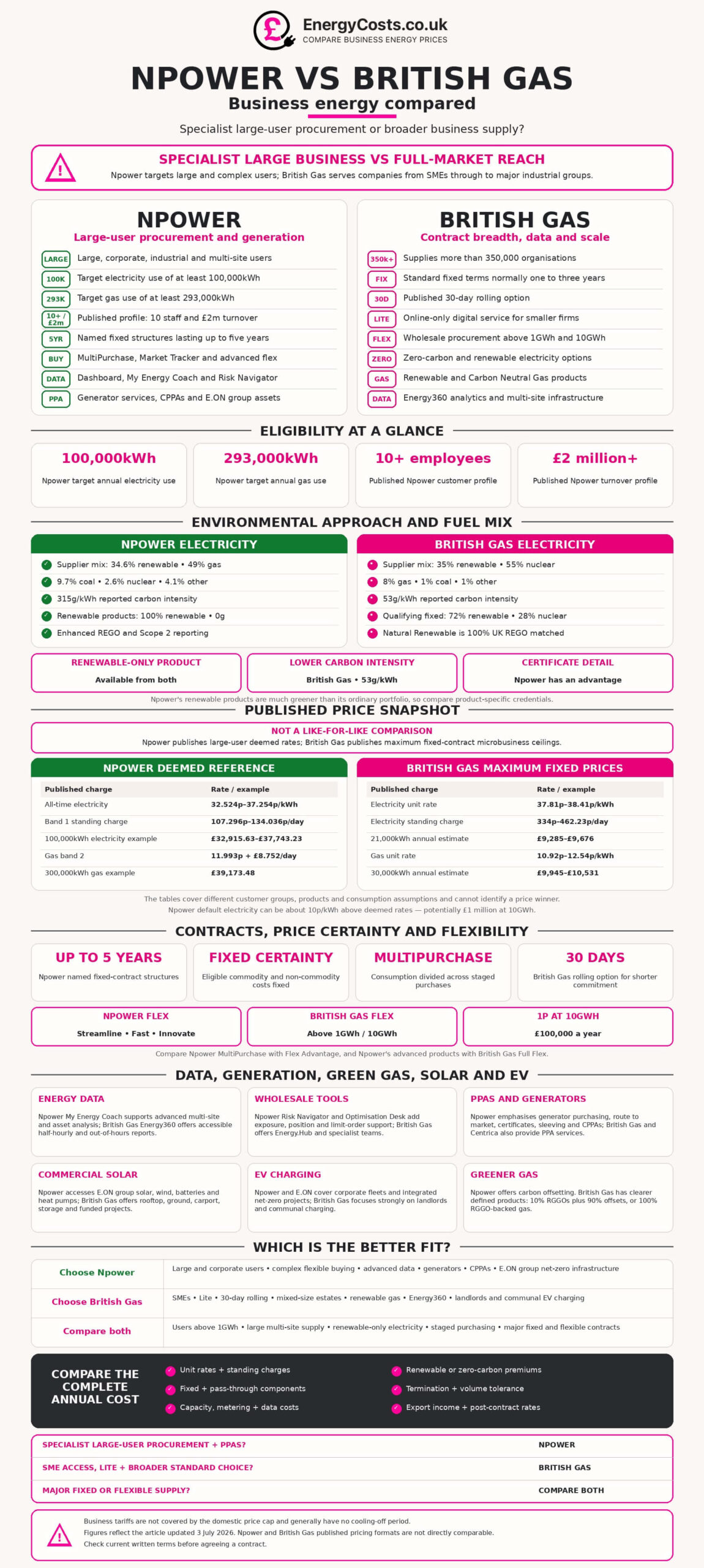
What happened to the old Npower business operation?
The current npower Business Solutions should not be confused with the former npower household and small business energy supplier.
The business now operates through Npower Commercial Gas Limited and is part of the E.ON group. Domestic customers and smaller former npower business customers were transferred to E.ON Next.
Npower Business Solutions remains an active supplier, but its focus is now:
- large businesses;
- corporate energy users;
- industrial organisations;
- multi-site portfolios;
- half-hourly meters;
- complex gas and electricity contracts;
- energy consultants;
- renewable generators; and
- organisations requiring flexible wholesale purchasing.
A small business searching for “npower business energy” will therefore normally be directed towards E.ON Next rather than receiving an nBS quotation.
Which companies qualify for npower Business Solutions?
Npower’s published quotation criteria state that its large-business target profile includes:
- annual electricity consumption of at least 100,000kWh;
- annual gas consumption of at least 293,000kWh;
- ten or more employees; and
- estimated annual turnover of at least £2 million.
The precise application of the electricity and gas thresholds will depend on which fuels the organisation wants to purchase. A business seeking electricity only would not ordinarily need an existing gas supply merely to request an electricity quotation.
Businesses below the published profile are directed towards E.ON Next.
Which companies can use British Gas?
British Gas supplies a much wider range of organisations, including:
- sole traders;
- small shops;
- offices;
- restaurants;
- landlords;
- hotels;
- schools;
- charities;
- workshops;
- warehouses;
- manufacturers;
- public-sector bodies;
- national retailers; and
- major industrial users.
British Gas Lite is primarily aimed at smaller companies willing to:
- manage their account online;
- pay by monthly Direct Debit;
- use electronic billing;
- have a compatible smart meter; and
- receive support through webchat.
Larger businesses can use British Gas’s standard, tailored, half-hourly and flexible products.
Example suitability by company size
| Example business | Annual electricity use | Likely suitable supplier |
|---|---|---|
| Small shop | 15,000kWh | British Gas or E.ON Next, not nBS |
| Office | 60,000kWh | British Gas or E.ON Next |
| Restaurant | 120,000kWh | British Gas; nBS only if wider business criteria are met |
| Hotel | 400,000kWh | Either supplier may be suitable |
| Manufacturer | 2GWh | Both suppliers |
| National retail group | 10GWh | Both suppliers |
| Industrial company with active trading team | 50GWh | Both, with advanced flexible procurement |
| Renewable generator | Project-dependent | Npower may be particularly attractive |
| Commercial landlord with many small meters | British Gas may be easier | Broader SME and landlord proposition |
Npower is therefore not simply a more expensive or more sophisticated alternative for every business. Many companies are outside its chosen customer segment altogether.
Which supplier is cheaper?
There is no universal answer.
Npower and British Gas calculate negotiated rates using factors such as:
- electricity MPAN;
- gas MPRN;
- distribution region;
- annual consumption;
- half-hourly demand profile;
- maximum import capacity;
- residual charging band;
- number of sites;
- contract start date;
- contract duration;
- payment method;
- credit rating;
- wholesale market prices;
- renewable-product selection; and
- treatment of non-commodity costs.
A complete annual comparison should include:
- Annual consumption × unit rate
- daily standing charge × 365
- capacity charges
- metering and data costs
- network charges
- policy and environmental costs
- VAT and Climate Change Levy where applicable
− export income and other contractual credits
A company should not compare only the headline unit rate.
How rate differences affect annual costs
| Annual consumption | Value of 0.5p/kWh | Value of 1p/kWh | Value of 3p/kWh | Value of 5p/kWh |
|---|---|---|---|---|
| 100,000kWh | £500 | £1,000 | £3,000 | £5,000 |
| 250,000kWh | £1,250 | £2,500 | £7,500 | £12,500 |
| 500,000kWh | £2,500 | £5,000 | £15,000 | £25,000 |
| 1GWh | £5,000 | £10,000 | £30,000 | £50,000 |
| 5GWh | £25,000 | £50,000 | £150,000 | £250,000 |
| 10GWh | £50,000 | £100,000 | £300,000 | £500,000 |
| 50GWh | £250,000 | £500,000 | £1.5 million | £2.5 million |
A difference of only 1p/kWh is worth £100,000 annually to a company using 10GWh.
Npower fixed business contracts
Npower offers several fixed-contract structures lasting up to five years.
Fixed Certainty
Fixed Certainty provides the greatest level of price predictability.
For electricity, it can fix:
- commodity costs;
- network charges;
- environmental charges and levies; and
- other eligible contracted components.
For gas, it can fix:
- commodity costs;
- transportation charges; and
- metering charges.
It is designed for businesses that prioritise:
- budget certainty;
- straightforward forecasting;
- less exposure to changing industry costs; and
- simpler internal approval.
Fixed Certainty can also include a mid-term review. This gives the customer an opportunity to request new prices before the contract midpoint if wholesale markets have fallen.
If new prices are not accepted, the original agreement continues.
Fixed Commodity
Fixed Commodity locks in the wholesale energy element but passes through certain non-commodity costs.
For electricity, network and environmental costs can therefore change.
For gas, transportation and metering costs may be passed through.
This may suit a business that wants protection from wholesale price movements but is willing to accept changes in regulated and third-party charges.
Fixed Choice
Fixed Choice is an electricity product that offers greater control over how non-commodity charges are treated.
The customer can select which eligible elements are fixed and which are passed through.
This provides a middle ground between:
- paying a premium for full certainty; and
- accepting complete exposure to changing industry charges.
Npower MultiPurchase
MultiPurchase allows a business to divide its expected consumption into several separate purchases.
Instead of fixing the entire contract volume on one date, the company might purchase:
- 25% when signing;
- 25% six months later;
- 25% when a target price is reached; and
- 25% closer to delivery.
This spreads market-timing risk.
For a company using 10GWh, the difference between an average purchase price of 18p/kWh and 20p/kWh would be:
10,000,000kWh × 2p = £200,000
The same strategy could cost £200,000 more if the average purchase price rose to 22p/kWh.
MultiPurchase therefore reduces reliance on one fixing date but does not guarantee a saving.
Npower Market Tracker
Market Tracker provides a market-reflective monthly energy rate.
The price follows wholesale market movements rather than remaining fixed throughout the term.
It can suit an organisation that:
- wants a shorter commitment;
- expects wholesale prices to fall;
- can tolerate monthly price changes;
- plans to move onto a fixed contract later; or
- does not want to choose individual trading dates.
The risk is that costs rise quickly when wholesale markets increase.
Npower allows Market Tracker customers to move towards fixed or MultiPurchase arrangements where their strategy changes.
Npower advanced flexible contracts
Npower provides several advanced products for large and corporate users.
Flex Streamline
Flex Streamline supports flexible gas and electricity buying with help from the supplier’s Optimisation Desk.
It uses pre-agreed shape premiums to manage consumption outside normal wholesale trading blocks.
A forecast invoice rate is set, followed by monthly reconciliation.
Fast Flex
Fast Flex provides similar trading flexibility but removes the forecast invoice rate and monthly reconciliation structure.
Monthly invoices instead reflect the energy transactions made for the relevant period.
Flex Innovate
Flex Innovate uses market indices to settle the customer’s demand shape.
It can support:
- limit orders;
- unset functionality;
- renewable-energy options;
- sleeving;
- consortium structures; and
- more detailed wholesale-market participation.
Npower generally indicates minimum annual volumes above 1GWh for its principal advanced flexible contracts.
British Gas fixed contracts
British Gas’s principal Fixed Price Energy Plan normally offers contracts lasting one, two or three years.
Its features include:
- fixed unit rates;
- fixed standing charges, subject to the detailed terms;
- Direct Debit discounts;
- smart-meter installation where eligible;
- online account management;
- renewal reminders; and
- zero-carbon electricity on qualifying plans.
British Gas’s published maximum-price schedule also includes four-year options, although the availability of a four-year tariff should be confirmed in the individual quotation.
British Gas Lite
British Gas Lite is a digital-first fixed service for small companies.
It includes:
- online account management;
- monthly Direct Debit;
- electronic billing;
- automatic smart-meter readings;
- a free smart meter where eligible; and
- support through webchat.
Lite is not a direct competitor to npower Business Solutions because nBS does not target businesses of this size.
The more relevant alternative for a small former npower customer is likely to be E.ON Next rather than nBS.
British Gas 30-day plan
British Gas offers a short rolling contract that provides greater flexibility than a multi-year fixed agreement.
It may suit a company that:
- expects to move premises;
- is being sold;
- plans to close;
- has uncertain future consumption;
- is waiting for a property transaction; or
- wants to avoid a long commitment.
Rates can rise or fall, so the tariff provides less budget certainty.
Npower Market Tracker offers market-linked flexibility to large organisations, but it is not designed as a direct small-business equivalent to the British Gas rolling plan.
British Gas Flex Advantage
Flex Advantage is aimed at organisations consuming more than 1GWh annually.
It allows the customer to:
- buy energy in 20% tranches;
- fix up to 100% of the forecast volume;
- leave unfixed energy exposed to day-ahead pricing;
- view market prices online;
- monitor its trading position; and
- authorise more than one user to make purchases.
Non-commodity charges can be fixed for up to three years.
Flex Advantage is likely to be the closest British Gas equivalent to npower MultiPurchase or an entry-level nBS flexible contract.
British Gas Full Flex
Full Flex is designed for organisations consuming more than 10GWh annually.
It allows the company to:
- buy and sell energy in blocks;
- trade in response to market movements;
- view portfolio forecasts;
- monitor purchased positions;
- access an Optimisation Desk;
- receive market reports; and
- enter contracts lasting up to five years.
This is a more direct competitor to npower Flex Streamline, Fast Flex and Flex Innovate.
Comparing fixed and flexible products
| Requirement | Npower option | British Gas option |
|---|---|---|
| Maximum budget certainty | Fixed Certainty | Fixed Price Energy Plan |
| Fix wholesale but pass through other costs | Fixed Commodity | Bespoke pass-through arrangement |
| Choose treatment of non-commodity costs | Fixed Choice | Tailored large-business contract |
| Split purchasing into stages | MultiPurchase | Flex Advantage |
| Market-reflective monthly rate | Market Tracker | Variable or rolling contract |
| Advanced trading above 1GWh | Flex Streamline or Flex Innovate | Flex Advantage |
| Advanced trading above 10GWh | Flexible portfolio products | Full Flex |
| Wholesale trading support | Optimisation Desk and Risk Navigator | Optimisation Desk and Energy.Hub |
| Contract term up to five years | Yes | Yes for Full Flex |
Npower provides a larger number of named contract structures, while British Gas presents a simpler progression from fixed supply to Flex Advantage and Full Flex.
Npower published deemed electricity rates
Deemed rates apply where npower supplies premises without an agreed contract. This commonly happens after a business moves into an nBS-supplied property.
The following prices took effect on 1 April 2026 and exclude VAT.
Non-half-hourly electricity
| Charge | Published regional range |
|---|---|
| All-time unit rate | 32.524p–37.254p/kWh |
| Band 1 standing charge | 107.296p–134.036p per day |
| Band 2 standing charge | 143.122p–192.882p per day |
| Band 3 standing charge | 210.569p–308.459p per day |
| Band 4 standing charge | 438.981p–709.221p per day |
| Non-residual standing charge | 88.528p–110.308p per day |
| Unmetered-supply unit rate | 37.634p/kWh |
| Unmetered standing charge | 39.452p per day |
The unit rate and standing charge depend on the electricity distribution region and residual charging band.
Annual npower standing charges
| Category | Approximate annual range |
|---|---|
| Band 1 | £391.63–£489.23 |
| Band 2 | £522.40–£704.02 |
| Band 3 | £768.58–£1,125.88 |
| Band 4 | £1,602.28–£2,588.66 |
| Non-residual | £323.13–£402.62 |
A large multi-site portfolio could face substantial fixed costs where numerous meters fall into Bands 3 or 4.
Illustrative npower deemed electricity costs
The examples below use the all-time non-half-hourly unit-rate range and Band 1 standing charges.
| Annual consumption | Lowest regional total | Highest regional total |
|---|---|---|
| 100,000kWh | £32,915.63 | £37,743.23 |
| 250,000kWh | £81,701.63 | £93,624.23 |
| 500,000kWh | £163,011.63 | £186,759.23 |
| 1GWh | £325,631.63 | £373,029.23 |
These figures exclude VAT, Climate Change Levy and additional charges.
Many businesses consuming towards 1GWh will have half-hourly rather than non-half-hourly meters, so the higher-consumption examples are mathematical illustrations rather than typical meter configurations.
Npower half-hourly deemed electricity
For low-voltage half-hourly supplies, npower’s April 2026 schedule includes:
| Charge | Published regional range |
|---|---|
| All-time rate | 32.071p–35.578p/kWh |
| Night rate | 25.534p–28.355p/kWh |
| Non-business-day rate | 32.481p–36.404p/kWh |
| November–March business-day rate | 40.314p–44.305p/kWh |
| April–October business-day rate | 29.274p–32.782p/kWh |
| Capacity charge | 3.82p–13.83p per kVA per day |
Standing charges then depend on the residual band and region.
The prices include several network and government charges, but exclude items such as:
- reactive power;
- excess capacity;
- Climate Change Levy;
- meter operation;
- data aggregation; and
- data collection.
A half-hourly business should compare a full annual cost model based on its actual interval data.
Npower deemed gas rates
Npower’s deemed gas rates effective from 1 April 2026 are:
| Consumption band | Unit rate | Standing charge |
|---|---|---|
| 0–73,200kWh | 13.391p/kWh | £1.367 per day |
| 73,200–732,000kWh | 11.993p/kWh | £8.752 per day |
| Above 732,000kWh | 11.243p/kWh | £35.909 per day |
The approximate annual standing charges are:
| Band | Annual standing charge |
|---|---|
| Band 1 | £498.95 |
| Band 2 | £3,194.48 |
| Band 3 | £13,106.79 |
Illustrative npower deemed gas costs
| Annual gas use | Applicable band | Approximate annual cost |
|---|---|---|
| 300,000kWh | Band 2 | £39,173.48 |
| 500,000kWh | Band 2 | £63,159.48 |
| 1GWh | Band 3 | £125,536.79 |
The calculations exclude VAT and Climate Change Levy.
Npower default rates
Npower distinguishes between deemed and default rates.
- Deemed rates apply where the supplier provides energy without an agreed contract, such as after a change of occupancy.
- Default rates generally apply after an agreed contract expires without a replacement.
Npower warns that both are normally more expensive than negotiated contract rates.
Its April 2026 non-half-hourly default electricity rates are approximately 10p/kWh higher than the equivalent deemed prices, at 42.524p–47.254p/kWh.
Its default gas unit rates are 5p/kWh above the equivalent deemed rates:
| Gas band | Deemed rate | Default rate |
|---|---|---|
| Band 1 | 13.391p/kWh | 18.391p/kWh |
| Band 2 | 11.993p/kWh | 16.993p/kWh |
| Band 3 | 11.243p/kWh | 16.243p/kWh |
A large business should therefore avoid allowing its npower contract to expire without arranging a replacement.
British Gas maximum microbusiness prices
British Gas publishes maximum rates for qualifying microbusinesses entering or renewing a Fixed Price Energy Plan.
These are price ceilings, not average quotations. They also cover smaller customers than npower Business Solutions normally targets.
Single-rate electricity
| Contract term | Maximum unit rate | Maximum standing charge | Published contract cost |
|---|---|---|---|
| One year | 38.41p/kWh | 334p per day | £9,285 |
| Two years | 37.81p/kWh | 379.96p per day | £18,654 |
| Three years | 38.04p/kWh | 428.43p per day | £28,657 |
| Four years | 38.04p/kWh | 462.23p per day | £38,702 |
The electricity examples assume annual consumption of 21,000kWh.
Day-and-night electricity
| Term | Maximum day rate | Maximum night rate | Standing charge |
|---|---|---|---|
| One year | 40p/kWh | 31.76p/kWh | 334p per day |
| Two years | 39.37p/kWh | 31.17p/kWh | 379.96p per day |
| Three years | 39.61p/kWh | 31.42p/kWh | 428.43p per day |
| Four years | 39.61p/kWh | 31.42p/kWh | 462.23p per day |
Gas
| Term | Maximum gas rate | Maximum standing charge | Published contract cost |
|---|---|---|---|
| One year | 12.54p/kWh | 1,710.28p per day | £10,005 |
| Two years | 11.44p/kWh | 1,784.47p per day | £19,891 |
| Three years | 10.92p/kWh | 1,862.57p per day | £30,223 |
| Four years | 11.07p/kWh | 1,975.41p per day | £42,125 |
The gas examples assume annual consumption of 30,000kWh.
The unusually high maximum standing charges should not be interpreted as the normal quotation every British Gas customer receives.
Can the published prices identify a winner?
No.
The public figures relate to different tariff types and customer groups.
| Factor | Npower figures | British Gas figures |
|---|---|---|
| Customer type | Generally large businesses | Microbusinesses |
| Tariff type | Deemed or default | Fixed contract maximum |
| Contract agreed | No | Yes |
| Consumption assumptions | Large and complex supplies | 21,000kWh electricity and 30,000kWh gas |
| Regional variation | Yes | National maximum table |
| Suitable for direct comparison | No | No |
A large organisation should request individually tailored fixed or flexible quotations from both suppliers.
Comparing renewable electricity
Both companies provide 100% renewable products, but their supplier-wide fuel mixes differ.
Npower supplier-wide fuel mix
Npower Commercial Gas Limited’s 2024/25 fuel mix was:
| Source | Npower |
|---|---|
| Coal | 9.7% |
| Natural gas | 49% |
| Nuclear | 2.6% |
| Renewables | 34.6% |
| Other | 4.1% |
| Reported carbon emissions | 315g/kWh |
| Radioactive waste | 0g/kWh |
The overall renewable proportion is similar to British Gas, but npower’s standard portfolio is much more dependent on gas and coal.
Npower product-level mix
Npower’s product disclosure makes the distinction clearer:
| Source | Business Renewable products | All other products |
|---|---|---|
| Coal | 0% | 14.6% |
| Natural gas | 0% | 74% |
| Nuclear | 0% | 3.9% |
| Renewables | 100% | 1.3% |
| Other | 0% | 6.2% |
| Reported carbon emissions | 0g/kWh | 476g/kWh |
A company should therefore ensure that its quotation specifically includes one of npower’s renewable products if environmental performance matters.
Npower renewable products
Npower’s renewable range includes:
- UK Business Renewable;
- UK Renewable Pure;
- UK Renewable Pure Plus; and
- Corporate Power Purchase Agreements.
UK Business Renewable matches the customer’s consumption with UK-generated renewable electricity backed by REGOs.
The product is:
- available with fixed or flexible contracts;
- independently assured;
- suitable for GHG Protocol Scope 2 market-based reporting;
- supported by a Renewable Energy Label; and
- reported as zero carbon under the market-based method.
Pure and Pure Plus use wind, solar and hydro asset types.
Npower also offers enhanced renewable reporting showing:
- allocated REGO certificates;
- renewable asset types;
- matched generation;
- consumption information; and
- carbon-accounting data.
British Gas fuel mix
British Gas’s 2024/25 supplier-wide mix was:
| Source | British Gas |
|---|---|
| Coal | 1% |
| Natural gas | 8% |
| Nuclear | 55% |
| Renewables | 35% |
| Other | 1% |
| Reported carbon emissions | 53g/kWh |
| Radioactive waste | 0.0038g/kWh |
| Zero-carbon proportion | 90% |
British Gas’s renewable percentage was almost identical to npower’s, but its carbon intensity was much lower because nuclear generation replaced much of the gas and coal.
British Gas renewable and zero-carbon products
Qualifying British Gas fixed electricity plans are currently described as zero carbon, backed by:
- 72% renewable electricity; and
- 28% nuclear generation.
Businesses requiring renewable-only electricity can opt into Natural Renewable Electricity.
Under that product:
- consumption is matched with natural renewable generation;
- British Gas holds corresponding REGOs;
- the electricity can support market-based Scope 2 reporting; and
- eligible contracted customers can select it for the same price as standard zero-carbon electricity.
British Gas Lite and non-contracted customers can be excluded.
Which has greener electricity?
| Environmental priority | Likely stronger fit |
|---|---|
| Renewable-only electricity | Either supplier |
| Lower supplier-wide carbon intensity | British Gas |
| Avoiding nuclear power | Npower renewable product or British Gas Natural Renewable |
| Lower supplier-wide fossil-fuel share | British Gas |
| Detailed renewable certificate reporting | Npower |
| Renewable product on a flexible contract | Npower or British Gas |
| Direct link to wind or solar through CPPA | Npower may have an advantage |
| Standard zero-carbon fixed electricity | British Gas |
| No radioactive waste in renewable product | Either renewable-only product |
Npower’s renewable products are substantially greener than its non-renewable products. The customer should therefore compare product-specific credentials rather than relying on the npower brand name.
Comparing greener business gas
Npower allows large customers to add carbon offsetting to a business gas contract.
However, it does not prominently publish one standard percentage split comparable with British Gas’s two named environmental gas products.
British Gas offers:
Carbon Neutral Gas
| Environmental mechanism | Proportion |
|---|---|
| UK Renewable Gas Guarantees of Origin | 10% |
| Approved carbon-offsetting projects | 90% |
Renewable Gas
British Gas Renewable Gas matches 100% of the customer’s gas consumption with UK-produced renewable biomethane using RGGOs.
The physical gas entering the property remains part of the mixed national gas network.
British Gas currently has the clearer standard proposition for a company requiring:
- defined renewable-gas percentages;
- auditable RGGOs;
- a formal renewable-gas product; or
- environmental evidence for tenders and reporting.
Energy-management tools
Npower Dashboard
Npower Dashboard allows customers to:
- view contracts;
- manage account information;
- download invoices;
- submit meter readings;
- view consumption;
- manage multiple sites; and
- handle routine account administration.
My Energy Coach
My Energy Coach is a more advanced energy-management system.
Depending on the service level, it can provide:
- half-hourly consumption information;
- multi-site analysis;
- configurable dashboards;
- alerts;
- targeting;
- benchmarking;
- normalisation using production or weather data;
- asset-level analysis; and
- carbon and cost reporting.
It may suit manufacturers, estates and multi-site organisations that need more than a basic billing portal.
Risk Navigator
Risk Navigator is designed for flexible-contract customers.
It can help users monitor:
- wholesale purchases;
- forecast positions;
- market exposure;
- budget performance;
- remaining unfixed volume; and
- risk against agreed strategies.
Npower Optimisation Desk
The Optimisation Desk supports customers making wholesale purchasing decisions.
Its services can include:
- market insight;
- trade execution;
- limit orders;
- position reporting;
- price updates;
- portfolio reviews; and
- purchasing-strategy support.
British Gas Energy360
Energy360 DataView is a free platform for eligible British Gas business customers with compatible smart meters.
It provides:
- half-hourly consumption graphs;
- daily updates;
- historical downloads;
- scheduled reports;
- out-of-hours analysis;
- consumption trends; and
- information that can help identify wasted energy.
British Gas’s flexible customers can also use separate purchasing and portfolio tools, including Energy.Hub.
Which supplier has better energy data?
| Requirement | Likely stronger fit |
|---|---|
| Straightforward smart-meter reporting | British Gas Energy360 |
| Out-of-hours usage reports | British Gas |
| Advanced multi-site energy management | Npower My Energy Coach |
| Asset-level analysis | Npower |
| Wholesale purchasing positions | Both |
| Limit orders and flexible portfolio support | Npower |
| Simple SME access | British Gas |
| Large industrial estate | Npower may have an advantage |
| Free basic consumption platform | Both, subject to eligibility |
Npower’s data proposition is more sophisticated for large organisations, while British Gas provides a more accessible service across a broader customer base.
Power Purchase Agreements and generation
Npower has a substantial PPA and generator-services proposition.
Its services can include:
- purchasing exported renewable power;
- fixed and indexed PPAs;
- route-to-market services;
- renewable certificate trading;
- balancing and settlement;
- generator portfolio management;
- Energy Generators software;
- Corporate PPAs;
- tender support; and
- integration of a CPPA into the customer’s supply contract.
A Corporate PPA can allow a large business to purchase renewable electricity linked more directly with a wind or solar generator.
This can provide:
- long-term price certainty;
- stronger traceability;
- support for new generation;
- additional renewable capacity; and
- closer alignment with corporate environmental targets.
British Gas and Centrica also offer funded generation and PPA services, but npower’s current business proposition places particularly strong emphasis on generators, sleeving and renewable certificate management.
Commercial solar and battery storage
Npower works within the E.ON group to support:
- solar photovoltaic systems;
- wind generation;
- batteries;
- heat pumps;
- combined heat and power;
- building energy management;
- demand-side response; and
- EV charging.
The service can include project design, installation and optimisation through E.ON group capabilities.
British Gas provides commercial solar through specialist partners and Centrica Business Solutions.
Its services include:
- rooftop solar;
- ground-mounted solar;
- carports;
- battery storage;
- monitoring;
- maintenance;
- purchased installations;
- funded projects; and
- on-site PPAs.
EV charging comparison
Npower can connect customers with E.ON group EV services covering:
- workplace charging;
- employee charging;
- fleet depots;
- public chargers;
- charging design;
- installation;
- management; and
- integration with solar and battery storage.
British Gas currently has a prominent communal EV proposition for:
- landlords;
- developers;
- apartment buildings;
- management companies; and
- shared commercial parking.
British Gas’s communal tariff can include off-peak time-of-use pricing and compatible charging equipment.
Npower and E.ON may be more suitable for a large corporate fleet or integrated net-zero project. British Gas may be stronger for landlords and communal parking.
Multi-site management
Both suppliers support multi-site organisations.
Npower’s quotation process explicitly allows businesses to submit numerous sites and meters under one supplier relationship.
Its services can include:
- consolidated portfolio management;
- flexible purchasing;
- meter data;
- Risk Navigator;
- My Energy Coach;
- renewable reporting;
- generation assets; and
- PPAs.
British Gas offers:
- multi-site supply;
- landlord services;
- half-hourly meters;
- Energy360;
- fixed and flexible procurement;
- new connections;
- metering services; and
- national account support.
Npower may have the advantage where the portfolio is large, industrial and actively traded.
British Gas may be easier where the estate combines smaller and larger properties under one supplier.
Contract expiry and default rates
Both suppliers apply higher charges where a customer remains without an agreed replacement contract.
Npower’s current default electricity unit rates are around 10p/kWh above its equivalent deemed rates.
For a company using 10GWh, an additional 10p/kWh would amount to:
10,000,000kWh × 10p = £1 million annually
The actual impact depends on the meter, region and length of time spent on default rates.
A business should begin procurement well before its contract end date.
Contract protections
Ordinary business energy contracts are not protected by the domestic energy price cap.
Most business agreements also do not have an automatic cooling-off period, including contracts agreed over the telephone.
Before accepting an npower or British Gas offer, check:
- contract term;
- unit rates;
- standing charges;
- fixed and pass-through costs;
- treatment of network charges;
- treatment of policy costs;
- volume tolerances;
- metering charges;
- capacity charges;
- excess-capacity charges;
- early termination formula;
- broker commission;
- renewable certificates;
- purchasing authority;
- renewal dates; and
- deemed and default prices.
Npower advantages and disadvantages
Advantages
- Specialist focus on large and corporate businesses.
- Fixed contracts are available for up to five years.
- Fixed Certainty can provide extensive budget protection.
- Fixed Commodity and Fixed Choice allow more tailored cost treatment.
- MultiPurchase spreads wholesale purchasing decisions.
- Market Tracker offers market-reflective pricing.
- Advanced flexible contracts are available above approximately 1GWh.
- Risk Navigator provides detailed procurement oversight.
- Optimisation Desk supports wholesale purchasing.
- My Energy Coach provides advanced multi-site analysis.
- Renewable electricity is available with fixed and flexible contracts.
- Renewable products are independently assured.
- Enhanced REGO reporting supports Scope 2 disclosures.
- Extensive Corporate PPA and generator services.
- Strong support for complex multi-site portfolios.
- Access to E.ON group solar, batteries, EV charging and net-zero technology.
Disadvantages
- Does not quote smaller businesses.
- Published eligibility criteria are more restrictive than British Gas’s.
- Contract prices are not published.
- Products can be complicated for organisations without energy-procurement expertise.
- The supplier-wide electricity mix contains significant gas and coal.
- Non-renewable products were only 1.3% renewable in the latest disclosure.
- Non-renewable product carbon intensity was 476g/kWh.
- Market Tracker and flexible products expose customers to price increases.
- Default prices are considerably above deemed rates.
- Half-hourly and high-band standing charges can be substantial.
- Gas carbon-offsetting terms are less clearly standardised than British Gas’s green-gas products.
- E.ON and npower branding can be confusing for customers.
British Gas advantages and disadvantages
Advantages
- Accepts both small and large businesses.
- Provides fixed, rolling, digital and flexible contracts.
- British Gas Lite suits online-managed SMEs.
- The 30-day rolling plan provides short-term flexibility.
- Flex Advantage is available above 1GWh.
- Full Flex serves organisations above 10GWh.
- Qualifying fixed electricity contracts are zero carbon.
- Natural Renewable Electricity is available.
- Supplier-wide carbon intensity is much lower than npower’s.
- Offers clearly defined Carbon Neutral Gas and Renewable Gas.
- Energy360 provides free half-hourly data to eligible customers.
- Supports multi-site and half-hourly portfolios.
- Provides commercial solar and export services.
- Has specialist landlord and communal EV charging services.
- Publishes maximum microbusiness prices.
Disadvantages
- Maximum microbusiness standing charges can be high.
- Maximum gas standing charges are particularly expensive.
- Standard zero-carbon electricity includes nuclear generation.
- Renewable-only electricity may need to be selected separately.
- British Gas Lite provides webchat rather than telephone support.
- Full Flex is aimed at organisations above 10GWh.
- Advanced procurement remains complex and carries market risk.
- Supplier-wide electricity is not renewable-only.
- Carbon offsets do not stop emissions when gas is burned.
- Its generator and PPA proposition may be less prominent than npower’s specialist service.
Which supplier is better for different businesses?
| Business type or requirement | Likely better fit | Reason |
|---|---|---|
| Small shop or office | British Gas | Npower does not supply smaller businesses |
| Online-only SME | British Gas Lite | Dedicated digital service |
| Business wanting a 30-day contract | British Gas | Published rolling product |
| Company using 150,000kWh | British Gas may be easier | Npower also considers employees and turnover |
| Manufacturer using 2GWh | Compare both | Both offer fixed and flexible contracts |
| Corporate user above 10GWh | Compare both | Advanced procurement from both |
| Company needing full budget certainty | Npower Fixed Certainty | Fixes eligible commodity and non-commodity costs |
| Company wanting staged purchasing | Npower MultiPurchase or British Gas Flex Advantage | Both spread procurement decisions |
| Company seeking market-linked monthly pricing | Npower Market Tracker | Dedicated product |
| Company requiring detailed procurement controls | Npower | Risk Navigator and Optimisation Desk |
| SME needing simple energy data | British Gas | Energy360 |
| Industrial user needing asset analysis | Npower | My Energy Coach |
| Company requiring renewable-only electricity | Either | Both offer 100% renewable-backed products |
| Company wanting lower supplier-wide carbon intensity | British Gas | 53g/kWh compared with 315g/kWh |
| Company excluding nuclear power | Npower renewable product or British Gas Natural Renewable | Standard British Gas zero carbon includes nuclear |
| Company requiring 100% renewable gas certificates | British Gas | Defined RGGO-backed product |
| Renewable generator | Npower may have an advantage | Specialist PPA and certificate services |
| Company seeking a complex CPPA | Npower may have an advantage | Strong consumer and generator proposition |
| Commercial landlord | British Gas may have an advantage | Broader smaller-meter and landlord services |
| Large fleet or net-zero infrastructure programme | Npower and E.ON may have an advantage | Integrated group technology services |
Final verdict: Npower vs British Gas
Npower Business Solutions and British Gas are both credible energy suppliers, but they are not direct competitors for every company.
British Gas is the clear choice between the two for most smaller businesses because npower no longer supplies that market.
Npower becomes a serious alternative where the organisation:
- consumes substantial amounts of electricity or gas;
- has at least ten employees;
- has turnover of £2 million or more;
- operates several sites;
- wants to purchase energy in stages;
- needs active wholesale-market support;
- requires advanced energy data;
- owns renewable generation;
- wants a Corporate PPA; or
- requires an integrated net-zero strategy.
British Gas may be stronger where the business wants:
- a straightforward SME contract;
- British Gas Lite;
- a short rolling agreement;
- a mixture of small and large sites;
- renewable gas;
- a simpler entry-level flex contract;
- Energy360 reporting;
- commercial-landlord support; or
- communal EV charging.
The environmental comparison depends heavily on the product selected.
British Gas has the lower-carbon supplier-wide fuel mix. Npower’s ordinary non-renewable products contain a substantial proportion of gas and coal.
Npower’s renewable products, however, are 100% renewable and supported by more detailed certificate reporting. British Gas also offers renewable-only electricity, while its standard qualifying zero-carbon product combines renewables with nuclear generation.
Price can only be established through individual quotations.
A fair large-business comparison should require both suppliers to quote for:
- the same meter portfolio;
- the same annual consumption forecast;
- identical contract dates;
- the same payment terms;
- equivalent renewable credentials;
- the same fixed or pass-through cost structure;
- all standing and capacity charges;
- meter and data services;
- volume-tolerance terms;
- wholesale trading fees;
- broker commission;
- early termination liability; and
- the complete expected annual cost.
For most companies, the decision can be summarised as follows:
- choose British Gas for small-business supply, broader customer eligibility and simpler standard tariffs;
- choose npower Business Solutions for specialist large-business procurement, advanced data, PPAs and generator services;
- compare npower UK Business Renewable with British Gas Natural Renewable Electricity where renewable-only supply is required;
- compare npower MultiPurchase with British Gas Flex Advantage for entry-level flexible purchasing;
- compare npower’s corporate flexible contracts with British Gas Full Flex for major users; and
- avoid allowing either contract to expire onto default or out-of-contract rates.
FAQ
Yes. Npower Business Solutions actively supplies large and corporate organisations through Npower Commercial Gas Limited.
No. Npower Business Solutions directs smaller businesses to E.ON Next.
Yes. British Gas offers standard business contracts and the online-only British Gas Lite service.
It depends on the individual quotation. Npower does not publish standard contracted prices, while British Gas’s public microbusiness figures are maximum rates rather than typical offers.
Npower offers fixed contracts lasting up to five years. British Gas’s main fixed SME plan normally lasts up to three years, although some products extend further.
Both have strong services. Npower offers MultiPurchase, Flex Streamline, Fast Flex and Flex Innovate. British Gas offers Flex Advantage and Full Flex.
It is a fixed contract designed to provide extensive budget certainty by fixing eligible commodity, network and environmental costs.
Market Tracker follows monthly wholesale energy prices. It can benefit from falling markets but also exposes the business to price increases.
Not automatically. Its supplier-wide mix was 34.6% renewable, while its specific Business Renewable products were 100% renewable.
Qualifying fixed contracts are zero carbon, using renewable and nuclear-backed electricity. A separate renewable-only option is available.
British Gas reported supplier-wide emissions of 53g/kWh, compared with 315g/kWh for npower.
Npower offers carbon-offsetting options for gas. British Gas has more clearly defined 10% and 100% RGGO-backed products.
British Gas Energy360 is easier for general business reporting. Npower My Energy Coach and Risk Navigator offer more advanced tools for large and actively managed portfolios.
Npower has a particularly strong proposition covering PPAs, renewable certificates, route-to-market services and generator portfolio management.
Yes. Both suppliers can manage multi-site portfolios, although npower concentrates on larger and more complex organisations.