
ScottishPower and E.ON are two of the UK’s largest business energy suppliers. Both offer fixed gas and electricity contracts, renewable electricity, smart meters, online account management, commercial solar panels and electric vehicle charging.
For a typical small or medium-sized business, the decision is relatively close:
- ScottishPower has the stronger standard renewable proposition. Its currently promoted SME electricity tariff matches every unit used with renewable power generated from ScottishPower’s own UK renewable assets.
- E.ON provides more advanced energy-management tools. Eligible SME customers can use E.ON Optimum to analyse consumption over periods of up to three years.
- E.ON has the broader large-business offering. Its npower Business Solutions division provides fixed contracts lasting up to five years, flexible purchasing, corporate power purchase agreements and several ways of handling non-commodity costs.
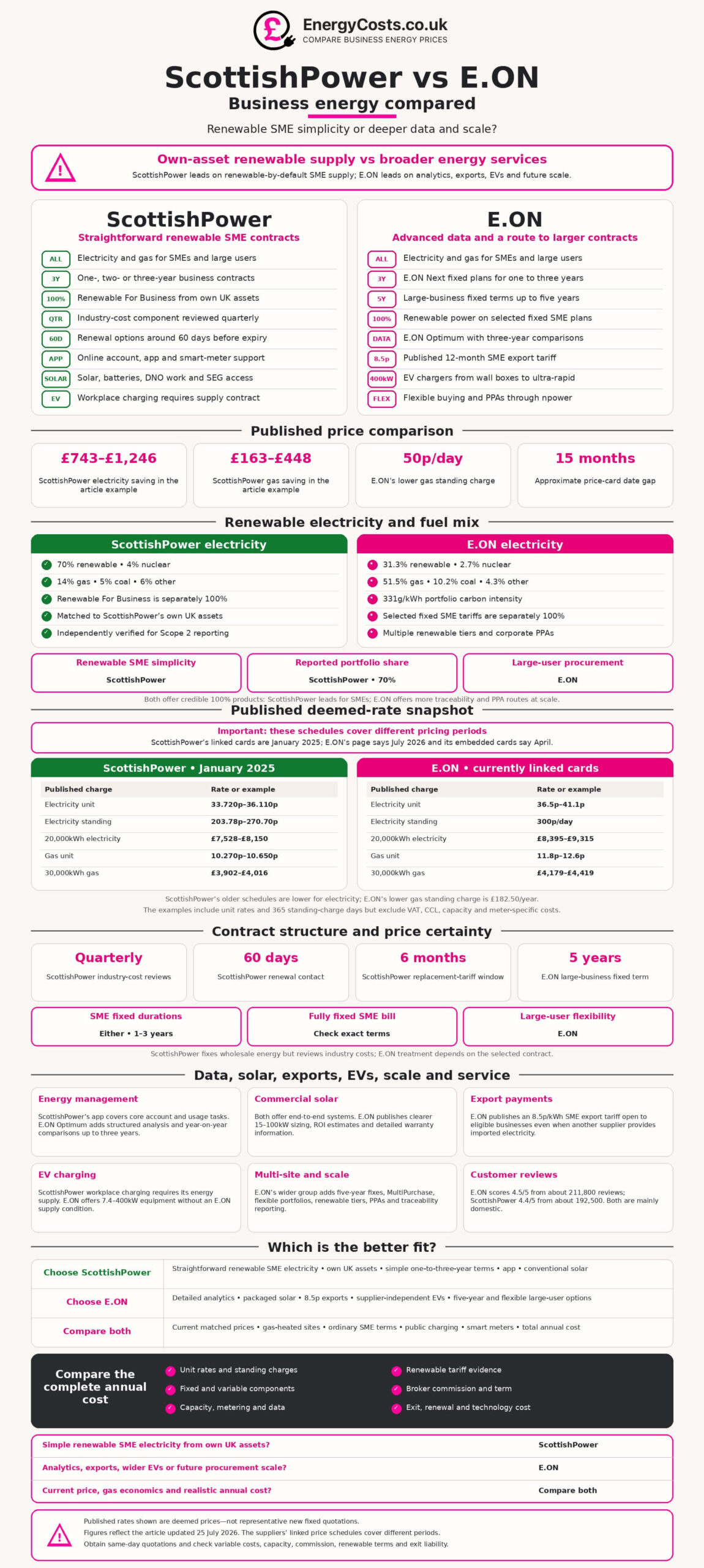
- ScottishPower’s publicly linked deemed rates appear lower, but those price cards are still dated January 2025. E.ON’s official deemed-contract page is effective from July 2026, with the embedded SME rate cards dated April 2026. The published prices are therefore not directly comparable.
ScottishPower is likely to suit an SME seeking a straightforward renewable electricity contract. E.ON is likely to be more attractive where energy analytics, solar and battery installations or future access to sophisticated procurement services are priorities.
ScottishPower vs E.ON at a glance
| Comparison area | ScottishPower | E.ON |
|---|---|---|
| Business electricity | Yes | Yes |
| Business gas | Yes | Yes |
| SME contract lengths | One, two or three years | One, two or three years |
| Large-business fixed terms | Bespoke arrangements available | Up to five years through npower Business Solutions |
| SME electricity source | 100% renewable on its currently promoted Renewable For Business tariff | 100% renewable on selected fixed tariffs |
| Fixed-price structure | Wholesale energy fixed; industry costs reviewed quarterly | Depends on selected contract |
| Flexible purchasing | More limited within its standard SME proposition | Extensive options through npower Business Solutions |
| Corporate PPAs | Available for qualifying organisations | Available through npower Business Solutions |
| Published deemed electricity rate | 33.720p to 36.110p per kWh | 36.5p to 41.1p per kWh |
| Published electricity standing charge | 203.78p to 270.70p per day | 300p per day |
| Published deemed gas rate | 10.270p to 10.650p per kWh | 11.8p to 12.6p per kWh |
| Published gas standing charge | 225p per day | 175p per day |
| Smart meters | Free installation for eligible businesses | Available to eligible businesses |
| Energy-use platform | ScottishPower app and online account | E.ON Optimum |
| Commercial solar and batteries | Yes | Yes |
| Business EV chargers | Yes | Yes |
| Trustpilot rating | 4.4 out of 5 | 4.5 out of 5 |
| Best suited to | SMEs wanting renewable electricity | Data-led SMEs and complex larger users |
ScottishPower’s Renewable For Business electricity contracts last one, two or three years. Its energy component is fixed, while network, environmental and social costs can change quarterly. E.ON Next also offers one, two and three-year SME tariffs, with renewable electricity included on selected fixed products.
Which is cheaper: ScottishPower or E.ON?
Business energy quotations are calculated individually. The final price can depend on:
- Annual gas and electricity consumption
- Meter type and profile
- Electricity distribution region
- Agreed supply capacity
- Number of premises
- Contract length
- Contract start date
- Payment method
- Credit history
- Whether non-commodity charges are fixed
- Renewable-energy requirements
- Broker commission
Neither supplier publishes standard fixed-contract rates that apply to every business.
The clearest public comparison uses deemed rates. These apply when a business consumes energy at premises without having agreed a contract with the incumbent supplier.
Deemed prices are normally considerably more expensive than negotiated fixed tariffs and should not be treated as representative quotations.
Important pricing-date warning
The latest ScottishPower deemed electricity and gas price cards linked from its business terms page are effective from 1 January 2025. ScottishPower states that deemed prices are updated regularly, but its public pricing page has not been updated with a more recent complete schedule.
E.ON’s official deemed-contract page says its latest contracts and prices are effective from 1 July 2026. However, the SME electricity and gas rate cards contained inside the documents are dated 10 April 2026.
ScottishPower’s figures consequently look more competitive, but they are approximately 15 months older than the E.ON price cards. The figures below provide transparency about published rates, not a definitive indication of which supplier would quote the lower current fixed price.
ScottishPower vs E.ON electricity prices
The following rates apply to standard unrestricted non-half-hourly electricity meters. Prices exclude VAT and the Climate Change Levy.
| Supplier | Published effective date | Unit rate | Standing charge |
|---|---|---|---|
| ScottishPower | January 2025 | 33.720p to 36.110p per kWh | 203.78p to 270.70p per day |
| E.ON | Official page: July 2026; rate card: April 2026 | 36.5p to 41.1p per kWh | 300p per day |
ScottishPower’s publicly linked tariff has a lower unit rate and standing charge in every electricity region. However, the difference may largely reflect the different pricing dates rather than how the suppliers would compare in a live tender.
Electricity prices by region
| Electricity region | ScottishPower unit rate | ScottishPower standing charge | E.ON unit rate | E.ON standing charge |
|---|---|---|---|---|
| Eastern | 34.100p | 211.09p | 36.8p | 300p |
| East Midlands | 33.950p | 222.11p | 36.7p | 300p |
| London | 33.920p | 203.78p | 37.5p | 300p |
| Merseyside and North Wales | 35.810p | 270.70p | 39.6p | 300p |
| West Midlands | 33.720p | 229.27p | 36.5p | 300p |
| North East | 34.210p | 231.33p | 37.4p | 300p |
| North West | 35.210p | 217.02p | 38.1p | 300p |
| North Scotland | 36.110p | 231.95p | 41.1p | 300p |
| South Scotland | 34.140p | 242.15p | 36.8p | 300p |
| South East | 34.110p | 214.47p | 36.9p | 300p |
| Southern | 34.090p | 217.83p | 37.5p | 300p |
| South Wales | 34.370p | 228.72p | 37.8p | 300p |
| South West | 34.270p | 231.65p | 38.1p | 300p |
| Yorkshire | 33.950p | 231.98p | 36.8p | 300p |
ScottishPower uses traditional distribution-area names such as Manweb, Norweb, Scottish Hydro and SWEB. The table translates these into more recognisable geographic descriptions.
Example annual electricity cost
The following estimates assume that a business uses 20,000 kWh of electricity annually.
| Supplier | Lowest regional annual cost | Highest regional annual cost |
|---|---|---|
| ScottishPower | £7,528 | £8,150 |
| E.ON | £8,395 | £9,315 |
The estimates include the published unit rate and 365 days of standing charges. They exclude VAT, the Climate Change Levy, capacity costs and any additional meter-specific charges.
On the published schedules, ScottishPower is between approximately £743 and £1,246 cheaper per year, depending on the region.
That saving should not be interpreted as proof that ScottishPower currently costs less. A fair comparison requires quotations prepared on the same day for the same meter, consumption forecast, contract duration and start date.
Economy 7 electricity rates
Both suppliers publish separate day and night prices for Economy 7 meters.
| Supplier | Day rate range | Night rate range | Standing charge |
|---|---|---|---|
| ScottishPower | 33.90p to 36.12p per kWh | 29.55p to 30.59p per kWh | 203.78p to 270.70p per day |
| E.ON | 40.3p to 45.1p per kWh | 27.7p to 33.8p per kWh | 300p per day |
E.ON’s night rate is lower in some regions, but its day rate and standing charge are higher throughout the published schedules.
The cheaper option for an Economy 7 customer depends on the percentage of consumption occurring overnight. A hotel, refrigerated facility or business charging vehicles overnight could produce a different result from an office that operates mainly during the day.
ScottishPower vs E.ON gas prices
| Supplier | Published effective date | Unit rate | Standing charge |
|---|---|---|---|
| ScottishPower | January 2025 | 10.270p to 10.650p per kWh | 225p per day |
| E.ON | Official page: July 2026; rate card: April 2026 | 11.8p to 12.6p per kWh | 175p per day |
E.ON has the lower standing charge by 50p per day, equivalent to £182.50 per year.
ScottishPower’s older price card has a unit rate between approximately 1.15p and 2.26p per kWh lower. That unit-price difference outweighs E.ON’s standing-charge advantage once a business uses a moderate amount of gas.
Gas prices by region
| Gas region | ScottishPower unit rate | E.ON unit rate |
|---|---|---|
| Eastern | 10.270p | 11.9p |
| East Midlands | 10.310p | 11.8p |
| London | 10.470p | 12.4p |
| Merseyside and North Wales | 10.580p | 12.2p |
| West Midlands | 10.650p | 12.1p |
| North East | 10.450p | 12.2p |
| North West | 10.330p | 12.2p |
| North Scotland | 10.340p | 12.1p |
| South Scotland | 10.340p | 12.4p |
| South East | 10.390p | 12.2p |
| Southern | 10.500p | 12.6p |
| South Wales | 10.310p | 11.8p |
| South West | 10.650p | 11.8p |
| Yorkshire | 10.540p | 12.6p |
Both suppliers exclude VAT from the published figures. The Climate Change Levy may also apply to qualifying business consumption.
Example annual gas cost
The following example assumes annual gas consumption of 30,000 kWh.
| Supplier | Lowest regional annual cost | Highest regional annual cost |
|---|---|---|
| ScottishPower | £3,902 | £4,016 |
| E.ON | £4,179 | £4,419 |
ScottishPower is between approximately £163 and £448 cheaper per year on the published schedules.
The result again comes with a major qualification: ScottishPower’s prices are dated January 2025, while the E.ON rate card is dated April 2026. Current fixed quotations may show a completely different result.
ScottishPower business contracts
ScottishPower offers SME business agreements lasting:
- One year
- Two years
- Three years
Its currently promoted electricity product is Renewable For Business. Its gas product is described as For Business and is supplied from mixed sources.
How ScottishPower fixed tariffs work
ScottishPower divides its contracted price into two elements.
The energy component is fixed for the agreed contract term. This protects the customer from increases in the wholesale gas or electricity price included in the quotation.
The industry-cost component remains variable. It includes relevant network, environmental and social costs. ScottishPower reviews these charges every quarter, with changes taking effect on 1 January, 1 April, 1 July or 1 October.
This means ScottishPower’s one, two and three-year contracts are not necessarily fully fixed. A customer’s billed unit price can change even though the wholesale energy component remains protected.
Businesses should check whether the variable element includes:
- Distribution Use of System charges
- Transmission Network Use of System charges
- Balancing costs
- Renewable Obligation costs
- Contracts for Difference
- Capacity Market charges
- Metering costs
- Other regulatory levies
ScottishPower contacts fixed-term customers with contract renewal options approximately 60 days before the contract ends. Customers can agree a replacement tariff up to six months before the current contract expires.
E.ON business contracts
E.ON Next offers small and medium-sized businesses bespoke fixed agreements lasting one, two or three years. Customers receive access to an online account and dedicated Energy Specialists.
Selected fixed electricity tariffs include 100% renewables-backed electricity. E.ON’s conditions state that a smart meter is required where the premises is eligible, and that exit fees and other terms can apply.
Customers who do not renew before the contract ends are moved onto a variable business tariff. They can subsequently move from that variable arrangement to an available fixed tariff.
Large-business contracts
E.ON serves larger and more complex organisations through npower Business Solutions.
Its fixed contracts can last up to five years. Customers can select different approaches to wholesale energy, network charges and environmental levies. Available structures include products where these costs are fixed, passed through or reviewed during the agreement.
Flexible procurement options allow businesses to spread purchases across several transactions rather than buying all expected consumption at one market price. This can reduce exposure to a single market peak, although it also creates the risk of leaving energy unpurchased while prices rise.
Contract flexibility winner: E.ON
ScottishPower provides a relatively simple SME structure. E.ON offers a comparable SME choice but has a much broader progression into long-term fixed, multi-purchase and flexible contracts for larger organisations.
Which offers greater price certainty?
ScottishPower clearly explains that the wholesale component is fixed but that relevant industry costs can change quarterly.
E.ON Next advertises fixed SME tariffs, but the exact treatment of non-commodity charges must be confirmed in the quotation and contract. Through npower Business Solutions, larger customers can choose products that fix both network and environmental charges or pass them through separately.
For an SME, neither supplier should be assumed to provide a completely fixed final bill without reviewing the contract.
For a larger organisation, E.ON has the advantage because it offers several explicit methods for fixing or passing through non-commodity costs.
Renewable electricity comparison
ScottishPower renewable electricity
ScottishPower’s Renewable For Business tariff matches every unit consumed with renewable electricity generated from its own renewable resources in the UK.
The tariff is backed by Renewable Energy Guarantees of Origin and is independently verified. ScottishPower states that the product complies with Greenhouse Gas Protocol Scope 2 requirements.
ScottishPower operates 38 onshore wind farm sites and has generated renewable electricity since 1992. Its currently promoted SME electricity product is renewable by default, rather than requiring a customer to choose a separate conventional mixed-fuel tariff.
E.ON renewable electricity
E.ON Next includes 100% renewables-backed electricity on selected fixed SME tariffs.
The supply is supported by E.ON renewable assets, agreements with UK generators and renewable electricity certificates. The physical electricity delivered to the premises continues to come through the National Grid.
For large organisations, npower Business Solutions offers:
- UK Business Renewable
- UK Renewable Pure
- UK Renewable Pure Plus
- UK corporate power purchase agreements
UK Renewable Pure is limited to wind, hydro and solar. Pure Plus uses REGOs sourced from known UK generation partners alongside the purchased power. Corporate PPAs can provide long-term renewable electricity from named wind or solar assets.
Fuel-mix comparison
E.ON Next’s disclosed overall electricity mix for April 2024 to March 2025 was:
| Source | E.ON fuel mix |
|---|---|
| Natural gas | 51.5% |
| Renewables | 31.3% |
| Coal | 10.2% |
| Other fuels | 4.3% |
| Nuclear | 2.7% |
E.ON reported portfolio carbon intensity of 331 grams of carbon dioxide per kWh. These figures cover the wider portfolio and include customers who were not on a dedicated renewable tariff.
ScottishPower’s corresponding total fuel mix was reported as 70% renewable, 14% gas, 6% other fuels, 5% coal and 4% nuclear. Its non-green tariffs used a different mix, while its dedicated renewable products were matched with 100% renewable electricity.
Renewable electricity winner: ScottishPower for SMEs
ScottishPower’s current SME electricity proposition is simpler because its promoted electricity tariff is renewable as standard and linked to its own UK renewable resources.
Renewable procurement winner: E.ON for large businesses
E.ON’s npower Business Solutions division offers a wider range of traceability levels, minimum-volume products and long-term corporate PPAs.
Smart meters and energy management
ScottishPower smart meters
ScottishPower provides free smart-meter installations for eligible businesses.
Customers can use its app and online account to:
- Monitor business energy consumption
- Submit meter readings
- View bills
- Make payments
- Manage account details
ScottishPower also works with the Carbon Trust to provide advice on reducing consumption, costs and carbon emissions.
E.ON Optimum
Eligible E.ON SME customers with compatible smart or AMR meters can use E.ON Optimum without an additional subscription charge.
The platform provides:
- A digital consumption dashboard
- Analysis by meter and time period
- Year-on-year comparisons covering up to three years
- Sustainability and energy-saving guidance
- Remote access to energy data
Businesses must register compatible meters with the service.
Energy-management winner: E.ON
ScottishPower provides the essential account and consumption functions most SMEs need. E.ON Optimum adds longer-term comparison and more structured analytical tools.
Commercial solar and battery storage
Both suppliers offer end-to-end commercial solar services.
ScottishPower solar
ScottishPower’s service can include:
- Solar panels
- Battery storage
- A preliminary proposal
- A detailed site survey
- Bespoke system design
- Nationwide installation
- Distribution Network Operator applications
- Smart Export Guarantee access
ScottishPower says a typical commercial solar installation has a lifespan of 25 to 30 years. Its typical warranty package includes a 24-month installer warranty, a 12-year panel manufacturer warranty and a 25-year performance warranty, subject to the selected equipment and terms.
E.ON solar
E.ON offers solar-only, solar-and-battery and battery-only systems. Installations typically range from 15 kW to 100 kW, although larger projects and multi-site designs are available.
The service includes:
- Three-dimensional system design
- A structural roof assessment
- DNO applications
- A dedicated project manager
- Return-on-investment projections
- Performance-monitoring tools
- Up to a 25-year panel product warranty
- Up to a 30-year performance warranty
- Up to a ten-year battery warranty
E.ON gives general payback estimates of four to six years for combined solar and battery systems and four to seven years for battery-only installations. Actual results depend on usage, system size, location, export restrictions and financing.
E.ON also offers an SME Smart Export Guarantee paying 8.5p per kWh on its current 12-month business export tariff, subject to eligibility and smart-meter requirements. The export product is available to qualifying businesses even when another company supplies their imported electricity.
Commercial solar winner: E.ON by a narrow margin
Both provide credible end-to-end installations. E.ON publishes more detailed information about system sizes, warranties, return-on-investment projections and its business export tariff.
Electric vehicle charging
ScottishPower provides workplace chargers and fully funded public charging arrangements. A business must take its premises’ energy supply from ScottishPower to purchase its standard workplace charging solution.
E.ON offers chargers ranging from small 7.4 kW wall-mounted units to 400 kW ultra-rapid equipment. Its installation service is available to businesses regardless of which supplier provides their electricity. Standard quotations include the charger, installation and a three-year maintenance and warranty package.
EV charging winner: E.ON
E.ON offers the wider published range and does not require the business to become an E.ON energy customer.
Multi-site and large-business services
ScottishPower can supply organisations with multiple premises, although its standard business proposition concentrates primarily on fixed one, two and three-year contracts.
E.ON’s npower Business Solutions division offers:
- Fixed contracts lasting up to five years
- Flexible wholesale purchasing
- MultiPurchase structures
- Market-linked contracts
- Multi-site portfolio management
- Renewable fixed and flexible products
- Carbon-offset gas options
- Corporate PPAs
- Renewable traceability reporting
This gives E.ON a clearer route for businesses that grow beyond conventional SME contracts.
Large-business winner: E.ON
Customer-review comparison
| Supplier | Trustpilot score | Reviews |
|---|---|---|
| ScottishPower | 4.4 out of 5 | Approximately 192,500 |
| E.ON Next | 4.5 out of 5 | Approximately 211,800 |
E.ON has the slightly higher score. Trustpilot reports that E.ON invites reviews, responds to 99% of negative reviews and usually responds within 24 hours.
ScottishPower also invites reviews. It reportedly responds to 90% of negative reviews and typically replies within 24 hours.
These profiles cover the suppliers’ wider customer bases and are dominated by domestic experiences. They are not separate business-only ratings and should therefore be treated cautiously when assessing commercial account service.
Customer-review winner: E.ON
Its lead is small, but E.ON has a higher TrustScore, a larger review sample and a higher reported negative-review response rate.
ScottishPower advantages and disadvantages
Advantages of ScottishPower
- Renewable electricity is central to its current SME proposition
- Electricity is matched with power from ScottishPower’s own UK renewable resources
- One, two and three-year contracts
- Lower publicly linked deemed electricity rates
- Lower publicly linked deemed gas unit rates
- Free smart-meter installation for eligible businesses
- Online account and mobile app
- Commercial solar and battery systems
- Smart Export Guarantee access
- Workplace and public EV charging
- Energy-efficiency support developed with the Carbon Trust
- Strong overall Trustpilot rating
Disadvantages of ScottishPower
- Publicly linked deemed-rate cards are still dated January 2025
- Industry costs can change quarterly during a fixed-term contract
- No clearly promoted fully fixed SME option covering every existing third-party charge
- Standard business gas is not renewable
- Less extensive flexible procurement information than E.ON
- Workplace EV charging requires ScottishPower to supply the premises
- Trustpilot reviews are not specific to business customers
E.ON advantages and disadvantages
Advantages of E.ON
- One, two and three-year SME contracts
- Selected fixed tariffs include 100% renewable electricity
- Lower published gas standing charge
- E.ON Optimum consumption dashboard
- Up to three years of energy-use comparisons
- Dedicated Energy Specialists
- Strong commercial solar and battery proposition
- Published 8.5p-per-kWh SME export tariff
- Wide range of business EV chargers
- EV installations do not require E.ON energy supply
- Fixed contracts lasting up to five years for larger customers
- Extensive flexible purchasing through npower Business Solutions
- Sophisticated renewable products and corporate PPAs
- Slightly higher Trustpilot score
Disadvantages of E.ON
- Higher published deemed electricity prices
- Higher published deemed gas unit rates
- Renewable electricity is limited to selected SME tariffs
- Smart meters are required where eligible for certain renewable fixed products
- The official deemed-contract effective date differs from the date printed on its SME price cards
- Larger customers must deal with the separate npower Business Solutions brand
- Contract and non-commodity structures can become complicated
- Trustpilot reviews are predominantly domestic
Which supplier is best for different businesses?
| Business requirement | Better choice | Reason |
|---|---|---|
| Small office or shop | ScottishPower | Simple renewable SME electricity proposition |
| Business prioritising published deemed prices | ScottishPower | Lower prices in its publicly linked schedules |
| Business needing genuinely current price evidence | Compare live quotes | Published schedules cover different periods |
| Renewable SME electricity | ScottishPower | Renewable electricity is its current standard SME product |
| Gas-heated SME | Compare both | ScottishPower’s older unit rate is lower; E.ON has a lower standing charge |
| Detailed consumption analysis | E.ON | E.ON Optimum provides three-year comparisons |
| Commercial solar and batteries | E.ON | More detailed packages, warranties and ROI guidance |
| Workplace EV charging without changing supplier | E.ON | Installation is open to non-E.ON customers |
| Public charging site | Compare both | Both offer commercial charging solutions |
| Straightforward one to three-year contract | Either | Both serve conventional SMEs |
| Fully fixed large-business costs | E.ON | Several explicit non-commodity cost options |
| Five-year fixed contract | E.ON | Available through npower Business Solutions |
| Flexible wholesale purchasing | E.ON | Broader fixed-flexible product range |
| Corporate PPA | E.ON | Clearly defined long-term CPPA products |
| Renewable electricity from supplier-owned assets | ScottishPower | Matched with ScottishPower’s own UK renewable generation |
| Highest headline review score | E.ON | 4.5 compared with ScottishPower’s 4.4 |
Final verdict: ScottishPower vs E.ON
ScottishPower is likely to be the better fit for a conventional SME that wants straightforward renewable electricity.
Its current Renewable For Business tariff provides one, two and three-year contracts with electricity matched to generation from ScottishPower’s own UK renewable assets. Its app, smart meters, solar panels and EV charging services create a relatively complete SME proposition.
Its published deemed electricity and gas rates are also lower than E.ON’s. However, those ScottishPower rate cards date from January 2025 and cannot fairly be compared with E.ON’s 2026 documents. Businesses should not choose ScottishPower solely because the older published rates appear cheaper.
E.ON is the stronger option for energy analytics, commercial technology and complex procurement.
E.ON Optimum provides more developed energy-use analysis, while its solar, battery and EV charging ranges are described in greater technical detail. Larger organisations can move to npower Business Solutions for contracts lasting up to five years, flexible purchasing, renewable traceability and corporate PPAs.
The practical conclusion is:
- Choose ScottishPower for a simple SME electricity agreement backed by renewable power from ScottishPower’s UK assets.
- Consider E.ON for stronger consumption analytics, commercial solar, EV charging or sophisticated large-business procurement.
- Obtain live quotations from both before deciding on price.
A proper quotation comparison should include:
- Electricity and gas unit rates
- Standing charges
- Estimated annual cost
- Contract length
- Fixed and variable cost components
- Pass-through charges
- Meter and data costs
- Agreed capacity charges
- Renewable-energy evidence
- Broker commission
- Early termination provisions
- End-of-contract arrangements
FAQ
ScottishPower’s publicly linked deemed rates are lower, but they date from January 2025. E.ON’s documents are from 2026. Only live quotations produced for the same premises, consumption and contract period can establish which supplier is currently cheaper.
ScottishPower’s published rates range from 33.720p to 36.110p per kWh, compared with E.ON’s 36.5p to 41.1p. ScottishPower’s figures are substantially older, so this is not a reliable current fixed-tariff comparison.
ScottishPower publishes gas rates between 10.270p and 10.650p per kWh. E.ON publishes 11.8p to 12.6p, but has a lower standing charge. The ScottishPower schedule is dated January 2025.
Yes. Both offer SME contracts lasting one, two or three years. E.ON also offers larger organisations fixed agreements lasting up to five years through npower Business Solutions.
No. ScottishPower fixes the energy component, but relevant network, environmental and social costs remain variable. These charges are reviewed every quarter and can increase or decrease during the contract.
It depends on the contract. E.ON Next provides fixed SME tariffs, while npower Business Solutions offers several ways of fixing or passing through network and environmental charges. The quotation should state exactly which components can change.
ScottishPower has the simpler renewable SME proposition because its currently promoted business electricity tariff is matched with renewable power generated from its own UK resources. E.ON provides 100% renewable electricity on selected SME tariffs and more advanced renewable options for large users.
Yes. Both install smart meters for eligible business customers. ScottishPower provides app-based account management, while compatible E.ON customers can use E.ON Optimum for detailed consumption analysis.
Yes. Both provide commercial solar panels and battery storage. E.ON publishes typical system sizes, payback guidance and detailed warranties, while ScottishPower offers bespoke installations and manages DNO applications.
E.ON has the broader published product range, from 7.4 kW wall chargers to 400 kW ultra-rapid equipment. Businesses do not need to buy energy from E.ON. ScottishPower requires energy supply customers for its standard workplace charger proposition.
E.ON is generally stronger. npower Business Solutions offers five-year fixed contracts, flexible purchasing, multi-site management, renewable traceability and corporate PPAs.
E.ON has a Trustpilot rating of 4.5, compared with ScottishPower’s 4.4. Both scores cover mainly domestic customers and should not be treated as business-only service ratings.
Choose ScottishPower for a straightforward renewable SME electricity contract. Consider E.ON for advanced consumption data, solar and batteries, EV charging or large-business procurement. Compare live total annual costs before signing.