
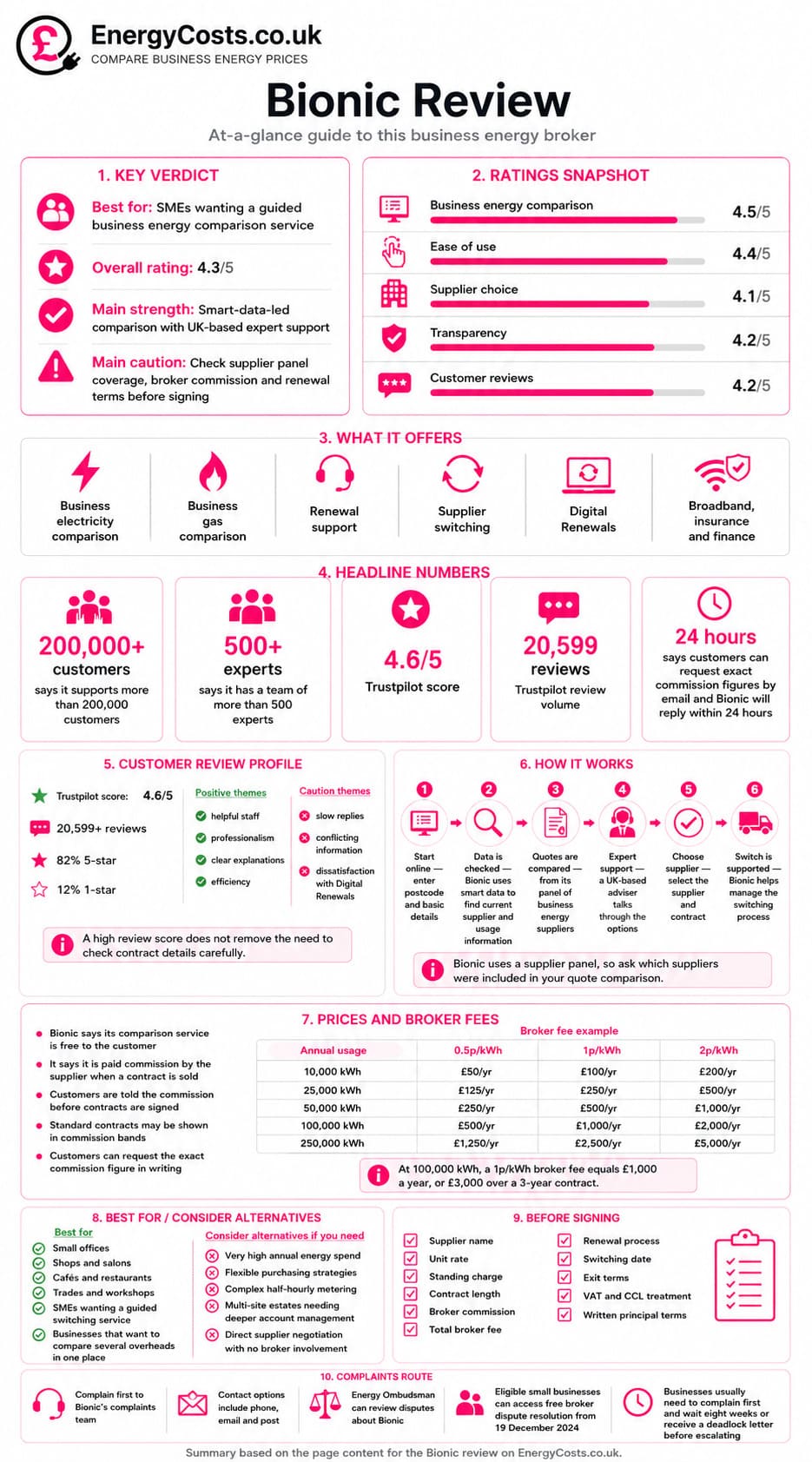
Bionic is one of the UK’s best-known business comparison services, with a strong focus on business energy switching for small and medium-sized companies. It helps businesses compare, switch and renew essential services including energy, broadband, insurance and finance, and says it supports more than 200,000 customers through a team of more than 500 experts.
For business energy, Bionic is best suited to SMEs that want a guided comparison service rather than contacting suppliers one by one. Bionic says it compares quotes from a panel of business energy suppliers, uses smart data to reduce form-filling, and provides UK-based experts to talk customers through the quotes and switching process.
The main point to understand is that Bionic is a broker and comparison service, not the energy supplier. The actual gas or electricity contract will normally be with the supplier chosen through the comparison process. Businesses should therefore check the supplier name, unit rate, standing charge, contract length, broker commission and renewal terms before agreeing.
Quick verdict
| Category | Rating | Notes |
|---|---|---|
| Business energy comparison | 4.5/5 | Strong SME focus and a clear comparison-led service |
| Ease of use | 4.4/5 | Postcode-led journey and smart data reduce form-filling |
| Supplier choice | 4.1/5 | Uses a panel of suppliers rather than claiming whole-market comparison |
| Transparency | 4.2/5 | Bionic publishes information about commission and says customers can request exact commission figures |
| Customer reviews | 4.2/5 | Strong overall Trustpilot score, but a notable minority of negative reviews |
| Best for | SMEs | Particularly useful for small businesses wanting guided switching |
| Overall rating | 4.3/5 | A strong SME broker, provided fees and renewal terms are checked carefully |
What is Bionic?
Bionic is a business comparison and switching service aimed mainly at small businesses. Its website describes it as “the comparison site for your small business” and says it helps companies compare, switch and renew business energy, insurance, broadband and other services.
Companies House currently records company number 05949018 as Business Essential Services Limited, with previous names including Bionic Services Limited from 9 December 2019 to 7 May 2026 and Make It Cheaper Limited from 27 September 2006 to 9 December 2019. The registered office is listed as 5th Floor, 9 Appold Street, London, EC2A 2AP.
For business energy customers, the Bionic brand is best understood as a broker and comparison service that helps arrange contracts with suppliers, rather than as an electricity or gas supplier itself.
What does Bionic offer?
Bionic’s wider business services include energy, connectivity, insurance and finance. Its energy service focuses on helping businesses compare, switch and renew gas and electricity contracts.
| Service | What it means | Best suited to |
|---|---|---|
| Business electricity comparison | Comparing electricity quotes from Bionic’s supplier panel | Shops, offices, cafés, salons, workshops and SMEs |
| Business gas comparison | Comparing gas contracts for commercial premises | Hospitality, retail, leisure, care and light industrial users |
| Renewal support | Arranging a new deal before the current contract expires | Businesses wanting to avoid out-of-contract rates |
| Supplier switching | Support through the switch once a supplier is chosen | SMEs that want less admin |
| Digital Renewals | Bionic says it can automatically compare quotes ahead of renewal | Businesses that want renewal reminders, but should check consent and terms |
| Wider business services | Broadband, insurance, finance and other essentials | SMEs wanting to review several overheads |
Bionic also says it helps commercial customers from major price comparison websites, including Compare the Market, MoneySuperMarket, Uswitch and Confused.com, compare business energy prices.
How Bionic business energy comparison works
Bionic’s process starts online. It says customers can begin with a business postcode and that it uses smart data to find energy information and reduce the amount of form-filling required. Its UK-based experts then compare quotes and talk customers through their options before the business chooses a supplier and rate.
- Start online: The business enters its postcode and some basic details
- Data is checked: Bionic searches current supplier and usage information through industry-held data
- Quotes are compared: Bionic compares quotes from its panel of business energy suppliers
- Expert support is provided: A Bionic energy expert talks the customer through the options
- Supplier is chosen: The business chooses the supplier and contract it wants
- Switch is supported: Bionic supports the switching process
Bionic says it compares quotes from a panel of suppliers, including big names and specialist providers. This can save time, but it also means businesses should ask which suppliers were included in their specific quote comparison.
Bionic prices and broker fees
Bionic does not publish one fixed energy broker fee because commercial energy contracts are priced individually. Rates depend on factors such as the supplier, business size, usage, location, meter type, contract length and market conditions.
Bionic says its comparison service is free to the customer and that it makes money by receiving commission from the supplier when a customer switches. It also says it tells customers how much commission will be paid before contracts are signed.
Bionic’s service page says that, for standard energy contracts, agents will tell customers the commission band their new contract falls within. It also says customers can request the exact commission by emailing Bionic, and Bionic will reply within 24 hours. For larger or more complex contracts, it says agents will discuss the exact commission.
| Fee issue | What Bionic says | What businesses should do |
|---|---|---|
| Direct customer fee | Bionic says its comparison service is free | Confirm whether any fee is included in the energy price |
| Supplier commission | Bionic says it is paid by the supplier when a contract is sold | Ask for the commission in p/kWh and in total pounds |
| Commission disclosure | Bionic says customers are told how much commission will be paid | Request written confirmation before agreeing |
| Standard contracts | Bionic says it gives a commission band | Ask for the exact figure if needed |
| Complex contracts | Bionic says exact commission is discussed | Make sure this is confirmed in writing |
Example broker-fee calculation
Broker commission can look small when expressed as pence per kWh, but it can become substantial over a long contract.
| Annual energy usage | 0.5p/kWh broker fee | 1p/kWh broker fee | 2p/kWh broker fee |
|---|---|---|---|
| 10,000 kWh | £50 per year | £100 per year | £200 per year |
| 25,000 kWh | £125 per year | £250 per year | £500 per year |
| 50,000 kWh | £250 per year | £500 per year | £1,000 per year |
| 100,000 kWh | £500 per year | £1,000 per year | £2,000 per year |
| 250,000 kWh | £1,250 per year | £2,500 per year | £5,000 per year |
For example, a business using 100,000 kWh per year would pay £1,000 per year for every 1p/kWh of broker commission included in the contract price. Over a three-year contract, that would be £3,000. That does not automatically mean the broker is poor value, but the fee should be visible before the contract is agreed.
Broker fee rules for business customers
Broker fee transparency has become more important in the UK business energy market. Ofgem confirmed that, for non-domestic contracts signed from 1 October 2024, broker fees must be displayed in the contract’s principal terms, and suppliers must make this information available on request.
The UK government has also confirmed plans to appoint Ofgem as the regulator for third-party intermediaries, including energy brokers, when parliamentary time allows. The proposed framework includes principles, specific rules, registration requirements and enforcement tools.
This means businesses using Bionic should expect clear written information about broker fees and contract terms. If a quote is not clear, the business should ask for a full breakdown before agreeing.
Bionic customer reviews
Bionic has a strong Trustpilot profile overall. At the time of writing, Trustpilot lists Bionic with a score of 4.6 out of 5 from 20,599 reviews, with 82% of reviews rated 5-star and 12% rated 1-star. Trustpilot also says Bionic has replied to 96% of negative reviews and typically replies within one week.
Trustpilot’s review summary says customers frequently praise Bionic staff for helpfulness, professionalism and clear explanations, and often mention efficiency and ease of use. However, it also notes some customer concerns about slow replies, conflicting information and dissatisfaction with the Digital Renewal service.
| Review theme | Positive signals | Caution points |
|---|---|---|
| Staff | Helpful, professional and clear explanations are commonly mentioned | Service can depend on the individual adviser |
| Speed | Many customers praise quick handling and efficiency | Businesses should still take time to check terms |
| Price | Customers often mention competitive deals | Savings should be checked against total contract cost |
| Digital Renewals | Can reduce renewal admin | Some customers have expressed dissatisfaction with renewal handling |
| Complaints handling | Bionic replies to most negative Trustpilot reviews | A high review score does not remove the need to check contract details |
The review picture is therefore mixed but broadly positive. Bionic has a high overall rating, but the 1-star share and comments about renewals mean businesses should pay particular attention to renewal permissions, contract length and written confirmation of fees.
Pros and cons
Pros
- Strong brand recognition in SME business comparison
- Can compare energy, broadband, insurance and finance
- Postcode-led comparison process reduces admin
- UK-based experts talk customers through quotes
- Bionic publishes information about how it earns commission
- Strong Trustpilot score and high review volume
- Can help avoid out-of-contract rates
Cons
- Uses a supplier panel, not necessarily the whole market
- Broker commission may be included in the contract price
- Business energy contracts usually have no cooling-off period
- Some customers report dissatisfaction with Digital Renewals
- Standard contracts may initially be shown in commission bands
- 12% of Trustpilot reviews are 1-star at the time of writing
- Businesses should still compare direct supplier quotes where possible
Who is Bionic best for?
Bionic is best suited to small and medium-sized businesses that want a guided, broker-led way to compare business energy contracts. It is especially relevant for companies that do not have the time to contact multiple suppliers themselves.
| Business type | Suitability | Why |
|---|---|---|
| Small offices | High | Simple usage and standard contracts are usually well suited to comparison |
| Shops and salons | High | Good fit for SME electricity and gas switching |
| Cafés and restaurants | High | Useful where both gas and electricity costs matter |
| Trades and workshops | Medium to high | Can help compare fixed rates and avoid out-of-contract prices |
| Small warehouses | Medium to high | Suitability depends on usage and meter type |
| Multi-site SMEs | Medium | Useful, but may need more hands-on account management |
| Large manufacturers | Medium | May need specialist procurement alongside Bionic quotes |
| Large corporates | Lower | Strategic procurement consultancies may be more appropriate |
Who might need an alternative?
Bionic may not be the best choice for every energy buyer. Some businesses may prefer a specialist energy consultancy or direct supplier tender.
| Situation | Why another option may help |
|---|---|
| Very high annual energy spend | A procurement consultancy may provide deeper market strategy |
| Flexible purchasing needs | Large users may need fixed, flexible or pass-through contract analysis |
| Complex half-hourly metering | Specialist support may be needed for capacity, TNUoS and DUoS issues |
| Multi-site estates | A dedicated account-managed consultancy may be more suitable |
| Disputes with existing suppliers | It may be better to resolve issues before switching |
| Preference for direct negotiation | Some businesses may want supplier quotes without broker commission |
Bionic compared with other brokers
| Broker | Best for | How Bionic compares |
|---|---|---|
| Love Energy Savings | Fast online business energy comparison | Bionic has a broader “business essentials” proposition beyond energy |
| Utility Bidder | Energy, water and telecoms comparison | Bionic is particularly strong for SME energy and broader business services |
| Northern Gas and Power | Larger and more complex procurement | Northern Gas and Power may suit higher-usage or multi-site users better |
| Inenco | Large energy users and strategic procurement | Inenco is more consultancy-led and suited to complex energy portfolios |
| Inspired PLC | Corporate procurement and risk management | Inspired is more appropriate for large-scale energy strategy |
| Auditel | Cost reduction and carbon support | Auditel may be better where energy is part of wider procurement or net zero work |
For a typical SME, Bionic is a strong option to include in a comparison. For larger or more complex businesses, it may be sensible to compare Bionic with one or two specialist energy procurement consultancies.
What to check before signing through Bionic
Before agreeing to a business energy contract through Bionic, ask for the following in writing:
- Supplier name: Confirms who will actually supply the energy
- Unit rate: Shows the p/kWh electricity or gas rate
- Standing charge: Important for low and medium-usage sites
- Contract length: Business contracts can lock customers in for years
- Broker commission: Shows how Bionic is being paid
- Total broker fee: Helps compare the real cost of the contract
- Renewal process: Important if Digital Renewals are used
- Switching date: Confirms when the new contract starts
- Exit terms: Business contracts are usually difficult to cancel early
- VAT and CCL treatment: Incorrect assumptions can distort the expected bill
- Written principal terms: Confirms fees, rates and key contract conditions
Complaints and dispute resolution
Bionic publishes a complaints policy. It says customers can complain by calling its complaints team, emailing [email protected], or writing to its complaints team at 5th Floor, 9 Appold Street, London, EC2A 2AP.
The Energy Ombudsman lists Bionic as an energy broker it can review disputes about, with active membership shown under company number 05949018.
From 19 December 2024, the Energy Ombudsman says eligible UK small businesses can receive free dispute resolution support for energy broker disputes. Eligibility can apply where the business has fewer than 50 employees and meets turnover or balance sheet limits, or where annual electricity consumption is not more than 200,000 kWh, or annual gas consumption is not more than 500,000 kWh. Businesses must normally follow the broker or supplier complaints process first and wait eight weeks or receive a deadlock letter before escalating.
Final verdict: Bionic review
Bionic is a strong choice for UK SMEs that want a guided way to compare and switch business energy contracts. Its main strengths are brand recognition, a clear SME focus, smart-data-led comparison, expert support and the ability to review several business essentials in one place.
However, businesses should not treat any broker quote as automatically the cheapest or safest option. Bionic uses a supplier panel, is paid through supplier commission, and business energy contracts can be legally binding without a cooling-off period. The most important checks are the unit rate, standing charge, contract length, broker commission, renewal process and supplier terms.
For small businesses, Bionic is worth comparing alongside Love Energy Savings, Utility Bidder and direct supplier quotes. For larger or more energy-intensive companies, Bionic may still be useful, but it should be compared with specialist procurement consultancies such as Inenco, Inspired PLC or Northern Gas and Power.
FAQ
No. Bionic is a business comparison and switching service, not a gas or electricity supplier. It helps businesses compare quotes from a panel of suppliers and supports the switch, but the supply contract is normally with the chosen energy supplier.
Yes. Bionic is an established UK business comparison brand. Companies House records company number 05949018 as active, now under Business Essential Services Limited, with previous names including Bionic Services Limited and Make It Cheaper Limited.
Bionic says its comparison service is free to customers and that it makes money by receiving commission from suppliers when a customer switches. It says customers are told how much commission will be paid before contracts are signed.
Bionic says that, for standard energy contracts, agents tell customers the commission band for the new contract. Customers can ask for the exact commission by emailing Bionic, and Bionic says it will reply within 24 hours.
Bionic is well suited to many small businesses because it focuses on SME comparison and switching. It can be useful for shops, offices, cafés, salons and small service businesses that want help comparing fixed business energy contracts.
Bionic has a strong Trustpilot profile overall, with a score of 4.6 out of 5 from 20,599 reviews at the time of writing. However, 12% of reviews are 1-star, so businesses should still check contract terms carefully.
Bionic says its Digital Renewals service automatically compares quotes ahead of time and lines up renewal options to help businesses avoid unnecessary costs. Businesses should check exactly what authority they are giving and whether final approval is needed before a renewal contract is accepted.
Yes. Bionic publishes a complaints policy with phone, email and postal complaint routes. The Energy Ombudsman also lists Bionic as an energy broker it can review disputes about, subject to eligibility and process requirements.
Not always. Bionic may help find competitive quotes from its supplier panel, but commission may be built into the contract price. The fairest comparison is to compare Bionic’s total contract cost against direct supplier quotes, including unit rates, standing charges and broker fees.
Ask which suppliers were compared, what the unit rate and standing charge are, how long the contract lasts, whether the rate includes broker commission, what the total commission is, and what happens at renewal. These details should be confirmed in writing before agreeing.