
Utility Bidder is a UK business utility comparison and energy broker that helps companies compare commercial gas, electricity, water, telecoms, waste, merchant services, business insurance and green energy options. It is best known as a business energy broker, but its wider service range makes it more of a multi-utility comparison provider than a single-product energy switching site.
The company says it has helped 90,000 businesses, manages around 20,000 electricity meters for commercial customers, and works with leading UK energy and utility suppliers to compare live prices. Its website also says Utility Bidder supports microbusinesses, small businesses, medium-sized businesses, large businesses and public sector organisations.
Utility Bidder is likely to be a strong fit for SMEs that want help comparing several business utilities in one place. Its main caution is the same as with any broker: customers should check the supplier panel, unit rate, standing charge, contract length, commission, renewal process and complaint route before agreeing to a contract.
Quick verdict
| Category | Rating | Notes |
|---|---|---|
| Business energy comparison | 4.4/5 | Strong core service for business gas and electricity quotes |
| Multi-utility support | 4.6/5 | Covers energy, water, telecoms, waste, merchant services and insurance |
| Supplier access | 4.3/5 | Utility Bidder refers to leading suppliers and, in some content, 27+ business energy suppliers |
| Transparency | 4.3/5 | Its terms explain commission uplifts and give a worked example |
| Customer reviews | 4.4/5 | Trustpilot shows an Excellent rating, 4.5/5 and more than 3,000 reviews |
| Best for | SMEs and multi-utility buyers | Particularly useful for businesses wanting account-managed utility support |
| Overall rating | 4.4/5 | A strong broker for SME utility comparison, provided commission is checked carefully |
What is Utility Bidder?
Utility Bidder Limited is an active private limited company registered in England and Wales under company number 06954978. Companies House lists its registered office as Corby Innovation Hub, Bangrave Road South, Corby, England, NN17 1NN, and shows that the company was incorporated on 7 July 2009.
For business customers, Utility Bidder is best understood as a broker and comparison service, not an energy supplier. It helps businesses compare and arrange contracts with third-party suppliers. The actual energy supply contract will normally be with the chosen gas or electricity supplier.
What does Utility Bidder offer?
Utility Bidder’s services cover more than business energy. Its website menu lists business electricity, business energy, business gas, business water, business waste, business merchant services, business telecoms, corporate energy, business insurance, green business energy and solar as a service.
| Service | What it means | Best suited to |
|---|---|---|
| Business electricity | Comparing electricity contracts and rates | Shops, offices, warehouses, hospitality, leisure and light industrial firms |
| Business gas | Comparing commercial gas contracts | Restaurants, cafés, care homes, manufacturers and heated premises |
| Business energy | Combined gas and electricity comparison | SMEs wanting a simpler renewal process |
| Business water | Commercial water and wastewater comparison | Businesses in England and Scotland able to switch water retailers |
| Business telecoms | Telecoms and connectivity comparison | SMEs reviewing phone and broadband costs |
| Business waste | Waste service comparison | Retail, hospitality, offices and multi-site businesses |
| Merchant services | Payment terminal and merchant account comparison | Retail, hospitality and service businesses |
| Green business energy | Renewable energy tariff support | Businesses with sustainability targets |
| Corporate energy | Larger business energy support | High-usage and multi-site organisations |
| Solar as a service | On-site solar-style proposition | Businesses exploring lower-carbon energy options |
This range makes Utility Bidder useful for companies that want one provider to look at several overheads, rather than using a different broker for each category.
How Utility Bidder works
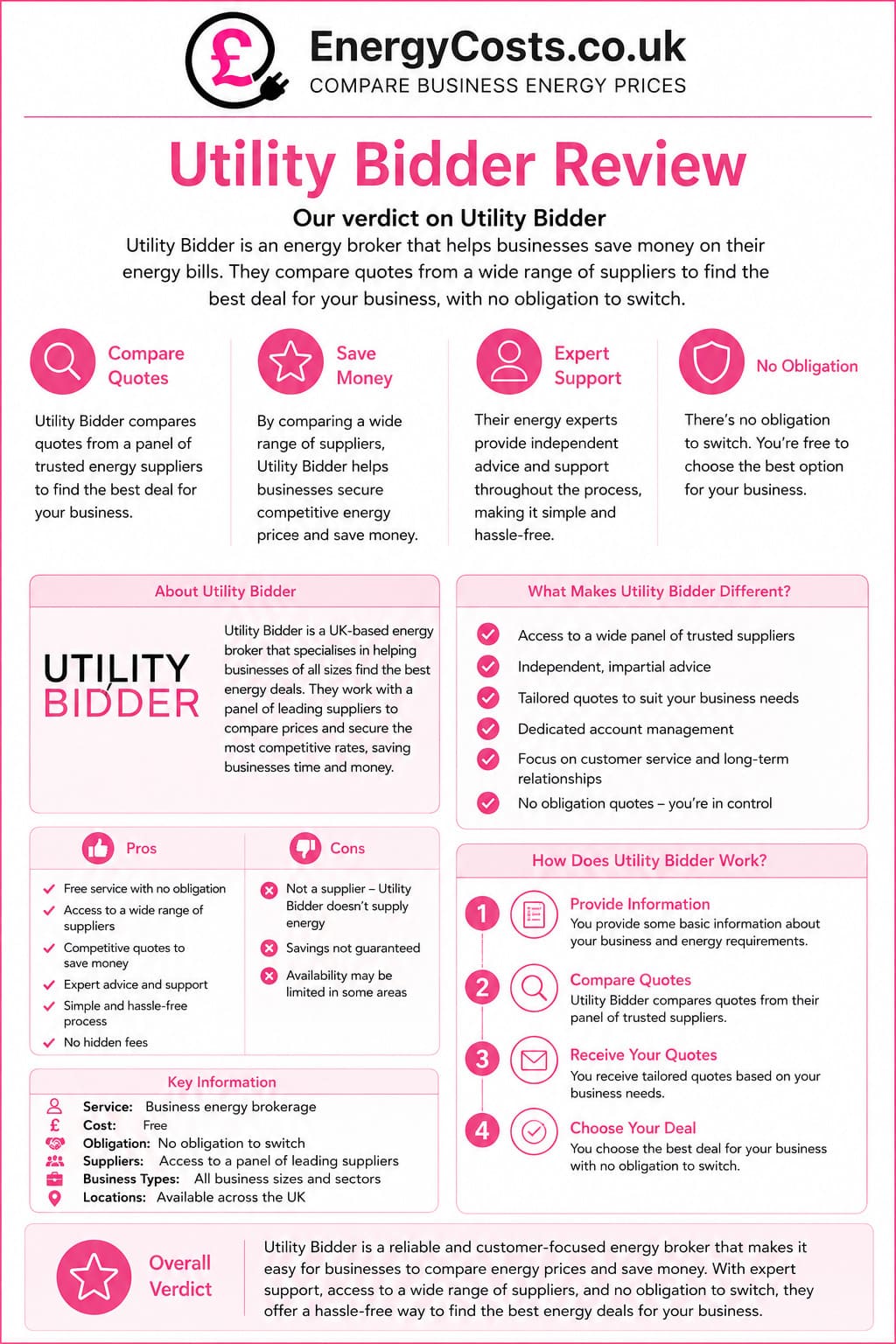
Utility Bidder’s process is based on comparing business utility prices and managing the switch. Its website describes a simple three-step journey: enter a business postcode, compare the options online, and choose a better business utility tariff. It says its team compares prices from top energy and utility suppliers to secure competitive rates.
- Enter business details: The business provides its postcode, supplier or meter information
- Compare quotes: Utility Bidder compares prices from available suppliers
- Discuss options: A consultant or account manager may explain the available contracts
- Choose a deal: The business selects a supplier, rate and contract term
- Complete paperwork: Utility Bidder says paperwork, supplier communication and queries can be handled by an account manager
- Manage renewal: The business may receive further support when the contract approaches renewal
Trustpilot’s company-supplied information also states that Utility Bidder works to secure business gas, electricity, water and telecoms arrangements, and that customers receive a dedicated account manager when they sign up.
Utility Bidder prices and broker fees
Utility Bidder does not publish a single fixed broker fee for every customer, because business energy contracts are priced individually. Rates depend on usage, meter type, location, business sector, credit profile, contract length and market conditions.
However, Utility Bidder’s terms and conditions provide a useful explanation of how its commission can work. The terms give an example where Utility Bidder secures an electricity price of 26p/kWh and applies a 0.9p uplift, producing a contracted price of 26.9p/kWh. The terms state that commission would be calculated as 0.9p multiplied by annual energy consumption and contract term, and say its average uplift is typically around 1p/kWh.
| Fee issue | What Utility Bidder says | What businesses should ask |
|---|---|---|
| Commission method | Commission may be applied as a p/kWh uplift | What is the exact uplift on my quote? |
| Example uplift | Its terms use a 0.9p/kWh electricity uplift example | Is my uplift higher or lower than this example? |
| Average uplift | Its terms say the average uplift is typically around 1p/kWh | What is the total cost over the full contract? |
| Contract factors | Uplifts may depend on contract size, length and credit risk | Why is this fee appropriate for my business? |
| Disclosure | Broker fees should now be shown in principal terms | Can I have the fee in writing before signing? |
Example Utility Bidder broker-fee calculation
Because Utility Bidder’s own terms refer to p/kWh uplifts, it is important to understand the cash impact.
| Annual energy usage | 0.5p/kWh broker fee | 0.9p/kWh broker fee | 1p/kWh broker fee | 2p/kWh broker fee |
|---|---|---|---|---|
| 10,000 kWh | £50 per year | £90 per year | £100 per year | £200 per year |
| 25,000 kWh | £125 per year | £225 per year | £250 per year | £500 per year |
| 50,000 kWh | £250 per year | £450 per year | £500 per year | £1,000 per year |
| 100,000 kWh | £500 per year | £900 per year | £1,000 per year | £2,000 per year |
| 250,000 kWh | £1,250 per year | £2,250 per year | £2,500 per year | £5,000 per year |
A 0.9p/kWh uplift on 100,000 kWh of annual usage would cost £900 per year, or £2,700 over a three-year contract. A 1p/kWh uplift would cost £3,000 over the same period.
This does not automatically mean Utility Bidder is expensive. A broker can still deliver value if it secures a lower supplier rate, saves admin time, avoids out-of-contract rates or helps resolve billing issues. However, the commission should be compared against the saving and the level of support provided.
Broker fee rules for business customers
Broker fee transparency is now a major issue in the UK business energy market. Ofgem confirmed that, for non-domestic contracts signed from 1 October 2024, broker fees must be displayed in the contract’s principal terms, and suppliers must make that information available on request.
The UK government has also set out plans to appoint Ofgem as the regulator for third-party intermediaries, including energy brokers, when parliamentary time allows. Its response says the proposed framework would allow Ofgem to create principles, set specific rules, require registration and use monitoring, investigation and enforcement tools.
For a Utility Bidder customer, the practical point is simple: ask for the broker commission in p/kWh and in total pounds before agreeing to a contract.
Supplier panel and market access
Utility Bidder says it partners with leading UK energy and utility suppliers to compare live prices and find competitive options for businesses. Its homepage states that it works with top utility and energy suppliers, and Trustpilot’s company-supplied information says it has close relationships with 20 suppliers.
Some Utility Bidder content refers to 27+ business energy suppliers. That means the supplier count can vary depending on the page, product, service or date. Businesses should therefore ask which suppliers were actually included in their own quote comparison, rather than assuming every possible supplier was considered.
| Question to ask | Why it matters |
|---|---|
| Which suppliers quoted for my business? | Shows how broad the comparison really was |
| Which suppliers declined to quote? | Helps explain why some suppliers are missing |
| Are you comparing live rates or indicative rates? | Commercial energy prices can change quickly |
| Are standing charges included? | Important for lower-usage premises |
| Is the broker commission included? | Needed to compare the true contract cost |
| Can I compare my current supplier too? | Useful if the renewal offer is competitive |
| Is the contract fixed or pass-through? | Determines how much price certainty you have |
Customer reviews
Utility Bidder has a strong Trustpilot profile overall. At the time of writing, Trustpilot lists Utility Bidder as “Excellent”, with a TrustScore of 4.5 out of 5 and more than 3,000 reviews. Trustpilot also states that Utility Bidder replies to 100% of negative reviews and typically replies within 48 hours.
Recent review snippets on Trustpilot frequently mention named advisers, clear explanations, responsiveness, help with renewals and support with supplier issues. However, Trustpilot also shows at least some negative feedback, including a recent 1-star review headed “Very pushy & unprofessional”, which Utility Bidder replied to by confirming that the reviewer would no longer be contacted.
| Review theme | Positive signals | Caution points |
|---|---|---|
| Account management | Customers often mention named consultants and ongoing support | Service quality can depend on the adviser assigned |
| Renewal support | Reviews commonly refer to contract renewals and call-backs | Customers should still compare direct supplier quotes |
| Supplier issue support | Some reviews mention help with supplier problems | Broker support does not replace supplier obligations |
| Sales approach | Many reviews describe clear, helpful service | Some negative reviews mention pushiness |
| Complaint responsiveness | Trustpilot shows rapid replies to negative reviews | Public replies are not the same as complaint resolution |
Trustpilot is useful, but it should not be the only basis for choosing a broker. The most important checks are still the contract terms, commission, unit rates, standing charges and supplier name.
Pros and cons
Pros
- Broad multi-utility service, not just energy
- Covers gas, electricity, water, telecoms and more
- Useful for SMEs wanting account-managed support
- Strong Trustpilot score and review volume
- Terms give a clear commission example
- Energy Ombudsman lists Utility Bidder as an active broker member
- ECA member listing provides an additional industry signal
Cons
- Supplier panel may not cover every supplier in the market
- Commission may be built into the unit rate
- P/kWh uplifts can become expensive over long contracts
- Some negative reviews mention sales pressure
- Businesses still need to request their exact fee
- Ombudsman support is usually only available after the complaint process is followed
- ECA membership is not the same as statutory regulation
Is Utility Bidder regulated?
Utility Bidder is not currently regulated by Ofgem in the same way as an energy supplier. This is normal for energy brokers, although the regulatory position is changing. The government has confirmed plans to bring third-party intermediaries, including energy brokers, under Ofgem regulation when parliamentary time allows.
Utility Bidder is listed by the Energy Ombudsman as an energy broker whose disputes can be reviewed, with active membership shown from 1 December 2022.
Utility Bidder is also listed as a member of the Energy Consultants Association, whose members are described as upholding a code of practice focused on fairness, transparency and professionalism.
Complaints and dispute resolution
Utility Bidder publishes a complaints procedure. It says complaints can be made in writing, by email, by telephone or in any other form. Its published contact details include [email protected], telephone number 01858 439330 and postal address Utility Bidder, Corby Innovation Hub, Bangrave Road South, Corby, NN17 1NN.
Its procedure says Utility Bidder will acknowledge a complaint within five business days and will then send either a final response or a holding response within two weeks of receiving the complaint.
The Energy Ombudsman lists Utility Bidder as an energy broker it can review disputes about, provided the customer has complained to Utility Bidder first and either received a deadlock letter or waited at least eight weeks without resolution.
Small businesses can access Energy Ombudsman support for broker disputes from 19 December 2024 if they meet eligibility criteria. The Energy Ombudsman says eligibility can apply where the business has fewer than 50 employees and meets turnover or balance sheet thresholds, or where annual electricity consumption is not more than 200,000 kWh, or annual gas consumption is not more than 500,000 kWh.
Who is Utility Bidder best for?
Utility Bidder is best suited to businesses that want help comparing more than one utility cost, particularly where energy, water, telecoms or merchant services are all being reviewed.
| Business type | Suitability | Why |
|---|---|---|
| Small shops | High | Can compare electricity, gas, water and card payment services |
| Offices | High | Useful for electricity, water, telecoms and broadband-style needs |
| Cafés and restaurants | High | Gas, electricity, water and merchant services can all matter |
| Salons | High | Suitable for standard SME gas, electricity and water comparison |
| Small warehouses | Medium to high | Useful if usage is not too complex |
| Multi-site SMEs | Medium to high | Account management may help with several contracts |
| Public sector bodies | Medium | Utility Bidder says it supports public sector needs, but formal procurement rules should be checked |
| Large manufacturers | Medium | Worth comparing, but specialist procurement consultancies may also be needed |
| Large corporates | Medium | Corporate energy service exists, but larger firms may want deeper risk-management support |
Who might need an alternative?
Utility Bidder may not be the best fit for every business. Larger or more complex energy users may want to compare it with a specialist energy consultancy.
| Situation | Why another option may help |
|---|---|
| Very high energy consumption | A strategic procurement consultant may provide deeper market analysis |
| Half-hourly electricity portfolio | Specialist support may be needed for capacity, DUoS, TNUoS and pass-through charges |
| Flexible energy purchasing | Larger users may require flexible or basket procurement |
| Complex sustainability reporting | Carbon accounting or SECR support may need specialist advice |
| Supplier dispute already in progress | It may be better to resolve billing or contract issues before switching |
| Preference for direct pricing | Some businesses may want direct supplier quotes without broker commission |
Utility Bidder compared with other brokers
| Broker | Best for | How Utility Bidder compares |
|---|---|---|
| Bionic | SME business energy and business essentials | Utility Bidder has a stronger multi-utility emphasis across energy, water, telecoms and merchant services |
| Love Energy Savings | Fast online energy comparison | Utility Bidder may be more account-managed and broader in utility scope |
| Northern Gas and Power | Larger energy procurement and management | Northern Gas and Power may suit more complex energy portfolios |
| Inenco | Large energy users and strategic procurement | Inenco is more consultancy-led for large or complex organisations |
| Inspired PLC | Corporate energy risk and sustainability | Inspired is stronger for risk, compliance and large-scale procurement |
| Auditel | Cost, procurement and carbon reduction | Auditel may suit organisations wanting wider procurement and net zero support |
For a typical SME, Utility Bidder is a strong option to include alongside Bionic and Love Energy Savings. For a large or energy-intensive business, it should be compared with specialist procurement consultancies before making a decision.
What to check before signing through Utility Bidder
Before agreeing to a business energy contract through Utility Bidder, ask for the following in writing:
- Supplier name: Confirms who will actually supply the gas or electricity
- Unit rate: Shows the p/kWh charge before VAT and other taxes
- Standing charge: Can materially affect low-usage businesses
- Contract length: Determines how long the business is locked in
- Broker uplift: Shows Utility Bidder’s commission in p/kWh
- Total broker fee: Makes the commission understandable in pounds
- Total contract cost: Allows fair comparison with other quotes
- Renewal terms: Helps avoid out-of-contract or deemed rates
- Letter of authority: Confirms what Utility Bidder is allowed to do
- Complaint route: Shows how disputes can be escalated
- Supplier panel: Shows which suppliers were actually compared
Final verdict: Utility Bidder review
Utility Bidder is a strong business energy broker for SMEs that want more than a simple electricity or gas quote. Its main strengths are its broad utility coverage, account-managed approach, established trading history, clear commission example in its terms, strong Trustpilot profile and active listing with the Energy Ombudsman.
The main caution is that commission can be built into the energy rate. Utility Bidder’s own terms refer to uplifts and say the average uplift is typically around 1p/kWh, so businesses should always ask for the exact commission in p/kWh and total pounds before signing.
For small and medium-sized businesses comparing gas, electricity, water, telecoms or other utility costs, Utility Bidder is well worth considering. For very high-usage, multi-site or complex energy portfolios, it is sensible to compare Utility Bidder with specialist procurement consultants such as Inenco, Inspired PLC or Northern Gas and Power.
FAQ
No. Utility Bidder is a business utility broker and comparison service, not a gas or electricity supplier. It helps businesses compare and arrange contracts with third-party suppliers.
Yes. Utility Bidder Limited is an active UK private limited company registered with Companies House under company number 06954978. It was incorporated on 7 July 2009 and is registered at Corby Innovation Hub, Bangrave Road South, Corby.
Utility Bidder makes money through broker commission. Its terms explain that this can work as a p/kWh uplift added to the supplier price. The terms give an example of a 0.9p/kWh uplift and say its average uplift is typically around 1p/kWh.
Utility Bidder’s terms explain how commission can be calculated. For any specific quote, businesses should ask for the broker fee in writing, both as p/kWh and as a total cost over the contract term.
Yes, Utility Bidder is well suited to many small businesses, especially those wanting to compare gas, electricity, water, telecoms or merchant services together. It may be particularly useful for SMEs that want account-managed support rather than a purely online comparison.
Trustpilot lists Utility Bidder as Excellent, with a TrustScore of 4.5 out of 5 and more than 3,000 reviews at the time of writing. Trustpilot also says the company replies to 100% of negative reviews, usually within 48 hours.
The Energy Ombudsman lists Utility Bidder as an energy broker it can review disputes about, with active membership shown from 1 December 2022. Customers usually need to complain to Utility Bidder first and wait eight weeks or receive a deadlock letter before escalating.
Utility Bidder compares business electricity, gas, water, waste, telecoms, merchant services, business insurance, green business energy and corporate energy services. Its website also lists solar as a service.
Not always. Utility Bidder may find competitive supplier prices and save time, but broker commission may be included in the final unit rate. Businesses should compare the total contract cost against direct supplier quotes.
Ask which suppliers were compared, what the unit rate and standing charge are, how long the contract lasts, what the broker uplift is, what the total broker fee is, and what happens at renewal. These details should be confirmed in writing before signing.