
Ecotricity and Octopus Energy are two of Britain’s best-known green energy suppliers, but their business energy propositions are notably different.
Ecotricity concentrates on supplying renewable electricity, developing new sources of green generation and supporting direct environmental projects. Octopus combines zero-carbon electricity with a wider selection of smart tariffs, half-hourly pricing, commercial export products, multi-site management and on-site generation services.
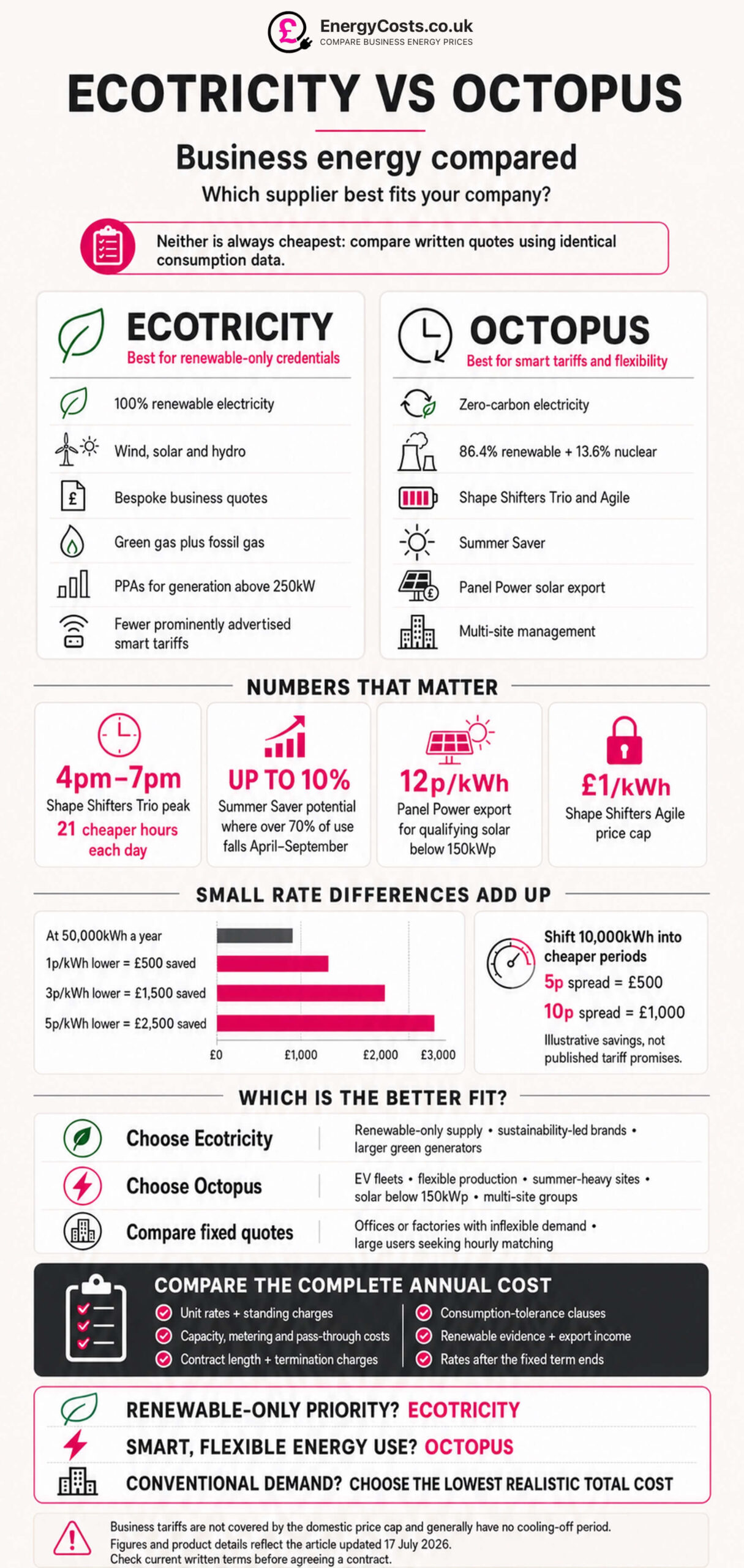
There is no universal answer to which supplier is cheaper. Standard business tariff prices are normally calculated individually according to your location, meter, consumption, credit profile and proposed contract term. The better choice therefore depends on both the quotes you receive and how your company uses energy.
Ecotricity vs Octopus at a glance
| Feature | Ecotricity Business | Octopus Energy for Business |
|---|---|---|
| Business electricity | Yes | Yes |
| Business gas | Yes | Yes |
| Electricity description | 100% renewable electricity | Zero-carbon electricity |
| Published electricity mix | Renewable sources including wind, solar and hydro | 86.4% renewable and 13.6% nuclear in 2024/25 |
| Standard fixed prices | Bespoke quotation | Bespoke quotation |
| Half-hourly products | Available for suitable commercial supplies | Extensive half-hourly and smart tariff options |
| Time-of-use tariff | Ask for available options | Shape Shifters Trio and Agile |
| Seasonal tariff | No equivalent prominently advertised | Summer Saver |
| Business solar export | PPAs available for qualifying larger generators | Panel Power and Shape Shifters: Export |
| Multi-site management | Available for commercial customers | Joint multi-site portfolio service |
| On-site generation | PPAs for generation above 250kW | Wind Works can fund, build and operate technology |
| Matched renewable supply | Bespoke renewable PPAs and hourly matching for some major customers | Electric Match traces electricity to green sources within half an hour |
| Published deemed rates | Detailed national PDF schedule | Online tools based on meter and location |
| Best suited to | Companies prioritising renewable-only credentials | Companies wanting smart tariffs and load flexibility |
Which supplier is likely to be cheaper?
Neither Ecotricity nor Octopus publishes one business unit rate that applies to every company. A quote can change according to:
- your electricity MPAN or gas MPRN;
- annual consumption;
- postcode and distribution region;
- meter type and profile class;
- half-hourly consumption pattern;
- agreed supply capacity;
- credit history;
- contract start date;
- one-, two- or three-year contract length;
- fixed, variable or pass-through pricing;
- payment method;
- whether several sites are combined; and
- current wholesale prices.
Octopus allows smaller businesses to request an online quote, while Ecotricity normally requires information about the site and its annual consumption. Quotes obtained on different days may reflect different wholesale prices, so comparisons should ideally be requested at approximately the same time.
The correct calculation is not simply:
Unit rate × annual consumption
A more complete comparison is:
- Annual consumption × unit rate
- standing charge × 365
- capacity and metering charges
- pass-through costs
- VAT and Climate Change Levy where applicable
− export income or other credits
A supplier with a lower unit price can still be more expensive if it has a substantially higher standing charge, capacity charge or additional pass-through costs.
How small tariff differences affect annual costs
The effect of a unit-rate difference grows rapidly as consumption increases.
| Annual electricity consumption | Saving from 1p/kWh reduction | Saving from 3p/kWh reduction | Saving from 5p/kWh reduction |
|---|---|---|---|
| 10,000kWh | £100 | £300 | £500 |
| 25,000kWh | £250 | £750 | £1,250 |
| 50,000kWh | £500 | £1,500 | £2,500 |
| 100,000kWh | £1,000 | £3,000 | £5,000 |
| 250,000kWh | £2,500 | £7,500 | £12,500 |
Standing charges are less significant for high-consumption sites but can make a material difference to small premises and businesses with several meters.
| Daily standing-charge difference | Annual difference per meter |
|---|---|
| 10p per day | £36.50 |
| 25p per day | £91.25 |
| 50p per day | £182.50 |
| £1 per day | £365 |
| £2 per day | £730 |
A business with ten separately metered sites would pay £3,650 more annually if its standing charge were £1 per meter per day higher.
Ecotricity business tariff pricing
Ecotricity offers quoted business electricity and gas contracts rather than a single publicly available fixed rate. The agreed Business Supply Agreement should identify the unit rate, standing charge, payment terms and any costs that will be passed through separately.
Its general business terms distinguish between a fully inclusive fixed price and arrangements under which some network, policy or metering costs can be charged separately. Companies should therefore confirm whether the quotation includes:
- distribution and transmission charges;
- balancing charges;
- capacity costs;
- meter operator and data collection fees;
- environmental levies;
- reactive power charges; and
- charges caused by exceeding agreed capacity.
Ecotricity deemed business electricity rates
Ecotricity publishes a detailed deemed-rate schedule for businesses that move into premises it already supplies without agreeing a new contract.
From 1 April 2026, its published non-half-hourly electricity schedule contains several categories. The rate applicable to a particular site depends on its distribution region and DUoS residual band.
| Published Ecotricity category | Unit rate | Standing-charge range |
|---|---|---|
| Domestic residual band | 23.80p–26.33p/kWh | 49.63p–75.82p per day |
| No Residual | 33p/kWh | 51.13p–77.87p per day |
| Band 1 | 35p/kWh | 51.13p–77.87p per day |
| Band 2 | 35p/kWh | 86.20p–135.96p per day |
| Band 3 | 35p/kWh | 152.21p–250.10p per day |
| Band 4 | 35p/kWh | 375.75p–645.99p per day |
These figures exclude VAT, Climate Change Levy, government-imposed taxes and any applicable support schemes. Additional capacity, excess-capacity, reactive-power, meter-maintenance and data-collection costs can also apply to half-hourly supplies.
The wide standing-charge range demonstrates why a company should identify its exact residual band rather than relying on a headline unit price.
For example, at 50,000kWh per year:
- 35p/kWh equates to £17,500 in annual consumption charges;
- a 60p daily standing charge adds £219;
- a 250p daily standing charge adds £912.50; and
- a 645.99p daily standing charge adds approximately £2,358.
These calculations exclude VAT, CCL and other charges.
Ecotricity deemed business gas rates
Ecotricity’s published deemed business gas price from 1 April 2026 is uniform across its listed regions:
| Charge | Published rate |
|---|---|
| Gas unit rate | 10p/kWh |
| Standing charge | 100p per day |
| Annual standing-charge cost | £365 |
A business using 100,000kWh of gas would therefore incur £10,000 in consumption charges plus £365 in standing charges before VAT, CCL and other applicable additions.
Deemed rates are variable and Ecotricity reserves the right to amend them in response to market conditions. A company moving into an Ecotricity-supplied property should contact the supplier promptly and either agree a contract or arrange a switch.
Octopus business tariff pricing
Octopus also provides location- and meter-specific quotes rather than one national business rate. It promotes direct applications as the route to its lowest available prices.
For conventional fixed contracts, businesses should compare the supply summary carefully. Octopus’s terms allow a business bill to contain several different elements, including:
- a wholesale unit price;
- non-wholesale unit charges;
- a daily standing charge;
- capacity charges;
- exceeded-capacity charges;
- advance payments; and
- security deposits.
Its published half-hourly out-of-contract rates vary according to distribution region, voltage level and usage band. Octopus states that these variable rates tend to be more expensive than its fixed rates because the supplier has less certainty over the future wholesale cost.
Non-half-hourly out-of-contract prices are provided through a postcode-based tariff lookup rather than a single national table. Businesses should therefore obtain the exact rate for their meter rather than using a domestic Octopus price as a guide.
Comparing renewable electricity
Both suppliers offer electricity with strong low-carbon credentials, but their definitions are different.
Ecotricity electricity
Ecotricity describes its electricity as 100% green and sourced from renewable generation, including:
- onshore and offshore wind;
- solar generation; and
- hydroelectric power.
It also emphasises using customer revenue to develop additional renewable generation. This makes Ecotricity particularly attractive to businesses that want to state that their purchased electricity is matched entirely with renewable sources rather than a combination of renewables and nuclear power.
Octopus electricity
Octopus describes its business electricity products as zero carbon. Its published fuel mix for 1 April 2024 to 31 March 2025 was:
| Source | Octopus electricity mix | UK average shown by Octopus |
|---|---|---|
| Renewables | 86.4% | 42.1% |
| Nuclear | 13.6% | 16.2% |
| Gas | 0% | 33.3% |
| Coal | 0% | 5.9% |
| Other | 0% | 2.5% |
| Reported carbon emissions | 0g/kWh | 154g/kWh |
Octopus’s electricity proposition is therefore zero carbon, but not exclusively renewable, because its disclosed mix includes nuclear generation.
Octopus also reports that its generation business manages approximately 4GW of renewable capacity across more than 240 projects in ten countries, with an asset value of about £6 billion. It purchases renewable electricity from more than 700 UK generators through power purchase agreements.
Comparing business gas
The environmental comparison is less straightforward for gas because gas burned on business premises creates direct Scope 1 emissions.
Ecotricity says its supply contains a mixture of sustainable green gas and fossil gas. It also invests in direct carbon-removal projects in Britain through the Carbon Bank.
A business considering Ecotricity should ask for the precise proportion of green gas associated with the proposed contract and the methodology used to address emissions from the remaining fossil gas. It should not assume that every physical unit delivered through the gas network is renewable.
Octopus supplies business gas, but its prominent zero-carbon claims focus principally on electricity. Businesses should check the supply summary for any specific renewable-gas, biomethane or carbon-offsetting commitment rather than assuming that standard business gas is carbon neutral.
For emissions reporting, businesses may also need to distinguish between:
- the physical fuel consumed;
- renewable-gas certificates;
- carbon removal or offsetting;
- location-based emissions; and
- market-based emissions.
Octopus Shape Shifters
Octopus has a clear advantage for businesses that can move consumption away from expensive periods.
Shape Shifters is a 12-month business electricity tariff available to qualifying customers with a working smart meter who pay by Direct Debit and are up to date with their bills.
There are two versions.
Shape Shifters Trio
Trio has three predetermined rates:
- a night rate;
- a day rate; and
- a peak rate.
The peak period is 4pm to 7pm, giving the business 21 hours of cheaper electricity each day. Rates remain consistent, so the business does not have to monitor wholesale prices continuously.
Trio may suit:
- workshops that can schedule machinery earlier in the day;
- offices with batteries or controllable heating;
- depots charging electric vehicles overnight;
- laundries and commercial kitchens with movable loads; and
- businesses that want time-of-use savings without half-hourly price volatility.
Shape Shifters Agile
Agile prices electricity in half-hourly periods according to wholesale market conditions. Prices for the following day are published in advance, allowing businesses to schedule consumption.
The unit rate is capped at £1 per kWh. That cap limits the maximum rate but remains considerably higher than normal fixed business prices, so companies need to understand their exposure during expensive periods.
Agile may suit businesses with:
- battery storage;
- automated energy-management systems;
- flexible production schedules;
- overnight electric vehicle charging;
- refrigeration or thermal storage; or
- staff able to respond to price signals.
It is less suitable for businesses that must consume large amounts of electricity at fixed peak times.
Potential time-shifting savings
Suppose a company consumes 50,000kWh per year and can move 20% of its consumption into cheaper periods. It would shift 10,000kWh.
| Difference between peak and cheaper rate | Illustrative annual saving |
|---|---|
| 3p/kWh | £300 |
| 5p/kWh | £500 |
| 10p/kWh | £1,000 |
| 15p/kWh | £1,500 |
These are mathematical examples rather than published Octopus savings. Actual results depend on the regional tariff, consumption pattern and market prices.
Octopus Summer Saver
Summer Saver is intended for highly seasonal businesses. Octopus says it could reduce annual bills by up to 10% where more than 70% of consumption occurs between April and September.
It has two rates:
- a lower summer price from April to September; and
- a higher winter price from October to March.
Potential users include:
- campsites;
- visitor attractions;
- coastal hospitality businesses;
- seasonal cafés and restaurants;
- outdoor leisure operators; and
- summer event venues.
A business must examine interval data rather than simply assuming it is summer-heavy. If less than 70% of annual consumption falls within the summer period, the higher winter rate may eliminate the expected saving.
Solar export and on-site generation
Octopus Panel Power
Panel Power pays qualifying businesses a flat 12p for each kWh exported.
Eligibility includes:
- solar capacity below 150kWp;
- a working smart meter or other export-compatible meter;
- no receipt of Feed-in Tariff export payments; and
- an Octopus business import supply.
At an export rate of 12p/kWh, estimated annual revenue would be:
| Electricity exported | Annual Panel Power income |
|---|---|
| 5,000kWh | £600 |
| 10,000kWh | £1,200 |
| 25,000kWh | £3,000 |
| 50,000kWh | £6,000 |
Octopus also offers Shape Shifters: Export. Its prices change every half hour with wholesale market conditions. It is designed primarily for businesses with batteries that can store electricity and export when prices are highest, which is often between 4pm and 7pm.
Ecotricity power purchase agreements
Ecotricity says businesses generating more than 250kW of green electricity on site can discuss a power purchase agreement. A PPA can provide a route to market for surplus generation and establish an agreed pricing structure.
This threshold makes the publicly promoted Ecotricity service more relevant to larger solar, wind or other renewable installations than to a small rooftop solar array.
For very large or complex generation projects, the business should compare:
- fixed versus market-linked export pricing;
- contract duration;
- balancing responsibilities;
- metering requirements;
- route-to-market charges;
- certificate ownership; and
- whether the buyer accepts all generation or only a nominated volume.
Options for larger companies
Both suppliers can support more complex commercial requirements.
Ecotricity for larger users
Ecotricity can structure renewable supply arrangements involving power purchase agreements and on-site generation. It has also announced major commercial arrangements combining PPAs with renewable electricity backed by hourly matching.
This can be valuable where a company wants stronger evidence that renewable production corresponds with consumption, rather than relying only on annual certificate matching.
Octopus Electric Match
Electric Match is designed to trace electricity supplied to a company back to green generation within half-hourly periods. This provides a more granular connection between consumption and renewable production than annual fuel-mix reporting.
It may be relevant to companies working towards:
- 24/7 carbon-free electricity;
- detailed Scope 2 reporting;
- science-based emissions targets;
- hourly matching commitments; or
- improved audit evidence for sustainability claims.
Octopus Wind Works
Wind Works allows Octopus to fund, build and operate renewable technology at a business site. The company then receives electricity directly from the installation, potentially at a lower long-term price.
A proposal of this kind should be assessed as an infrastructure agreement rather than an ordinary energy tariff. Important points include the contract length, roof or land rights, maintenance responsibilities, minimum purchase commitments, indexation and arrangements when the property is sold or leased.
Multi-site energy management
Octopus offers a joint portfolio service through which businesses can manage switching, renewals, billing and online account administration for several locations.
Centralised management can be particularly useful for:
- retail chains;
- hospitality groups;
- landlords;
- care providers;
- franchise networks;
- warehouse operators; and
- businesses acquiring or closing sites regularly.
Ecotricity can also supply multi-site and larger commercial customers, but a company should establish what consolidated billing, account reporting and consumption-data facilities will be included in its proposal.
Contract terms and early termination
Business energy contracts do not provide the same protections as domestic energy tariffs. In particular, business customers are not protected by the domestic energy price cap, and Ofgem warns that there is generally no cooling-off period after a business contract has been agreed.
The full contract should therefore be reviewed before acceptance.
Ecotricity terms
Ecotricity’s published general business terms state that a fixed contract may be subject to an early termination fee where the customer switches before expiry.
The stated customer-initiated calculation includes:
- a £100 administration fee; and
- a consumption-based amount linked to 25% of estimated annual consumption and the number of complete months remaining.
Where Ecotricity terminates because of specified contractual circumstances, its published formula refers to a £100 administration fee plus a larger consumption-based amount linked to 100% of estimated annual consumption.
The individual Business Supply Agreement should be checked because it determines the specific rates, estimated consumption and other contractual provisions.
Ecotricity’s terms also contain a volume-tolerance mechanism. Where actual consumption is more than 20% above or below estimated annual consumption, compensation may become payable under the contractual calculation.
This can matter for rapidly growing businesses, companies moving premises or organisations planning major energy-efficiency work.
Octopus terms
Octopus’s business terms state that the cancellation notice period will be specified in the Supply Summary.
Early termination costs can include reasonable losses incurred by Octopus, including losses associated with selling forward energy contracts purchased for delivery after the proposed termination date. The final charge may therefore be market-dependent rather than a simple fixed fee.
For half-hourly customers, Octopus also requires notification where a planned change is forecast to alter annual consumption or the expected consumption-profile ratio by more than 25%. Changes of this scale can result in revised charges or pass-through costs.
What happens at the end of the contract?
Both suppliers can move a business onto variable or deemed prices if no replacement contract or switch has been arranged.
Ecotricity’s published terms say it will contact microbusiness customers no later than 60 days before the fixed term expires. If no new agreement is completed, the company may move onto deemed out-of-contract rates.
Octopus says it will write to the customer before the contract end date. Unless the agreement is renewed or valid termination notice has been provided, the supply can move to its standard variable tariff under a deemed contract.
Businesses should begin reviewing options several months before expiry. Waiting until the final days can create administrative problems and expose the company to more expensive out-of-contract pricing.
Ecotricity advantages and disadvantages
Advantages
- Electricity is described as 100% renewable rather than a mixture of renewable and nuclear power.
- Strong environmental positioning for sustainability-led brands.
- Revenue is used to support new green energy generation.
- Green gas and direct carbon-removal activity form part of the wider proposition.
- PPA support is available for qualifying on-site generation above 250kW.
- Detailed deemed-rate schedules are published.
- Bespoke renewable and hourly-matched arrangements may be available for major users.
Disadvantages
- It does not advertise as broad a selection of business smart tariffs as Octopus.
- Public fixed business prices are not available without a quotation.
- Some deemed electricity categories carry high standing charges.
- Published early termination provisions can be financially significant.
- Consumption variance provisions need careful review.
- Its publicly promoted PPA threshold may be too high for smaller solar installations.
Octopus advantages and disadvantages
Advantages
- Broad selection of smart, half-hourly and time-of-use products.
- Shape Shifters can reward businesses that avoid the 4pm to 7pm peak.
- Agile provides exposure to low or occasionally negative wholesale pricing periods, although expensive periods remain possible.
- Summer Saver is tailored to highly seasonal companies.
- Panel Power offers a published 12p/kWh solar export rate.
- Dynamic export is available for businesses with battery storage.
- Multi-site portfolio management is available.
- Electric Match supports half-hourly traceability for larger users.
- Wind Works can provide funded on-site renewable generation.
- Octopus has a large renewable investment and PPA portfolio.
Disadvantages
- Its zero-carbon electricity mix is not renewable-only because it includes nuclear power.
- Standard business fixed rates require a personalised quote.
- Agile pricing introduces greater volatility and requires active management.
- Early termination costs may depend on wholesale-market losses rather than a simple published fee.
- Direct Debit and a working smart meter are required for Shape Shifters.
- A business unable to move consumption away from peak periods may gain little from time-of-use pricing.
Which supplier is best for different companies?
| Type of business | Likely better fit | Reason |
|---|---|---|
| Sustainability-led retailer | Ecotricity | Renewable-only electricity provides a straightforward environmental message |
| Office with little load flexibility | Compare fixed quotes | Standard annual cost is likely to matter more than smart tariff features |
| EV fleet or delivery depot | Octopus | Overnight charging and time-of-use tariffs can reduce charging costs |
| Factory with flexible production | Octopus | Half-hourly pricing can reward production outside peak periods |
| Factory with fixed daytime demand | Compare fixed quotes | Dynamic tariffs may provide limited benefit |
| Campsite or visitor attraction | Octopus | Summer Saver is designed for summer-heavy consumption |
| Business with rooftop solar below 150kWp | Octopus | Published 12p/kWh Panel Power export rate |
| Large on-site renewable generator | Compare both | Ecotricity offers PPAs above 250kW; Octopus offers dynamic export and generation services |
| Company seeking renewable-only supply | Ecotricity | Ecotricity’s disclosed electricity is entirely renewable |
| Company seeking zero-carbon supply with smart technology | Octopus | Wider smart tariff and energy-management ecosystem |
| Multi-site chain | Octopus | Dedicated joint portfolio service |
| Large company pursuing hourly matching | Compare both | Both can support more granular renewable matching arrangements |
Final verdict: Ecotricity vs Octopus for business energy
Ecotricity is likely to be the more natural choice for a business whose first priority is a clear renewable-only electricity proposition. Its long-standing focus on green generation, renewable PPAs and direct environmental investment can support a strong sustainability narrative.
Octopus is likely to be the better fit for a technologically flexible business. Its Shape Shifters tariffs, seasonal pricing, commercial export rates, multi-site service, Electric Match and Wind Works proposition provide more ways to manage when electricity is consumed, generated and exported.
Price cannot be decided from brand reputation alone. The cheapest supplier will depend on the individual quotes and the company’s consumption profile. A standard fixed Ecotricity quote could beat an Octopus quote for one meter and lose on another.
Before deciding, obtain written quotations from both suppliers using identical consumption data and compare:
- the projected annual cost;
- the unit and standing charges;
- whether prices are fully inclusive;
- capacity and metering charges;
- contract length;
- termination fees;
- consumption-tolerance clauses;
- renewable or zero-carbon evidence;
- export income;
- billing and account-management facilities; and
- the rate applied after the contract expires.
For most businesses, the best conclusion is:
- choose Ecotricity where renewable-only credentials and direct green investment outweigh the need for sophisticated smart products;
- choose Octopus where the business can use smart meters, batteries, electric vehicles, solar generation or flexible operating hours to reduce costs; and
- choose whichever fixed quotation produces the lowest realistic total annual cost where the company has a conventional, inflexible consumption pattern.
FAQ
Not necessarily. Both calculate business prices using the meter, postcode, consumption, credit risk and contract period. The only reliable comparison is to obtain written quotes at the same time and calculate the complete annual cost.
Ecotricity supplies electricity described as 100% renewable. Octopus reported a 2024/25 zero-carbon mix of 86.4% renewables and 13.6% nuclear. Ecotricity may therefore suit companies that specifically require renewable-only electricity.
Yes. Both supply business gas. Ecotricity says its gas combines sustainable green gas and fossil gas, supported by direct carbon-removal investment. Businesses should verify the environmental characteristics included in any gas quotation.
Octopus generally has the stronger business proposition for flexible electric vehicle charging because Shape Shifters rewards off-peak use. Actual savings depend on charging times and the difference between peak and off-peak rates.
Octopus offers Panel Power at 12p/kWh for qualifying systems below 150kWp. Ecotricity promotes PPAs for businesses generating more than 250kW. The better option therefore depends partly on installation size and whether the site has battery storage.
No. Business energy contracts are not protected by Ofgem’s domestic energy price cap. Fixed, variable, deemed and out-of-contract business prices are determined by the contract and supplier.
Possibly, but substantial termination costs may apply. Ecotricity publishes a fee structure containing an administration fee and consumption-based charge. Octopus may recover reasonable losses associated with unwinding forward energy purchases.
You will normally need the MPAN or MPRN, postcode, annual consumption, recent bills, meter type, contract end date and company details. Half-hourly businesses should also provide interval consumption data where possible.
Research notes
Ecotricity environmental claims: Ecotricity says it supplies 100% renewable electricity sourced from wind, solar and hydro. Its current gas description refers to a mixture of sustainable green gas and fossil gas, with investment in direct carbon removal through the Carbon Bank.
Octopus fuel mix and generation scale: Octopus reports that its electricity between April 2024 and March 2025 was 86.4% renewable and 13.6% nuclear, with reported emissions of 0g/kWh. It also reports approximately 4GW across more than 240 renewable projects and power purchase agreements with more than 700 UK generators.
Ecotricity deemed prices: The published schedule applies from 1 April 2026, excludes VAT, CCL and specified additional costs, and contains the electricity and gas figures used in the article.
Octopus business products: Octopus advertises multi-site management, Shape Shifters, commercial export, Electric Match and Wind Works. It says it promotes direct purchasing as the route to its lowest rates.
Shape Shifters: Trio provides 21 cheaper hours with a 4pm–7pm peak. Agile changes every half hour and is capped at £1/kWh. Both require a working smart meter, Direct Debit and a 12-month agreement.
Seasonal and export figures: Summer Saver advertises potential savings of up to 10% where more than 70% of consumption occurs from April to September. Panel Power currently advertises 12p/kWh for eligible commercial exports from systems below 150kWp.
Ecotricity generation services: Ecotricity says it can arrange a PPA where a business generates more than 250kW on site.
Contract provisions: Ecotricity’s published terms cover deemed rates, pass-through costs, consumption variance, early termination and renewal. Octopus’s terms cover pass-through components, Direct Debit, changes in half-hourly consumption profiles, termination losses and movement to variable pricing after expiry.
Business customer protections: Ofgem confirms that business contracts are not protected by the domestic price cap. It also advises that business agreements generally have no cooling-off period and should be obtained in writing before acceptance.
Business size definitions: Ofgem defines microbusiness and small-business categories using employee, financial and consumption thresholds. The small-business category has applied since December 2024 and extends Energy Ombudsman access to qualifying companies.