

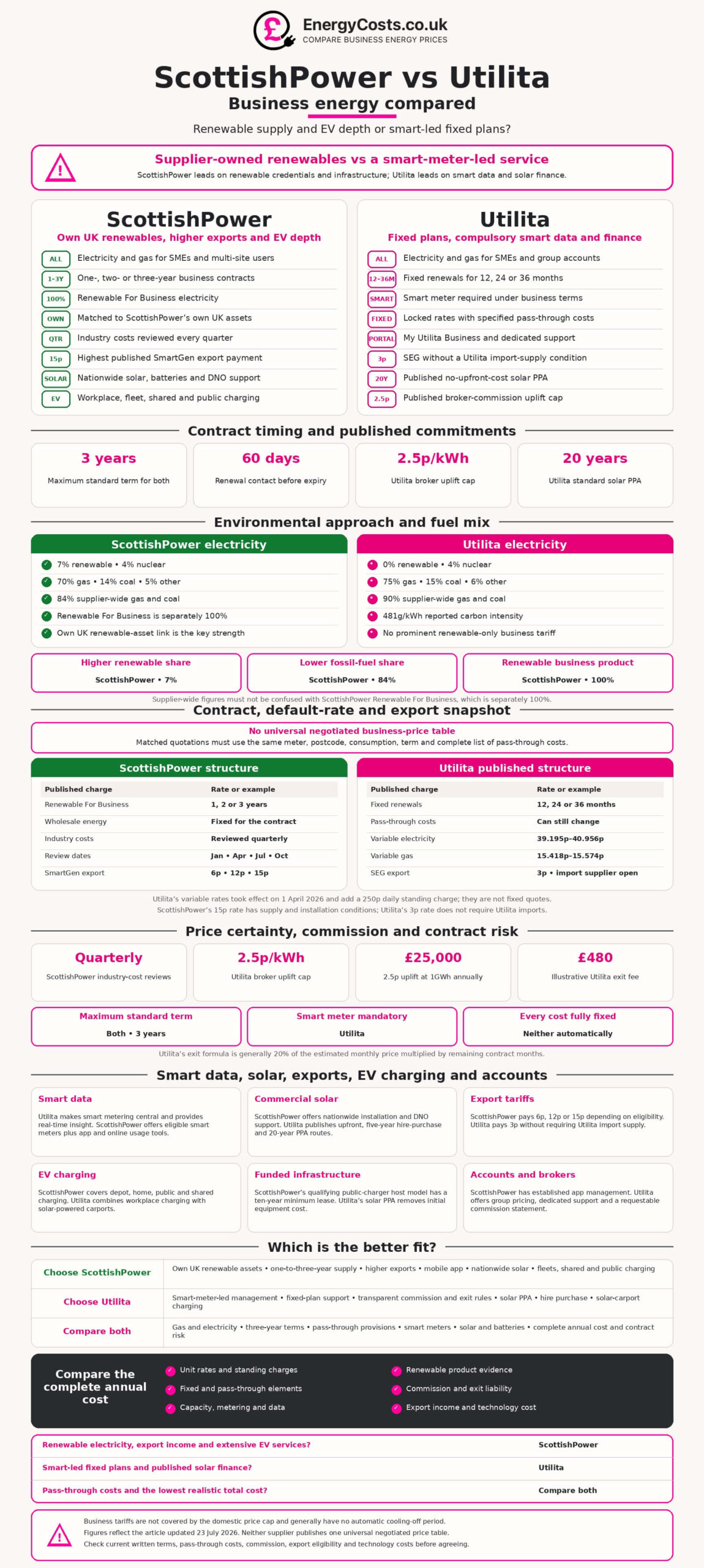
ScottishPower and Utilita both supply gas and electricity to UK businesses, but their services have different strengths.
ScottishPower’s current business electricity proposition is Renewable For Business. It offers one-, two- and three-year contracts, with wholesale energy costs fixed and network, environmental and other industry costs reviewed quarterly. Every unit of electricity is matched with renewable power generated from ScottishPower’s own UK renewable resources.
Utilita Business focuses on fixed-price energy plans, compulsory smart metering, real-time consumption information and dedicated account support. Its renewal service currently offers fixed terms of 12, 24 or 36 months. Charges are generally fixed apart from pass-through costs and specified contractual circumstances.
ScottishPower is likely to be the stronger choice where renewable-backed electricity, supplier-owned UK generation and a broad EV-charging service are priorities.
Utilita may suit companies that value smart-meter data, conventional fixed pricing, transparent broker-commission provisions and flexible funding for commercial solar installations.
Neither supplier is automatically cheaper. The result depends on matched quotations for the same meter, consumption, postcode and contract period.
ScottishPower vs Utilita at a glance
| Feature | ScottishPower Business | Utilita Business |
|---|---|---|
| Business electricity | Yes | Yes |
| Business gas | Yes | Yes |
| Fixed contract terms | One, two or three years | 12, 24 or 36 months |
| Wholesale energy fixed | Yes | Yes on fixed plans |
| Industry and pass-through costs | Reviewed quarterly | Certain costs can be passed through |
| Renewable business electricity | Renewable For Business | No prominent renewable-only supply tariff |
| Source of renewable backing | ScottishPower’s UK renewable assets | Not applicable to standard supply |
| Smart meter | Available | Required under business terms |
| Online account | Yes | Yes |
| Mobile app | Yes | My Utilita Business is primarily an online portal |
| Dedicated account support | Yes | Yes |
| Supplier-wide renewable share | 7% | 0% |
| Supplier-wide gas and coal share | 84% | 90% |
| Supplier-wide nuclear share | 4% | 4% |
| Reported carbon intensity | Not stated in the comparable summary | 481g CO₂/kWh |
| Standard SEG export rate | 6p/kWh | 3p/kWh |
| Higher export rates | Up to 15p/kWh | No enhanced rate currently advertised |
| Commercial solar | Yes | Yes |
| Solar PPA | Bespoke arrangements may be available | Published 20-year PPA option |
| Hire purchase for solar | Not prominently advertised | Five-year option |
| Business EV charging | Workplace, fleet, shared and public | Workplace, customer, fleet and solar-carport charging |
| Fully funded public chargers | Yes, for qualifying host sites | Not prominently advertised |
| Broker support | Yes | Yes |
| Published broker-commission cap | Not prominently stated | 2.5p/kWh |
| Best suited to | Renewable supply and extensive EV services | Fixed plans, smart data and financed solar |
The tariff and contract information reflects the products promoted by the suppliers in July 2026.
Which businesses can apply?
Both suppliers serve ordinary SMEs, including:
- shops;
- cafés;
- restaurants;
- offices;
- hotels;
- workshops;
- care providers;
- charities;
- landlords;
- warehouses; and
- small manufacturers.
ScottishPower’s quotation process covers business electricity and gas, including companies wanting solar panels, batteries or charging infrastructure. Utilita offers online quotations for individually tailored fixed-price plans and also supports group accounts and half-hourly supplies.
Eligibility and the quoted price can depend on:
- the type of meter;
- annual electricity or gas use;
- half-hourly demand;
- postcode;
- available electricity capacity;
- the number of locations;
- creditworthiness;
- payment history; and
- the proposed contract start date.
Example suitability by business type
| Example business | Annual electricity use | Potentially suitable option |
|---|---|---|
| Small shop | 12,000kWh | Fixed quotation from either supplier |
| Medium office | 50,000kWh | ScottishPower renewable tariff or Utilita fixed plan |
| Restaurant | 100,000kWh | Compare the complete quotations |
| Hotel | 400,000kWh | Bespoke or group arrangement |
| Multi-site retailer | 1GWh | Portfolio quotation from either supplier |
| Business prioritising renewable electricity | Any eligible level | ScottishPower |
| Business prioritising smart-meter visibility | Any eligible level | Utilita |
| Company installing rooftop solar | Site-dependent | Compare both installation proposals |
| Solar exporter | Generation-dependent | ScottishPower likely pays more |
| EV fleet operator | High site demand | ScottishPower fleet solution |
| Business wanting solar with no upfront payment | Suitable premises | Utilita solar PPA |
| Retail site wanting public chargers | Suitable car park | ScottishPower host scheme |
Which supplier is cheaper?
Neither ScottishPower nor Utilita publishes a single contracted rate applying to every UK business.
Commercial quotations normally depend on:
- the electricity MPAN or gas MPRN;
- distribution region;
- annual consumption;
- meter profile;
- half-hourly demand pattern;
- agreed electricity capacity;
- contract start date;
- contract length;
- payment method;
- company credit;
- broker involvement; and
- wholesale prices when the quote is prepared.
The expected annual cost should be calculated as:
- Annual consumption multiplied by the unit rate
- plus the daily standing charge multiplied by 365
- plus capacity, metering, network and policy costs
- plus VAT and Climate Change Levy where applicable
- minus export payments and other credits
A tariff with the lowest unit rate may not produce the lowest bill if it has higher standing charges or pass-through costs.
How unit-rate differences affect annual costs
| Annual consumption | Value of 0.5p/kWh | Value of 1p/kWh | Value of 3p/kWh | Value of 5p/kWh |
|---|---|---|---|---|
| 10,000kWh | £50 | £100 | £300 | £500 |
| 25,000kWh | £125 | £250 | £750 | £1,250 |
| 50,000kWh | £250 | £500 | £1,500 | £2,500 |
| 100,000kWh | £500 | £1,000 | £3,000 | £5,000 |
| 250,000kWh | £1,250 | £2,500 | £7,500 | £12,500 |
| 1GWh | £5,000 | £10,000 | £30,000 | £50,000 |
For a business using 1GWh annually, a difference of only 1p/kWh changes expenditure by £10,000.
How standing charges affect annual costs
| Daily standing-charge difference | Annual difference per meter | Difference across ten meters |
|---|---|---|
| 25p | £91.25 | £912.50 |
| 50p | £182.50 | £1,825 |
| £1 | £365 | £3,650 |
| £2 | £730 | £7,300 |
| £5 | £1,825 | £18,250 |
Standing charges are particularly important for seasonal businesses, landlords, vacant premises and companies operating numerous lightly used meters.
ScottishPower Renewable For Business
ScottishPower’s current electricity product is Renewable For Business.
Its main features are:
- one-, two- or three-year terms;
- fixed wholesale electricity costs;
- variable industry costs;
- quarterly cost reviews;
- renewable electricity matching;
- a choice of payment methods; and
- online and app-based account management.
ScottishPower states that every unit consumed under Renewable For Business is matched with renewable electricity generated from its own UK renewable resources and supported by Renewable Energy Guarantees of Origin.
This provides a more specific environmental proposition than merely buying unrelated certificates, because the matching is linked with ScottishPower’s renewable generation portfolio.
How ScottishPower’s pricing works
ScottishPower divides the tariff into two main elements.
Fixed energy costs
The wholesale energy portion is fixed for the agreed contract period.
This protects the company from increases in the wholesale price of electricity or gas during the term.
Variable industry costs
Network, social, environmental and other industry charges can move up or down.
ScottishPower reviews them quarterly, with changes taking effect on:
- 1 January;
- 1 April;
- 1 July; and
- 1 October.
The tariff therefore has a fixed contract term without guaranteeing that every part of the total unit rate and standing charge will remain unchanged.
Advantages of ScottishPower’s tariff structure
The tariff can provide:
- protection against wholesale-price increases;
- renewable electricity as the standard electricity proposition;
- one-, two- and three-year choices;
- a connection with supplier-owned UK renewable assets; and
- the possibility that variable industry charges could fall.
This structure may suit a business that accepts some variation in exchange for potentially avoiding the risk premium charged by a completely fixed tariff.
Disadvantages of ScottishPower’s tariff structure
Quarterly adjustments make exact long-term budgeting more difficult.
Before accepting the contract, the business should request:
- the fixed wholesale-energy component;
- the initial variable component;
- the standing charge;
- the full list of adjustable costs;
- the date of the next review; and
- examples of previous quarterly movements.
Utilita fixed-price business plans
Utilita promotes locked business energy rates intended to provide protection against unexpected price rises.
Its business proposition includes:
- individually tailored electricity and gas plans;
- fixed-price contracts;
- smart-meter installation;
- real-time usage information;
- accurate billing;
- dedicated business specialists;
- proactive account management; and
- online quotation and switching.
Utilita’s renewal page states that current fixed-term deals are available for:
- 12 months;
- 24 months; or
- 36 months.
Are Utilita’s rates completely fixed?
Not necessarily.
Utilita’s principal terms state that fixed-term charges remain unchanged except for pass-through costs and specified circumstances. Prices may also change because of legislation, regulation, VAT, incompatible metering or a material difference between actual and estimated consumption.
Utilita separately explains that Transmission Network Use of System charges may still affect businesses on fixed-price contracts because these can be regulated pass-through costs.
The written quote should therefore distinguish between:
- wholesale electricity or gas;
- supplier charges;
- network charges;
- policy costs;
- metering costs;
- capacity charges; and
- other pass-through items.
ScottishPower versus Utilita for price certainty
| Pricing feature | ScottishPower | Utilita |
|---|---|---|
| Wholesale energy fixed | Yes | Yes |
| Network and policy costs | Reviewed quarterly | Some can be passed through |
| Standard term options | One, two or three years | 12, 24 or 36 months |
| Exact complete bill fixed | No | Not necessarily |
| Published review frequency | Quarterly | Depends on the pass-through charge |
| Renewable electricity included | Yes on Renewable For Business | No equivalent standard product promoted |
| Smart-meter requirement | Not universal | Required |
| Best suited to | Renewable supply with transparent quarterly movements | Conventional fixed plan with smart monitoring |
Utilita may offer somewhat greater apparent price stability, but the difference depends on the pass-through provisions in the specific quotation.
ScottishPower is more explicit that industry costs are reviewed every three months.
Published Utilita variable rates
Utilita publishes regional Business Variable Rates for companies that do not have a fixed plan, move into premises it already supplies or remain with Utilita after a pricing agreement ends.
The rates effective from 1 April 2026 include:
| Supply | Published range |
|---|---|
| Unrestricted electricity | 39.195p–40.956p/kWh |
| Electricity standing charge | 250p per day |
| Two-rate electricity day rate | 40.543p–42.492p/kWh |
| Two-rate electricity night rate | 38.133p–39.344p/kWh |
| Gas unit rate | 15.418p–15.574p/kWh |
| Gas standing charge | 250p per day |
The precise rate depends on the electricity distribution region. These prices exclude VAT and are variable or deemed rates, not fixed-contract quotations.
Illustrative Utilita variable electricity costs
The following examples use the lowest and highest unrestricted regional rates and the published £2.50 daily charge.
| Annual electricity use | Lowest regional total | Highest regional total |
|---|---|---|
| 10,000kWh | £4,832.00 | £5,008.10 |
| 25,000kWh | £10,711.25 | £11,151.50 |
| 50,000kWh | £20,510.00 | £21,390.50 |
| 100,000kWh | £40,107.50 | £41,868.50 |
These figures exclude VAT, Climate Change Levy and any other applicable costs.
They illustrate the potential cost of remaining without a negotiated fixed agreement rather than the price Utilita would necessarily quote to a new customer.
Utilita half-hourly default rates
Utilita’s half-hourly deemed and out-of-contract schedule effective from 1 April 2026 publishes:
| Meter structure | Day or unit rate | Night rate | Standing charge |
|---|---|---|---|
| Unrestricted | 39.095p/kWh | Not applicable | £14.40 per day plus kVA charges |
| Day and night | 40.078p/kWh | 38.664p/kWh | £14.40 per day plus kVA charges |
Metering, data collection, data aggregation, reactive power, excess capacity, CCL and other industry charges can be added separately.
The £14.40 daily base charge alone equals £5,256 annually before capacity and consumption costs.
A half-hourly customer should therefore compare the full meter-specific annual model rather than looking only at the unit rate.
Can these rates identify the cheaper supplier?
No.
Utilita’s published figures apply to variable, deemed or out-of-contract customers.
ScottishPower does not currently present one directly comparable national table alongside its main contracted-tariff page. Instead, it publishes regional quarterly cost movements for different meter types.
A negotiated fixed quotation from either supplier may be substantially below the default rates.
Contract renewal
ScottishPower contacts fixed-term business customers about 60 days before the contract ends. Customers can discuss renewal prices and agree a replacement contract up to six months in advance.
Where no renewal or supplier switch is arranged, the business moves onto ScottishPower’s Standard Variable tariff, which ScottishPower says is normally more expensive than its contracted products.
Utilita also contacts customers 60 days before expiry. Its renewal service provides an account review, personalised pricing and options for 12-, 24- or 36-month fixed plans.
A customer that does not agree another contract can move onto Utilita’s business variable rates.
Smart meters
Smart metering is a much more central part of Utilita’s proposition.
Utilita smart meters
Utilita requires business energy customers to have a smart meter installed in accordance with its terms.
The meter can provide:
- automatic readings;
- fewer estimated bills;
- actual consumption information;
- real-time usage insight;
- improved budgeting; and
- data to support energy-efficiency decisions.
A smart meter does not reduce consumption by itself. Savings depend on the company using the information to change equipment schedules, heating, lighting or operating practices.
ScottishPower smart meters
ScottishPower also installs smart meters for eligible business customers.
Customers can use the online account or mobile app to:
- monitor energy use;
- enter meter readings where necessary;
- view bills;
- make payments; and
- manage account details.
Online account comparison
| Feature | ScottishPower | Utilita |
|---|---|---|
| View bills | Yes | Yes |
| Make payments | Yes | Yes |
| Submit meter readings | Yes | Yes |
| Automatic smart readings | Yes | Yes |
| View billed consumption | Yes | Yes |
| Real-time energy emphasis | Moderate | Strong |
| Mobile app | Yes | Business portal is the main service |
| Dedicated account manager | Available | Prominent part of proposition |
| Group-account pricing | Available through commercial service | Bespoke pricing offered |
| Smart meter mandatory | No general requirement stated | Yes |
My Utilita Business allows customers to view and pay bills, inspect payment history and review billed and estimated consumption.
ScottishPower has the advantage for businesses wanting established mobile-app management.
Utilita has the stronger smart-meter-led service model.
Comparing environmental credentials
The supplier-wide fuel mixes are substantially different.
ScottishPower fuel mix
ScottishPower’s total 2024/25 fuel mix was:
| Source | Proportion |
|---|---|
| Renewables | 7% |
| Natural gas | 70% |
| Coal | 14% |
| Nuclear | 4% |
| Other fuels | 5% |
Its other, non-green tariffs were reported as 3% renewable, 73% gas, 14% coal, 4% nuclear and 6% other.
These figures should not be confused with Renewable For Business, which is separately matched with 100% renewable electricity.
Utilita fuel mix
Utilita’s corresponding 2024/25 disclosure was:
| Source | Proportion |
|---|---|
| Renewables | 0% |
| Natural gas | 75% |
| Coal | 15% |
| Nuclear | 4% |
| Other fuels | 6% |
| Carbon emissions | 481g/kWh |
| Radioactive waste | 0.00028g/kWh |
The disclosure covers electricity purchased for supply by Utilita during the reporting period.
Which has the greener electricity?
| Environmental requirement | Stronger fit |
|---|---|
| Renewable-backed business tariff | ScottishPower |
| Renewable electricity from supplier-owned UK assets | ScottishPower |
| Higher supplier-wide renewable share | ScottishPower |
| Lower supplier-wide gas and coal share | ScottishPower |
| No renewable certificate requirement | Neither standard grid supply changes physical delivery |
| Smart-meter-led consumption reduction | Utilita |
| On-site solar installation | Compare both |
| Published carbon-intensity figure | Utilita publishes one, but it is high |
| Simple renewable business claim | ScottishPower |
ScottishPower is the clear winner for purchased electricity credentials.
Utilita’s current business proposition focuses on smart metering, energy efficiency, solar generation and reducing consumption rather than prominently marketing a standard renewable-only supply tariff. This is an inference from the products currently displayed on its business pages.
Business gas
Both suppliers provide conventional business gas.
Neither currently foregrounds a standard SME gas tariff under which all consumption is matched with certified UK biomethane.
A company wanting a lower-carbon gas product should ask:
- whether renewable-gas certificates are available;
- what percentage of consumption is matched;
- whether carbon offsets are used;
- which assurance standard applies;
- what additional premium is charged; and
- what reporting evidence is provided.
Gas burned at the premises creates direct Scope 1 emissions regardless of the supplier.
Commercial solar
Both suppliers provide end-to-end commercial solar services.
ScottishPower solar
ScottishPower’s business solar service includes:
- rooftop, car-park or outdoor-site assessments;
- preliminary proposals;
- site surveys;
- tailored designs;
- solar panels;
- battery storage;
- nationwide installation;
- Distribution Network Operator applications; and
- arrangements for selling excess electricity.
ScottishPower’s main advantage is the ability to combine:
- renewable electricity supply;
- solar installation;
- battery storage;
- export payments; and
- EV charging.
Utilita solar
Utilita offers:
- commercial solar panels;
- batteries;
- EV chargers;
- bespoke system design;
- installation;
- monitoring and support;
- upfront purchase;
- hire purchase; and
- Power Purchase Agreement funding.
Utilita advertises a typical solar PPA term of 20 years. It installs and maintains the equipment without an initial capital payment, while the business purchases the generated electricity at an agreed rate that is adjusted annually for inflation.
Its hire-purchase option normally spreads payments over five years, after which the customer owns the system.
Which is better for commercial solar?
| Solar requirement | Stronger fit |
|---|---|
| Nationwide turnkey installation | ScottishPower |
| Solar and battery package | Either |
| Published no-upfront-cost PPA | Utilita |
| Published hire-purchase option | Utilita |
| Full ownership from installation | Either |
| Solar linked with renewable import tariff | ScottishPower |
| Solar linked with highest export payment | ScottishPower |
| DNO application management | ScottishPower |
| Solar-powered EV canopy | Utilita |
| Long-term maintenance included | Utilita PPA |
| Standard export tariff without changing supplier | Compare eligibility |
Utilita has the clearer published financing menu.
ScottishPower has the stronger combination of renewable supply, installation and export rates.
Comparing export tariffs
ScottishPower SmartGen
ScottishPower’s current SEG range publishes:
| Tariff | Export payment | Principal condition |
|---|---|---|
| SmartGen | 6p/kWh | Eligible renewable generator |
| SmartGen Premium | 12p/kWh | ScottishPower electricity customer |
| SmartGen Premium Plus | 15p/kWh | ScottishPower customer with qualifying solar or battery installed by ScottishPower |
The rates and eligibility are subject to the current SEG terms.
Utilita SEG
Utilita pays:
3p per exported kWh
The company does not need to buy its imported electricity from Utilita.
Eligible technologies include:
- solar PV;
- wind;
- hydro;
- anaerobic digestion; and
- micro combined heat and power.
Generation can normally be up to 5MW, or 50kW for micro-CHP, and a meter capable of providing half-hourly export readings is required.
Export-income comparison
| Annual export | Utilita at 3p | ScottishPower at 6p | ScottishPower at 12p | ScottishPower at 15p |
|---|---|---|---|---|
| 5,000kWh | £150 | £300 | £600 | £750 |
| 10,000kWh | £300 | £600 | £1,200 | £1,500 |
| 25,000kWh | £750 | £1,500 | £3,000 | £3,750 |
| 50,000kWh | £1,500 | £3,000 | £6,000 | £7,500 |
| 100,000kWh | £3,000 | £6,000 | £12,000 | £15,000 |
ScottishPower offers the higher published export payments at every tier.
Utilita’s main advantage is that its 3p tariff does not require the company to purchase imported electricity from Utilita.
A business should compare import expenditure as well as export income. A higher export payment may not compensate for a significantly higher import contract where the company purchases much more electricity than it exports.
Electric vehicle charging
Both suppliers provide business charging, but ScottishPower currently offers the broader proposition.
ScottishPower EV charging
ScottishPower’s services include:
- fast chargers;
- rapid chargers;
- ultra-rapid chargers;
- workplace charging;
- fleet-depot charging;
- employee home chargers;
- public-network access;
- shared or communal charging;
- back-office charger management; and
- support with electricity capacity and DNO applications.
Its fleet service can combine depot, home and public charging.
ScottishPower also offers a fully funded public-charger host model for eligible sites. It leases the required land, pays for installation, owns and maintains the chargers and shares revenue with the site owner. The published minimum lease is ten years.
Utilita EV charging
Utilita provides tailored chargers for:
- employees;
- customers;
- visitors;
- car parks; and
- commercial fleets.
Its service can include payment solutions, revenue collection, maintenance, software updates and support. Utilita also installs overhead solar-powered charging stations and can integrate charging with its commercial solar packages.
Which is better for EV charging?
| EV requirement | Stronger fit |
|---|---|
| Basic workplace chargers | Either |
| Fast, rapid and ultra-rapid options | ScottishPower |
| Fleet-depot charging | ScottishPower |
| Employee home charging for fleet vehicles | ScottishPower |
| Public charging access | ScottishPower |
| Fully funded public charger hosting | ScottishPower |
| Shared residential or landlord charging | ScottishPower |
| Solar-powered carport charging | Utilita |
| Customer payment and revenue system | Either |
| Integrated solar and charger installation | Utilita has a clear package |
| DNO and capacity support | ScottishPower |
ScottishPower is likely to be the stronger choice for fleets and public charging.
Utilita may be attractive where chargers form part of a financed solar and battery installation.
Multi-site businesses
ScottishPower allows businesses to manage bills, readings and energy use through its app and online account. Its wider proposition can combine supply, renewable electricity, solar and charging infrastructure.
Utilita provides dedicated account support and bespoke group-account pricing. Its payment services can consolidate arrangements for multiple sites, while My Utilita Business provides online bill and consumption management.
ScottishPower may be stronger where the portfolio wants renewable-backed supply and low-carbon technology.
Utilita may suit a smaller group seeking fixed rates, smart meters and proactive account management.
Early termination
Utilita publishes a defined early termination calculation.
The fee is:
20% of the estimated monthly contract price multiplied by the number of months remaining after the applicable 30-day notice period
The estimated monthly price is based on one-twelfth of annual energy costs, including the standing charge.
For example, if:
- annual projected cost is £3,600;
- the monthly price is £300; and
- eight months remain;
the fee would be:
£300 × 20% × 8 = £480
ScottishPower’s termination rights and any applicable costs depend on the tariff and written contract. Its business terms use an earliest termination date, and customers should confirm the liability for leaving before that date.
Broker commission
Utilita explicitly allows a broker commission uplift to be included in the energy unit rate.
Its principal terms cap the uplift at:
2.5p/kWh
Customers may request a statement showing commission paid or due.
The potential cost is:
| Annual consumption | Cost of a 2.5p/kWh uplift |
|---|---|
| 10,000kWh | £250 |
| 25,000kWh | £625 |
| 50,000kWh | £1,250 |
| 100,000kWh | £2,500 |
| 250,000kWh | £6,250 |
| 1GWh | £25,000 |
ScottishPower also accepts business arranged through brokers, but its current public renewal information does not state an equivalent universal commission cap.
A business using any broker should request:
- the total commission;
- the pence-per-kWh uplift;
- the payment period;
- whether commission continues after renewal; and
- a direct-supplier quotation for comparison.
Business contract protections
Non-domestic energy contracts are not protected by the household energy price cap.
Ofgem also states that there is no cooling-off period after a business agrees an energy contract, including a contract accepted over the telephone.
Before accepting either supplier’s offer, check:
- all unit rates;
- standing charges;
- fixed and pass-through elements;
- quarterly review rules;
- meter requirements;
- contract start and end dates;
- electricity-capacity charges;
- broker commission;
- early termination fees;
- moving-premises provisions;
- renewable evidence;
- export eligibility;
- renewal procedure; and
- default rates after expiry.
ScottishPower advantages and disadvantages
Advantages
- Supplies electricity and gas to businesses.
- Offers one-, two- and three-year contracts.
- Wholesale energy costs are fixed.
- Renewable For Business is matched with 100% renewable electricity.
- Renewable backing comes from ScottishPower’s own UK assets.
- The supplier has a higher renewable share than Utilita.
- Provides online and app-based account management.
- Offers nationwide commercial solar installation.
- Solar batteries and DNO applications can be included.
- SEG rates reach 15p/kWh.
- Offers workplace, fleet, shared and public EV charging.
- Fast, rapid and ultra-rapid chargers are available.
- Qualifying businesses can host fully funded public chargers.
- Public-charger hosts can receive a share of charging revenue.
- Works with the Carbon Trust on business energy guidance.
Disadvantages
- Negotiated contract rates are not published.
- Network and policy costs are reviewed quarterly.
- Total contract costs are not fully fixed.
- The maximum standard contract term is three years.
- Supplier-wide electricity contained 70% gas and 14% coal.
- Its supplier-wide renewable share was only 7%.
- Renewable credentials depend on choosing Renewable For Business.
- The highest export rate has supply and installation conditions.
- No prominent business time-of-use tariff is advertised.
- No clear solar hire-purchase option is promoted.
- No prominent standard renewable business-gas tariff is offered.
Utilita advantages and disadvantages
Advantages
- Supplies gas and electricity to businesses.
- Fixed terms of 12, 24 and 36 months are available.
- Promotes locked rates and conventional budget planning.
- Smart meters are central to the service.
- Automatic readings reduce estimated billing.
- Real-time data can support energy-efficiency decisions.
- Dedicated business specialists and account managers are available.
- Provides bespoke group-account pricing.
- Publishes current variable and out-of-contract rates.
- Publishes its early termination formula.
- Caps broker commission uplifts at 2.5p/kWh.
- Customers can request a broker-commission statement.
- Offers turnkey commercial solar.
- Publishes PPA, hire-purchase and upfront funding options.
- Solar PPAs require no initial equipment investment.
- Provides workplace, customer and fleet EV charging.
- Solar-powered charging can be included.
- SEG does not require Utilita import supply.
Disadvantages
- Contracted unit rates are not published.
- Some network and pass-through costs can still change.
- A smart meter is required under the business terms.
- Supplier-wide electricity contained 75% gas and 15% coal.
- Its disclosed renewable share was 0%.
- Reported carbon intensity was 481g/kWh.
- No prominent renewable-only business tariff is advertised.
- The SEG payment is only 3p/kWh.
- No enhanced export tariff is currently promoted.
- No prominent business time-of-use tariff is offered.
- Broker commission can add as much as 2.5p/kWh.
- Fixed contracts have a consumption-based termination fee.
- A standard solar PPA typically lasts 20 years.
- Group customers may not receive the same digital features as a simple single-site account.
Which supplier is better for different businesses?
| Business or requirement | Likely stronger fit | Reason |
|---|---|---|
| Company wanting renewable electricity | ScottishPower | Renewable For Business |
| Business wanting supplier-owned renewable generation | ScottishPower | UK ScottishPower assets |
| Company prioritising fixed-rate simplicity | Utilita | Locked-plan proposition |
| Company wanting every cost fixed | Neither automatically | Check pass-through provisions |
| Business wanting real-time smart data | Utilita | Central part of the service |
| Company reluctant to install a smart meter | ScottishPower may suit | Utilita requires one |
| Business wanting mobile-app management | ScottishPower | Established business app access |
| Solar exporter seeking the highest rate | ScottishPower | Up to 15p/kWh |
| Exporter not changing import supplier | Utilita or ScottishPower standard SEG | Compare 3p with 6p |
| Business seeking a solar PPA | Utilita | Clear 20-year published option |
| Business wanting solar hire purchase | Utilita | Five-year route |
| Company seeking a turnkey solar package | Compare both | Different financing strengths |
| EV fleet operator | ScottishPower | Depot, home and public charging |
| Retailer hosting public chargers | ScottishPower | Fully funded host model |
| Business wanting solar-carport charging | Utilita | Integrated solution |
| Landlord needing shared charging | ScottishPower | Dedicated proposition |
| Business using an energy broker | Compare carefully | Utilita permits a stated uplift |
| Multi-site SME wanting account support | Utilita | Dedicated group pricing |
| Company prioritising environmental reporting | ScottishPower | Clear renewable product |
| Low-carbon technology project | Compare both | Strong but different propositions |
Final verdict: ScottishPower vs Utilita
ScottishPower and Utilita can both provide competitive business energy services, but their principal strengths are quite different.
ScottishPower is likely to be the better choice where the company wants:
- electricity matched with renewable generation;
- a direct link with supplier-owned UK renewable assets;
- a one-, two- or three-year contract;
- solar panels and batteries;
- higher export payments;
- workplace, fleet or shared charging;
- fast, rapid or ultra-rapid chargers; or
- a fully funded public-charging installation.
Utilita is likely to be stronger where the company wants:
- a conventional fixed-price plan;
- compulsory smart metering and real-time usage data;
- dedicated account management;
- transparent early termination calculations;
- published broker-commission limits;
- a solar installation with no upfront capital;
- five-year solar hire purchase; or
- solar-powered workplace and customer charging.
The environmental result clearly favours ScottishPower.
ScottishPower’s total 2024/25 fuel mix was:
- 7% renewable;
- 70% natural gas;
- 14% coal;
- 4% nuclear; and
- 5% other fuels.
Utilita’s mix was:
- 0% renewable;
- 75% natural gas;
- 15% coal;
- 4% nuclear; and
- 6% other fuels.
More importantly, ScottishPower’s Renewable For Business tariff matches every unit with electricity generated from its own UK renewable resources.
Utilita does not currently promote an equivalent renewable-only business supply tariff.
The price comparison is less straightforward.
ScottishPower fixes wholesale energy but reviews industry charges quarterly. Utilita locks most fixed-plan charges but retains pass-through provisions for certain network, legal and regulatory costs.
A fair comparison should require both suppliers to quote for:
- the same meter and postcode;
- identical annual consumption;
- the same contract start date;
- the same contract duration;
- all unit rates;
- all standing charges;
- fixed and pass-through elements;
- capacity, metering and data costs;
- broker commission;
- early termination liability;
- export income;
- renewable credentials;
- renewal and default rates; and
- the complete expected annual cost.
For most companies, the conclusion is:
- choose ScottishPower for renewable electricity, export income and extensive EV services;
- choose Utilita for smart-meter-led management, fixed-plan support and published solar-finance options;
- compare ScottishPower’s quarterly industry-cost adjustments with Utilita’s pass-through clauses;
- add any broker commission to Utilita’s projected cost before comparing;
- compare both import and export rates where solar panels are involved; and
- select the supplier producing the lowest complete annual cost rather than the lowest headline unit rate.
FAQ
It depends on the individual quotations. ScottishPower reviews industry costs quarterly, while Utilita fixed plans can still contain pass-through charges.
Yes. ScottishPower and Utilita both supply electricity to UK businesses.
Yes. Both offer commercial gas contracts.
Both currently offer terms of up to three years through their standard business services.
Renewable For Business matches every unit with renewable electricity generated from ScottishPower’s UK renewable resources.
No. Its total supplier fuel mix was 7% renewable. The 100% claim applies to its renewable tariffs.
Utilita does not currently prominently advertise a standard renewable-only business supply tariff.
ScottishPower. Its total mix had a higher renewable share and a lower combined gas-and-coal percentage.
Yes. Utilita states that its business energy customers are required to have a smart meter under its terms.
Yes. Eligible businesses can have smart meters and manage usage, bills and readings online or through the app.
ScottishPower. Its published rates range from 6p to 15p/kWh, while Utilita currently pays 3p/kWh.
Yes. A company does not have to purchase imported electricity from Utilita to use its SEG tariff.
Utilita has clearer published finance options. ScottishPower combines nationwide installation with stronger export payments.
ScottishPower. It offers depot, employee-home and public charging as one fleet proposition.
ScottishPower offers qualifying sites a funded host model under which it installs, owns and maintains the chargers.
Yes. Its terms cap the commission uplift at 2.5p/kWh and allow the customer to request a statement.
It is generally 20% of the estimated monthly contract price multiplied by the remaining contract months after the notice period.