
Shell Energy and E.ON both supply gas and electricity to UK businesses, but their products are aimed at somewhat different customers.
E.ON Next offers relatively straightforward one, two and three-year contracts to small and medium-sized businesses. It also provides smart meters, the E.ON Optimum consumption platform, commercial solar panels, battery storage and electric vehicle charging. Larger users can access sophisticated fixed and flexible procurement through npower Business Solutions, which forms part of the E.ON group.
Shell Energy supplies businesses ranging from small enterprises spending less than £50,000 a year to major industrial customers with multimillion-pound energy portfolios. Its offering includes fixed contracts, pass-through products, flexible wholesale purchasing, renewable gas and electricity, corporate power purchase agreements and integrated energy infrastructure.
For a typical SME, E.ON is likely to offer the more accessible all-round package. Its business proposition is simpler, its gas standing charge is considerably lower and its energy-monitoring, solar and electric vehicle services are clearly packaged for smaller organisations.
Shell Energy may be better for renewable procurement and complex commercial requirements. Its fixed electricity products include 100% renewable electricity, while larger customers can select flexible contracts lasting as long as five years and obtain renewable gas backed by Renewable Gas Guarantees of Origin.
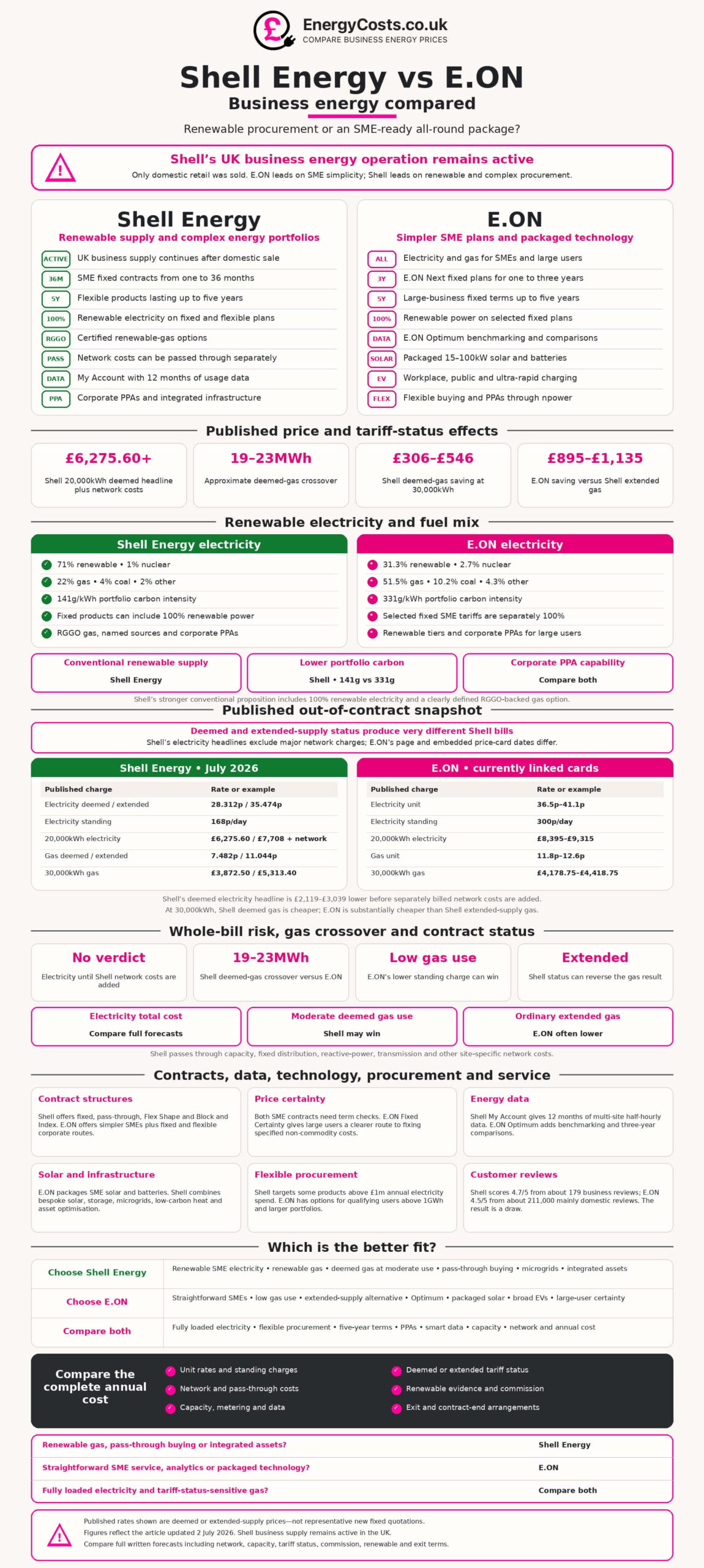
The price comparison is not straightforward. Shell’s published deemed electricity rates have lower headline unit and standing charges, but major network costs are passed through separately. Shell’s deemed gas rate can be cheaper for moderate and high consumption, whereas its extended-supply gas tariff is substantially more expensive than E.ON’s deemed rates.
Is Shell Energy still operating in the UK?
Shell Energy remains active as a UK business energy supplier.
Shell sold its UK domestic electricity and gas retail operation to Octopus Energy in December 2023. The transfer of domestic Shell Energy customers was completed in 2024, meaning households previously supplied by Shell now receive their energy from Octopus.
That sale did not close Shell’s commercial energy-supply operation. Shell Energy continues to supply electricity, gas and energy-management services to UK businesses, including small companies, multi-site organisations and major industrial users.
This distinction is important because online reviews or articles describing Shell Energy as closed often refer only to the former domestic retail business.
Shell Energy vs E.ON at a glance
| Comparison area | Shell Energy | E.ON |
|---|---|---|
| Business electricity | Yes | Yes |
| Business gas | Yes | Yes |
| Domestic energy supply | Sold to Octopus Energy | Yes |
| SME fixed contract lengths | One to 36 months | One, two or three years |
| Large-business fixed terms | Up to five years on selected products | Up to five years through npower Business Solutions |
| Renewable electricity | 100% renewable electricity available with fixed and flexible products | 100% renewable electricity on selected fixed tariffs |
| Renewable gas | RGGO-backed renewable gas available | Specialist low-carbon gas options through the wider group |
| Flexible purchasing | Yes | Yes, through npower Business Solutions |
| Corporate PPAs | Yes | Yes |
| Published deemed electricity rate | 28.312p per kWh | 36.5p to 41.1p per kWh |
| Published electricity standing charge | 168p per day | 300p per day |
| Electricity network costs | Significant charges passed through separately | Treatment depends on contract and meter |
| Published deemed gas rate | 7.482p to 7.680p per kWh | 11.8p to 12.6p per kWh |
| Published gas standing charge | 446p to 2,646p per day | 175p per day for SME deemed contracts |
| SME energy platform | Shell Energy My Account | E.ON Optimum |
| Commercial solar and batteries | Bespoke solar, storage and microgrid projects | Packaged solar and battery installations |
| Business EV charging | Available as part of integrated energy solutions | Chargers from workplace units to ultra-rapid equipment |
| Trustpilot rating | 4.7 out of 5 from around 179 reviews | 4.5 out of 5 from around 211,000 reviews |
| Best suited to | Renewable procurement and complex energy portfolios | Conventional SMEs and scalable energy services |
Shell defines small businesses broadly as organisations spending less than £50,000 a year on energy. Medium-sized organisations spend between £50,000 and £10 million, while major industrial and commercial customers can access Shell’s most sophisticated flexible products.
E.ON Next generally serves organisations using no more than 100,000 kWh of electricity or 293,000 kWh of gas annually. Larger users are directed to npower Business Solutions.
Which is cheaper: Shell Energy or E.ON?
Neither supplier publishes universal fixed-contract prices. A business quotation can depend on:
- Annual electricity and gas consumption
- Meter profile and settlement type
- Distribution region
- Number of premises
- Agreed electricity capacity
- Contract duration
- Contract start date
- Payment method
- Credit history
- Renewable-energy requirements
- Treatment of network and government charges
- Broker commission
The clearest public comparison uses deemed and variable prices. These rates normally apply when a business occupies premises without having agreed a formal supply contract.
Shell also publishes separate extended-supply rates. These can apply when a Shell fixed contract expires and the customer continues taking energy without arranging a replacement agreement.
This means a Shell customer’s out-of-contract price depends on why the site is not covered by a fixed agreement. Shell’s deemed and extended-supply tariffs differ substantially.
Shell Energy vs E.ON electricity prices
The latest Shell rates took effect on 1 July 2026. E.ON’s deemed-contract webpage also identifies its current documents as effective from 1 July 2026, although the SME price cards inside the E.ON documents are dated 10 April 2026. Businesses should confirm the rate applying to their account before making a financial decision.
Non-half-hourly electricity rates
| Supplier and tariff | Unit rate | Standing charge |
|---|---|---|
| Shell deemed electricity | 28.312p per kWh | 168p per day |
| Shell extended-supply electricity | 35.474p per kWh | 168p per day |
| E.ON deemed electricity | 36.5p to 41.1p per kWh | 300p per day |
On the headline figures, Shell appears considerably cheaper. However, Shell’s published electricity rates exclude several important network costs.
Shell passes through prevailing charges including:
- Distribution Use of System capacity charges
- Distribution fixed charges
- Reactive-power charges
- Transmission Network Use of System charges
- Other applicable meter or site-specific network costs
The Shell unit rate and standing charge therefore do not represent the complete electricity bill.
E.ON’s published SME price card does not present the same explicit network-cost exclusion beside its unrestricted unit rate. Nevertheless, businesses should still check the contractual treatment of taxes, regulatory costs, capacity charges and other third-party costs before comparing totals.
Example annual electricity cost
The following illustration assumes annual electricity consumption of 20,000 kWh through a standard unrestricted meter.
| Supplier and tariff | Unit-rate cost | Standing charge | Headline annual total |
|---|---|---|---|
| Shell deemed | £5,662.40 | £613.20 | £6,275.60 plus network pass-through costs |
| Shell extended supply | £7,094.80 | £613.20 | £7,708.00 plus network pass-through costs |
| E.ON – lowest-priced region | £7,300.00 | £1,095.00 | £8,395.00 |
| E.ON – highest-priced region | £8,220.00 | £1,095.00 | £9,315.00 |
Shell’s headline deemed total is £2,119 to £3,039 below E.ON’s published total before Shell’s separately billed network charges are added.
Shell’s extended-supply headline total is £687 to £1,607 below E.ON before those pass-through charges.
A business should not conclude that Shell is cheaper from this table alone. The fair comparison is a fully loaded annual quotation showing every pass-through, capacity, metering and network charge.
Electricity price winner
There is no definitive winner from the published electricity rates.
Shell has the lower unit rate and standing charge, but its separately passed-through network costs prevent a direct like-for-like comparison.
E.ON provides a more immediately understandable regional price schedule. Shell may still produce the lower total cost, particularly for sites with favourable network characteristics, but this can only be established from a complete annual forecast.
Shell Energy vs E.ON gas prices
Shell’s gas tariff structure differs significantly from E.ON’s.
| Supplier and tariff | Annual consumption | Unit rate | Standing charge |
|---|---|---|---|
| Shell deemed gas | 1–73,200 kWh | 7.482p per kWh | 446p per day |
| Shell deemed gas | 73,201–732,000 kWh | 7.680p per kWh | 1,586p per day |
| Shell deemed gas | More than 732,000 kWh | 7.571p per kWh | 2,646p per day |
| Shell extended supply | 1–73,200 kWh | 11.044p per kWh | 548p per day |
| Shell extended supply | 73,201–732,000 kWh | 11.242p per kWh | 1,688p per day |
| Shell extended supply | More than 732,000 kWh | 11.133p per kWh | 2,747p per day |
| E.ON deemed gas | Typical SME supply | 11.8p to 12.6p per kWh | 175p per day |
Shell’s deemed gas unit price is substantially below E.ON’s. However, Shell has a much higher standing charge.
For a small gas site, Shell charges 446p per day, compared with E.ON’s 175p. Shell’s daily charge rises sharply when annual consumption exceeds 73,200 kWh.
Example annual gas cost
The following example assumes annual gas consumption of 30,000 kWh.
| Supplier and tariff | Unit-rate cost | Standing charge | Estimated annual total |
|---|---|---|---|
| Shell deemed | £2,244.60 | £1,627.90 | £3,872.50 |
| Shell extended supply | £3,313.20 | £2,000.20 | £5,313.40 |
| E.ON – lowest regional rate | £3,540.00 | £638.75 | £4,178.75 |
| E.ON – highest regional rate | £3,780.00 | £638.75 | £4,418.75 |
At 30,000 kWh:
- Shell’s deemed gas tariff is approximately £306 to £546 cheaper than E.ON.
- E.ON is approximately £895 to £1,135 cheaper than Shell’s extended-supply tariff.
This illustrates why the customer’s contractual status matters. A new occupier on Shell’s deemed tariff may obtain a relatively competitive result, while an existing Shell customer moved onto extended-supply rates could pay substantially more.
Gas crossover point
Shell’s lower deemed gas unit rate begins to outweigh its higher standing charge at approximately 19,000 to 23,000 kWh of annual consumption, depending on the E.ON regional rate.
This means:
- E.ON can be cheaper for a very low-consumption gas site.
- Shell’s deemed tariff can become cheaper as consumption rises.
- E.ON is likely to be cheaper than Shell’s extended-supply tariff at ordinary SME consumption levels.
Gas price winner: dependent on tariff status
Shell has the stronger deemed unit rate, while E.ON has the much lower standing charge and is considerably cheaper than Shell’s extended-supply product in the example.
Half-hourly electricity comparison
Larger electricity customers are often settled half-hourly and face additional capacity, metering and data charges.
Shell’s published rates effective from 1 July 2026 are:
| Shell half-hourly tariff | Unit rate | Standing charge |
|---|---|---|
| Deemed | 27.919p per kWh | 217p per day |
| Extended supply | 35.081p per kWh | 217p per day |
Availability, capacity, reactive-power and other applicable network charges are passed through separately.
E.ON’s half-hourly deemed prices vary by distribution region, voltage, capacity and charging band. Its complete annual cost can include:
- Unit rates
- Daily standing charges
- Agreed capacity
- Excess-capacity charges
- Reactive-power charges
- Meter operator charges
- Data collection and aggregation
- Distribution charges
- Transmission charges
A half-hourly business should obtain a full annual forecast rather than comparing the headline unit rates alone.
Shell may look less expensive at unit-rate level, but the final result depends heavily on its passed-through network charges and the characteristics of the site.
Shell Energy contract options
Shell offers different products based on the size and complexity of the business.
Shell fixed-price contracts
Shell’s conventional fixed product is primarily aimed at businesses spending less than £50,000 a year on energy.
Features include:
- Contract terms from one to 36 months
- An all-inclusive quoted rate
- 100% renewable electricity
- Online account management
- Smart or advanced meter support
- Options for gas and electricity
Shell describes the price as agreed upfront, although its terms allow changes where laws, regulation or certain third-party charges alter beyond its reasonable control. Businesses should therefore review the pass-through and variation clauses rather than relying solely on the term “fixed”.
Shell pass-through contracts
Shell’s pass-through product is aimed mainly at half-hourly customers spending more than £50,000 annually.
The business can fix its commodity cost while allowing selected non-commodity charges to be billed at their prevailing rates. This can avoid the risk premium a supplier may add when guaranteeing uncertain industry charges.
Pass-through contracts can provide:
- Greater bill transparency
- Separate visibility of wholesale and industry costs
- Reduced supplier risk premiums
- Greater exposure to increases in network and policy charges
- Group billing and flexible payment arrangements for multi-site customers
This product is more suitable for organisations that understand non-commodity charges and can tolerate changes in their bills.
Shell flexible purchasing
Shell offers two principal flexible electricity structures for major customers.
Flex Shape is generally available for contracts lasting 12 to 36 months. It allows the supplier and customer to manage the shape of expected demand while giving the business access to wholesale purchasing opportunities.
Block and Index can last from 12 to 60 months. The customer purchases blocks of electricity in advance, while residual consumption is settled against an agreed market index.
Shell generally positions these products towards businesses spending more than £1 million annually on electricity. Both can include 100% renewable electricity.
E.ON contract options
E.ON Next SME contracts
E.ON Next offers small and medium-sized businesses fixed contracts lasting:
- One year
- Two years
- Three years
Selected fixed electricity tariffs include 100% renewable electricity. Customers also receive online account management and access to dedicated Energy Specialists.
E.ON’s standard SME proposition is less complex than Shell’s range. This can make it more accessible to shops, offices, hospitality businesses and smaller property portfolios that want predictable rates without actively managing wholesale purchases.
E.ON large-business contracts
Larger users can access npower Business Solutions.
Its fixed products include:
- Fixed Certainty
- Fixed Commodity
- Fixed Choice
- MultiPurchase
- Market Tracker
Fixed Certainty is designed to fix wholesale, network and environmental charges included in the contract. Fixed Commodity fixes the wholesale element while allowing specified third-party charges to pass through. MultiPurchase lets customers buy expected consumption in several transactions instead of fixing everything on one date.
Flexible products include:
- Flex Streamline
- Fast Flex
- Flex Innovate
- Renewable flexible contracts
- Portfolio management and market reporting
Some flexible products are aimed at organisations consuming more than 1 GWh annually, although suitability depends on the customer’s metering, portfolio and risk-management requirements.
Which provides better price certainty?
For a conventional SME, both suppliers offer fixed products, but the contract wording remains important.
Shell describes its standard fixed product as an all-inclusive price agreed upfront. However, its terms allow adjustments for certain legal, regulatory and third-party cost changes.
E.ON Next also offers fixed tariffs, but businesses should confirm which non-commodity charges are guaranteed. For larger customers, npower Business Solutions provides more explicit choices between fixing and passing through network and environmental charges.
Price-certainty winner: E.ON for larger organisations
E.ON’s Fixed Certainty structure provides a clearly defined route for major customers seeking protection from both wholesale and specified non-commodity cost changes.
For SMEs, the result depends on the exact Shell or E.ON contract rather than the supplier name alone.
Renewable electricity and gas
Shell renewable energy
Shell’s fixed and flexible electricity products can include electricity matched with 100% renewable generation through Renewable Energy Guarantees of Origin.
Businesses can also request supplies linked to particular generation technologies, projects or locations. Shell additionally provides renewable gas supported by Renewable Gas Guarantees of Origin and can develop corporate power purchase agreements for larger organisations.
Shell’s disclosed electricity fuel mix for April 2024 to March 2025 was:
| Energy source | Shell Energy fuel mix |
|---|---|
| Renewables | 71% |
| Natural gas | 22% |
| Coal | 4% |
| Other fuels | 2% |
| Nuclear | 1% |
Shell reported carbon intensity of 141 grams of carbon dioxide per kWh across its overall disclosed supply portfolio. Dedicated renewable products are separately evidenced using renewable certificates.
E.ON renewable energy
E.ON Next offers 100% renewable electricity on selected fixed business tariffs rather than every standard contract.
For larger users, npower Business Solutions offers:
- UK Business Renewable
- UK Renewable Pure
- UK Renewable Pure Plus
- Corporate power purchase agreements
- Renewable fixed and flexible contracts
UK Renewable Pure is sourced from wind, solar and hydro generation. Pure Plus offers greater traceability by matching the customer’s consumption with known UK generation partners. Corporate PPAs are generally designed for substantial half-hourly users and can connect an organisation contractually with a specific renewable project.
E.ON’s overall disclosed electricity mix for April 2024 to March 2025 was:
| Energy source | E.ON fuel mix |
|---|---|
| Natural gas | 51.5% |
| Renewables | 31.3% |
| Coal | 10.2% |
| Other fuels | 4.3% |
| Nuclear | 2.7% |
E.ON reported portfolio carbon intensity of 331 grams of carbon dioxide per kWh. The figures include customers on both conventional and dedicated renewable products.
Renewable-energy winner
Shell has the advantage for conventional renewable business supply.
Its fixed electricity proposition includes 100% renewable electricity, its overall disclosed fuel mix contains a higher renewable share and it offers a clearly defined RGGO-backed renewable gas option.
For complex corporate PPAs, the comparison is closer. Both suppliers provide traceable renewable procurement structures for major energy users.
Smart meters and energy monitoring
Shell smart meters and My Account
Shell provides smart and advanced meters to eligible businesses without a separate installation charge.
From October 2024, customers with compatible meters have been able to access their half-hourly consumption data through Shell Energy My Account. The service provides:
- Up to 12 months of consumption data
- Downloadable usage information
- Automatic meter readings
- Reduced reliance on estimated bills
- Analysis across several premises
- Visibility of consumption patterns
This can help businesses identify overnight baseload, unusual peaks and differences between sites.
E.ON smart meters and Optimum
E.ON also installs eligible business smart meters without a separate installation charge. It reports having installed more than 160,000 smart meters for business customers.
E.ON Optimum is available without an additional subscription charge to eligible SME customers. It provides:
- Half-hourly consumption information
- Up to 12 months of downloadable data
- Year-on-year comparisons covering up to three years
- Benchmarking against comparable properties
- Energy-efficiency and sustainability guidance
- Remote access to gas and electricity information
The benchmarking and longer-term comparison functions make Optimum particularly useful for SMEs that want an accessible energy-management tool without purchasing specialist software.
Energy-monitoring winner: E.ON by a narrow margin
Both suppliers provide free consumption data to eligible customers. E.ON Optimum adds structured benchmarking and longer-term year-on-year comparisons, while Shell’s platform is well suited to downloading and analysing multi-site half-hourly data.
Commercial solar, batteries and energy infrastructure
E.ON has a clearly packaged solar and battery proposition for small and medium-sized businesses.
Its systems typically range from 15 kW to 100 kW, although larger installations can be developed. Services include:
- Solar-panel installation
- Battery storage
- Structural roof assessments
- Distribution Network Operator applications
- Three-dimensional system design
- Return-on-investment forecasts
- Monitoring software
- Multi-site designs
E.ON also provides workplace and public electric vehicle chargers, ranging from wall-mounted units to ultra-rapid equipment.
Shell takes a more integrated and bespoke approach. Its energy solutions can include:
- On-site solar generation
- Battery storage
- Microgrids
- Low-carbon heating
- Electric vehicle infrastructure
- Flexible generation
- Battery optimisation
- Trading and route-to-market services
This broader proposition is more likely to appeal to industrial facilities, large property portfolios, logistics businesses and organisations seeking to coordinate several energy assets.
Packaged SME solar winner: E.ON
Integrated industrial energy winner: Shell
Customer service comparison
Shell separates support according to annual energy expenditure.
Businesses spending less than £50,000 can obtain quotations and manage their accounts through Shell’s small-business channels. Larger organisations are directed to specialist commercial teams and account managers. Shell also promotes support from UK-based energy specialists.
E.ON’s business telephone service operates:
- 9am to 5pm Monday to Thursday
- 9am to 4pm on Friday
Customers can also use email, WhatsApp and online account services. Emergency support remains available outside ordinary contact-centre hours.
Both suppliers operate formal complaint procedures. Eligible microbusinesses and small-business customers may refer unresolved complaints to the Energy Ombudsman once the applicable eight-week or deadlock requirements have been met.
Trustpilot ratings
| Supplier profile | TrustScore | Number of reviews |
|---|---|---|
| Shell Energy UK business | 4.7 out of 5 | Approximately 179 |
| E.ON Next | 4.5 out of 5 | Approximately 211,000 |
Shell has the higher score and its profile relates directly to business energy. However, the sample is very small, so a modest number of reviews can significantly alter the rating. Shell uses a paid Trustpilot profile and invites reviews.
E.ON’s score is based on a vastly larger sample but covers its wider customer base, which is dominated by domestic energy users. E.ON also invites reviews and reportedly responds to most negative submissions.
Review winner: Draw
Shell has the more relevant business-only profile, while E.ON has the much stronger sample size. Neither score provides a perfect measure of the service a particular business account will receive.
Shell Energy advantages and disadvantages
Advantages of Shell Energy
- UK business supply operation remains active
- Fixed SME contracts lasting up to 36 months
- Flexible products lasting up to five years
- 100% renewable electricity available
- Renewable gas backed by RGGOs
- Corporate power purchase agreements
- Lower published deemed electricity headline rates
- Competitive deemed gas unit rates
- Pass-through products for greater cost transparency
- Multi-site and group-billing support
- Half-hourly consumption data through My Account
- Integrated solar, battery and microgrid projects
- Strong business-specific Trustpilot score
- High renewable share across its disclosed fuel mix
Disadvantages of Shell Energy
- Domestic business was sold, which can cause brand confusion
- Electricity network charges are passed through separately
- Headline electricity rates cannot be compared directly with all-inclusive quotations
- Gas standing charges are high
- Gas standing charges increase sharply with consumption
- Extended-supply prices are considerably higher than deemed rates
- Only a small number of Trustpilot reviews
- Flexible purchasing products may be unnecessarily complex for an SME
- Some fixed prices can still change following specified regulatory or third-party cost changes
E.ON advantages and disadvantages
Advantages of E.ON
- Straightforward one, two and three-year SME contracts
- Lower published SME gas standing charge
- Dedicated Energy Specialists
- E.ON Optimum consumption platform
- Benchmarking and three-year usage comparisons
- Smart-meter installation for eligible businesses
- Packaged commercial solar and battery systems
- Extensive electric vehicle charging range
- Selected tariffs include 100% renewable electricity
- Large-business contracts lasting up to five years
- Fixed, multi-purchase and flexible procurement options
- Corporate PPAs through npower Business Solutions
- Very large public review sample
- Clear progression from SME to corporate services
Disadvantages of E.ON
- Higher published electricity unit and standing charges
- Higher deemed gas unit rates
- Renewable electricity is included only on selected SME tariffs
- Overall disclosed fuel mix has a lower renewable share than Shell’s
- Large-business services use the separate npower Business Solutions brand
- Flexible and non-commodity structures can become complicated
- Trustpilot profile is primarily based on domestic customers
- The date inside E.ON’s current price cards differs from the effective date stated on its webpage
Which supplier is best for different businesses?
| Business requirement | Better choice | Reason |
|---|---|---|
| Small office or shop | E.ON | Simpler contract and lower gas standing charge |
| Business comparing headline deemed electricity rates | Shell | Lower unit rate and standing charge |
| Business requiring a fully loaded electricity comparison | Compare quotations | Shell passes network costs through separately |
| Low-consumption gas site | E.ON | Lower standing charge |
| Moderate or high deemed gas consumption | Shell | Lower deemed unit rate can offset the standing charge |
| Existing Shell customer out of contract | E.ON may be cheaper | Shell extended-supply rates are substantially higher |
| Renewable SME electricity | Shell | Renewable electricity included with its fixed proposition |
| Renewable gas | Shell | RGGO-backed products available |
| SME energy analytics | E.ON | Optimum includes benchmarking and longer-term comparisons |
| Multi-site half-hourly data | Compare both | Both provide downloadable consumption information |
| Commercial rooftop solar | E.ON | More clearly packaged SME proposition |
| Integrated microgrid or industrial project | Shell | Wider bespoke energy-infrastructure capabilities |
| Flexible wholesale purchasing | Compare both | Both offer sophisticated products |
| Five-year contract | Either | Available through Shell and npower Business Solutions |
| Corporate PPA | Compare both | Both support long-term renewable procurement |
| Maximum large-business price certainty | E.ON | Fixed Certainty covers specified network and environmental costs |
| Business-specific public reviews | Shell | Dedicated commercial profile, but with a small sample |
Final verdict: Shell Energy vs E.ON
E.ON is the better all-round supplier for a typical small or medium-sized business.
Its one, two and three-year contracts are relatively straightforward, its gas standing charge is substantially lower and E.ON Optimum provides accessible consumption analysis. E.ON also has a clearly structured commercial solar, battery and electric vehicle proposition.
The route into npower Business Solutions gives growing organisations access to longer contracts, flexible purchasing, renewable products and corporate PPAs without moving outside the wider E.ON group.
Shell Energy is particularly strong for renewable energy and complex procurement.
Its fixed electricity products include 100% renewable electricity, while renewable gas, pass-through contracts, flexible purchasing and integrated energy infrastructure make it a credible option for major industrial and multi-site customers.
The published price comparison produces a mixed result:
- Shell has much lower headline deemed electricity rates, but separately passes through important network charges.
- Shell’s deemed gas tariff can be cheaper at moderate and high consumption.
- E.ON can be cheaper for low-consumption gas sites because of its lower standing charge.
- E.ON is substantially cheaper than Shell’s extended-supply gas tariff in the 30,000 kWh example.
- A fully loaded annual electricity forecast is essential before declaring either supplier cheaper.
For a conventional SME, E.ON offers the more balanced combination of simplicity, technology and supporting services.
For a business prioritising renewable gas, 100% renewable fixed electricity, flexible purchasing or an integrated industrial energy strategy, Shell Energy may be the stronger choice.
FAQ
Yes. Shell sold its UK domestic retail operation to Octopus Energy, but Shell Energy continues to supply gas, electricity and energy services to UK business customers.
Shell publishes lower headline deemed electricity rates, but separately passes through major network charges. Its deemed gas tariff can be cheaper at higher consumption, while E.ON can be cheaper for low-use sites and customers comparing against Shell’s extended-supply rates.
Shell’s deemed rate is 28.312p per kWh with a 168p daily standing charge. E.ON publishes 36.5p to 41.1p with a 300p charge. Shell’s total also includes separately passed-through network costs.
Shell’s deemed gas unit rate is lower, but its standing charge is higher. At 30,000 kWh, Shell’s deemed tariff is cheaper in the example. E.ON is cheaper than Shell’s extended-supply tariff.
Extended supply can apply when a Shell fixed contract expires without a replacement being agreed. Shell’s extended-supply rates are higher than its deemed prices and should not be confused with a new-occupier deemed tariff.
Yes. Shell offers fixed contracts lasting up to 36 months for smaller businesses. E.ON Next offers one, two and three-year SME contracts. Both provide contracts lasting up to five years for eligible larger users.
Shell has the stronger standard renewable proposition because its fixed business electricity products include 100% renewable electricity. E.ON provides 100% renewable power on selected SME tariffs and several specialist large-business products.
Yes. Shell offers renewable gas supported by Renewable Gas Guarantees of Origin. It can also provide bespoke renewable procurement and corporate power purchase agreements.
Yes. Both provide smart or advanced meters to eligible businesses without a separate installation charge. Each supplier also gives compatible customers access to half-hourly consumption information.
E.ON has a narrow advantage for SMEs. E.ON Optimum provides benchmarking and up to three years of comparisons. Shell My Account provides downloadable half-hourly information and multi-site visibility.
Yes. E.ON provides packaged commercial solar and battery installations. Shell offers bespoke solar, batteries, microgrids and integrated energy assets, primarily for larger or more complex projects.
Both are credible. Shell is strong in renewable gas, pass-through pricing and integrated energy infrastructure. E.ON, through npower Business Solutions, offers fixed certainty, MultiPurchase, flexible procurement and several renewable traceability options.
Shell’s business profile has a higher score of 4.7, but only around 179 reviews. E.ON has a 4.5 score from approximately 211,000 reviews, although most relate to domestic customers.
Choose E.ON for straightforward SME contracts, a lower gas standing charge, energy analytics, solar panels or EV charging. Consider Shell for renewable electricity and gas, flexible purchasing, pass-through contracts or complex industrial energy projects.