

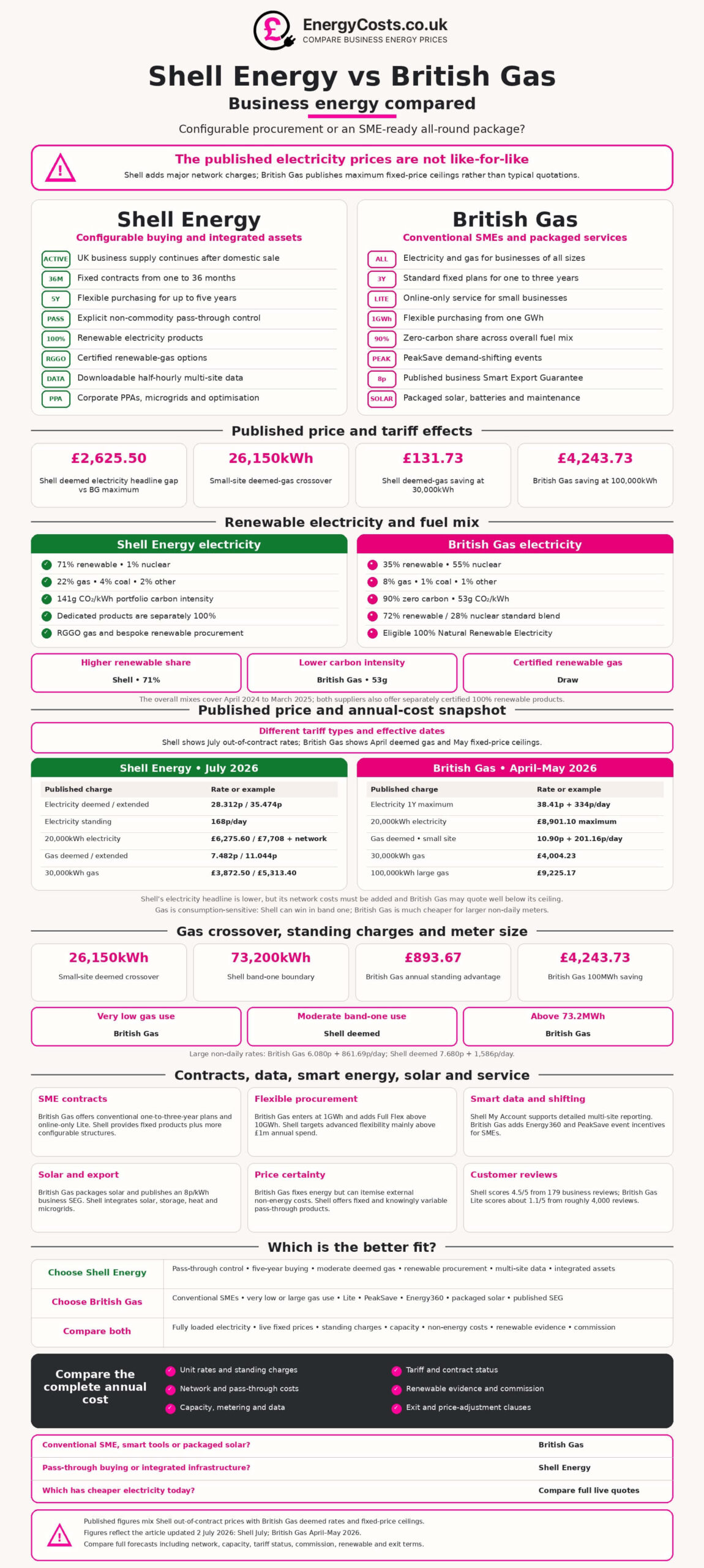
Shell Energy and British Gas both supply gas and electricity to UK businesses, but their strongest products serve different types of customer.
British Gas is likely to be the more accessible all-round choice for a conventional small or medium-sized business. It offers standard fixed plans, the online-only British Gas Lite service, smart meters, Energy360 consumption analysis, PeakSave events, commercial solar panels and a business Smart Export Guarantee.
Shell Energy has the stronger proposition for organisations wanting configurable pass-through pricing, renewable gas, long-term flexible purchasing or integrated energy infrastructure. Its services include fixed contracts, pass-through products, wholesale-market purchasing, renewable electricity and gas, solar, batteries, microgrids and low-carbon heat.
The published price comparison is mixed:
- Shell has lower headline deemed electricity rates, but important network charges are added separately.
- Shell’s small-site deemed gas tariff is marginally cheaper at around 30,000 kWh.
- British Gas has the lower gas standing charge and becomes markedly cheaper for larger non-daily-meter customers.
- British Gas publishes maximum fixed-contract prices for microbusinesses, but these are price ceilings rather than representative quotations.
Shell Energy vs British Gas at a glance
| Comparison area | Shell Energy | British Gas |
|---|---|---|
| Business electricity | Yes | Yes |
| Business gas | Yes | Yes |
| Standard fixed terms | One to 36 months | Normally one, two or three years |
| Other published fixed terms | Bespoke arrangements | Four-year microbusiness price caps also published |
| Online-only SME service | No separate sub-brand | British Gas Lite |
| Rolling contract | Extended supply and other variable arrangements | 30-day rolling and Variable Price Plans |
| Pass-through pricing | Yes, for eligible larger users | Non-energy costs can be itemised; tailored products available |
| Flexible purchasing | For businesses typically spending over £1 million annually | From 1 GWh through Flex Advantage |
| 100% renewable electricity | Available | Natural Renewable Electricity available |
| Standard fixed electricity | Renewable options available | Zero-carbon electricity as standard |
| Renewable gas | Available through certified green-gas products | 100% RGGO-backed Renewable Gas available |
| Current deemed electricity rate | 28.312p per kWh | Separate official deemed schedule |
| Shell electricity standing charge | 168p per day | Varies by tariff and meter |
| Current small-site deemed gas | 7.482p per kWh and 446p per day | 10.90p per kWh and 201.16p per day |
| Smart-meter platform | Shell Energy My Account | Energy360 DataView |
| Demand-shifting product | Flexible products for large users | PeakSave for Business |
| Commercial solar | Bespoke integrated energy projects | Packaged commercial solar through Centrica partners |
| Solar export tariff | Bespoke arrangements | Business Smart Export Guarantee |
| Business-specific Trustpilot profile | 4.5 from 179 reviews | British Gas Lite: 1.1 from around 4,000 reviews |
| Best suited to | Complex procurement and infrastructure | Conventional SMEs and packaged energy services |
British Gas markets fixed SME contracts lasting one, two or three years, although its current maximum-pricing page also publishes four-year microbusiness caps. Shell offers fixed, pass-through and flexible arrangements, with its most advanced purchasing products intended mainly for substantial electricity users.
Does Shell Energy still supply businesses?
Yes. Shell Energy continues to supply gas, electricity and low-carbon energy services to British businesses.
Shell sold its former UK household retail operation, but the commercial energy business remains active. Its present offering includes fixed and pass-through supply, flexible purchasing, renewable energy and integrated on-site solutions.
This means references to Shell Energy leaving the UK retail market generally concern household supply, not Shell Energy UK’s business operation.
Which is cheaper: Shell Energy or British Gas?
Neither supplier publishes one fixed rate that applies to every business.
A quotation can vary according to:
- Annual consumption
- Meter type and profile
- Electricity distribution region
- Contract duration
- Contract start date
- Credit history
- Payment method
- Number of premises
- Agreed electricity capacity
- Renewable-energy requirements
- Broker commission
- Treatment of network and policy costs
The available public rates also cover different types of contract.
Shell publishes current deemed and extended-supply rates. British Gas publishes deemed schedules as well as maximum prices that microbusiness customers may be charged when signing or renewing a fixed contract.
A maximum fixed price is not the same as a deemed rate. It is also not necessarily the price that British Gas will quote: eligible businesses may receive considerably lower bespoke rates.
Shell Energy vs British Gas electricity prices
Shell’s current deemed and extended-supply electricity rates took effect on 1 July 2026.
| Shell tariff | Unit rate | Standing charge |
|---|---|---|
| Deemed non-half-hourly electricity | 28.312p per kWh | 168p per day |
| Extended-supply non-half-hourly electricity | 35.474p per kWh | 168p per day |
| Deemed half-hourly electricity | 27.919p per kWh | 217p per day |
| Extended-supply half-hourly electricity | 35.081p per kWh | 217p per day |
Shell deemed rates normally apply when a business moves into premises supplied by Shell without agreeing a contract. Extended supply applies when an existing fixed contract ends and the business remains with Shell without completing a renewal.
Shell’s additional network charges
Shell’s headline electricity prices exclude:
- Distribution Use of System capacity charges
- Distribution fixed charges
- Reactive-power charges
- Transmission Network Use of System charges
These costs are passed through at the prevailing network rates. The unit rate and standing charge therefore do not represent the complete Shell electricity bill.
British Gas maximum fixed electricity prices
British Gas’s current maximum-pricing page gives the following ceilings for a new microbusiness customer taking a single-rate fixed plan:
| British Gas fixed term | Maximum unit rate | Maximum standing charge |
|---|---|---|
| One year | 38.41p per kWh | 334.00p per day |
| Two years | 37.81p per kWh | 379.96p per day |
| Three years | 38.04p per kWh | 428.43p per day |
| Four years | 38.04p per kWh | 462.23p per day |
The figures were current on 27 May 2026. They are the most a qualifying microbusiness would pay under the covered contracts, rather than typical British Gas tariff rates. They exclude VAT, the Climate Change Levy and other applicable charges.
Example annual electricity cost
The following calculations assume annual electricity consumption of 20,000 kWh.
| Supplier and tariff | Headline annual cost |
|---|---|
| Shell deemed | £6,275.60 plus passed-through network costs |
| Shell extended supply | £7,708.00 plus passed-through network costs |
| British Gas one-year maximum fixed price | £8,901.10 |
| British Gas two-year maximum, annual equivalent | £8,948.85 |
| British Gas three-year maximum, annual equivalent | £9,171.77 |
| British Gas four-year maximum, annual equivalent | £9,295.14 |
Shell’s deemed headline total is £2,625.50 below British Gas’s one-year maximum fixed figure. Shell extended supply is £1,193.10 lower.
These differences should not be presented as savings because:
- Shell adds separately charged network costs.
- The British Gas figures are maximum permitted fixed prices, not typical quotations.
- Deemed and contracted tariffs serve different circumstances.
- A live British Gas quotation may be substantially below its published ceiling.
Electricity price verdict: inconclusive.
Shell has the lower headline figures, but only a fully loaded fixed quotation from each supplier can produce a valid comparison.
Two-rate electricity tariffs
British Gas publishes maximum prices for several multi-rate meter arrangements.
For a new customer taking a one-year day-and-night plan, the current maximum charges are:
| Charge | British Gas one-year maximum |
|---|---|
| Day rate | 40.00p per kWh |
| Night rate | 31.76p per kWh |
| Standing charge | 334p per day |
Its one-year evening-and-weekend product has a maximum 31.66p off-peak rate and a 42.27p weekday-day rate. A three-period meter has maximum one-year rates of 43.03p during weekday daytime, 34.84p in evenings and weekends and 31.12p overnight.
A business with substantial overnight or weekend demand should model its actual consumption across the charging periods rather than comparing only the cheapest rate.
Shell Energy vs British Gas gas prices
The gas comparison is more direct because both suppliers publish current deemed rates.
Small non-daily meters
| Supplier and tariff | Annual quantity | Unit rate | Standing charge |
|---|---|---|---|
| Shell deemed | 1–73,200 kWh | 7.482p per kWh | 446p per day |
| Shell extended supply | 1–73,200 kWh | 11.044p per kWh | 548p per day |
| British Gas deemed | Below 73,200 kWh | 10.90p per kWh | 201.16p per day |
The British Gas schedule applies from 1 April 2026. Its rates can be changed with 30 days’ written notice and exclude VAT and the Climate Change Levy.
Example annual gas cost
For a business using 30,000 kWh annually:
| Supplier and tariff | Unit cost | Standing charge | Annual total |
|---|---|---|---|
| Shell deemed | £2,244.60 | £1,627.90 | £3,872.50 |
| British Gas deemed | £3,270.00 | £734.23 | £4,004.23 |
| Shell extended supply | £3,313.20 | £2,000.20 | £5,313.40 |
At this consumption level:
- Shell deemed supply is approximately £131.73 cheaper than British Gas deemed supply.
- British Gas deemed supply is approximately £1,309.17 cheaper than Shell extended supply.
Small-site crossover point
British Gas’s lower standing charge saves approximately £893.67 annually compared with Shell deemed supply.
Shell’s unit rate is 3.418p per kWh lower. That difference offsets British Gas’s standing-charge advantage at approximately 26,150 kWh per year.
This means:
- Below roughly 26,150 kWh, British Gas deemed supply is likely to be cheaper.
- Above roughly 26,150 kWh, Shell’s band-one deemed tariff is likely to become cheaper.
- The calculation stops being relevant once consumption exceeds Shell’s 73,200 kWh band threshold.
Larger gas meters
| Supplier and tariff | Consumption category | Unit rate | Standing charge |
|---|---|---|---|
| Shell deemed | 73,201–732,000 kWh | 7.680p per kWh | 1,586p per day |
| Shell extended | 73,201–732,000 kWh | 11.242p per kWh | 1,688p per day |
| British Gas large non-daily deemed | At least 73,200 kWh | 6.080p per kWh | 861.69p per day |
British Gas has both the lower unit rate and the lower standing charge for these larger non-daily-meter categories.
For a business consuming 100,000 kWh annually:
| Supplier | Estimated annual deemed cost |
|---|---|
| Shell | £13,468.90 |
| British Gas | £9,225.17 |
British Gas is approximately £4,243.73 cheaper in this example.
Gas price verdict:
- Shell is marginally stronger for moderate band-one deemed consumption.
- British Gas is better for very low consumption because of its lower standing charge.
- British Gas is considerably cheaper for larger non-daily-meter customers.
- British Gas is much cheaper than Shell extended supply in the 30,000 kWh example.
British Gas maximum fixed gas prices
British Gas also publishes the maximum prices a qualifying microbusiness can be charged on a new fixed gas contract.
| Contract term | Maximum unit rate | Maximum standing charge |
|---|---|---|
| One year | 12.54p per kWh | 1,710.28p per day |
| Two years | 11.44p per kWh | 1,784.47p per day |
| Three years | 10.92p per kWh | 1,862.57p per day |
| Four years | 11.07p per kWh | 1,975.41p per day |
At 30,000 kWh, British Gas estimates maximum total contract costs of approximately £10,005 for one year, £19,891 over two years, £30,223 over three years and £42,125 over four years. These are regulatory maximums and should not be interpreted as ordinary market quotations.
Shell Energy contract options
Shell divides its proposition broadly between fixed, pass-through and flexible purchasing.
Shell fixed contracts
Shell offers fixed-price products designed to improve budget certainty. Its broader product information shows fixed options for smaller businesses alongside renewable electricity and gas choices, tailored payment terms and multi-site support.
A business should check whether its quoted price includes:
- Wholesale energy
- Distribution charges
- Transmission charges
- Balancing costs
- Environmental levies
- Metering and data costs
- Capacity charges
- New taxes or regulatory costs
Shell pass-through contracts
Shell’s pass-through electricity contracts are intended for businesses spending more than £50,000 annually on energy.
The business fixes its commodity price but chooses which non-commodity charges, such as distribution and transmission costs, are passed through at market rates. This can reduce the risk premium built into a fully fixed contract, but it also creates exposure to increasing third-party charges.
Pass-through pricing may suit a business that:
- Understands non-commodity charges
- Can tolerate variable bills
- Wants greater billing transparency
- Has access to energy-procurement expertise
- Believes third-party charges may undershoot suppliers’ forecasts
Shell flexible purchasing
Shell’s flexible purchasing products are aimed mainly at businesses spending more than £1 million annually on electricity.
Eligible organisations can purchase electricity in monthly, quarterly or seasonal blocks or combine pre-purchased volumes with market-indexed residual demand. Shell’s products offer different levels of market access and risk, rather than requiring all expected consumption to be fixed on one date.
Shell’s main contract advantage is configurability. It gives substantial users a clear progression from conventional fixed pricing to pass-through and actively managed purchasing.
British Gas contract options
British Gas offers products for small businesses, conventional SMEs and high-consuming organisations.
Fixed Price Energy Plan
The standard Fixed Price Energy Plan is available for one, two or three years. British Gas fixes the energy cost, although external non-energy charges can be itemised separately on the bill.
The business’s total bill can still vary because:
- Consumption changes
- Certain network and policy charges change
- Capacity or meter costs apply
- Taxes or levies change
British Gas Lite
British Gas Lite is an online-only fixed-price product for small businesses.
Customers pay by Direct Debit, receive a free eligible smart meter and manage the account through an online portal and dedicated webchat. Lite does not provide conventional telephone customer service; its chat team operates from 8am to 6pm, Monday to Friday.
The reduced-contact model may suit a digitally confident small business, but it is less suitable for organisations that want to resolve complex account problems over the telephone.
Rolling and variable plans
British Gas offers a 30-day rolling arrangement and a Variable Price Plan. Customers whose fixed contracts expire without renewal can be moved onto the Variable Price Plan, where rates can rise or fall and British Gas gives notice before changing them.
Flexible purchasing
British Gas offers three principal flexible routes:
| Product | Intended customer |
|---|---|
| Flex Advantage | Businesses consuming more than 1 GWh annually |
| Full Flex | Organisations using more than 10 GWh |
| Flex Cash Out | Industrial users above 10 GWh with variable consumption |
Flex Advantage allows energy to be bought in 20% tranches. Full Flex supports fixing and unfixing in smaller clips, while Flex Cash Out provides direct wholesale-market trading with market-based settlement of consumption differences.
British Gas’s main contract advantage is scalability. A business can start with Lite or a conventional SME plan and later move into increasingly sophisticated flexible purchasing.
Which offers better price certainty?
Neither supplier should automatically be assumed to fix every component of the bill.
British Gas states that the energy cost is fixed when a contract is agreed. It also explains that non-energy costs cover infrastructure and policy schemes, are set externally and can appear as separate line items. British Gas estimates that non-energy costs can make up around 60% of a typical business electricity bill.
Shell offers both fixed and explicitly pass-through products. A customer selecting pass-through pricing knowingly accepts that network and other non-commodity charges will change.
For a small business, the decisive document is the quotation or supply summary. It should state whether each significant charge is:
- Fixed
- Forecast and reconciled
- Passed through at cost
- Reviewed periodically
- Subject to a change-in-law clause
Price-certainty verdict: draw.
British Gas provides relatively straightforward fixed SME products, while Shell gives more control over which costs remain variable.
Renewable electricity comparison
Both suppliers offer 100% renewable electricity products, but their standard portfolios differ.
Shell Energy renewable electricity
Shell offers renewable electricity backed by UK-certified Renewable Energy Guarantees of Origin. Its disclosed business fuel mix for April 2024 to March 2025 was:
| Energy source | Shell Energy fuel mix |
|---|---|
| Renewables | 71% |
| Natural gas | 22% |
| Coal | 4% |
| Other fuels | 2% |
| Nuclear | 1% |
Shell reported carbon dioxide emissions of 141 grams per kWh across its overall portfolio. Its renewable products are evidenced through REGOs, while renewable gas uses the Green Gas Certification Scheme.
British Gas renewable and zero-carbon electricity
British Gas includes zero-carbon electricity with its fixed-price and fixed-term business plans. The promoted product blend is backed 72% by renewable electricity and 28% by nuclear generation.
Eligible customers can opt for 100% Natural Renewable Electricity at the same price as standard Zero Carbon electricity. The renewable option uses REGOs from sources including wind, solar and hydro, although it excludes British Gas Lite and non-contracted customers.
British Gas’s overall disclosed fuel mix for April 2024 to March 2025 was:
| Energy source | British Gas fuel mix |
|---|---|
| Nuclear | 55% |
| Renewables | 35% |
| Natural gas | 8% |
| Coal | 1% |
| Other fuels | 1% |
| Zero-carbon share | 90% |
Its portfolio carbon intensity was 53 grams per kWh. Its dedicated Renewable Energy for Business product was reported as 100% renewable, while its Zero Carbon product contained both renewable and nuclear generation.
Renewable electricity winner
Shell has the higher renewable share across its overall portfolio.
British Gas has the lower overall reported carbon intensity, largely because its supply contains considerably more nuclear generation.
For a dedicated 100% renewable product, the comparison is close. Both suppliers offer certificate-backed electricity suitable for market-based Scope 2 reporting, subject to the specific contract and documentation supplied.
Renewable gas comparison
Both suppliers offer certified renewable-gas products.
Shell evidences renewable gas through the Green Gas Certification Scheme, matching purchased supply with renewable gas placed into the network.
British Gas offers 100% Renewable Gas backed by UK biomethane and Renewable Gas Guarantees of Origin. The product is promoted to businesses using more than 150 MWh of gas annually. British Gas also offers Carbon Neutral Gas, combining 10% RGGO-backed gas with 90% independently certified carbon offsets.
Renewable gas verdict: draw.
Shell has a strong green-gas offering within its broader procurement service. British Gas publishes more detailed information about its UK biomethane product and its 150 MWh eligibility threshold.
Smart meters and energy monitoring
Shell Energy My Account
Shell gives customers with compatible smart or advanced meters free access to half-hourly consumption data through My Account.
Features include:
- Gas and electricity data
- Intervals as short as 30 minutes
- Up to 12 months of historical information by default
- Downloadable datasets
- Charts showing trends
- Multi-site information
- Bespoke reports
- Account-query tracking
British Gas Energy360
British Gas provides Energy360 DataView without an additional subscription charge to eligible smart-meter customers.
Businesses can view and download daily and half-hourly consumption, identify out-of-hours demand and examine usage trends. Eligible existing customers can request a smart-meter upgrade through their online account.
PeakSave for Business
PeakSave rewards eligible British Gas customers for moving electricity consumption into designated lower-cost periods.
A 2026 promotion offered half-price electricity between 11am and 4pm during weekly events, with advertised savings of up to £100 per meter per event day. British Gas reported that participating business customers had collectively saved more than £640,000, although events, eligibility and savings are not guaranteed for every account.
Smart-energy winner: British Gas for SMEs.
Shell provides strong conventional multi-site reporting. British Gas goes further by combining Energy360 with PeakSave incentives that can convert consumption flexibility into direct bill savings.
Commercial solar and export payments
British Gas commercial solar
British Gas arranges commercial solar systems through partners including Centrica Business Solutions.
Its service can include:
- Site assessment
- System design
- Roof or ground-mounted panels
- Project management
- DNO applications
- Battery storage
- Monitoring
- Maintenance options
British Gas states that suitable projects may see returns in as little as three years, with a more general expected payback range of around three to five years. Actual performance depends on the site, financing, system cost and how much solar electricity is used directly.
British Gas also offers a business Smart Export Guarantee. Its current page shows an 8p-per-kWh rate for existing electricity customers with qualifying installations below 15 kW or between 15 kW and 5 MW. Different terms can apply to businesses that do not buy their imported electricity from British Gas.
Shell integrated energy solutions
Shell’s on-site proposition is more bespoke and can combine:
- Solar generation
- Battery storage
- Microgrids
- Energy-management systems
- Low-carbon heat
- On-site gas generation
- Design and construction
- Operation and maintenance
- Fully funded arrangements
Solar verdict:
- British Gas is better for a conventional commercial solar installation and published SEG arrangement.
- Shell is stronger for an integrated industrial project involving several technologies.
Multi-site and large-business procurement
Both suppliers can support substantial multi-site organisations.
Shell’s advantages include pass-through pricing, group-level procurement, flexible purchasing and the ability to integrate energy supply with on-site assets and decarbonisation projects. Its flexible products are aimed particularly at businesses spending more than £1 million annually.
British Gas provides dedicated support for organisations using more than 100,000 kWh annually, alongside flexible purchasing from 1 GWh and more active wholesale access above 10 GWh. Large customers can receive dedicated account management, quarterly market information and Energy360 consumption monitoring.
Large-business verdict:
- Shell for configurable pass-through supply and integrated infrastructure.
- British Gas for a clearer progression from SME contracts into flexible wholesale purchasing.
Customer service comparison
Shell’s business account and complaint teams operate from 8am to 5pm, Monday to Friday. Customers can make contact by telephone or email and use My Account for billing, reports, payments and account queries.
British Gas’s standard business quotation and support lines operate from 8am to 6pm, Monday to Friday. British Gas Lite is online-only and provides webchat during the same weekday hours.
Eligible microbusiness and small-business customers can take an unresolved complaint to the Energy Ombudsman after eight weeks or following a deadlock letter. This protection is available under both suppliers’ complaints procedures.
Trustpilot ratings
| Supplier profile | TrustScore | Reviews |
|---|---|---|
| Shell Energy for Business Customers | 4.5 out of 5 | 179 |
| British Gas Lite | 1.1 out of 5 | Around 4,000 |
Shell has the much higher relevant business-specific rating, although its sample is small. The profile says Shell supplies renewable electricity, gas and cleaner-energy options to UK businesses.
British Gas Lite’s profile is specifically associated with its online-only small-business service. Trustpilot reports a score of approximately 1.1 from around 4,000 reviews and notes that the company has not historically invited reviews, meaning the sample may not represent all customers.
The main British Gas Trustpilot profile has hundreds of thousands of reviews and a much stronger rating, but it is dominated by domestic energy, boiler servicing and HomeCare experiences. It is therefore less relevant to a business energy comparison.
Business-review winner: Shell Energy.
British Gas Lite’s review record is a material drawback for businesses considering the cheaper online-only service.
Shell Energy advantages and disadvantages
Advantages of Shell Energy
- Lower headline deemed electricity rate
- Competitive small-site deemed gas rate
- Fixed, pass-through and flexible contracts
- Explicit control over passed-through network costs
- Flexible purchasing for substantial electricity users
- 100% renewable electricity products
- Certified renewable-gas options
- High overall renewable fuel-mix share
- Downloadable half-hourly data
- Detailed multi-site account portal
- Solar, batteries and microgrids
- Integrated low-carbon heat and efficiency projects
- Strong business-specific Trustpilot score
Disadvantages of Shell Energy
- Electricity network costs are added separately to deemed rates
- Headline electricity prices are not the complete bill
- High small-site gas standing charge
- Much higher gas standing charges above 73,200 kWh
- Extended-supply rates are considerably more expensive
- Complex products may not suit a very small business
- Flexible purchasing is aimed mainly at major users
- Trustpilot score is based on a small sample
- No directly comparable packaged PeakSave product for SMEs
British Gas advantages and disadvantages
Advantages of British Gas
- Straightforward one, two and three-year SME plans
- British Gas Lite for digital-first small businesses
- Lower small-site deemed gas standing charge
- Competitive large-meter deemed gas tariff
- Zero-carbon electricity on fixed plans
- 100% renewable electricity available to eligible customers
- 100% RGGO-backed renewable gas
- Energy360 DataView
- PeakSave for Business
- Free eligible smart-meter upgrades
- Commercial solar and batteries
- Published business Smart Export Guarantee
- Flexible purchasing from 1 GWh
- Longer weekday customer-service hours
Disadvantages of British Gas
- Published microbusiness maximum prices are high
- Maximum prices are not representative quotations
- Standard fixed electricity contains nuclear as well as renewable power
- Non-energy charges can appear separately and may change
- British Gas Lite is online-only
- British Gas Lite has a very poor Trustpilot score
- Advanced flexible products require substantial consumption
- Different British Gas products and brands can make comparisons complicated
- The main British Gas Trustpilot rating is not business-specific
Which supplier is best for different businesses?
| Business requirement | Better choice | Reason |
|---|---|---|
| Small office or shop | British Gas | Straightforward SME options and smart-meter tools |
| Digital-only small business | British Gas Lite | Online service may reduce administration |
| Business wanting telephone support | British Gas standard plan | Longer weekday support hours |
| Very low gas consumption | British Gas | Lower deemed standing charge |
| Moderate small-site deemed gas use | Shell | Lower unit rate after the crossover point |
| Gas use above 73,200 kWh | British Gas | Lower large-meter unit rate and standing charge |
| Lowest headline deemed electricity rate | Shell | 28.312p per kWh |
| Fully loaded electricity comparison | Compare live quotes | Shell adds network costs separately |
| 100% renewable electricity | Either | Both provide REGO-backed products |
| Highest portfolio renewable percentage | Shell | 71% renewable fuel mix |
| Lowest portfolio carbon intensity | British Gas | 53g compared with Shell’s 141g per kWh |
| Renewable gas | Either | Both offer certified 100% renewable products |
| SME demand shifting | British Gas | PeakSave events |
| Half-hourly multi-site reporting | Either | My Account and Energy360 both provide detailed data |
| Conventional commercial solar | British Gas | Packaged installation and SEG service |
| Microgrid or integrated heat project | Shell | Broader infrastructure proposition |
| Pass-through electricity contract | Shell | Explicit configurable product |
| Flexible purchasing from 1 GWh | British Gas | Lower published entry threshold |
| Business spending over £1 million | Compare both | Both provide sophisticated procurement |
| Business-specific review rating | Shell | Much stronger Trustpilot score |
Final verdict: Shell Energy vs British Gas
British Gas is the better all-round option for many conventional small and medium-sized businesses.
Its standard fixed plans are relatively straightforward, while British Gas Lite gives digitally confident small businesses an online-only alternative. Energy360, PeakSave, smart meters, commercial solar and the Smart Export Guarantee create a broad package of supporting services.
British Gas is particularly attractive for:
- Very low gas consumption
- Gas sites using more than 73,200 kWh
- Businesses wanting PeakSave
- Commercial solar installations
- Smart export payments
- Organisations that may progress from fixed to flexible purchasing
Its most significant weakness is customer service under British Gas Lite. The product’s 1.1 Trustpilot score from around 4,000 reviews is difficult to ignore, even allowing for the limitations of unsolicited online reviews.
Shell Energy is stronger for configurable procurement and integrated energy projects.
Its pass-through contracts give businesses control over how network charges are handled, while its flexible products serve major users that want to spread wholesale purchases over time. Shell also has a higher renewable share across its overall fuel mix and offers substantial on-site energy infrastructure.
Shell is particularly attractive for:
- Pass-through electricity pricing
- Renewable electricity and gas
- Large multi-site portfolios
- Flexible purchasing
- Downloadable half-hourly data
- Solar, storage and microgrids
- Integrated low-carbon heat projects
The price verdict depends on consumption and contractual status:
- Shell’s deemed gas is slightly cheaper at 30,000 kWh.
- British Gas becomes cheaper below approximately 26,150 kWh.
- British Gas is significantly cheaper for larger non-daily-meter gas customers.
- Shell’s extended-supply gas tariff is expensive.
- Shell’s electricity rates cannot be judged without adding its network charges.
- British Gas’s published maximum fixed prices are ceilings, not likely quotations.
For an ordinary SME wanting a broad package of supply, smart technology and solar services, British Gas is the stronger overall choice.
For a substantial energy user wanting control over pass-through charges or an integrated infrastructure project, Shell Energy is likely to be more suitable.
FAQ
It depends on the fuel, consumption and tariff. Shell deemed gas is slightly cheaper at 30,000 kWh, while British Gas is cheaper for very low consumption and larger non-daily-meter sites. Electricity requires fully loaded quotations.
Shell has the lower published headline deemed rate at 28.312p per kWh. However, distribution and transmission charges are added separately, preventing a direct comparison with a British Gas fixed quotation.
Shell’s small-site deemed unit rate is lower, but British Gas has a lower standing charge. Shell becomes cheaper at approximately 26,150 kWh. British Gas is cheaper for larger non-daily meters.
Extended supply applies when a Shell fixed contract ends and the business remains on supply without agreeing a renewal. Its rates are higher than Shell’s deemed rates.
Yes. Shell offers fixed products alongside pass-through and flexible contracts. British Gas markets one, two and three-year fixed plans and also publishes maximum prices for some four-year microbusiness contracts.
No. British Gas Lite is online-only. Customers manage their accounts digitally and contact its dedicated team through webchat from 8am to 6pm on weekdays.
Yes. Shell offers REGO-backed renewable electricity. British Gas offers zero-carbon electricity as standard on fixed plans and an eligible 100% renewable upgrade backed by wind, solar and hydro.
Yes. Both provide renewable-gas products supported by recognised certification. British Gas promotes a 100% UK biomethane product to businesses using more than 150 MWh annually.
Shell’s overall mix contains more renewable electricity: 71% compared with British Gas’s 35%. British Gas has a lower reported carbon intensity because 55% of its overall supply comes from nuclear generation.
Yes. Both support eligible business smart meters. Shell provides data through My Account, while British Gas offers Energy360 and access to selected PeakSave events.
British Gas is more suitable for a conventional packaged installation and SEG tariff. Shell is stronger for complex projects combining solar, batteries, microgrids and low-carbon heat.
Both are credible. Shell is stronger in pass-through pricing and integrated infrastructure. British Gas offers flexible purchasing from 1 GWh and more advanced wholesale products above 10 GWh.
Shell’s business profile has a 4.5 TrustScore from 179 reviews. British Gas Lite has approximately 1.1 from around 4,000 reviews. The broader British Gas profile is stronger but predominantly concerns domestic services.
Choose British Gas for a conventional SME plan, PeakSave, commercial solar or large-meter gas supply. Consider Shell for pass-through pricing, renewable procurement, flexible purchasing or integrated energy infrastructure.