

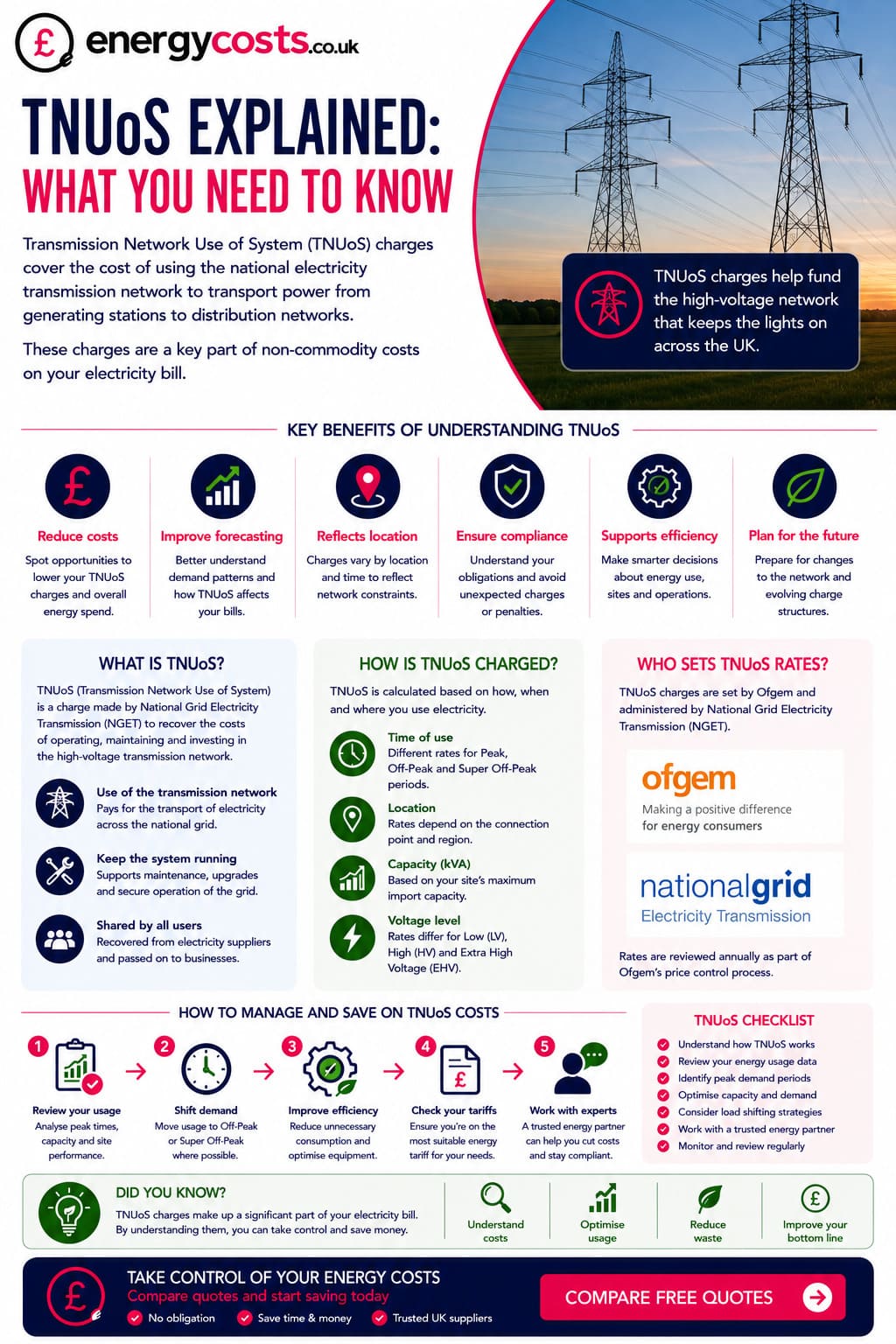
TNUoS stands for Transmission Network Use of System. It is a charge on electricity bills that helps pay for the high-voltage transmission network that moves electricity around Great Britain.
For businesses, TNUoS matters because it is one of the non-commodity charges that can increase electricity bills even when wholesale electricity prices are stable or falling. It is especially important in 2026 because TNUoS charges have risen sharply from April 2026, adding pressure to many business electricity contracts.
NESO publishes the official TNUoS charging information and final tariffs, including the final 2026/27 tariffs published on 30 January 2026.
Summary answer
| Question | Answer |
|---|---|
| What does TNUoS mean? | Transmission Network Use of System |
| What does it pay for? | The high-voltage electricity transmission network |
| Who sets the charges? | NESO calculates and publishes TNUoS tariffs |
| Who ultimately pays? | Electricity suppliers recover the cost from customers, including businesses |
| Is TNUoS a wholesale electricity cost? | No, it is a non-commodity network charge |
| Does it affect gas bills? | No, TNUoS is an electricity charge |
| Why is it important in 2026? | Charges have increased sharply from April 2026 |
| Does every business pay the same? | No, impact varies by site, meter type, region, voltage level and contract |
| Can businesses avoid it completely? | Usually no, but they may reduce exposure through efficiency, capacity reviews and contract structure |
What does TNUoS pay for?
TNUoS pays for the cost of the electricity transmission network. This is the high-voltage system that moves power from large generators, interconnectors and transmission-connected assets to the regional distribution networks.
It helps fund:
- high-voltage overhead lines
- underground and subsea cables
- major substations
- transmission network maintenance
- transmission upgrades
- grid reinforcement
- offshore transmission infrastructure
- the cost of connecting and moving electricity from new generation sources
A useful way to think about it is that TNUoS pays for the electricity “motorway network”, while DUoS pays for the local electricity “road network”.
| Charge | What it covers | Simple comparison |
|---|---|---|
| TNUoS | National high-voltage transmission system | Electricity motorways |
| DUoS | Regional and local distribution networks | Local roads |
| BSUoS | Balancing the electricity system in real time | Traffic control |
Why do businesses pay TNUoS?
Businesses pay TNUoS because they use the electricity system. Even if a business buys electricity from a supplier, the electricity still has to travel through national and local infrastructure before it reaches the premises.
The supplier usually pays industry charges and then recovers them from customers through the unit rate, standing charge, pass-through costs or separate invoice lines.
For smaller businesses, TNUoS is usually hidden inside the electricity price. For larger businesses, especially those with half-hourly meters or pass-through contracts, TNUoS may be more visible.
| Business type | How TNUoS may appear |
|---|---|
| Small office or shop | Usually bundled into the unit rate or standing charge |
| Café, salon or small retail site | Usually included in supplier pricing |
| Half-hourly metered site | May be more directly reflected in standing charges or pass-through costs |
| Large manufacturer | Often more visible and financially significant |
| Multi-site business | May vary by location and meter type |
| Flexible procurement customer | Often treated as a separate forecast or pass-through item |
Why TNUoS affects business electricity bills in 2026
TNUoS is a major 2026 issue because charges have increased sharply.
EDF says the average £/MWh equivalent residual charge for 2026/27 is around £25.70/MWh, up from around £15.70/MWh, which represents an increase of roughly £10/MWh year on year.
That £10/MWh increase is equivalent to about 1p/kWh. For a small user, that may be noticeable. For a larger user, it can be a major annual cost increase.
| Annual electricity use | Approximate extra cost from £10/MWh increase |
|---|---|
| 10,000kWh | £100 per year |
| 25,000kWh | £250 per year |
| 50,000kWh | £500 per year |
| 100,000kWh | £1,000 per year |
| 250,000kWh | £2,500 per year |
| 500,000kWh | £5,000 per year |
| 1,000,000kWh | £10,000 per year |
| 5,000,000kWh | £50,000 per year |
These are simplified figures. Actual TNUoS impact depends on the site’s location, meter type, voltage level, charging band, supplier contract and whether the charge is fixed or passed through.
Why has TNUoS increased?
TNUoS is rising because the electricity transmission system needs major investment. The UK is changing where and how electricity is generated, with more offshore wind, renewable generation, interconnectors, storage, electrification and large demand projects such as data centres.
That means the grid needs more capacity, more reinforcement and more connections.
NESO’s 2026/27 material notes pointed to a forecast total TNUoS revenue of £6.2 billion, an increase of £1.2 billion from the 2025/26 final tariffs, with increases linked to onshore and offshore transmission owner revenue and other pass-through items.
For businesses, the practical point is that the cost of upgrading and operating the transmission system is increasingly being felt through electricity bills.
Is TNUoS the same as wholesale electricity?
No. TNUoS is not the wholesale cost of electricity.
Wholesale electricity is the cost of buying the power itself. TNUoS is the cost of using the high-voltage transmission network.
| Cost | What it means |
|---|---|
| Wholesale electricity | The cost of buying electricity from the market |
| TNUoS | The cost of using the transmission network |
| DUoS | The cost of using local distribution networks |
| BSUoS | The cost of balancing the electricity system |
| Supplier margin | Supplier operating costs and profit |
| Policy costs | Charges such as RO, FiT, CfD and Capacity Market |
| Taxes | VAT and Climate Change Levy |
This is why a business electricity bill can rise even if wholesale electricity prices fall. The wholesale element may be lower, while network and policy charges are higher.
How is TNUoS different from DUoS?
TNUoS and DUoS are both network charges, but they pay for different parts of the electricity system.
| Feature | TNUoS | DUoS |
|---|---|---|
| Full name | Transmission Network Use of System | Distribution Use of System |
| Network level | National high-voltage network | Regional and local networks |
| Main purpose | Moving electricity across Great Britain | Delivering electricity locally to premises |
| Applies to | Electricity bills | Electricity bills |
| Varies by | Location, voltage, meter type, charging band and methodology | Region, voltage, meter type, time band and capacity |
| Commonly visible to SMEs? | Usually bundled | Usually bundled |
| More visible to large users? | Yes | Yes |
A simple example: electricity generated by an offshore wind farm may travel across the high-voltage transmission system, then through regional distribution networks before reaching a business. TNUoS relates to the first part of that journey; DUoS relates to the local delivery.
How is TNUoS different from BSUoS?
BSUoS stands for Balancing Services Use of System. It pays for the cost of keeping the electricity system balanced in real time. NESO says BSUoS recovers the cost of day-to-day system operation, including balancing the electricity transmission system.
| Charge | What it pays for |
|---|---|
| TNUoS | Building, operating and upgrading the transmission network |
| DUoS | Local distribution network costs |
| BSUoS | Balancing supply and demand on the electricity system |
TNUoS is about transmission infrastructure. BSUoS is about real-time system operation.
Why does TNUoS appear in standing charges?
TNUoS can be recovered through standing charges, particularly where residual charges are involved. EDF notes that TNUoS residual charges are recovered through standing charges expressed in £/site/day, even though the average £/MWh equivalent is often used for comparison.
This is one reason businesses may see standing charges rise even if their electricity consumption has not increased.
| Example | What happens |
|---|---|
| Unit rate unchanged, standing charge rises | Total bill increases despite stable usage |
| Usage falls, standing charge rises | Savings are smaller than expected |
| Business uses very little electricity | Standing charge becomes a larger share of total bill |
| Larger site has higher residual band | Fixed daily cost may rise significantly |
For low-usage businesses, higher standing charges can be especially frustrating because the cost is fixed regardless of how much electricity is used.
Why does TNUoS vary between businesses?
TNUoS is not the same for every business. The impact can vary because of:
- location
- region
- meter type
- half-hourly or non-half-hourly status
- voltage level
- line loss factor class
- agreed capacity
- charging band
- annual consumption
- contract type
- supplier pricing method
This means two businesses using the same amount of electricity may not face exactly the same TNUoS cost.
| Factor | Why it matters |
|---|---|
| Location | Transmission costs vary across the system |
| Meter type | Half-hourly and non-half-hourly sites may be treated differently |
| Voltage level | Larger or higher-voltage sites can fall into different charging groups |
| Charging band | Residual charges can depend on banding |
| Contract structure | Fixed contracts and pass-through contracts treat TNUoS differently |
| Supplier approach | Some suppliers bundle TNUoS; others itemise or reconcile it |
Does TNUoS affect small businesses?
Yes, but often indirectly. A small business may not see a line on its bill labelled “TNUoS”, but the cost can still be included in the standing charge or unit rate.
For example, a small shop or office may simply see:
- a higher standing charge
- a higher renewal quote
- a higher pence-per-kWh unit rate
- a supplier explanation that “network costs” have increased
That increase may partly reflect TNUoS, even if the bill does not mention it by name.
Does TNUoS affect large businesses more?
Usually, yes. Larger electricity users are more exposed because even small changes in £/MWh can create large annual cost increases.
| Business type | Why TNUoS can matter |
|---|---|
| Manufacturer | High electricity usage magnifies £/MWh increases |
| Cold storage site | Continuous demand means network charges are material |
| Warehouse | Lighting, automation, HVAC and EV charging increase exposure |
| Hotel | High electricity use across kitchens, laundry, lifts, lighting and HVAC |
| Care home | Continuous operation creates high annual consumption |
| Leisure centre | Pools, gyms, lighting and heating systems increase electricity demand |
| Multi-site retailer | Small increases multiplied across many sites become significant |
| Data centre | High power demand makes transmission charges strategically important |
A large business using 1,000,000kWh per year could face an extra £10,000 per year from a £10/MWh increase alone. A business using 5,000,000kWh could face an extra £50,000 per year.
Does TNUoS affect fixed energy contracts?
It depends on the contract.
Some contracts are fully fixed, meaning the supplier has built forecast TNUoS costs into the price. Others are pass-through or partly pass-through, meaning TNUoS can be adjusted during the contract.
| Contract type | TNUoS treatment |
|---|---|
| Fully fixed contract | TNUoS usually included in fixed rate, subject to contract wording |
| Fixed contract with exclusions | TNUoS may be passed through or reconciled later |
| Pass-through contract | TNUoS billed at actual or updated cost |
| Flexible contract | TNUoS usually forecast, passed through or separately managed |
This is why businesses should check the wording carefully. A contract described as “fixed” may not fix every non-commodity charge.
Why TNUoS matters for pass-through contracts
TNUoS is one of the biggest risks in a pass-through electricity contract. If the supplier passes through actual TNUoS costs, the business can face increases even after signing.
For example:
| Annual usage | Extra cost if TNUoS rises by £5/MWh | Extra cost if TNUoS rises by £10/MWh | Extra cost if TNUoS rises by £15/MWh |
|---|---|---|---|
| 50,000kWh | £250 | £500 | £750 |
| 100,000kWh | £500 | £1,000 | £1,500 |
| 250,000kWh | £1,250 | £2,500 | £3,750 |
| 500,000kWh | £2,500 | £5,000 | £7,500 |
| 1,000,000kWh | £5,000 | £10,000 | £15,000 |
| 5,000,000kWh | £25,000 | £50,000 | £75,000 |
This is why a low headline unit rate can be misleading if TNUoS and other non-commodity charges are not fixed.
Can businesses reduce TNUoS costs?
Most businesses cannot avoid TNUoS completely. It is part of the cost of using the electricity system. However, some businesses can reduce their exposure.
| Action | How it may help |
|---|---|
| Reduce imported electricity | Lower grid consumption can reduce some usage-linked exposure |
| Install solar panels | Reduces electricity imported from the grid during daylight hours |
| Add battery storage | Can reduce peak import and increase solar self-consumption |
| Review agreed supply capacity | May reduce fixed capacity-related network costs where applicable |
| Improve energy efficiency | Reduces total kWh use |
| Check contract structure | Avoids unexpected pass-through increases |
| Monitor half-hourly data | Helps identify peak demand and unusual consumption |
| Compare suppliers early | Allows better assessment of fixed versus pass-through offers |
| Check meter and site details | Incorrect meter data or banding can affect charges |
The right strategy depends on the size and type of business. A small office may focus on contract choice and standing charges. A manufacturer may need a more detailed review of capacity, half-hourly data, solar, batteries and demand management.
Should businesses choose fixed or pass-through TNUoS?
There is no single answer. It depends on whether the business values budget certainty or cost transparency.
| Option | Advantage | Disadvantage |
|---|---|---|
| Fixed TNUoS | Better budget certainty | Supplier may include a risk premium |
| Pass-through TNUoS | More transparent and may be cheaper if charges fall | Business takes the risk if charges rise |
| Reconciled TNUoS | Can reflect actual costs more closely | May create catch-up charges |
| Flexible procurement | Suitable for larger energy users | Requires expertise and active management |
For many SMEs, a fully fixed contract is easier to budget. For large half-hourly users, a pass-through or flexible approach may make sense, but only if the business understands the risk.
What should businesses ask suppliers about TNUoS?
Before signing a business electricity contract, ask:
- Is TNUoS fixed for the full contract? Confirms budget certainty
- Is TNUoS included in the unit rate or standing charge? Shows where the cost is hidden
- Can TNUoS be passed through later? Identifies future price risk
- Will TNUoS be reconciled? Warns of possible catch-up invoices
- What assumptions have been used? Helps compare quotes fairly
- How does my meter type affect TNUoS? Important for half-hourly sites
- How does my region affect TNUoS? Charges can vary by location
- Is broker commission added on top? Prevents misleading quote comparisons
- What is the estimated annual TNUoS cost? Gives a clearer view of total cost
- Can I see a fully fixed alternative? Helps compare risk against price
A supplier or broker should be able to explain whether TNUoS is fixed, passed through or excluded from the quote. If they cannot, the contract may be difficult to manage.
How to check whether TNUoS has affected your bill
A business should check:
- Standing charge: TNUoS residual increases may appear here
- Unit rate: The supplier may have bundled TNUoS into the p/kWh price
- Contract renewal date: New TNUoS assumptions may apply after renewal
- Pass-through clauses: Confirm whether TNUoS can change during the contract
- Supplier invoice notes: Some suppliers show non-commodity adjustments separately
- Half-hourly statement: Larger sites may see more detail
- MPAN and meter type: Confirm whether the correct charging basis is being used
- Site capacity: Higher capacity may increase fixed network exposure
- Broker quote sheet: May show whether TNUoS was included or excluded
If a bill has risen sharply from April 2026, TNUoS should be one of the first items to check alongside DUoS, BSUoS, standing charges and contract renewal rates.
Worked example: small business impact
A small business uses 30,000kWh of electricity per year.
| Item | Before increase | After increase |
|---|---|---|
| Annual use | 30,000kWh | 30,000kWh |
| TNUoS-equivalent cost | £15.70/MWh | £25.70/MWh |
| Approximate annual TNUoS cost | £471 | £771 |
| Approximate increase | — | £300 |
This does not mean every small business will see exactly a £300 increase. It shows how a £10/MWh increase translates into annual cost for a 30,000kWh user.
Why TNUoS is part of the wider electricity cost problem
TNUoS is one of several non-commodity charges that are becoming more important on business electricity bills. Businesses are often told that wholesale electricity prices have fallen from crisis peaks, but final bills remain high because other costs have risen.
These include:
- TNUoS
- DUoS
- BSUoS
- Renewables Obligation
- Feed-in Tariff
- Contracts for Difference
- Capacity Market
- metering costs
- supplier operating costs
- broker commission
- VAT and Climate Change Levy
For many businesses, the final electricity price is now as much about infrastructure and policy costs as it is about wholesale electricity.
Does TNUoS encourage better use of the grid?
In principle, network charges are intended to recover the cost of electricity infrastructure and send signals about the cost of using the system. In practice, many businesses experience TNUoS simply as a bill increase.
The policy challenge is that the electricity system needs investment, but businesses also need affordable and predictable power. This is especially important for energy-intensive sectors, manufacturing, cold storage, logistics, hospitality and other businesses where electricity is a major operating cost.
Summary
TNUoS is the Transmission Network Use of System charge. It helps pay for the high-voltage electricity network that moves power around Great Britain.
It affects businesses because suppliers recover TNUoS costs through electricity bills. For smaller businesses, it may be hidden inside the standing charge or unit rate. For larger businesses, it may be shown more clearly or passed through as a separate cost.
TNUoS is especially important in 2026 because charges have risen sharply from April 2026. EDF says the average £/MWh equivalent residual charge has increased from around £15.70/MWh to around £25.70/MWh, adding roughly £10/MWh year on year.
For a business using 100,000kWh per year, a £10/MWh increase is roughly £1,000 per year. For a business using 1,000,000kWh, it is roughly £10,000 per year.
The key lesson for businesses is to look beyond the headline unit rate. TNUoS, standing charges, pass-through clauses and other non-commodity costs can have a major effect on the final bill.
FAQ
TNUoS stands for Transmission Network Use of System. It is a charge that helps pay for the high-voltage electricity transmission network in Great Britain.
TNUoS pays for building, operating, maintaining and upgrading the electricity transmission system, including high-voltage lines, cables and substations.
NESO calculates and publishes TNUoS tariffs. The final TNUoS tariffs for 2026/27 were published on 30 January 2026.
TNUoS has increased because the transmission network needs major investment to support new generation, grid reinforcement, offshore infrastructure and wider electricity system changes.
It can be. TNUoS residual charges are often recovered through standing charges, which is one reason business standing charges may rise even when usage does not.
Yes. Small businesses may not see TNUoS listed separately, but it can still be included in the unit rate, standing charge or renewal quote.
No. TNUoS is an electricity charge. Gas bills have their own network and transportation charges, but they do not include TNUoS.
Usually not completely. However, businesses may reduce exposure by cutting grid electricity use, reviewing capacity, improving efficiency, installing solar panels, using batteries and choosing the right contract structure.
No. TNUoS pays for the national transmission network. DUoS pays for local distribution networks that deliver electricity to individual premises.
Because TNUoS may be fixed, passed through or reconciled depending on the contract. Asking how it is treated helps you understand whether your business is exposed to future increases.