
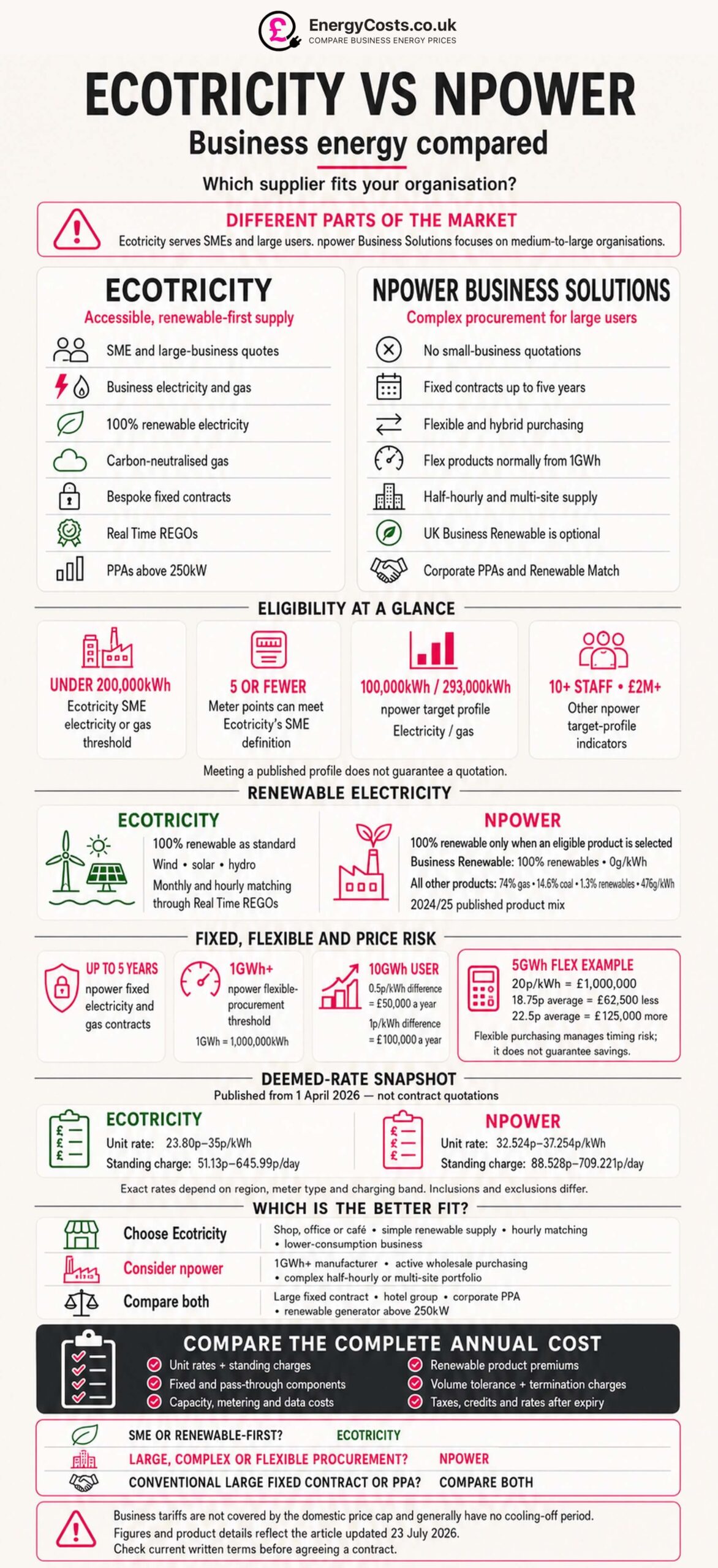
Ecotricity and npower Business Solutions both supply electricity and gas to British organisations, but they target different parts of the business energy market.
Ecotricity accepts enquiries from small and medium-sized enterprises as well as major companies. Its proposition centres on 100% renewable electricity, carbon-neutralised gas and using customer revenue to support new renewable generation.
npower Business Solutions, commonly abbreviated to nBS, concentrates on medium-to-large energy users. It offers fixed, flexible and hybrid procurement arrangements, multi-site management, wholesale-market purchasing tools and specialist services for companies with complex energy requirements.
For a small shop, office, café or workshop, Ecotricity is likely to be the only direct option of the two. For a manufacturer, logistics operator, large retailer or multi-site organisation consuming hundreds of thousands or millions of kilowatt-hours, both may be worth considering.
The better supplier will depend on the size of the company, its consumption profile, its approach to price risk and how important renewable sourcing is to its environmental strategy.
Ecotricity vs npower at a glance
| Feature | Ecotricity Business | npower Business Solutions |
|---|---|---|
| Small-business energy quotes | Yes | No |
| Medium-sized business supply | Yes | Yes, subject to eligibility |
| Large-business supply | Yes | Yes |
| Business electricity | Yes | Yes |
| Business gas | Yes | Yes |
| Standard published contract rates | No, bespoke quote | No, bespoke quote |
| Fixed contracts | Yes | Up to five years |
| Flexible wholesale purchasing | Bespoke options for larger users | Extensive flex and hybrid products |
| Published flex threshold | No general threshold stated | Normally at least 1GWh per fuel annually |
| Renewable electricity | 100% renewable electricity | Optional 100% UK renewable product |
| Standard electricity fuel mix | Renewable electricity | Standard products include fossil fuels |
| Time-matched renewable certificates | Real Time REGOs | Conventional UK REGO-backed products and CPPA options |
| Business gas environmental option | Carbon-neutralised gas | Carbon-offsetting options available |
| Multi-site management | Yes | Extensive multi-site and portfolio services |
| Online energy analytics | Account and reporting tools | Dashboard, My Energy Coach and Risk Navigator |
| On-site generation support | Yes | Yes |
| Power Purchase Agreements | Available, including for generation above 250kW | Generator PPAs and corporate PPAs |
| Best suited to | SMEs and companies prioritising renewable supply | Large users needing sophisticated procurement |
What happened to the original npower business operation?
The name “npower” can create confusion because the former domestic and small-business supplier is no longer the relevant company for new business quotations.
Small-business npower customers were transferred to E.ON Next. The current npower Business Solutions website explicitly states that it does not provide energy for smaller businesses and cannot give them quotations.
The active large-business supplier trades as npower Business Solutions and supplies customers through Npower Commercial Gas Limited. This company continues to hold a non-domestic electricity supply licence.
The separate electricity supply licence held by Npower Limited was revoked with effect from 1 August 2025. This did not close npower Business Solutions because its commercial customers are supplied through the different licensed company.
For the purpose of this comparison:
- npower means npower Business Solutions;
- E.ON Next is the appropriate E.ON group brand for many smaller businesses; and
- Ecotricity can quote for both SMEs and large organisations.
Which businesses can apply?
Eligibility is one of the most important differences between these suppliers.
Ecotricity eligibility
Ecotricity defines an SME customer as a business meeting at least one of the following conditions:
- annual electricity consumption below 200,000kWh;
- annual gas consumption below 200,000kWh; or
- five or fewer meter points.
Larger organisations are directed to Ecotricity’s large-business service.
This means Ecotricity can potentially serve a wide range of organisations, including:
- independent shops;
- offices;
- cafés and restaurants;
- hotels;
- charities;
- workshops;
- schools;
- care providers;
- factories;
- retail chains; and
- national multi-site organisations.
npower Business Solutions eligibility
npower Business Solutions describes its target customer as a medium-to-large business with:
- ten or more employees;
- more than 100,000kWh of annual electricity consumption or 293,000kWh of annual gas consumption; and
- turnover above £2 million.
Its flexible procurement contracts are generally designed for companies consuming at least 1GWh, equivalent to 1,000,000kWh, of electricity or gas each year.
These criteria make npower more relevant to:
- factories and industrial plants;
- large warehouses;
- supermarket and retail portfolios;
- universities;
- hospitals;
- hotel groups;
- transport operators;
- data centres;
- property portfolios;
- public-sector organisations; and
- companies with numerous half-hourly meters.
Meeting the published profile does not guarantee that a quotation will be offered. Creditworthiness, meter type, site complexity, annual expenditure and contract requirements may also be considered.
Eligibility examples
| Example company | Annual electricity | Annual gas | Likely position |
|---|---|---|---|
| Independent shop | 15,000kWh | 20,000kWh | Ecotricity |
| Medium office | 80,000kWh | 120,000kWh | Ecotricity; unlikely to fit npower’s target profile |
| Large restaurant | 150,000kWh | 350,000kWh | Potentially both, depending on turnover and employees |
| Hotel | 400,000kWh | 1,200,000kWh | Both |
| Manufacturer | 2,500,000kWh | 4,000,000kWh | Both; npower flex products become relevant |
| National retail chain | 10,000,000kWh | 2,000,000kWh | Both; npower has extensive portfolio tools |
A company consuming between 100,000kWh and 200,000kWh of electricity may fall within Ecotricity’s SME definition while also meeting part of npower’s published large-business profile. Employee numbers and turnover would help determine whether npower is likely to quote.
Which supplier is cheaper?
Neither supplier publishes one contract rate that applies to every business.
Prices are normally calculated according to:
- annual electricity or gas consumption;
- MPAN or MPRN;
- meter type;
- half-hourly consumption data;
- electricity distribution region;
- agreed supply capacity;
- number of sites;
- contract start date;
- proposed contract length;
- wholesale purchasing strategy;
- payment method;
- credit risk;
- renewable product selection; and
- treatment of network and policy charges.
Ecotricity may provide a relatively straightforward fixed SME quotation. npower can offer anything from a conventional fixed agreement to a complex wholesale purchasing arrangement involving several trades over several years.
A headline unit rate therefore provides only part of the comparison.
The projected annual cost should be calculated as:
- Annual consumption × unit rate
- standing charges
- capacity charges
- metering and data costs
- network and policy charges
- environmental product premiums
- taxes
− export income or contractual credits
Businesses should also check whether each cost is fixed or passed through at the prevailing industry rate.
How much does a rate difference matter?
Large consumers can save or lose substantial sums from apparently small unit-rate differences.
| Annual consumption | Value of 0.5p/kWh | Value of 1p/kWh | Value of 3p/kWh | Value of 5p/kWh |
|---|---|---|---|---|
| 50,000kWh | £250 | £500 | £1,500 | £2,500 |
| 100,000kWh | £500 | £1,000 | £3,000 | £5,000 |
| 250,000kWh | £1,250 | £2,500 | £7,500 | £12,500 |
| 500,000kWh | £2,500 | £5,000 | £15,000 | £25,000 |
| 1GWh | £5,000 | £10,000 | £30,000 | £50,000 |
| 5GWh | £25,000 | £50,000 | £150,000 | £250,000 |
| 10GWh | £50,000 | £100,000 | £300,000 | £500,000 |
For a 10GWh electricity user, a difference of only 0.5p/kWh is worth £50,000 annually. This explains why large companies may employ energy procurement teams or use flexible trading services instead of simply accepting a fixed headline price.
Published deemed electricity rates
Deemed rates apply when a company occupies premises supplied by a provider without first agreeing a contract. They are generally more expensive than negotiated rates and should not be treated as representative quotations.
Both suppliers have published electricity deemed rates effective from 1 April 2026.
Non-half-hourly deemed rates
| Charge category | Ecotricity | npower Business Solutions |
|---|---|---|
| Lowest published standard unit rate | 23.80p/kWh for certain domestic-residual supplies | 32.524p/kWh |
| No-residual unit rate | 33p/kWh | Included within regional 32.524p–37.254p range |
| Commercial band unit rate | 35p/kWh for bands 1–4 | 32.524p–37.254p/kWh |
| Band 1 standing charge | 51.13p–77.87p per day | 107.296p–134.036p per day |
| Band 2 standing charge | 86.20p–135.96p per day | 143.122p–192.882p per day |
| Band 3 standing charge | 152.21p–250.10p per day | 210.569p–308.459p per day |
| Band 4 standing charge | 375.75p–645.99p per day | 438.981p–709.221p per day |
| Non-residual standing charge | 51.13p–77.87p per day | 88.528p–110.308p per day |
The exact rate depends on the distribution region, meter classification and residual charging band.
Ecotricity’s schedule excludes VAT, Climate Change Levy, government-imposed taxes and certain additional half-hourly metering or capacity costs.
npower’s published non-half-hourly charges include a range of network, metering and policy components, but exclude reactive-power charges, Climate Change Levy and any other items identified as exclusions in the applicable schedule.
Annual standing-charge comparison
Converting the published daily ranges into approximate annual costs gives the following figures.
| Band | Ecotricity annual range | npower annual range |
|---|---|---|
| Band 1 | £186.62–£284.23 | £391.63–£489.23 |
| Band 2 | £314.63–£496.25 | £522.40–£704.02 |
| Band 3 | £555.57–£912.87 | £768.58–£1,125.88 |
| Band 4 | £1,371.49–£2,357.86 | £1,602.28–£2,588.66 |
These figures do not prove that Ecotricity will provide the cheaper contract. They only compare published deemed standing charges for broad categories.
Illustrative deemed electricity costs
The following table compares consumption charges before standing charges and taxes.
| Annual consumption | Ecotricity at 35p/kWh | npower at 32.524p/kWh | npower at 37.254p/kWh |
|---|---|---|---|
| 100,000kWh | £35,000 | £32,524 | £37,254 |
| 250,000kWh | £87,500 | £81,310 | £93,135 |
| 500,000kWh | £175,000 | £162,620 | £186,270 |
| 1GWh | £350,000 | £325,240 | £372,540 |
At 1GWh, npower’s lowest regional non-half-hourly deemed unit rate would be £24,760 below Ecotricity’s 35p rate. Its highest rate would be £22,540 above it.
However, the comparison is not a substitute for contract quotes because:
- most 1GWh customers are likely to use half-hourly metering;
- deemed rates are intended for uncontracted supplies;
- each supplier includes and excludes different cost elements;
- meter categories may not correspond exactly; and
- negotiated large-business rates can be substantially different.
Half-hourly deemed pricing
npower publishes detailed half-hourly deemed rates by voltage, distribution region, time period and charging band.
For low-voltage half-hourly supplies from 1 April 2026, the published ranges include:
| npower half-hourly charge | Published range |
|---|---|
| Night electricity | 25.534p–28.355p/kWh |
| Non-business-day electricity | 32.481p–36.404p/kWh |
| November–March business-day electricity | 40.314p–44.305p/kWh |
| April–October business-day electricity | 29.274p–32.782p/kWh |
| Capacity charge | 3.820p–13.830p per day per kVA |
The seasonal spread demonstrates how a high-consumption company’s operating pattern can affect costs. Electricity consumed during winter business days attracts a higher published deemed rate than overnight or summer usage.
Ecotricity’s deemed schedule generally applies a common unit rate within each relevant voltage or metering category, accompanied by region- and band-specific standing charges.
Large businesses should provide at least 12 months of half-hourly data when requesting quotations. Annual consumption alone cannot show whether a company uses most of its electricity during cheap or expensive settlement periods.
Ecotricity fixed business tariffs
Ecotricity provides individually quoted tariffs for SMEs and larger organisations.
Its SME proposition emphasises:
- a simple tariff;
- clear pricing;
- no hidden fees;
- 100% renewable electricity;
- carbon-neutralised gas; and
- support from a dedicated SME energy team.
Larger customers can discuss more complex arrangements, including renewable sourcing, generation and time-matched environmental reporting.
A company considering Ecotricity should ask whether its quotation fixes:
- the wholesale energy price;
- network charges;
- policy costs;
- transmission charges;
- distribution charges;
- metering costs;
- standing charges; and
- renewable certificate costs.
Ecotricity has said that increased TNUoS costs affecting businesses from April 2026 are being incorporated into a fixed daily rate for new contracts. This can improve budget predictability, although the complete quotation still needs to be reviewed.
npower fixed contracts
npower offers fixed electricity and gas contracts for periods of up to five years.
A fixed contract is intended to provide:
- a pre-agreed energy price;
- greater budget certainty;
- protection against some wholesale price increases;
- simpler internal forecasting; and
- less need for active market trading.
The company may still allow different approaches to non-commodity costs. A business might fix these costs, pass them through or use a combination, depending on the product.
This distinction is important because wholesale energy is only one part of the bill. The remainder may include:
- TNUoS;
- DUoS;
- BSUoS;
- Contracts for Difference;
- Renewables Obligation;
- Capacity Market charges;
- meter operation;
- data collection;
- data aggregation;
- transmission and distribution losses; and
- supplier operating costs.
A contract described as “fixed” does not necessarily guarantee that every invoice component will remain unchanged.
npower flexible contracts
npower’s major advantage for large organisations is its range of flexible purchasing options.
Instead of fixing the entire expected consumption volume on one day, a flexible customer can make several purchases over time. This may reduce the risk of fixing all energy when the wholesale market is unusually expensive.
For example, a business could purchase:
- 25% of forecast consumption when the contract is agreed;
- another 25% six months later;
- further volumes when market conditions meet agreed targets; and
- the remaining requirement closer to delivery.
The company may also leave some volume linked to day-ahead or other market indices.
Potential benefits include:
- spreading market timing risk;
- taking advantage of falling prices;
- creating different hedging strategies for different years;
- separating commodity and non-commodity decisions;
- adjusting purchasing as forecasts change; and
- accessing specialist market information.
Potential disadvantages include:
- exposure to price increases;
- greater contract complexity;
- internal governance requirements;
- the risk of poor trading decisions;
- volume forecasting errors; and
- less certainty over the final annual cost.
npower says its flexible products are suitable for companies consuming at least 1GWh of electricity or gas annually.
Fixed versus flexible example
Consider a manufacturer expecting to consume 5GWh of electricity annually.
Under a fixed approach, it might secure the entire expected volume at 20p/kWh for the commodity and agreed contract components.
The energy charge would be:
5,000,000kWh × £0.20 = £1,000,000
Under a staged purchasing strategy, it might secure four equal volumes at:
- 21p/kWh;
- 19p/kWh;
- 18p/kWh; and
- 22p/kWh.
The weighted average would still be 20p/kWh.
If the four trades were instead 21p, 18p, 17p and 19p, the average would fall to 18.75p/kWh, producing a £62,500 saving against 20p.
If they were 21p, 23p, 24p and 22p, the average would rise to 22.5p/kWh, adding £125,000.
Flexible procurement does not guarantee savings. Its principal purpose is to manage market timing and risk in a way that suits the organisation.
Comparing renewable electricity
Both suppliers can provide 100% renewable electricity, but it is not automatically included in every npower product.
Ecotricity renewable electricity
Ecotricity describes its business electricity as 100% renewable, with electricity sourced from renewable technologies such as:
- wind;
- solar;
- hydroelectric generation.
The supplier also operates its “Bills into Mills” model, under which money generated from energy supply supports the development of additional renewable projects.
For a company seeking a simple environmental statement, Ecotricity’s proposition is relatively straightforward: its business electricity product is renewable rather than a conventional mixed-fuel product with a renewable upgrade.
npower UK Business Renewable
npower’s UK Business Renewable product matches the customer’s electricity use with Renewable Energy Guarantees of Origin from UK generation.
Its advertised benefits include:
- 100% UK renewable electricity;
- compatibility with fixed and flexible contracts;
- market-based Scope 2 zero-emission reporting;
- independent assurance;
- a renewable energy label for the customer; and
- compliance with relevant Greenhouse Gas Protocol guidance.
npower also lists UK Renewable Pure and UK Renewable Pure Plus products. Its fuel-mix disclosure says these use wind, solar and hydro asset types.
The renewable option must be selected. A customer on an ordinary npower product should not assume that its electricity is 100% renewable.
npower fuel mix
npower’s published product-specific fuel mix for 1 April 2024 to 31 March 2025 shows a substantial difference between its renewable and non-renewable products.
| Source | Business Renewable product | All other products |
|---|---|---|
| Coal | 0% | 14.6% |
| Natural gas | 0% | 74.0% |
| Nuclear | 0% | 3.9% |
| Renewables | 100% | 1.3% |
| Other | 0% | 6.2% |
| Reported carbon emissions | 0g/kWh | 476g/kWh |
The supplier-wide fuel mix under the Npower Commercial Gas Limited licence was reported as:
| Source | Licence-wide mix |
|---|---|
| Coal | 9.7% |
| Natural gas | 49.0% |
| Nuclear | 2.6% |
| Renewables | 34.6% |
| Other | 4.1% |
| Carbon emissions | 315g/kWh |
A company comparing quotations should establish which specific renewable product is included and whether its price contains the relevant REGO premium.
Time-matched renewable electricity
Ecotricity offers Real Time REGOs, which provide more detailed matching between consumption and renewable generation.
Traditional renewable electricity products normally match the total electricity consumed over a long reporting period with the equivalent number of certificates. This does not necessarily mean renewable electricity was generated during the same hour in which the business consumed power.
Time matching can show a closer relationship between:
- when the company used electricity; and
- when renewable generation entered the system.
Ecotricity’s options include monthly and hourly matching. This may be useful for organisations pursuing:
- 24/7 carbon-free energy objectives;
- detailed Scope 2 reporting;
- net-zero building standards;
- supply-chain environmental requirements; or
- independently audited sustainability claims.
npower’s conventional UK Business Renewable product is REGO-backed. For larger companies seeking a more direct link to named renewable projects, its Corporate Power Purchase Agreement and Renewable Match services may provide another route.
Comparing business gas
Both suppliers offer gas, but neither should be assumed to deliver entirely renewable physical gas through the national network.
Ecotricity describes its SME gas as carbon neutralised. Its wider environmental strategy includes developing green gas and funding carbon-removal activities.
npower allows customers to add carbon-offsetting options to gas purchasing arrangements.
Companies should distinguish between:
- fossil gas;
- biomethane or renewable gas;
- green gas certificates;
- carbon offsets;
- direct carbon removal; and
- emissions reductions achieved by using less gas.
Burning natural gas at company premises normally creates direct Scope 1 emissions. Certificates or offsets may address the reported environmental impact, but they do not prevent combustion emissions from occurring at the site.
A gas quotation should therefore identify:
- the physical fuel supplied;
- the offset or certificate standard;
- the volume covered;
- project location;
- additionality;
- verification arrangements; and
- whether the environmental claim covers all lifecycle emissions.
Power Purchase Agreements
Both Ecotricity and npower can support renewable generation and Power Purchase Agreements.
Ecotricity PPAs
Ecotricity says it can arrange a PPA where a business generates more than 250kW of renewable electricity on site.
A PPA can provide:
- a buyer for surplus generation;
- a defined export-price mechanism;
- longer-term revenue certainty;
- a route to market;
- treatment of renewable certificates; and
- support with settlement and administration.
Ecotricity can also combine supply agreements, PPAs and Real Time REGOs for larger corporate customers.
npower PPAs and Renewable Match
npower provides generation services for businesses that produce electricity and offers PPAs to help generators sell their output.
Its Renewable Match service can support a corporate PPA from the tender process through to integration with the company’s supply contract.
This may suit a large organisation that wants to:
- contract directly with a renewable generator;
- support construction of additional renewable capacity;
- improve energy traceability;
- obtain longer-term price certainty; or
- align procurement with corporate net-zero commitments.
CPPAs are normally more complex than standard renewable tariffs. Companies should assess:
- contract duration;
- minimum volume;
- generation technology;
- generation profile;
- sleeving fees;
- balancing costs;
- shape risk;
- volume tolerance;
- credit requirements;
- certificate ownership;
- change-of-law provisions; and
- termination liabilities.
A wind or solar generator will not produce the same quantity every half hour. The supply contract must cover the difference between generated output and the customer’s actual demand.
Multi-site management
npower has the more developed public proposition for complex multi-site portfolios.
Its services include:
- fixed, flex and hybrid supply;
- consolidated portfolio management;
- half-hourly consumption insights;
- online account access;
- market-position monitoring;
- consumption reporting;
- new meter connections;
- generator administration; and
- specialist procurement support.
Its My Energy Coach service is intended to help customers examine consumption and identify efficiency opportunities. Risk Navigator provides market information, position tracking and analysis for customers using flexible procurement.
Ecotricity can also supply multi-site organisations and major corporate customers. However, its public proposition places greater emphasis on renewable sourcing and environmental reporting than on wholesale trading infrastructure.
Metering and new connections
Metering can materially affect both the tariff and the quality of information available to the business.
Large organisations may require:
- half-hourly electricity meters;
- automated meter reading;
- meter operator contracts;
- data collection;
- data aggregation;
- capacity reviews;
- new electricity connections; or
- upgrades to support electric heating, vehicles or machinery.
npower promotes a managed new-connections service alongside its supply and portfolio products.
Ecotricity can also support commercial metering and supplies, but companies with highly complex new-connection programmes should compare the scope, timetable and charges in detail.
The energy supplier is not necessarily responsible for every element of a new connection. Distribution network operators, meter operators, electrical contractors and data agents may also be involved.
Contract risks to examine
Business energy contracts do not receive the same protections as standard domestic tariffs.
Companies are not protected by the domestic energy price cap, and there is generally no cooling-off period after a business contract has been accepted, including agreements made over the telephone.
Before signing with either supplier, check:
- start and end dates;
- unit rates;
- standing charges;
- fixed and pass-through components;
- renewable premiums;
- termination charges;
- volume-tolerance clauses;
- take-or-pay commitments;
- security deposits;
- credit requirements;
- meter charges;
- capacity charges;
- indexation;
- change-of-law provisions;
- renewal and termination windows;
- broker commission; and
- rates applied after expiry.
This review is particularly important for flexible contracts because the initial paperwork may set out a procurement framework rather than one final unit price.
Ecotricity advantages and disadvantages
Advantages
- Accepts SME and large-business enquiries.
- Supplies both business electricity and gas.
- Electricity is supplied as 100% renewable.
- Straightforward environmental proposition.
- SME tariff structure is intended to be simple.
- Carbon-neutralised gas is available.
- Real Time REGOs support monthly or hourly renewable matching.
- PPAs are available for qualifying generators.
- Can support businesses with strong ethical or sustainability objectives.
- Publishes detailed deemed rates.
Disadvantages
- Negotiated contract rates are not publicly displayed.
- Fewer publicly described wholesale trading tools than npower.
- May be less suitable for companies wanting to make frequent market trades.
- Some deemed standing charges are substantial.
- PPA arrangements are likely to require specialist negotiation.
- Carbon-neutralised gas should not be confused with wholly renewable physical gas.
- Large users must confirm which non-commodity charges are fixed.
npower advantages and disadvantages
Advantages
- Strong focus on medium-to-large energy users.
- Fixed electricity and gas contracts available for up to five years.
- Extensive flexible and hybrid purchasing options.
- Flex contracts can spread wholesale purchasing decisions.
- Dedicated market-analysis and optimisation services.
- Suitable for complex half-hourly and multi-site portfolios.
- UK Business Renewable can be added to fixed or flexible contracts.
- Independently assured renewable product.
- Generator PPAs and Corporate PPAs available.
- Online consumption, account and market-position tools.
- Detailed half-hourly deemed-rate schedules.
Disadvantages
- Does not quote for smaller businesses.
- Standard products are not automatically renewable.
- Published non-renewable product mix is heavily dependent on fossil fuels.
- Flexible procurement can expose customers to market increases.
- Contract structures may be too complex for companies without energy expertise.
- No standard quoted rates are published.
- Some deemed standing charges are high.
- The npower name can be confused with the former domestic and SME supplier.
- Customers need to establish exactly which costs are fixed and which are passed through.
Which supplier is better for different companies?
| Type of company | Likely better fit | Reason |
|---|---|---|
| Independent shop | Ecotricity | npower does not quote smaller businesses |
| Small office | Ecotricity | Simple SME route and renewable electricity |
| Café or restaurant | Ecotricity | More accessible for lower consumption |
| Medium business using 150,000kWh | Compare eligibility | Ecotricity can quote; npower may quote if other size criteria are met |
| Large hotel | Compare both | Both can supply large gas and electricity loads |
| Manufacturer using more than 1GWh | npower may have an advantage | Flexible purchasing and risk tools |
| Company wanting a simple renewable contract | Ecotricity | Renewable electricity is the core supply proposition |
| Company wanting a renewable flex contract | npower | Renewable product can be combined with flexible purchasing |
| National multi-site retailer | npower may have an advantage | Extensive portfolio and data-management services |
| Business seeking hourly renewable matching | Ecotricity | Real Time REGOs provide time-matched reporting |
| Large corporate seeking a CPPA | Compare both | Both provide specialist renewable procurement |
| Renewable generator above 250kW | Compare both | Both can discuss PPAs and route-to-market services |
| Company without an energy procurement team | Ecotricity or npower fixed | A simple fixed structure may be safer than active flex purchasing |
| Energy-intensive industrial group | npower | Procurement, hedging and portfolio tools are designed for large users |
Final verdict: Ecotricity vs npower
Ecotricity and npower Business Solutions are not direct competitors for every company.
For small businesses, Ecotricity is the clear option of the two because npower Business Solutions does not offer small-business quotations. Ecotricity provides a route to obtain business electricity and gas while supporting a renewable-focused supplier.
For medium and large organisations, the decision is more balanced.
Ecotricity is likely to be the stronger fit where the priorities are:
- 100% renewable electricity as standard;
- a clear environmental brand;
- time-matched renewable certificates;
- carbon-neutralised gas;
- a relatively straightforward supply arrangement; and
- direct support for additional renewable development.
npower is likely to be the stronger fit where the priorities are:
- contracts fixed for up to five years;
- staged wholesale purchasing;
- flexible or hybrid procurement;
- complex half-hourly supplies;
- multi-site portfolio management;
- detailed market reporting;
- active risk management; and
- integrating a corporate PPA into a supply contract.
Neither supplier can be declared universally cheaper. Prices depend on the quotation, consumption profile, contract structure and treatment of non-commodity charges.
A large organisation should ask both suppliers to price the same specification, including:
- the same annual consumption forecast;
- identical contract dates;
- the same renewable requirements;
- matching volume-tolerance assumptions;
- identical treatment of network charges;
- the same metering scope;
- equivalent credit terms; and
- a complete projected annual cost.
The practical conclusion is:
- choose Ecotricity for an accessible SME service or a renewable-first supply proposition;
- consider npower Business Solutions for sophisticated procurement and large multi-site requirements;
- compare both for a conventional fixed large-business contract; and
- do not compare old npower small-business tariff information with Ecotricity’s current products.
FAQ
Yes. npower Business Solutions supplies medium-to-large organisations through Npower Commercial Gas Limited. The former npower domestic and small-business operation is separate and its customers were moved to E.ON Next.
No. npower Business Solutions states that it cannot provide quotes for smaller businesses. Small companies are directed to E.ON Next, while Ecotricity accepts SME business enquiries.
It depends on the individual quotation. Neither publishes standard contract rates for every business. Consumption, meter type, region, contract length, renewable requirements and non-commodity charges all affect the final cost.
Both can supply 100% renewable electricity. Ecotricity makes renewable electricity central to its standard business proposition. npower customers must select an eligible UK Business Renewable or related renewable product.
npower may suit companies requiring flexible purchasing, market analysis and multi-site portfolio management. Ecotricity may suit large companies prioritising renewable sourcing, Real Time REGOs and a simpler environmental proposition.
npower says its flexible electricity and gas purchasing contracts are suitable for businesses consuming at least 1GWh per year. One gigawatt-hour equals one million kilowatt-hours.
npower advertises fixed business electricity and gas contracts lasting up to five years. The available term and price depend on the quotation and the company’s circumstances.
Yes. Ecotricity provides quoted contracts for SMEs and larger companies. Businesses should check which wholesale, network, policy and metering costs remain fixed throughout the agreement.
Not automatically. npower’s published fuel mix shows that its ordinary products contain substantial gas and coal generation. Customers requiring renewable electricity must select a specific renewable product.
Real Time REGOs allow electricity consumption to be matched more closely with the timing of renewable generation. Ecotricity offers monthly and hourly matching options for qualifying business customers.
Yes. Ecotricity offers carbon-neutralised gas, while npower provides gas contracts with carbon-offsetting options. Businesses should investigate exactly how the relevant environmental claims are substantiated.
Yes. Both offer Power Purchase Agreement services. Ecotricity promotes PPAs for businesses generating more than 250kW on site, while npower provides generator services and corporate Renewable Match arrangements.
No. Non-domestic energy contracts are not protected by the domestic energy price cap. Contract terms, rates and termination provisions should be checked carefully before acceptance.
Research notes
Current npower market position: npower Business Solutions states that it does not supply smaller businesses and directs them to E.ON Next. Its large-business page targets organisations with at least ten employees, electricity use above 100,000kWh or gas use above 293,000kWh, and turnover exceeding £2 million.
Licence and company identity: Ofgem’s April 2026 licensee list includes Npower Commercial Gas Limited as a non-domestic electricity supplier. The separate Npower Limited electricity supply licence was revoked from 1 August 2025.
Ecotricity eligibility: Ecotricity defines an SME as using under 200,000kWh of electricity, under 200,000kWh of gas or having no more than five meter points. It also accepts large-business enquiries.
npower fixed and flexible products: npower offers fixed electricity and gas contracts for up to five years. Its flexible products are described as suitable for annual consumption of 1GWh or more and include market analysis, position tracking and procurement support.
Renewable products and fuel mix: npower’s renewable product is backed by UK REGOs and can be combined with fixed or flexible contracts. Its published 2024/25 product mix shows 100% renewables for Business Renewable customers and a fossil-heavy mix for other products.
Ecotricity renewable features: Ecotricity supplies SMEs with 100% renewable electricity and carbon-neutralised gas. It offers Real Time REGOs and promotes PPAs for on-site generation above 250kW.
Current deemed prices: The Ecotricity and npower figures in the article come from their published deemed electricity schedules effective from 1 April 2026. The schedules contain different inclusions and exclusions, so the rates are not direct contract-price quotations.
PPAs and portfolio services: npower provides generator PPAs, Corporate PPAs and a Renewable Match service. Its large-business proposition also includes multi-site management, half-hourly insights and managed connections.
Business contract protections: Ofgem confirms that non-domestic contracts are not protected by the domestic energy price cap and that there is generally no cooling-off period after a business energy agreement is accepted.