
E.ON and ENGIE both supply electricity and gas to UK businesses, but their strongest offerings target different types of customer.
E.ON Next provides relatively straightforward one, two and three-year fixed tariffs for small and medium-sized businesses. Larger organisations are served through npower Business Solutions, which offers fixed, flexible and renewable energy procurement products. ENGIE serves businesses of different sizes directly, with fixed contracts lasting up to five years, sophisticated pass-through arrangements, renewable gas and advanced energy-management services.
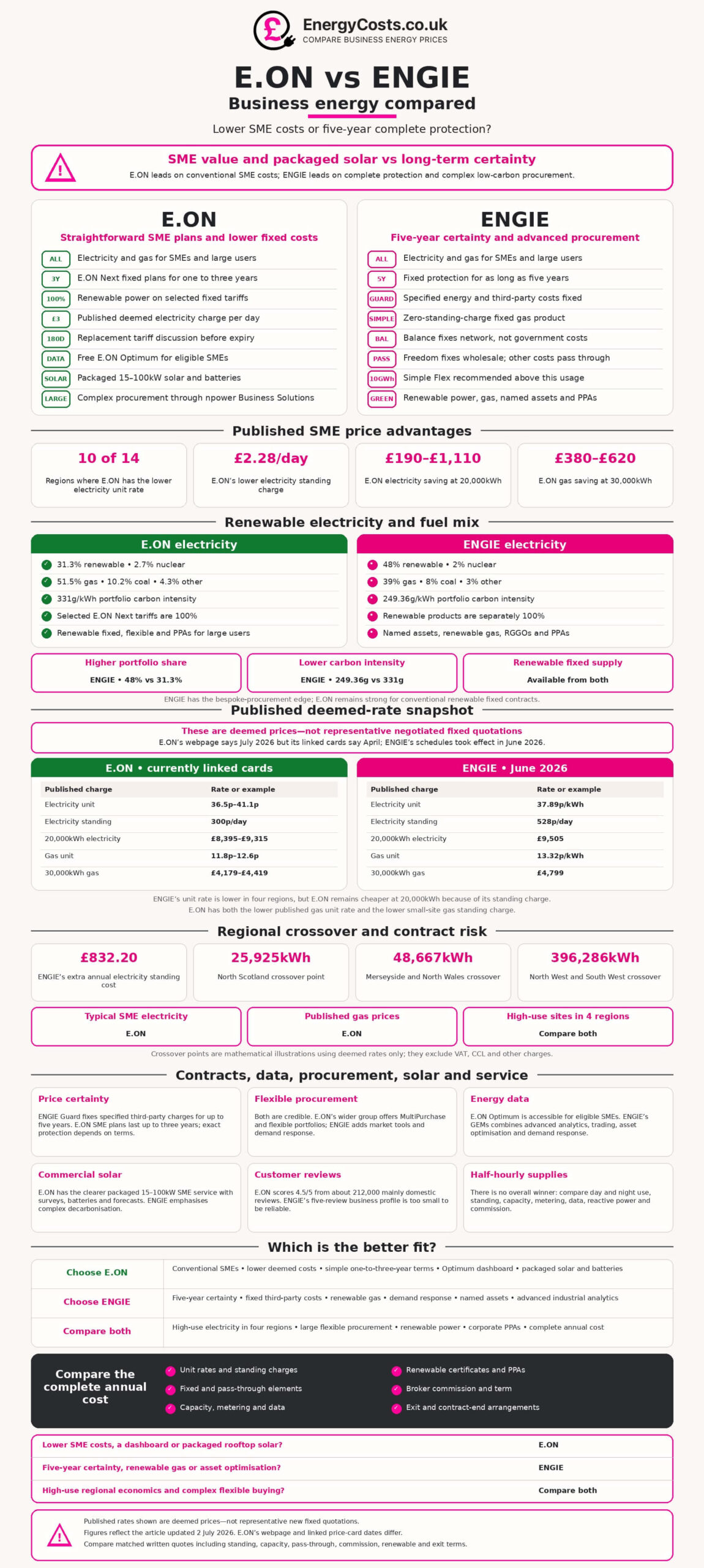
Based on their currently published deemed rates, E.ON is likely to be cheaper for most conventional small and medium-sized businesses. Its gas prices are lower in every region, while its lower electricity standing charge makes it cheaper than ENGIE for a business using 20,000 kWh annually in all 14 electricity regions.
ENGIE is the stronger option where complete price protection, renewable gas, long contract terms or complex procurement is more important. Its Guard product fixes a rate inclusive of third-party charges for up to five years, while its flexible products give large users more control over wholesale purchasing and demand management.
E.ON vs ENGIE at a glance
| Comparison area | E.ON | ENGIE |
|---|---|---|
| Business electricity | Yes | Yes |
| Business gas | Yes | Yes |
| SME fixed terms | One, two or three years | Up to five years |
| Fully fixed product | Fixed SME tariffs and large-user options | Guard, including specified third-party charges |
| No-standing-charge option | Not prominently offered | Simple gas tariff |
| Flexible purchasing | Through npower Business Solutions | Yes |
| Renewable electricity | 100% renewable electricity on selected E.ON Next tariffs | Optional with fixed and flexible contracts |
| Renewable gas | Specialist options through the wider group | Green gas and RGGO options |
| Corporate PPAs | Available through npower Business Solutions | Available |
| Published deemed electricity rate | 36.5p to 41.1p per kWh | 37.89p per kWh |
| Electricity standing charge | 300p per day | 528p per day |
| Published deemed gas rate | 11.8p to 12.6p per kWh | 13.32p per kWh |
| Gas standing charge for a small site | 175p per day | 220p per day |
| SME energy dashboard | E.ON Optimum | ENGIE online account |
| Advanced energy management | Through npower Business Solutions | GEMs, asset optimisation and demand response |
| Commercial solar | Packaged solar and battery installations | Bespoke renewable and energy-management projects |
| Main Trustpilot score | 4.5 out of 5 | Business profile has only five reviews |
| Best suited to | SMEs, lower deemed costs and packaged solar | Long-term certainty and complex procurement |
E.ON Next defines its conventional SME customers as businesses using no more than 100,000 kWh of electricity or 293,000 kWh of gas annually, or meeting the relevant small-business turnover and staffing criteria. Larger customers are directed to npower Business Solutions. E.ON Next offers one, two and three-year fixed tariffs, while ENGIE’s fixed products can provide price protection for as long as five years.
Which is cheaper: E.ON or ENGIE?
Neither supplier publishes fixed-contract prices that apply universally. A quotation will depend on factors including:
- Annual consumption
- Electricity distribution region
- Meter and settlement type
- Agreed supply capacity
- Contract length and start date
- Payment method
- Credit history
- Number of sites
- Renewable-energy requirements
- Which third-party charges are fixed or passed through
The most transparent public comparison is therefore between each supplier’s deemed rates. These normally apply when a business occupies premises without agreeing a supply contract.
Deemed tariffs are generally more expensive than negotiated contracts and should not be treated as representative fixed-price quotations.
Important E.ON date qualification
E.ON’s deemed-contract webpage describes the currently downloadable documents as effective from 1 July 2026. However, the SME electricity and gas price cards contained within those documents are stamped 10 April 2026. The following comparison uses the rates in those currently linked official price cards, but businesses should confirm the applicable billing rates directly with E.ON.
ENGIE’s current non-half-hourly electricity and gas schedules took effect on 1 June 2026 and apply until further notice.
E.ON vs ENGIE electricity prices
The following rates apply to standard unrestricted non-half-hourly electricity meters. Prices exclude VAT and the Climate Change Levy.
| Supplier | Unit rate | Standing charge |
|---|---|---|
| E.ON | 36.5p to 41.1p per kWh | 300p per day |
| ENGIE | 37.89p per kWh | 528p per day |
E.ON’s unit price varies by distribution region. ENGIE applies a nationwide 37.89p rate to its published non-half-hourly deemed tariff.
ENGIE has the lower unit rate in four regions, but its standing charge is £2.28 per day higher. That adds £832.20 to the annual fixed cost before any electricity is consumed.
E.ON and ENGIE electricity rates by region
| Electricity region | E.ON unit rate | ENGIE unit rate | Lower unit rate |
|---|---|---|---|
| Eastern | 36.8p | 37.89p | E.ON |
| East Midlands | 36.7p | 37.89p | E.ON |
| London | 37.5p | 37.89p | E.ON |
| Merseyside and North Wales | 39.6p | 37.89p | ENGIE |
| West Midlands | 36.5p | 37.89p | E.ON |
| North East | 37.4p | 37.89p | E.ON |
| North West | 38.1p | 37.89p | ENGIE |
| North Scotland | 41.1p | 37.89p | ENGIE |
| South Scotland | 36.8p | 37.89p | E.ON |
| South East | 36.9p | 37.89p | E.ON |
| Southern | 37.5p | 37.89p | E.ON |
| South Wales | 37.8p | 37.89p | E.ON |
| South West | 38.1p | 37.89p | ENGIE |
| Yorkshire | 36.8p | 37.89p | E.ON |
E.ON has the lower electricity unit rate in ten of the 14 regions. ENGIE is lower in Merseyside and North Wales, the North West, North Scotland and the South West.
Example annual electricity cost
The following example assumes annual consumption of 20,000 kWh through an unrestricted meter.
| Supplier | Estimated annual cost |
|---|---|
| E.ON – lowest-price region | £8,395 |
| E.ON – highest-price region | £9,315 |
| ENGIE | £9,505 |
The calculations include the published unit rate and 365 days of standing charges but exclude VAT, the Climate Change Levy and additional site-specific charges.
Despite having a higher unit rate in four regions, E.ON remains cheaper at 20,000 kWh because of its lower standing charge. The estimated annual saving ranges from approximately £190 to £1,110.
When could ENGIE become cheaper?
In the four regions where ENGIE has the lower unit rate, its energy-price advantage eventually offsets its higher standing charge.
| Region | Approximate annual crossover point |
|---|---|
| North Scotland | 25,925 kWh |
| Merseyside and North Wales | 48,667 kWh |
| North West | 396,286 kWh |
| South West | 396,286 kWh |
For example, an unrestricted North Scotland customer consuming more than approximately 25,925 kWh annually could pay less with ENGIE’s published deemed tariff. Below that level, E.ON’s lower standing charge is likely to outweigh its higher unit price.
These are mathematical crossover points based solely on the published rates. They do not include VAT, the Climate Change Levy, additional network costs or alternative meter arrangements.
Electricity price winner: E.ON for most SMEs
ENGIE can become cheaper for higher-consumption customers in certain regions, particularly North Scotland.
E.ON vs ENGIE gas prices
| Supplier | Gas unit rate | Standing charge |
|---|---|---|
| E.ON | 11.8p to 12.6p per kWh | 175p per day |
| ENGIE – up to 73,200 kWh | 13.32p per kWh | 220p per day |
| ENGIE – 73,201 to 293,000 kWh | 13.32p per kWh | 539p per day |
E.ON has both the lower gas unit rate and the lower standing charge for a conventional small-business site.
ENGIE applies the same unit rate across its published consumption bands, but its standing charge increases sharply as annual quantity rises. For example, a site consuming between 293,001 and 732,000 kWh pays £14.11 per day, while one using between 732,001 and 2,196,000 kWh pays £32.84 per day.
Example annual gas cost
The following calculation assumes annual gas consumption of 30,000 kWh.
| Supplier | Estimated annual cost |
|---|---|
| E.ON – lowest-price region | £4,179 |
| E.ON – highest-price region | £4,419 |
| ENGIE | £4,799 |
On the published deemed prices, E.ON would be approximately £380 to £620 cheaper per year.
The difference becomes much larger for businesses entering ENGIE’s higher standing-charge bands. A restaurant, hotel, school, care home or manufacturer should therefore examine the annual quantity band carefully rather than comparing only unit rates.
Gas price winner: E.ON
Half-hourly electricity comparison
Half-hourly prices are more difficult to compare because the suppliers structure rates, standing charges, capacity costs and settlement bands differently.
ENGIE’s current published half-hourly deemed prices are:
| ENGIE meter category | Day rate | Night rate | Standing charge |
|---|---|---|---|
| LV, LV Sub and HV bands 1–2 | 40.47p per kWh | 26.45p per kWh | £27.85 per day |
| HV bands 3–4 | 40.47p per kWh | 26.45p per kWh | £510.31 per day |
ENGIE passes through additional capacity, excess-capacity and reactive-power costs where applicable. Its schedule also states that its out-of-contract electricity rates are 100% green.
E.ON’s half-hourly deemed rates vary by regional band. Published unit prices range from approximately 30.8p to 49.4p per kWh, while daily charges range from £1.56 for a low aggregated band to several hundred pounds for high-voltage, high-capacity supplies. Capacity and excess-capacity charges are added to relevant LV and HV accounts.
A half-hourly customer should request a complete annual forecast containing:
- Day and night consumption
- Daily standing charges
- Agreed capacity
- Excess-capacity charges
- Reactive-power charges
- Meter operator costs
- Data collection and aggregation
- Distribution and transmission charges
- Balancing costs
- Broker commission
There is no reliable overall half-hourly winner without a specific meter, regional band and consumption profile.
E.ON contract options
E.ON Next SME contracts
E.ON Next offers bespoke fixed business tariffs lasting one, two or three years. Selected fixed electricity tariffs include 100% renewable electricity.
SME customers also receive online account management and access to dedicated Energy Specialists. Eligible businesses can obtain quotations online, while multi-site customers, landlords and property managers can request bespoke support.
E.ON allows existing customers to discuss a replacement tariff up to 180 days before their current contract ends. Online renewal may be available closer to the termination date, subject to eligibility.
E.ON large-business contracts
Large and corporate customers are served through npower Business Solutions, part of the E.ON group.
Its procurement options include:
- Conventional fixed contracts
- MultiPurchase contracts
- Market Tracker
- Flex Streamline
- Fast Flex
- Flex Innovate
- Renewable fixed and flexible products
- Corporate power purchase agreements
MultiPurchase allows a business to fix separate portions of its expected energy volume at different points. More advanced flexible products provide access to wholesale purchasing, dedicated portfolio management, risk reporting and options for handling non-commodity charges.
ENGIE contract options
ENGIE’s fixed portfolio provides a wider range of approaches to third-party costs.
ENGIE Guard
Guard includes specified third-party charges within a fixed rate. ENGIE states that contracted prices remain consistent and can be guaranteed for up to five years.
The product is available for standard or green electricity and gas contracts. It is likely to suit businesses that prioritise long-term budget certainty and want protection from changes to the charges included in the agreement.
ENGIE Simple
Simple is a fixed gas tariff with no separate daily standing charge. Instead, the relevant costs are incorporated into the unit price.
It may suit low-use or seasonal gas sites, although a tariff without a standing charge is not automatically cheaper because the unit rate may be higher.
ENGIE Balance
Balance fixes network charges while passing government programme costs through at their current rates.
This can remove some of the risk premium associated with fixing uncertain policy costs, but the overall bill can change during the contract.
ENGIE Freedom
Freedom fixes wholesale energy while passing third-party charges through at cost.
The tariff provides transparency and may reward customers that can reduce demand during expensive network periods, but it provides less complete budget certainty than Guard.
Which provides better price certainty?
ENGIE provides the clearest fully fixed proposition.
Guard expressly includes third-party charges in its fixed contracted rate and can run for up to five years. E.ON offers straightforward fixed SME tariffs and large-business contracts with different approaches to non-commodity costs, but the precise protection depends on the individual quotation and contract terms.
Businesses should confirm whether a fixed quotation includes:
- Wholesale energy
- Distribution charges
- Transmission charges
- Balancing costs
- Capacity Market costs
- Contracts for Difference
- Renewable Obligation costs
- Metering and data charges
- New taxes or regulatory levies
“Fixed” does not always mean every element of the final bill is guaranteed.
Flexible purchasing comparison
E.ON’s advanced flexible contracts are provided through npower Business Solutions. A corporate customer can divide volumes into several purchases, follow market-reflective rates or actively trade wholesale energy with support from a portfolio manager.
Its Flex Portfolio Solutions allow businesses to select different levels of market updates, risk reviews and performance reporting. Flex Innovate also removes contractual volume tolerances and prices differences between traded blocks and actual consumption against a published index.
ENGIE offers:
- Simple Flex electricity
- Day Ahead gas
- Fixed Price
- Market Choice
- Daily Flex electricity
- Tailored trading services
Simple Flex is recommended for electricity users consuming more than 10 GWh annually. Market Choice allows customers to select monthly average day-ahead pricing or purchase volumes for months, quarters and seasons when market conditions appear favourable. Daily Flex can contain up to eight separate rates covering seasons, weekdays, weekends and different times of day.
Flexible purchasing winner: Draw
Both companies offer credible flexible procurement. E.ON’s wider group provides a particularly broad choice of portfolio-management structures, while ENGIE combines flexible energy supply with demand response, asset optimisation and market-access services.
Renewable electricity comparison
E.ON renewable electricity
E.ON Next offers 100% renewable electricity on selected one, two and three-year fixed business tariffs.
For larger businesses, npower Business Solutions offers UK Business Renewable and UK Renewable Pure products. UK Renewable Pure uses wind, solar and hydro generation, while both products use REGOs and are designed to support zero market-based Scope 2 reporting. Renewable options can be added to fixed and flexible contracts.
E.ON Next’s overall electricity portfolio for residential, small-business and corporate customers between April 2024 and March 2025 was:
| Source | E.ON fuel mix |
|---|---|
| Natural gas | 51.5% |
| Renewables | 31.3% |
| Coal | 10.2% |
| Other fuels | 4.3% |
| Nuclear | 2.7% |
Its reported portfolio carbon intensity was 331 grams of carbon dioxide per kWh. These figures include customers who were not using a dedicated renewable product.
ENGIE renewable electricity
ENGIE makes 100% renewable electricity available with its fixed and flexible contracts. It also provides named-asset and bespoke corporate PPA structures, renewable gas and support for retiring Renewable Gas Guarantees of Origin.
ENGIE’s 2024/25 fuel mix was:
| Source | Overall ENGIE supply | Renewable products | Standard products |
|---|---|---|---|
| Renewables | 48% | 100% | 11.6% |
| Natural gas | 39% | 0% | 66% |
| Coal | 8% | 0% | 13% |
| Other fuels | 3% | 0% | 6% |
| Nuclear | 2% | 0% | 3% |
ENGIE reported overall carbon intensity of 249.36 grams of carbon dioxide per kWh. Its renewable products reported zero market-based Scope 2 emissions, while its standard products produced 426.71 grams per kWh.
Renewable-energy winner
ENGIE has a narrow advantage for bespoke renewable procurement.
Both suppliers can provide credible REGO-backed renewable electricity and corporate PPAs. ENGIE’s advantages include renewable gas, RGGOs, named-asset arrangements and a higher renewable share across its overall disclosed power mix.
E.ON remains highly competitive for businesses wanting a conventional renewable fixed contract, particularly through its independently verified npower Business Solutions products.
Smart meters and energy data
E.ON Optimum
E.ON Optimum is a free energy-management dashboard for eligible SME customers with compatible meters.
It allows businesses to:
- View electricity and gas consumption
- Compare usage year on year for up to three years
- Benchmark consumption
- Receive sustainability and efficiency tips
- Access data remotely
E.ON also offers commercial smart-meter installation without a separate installation charge, subject to eligibility and site suitability.
ENGIE online account and GEMs
ENGIE customers with compatible smart, AMR or half-hourly meters can access yearly, daily or half-hourly consumption information through an online account. Half-hourly data files can also be requested separately.
For more complex customers, ENGIE offers GEMs and other energy-management services combining real-time data, analytics, market expertise, demand response and asset optimisation.
Energy-data winner:
- E.ON for a typical SME, because Optimum provides an accessible, packaged dashboard.
- ENGIE for advanced industrial energy management, because its tools extend into asset optimisation, trading and demand response.
Commercial solar and batteries
E.ON has the more clearly defined small-business solar proposition.
Its commercial systems typically range from 15 kW to 100 kW, although larger systems are available. Services can include:
- Three-dimensional system design
- Structural roof assessments
- Distribution network applications
- Solar and battery installation
- Performance and return-on-investment forecasts
- Monitoring tools
- Multi-site designs
- Solar-only, battery-only or combined installations
E.ON gives general payback estimates of four to six years for solar and battery systems and four to seven years for battery-only projects. Actual results depend on system size, usage patterns, financing, roof orientation and export restrictions.
ENGIE’s published UK proposition places greater emphasis on renewable generation, PPAs, biomethane, energy management, asset optimisation and demand response than on a standard packaged rooftop-solar service for SMEs. For a large or technically complex decarbonisation project, however, ENGIE’s wider capabilities may be more relevant.
Packaged commercial solar winner: E.ON
Customer service comparison
E.ON Next gives business customers online account access and support through telephone, email and WhatsApp. Dedicated Energy Specialists are included in its SME proposition.
ENGIE provides online account management, telephone and email support. Its sales lines normally operate during weekday business hours, and specialist account management is available for tailored energy contracts.
Eligible small and microbusiness customers can refer unresolved complaints to the Energy Ombudsman once the required escalation conditions have been met.
Trustpilot ratings
| Supplier profile | TrustScore | Reviews |
|---|---|---|
| E.ON Next Energy Ltd | 4.5 out of 5 | Approximately 212,000 |
| ENGIE UK & Ireland business profile | 2.5 out of 5 | 5 |
The headline figures are not directly comparable.
E.ON’s profile includes predominantly domestic reviews rather than a separate business-only sample. E.ON invites customers to submit reviews and Trustpilot reports that it responds to 99% of negative reviews, generally within 24 hours.
ENGIE’s business-specific profile contains only five reviews and has no history of inviting customers. Trustpilot explicitly warns that the reviews may not be representative. The 2.5 score is therefore too weak a dataset to assess current ENGIE business service reliably.
Customer-review winner: E.ON, with an important comparability warning
E.ON advantages and disadvantages
Advantages of E.ON
- Lower published deemed gas prices
- Lower electricity standing charge
- Cheaper published electricity cost for most SMEs
- One, two and three-year SME tariffs
- Selected tariffs include 100% renewable electricity
- Free E.ON Optimum dashboard for eligible SMEs
- Commercial smart meters
- Packaged solar and battery installations
- Dedicated Energy Specialists
- Large-business fixed and flexible procurement
- Corporate PPAs and renewable products through npower Business Solutions
- Strong headline Trustpilot score
Disadvantages of E.ON
- Deemed electricity rates vary considerably by region
- ENGIE has a lower unit price in four regions
- SME contracts do not extend to five years
- The date inside E.ON’s currently linked rate cards differs from the effective date stated on its webpage
- Its large-business offering uses a separate npower Business Solutions brand
- Trustpilot reviews are predominantly domestic
- Renewable electricity applies only to selected E.ON Next tariffs
ENGIE advantages and disadvantages
Advantages of ENGIE
- Guard can fix included third-party charges
- Contract terms of up to five years
- One nationwide non-half-hourly deemed electricity rate
- Zero-standing-charge fixed gas option
- Four distinct approaches to third-party charges
- Sophisticated flexible purchasing
- Corporate PPAs and named-asset options
- 100% renewable electricity available
- Renewable gas and RGGO services
- Advanced asset optimisation and demand response
- GEMs energy-management tools
- Strong capabilities for large industrial users
Disadvantages of ENGIE
- Higher published deemed gas rate
- Higher gas standing charge
- High £5.28 daily electricity standing charge
- Gas standing charges rise substantially with consumption
- Higher annual deemed electricity cost for a typical SME
- No substantial representative business-review dataset
- Fixed and flexible products may be overly complex for a very small business
- No equally prominent packaged SME solar proposition
Which supplier is best for different businesses?
| Business requirement | Better choice | Reason |
|---|---|---|
| Small office or shop | E.ON | Lower standing charge and simple SME tariffs |
| Typical SME electricity account | E.ON | Lower annual cost at common consumption levels |
| Gas-heated business | E.ON | Lower unit rate and standing charge |
| North Scotland electricity site | Compare both | ENGIE becomes competitive at higher consumption |
| Five-year contract | ENGIE | Guard prices can be guaranteed for up to five years |
| Complete price certainty | ENGIE | Guard includes specified third-party charges |
| Simple one to three-year fix | E.ON | Straightforward E.ON Next SME proposition |
| Zero-standing-charge gas | ENGIE | Simple tariff |
| Renewable SME electricity | Compare both | Both offer 100% renewable products |
| Renewable gas | ENGIE | Green-gas and RGGO services |
| Commercial rooftop solar | E.ON | Clearly packaged SME installation service |
| Large industrial customer | Compare both | Both offer advanced flexible purchasing |
| Demand response | ENGIE | Integrated flexibility and asset optimisation |
| Multi-stage wholesale purchasing | Either | Both offer split-purchase arrangements |
| Corporate PPA | Compare both | Both provide renewable PPA solutions |
| Accessible SME data dashboard | E.ON | Optimum is free for eligible customers |
| Advanced asset analytics | ENGIE | GEMs and energy-management services |
| Public customer-review record | E.ON | Much larger review base, though mostly domestic |
Final verdict: E.ON vs ENGIE
E.ON is the better overall option for most small and medium-sized UK businesses.
Its published deemed gas rates are lower than ENGIE’s, and its £3 daily electricity standing charge is substantially below ENGIE’s £5.28 charge. At annual electricity consumption of 20,000 kWh, E.ON is cheaper in every region, producing an estimated saving of approximately £190 to £1,110.
E.ON also provides a simpler SME proposition, a free energy-use dashboard for eligible customers and a well-developed commercial solar and battery service.
ENGIE is the stronger choice for businesses prioritising long-term certainty or advanced energy procurement.
Guard provides a clearly defined fixed rate inclusive of specified third-party costs for as long as five years. ENGIE also has advantages in renewable gas, demand response, asset optimisation and tailored PPA arrangements.
The practical conclusion is:
- Choose E.ON for conventional SME electricity and gas, lower published deemed costs, an accessible dashboard or commercial solar.
- Consider ENGIE for a five-year agreement, comprehensive price protection, renewable gas or complex industrial procurement.
- Compare both for high-consumption electricity in North Scotland, where ENGIE’s lower unit rate can offset its higher standing charge.
Businesses should compare personalised quotations using the total estimated annual cost rather than the unit rate alone. The comparison should include standing charges, capacity costs, pass-through provisions, broker commission, renewable certificates, exit terms and contract-end arrangements.
FAQ
E.ON currently publishes lower deemed gas rates and a lower electricity standing charge. It is cheaper for a business using 20,000 kWh of electricity in every region. ENGIE can become cheaper for higher-consuming electricity customers in several regions.
E.ON has the lower unit rate in ten of 14 regions. ENGIE has the lower unit rate in Merseyside and North Wales, the North West, North Scotland and the South West, but charges a substantially higher daily standing charge.
E.ON. Its published deemed gas rate ranges from 11.8p to 12.6p per kWh with a 175p daily charge. ENGIE charges 13.32p per kWh and at least 220p per day.
Yes. E.ON Next offers one, two and three-year fixed SME tariffs. ENGIE offers fixed structures including Guard, Simple, Balance and Freedom, with protection lasting up to five years on qualifying contracts.
ENGIE Guard includes specified third-party charges within a fixed contracted rate. Balance and Freedom treat industry charges differently, so businesses should check which product has been quoted.
Yes. E.ON Next offers 100% renewable electricity on selected fixed business tariffs. Larger organisations can access additional renewable products and corporate PPAs through npower Business Solutions.
Yes. ENGIE offers 100% renewable electricity with fixed and flexible contracts. Its renewable products are REGO-backed and can support zero market-based Scope 2 emissions reporting.
ENGIE has the more prominent renewable-gas proposition, including green gas and Renewable Gas Guarantees of Origin. E.ON’s wider group can provide specialist renewable procurement to larger organisations.
Both are credible. ENGIE is strong in Guard pricing, demand response and asset optimisation. E.ON’s npower Business Solutions division provides fixed, MultiPurchase and fully flexible procurement structures.
E.ON is generally better for a conventional small business because it has lower published deemed costs, straightforward fixed terms, E.ON Optimum and dedicated SME support.
Yes. Both provide commercial smart or AMR meters to eligible sites. E.ON customers can use Optimum, while ENGIE customers can access yearly, daily or half-hourly data through its online account.
E.ON has a 4.5 Trustpilot rating from approximately 212,000 reviews, although most concern domestic service. ENGIE’s dedicated business profile has only five reviews, so its score is not statistically useful.
Choose E.ON for lower published SME costs, straightforward fixed terms, solar panels or an accessible energy dashboard. Consider ENGIE for five-year protection, fixed third-party charges, renewable gas or advanced industrial energy management.