

BSUoS stands for Balancing Services Use of System. It is a charge used to recover the cost of balancing the electricity system in real time.
For businesses, BSUoS matters because it is one of the non-commodity charges included in electricity bills. It helps pay for the actions needed to keep electricity supply and demand matched, keep the system stable, and manage unexpected changes such as generator outages, weather-driven changes in renewable output, or sudden shifts in demand.
The short answer is: BSUoS is the cost of keeping the electricity system balanced day to day, and businesses pay it as part of their electricity bill.
Summary answer
| Question | Answer |
|---|---|
| What does BSUoS stand for? | Balancing Services Use of System |
| What does BSUoS pay for? | Day-to-day balancing of the electricity transmission system |
| Is BSUoS an electricity or gas charge? | Electricity only |
| Who manages BSUoS? | NESO, the National Energy System Operator |
| Is BSUoS the same as TNUoS? | No. TNUoS pays for transmission infrastructure; BSUoS pays for balancing the system |
| Is BSUoS the same as DUoS? | No. DUoS pays for local distribution networks |
| Do small businesses pay BSUoS? | Yes, usually bundled into the unit rate or standing charge |
| Do large businesses see BSUoS separately? | Sometimes, especially on pass-through or flexible contracts |
| Can BSUoS change during a contract? | Yes, depending on contract terms |
| Why does it matter in 2026? | It remains a significant non-commodity cost, even though fixed BSUoS tariffs for 2026/27 are lower than some previous periods |
NESO says the BSUoS charge recovers the cost of day-to-day operation, including the cost of balancing the electricity transmission system.
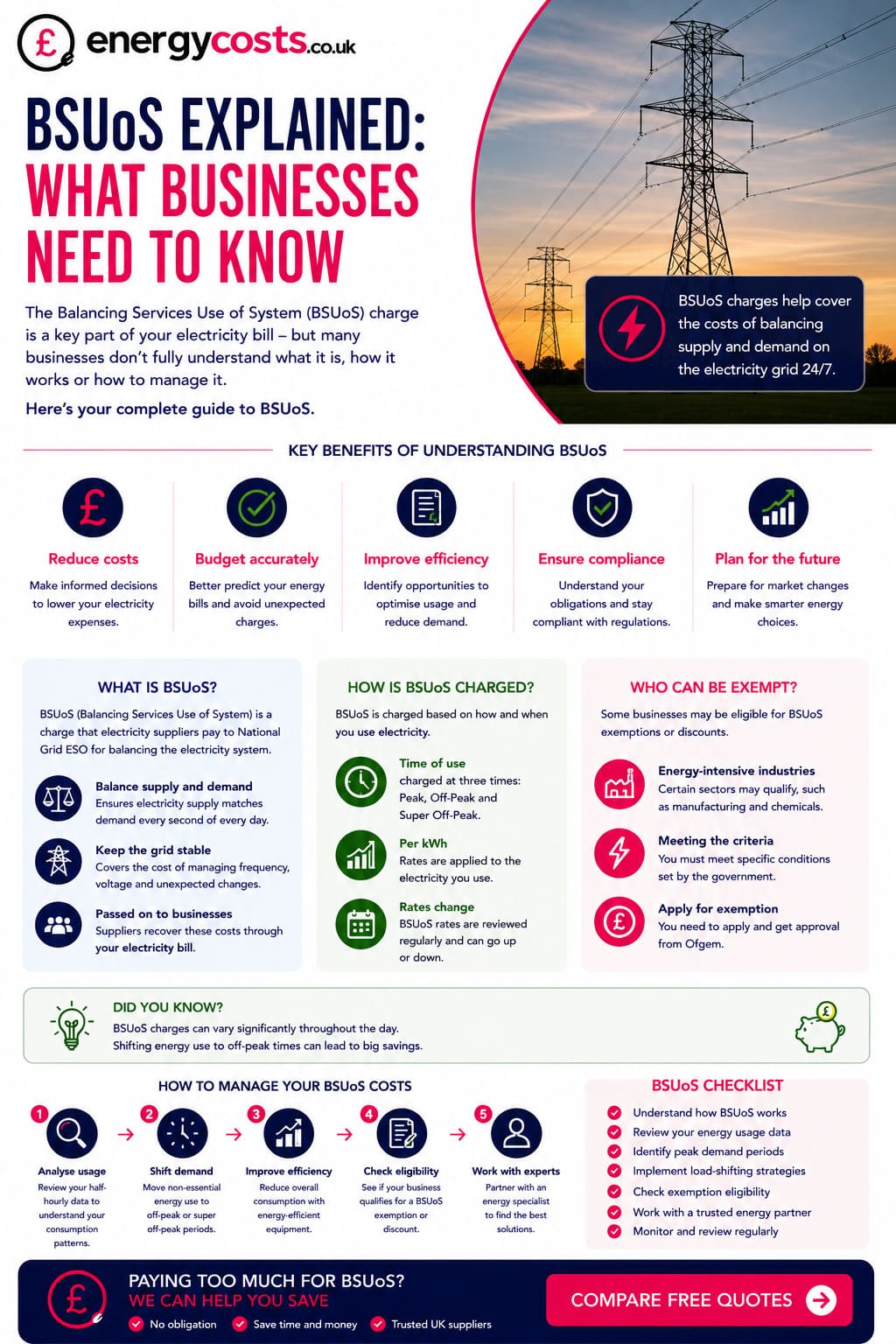
What does BSUoS pay for?
Electricity is different from many other products because it has to be produced and consumed at almost exactly the same time. If supply and demand move out of balance, the electricity system can become unstable.
BSUoS helps pay for the actions taken to keep the system balanced.
These actions can include:
- paying generators to increase output
- paying generators to reduce output
- calling on reserve power
- managing sudden generator outages
- managing changes in wind and solar generation
- keeping frequency stable
- dealing with network constraints
- balancing supply and demand across each settlement period
- maintaining system security
In simple terms, BSUoS pays for the electricity system’s real-time control and adjustment costs.
BSUoS versus TNUoS and DUoS
BSUoS is often mentioned alongside TNUoS and DUoS, but the three charges pay for different things.
| Charge | Full name | What it pays for | Simple comparison |
|---|---|---|---|
| TNUoS | Transmission Network Use of System | The national high-voltage electricity transmission network | Electricity motorways |
| DUoS | Distribution Use of System | Local and regional electricity distribution networks | Local electricity roads |
| BSUoS | Balancing Services Use of System | Real-time system balancing | Electricity traffic control |
TNUoS and DUoS are mainly network infrastructure charges. BSUoS is different because it pays for operating and balancing the system.
Why BSUoS affects business electricity bills
BSUoS affects business electricity bills because suppliers recover the cost from customers. Smaller businesses may not see BSUoS listed separately, but it is still normally built into the price they pay.
Depending on the contract, BSUoS may be:
| How BSUoS may appear | What it means |
|---|---|
| Included in the unit rate | The supplier builds BSUoS into the p/kWh price |
| Included in the standing charge | Some cost may be recovered as part of fixed pricing |
| Shown as a separate charge | More common for larger or more complex contracts |
| Passed through | The business pays the actual or updated BSUoS cost |
| Reconciled later | The supplier adjusts charges once final costs are known |
Ofgem lists BSUoS among the types of costs that may be included in business electricity pricing, alongside DUoS, transmission and distribution losses, reactive power charges, broker commissions and other supplier costs.
Is BSUoS a non-commodity charge?
Yes. BSUoS is a non-commodity charge.
This means it is not the wholesale cost of the electricity itself. It is a system cost added around the wholesale price.
A business electricity bill can include:
| Bill component | What it means |
|---|---|
| Wholesale electricity | The cost of buying electricity |
| TNUoS | Cost of the national transmission network |
| DUoS | Cost of local distribution networks |
| BSUoS | Cost of balancing the electricity system |
| RO | Renewables Obligation policy cost |
| FiT | Feed-in Tariff policy cost |
| CfD | Contracts for Difference policy cost |
| Capacity Market | Security-of-supply cost |
| Supplier margin | Supplier admin, billing and profit |
| Broker commission | Broker fee or commission, where applicable |
| Taxes | VAT and Climate Change Levy |
This is why businesses can see bills rise even when wholesale prices fall. The final bill depends on wholesale costs, network costs, balancing costs, policy charges, supplier pricing and contract structure.
Why does the electricity system need balancing?
The electricity system must be balanced constantly. Demand changes throughout the day, and generation does not always behave exactly as forecast.
For example:
| Situation | Why balancing may be needed |
|---|---|
| Wind output falls unexpectedly | Other generation or flexibility may be needed |
| Solar output drops because of cloud | The system may need replacement power |
| Demand is higher than forecast | Extra supply may be required |
| Demand is lower than forecast | Some generation may need to be reduced |
| A power station trips | Reserve power may be called on |
| Network constraints occur | Electricity may need to be redispatched |
| Interconnector flows change | The system may need rebalancing |
| Cold weather increases demand | More capacity may be required |
BSUoS is one way the cost of these balancing actions is recovered from electricity users.
How much is BSUoS in 2026/27?
BSUoS charges are set through fixed tariffs over defined periods. NESO’s final 2026/27 BSUoS tariffs cover two seasonal periods: April to September 2026 and October 2026 to March 2027.
Industry reporting after NESO’s final 2026/27 publication stated that the fixed BSUoS tariffs are £13.74/MWh for April to September 2026 and £12.49/MWh for October 2026 to March 2027.
| Period | Fixed BSUoS tariff |
|---|---|
| April 2026 to September 2026 | £13.74/MWh |
| October 2026 to March 2027 | £12.49/MWh |
Since 1MWh equals 1,000kWh, these rates are equivalent to roughly 1.37p/kWh and 1.25p/kWh respectively.
What could BSUoS cost a business?
The table below shows a simplified estimate using the 2026/27 fixed tariff levels.
| Annual electricity use | At £13.74/MWh | At £12.49/MWh |
|---|---|---|
| 10,000kWh | £137.40 | £124.90 |
| 25,000kWh | £343.50 | £312.25 |
| 50,000kWh | £687.00 | £624.50 |
| 100,000kWh | £1,374.00 | £1,249.00 |
| 250,000kWh | £3,435.00 | £3,122.50 |
| 500,000kWh | £6,870.00 | £6,245.00 |
| 1,000,000kWh | £13,740.00 | £12,490.00 |
| 5,000,000kWh | £68,700.00 | £62,450.00 |
These figures are simplified and do not include the rest of the electricity bill. They show why BSUoS can be a small-looking p/kWh charge but a material annual cost for high-usage businesses.
Why BSUoS is difficult to forecast
Balancing costs are difficult to forecast because they depend on real-time system conditions.
NESO’s draft 2026/27 tariff documentation noted that balancing costs are influenced by external factors including wholesale market prices, weather conditions and network outages.
| Driver | How it can affect BSUoS |
|---|---|
| Wholesale electricity prices | Higher market prices can increase the cost of balancing actions |
| Weather | Wind, solar output and demand can change quickly |
| Network outages | Constraints can increase redispatch costs |
| Generator outages | Replacement power may be needed |
| Demand forecasting errors | More balancing action may be required |
| Renewable generation variability | Output can differ from forecasts |
| Interconnector flows | Imports and exports can change system conditions |
| System constraints | Power may need to be moved or curtailed differently |
This is why BSUoS has historically been a volatile charge and why fixed tariffs were introduced to improve predictability.
Fixed BSUoS tariffs explained
From April 2023, BSUoS moved to a fixed tariff approach. NESO’s May 2026 forecast document states that, as a result of CMP361 and CMP362, the BSUoS charge has been a fixed tariff from 1 April 2023.
The purpose of fixed BSUoS tariffs is to give customers and suppliers more certainty. Instead of BSUoS changing half-hour by half-hour in a way that is difficult for end users to predict, it is set in advance for defined periods.
| Old-style issue | Fixed tariff benefit |
|---|---|
| More volatile charging | Greater predictability |
| Harder to forecast bills | Easier budget planning |
| Half-hourly variation | Published fixed tariff periods |
| Higher risk for pass-through customers | More certainty, though not no risk |
However, fixed does not mean risk-free. Ofgem has recently considered changes and urgency decisions relating to the BSUoS tariff reset process, because NESO may need mechanisms to reset tariffs where there is a material under-recovery of costs.
Can BSUoS still change during a contract?
Yes, depending on the contract and the regulatory arrangements.
For many small businesses on fixed-price contracts, BSUoS is usually already included in the quoted unit rate. For larger businesses on pass-through contracts, BSUoS may be charged more transparently and may change if tariffs, reconciliations or reset mechanisms apply.
| Contract type | BSUoS treatment |
|---|---|
| Fully fixed SME contract | Usually bundled into the agreed rate |
| Fixed contract with exclusions | BSUoS may still be adjustable |
| Pass-through contract | BSUoS may be charged at actual or updated cost |
| Flexible procurement contract | BSUoS may be managed separately from wholesale energy |
| Half-hourly contract | BSUoS may be more visible or itemised |
A contract described as “fixed” does not always mean every non-commodity charge is fixed. Businesses should check the wording.
BSUoS and pass-through contracts
BSUoS is especially important for businesses on pass-through electricity contracts.
A pass-through contract is one where the supplier passes certain third-party costs directly to the customer, rather than including them all in a fixed price. This can be more transparent, but it can also reduce budget certainty.
| Pass-through risk | Why it matters |
|---|---|
| BSUoS may be billed separately | The business sees the cost more directly |
| Forecasts may change | Final costs can differ from initial estimates |
| Reconciliation may apply | Catch-up charges or credits may occur |
| Quote comparisons become harder | A low unit rate may exclude some costs |
| Higher usage magnifies the impact | Small p/kWh changes become large annual costs |
A business comparing contracts should always ask whether BSUoS is fixed, forecast, passed through or reconciled.
BSUoS versus wholesale electricity price
BSUoS is not the wholesale electricity price. It is a separate system-balancing charge.
| Cost | What it means |
|---|---|
| Wholesale electricity | The cost of buying electricity in the market |
| BSUoS | The cost of balancing the system |
| TNUoS | The cost of the transmission network |
| DUoS | The cost of local distribution networks |
However, BSUoS can be influenced by wholesale market conditions. If balancing actions require buying or adjusting power when wholesale prices are high, balancing costs can be more expensive.
Why renewable energy can affect BSUoS
Renewable generation is not the only driver of BSUoS, but it can affect balancing costs.
Wind and solar generation are weather-dependent. When output is different from forecasts, the system may need balancing action. In some cases, renewable output may be constrained because the network cannot move all the power to where it is needed.
That does not mean renewable energy is bad for the system. It means the electricity system needs flexibility, storage, stronger networks and better forecasting to manage more variable generation efficiently.
Businesses may increasingly hear about BSUoS in the context of:
- wind curtailment
- grid constraints
- system balancing
- battery storage
- demand-side response
- flexible electricity use
- clean power targets
- grid reinforcement
Which businesses are most affected by BSUoS?
Every electricity customer contributes to BSUoS in some form, but the charge matters most for high-usage businesses.
| Business type | Why BSUoS matters |
|---|---|
| Manufacturer | High electricity use magnifies p/kWh charges |
| Cold storage site | Continuous load means high annual exposure |
| Warehouse | Lighting, automation, refrigeration and EV charging can increase usage |
| Hotel | Kitchens, lifts, laundry, cooling and lighting add demand |
| Care home | 24/7 operation means high annual electricity use |
| Leisure centre | Pools, gyms, HVAC and hot water systems use large amounts of energy |
| Data centre | High continuous load creates significant exposure |
| Multi-site retailer | Small charges multiplied across many sites become material |
| Food producer | Refrigeration, processing and machinery increase demand |
For a small office, BSUoS may be a hidden part of the unit rate. For a large half-hourly site, it can be a visible and significant charge.
Can businesses reduce BSUoS?
Businesses usually cannot avoid BSUoS entirely, because it is part of the cost of using the electricity system. However, they may reduce their exposure by reducing grid electricity consumption or choosing contract terms carefully.
| Action | How it can help |
|---|---|
| Reduce electricity use | Lowers usage-linked BSUoS exposure |
| Improve energy efficiency | Cuts the number of kWh billed |
| Install solar panels | Reduces imported electricity during generation periods |
| Use battery storage | May reduce grid imports and support peak management |
| Review contract structure | Helps decide between fixed and pass-through risk |
| Check invoices | Helps identify unexpected BSUoS adjustments |
| Use half-hourly data | Helps understand consumption patterns |
| Compare total annual cost | Avoids being misled by a low headline unit rate |
Unlike some DUoS-related costs, BSUoS is not usually something a small business can reduce by changing its usage time band. It is more commonly managed through consumption reduction, contract choice and procurement strategy.
Example: BSUoS impact on a small business
A small business uses 30,000kWh of electricity per year.
| BSUoS rate | Approximate annual BSUoS cost |
|---|---|
| £12.49/MWh | £374.70 |
| £13.74/MWh | £412.20 |
This does not mean the business will see a separate BSUoS charge of this amount. The supplier may bundle it into the unit rate or standing charge.
Example: BSUoS impact on a larger business
A manufacturer uses 2,000,000kWh of electricity per year.
| BSUoS rate | Approximate annual BSUoS cost |
|---|---|
| £12.49/MWh | £24,980 |
| £13.74/MWh | £27,480 |
For larger businesses, BSUoS can be a five-figure annual cost. It should therefore be part of any serious electricity procurement review.
Why BSUoS can make quotes difficult to compare
Business electricity quotes can be difficult to compare because suppliers may treat BSUoS differently.
One supplier may include BSUoS in a fully fixed price. Another may pass it through. A third may include a forecast but reconcile the difference later.
| Quote approach | What to watch |
|---|---|
| BSUoS included and fixed | Better certainty, but supplier may include risk premium |
| BSUoS passed through | More transparent, but variable |
| BSUoS forecast | Check whether it can be reconciled later |
| BSUoS excluded | The headline unit rate may look artificially low |
| BSUoS bundled | Harder to see the exact cost |
The safest way to compare offers is to ask for the estimated total annual cost, including all non-commodity charges, standing charges, broker commission, VAT and CCL.
Questions to ask your supplier or broker about BSUoS
Before signing a business electricity contract, ask:
| Question | Why it matters |
|---|---|
| Is BSUoS included in the unit rate? | Shows whether the quote is bundled |
| Is BSUoS fixed for the contract term? | Confirms budget certainty |
| Is BSUoS passed through? | Identifies variable-cost risk |
| Can BSUoS be reconciled later? | Warns of possible catch-up charges |
| What BSUoS forecast has been used? | Helps compare quotes |
| How often can BSUoS change? | Important for budgeting |
| Is the contract fully fixed or only energy-fixed? | Avoids misunderstanding |
| Is broker commission included? | Prevents misleading comparisons |
| Can I see the total annual cost? | Better than comparing p/kWh alone |
| What happens if NESO resets tariffs? | Important for pass-through customers |
If a broker cannot explain how BSUoS is treated, the quote may not be clear enough to sign.
How to check whether BSUoS is affecting your bill
Look for the following on your bill, contract or quote:
| Item to check | Why it matters |
|---|---|
| BSUoS line item | Shows whether the cost is itemised |
| Non-commodity charges | BSUoS may be grouped with other charges |
| Pass-through clause | Confirms whether BSUoS can move |
| Reconciliation wording | Indicates possible future adjustments |
| Unit rate | BSUoS may be bundled into p/kWh |
| Standing charge | Some costs may be recovered through fixed charges |
| Contract end date | New BSUoS forecasts may apply after renewal |
| Supplier pricing notes | May explain industry charge changes |
| Broker quote sheet | Should show whether BSUoS is included or excluded |
BSUoS should be checked alongside TNUoS, DUoS, RO, FiT, CfD, Capacity Market, standing charges and broker commission.
BSUoS and business electricity bills in 2026
BSUoS is not the main reason every business bill has risen in 2026. In many cases, TNUoS, standing charges and wider non-commodity costs are more prominent. However, BSUoS remains a significant part of the electricity cost stack.
The key issue is that businesses are paying for a more complex electricity system. The grid needs to balance more renewable generation, more flexible demand, more electrification, more interconnectors, more storage and more high-demand sites such as data centres.
Even where BSUoS fixed tariffs fall from one period to another, businesses should still understand the charge because it affects total cost, quote comparisons and pass-through contract risk.
Summary
BSUoS stands for Balancing Services Use of System. It is the charge used to recover the cost of balancing the electricity system in real time.
It affects businesses because suppliers recover BSUoS through electricity bills. For smaller businesses, it is usually hidden in the unit rate or standing charge. For larger businesses, it may appear separately, especially on pass-through or flexible contracts.
BSUoS is different from TNUoS and DUoS. TNUoS pays for the national transmission network. DUoS pays for local distribution networks. BSUoS pays for the day-to-day balancing actions needed to keep the electricity system stable.
For 2026/27, industry reporting of NESO’s final tariffs shows fixed BSUoS rates of £13.74/MWh for April to September 2026 and £12.49/MWh for October 2026 to March 2027. For a business using 1,000,000kWh per year, that equates to roughly £12,490–£13,740 before considering other bill components.
The key lesson for businesses is to ask whether BSUoS is fixed, passed through, forecast or reconciled. It may look like a technical industry charge, but for high-usage businesses it can be a meaningful annual cost.
FAQ
BSUoS stands for Balancing Services Use of System. It is an electricity charge used to recover the cost of balancing the electricity system.
BSUoS pays for the day-to-day operation and balancing of the electricity transmission system. NESO says BSUoS recovers the cost of day-to-day operation, including the cost of balancing the electricity transmission system.
Yes. BSUoS is included in business electricity costs, although smaller businesses may not see it listed separately.
No. BSUoS is an electricity charge. It does not apply to business gas bills.
No. TNUoS pays for the transmission network infrastructure. BSUoS pays for balancing the electricity system in real time.
No. DUoS pays for local distribution networks. BSUoS pays for electricity system balancing.
Yes, depending on the contract. Some suppliers fix BSUoS in the quoted rate, while others pass it through or reconcile it later.
BSUoS varies because balancing costs are affected by system conditions, wholesale prices, weather, network outages, demand changes and generation availability. NESO has noted that balancing costs are influenced by wholesale market prices, weather conditions and network outages.
Industry reporting of NESO’s final 2026/27 tariffs shows £13.74/MWh for April to September 2026 and £12.49/MWh for October 2026 to March 2027.
Usually not directly, but they can reduce exposure by cutting electricity use, improving efficiency, installing solar panels, using battery storage and choosing contracts where BSUoS treatment is clear.