
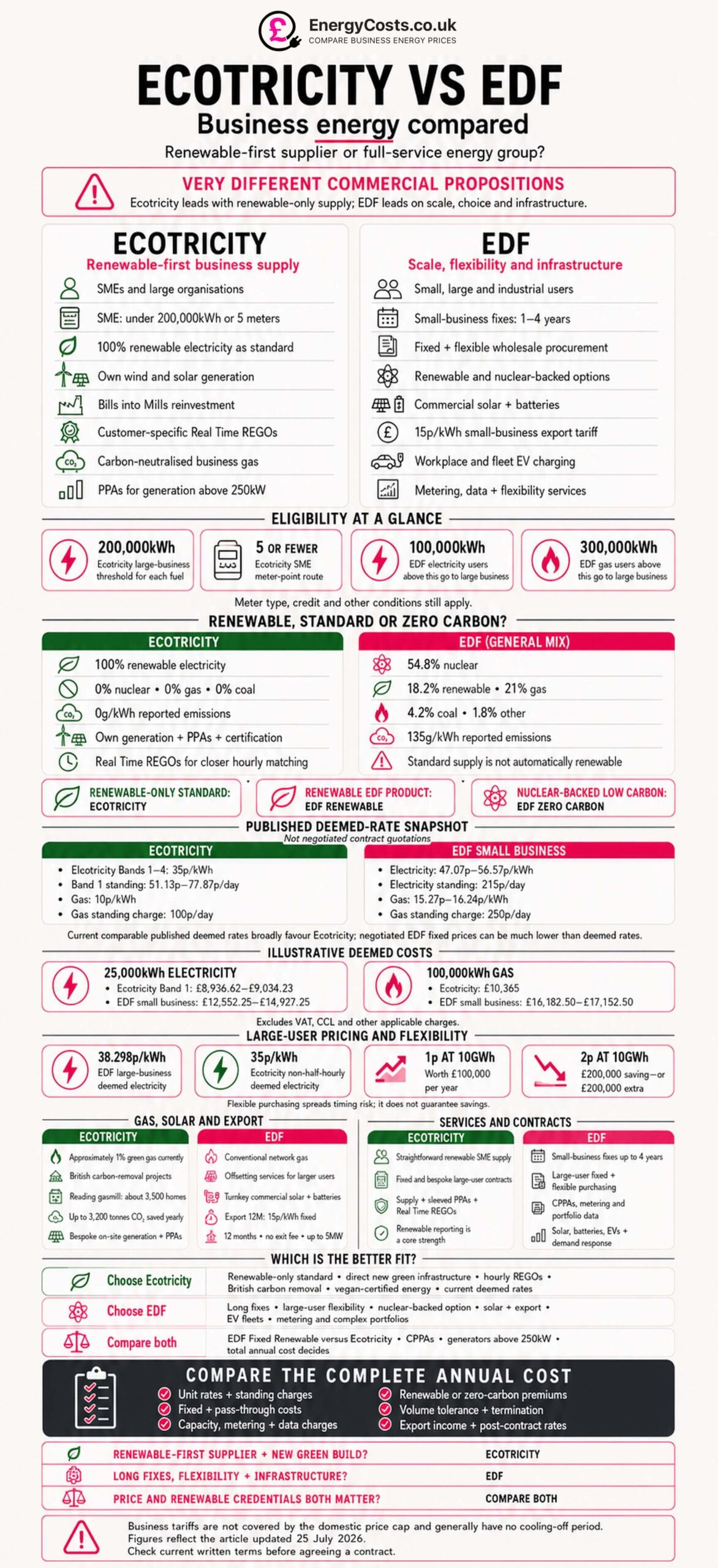
Ecotricity and EDF both supply electricity and gas to British businesses, but their commercial energy propositions are very different.
Ecotricity is a comparatively small, renewable-focused supplier. Its business electricity is described as 100% renewable, while money earned through energy supply is reinvested in new wind, solar and green-gas projects through its “Bills into Mills” model.
EDF is one of Britain’s largest energy companies and the country’s biggest generator of zero-carbon electricity. It supplies small companies, large organisations and major industrial users, offering fixed contracts, flexible wholesale purchasing, renewable electricity, nuclear-backed zero-carbon electricity, metering, commercial solar, electric vehicle charging and Corporate Power Purchase Agreements.
For a small company seeking a straightforward renewable electricity contract, Ecotricity may provide the clearer environmental proposition. For a large or complex energy user, EDF offers a much broader selection of procurement, data, infrastructure and net-zero services.
Price cannot be determined from the supplier names alone. Both companies calculate negotiated business rates according to the meter, location, consumption, credit profile and proposed contract. The only reliable way to identify the cheaper supplier is to obtain comparable written quotations.
Ecotricity vs EDF at a glance
| Feature | Ecotricity Business | EDF Business |
|---|---|---|
| Small-business electricity | Yes | Yes |
| Small-business gas | Yes | Yes |
| Large-business supply | Yes | Yes |
| Standard negotiated prices published | No | No |
| Fixed small-business contracts | Available by quotation | One, two, three or four years |
| Large-business fixed contracts | Yes | Yes |
| Flexible wholesale procurement | Bespoke arrangements | Extensive flexible purchasing options |
| Standard business electricity proposition | 100% renewable | Standard fuel mix unless a renewable or zero-carbon product is selected |
| Renewable electricity option | Included in the business proposition | Fixed Renewable and large-business renewable products |
| Nuclear-backed electricity option | No | Zero Carbon for Business |
| Supplier fuel mix | 100% renewable electricity | 54.8% nuclear, 18.2% renewable, 21% gas, 4.2% coal and 1.8% other |
| Time-matched renewable reporting | Real Time REGOs | Renewable products, fuel labels and CPPA reporting |
| Business gas | Carbon-neutralised gas | Conventional gas, with carbon-offsetting services available for larger users |
| Commercial solar | On-site generation support | Small-business and large-business solar services |
| Battery storage | Bespoke energy solutions | Available through EDF group partners |
| Small-business solar export | No equivalent prominent 15p tariff | 15p/kWh fixed for 12 months for eligible EDF supply customers |
| Commercial PPAs | Yes | Yes |
| Publicly promoted Ecotricity PPA threshold | Generation above 250kW | SEG available up to 5MW; larger PPA arrangements are bespoke |
| EV charging services | Limited compared with EDF | Commercial and public-sector EV charging services |
| Energy flexibility services | Bespoke | Extensive large-business flexibility services |
| Best suited to | Renewable-led SMEs and environmentally focused organisations | Businesses wanting scale, long fixes, procurement flexibility and net-zero infrastructure |
Which businesses can apply?
Both suppliers accept small-business and large-business customers, although they classify customers differently.
Ecotricity eligibility
Ecotricity directs a business to its large-business service if it uses more than:
- 200,000kWh of electricity annually; or
- 200,000kWh of gas annually.
Its SME service also covers businesses with no more than five meter points.
This means Ecotricity can potentially supply:
- independent shops;
- offices;
- cafés and restaurants;
- hotels;
- workshops;
- charities;
- schools;
- care homes;
- warehouses;
- manufacturers; and
- national multi-site organisations.
EDF eligibility
EDF’s online quotation route directs businesses consuming more than:
- 100MWh of electricity, equivalent to 100,000kWh; or
- 300MWh of gas, equivalent to 300,000kWh,
to its large-business service.
Businesses below those levels can generally use EDF’s small-business quotation service, subject to meter type, credit checks and other eligibility conditions.
The different thresholds create an area of overlap. For example, a company consuming 150,000kWh of electricity may be treated as an SME by Ecotricity but directed to EDF’s large-business team.
Eligibility examples
| Example organisation | Annual electricity | Annual gas | Likely quotation route |
|---|---|---|---|
| Small shop | 12,000kWh | 10,000kWh | Small-business service from both |
| Office | 60,000kWh | 80,000kWh | Small-business service from both |
| Restaurant | 120,000kWh | 250,000kWh | Ecotricity SME; EDF large-business electricity route |
| Hotel | 350,000kWh | 1,000,000kWh | Large-business service from both |
| Manufacturer | 2,000,000kWh | 4,000,000kWh | Large-business service from both |
| National retail chain | 15,000,000kWh | 5,000,000kWh | Large-business and multi-site teams |
The supplier may still refuse to quote or request a security deposit following a credit assessment.
Which supplier is cheaper?
Neither Ecotricity nor EDF has one national negotiated business rate.
A quotation can change according to:
- the electricity MPAN or gas MPRN;
- postcode and distribution region;
- meter profile;
- half-hourly consumption pattern;
- annual electricity and gas use;
- agreed electricity capacity;
- number of premises;
- credit history;
- contract length;
- contract start date;
- payment method;
- renewable product selection; and
- wholesale prices when the quote is prepared.
EDF says it reviews its small-business tariff prices weekly. Ecotricity also produces site-specific quotations rather than one permanent national price.
The correct comparison is:
- Annual consumption × unit rate
- daily standing charge × 365
- meter and data charges
- capacity charges
- network and policy costs
- renewable or zero-carbon premiums
- VAT and Climate Change Levy where applicable
− export income or contractual credits
A supplier with a lower unit rate can still cost more if it has a higher standing charge or additional pass-through costs.
How much does a rate difference matter?
| Annual consumption | Value of 1p/kWh | Value of 3p/kWh | Value of 5p/kWh |
|---|---|---|---|
| 10,000kWh | £100 | £300 | £500 |
| 25,000kWh | £250 | £750 | £1,250 |
| 50,000kWh | £500 | £1,500 | £2,500 |
| 100,000kWh | £1,000 | £3,000 | £5,000 |
| 250,000kWh | £2,500 | £7,500 | £12,500 |
| 1,000,000kWh | £10,000 | £30,000 | £50,000 |
| 10,000,000kWh | £100,000 | £300,000 | £500,000 |
A 1p/kWh difference may be relatively modest for a small office but worth £100,000 a year to a company consuming 10GWh.
Comparing small-business deemed electricity rates
Deemed tariffs apply when a business consumes energy without having agreed a contract. This often happens when a company moves into premises already supplied by the provider.
They are normally more expensive than negotiated contracts and should not be used as representative new-customer quotes.
EDF’s small-business deemed prices effective from 1 June 2026 include the following charges for a standard meter paid by Direct Debit:
| EDF small-business deemed electricity | Published rate |
|---|---|
| Lowest regional unit rate | 47.07p/kWh |
| Highest regional unit rate | 56.57p/kWh |
| Daily standing charge | 215p |
| Annual standing charge | £784.75 |
Cash or cheque customers pay unit rates 1p/kWh higher and a standing charge of 225p per day.
Ecotricity’s non-half-hourly commercial deemed rates from 1 April 2026 include:
| Ecotricity category | Unit rate | Daily standing-charge range |
|---|---|---|
| No Residual | 33p/kWh | 51.13p–77.87p |
| Band 1 | 35p/kWh | 51.13p–77.87p |
| Band 2 | 35p/kWh | 86.20p–135.96p |
| Band 3 | 35p/kWh | 152.21p–250.10p |
| Band 4 | 35p/kWh | 375.75p–645.99p |
The classifications are not directly equivalent. EDF’s table is based on meter type and region, while Ecotricity uses distribution residual bands.
However, Ecotricity’s published commercial deemed unit rate is currently below EDF’s small-business deemed range.
Illustrative small-business deemed electricity costs
The following examples compare EDF’s regional standard-meter range with Ecotricity’s Band 1 rate.
| Annual electricity use | EDF small-business range | Ecotricity Band 1 range |
|---|---|---|
| 10,000kWh | £5,491.75–£6,441.75 | £3,686.62–£3,784.23 |
| 25,000kWh | £12,552.25–£14,927.25 | £8,936.62–£9,034.23 |
| 50,000kWh | £24,319.75–£29,069.75 | £17,686.62–£17,784.23 |
| 100,000kWh | £47,854.75–£57,354.75 | £35,186.62–£35,284.23 |
These calculations exclude VAT, Climate Change Levy and other applicable charges.
They compare deemed tariffs only. A negotiated EDF fixed tariff could be considerably cheaper than EDF’s deemed rate.
Economy 7 and time-based deemed rates
EDF publishes separate deemed prices for businesses with Economy 7, evening and weekend, and off-peak meters.
From 1 June 2026, its Direct Debit Economy 7 prices include:
| EDF Economy 7 deemed charge | Published regional range |
|---|---|
| Day rate | 48.09p–57.79p/kWh |
| Night rate | 43.16p–51.87p/kWh |
| Daily standing charge | 215p |
The night rate is cheaper than the day rate, but remains above Ecotricity’s 35p/kWh standard commercial deemed rate.
A business should not select an Economy 7 contract solely because it has a cheaper night price. The weighted average depends on the proportion of consumption that occurs overnight.
For example, if the day rate is 50p and the night rate is 44p:
| Night-time share | Weighted average unit price |
|---|---|
| 10% | 49.4p/kWh |
| 25% | 48.5p/kWh |
| 50% | 47p/kWh |
| 75% | 45.5p/kWh |
A substantial amount of consumption must occur during the cheaper period before the night rate materially reduces the annual average.
Comparing large-business deemed electricity rates
EDF publishes separate deemed schedules for larger non-half-hourly and half-hourly supplies.
From 1 June 2026, EDF’s non-half-hourly large-business deemed electricity rate is:
| EDF large-business charge | Published amount |
|---|---|
| Unit rate | 38.298p/kWh |
| No Residual standing charge | 333.71p–360.66p per day |
| Band 1 standing charge | 356.06p–389.14p per day |
| Band 2 standing charge | 399.11p–460.68p per day |
| Band 3 standing charge | 480.16p–601.28p per day |
| Band 4 standing charge | 754.65p–1,089p per day |
The approximate annual standing charges are:
| Band | EDF annual standing-charge range | Ecotricity annual range |
|---|---|---|
| No Residual | £1,218–£1,316 | £186.62–£284.23 |
| Band 1 | £1,300–£1,420 | £186.62–£284.23 |
| Band 2 | £1,457–£1,681 | £314.63–£496.25 |
| Band 3 | £1,753–£2,195 | £555.57–£912.87 |
| Band 4 | £2,754–£3,975 | £1,371–£2,358 |
Ecotricity’s published non-half-hourly rate of 35p/kWh is also 3.298p/kWh below EDF’s 38.298p/kWh large-business rate.
At 500,000kWh, that unit-rate difference is worth £16,490 before standing charges.
Again, this is a comparison of deemed prices rather than negotiated fixed tariffs.
Half-hourly deemed electricity
EDF’s half-hourly deemed prices vary by region and voltage.
For low-voltage supplies from 1 June 2026:
| EDF half-hourly component | Published range |
|---|---|
| All Other Times rate | 37.206p–40.203p/kWh |
| Night rate | 34.649p–35.421p/kWh |
| Capacity charge | £0.0382–£0.1383 per kVA per day |
EDF also applies monthly TCR standing charges based on the site’s residual band.
Ecotricity publishes several half-hourly rate structures. Depending on voltage, capacity arrangements and residual band, its current deemed unit rates include 31p, 33p or 35p/kWh.
Ecotricity’s half-hourly published rates exclude:
- DUoS capacity charges;
- excess-capacity charges;
- reactive-power charges;
- meter-maintenance costs;
- data-collection costs;
- VAT;
- Climate Change Levy; and
- government-imposed taxes.
EDF’s prices similarly exclude VAT, CCL, metering, reactive power and excess-capacity charges.
A business with a half-hourly meter should request a full cost model based on at least 12 months of interval data. Comparing one unit-rate figure can conceal substantial capacity, standing and network charges.
Comparing small-business deemed gas rates
EDF’s small-business deemed gas prices effective from 1 June 2026 are:
| EDF small-business deemed gas | Published range |
|---|---|
| Direct Debit unit rate | 15.27p–16.24p/kWh |
| Direct Debit standing charge | 250p per day |
| Annual standing charge | £912.50 |
| Cash or cheque unit rate | 16.27p–17.24p/kWh |
| Cash or cheque standing charge | 260p per day |
Ecotricity’s published deemed business gas price is:
| Ecotricity deemed gas | Published rate |
|---|---|
| Unit rate | 10p/kWh |
| Standing charge | 100p per day |
| Annual standing charge | £365 |
Ecotricity is therefore cheaper on both the published unit rate and standing charge.
Illustrative small-business deemed gas costs
| Annual gas use | EDF Direct Debit range | Ecotricity |
|---|---|---|
| 25,000kWh | £4,730–£4,972.50 | £2,865 |
| 50,000kWh | £8,547.50–£9,032.50 | £5,365 |
| 100,000kWh | £16,182.50–£17,152.50 | £10,365 |
| 250,000kWh | £39,087.50–£41,512.50 | £25,365 |
The figures exclude VAT, CCL and any additional charges.
The comparison strongly favours Ecotricity’s current deemed gas tariff, but an EDF negotiated fixed contract may produce a different result.
EDF large-business deemed gas
EDF’s large-business deemed gas rate from 1 June 2026 is:
| Charge | EDF large business | Ecotricity |
|---|---|---|
| Unit rate | 9.996p/kWh | 10p/kWh |
| Daily standing charge | 909.04p | 100p |
| Annual standing charge | Approximately £3,318 | £365 |
The unit rates are almost identical, but EDF’s published daily charge is substantially higher.
| Annual gas use | EDF large-business deemed cost | Ecotricity deemed cost |
|---|---|---|
| 100,000kWh | £13,314 | £10,365 |
| 250,000kWh | £28,308 | £25,365 |
| 500,000kWh | £53,298 | £50,365 |
| 1,000,000kWh | £103,278 | £100,365 |
At high consumption levels, the effect of the standing-charge difference becomes less significant relative to the total bill.
EDF small-business fixed tariffs
EDF offers fixed small-business contracts lasting:
- one year;
- two years;
- three years; or
- four years.
The unit rate and standing charge are fixed for the selected contract period, subject to the specific contract terms.
Fixed contracts may suit a company that wants:
- protection from wholesale price increases;
- predictable monthly expenditure;
- simpler budgeting;
- fewer procurement decisions; and
- certainty over the contract end date.
The disadvantage is that the company may not benefit if market prices fall. An early termination fee can also apply if the business leaves before the end of the agreement.
EDF’s online fixed product generally requires:
- online account management;
- electronic bills;
- payment by the specified Direct Debit or PAYG method;
- a valid email address; and
- agreement to install a compatible smart meter where required.
Businesses wanting telephone account management should check that they are not selecting an online-only tariff.
EDF Fixed Renewable tariff
EDF launched a Fixed Renewable electricity tariff for small businesses in April 2026.
The product provides:
- fixed prices for one, two, three or four years;
- electricity matched with UK Renewable Energy Guarantees of Origin;
- renewable sources including wind, solar and hydro;
- payment by Direct Debit; and
- market-based zero-emission reporting for purchased electricity.
For every megawatt-hour used, EDF matches the consumption with one UK REGO.
The tariff does not mean that a separate physical cable connects the premises to a wind or solar farm. Electricity is delivered through the national grid, while the certificates evidence that an equivalent quantity of renewable generation has been allocated to the customer.
EDF large-business fixed contracts
EDF offers tailored fixed-price electricity, gas and dual-fuel contracts for larger organisations.
A large-business agreement can fix:
- the wholesale energy component;
- some non-energy charges;
- all eligible charges; or
- a selected combination of fixed and pass-through elements.
A company should establish exactly what “fixed” means in the proposed contract.
Non-energy costs can include:
- Distribution Use of System charges;
- Transmission Network Use of System charges;
- Balancing Services Use of System charges;
- Contracts for Difference;
- Capacity Market costs;
- Renewables Obligation charges;
- meter operation;
- data collection;
- transmission and distribution losses; and
- changes in law or regulation.
Two contracts carrying the same wholesale price can produce different total costs if one fixes more non-energy charges.
EDF flexible contracts
EDF has a clear advantage where a large organisation wants to purchase energy in stages rather than fixing the whole forecast on one day.
Its flexible contracts allow the company to choose:
- when energy is purchased;
- how much is purchased at each trade;
- whether some volume remains exposed to market prices;
- the degree of procurement support; and
- whether zero-carbon electricity is added.
A flexible strategy can spread market-timing risk.
For example, a business expecting to use 10GWh might buy:
- 25% when the contract is signed;
- 25% six months later;
- 25% when a price target is reached; and
- the final 25% closer to delivery.
If the four purchases average 18p/kWh instead of a possible 20p fixed price, the saving would be:
10,000,000kWh × 2p = £200,000
If the average rises to 22p/kWh, the company would instead pay £200,000 more.
Flexible procurement can reduce the risk of fixing everything at an unfavourable time, but it does not guarantee a saving.
Ecotricity fixed business tariffs
Ecotricity offers quoted business contracts for SMEs and fixed pricing for larger users.
Its SME proposition emphasises:
- straightforward pricing;
- 100% renewable electricity;
- carbon-neutralised gas;
- no hidden fees;
- assistance with switching; and
- reinvestment in new green energy.
Large companies can request made-to-measure pricing, half-hourly billing and more complex renewable arrangements.
Ecotricity publishes less information about standardised flexible wholesale-trading products than EDF. It is therefore more likely to appeal to a business seeking a straightforward renewable supply agreement than to a large organisation wanting an active hedging programme.
Comparing renewable electricity
The largest environmental distinction is that Ecotricity makes renewable electricity its standard business proposition, while EDF gives customers a choice between standard, renewable and nuclear-backed zero-carbon products.
Ecotricity electricity
Ecotricity’s published electricity mix is:
| Source | Ecotricity |
|---|---|
| Renewables | 100% |
| Nuclear | 0% |
| Gas | 0% |
| Coal | 0% |
| Other | 0% |
| Reported carbon emissions | 0g/kWh |
| Reported radioactive waste | 0g/kWh |
Ecotricity obtains electricity through its own wind and solar generation, Power Purchase Agreements and renewable certification.
Its environmental proposition also includes Bills into Mills. Rather than distributing excess profits as dividends, Ecotricity says it invests them in new wind, solar and green-gas infrastructure.
EDF’s general electricity mix
EDF’s published licence-wide fuel mix for April 2024 to March 2025 was:
| Source | EDF | UK average |
|---|---|---|
| Coal | 4.2% | 5.9% |
| Gas | 21% | 33.3% |
| Nuclear | 54.8% | 16.2% |
| Renewables | 18.2% | 42.1% |
| Other | 1.8% | 2.5% |
| Reported carbon emissions | 135g/kWh | 154g/kWh |
| Radioactive waste | 0.0038g/kWh | 0.0011g/kWh |
This supplier-wide mix does not apply to a customer who specifically buys EDF’s renewable or zero-carbon product.
EDF’s overall carbon intensity is below the stated UK average, principally because more than half of its mix is nuclear.
Renewable versus zero-carbon electricity
EDF gives large businesses a choice of different electricity sources.
EDF Renewable for Business
This product is backed by renewable generation such as:
- wind;
- solar; and
- hydroelectricity.
It can be combined with fixed or flexible procurement and can support market-based zero-emission reporting.
EDF Zero Carbon for Business
Zero Carbon for Business is backed principally by nuclear generation.
Nuclear electricity produces no carbon dioxide at the point of generation, but it is not renewable and produces radioactive waste.
A company may therefore choose:
- Ecotricity for renewable-only electricity;
- EDF Renewable for a renewable EDF product; or
- EDF Zero Carbon for nuclear-backed low-carbon electricity.
The appropriate option depends on the company’s environmental policy. Some organisations accept nuclear power as part of their net-zero strategy, while others require electricity sourced exclusively from renewable technologies.
Real Time REGOs and detailed reporting
Ecotricity offers Real Time REGOs for businesses seeking a closer match between when electricity is used and when renewable energy is generated.
Traditional renewable tariffs normally match consumption and renewable certificates over an annual period. This does not necessarily mean that renewable electricity was generated during the same hour in which the business consumed energy.
Ecotricity’s service can combine:
- half-hourly consumption data;
- renewable generation data;
- REGOs;
- Ecotricity PPAs; and
- a customer’s sleeved PPA.
This may suit companies pursuing:
- 24/7 carbon-free energy;
- detailed Scope 2 reporting;
- sustainability audits;
- science-based targets;
- supply-chain disclosure requirements; or
- stronger evidence against greenwashing accusations.
EDF can also provide renewable reporting, fuel labels and CPPA structures. However, Ecotricity places more public emphasis on time-matched REGOs as a standalone business product.
Comparing business gas
Neither supplier should be assumed to deliver entirely renewable physical gas.
Ecotricity gas
Ecotricity describes its business gas as carbon neutralised.
The supplier says approximately 1% of the gas it supplies currently comes from green gas mills, with the remainder being fossil gas.
It is developing gasmills that create biomethane from grass through anaerobic digestion. Ecotricity is also moving away from conventional international carbon-avoidance credits in favour of British carbon-removal and nature-recovery projects.
These include:
- rewilding;
- enhanced rock weathering; and
- projects intended to remove carbon directly from the atmosphere.
Its proposed Reading green gasmill is intended to produce the equivalent annual gas consumption of approximately 3,500 homes and save up to 3,200 tonnes of carbon dioxide each year.
EDF gas
EDF’s ordinary business gas remains conventional network gas.
For larger organisations, EDF offers access to carbon-offsetting services using credits from a portfolio of projects. These can be used for residual emissions while a company develops longer-term physical reduction plans.
Businesses should distinguish between:
- fossil gas;
- biomethane;
- renewable gas certificates;
- carbon avoidance;
- carbon offsetting;
- carbon removal; and
- reducing gas consumption.
Gas burned at the premises normally creates direct Scope 1 emissions regardless of the supplier. Offsets or removal credits address the reported impact but do not stop combustion emissions occurring at the site.
Commercial solar and batteries
EDF offers a broader publicly advertised commercial solar service.
EDF small-business solar
EDF directs small businesses towards solar panel and battery solutions through Contact Solar, which is part of the EDF family.
A system may include:
- roof-mounted solar panels;
- battery storage;
- monitoring;
- commercial EV charging; and
- an export tariff.
The value of solar depends on:
- installation size;
- roof direction;
- shading;
- daytime demand;
- capital cost;
- finance;
- export rate;
- maintenance;
- panel degradation; and
- how long the business occupies the premises.
EDF large-business solar
EDF Group company SAS Energy delivers commercial and public-sector solar projects.
EDF can combine solar with:
- battery storage;
- energy supply;
- EV charging;
- flexibility services;
- export purchasing; and
- wider decarbonisation planning.
Ecotricity on-site generation
Ecotricity can help businesses develop on-site wind and solar generation and can discuss purchasing surplus output through a PPA.
Its public proposition is less focused on a standard turnkey rooftop solar package and more on bespoke generation, supply and export arrangements.
For a typical SME wanting one provider to arrange panels, batteries, supply and export, EDF currently has the clearer route.
Export tariffs and PPAs
EDF small-business export tariff
EDF’s Export 12M Small Business tariff currently pays eligible existing EDF electricity customers:
| Feature | EDF Export 12M Small Business |
|---|---|
| Export rate | 15p/kWh |
| Price structure | Fixed |
| Contract length | 12 months |
| Exit fee | None |
| Maximum eligible generation | Up to 5MW, or 50kW for micro-CHP |
| Eligible technologies | Solar, wind, hydro, anaerobic digestion and micro-CHP |
At 15p/kWh, annual export income would be:
| Electricity exported | Annual income |
|---|---|
| 5,000kWh | £750 |
| 10,000kWh | £1,500 |
| 25,000kWh | £3,750 |
| 50,000kWh | £7,500 |
| 100,000kWh | £15,000 |
EDF also offers a variable small-business export tariff paying 5.6p/kWh to eligible EDF electricity customers.
Ecotricity PPAs
Ecotricity publicly promotes PPAs for companies generating more than 250kW on site.
A PPA can provide:
- a route to market;
- an agreed export price;
- renewable certificate treatment;
- payment arrangements;
- balancing support; and
- longer-term revenue certainty.
Ecotricity can also combine a PPA with business supply and Real Time REGOs.
Which is better for exports?
EDF is likely to be more accessible for an ordinary SME solar installation because it publishes a 15p/kWh tariff and supports eligible generation up to 5MW.
Ecotricity may be more relevant for larger bespoke installations, particularly where the company wants to combine the generator, supply contract and hourly renewable reporting.
Corporate Power Purchase Agreements
Both suppliers can help major organisations establish Corporate Power Purchase Agreements.
A CPPA links a business more directly with a renewable generator. It can support the financing of a new project and provide stronger traceability than a conventional annual REGO-backed tariff.
EDF has substantial experience supporting CPPAs for major companies and public-sector organisations. It can integrate the arrangement into a wider fixed or flexible supply contract.
Ecotricity can provide sleeving, supply and certificate matching alongside renewable generation.
Companies should assess:
- contract duration;
- fixed or indexed pricing;
- minimum volume;
- generation profile;
- sleeving charges;
- imbalance costs;
- credit requirements;
- REGO ownership;
- additionality;
- change-of-law provisions; and
- termination liabilities.
A long-term PPA should not be signed solely because its initial price appears lower. The company must consider what happens if wholesale prices fall, generation underperforms or its own demand changes.
EV charging and energy flexibility
EDF has the stronger commercial proposition for electric vehicle infrastructure and flexible demand.
Its business services include:
- workplace EV charging;
- fleet charging;
- public-sector charging;
- solar-compatible chargers;
- battery storage;
- managed charging;
- demand-response services; and
- energy flexibility.
EDF can optimise when electric vehicles or batteries charge so that the business avoids expensive periods or participates in flexibility markets.
Ecotricity has substantial historical links with electric transport and developed the Electric Highway charging network, which was sold to GRIDSERVE in 2021. Its current business energy proposition does not advertise a directly comparable package of fleet infrastructure and optimisation services.
A fleet operator, logistics company or public-sector organisation is therefore more likely to favour EDF for charging infrastructure.
Metering, data and account management
EDF provides separate small-business and large-business account platforms.
Its large-business services include:
- end-to-end metering;
- half-hourly data;
- Energy View;
- market insight;
- procurement support;
- meter connections;
- portfolio reporting; and
- flexibility monitoring.
Ecotricity offers half-hourly metering, accurate billing and in-depth consumption information to large users. It can also produce renewable matching reports through Real Time REGOs.
EDF is likely to have the advantage for a complex national portfolio requiring extensive metering, wholesale trading and infrastructure services.
Ecotricity may be preferable where the principal reporting requirement is demonstrating renewable energy sourcing.
Contract terms and early termination
Business energy contracts do not have the same protections as domestic tariffs.
They are not covered by the domestic price cap and there is generally no automatic 14-day cooling-off period.
EDF’s small-business terms state that the contract becomes legally binding when EDF accepts a signed or verbal agreement. An early termination fee may be based on:
- market energy prices;
- expected consumption; and
- the time remaining on the contract.
EDF says it will write to the customer at least 60 days before the end of a fixed small-business contract. If the customer does not select a new arrangement, it may move onto a variable Freedom tariff.
Ecotricity’s fixed agreements can also impose early termination costs and consumption-related provisions. The exact terms should be checked in the Business Supply Agreement.
Before accepting either quotation, review:
- contract start date;
- contract end date;
- unit and standing charges;
- pass-through components;
- early termination formula;
- volume tolerance;
- meter charges;
- capacity charges;
- security deposits;
- renewal procedure;
- payment method;
- broker commission;
- environmental claims; and
- post-contract rates.
Ecotricity advantages and disadvantages
Advantages
- Business electricity is supplied as 100% renewable.
- Accepts both small and large business enquiries.
- Clear environmental proposition without nuclear power.
- Excess profits support new wind, solar and green-gas projects.
- Provides carbon-neutralised business gas.
- Invests in direct British carbon removal.
- Real Time REGOs support detailed renewable reporting.
- Can combine PPAs, supply and hourly certificate matching.
- Current published deemed electricity rates are below EDF’s main commercial rates.
- Current deemed gas rates compare favourably with EDF.
- Many deemed standing charges are lower than EDF’s.
- May appeal to ethical, vegan or sustainability-led businesses.
Disadvantages
- Negotiated rates are not publicly available.
- Fewer standardised contract durations are advertised.
- Less extensive flexible wholesale-trading infrastructure than EDF.
- No directly comparable published 15p/kWh small-business export tariff.
- The promoted PPA threshold above 250kW excludes many small generators.
- Commercial solar and battery installation services are less prominently packaged.
- Only a small proportion of the gas currently supplied is green gas.
- Band 3 and Band 4 deemed standing charges can still be expensive.
- Smaller operational scale than EDF.
EDF advantages and disadvantages
Advantages
- Supplies businesses of every size.
- Small-business contracts can be fixed for up to four years.
- Offers fixed, flexible and bespoke large-business contracts.
- Extensive wholesale purchasing and risk-management services.
- Customers can choose standard, renewable or nuclear-backed zero-carbon electricity.
- Fixed Renewable electricity is available to small businesses.
- Strong commercial solar and battery services.
- Published small-business export rate of 15p/kWh.
- Commercial EV charging and fleet services are available.
- Provides CPPAs, metering, flexibility and decarbonisation support.
- Large operational and generation portfolio.
- EDF’s overall fuel mix has lower reported carbon intensity than the stated UK average.
Disadvantages
- Standard electricity is not automatically renewable.
- Its general fuel mix includes gas and coal.
- Nuclear-backed electricity is not suitable for companies requiring renewable-only power.
- Published small-business deemed electricity and gas rates are high.
- Large-business deemed standing charges can be substantial.
- Fixed contracts can carry market-based early termination fees.
- Online small-business products may require Direct Debit, electronic account management and a smart meter.
- Large-business flexible contracts can be complicated.
- Selecting renewable electricity may involve an additional product or premium.
- Nuclear generation produces radioactive waste.
Which supplier is best for different companies?
| Type of business or requirement | Likely better fit | Reason |
|---|---|---|
| Small sustainability-led retailer | Ecotricity | Renewable electricity is central to the standard proposition |
| Small company wanting a four-year fix | EDF | Published fixed terms of up to four years |
| Business on a deemed tariff | Ecotricity currently looks stronger | Lower published rates in many comparable categories |
| Company seeking renewable-only electricity | Ecotricity or EDF Renewable | Both can provide renewable-backed supply |
| Company accepting nuclear electricity | EDF | Zero Carbon for Business is nuclear backed |
| Large manufacturer | EDF may have an advantage | Fixed, flexible, metering and risk-management services |
| Major user wanting simple renewable supply | Ecotricity | Clearer renewable-first proposition |
| Business with rooftop solar | EDF | Turnkey solar and a published 15p export tariff |
| Generator above 250kW | Compare both | Both can structure PPAs |
| Company seeking hourly REGO matching | Ecotricity | Real Time REGOs are a prominent product |
| Company seeking a complex CPPA | Compare both | Both offer supply and sleeving services |
| EV fleet operator | EDF | Commercial charging and optimisation services |
| Multi-site public-sector organisation | EDF may have an advantage | Scale, metering and infrastructure services |
| Vegan or animal-free business | Ecotricity | Vegan-certified energy proposition |
| Company seeking direct British carbon removal | Ecotricity | Carbon Bank projects focus on British removal |
| Business prioritising supplier scale | EDF | Larger customer, generation and service operation |
Final verdict: EDF vs Ecotricity
Ecotricity is likely to be the stronger choice for a company whose principal objective is purchasing renewable electricity from a supplier focused entirely on the green energy transition.
Its advantages include:
- 100% renewable electricity as the standard business proposition;
- no nuclear generation in its disclosed mix;
- investment in additional wind, solar and green-gas projects;
- Real Time REGOs;
- British carbon removal; and
- currently competitive published deemed rates.
EDF is likely to be the better choice for a business requiring a wider energy-management package.
Its strengths include:
- fixed small-business contracts lasting up to four years;
- a dedicated small-business renewable tariff;
- fixed and flexible large-business procurement;
- nuclear-backed zero-carbon electricity;
- solar, batteries and EV charging;
- a 15p/kWh small-business export tariff;
- CPPAs;
- extensive metering; and
- wholesale market and flexibility services.
The pricing evidence from current deemed tariffs broadly favours Ecotricity. Ecotricity’s published commercial electricity rate is 35p/kWh, compared with EDF’s 47.07p–56.57p small-business range and 38.298p large-business non-half-hourly rate. Ecotricity also publishes materially lower deemed gas and standing charges.
Those figures do not prove that Ecotricity will provide the cheaper negotiated contract. EDF’s fixed tariffs can be priced substantially below its deemed rates, while individual Ecotricity quotes can vary by region, meter and contract.
The most reliable approach is to request both quotes using identical information and compare:
- projected annual cost;
- unit rates;
- standing charges;
- fixed and pass-through costs;
- contract duration;
- termination fees;
- renewable or zero-carbon evidence;
- metering costs;
- capacity charges;
- export income;
- online and account-management support; and
- post-contract prices.
For most businesses, the decision can be summarised as follows:
- choose Ecotricity for a renewable-first supplier and a direct link between energy bills and new green infrastructure;
- choose EDF for longer fixed terms, flexible procurement, commercial solar, export, EV charging and complex energy management;
- compare Ecotricity with EDF Fixed Renewable where both price and renewable credentials matter; and
- avoid remaining on either supplier’s deemed tariff once a negotiated contract can be arranged.
FAQ
It depends on the negotiated quotations. Ecotricity currently publishes lower deemed electricity and gas prices in many categories, but EDF’s fixed-contract rates can be substantially below its deemed tariffs.
Yes. EDF directs electricity users above 100,000kWh and gas users above 300,000kWh towards its large-business team. Ecotricity generally treats consumption above 200,000kWh per fuel as large business.
Yes. Ecotricity supplies its business electricity as 100% renewable. EDF offers a separate Fixed Renewable tariff for SMEs and renewable options for large organisations.
No. EDF’s standard fuel mix includes nuclear, renewable, gas, coal and other sources. Businesses must select an eligible renewable product if they require electricity matched entirely with REGOs.
Not necessarily. EDF’s Zero Carbon for Business product is principally backed by nuclear generation. Nuclear is low carbon at the point of generation but is not classified as renewable.
Ecotricity reports a 100% renewable electricity mix with no nuclear, gas or coal. EDF’s licence-wide mix is dominated by nuclear and also contains renewable electricity, gas and coal.
EDF advertises small-business fixed contracts lasting one, two, three or four years. Ecotricity provides fixed contracts by quotation but does not prominently advertise the same standard four-year selection.
EDF. Its large-business contracts allow companies to purchase forecast energy in stages and select different approaches to wholesale and non-energy costs.
EDF currently has the clearer end-to-end service, offering panels, batteries, export tariffs and large-business solar through EDF group companies.
EDF publishes a 15p/kWh fixed small-business export tariff for qualifying existing supply customers. Ecotricity’s business export prices are generally agreed through bespoke PPAs.
EDF has the stronger current commercial service, including workplace and fleet charging, solar-compatible infrastructure and managed charging.
Ecotricity says approximately 1% of the gas it supplies comes from green gas, with the remainder being fossil gas. It supports the supply through British carbon-removal investment and new gasmill development.
No. The numerical prices in this article are deemed rates applying where no negotiated contract has been agreed. Fixed-contract quotes are normally cheaper and must be obtained individually.
No. The domestic energy price cap does not protect ordinary non-domestic contracts. Businesses should review all charges and contract terms before accepting an agreement.
Research notes
EDF’s small-business quotation service offers fixed contracts of up to four years and directs electricity users above 100MWh, or gas users above 300MWh, to its large-business service. Its renewable SME tariff is available for one to four years and matches each megawatt-hour with a UK REGO.
EDF’s small-business deemed schedule effective from 1 June 2026 contains standard electricity rates of 47.07p–56.57p/kWh for Direct Debit customers, a 215p daily electricity standing charge, gas rates of 15.27p–16.24p/kWh and a 250p daily gas charge.
EDF’s large-business schedules effective from 1 June 2026 give a non-half-hourly electricity rate of 38.298p/kWh, regional TCR standing charges, half-hourly regional rates and a deemed gas rate of 9.996p/kWh with a 909.04p daily charge.
Ecotricity’s deemed schedule from 1 April 2026 sets most non-half-hourly commercial electricity at 35p/kWh, No Residual supplies at 33p/kWh and gas at 10p/kWh with a 100p daily standing charge. The electricity standing charge varies by region and residual band.
Ecotricity directs businesses using more than 200,000kWh of electricity or gas to its large-business team. It advertises renewable electricity, carbon-neutralised gas, fixed large-user pricing and half-hourly metering.
EDF’s licence-wide 2024/25 fuel mix was 54.8% nuclear, 18.2% renewable, 21% gas, 4.2% coal and 1.8% other, with reported carbon emissions of 135g/kWh. Customers can instead select renewable or nuclear-backed zero-carbon business products.
EDF offers fixed and flexible large-business contracts, metering, CPPAs, commercial solar, EV charging, energy flexibility and carbon-offsetting services.
EDF’s small-business SEG proposition includes a fixed 15p/kWh Export 12M tariff for eligible existing EDF electricity customers, alongside a 5.6p/kWh variable option. Eligible technologies can have capacity up to 5MW, except micro-CHP, which is limited to 50kW.
Ecotricity states that about 1% of the gas it supplies currently comes from green gas mills and that the remainder is fossil gas. It is replacing traditional avoidance credits with British carbon-removal and nature-recovery projects.