
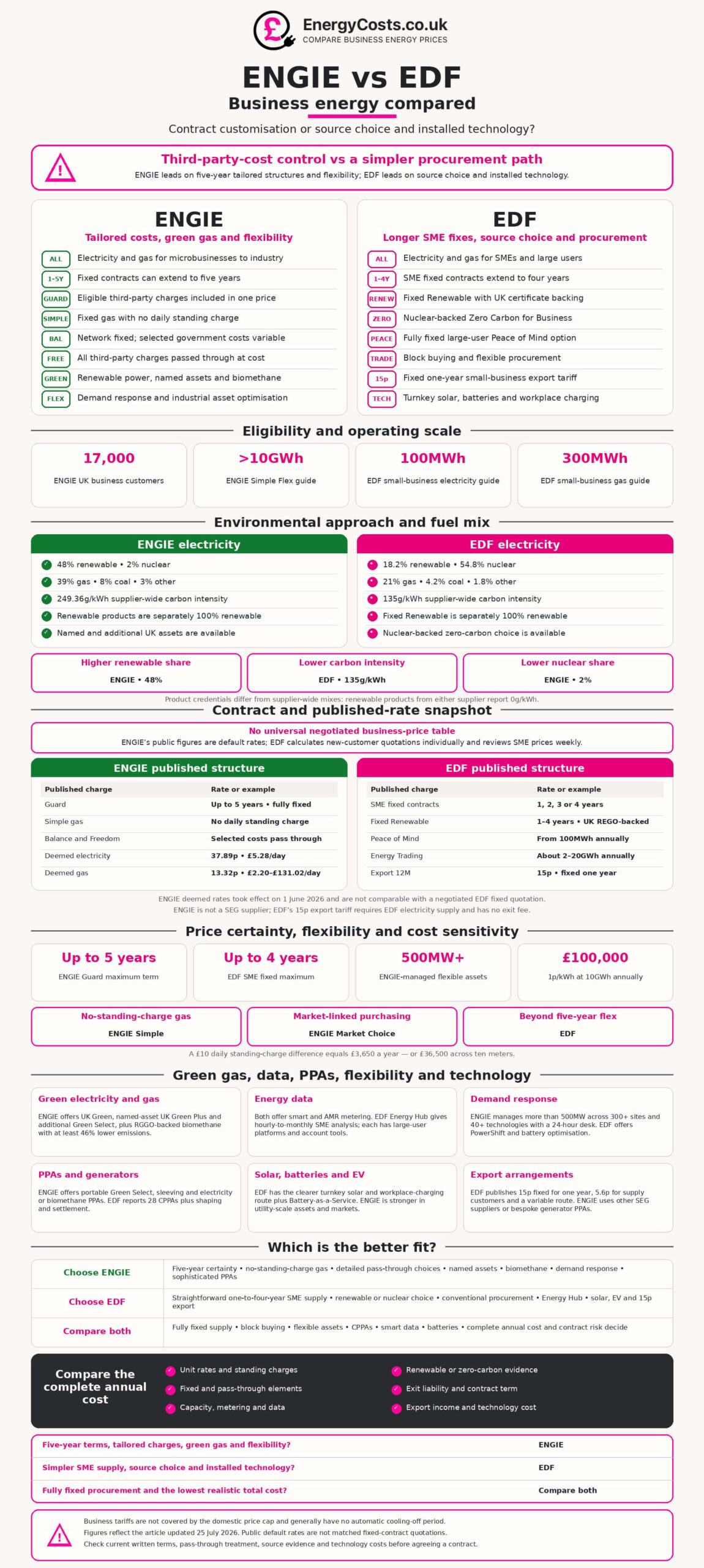
ENGIE and EDF are major business energy suppliers offering electricity, gas, renewable products, flexible procurement and services for large industrial users. However, their contract structures and environmental propositions differ considerably.
ENGIE supplies microbusinesses, SMEs and major corporate users. Its fixed-contract range includes Guard, Balance, Freedom and a no-standing-charge gas product called Simple. Businesses can fix prices for up to five years, choose how third-party charges are treated and add 100% renewable electricity to fixed or flexible arrangements.
EDF offers small-business fixed contracts lasting one, two, three or four years. Its Fixed Renewable tariff matches electricity use with UK Renewable Energy Guarantees of Origin, while larger businesses can choose fully fixed, partly fixed, actively traded or flexible contracts. EDF also offers renewable, nuclear-backed zero-carbon and standard mixed-source electricity.
ENGIE may be the stronger choice where the business wants:
- a five-year fixed contract;
- a gas tariff without a daily standing charge;
- detailed control over third-party charges;
- green gas backed by renewable-gas certificates;
- active demand-response services;
- a named renewable asset; or
- a sophisticated renewable PPA.
EDF may be more suitable where the company wants:
- a straightforward one-to-four-year SME contract;
- a choice between renewable and nuclear-backed electricity;
- extensive conventional large-business procurement;
- a published solar-export tariff;
- Energy Hub consumption analysis; or
- an integrated commercial solar and EV-charging package.
Neither supplier is universally cheaper. The winning quotation will depend on the premises, meter, consumption, contract dates, credit assessment and treatment of non-energy costs.
ENGIE vs EDF at a glance
| Feature | ENGIE Business | EDF Business |
|---|---|---|
| Business electricity | Yes | Yes |
| Business gas | Yes | Yes |
| Microbusiness supply | Yes | Yes |
| SME supply | Yes | Yes |
| Large and corporate supply | Yes | Yes |
| Standard national contract prices | Not published | Not published |
| Maximum advertised fixed term | Five years | Four years for SMEs |
| Fully fixed product | Guard | Fixed tariff or Fixed + Peace of Mind |
| Fixed network charges with government costs passed through | Balance | No directly equivalent SME product |
| All third-party costs passed through | Freedom | Available through selected large-business structures |
| Gas without daily standing charge | Simple | No prominent equivalent |
| Fixed wholesale with variable non-energy costs | Freedom or Balance, depending on costs selected | Fixed + Standard |
| Block purchasing | Market Choice and other flexible products | Fixed + Energy Trading |
| Day-ahead electricity product | Daily Flex | Flexible procurement and optimisation services |
| Large-user flex product | Simple Flex above 10GWh | Flexible contracts across several purchasing horizons |
| Maximum flexible purchasing horizon | Product-dependent | More than five years available |
| Renewable electricity option | Available with all fixed and flexible contracts | Fixed Renewable and large-business renewable products |
| Named renewable asset | UK Green Plus and Green Select | Available through renewable contracts and CPPAs |
| Nuclear-backed product | No prominent product | Zero Carbon for Business |
| Supplier-wide renewable share | 48% | 18.2% |
| Supplier-wide nuclear share | 2% | 54.8% |
| Supplier-wide gas and coal | 47% | 25.2% |
| Supplier-wide carbon intensity | 249.36g CO₂/kWh | 135g CO₂/kWh |
| Green gas | RGGO-backed biomethane | No equally prominent standard SME product |
| Energy monitoring | Online account, smart/AMR data and large-user platforms | Energy Hub, MyBusiness and Energy View |
| Published small-business export tariff | ENGIE does not offer SEG | Up to 15p/kWh |
| Commercial solar | Renewable projects and PPAs | Turnkey rooftop, ground and carport solar |
| Battery optimisation | Yes | Yes, including Battery-as-a-Service |
| EV charging | Bespoke low-carbon and infrastructure solutions | Workplace and fleet charging through EDF and Pod |
| Best suited to | Tailored contracts, green gas, PPAs and flexibility | Longer SME fixes, energy-source choice and conventional procurement |
The summary reflects the suppliers’ current business-contract pages and 2024/25 fuel-mix disclosures.
Which businesses can apply?
ENGIE explicitly markets electricity and gas contracts to microbusinesses, small businesses, larger enterprises and industrial organisations. It says it supplies around 17,000 UK business customers and offers fixed, flexible, renewable and green-gas products across those customer groups.
EDF’s small-business route generally applies where annual consumption is below:
- 100MWh, or 100,000kWh, of electricity; or
- 300MWh, or 300,000kWh, of gas.
Organisations above those thresholds are directed towards EDF Large Business, where fixed, flexible, renewable and zero-carbon options are available.
Example suitability by company type
| Example business | Annual electricity use | Potentially suitable option |
|---|---|---|
| Independent shop | 12,000kWh | ENGIE Guard or EDF fixed tariff |
| Small office | 40,000kWh | Fixed SME contract from either supplier |
| Low-use gas customer | Varies | ENGIE Simple may be relevant |
| Restaurant | 120,000kWh | ENGIE enterprise quote or EDF Large Business |
| Hotel | 400,000kWh | Multi-site or large-business contract |
| Manufacturer | 2GWh | ENGIE fixed/flexible or EDF large-business contract |
| Company wanting a five-year fix | Varies | ENGIE Guard |
| Business wanting a four-year SME fix | Below EDF threshold | EDF |
| Company using over 10GWh | Above 10GWh | ENGIE Simple Flex or EDF flexible procurement |
| Company wanting nuclear-backed electricity | Large-business account | EDF |
| Company needing renewable biomethane | Varies | ENGIE Green Gas |
| Renewable generator | Project-dependent | ENGIE or EDF PPA |
| Business with flexible batteries or generation | Asset-dependent | ENGIE demand response or EDF optimisation |
Actual eligibility can also depend on the meter type, payment history, creditworthiness, property use, number of locations and available electricity capacity.
Which supplier is cheaper?
Neither supplier publishes one universal contracted unit rate or standing charge.
A business quotation will normally consider:
- electricity MPAN or gas MPRN;
- distribution region;
- annual consumption;
- half-hourly demand;
- meter profile;
- voltage;
- agreed capacity;
- number of sites;
- contract start date;
- contract term;
- payment method;
- credit risk;
- renewable-product choice;
- pass-through-cost treatment; and
- prevailing wholesale prices.
The projected annual cost should be calculated as:
- Annual consumption × unit rate
- daily standing charge × 365
- capacity charges
- metering and data charges
- network costs
- environmental and government charges
- VAT and Climate Change Levy where applicable
− export income and other contractual credits
ENGIE provides a particularly broad choice over how third-party charges are treated. EDF also lets large customers choose whether third-party costs are fixed or variable, but EDF presents fewer named pass-through structures to ordinary small businesses.
How unit-rate differences affect annual costs
| Annual consumption | Value of 0.5p/kWh | Value of 1p/kWh | Value of 3p/kWh | Value of 5p/kWh |
|---|---|---|---|---|
| 10,000kWh | £50 | £100 | £300 | £500 |
| 25,000kWh | £125 | £250 | £750 | £1,250 |
| 50,000kWh | £250 | £500 | £1,500 | £2,500 |
| 100,000kWh | £500 | £1,000 | £3,000 | £5,000 |
| 250,000kWh | £1,250 | £2,500 | £7,500 | £12,500 |
| 1GWh | £5,000 | £10,000 | £30,000 | £50,000 |
| 10GWh | £50,000 | £100,000 | £300,000 | £500,000 |
| 50GWh | £250,000 | £500,000 | £1.5 million | £2.5 million |
For a company consuming 10GWh, a difference of only 1p/kWh changes annual expenditure by £100,000.
How standing charges affect annual costs
| Daily standing-charge difference | Annual difference per meter | Difference across ten meters |
|---|---|---|
| 25p | £91.25 | £912.50 |
| 50p | £182.50 | £1,825 |
| £1 | £365 | £3,650 |
| £2 | £730 | £7,300 |
| £5 | £1,825 | £18,250 |
| £10 | £3,650 | £36,500 |
This makes standing charges particularly important for low-use premises, seasonal sites, landlords and multi-site organisations.
ENGIE Guard
Guard is ENGIE’s highest-certainty fixed product.
It includes:
- one fixed contracted price;
- eligible third-party charges within the fixed price;
- protection from normal market changes;
- prices guaranteed for up to five years;
- standard or green electricity; and
- standard or green gas.
ENGIE states that contracted rates remain consistent and that it absorbs relevant market-cost movements during the contract.
Guard may suit a business that wants:
- long-term certainty;
- simple budgeting;
- protection against wholesale volatility;
- fewer reconciliation adjustments; and
- one predictable rate structure.
Its opening price may include a risk premium because ENGIE accepts more uncertainty over future third-party charges.
ENGIE Simple
Simple is a fixed gas product with no daily standing charge.
The network, supply and other costs are instead recovered through one unit rate, meaning the business pays according to the gas it consumes. ENGIE states that the unit rate remains fixed for the contract.
This could be useful for:
- low-use gas supplies;
- seasonal businesses;
- vacant or intermittently occupied properties;
- landlords with lightly used meters; and
- companies planning to reduce gas consumption.
It is not automatically cheaper. A supplier can recover the avoided standing charge through a higher unit rate.
Break-even example
Suppose the ordinary tariff has:
- a standing charge of £3 per day; and
- a unit rate 2p/kWh below the no-standing-charge product.
The annual standing charge is:
£3 × 365 = £1,095
The break-even consumption is:
£1,095 ÷ £0.02 = 54,750kWh
Below 54,750kWh, the no-standing-charge tariff may be cheaper.
Above that point, the lower conventional unit rate may save more than the standing charge costs.
ENGIE Balance
Balance fixes network charges while passing through selected government charges at their prevailing cost.
The pass-through elements can include:
- Feed-in Tariff costs;
- Contracts for Difference;
- Capacity Market charges; and
- Renewables Obligation costs.
ENGIE positions Balance as a middle ground between a fully fixed price and complete pass-through treatment. It is available for standard or green electricity contracts.
Balance may suit a company that:
- wants certainty over network charges;
- does not want to pay a risk premium on government costs;
- understands pass-through billing; and
- can tolerate some movement during the term.
ENGIE Freedom
Freedom fixes wholesale energy while passing all third-party charges through at cost.
ENGIE says this provides transparency, avoids risk premiums on pass-through charges and lets businesses reduce certain costs by avoiding peak periods. It is available for standard or green electricity and gas contracts.
Freedom is likely to appeal to experienced organisations that:
- understand network and policy charges;
- want transparent reconciliation;
- can forecast changing third-party costs;
- can reduce electricity use during expensive periods; and
- prefer to retain cost risk rather than paying the supplier to absorb it.
Comparing ENGIE fixed products
| Product | Wholesale price | Third-party costs | Standing-charge structure | Maximum published term |
|---|---|---|---|---|
| Guard | Fixed | Included in fixed rate | Conventional | Five years |
| Simple | Fixed gas rate | Included in unit price | No daily standing charge | Quote-dependent |
| Balance | Fixed | Network fixed; government costs passed through | Conventional | Quote-dependent |
| Freedom | Fixed | All third-party charges passed through | Conventional | Quote-dependent |
ENGIE therefore offers more granular control over third-party charges than most mainstream SME suppliers.
EDF small-business fixed tariffs
EDF offers fixed small-business contracts lasting one, two, three or four years. Prices are individually calculated and reviewed weekly for new quotations. Customers receive online account management and access to dedicated small-business specialists.
EDF may be preferable to ENGIE where the company wants:
- a simple fixed tariff;
- a standard term of up to four years;
- a recognisable SME quotation process;
- renewable-only electricity;
- smart-meter monitoring through Energy Hub; or
- fewer product structures to assess.
ENGIE Guard provides a longer maximum term, but EDF’s four-year fixed proposition may be easier to understand for a business that does not need to choose how network and government charges are treated.
EDF Fixed Renewable
EDF Fixed Renewable is available over one, two, three or four years.
Each unit consumed is matched with a UK REGO, providing 100% renewable-backed electricity and supporting zero market-based Scope 2 reporting.
The product may suit companies wanting:
- renewable-only electricity;
- no nuclear allocation to the selected product;
- a long conventional fixed term;
- evidence for tenders or supply-chain reporting; and
- a straightforward environmental claim.
ENGIE Guard versus EDF Fixed Renewable
| Feature | ENGIE Guard Green | EDF Fixed Renewable |
|---|---|---|
| Renewable electricity | Optional 100% renewable version | 100% renewable |
| Maximum term | Five years | Four years |
| Third-party costs | Included in Guard rate | Included according to EDF fixed terms |
| Named renewable asset | Requires UK Green Plus or PPA option | Requires bespoke renewable arrangement |
| Gas available | Yes | Separate gas contract |
| Green gas available | Yes | No prominent equivalent |
| Nuclear allocation | None on renewable product | None |
| Best suited to | Longest certainty and combined green gas/electricity | Straightforward renewable SME fix |
ENGIE flexible contracts
ENGIE offers several flexible products for businesses that want greater market exposure.
Fixed Price
Despite appearing on ENGIE’s flexible-product page, Fixed Price is a non-flexible structure under which the unit price remains fixed throughout the contract. It is included alongside ENGIE’s flexible range to help businesses compare procurement approaches.
Market Choice
Market Choice allows the business to choose its level of involvement.
By default, the price follows a market-reflective mechanism based on the monthly average of day-ahead prices. The customer can also purchase volumes for individual months, quarters or seasons when it considers market conditions favourable.
Market Choice may suit a company that:
- wants market-linked pricing;
- may trade some volumes actively;
- wants to purchase in several stages;
- has a defined risk policy; and
- can tolerate changing prices.
Daily Flex
Daily Flex is a multi-rate electricity product with as many as eight rates covering combinations of:
- seasons;
- times of day;
- weekdays; and
- weekends.
It may suit a business able to shift demand towards cheaper periods. The quoted unit rate includes an indicative commodity price.
Simple Flex
Simple Flex is recommended by ENGIE for electricity customers using more than 10GWh annually.
Monthly invoices are calculated from the weighted average of the business’s actual transaction costs and purchased volumes rather than a fixed monthly reference price.
Day Ahead gas
ENGIE’s Day Ahead gas product allows within-month purchasing and adjusts for differences between forecast and actual use at day-ahead prices.
The final invoiced rate is the average of the business’s trading decisions and relevant day-ahead transactions.
EDF large-business fixed contracts
EDF provides four principal named fixed structures for larger users.
Fixed + Peace of Mind
This fixes:
- wholesale electricity costs;
- eligible non-energy costs;
- delivery and new-generation costs; and
- EDF’s service charge.
It supports half-hourly and non-half-hourly meters and is aimed at businesses consuming more than 100MWh annually.
Fixed + Standard
This fixes:
- wholesale energy; and
- EDF’s service charge.
Forecast non-energy costs can change during the agreement.
Fixed + Energy Trading
This allows businesses consuming approximately 2,000MWh to 20,000MWh to purchase blocks of electricity through EDF’s trading desk.
EDF manages the remaining untraded volume, and live or reconciliation billing can be selected.
Standard Fixed gas
This fixes wholesale gas and EDF’s service charge while allowing forecast non-energy costs to vary. It is aimed at non-daily-metered gas customers using more than 300MWh annually.
ENGIE versus EDF fixed structures
| Requirement | ENGIE product | EDF product |
|---|---|---|
| Maximum fixed-term certainty | Guard | Fixed + Peace of Mind |
| Fixed rate for up to five years | Guard | No direct SME equivalent |
| Gas without standing charge | Simple | No equivalent |
| Fixed network, variable government costs | Balance | Tailored large-business structure |
| All third-party charges at cost | Freedom | Flexible or pass-through contract |
| Wholesale fixed, non-energy forecast variable | Freedom or tailored contract | Fixed + Standard |
| Block purchasing | Market Choice | Fixed + Energy Trading |
| Straightforward four-year SME fix | Guard could be quoted | EDF small-business fixed tariff |
ENGIE provides more named variations for handling third-party costs.
EDF provides a clearer division between small-business fixed tariffs and large-business procurement products.
EDF flexible procurement
EDF allows large customers to choose:
- a one-to-three-year purchasing horizon;
- a three-to-five-year horizon;
- a period exceeding five years;
- block or full-volume purchases;
- fixed or variable third-party costs;
- the level of specialist support; and
- tailored reporting tools.
EDF’s Customer Desk provides an auditable trading process, market information and support for customers with different levels of energy procurement experience.
ENGIE versus EDF for flexible purchasing
| Requirement | Likely stronger fit |
|---|---|
| Market-linked monthly averaging | ENGIE Market Choice |
| Buying monthly, quarterly or seasonal volumes | Either |
| Multi-rate daily electricity product | ENGIE Daily Flex |
| Flexible gas within the delivery month | ENGIE Day Ahead |
| Flex product specifically above 10GWh | ENGIE Simple Flex |
| Published purchasing horizons beyond five years | EDF |
| Conventional trading-desk block purchases | EDF |
| Fixing or passing through third-party costs | Either |
| Large menu of traditional procurement options | EDF |
| Demand response and grid-market participation | ENGIE |
ENGIE demand response and asset optimisation
ENGIE provides demand-response and flexibility services for businesses with controllable energy assets.
Its published portfolio includes more than 500MW of third-party assets under flexibility management, over 300 sites and more than 40 generating and demand-side technologies. A 24-hour trading desk responds to market and grid signals.
Potential assets include:
- batteries;
- generators;
- industrial machinery;
- heating and cooling;
- pumps;
- refrigeration;
- EV charging;
- on-site renewable generation; and
- other interruptible loads.
ENGIE can use flexibility to participate in wholesale markets, the Balancing Mechanism and frequency-response services.
EDF flexibility and battery optimisation
EDF also provides flexibility services and can optimise batteries, EV chargers, solar and other controllable assets. Its current services include PowerShift and Battery-as-a-Service, under which suitable businesses can use a fully financed and managed battery without paying the initial capital cost.
ENGIE may be stronger where the business already owns a diverse collection of flexible industrial assets.
EDF may be attractive where the company wants a financed battery combined with energy procurement and route-to-market services.
Current ENGIE deemed electricity rates
ENGIE’s non-half-hourly deemed and default electricity rates effective from 1 June 2026 are:
| Charge | Current published rate |
|---|---|
| Unit rate | 37.89p/kWh |
| Daily standing charge | £5.28 |
| Annual standing charge | £1,927.20 |
The rates exclude VAT, Climate Change Levy and other applicable taxes. They apply where ENGIE supplies a premises without an agreed contract or after an existing agreement ends.
Illustrative ENGIE non-half-hourly costs
| Annual electricity use | Unit-rate cost | Standing charge | Total |
|---|---|---|---|
| 10,000kWh | £3,789 | £1,927.20 | £5,716.20 |
| 25,000kWh | £9,472.50 | £1,927.20 | £11,399.70 |
| 50,000kWh | £18,945 | £1,927.20 | £20,872.20 |
| 100,000kWh | £37,890 | £1,927.20 | £39,817.20 |
These are default-price illustrations rather than negotiated Guard, Balance, Freedom or EDF fixed quotations.
ENGIE half-hourly deemed rates
ENGIE’s half-hourly rates effective from 1 June 2026 include:
| Meter category | Day rate | Night rate | Daily standing charge |
|---|---|---|---|
| Low voltage, LV substation and HV bands 1–2 | 40.47p/kWh | 26.45p/kWh | £27.85 |
| HV bands 3–4, approximately 1,000kVA or more | 40.47p/kWh | 26.45p/kWh | £510.31 |
Capacity, excess-capacity, reactive-power, VAT and Climate Change Levy charges can be added separately. ENGIE states that its out-of-contract half-hourly electricity is 100% green.
The £510.31 daily standing charge equals more than £186,000 annually before consumption and other charges. This illustrates the importance of arranging a negotiated contract for a large high-voltage supply.
Current ENGIE deemed gas rates
ENGIE’s deemed and default gas rate effective from 1 June 2026 is 13.32p/kWh across its published annual-quantity bands. Standing charges rise sharply with consumption.
| Annual quantity | Unit rate | Daily standing charge |
|---|---|---|
| 1–73,200kWh | 13.32p/kWh | £2.20 |
| 73,201–293,000kWh | 13.32p/kWh | £5.39 |
| 293,001–732,000kWh | 13.32p/kWh | £14.11 |
| 732,001–2,196,000kWh | 13.32p/kWh | £32.84 |
| 2,196,001–5,860,000kWh | 13.32p/kWh | £66.45 |
| 5,860,001–14,650,000kWh | 13.32p/kWh | £131.02 |
Illustrative ENGIE gas costs
| Annual gas use | Applicable standing charge | Approximate total |
|---|---|---|
| 25,000kWh | £803.00 | £4,133.00 |
| 30,000kWh | £803.00 | £4,799.00 |
| 50,000kWh | £803.00 | £7,463.00 |
| 100,000kWh | £1,967.35 | £15,287.35 |
| 250,000kWh | £1,967.35 | £35,267.35 |
| 500,000kWh | £5,150.15 | £71,750.15 |
The examples exclude VAT and CCL.
Can the published rates identify the cheaper supplier?
No.
ENGIE’s published rates apply to deemed or default supply without a negotiated contract. EDF’s new-customer business prices are individually quoted and change as wholesale markets move. EDF says it reviews its SME tariff prices weekly.
A contracted ENGIE or EDF price may be substantially lower than an out-of-contract rate.
Comparing supplier-wide fuel mixes
ENGIE and EDF used very different generation sources during the 2024/25 disclosure period.
| Source or impact | ENGIE | EDF |
|---|---|---|
| Coal | 8% | 4.2% |
| Natural gas | 39% | 21% |
| Nuclear | 2% | 54.8% |
| Renewables | 48% | 18.2% |
| Other | 3% | 1.8% |
| Carbon emissions | 249.36g/kWh | 135g/kWh |
| Radioactive waste | 0.000142g/kWh | 0.0038g/kWh |
ENGIE had the higher supplier-wide renewable share and much lower nuclear use.
EDF had substantially lower reported carbon emissions because more than half of its electricity was nuclear-generated.
Comparing product-level fuel mixes
| Product | Renewable | Nuclear | Gas, coal and other | Carbon emissions |
|---|---|---|---|---|
| ENGIE renewable products | 100% | 0% | 0% | 0g/kWh |
| ENGIE standard products | 11.6% | 3% | 85% | 426.71g/kWh |
| EDF renewable products | 100% | 0% | 0% | 0g/kWh |
| EDF Zero Carbon products | 0% | 100% | 0% | 0g/kWh |
| EDF all other products | 0.5% | 53% | 46.5% | 233g/kWh |
The suppliers’ published disclosures show that product selection is more important than their overall company averages.
Which supplier has greener electricity?
| Environmental priority | Likely stronger fit |
|---|---|
| Higher supplier-wide renewable percentage | ENGIE |
| Lower supplier-wide carbon intensity | EDF |
| Less nuclear power | ENGIE |
| Less coal and gas combined | EDF |
| 100% renewable fixed electricity | Either |
| 100% renewable flexible electricity | ENGIE or EDF large-business renewable option |
| Nuclear-backed zero-carbon electricity | EDF |
| Named renewable plant | ENGIE UK Green Plus |
| New additional named renewable asset | ENGIE Green Select |
| Choice between renewable and nuclear | EDF |
| Lower radioactive waste | ENGIE |
| Renewable gas | ENGIE |
Neither supplier should be described simply as greener without stating whether the comparison concerns renewable content, fossil-fuel use, nuclear generation or reported carbon emissions.
ENGIE Green Power
ENGIE’s green electricity contracts are backed by REGOs or equivalent Guarantees of Origin and are available with fixed and flexible supply.
The supplier says renewable power can be sourced from solar, onshore wind and offshore wind projects, with independent assurance supporting zero market-based carbon reporting.
ENGIE offers two particularly relevant sourcing options:
UK Green
UK Green supplies electricity from UK renewable plants and provides UK REGOs.
UK Green Plus
UK Green Plus links the fixed renewable supply with a named UK asset, enabling the company to identify the specific plant associated with its electricity.
ENGIE Green Select
Green Select is a portable long-term PPA linked with a new additional named UK renewable asset and backed by REGOs.
ENGIE also offers sleeving, allowing businesses with their own generation or an existing CPPA to incorporate output from that asset into an ENGIE supply contract.
Green Select may have an advantage over a conventional certificate tariff where the business wants:
- a named asset;
- evidence of additionality;
- a long-term renewable relationship;
- portability; and
- stronger environmental reporting.
EDF renewable and zero-carbon products
EDF offers large businesses a choice between:
- renewable electricity;
- nuclear-backed Zero Carbon for Business; and
- standard mixed-source electricity.
Zero Carbon for Business matches the organisation’s estimated consumption with EDF nuclear generation. Renewable products use renewable backing and can support zero market-based emissions reporting.
EDF therefore offers greater source choice.
ENGIE focuses more heavily on renewable electricity and biomethane.
Green business gas
ENGIE has a clear advantage where a company wants an environmental gas product.
Its green gas is produced from organic waste through anaerobic digestion or from captured landfill gas. ENGIE says the biomethane produces at least 46% fewer emissions than standard natural gas, and contracts are backed by Renewable Gas Guarantees of Origin through the Green Gas Certification Scheme.
The supplier can also create combined solutions involving:
- renewable electricity;
- biomethane;
- RGGOs; and
- tailored purchasing agreements.
EDF does not prominently market an equivalent standard SME tariff containing a stated proportion of certified biomethane.
The physical combustion of biomethane still produces emissions at the site, but certificate-backed renewable gas can reduce lifecycle emissions and support market development.
Corporate Power Purchase Agreements
Both suppliers have extensive PPA capabilities.
ENGIE PPAs
ENGIE offers:
- short- and long-term PPAs;
- fixed and market-linked prices;
- upstream agreements for generators;
- downstream agreements for corporate buyers;
- named renewable assets;
- sleeving;
- Green Select;
- biomethane agreements; and
- RGGO management.
ENGIE’s recent UK agreements include ten-year and 15-year renewable supply arrangements, demonstrating its ability to structure long-term corporate contracts.
EDF PPAs
EDF provides:
- short-term fixed and index agreements;
- long-term contracts;
- CPPAs;
- renewable-generator sourcing;
- balancing;
- shaping;
- sleeving;
- settlement; and
- renewable-certificate management.
EDF states that its dedicated team has arranged 28 CPPAs for major corporate clients.
Which is better for PPAs?
| PPA requirement | Likely stronger fit |
|---|---|
| Major global PPA experience | ENGIE |
| UK corporate PPA structuring | Either |
| Named new renewable asset | ENGIE Green Select |
| Portable PPA structure | ENGIE |
| Sleeving existing company generation | Either |
| Nuclear-backed supply alongside PPA | EDF |
| Generator balancing and shaping | EDF or ENGIE |
| Biomethane purchasing agreement | ENGIE |
| Short- and long-term generator offtake | Either |
| Combined gas and electricity decarbonisation | ENGIE |
The better offer will depend on price indexation, volume risk, contract length, credit requirements and balancing responsibility.
Smart and AMR meters
ENGIE provides smart and AMR meters to eligible businesses.
Its meters support:
- automatic readings;
- more accurate bills;
- real-time consumption tracking;
- fewer manual readings;
- improved visibility of costs; and
- energy-efficiency analysis.
Standard installation is generally free for eligible ENGIE customers, although additional site works can incur charges.
EDF also provides smart meters to eligible small businesses. Energy Hub displays consumption by hour, day, week and month, helping customers identify unusual or avoidable energy use.
ENGIE online account versus EDF Energy Hub
| Feature | ENGIE | EDF |
|---|---|---|
| View invoices | Yes | Yes |
| Download statements | Yes | Yes |
| Submit meter readings | Yes | Yes |
| View reading history | Yes | Yes |
| View contract documents | Yes | Yes |
| Consumption data | Yes | Yes |
| Add broker or authorised contact | Yes | Letter of Authority supported |
| Hourly, daily, weekly and monthly analysis | Meter-dependent | Energy Hub |
| Large-user trading platform | Yes | Yes |
| Dedicated account manager | Available | Available for relevant customers |
ENGIE’s account area is strong for contract and billing administration. EDF Energy Hub has the clearer public proposition for SME consumption analysis.
Commercial solar and battery storage
ENGIE
ENGIE develops and operates solar farms and provides renewable-energy and storage services. Its UK proposition is strongest around utility-scale renewable assets, PPAs, battery optimisation and access to energy markets rather than one standardised SME rooftop installation package.
EDF
EDF offers rooftop, ground-mounted and solar-carport systems to businesses and public-sector organisations.
Commercial projects can include:
- structural and site surveys;
- system design;
- construction;
- battery storage;
- monitoring;
- maintenance;
- multi-site roll-outs; and
- integration with EV charging.
EDF says most commercial installations are completed within approximately three weeks to three months, depending on scale and complexity.
Which is better for commercial solar?
| Requirement | Likely stronger fit |
|---|---|
| Standard turnkey SME rooftop project | EDF |
| Ground-mounted commercial solar | EDF or ENGIE project team |
| Solar carport | EDF |
| Utility-scale solar sourcing | ENGIE |
| PPA linked with a new solar project | Either |
| Battery revenue optimisation | ENGIE or EDF |
| Battery-as-a-Service | EDF |
| Generator offtake agreement | Either |
| Combined renewable electricity and biomethane | ENGIE |
| Public-sector multi-site solar | EDF |
EDF has the clearer public end-to-end installation journey.
ENGIE has broader renewable-generation, PPA and market-optimisation expertise.
Solar export tariffs
EDF publishes the following small-business export options:
| EDF export tariff | Payment | Main condition |
|---|---|---|
| Export 12M Small Business | 15p/kWh | Existing EDF electricity customer |
| SEG Export Variable Value | 5.6p/kWh | Existing EDF electricity customer |
| SEG Export Variable | Variable | Available to eligible non-EDF customers |
Export 12M Small Business is fixed for one year and has no exit fee.
ENGIE states that it is not currently a Smart Export Guarantee supplier. A business using ENGIE for imported electricity can appoint a different SEG supplier for exported electricity. ENGIE does, however, provide bespoke PPAs for qualifying generators and larger projects.
Illustrative EDF export income
| Annual export | Income at 15p/kWh |
|---|---|
| 5,000kWh | £750 |
| 10,000kWh | £1,500 |
| 25,000kWh | £3,750 |
| 50,000kWh | £7,500 |
| 100,000kWh | £15,000 |
EDF is the more straightforward option for a small business wanting an off-the-shelf export tariff.
ENGIE may be stronger for larger generators needing a negotiated PPA, route-to-market service or certificate management.
Electric vehicle charging
EDF provides workplace and fleet charging through EDF and Pod.
The service can include:
- an initial scoping call;
- site survey;
- charger installation;
- onboarding;
- online charger management; and
- ongoing support.
Pod also operates thousands of UK charging bays.
ENGIE’s current UK public proposition places more emphasis on renewable supply, infrastructure, batteries and demand-response optimisation than on one standard packaged SME charger product.
ENGIE may nevertheless be relevant to a major charging project where the operator needs:
- electricity supply;
- battery storage;
- grid flexibility;
- wholesale market access;
- asset optimisation; or
- renewable PPAs.
EDF is likely to be easier for an ordinary business seeking installed workplace chargers.
Multi-site businesses
Both suppliers can serve multi-site organisations.
ENGIE can combine:
- Guard, Balance or Freedom;
- flexible trading;
- renewable electricity;
- green gas;
- smart or AMR meters;
- large-business digital platforms;
- demand response;
- PPAs; and
- asset optimisation.
EDF can combine:
- fixed and flexible electricity;
- business gas;
- renewable or nuclear-backed power;
- Energy View and MyBusiness;
- solar;
- batteries;
- EV charging;
- CPPAs; and
- PowerShift flexibility.
ENGIE may have an advantage where the organisation requires detailed third-party-cost choices or combined renewable electricity and biomethane.
EDF may be preferable where the company wants a broad but more conventional package delivered under one large-business procurement structure.
Contract expiry and switching
ENGIE says businesses can request quotations up to 12 months before renewal and fix for up to five years. It also states that a switch can complete in as little as two business days where the circumstances permit.
EDF offers small-business fixes of up to four years and moves customers onto its applicable Freedom tariff if a replacement agreement is not arranged at the end of Fixed Renewable.
Businesses should begin reviewing their contract well before expiry to avoid:
- deemed or default rates;
- higher standing charges;
- rushed purchasing decisions;
- loss of renewable benefits;
- disputed renewal authority; and
- unplanned pass-through exposure.
Business contract protections
Ordinary commercial gas and electricity tariffs are not protected by the domestic energy price cap.
Business contracts also generally have no automatic cooling-off period, including contracts accepted over the telephone.
Before choosing ENGIE or EDF, check:
- unit rates;
- standing charges;
- contract duration;
- fixed and pass-through elements;
- reconciliation arrangements;
- volume tolerances;
- meter and data charges;
- electricity-capacity costs;
- broker commission;
- renewable certificates;
- nuclear content;
- gas environmental claims;
- export arrangements;
- early termination liability;
- renewal procedures; and
- default pricing.
ENGIE advantages and disadvantages
Advantages
- Supplies microbusinesses, SMEs and large organisations.
- Fixed terms can extend to five years.
- Guard provides extensive fixed-price certainty.
- Simple provides fixed gas without a daily standing charge.
- Balance separates network and government-cost treatment.
- Freedom passes third-party charges through transparently.
- All fixed and flexible contracts can include renewable electricity.
- UK Green Plus links supply with a named asset.
- Green Select supports a new additional renewable project.
- Strong green-gas proposition.
- RGGO-backed biomethane is available.
- Market Choice supports staged purchasing.
- Daily Flex rewards time-shifting.
- Simple Flex serves users above 10GWh.
- Strong demand-response and asset-optimisation services.
- Extensive electricity and biomethane PPA capabilities.
- Out-of-contract half-hourly electricity is described as 100% green.
Disadvantages
- Contracted prices are not publicly displayed.
- Numerous product structures can be difficult to compare.
- Freedom and Balance expose customers to changing costs.
- Flexible products require procurement expertise.
- Supplier-wide carbon intensity is higher than EDF’s.
- Standard products were only 11.6% renewable.
- Standard-product carbon intensity was 426.71g/kWh.
- Published deemed electricity standing charges are high.
- High-voltage deemed standing charges can be extremely expensive.
- ENGIE does not offer a standard SEG tariff.
- Its standard SME solar and EV installation propositions are less prominent than EDF’s.
- A named or additional renewable product may cost more than standard supply.
EDF advantages and disadvantages
Advantages
- Supplies SMEs and large organisations.
- SME fixed terms extend to four years.
- Fixed Renewable provides 100% renewable-backed power.
- Offers nuclear-backed Zero Carbon for Business.
- Customers can choose renewable, nuclear or mixed electricity.
- Fixed + Peace of Mind provides extensive certainty.
- Fixed + Standard offers a lower-certainty alternative.
- Fixed + Energy Trading supports block purchases.
- Flexible purchasing horizons can exceed five years.
- Strong trading-desk and market-information services.
- Energy Hub provides detailed SME consumption information.
- Offers rooftop, ground-mounted and carport solar.
- Battery-as-a-Service is available for suitable businesses.
- Published small-business export payments reach 15p/kWh.
- Workplace and fleet charging are available through Pod.
- Strong CPPA, balancing, shaping and sleeving capabilities.
Disadvantages
- Contracted business prices are not published.
- Maximum SME fixed term is shorter than ENGIE Guard.
- No prominent gas tariff without a standing charge.
- No equally prominent standard green-gas product.
- Supplier-wide renewable share is lower than ENGIE’s.
- Supplier-wide nuclear share is 54.8%.
- Renewable-only electricity must be selected specifically.
- Long fixed contracts can become expensive if market prices fall.
- Flexible products require expertise and active oversight.
- The highest SEG payment requires EDF electricity supply.
- Some businesses exclude nuclear power from their environmental policies.
Which supplier is better for different businesses?
| Business type or requirement | Likely better fit | Reason |
|---|---|---|
| SME wanting a straightforward fixed tariff | EDF | Simpler standard SME range |
| Business wanting a five-year fix | ENGIE Guard | Longer maximum term |
| Business wanting a four-year renewable fix | EDF | Fixed Renewable |
| Low-use gas customer | ENGIE Simple | No daily standing charge |
| Company wanting every third-party charge fixed | ENGIE Guard or EDF Peace of Mind | Compare complete quotations |
| Company wanting all third-party charges passed through | ENGIE Freedom | Dedicated named product |
| Business wanting network fixed but government charges variable | ENGIE Balance | Dedicated structure |
| Company wanting staged wholesale purchases | Either | Market Choice or EDF trading |
| Business consuming over 10GWh | Compare ENGIE Simple Flex and EDF flexible contracts | Both support active procurement |
| Company wanting lower supplier-wide carbon intensity | EDF | 135g/kWh versus 249.36g/kWh |
| Company wanting higher supplier-wide renewable share | ENGIE | 48% versus 18.2% |
| Business excluding nuclear power | ENGIE renewable or EDF Fixed Renewable | Product-specific selection required |
| Business wanting nuclear-backed electricity | EDF | Zero Carbon for Business |
| Company wanting a named renewable asset | ENGIE | UK Green Plus or Green Select |
| Business requiring green gas | ENGIE | RGGO-backed biomethane |
| Small solar exporter | EDF | Published SEG tariffs |
| Large renewable generator | Compare both | Strong PPA capabilities |
| Business wanting turnkey rooftop solar | EDF | Clear installation service |
| Company wanting battery flexibility revenue | Compare both | Strong optimisation services |
| SME wanting installed workplace chargers | EDF and Pod | Packaged installation route |
| Industrial user with flexible assets | ENGIE | Major demand-response portfolio |
| Complex national estate | Compare both | Different procurement strengths |
Final verdict: ENGIE vs EDF
ENGIE and EDF are both strong business energy suppliers, but they appeal to different procurement and sustainability priorities.
ENGIE is likely to be the stronger choice where the organisation wants:
- a fixed term lasting up to five years;
- a gas contract without a daily standing charge;
- detailed control over third-party charges;
- market-linked or multi-rate flexible products;
- renewable electricity from a named asset;
- renewable biomethane;
- combined green electricity and gas;
- demand response;
- battery and asset optimisation; or
- a sophisticated electricity or biomethane PPA.
EDF is likely to be stronger where the business wants:
- a simple one-to-four-year SME tariff;
- a choice between renewable and nuclear-backed power;
- a conventional fully fixed large-business contract;
- block purchases through a trading desk;
- flexible procurement lasting more than five years;
- Energy Hub;
- a turnkey solar installation;
- a published export tariff; or
- workplace and fleet EV charging.
The fuel-mix comparison produces different winners depending on the chosen measure.
ENGIE’s supplier-wide mix contained:
- 48% renewable electricity;
- 39% natural gas;
- 8% coal;
- 2% nuclear;
- 3% other fuels; and
- 249.36g of carbon dioxide per kWh.
EDF’s supplier-wide mix contained:
- 18.2% renewable electricity;
- 21% natural gas;
- 4.2% coal;
- 54.8% nuclear;
- 1.8% other fuels; and
- 135g of carbon dioxide per kWh.
ENGIE therefore had the higher renewable percentage and lower nuclear share.
EDF had the lower overall carbon intensity because of its extensive nuclear generation.
At product level, both suppliers offer renewable electricity reporting zero market-based emissions. EDF also offers a separate 100% nuclear-backed zero-carbon product, while ENGIE provides named renewable assets and green gas.
The financial comparison requires matched quotations.
A fair procurement exercise should ask both suppliers to quote for:
- the same meter portfolio;
- identical annual consumption;
- the same contract start date;
- equivalent contract duration;
- all standing charges;
- fixed and pass-through components;
- capacity, metering and data costs;
- equivalent renewable credentials;
- volume-tolerance provisions;
- broker commission;
- export income;
- termination liability;
- renewal and default prices; and
- the complete projected annual cost.
For most companies, the decision can be summarised as follows:
- choose ENGIE for the widest fixed-cost structures, five-year certainty, green gas, named assets and flexibility services;
- choose EDF for straightforward SME tariffs, nuclear-backed choices, conventional procurement, solar exports and installed technology;
- compare ENGIE Guard with EDF Fixed + Peace of Mind where budget certainty is the priority;
- compare ENGIE Freedom with EDF Fixed + Standard or a flexible contract where pass-through transparency matters;
- compare ENGIE Market Choice and Simple Flex with EDF’s trading and flexible contracts for major users; and
- select the supplier offering the lowest complete annual cost after every standing, capacity, network, policy and metering charge is included.
FAQ
It depends on the individual quotations. Neither supplier publishes one standard contracted price applying to every business.
Yes. Both supply electricity to microbusinesses, SMEs and large organisations.
Yes. Both provide commercial gas contracts.
ENGIE advertises fixed contracts lasting up to five years. EDF’s standard SME contracts last up to four years.
Guard fixes the contracted energy rate and eligible third-party charges for up to five years.
Simple is a fixed business-gas product with one unit rate and no daily standing charge.
Balance fixes network charges while passing selected government charges through at their current cost.
Freedom fixes wholesale energy but passes all third-party charges through transparently.
Yes. Every ENGIE fixed and flexible contract can include 100% renewable electricity.
Yes. EDF Fixed Renewable and selected large-business products provide 100% renewable-backed electricity.
ENGIE had the higher supplier-wide renewable share: 48%, compared with 18.2% for EDF.
EDF reported lower supplier-wide carbon intensity: 135g/kWh compared with 249.36g/kWh for ENGIE.
EDF. Nuclear represented 54.8% of EDF’s fuel mix, compared with 2% for ENGIE.
ENGIE. It supplies RGGO-backed biomethane and offers biomethane purchasing agreements.
Both are strong. ENGIE offers Market Choice, Daily Flex, Simple Flex and Day Ahead gas. EDF offers block buying and flexible horizons exceeding five years.
Both provide extensive services. ENGIE has particularly strong named-asset and biomethane options, while EDF provides balancing, shaping and sleeving.
EDF publishes SEG tariffs paying up to 15p/kWh. ENGIE is not currently a SEG supplier but offers bespoke PPAs for qualifying generators.
EDF has the clearer turnkey rooftop, ground-mounted and carport installation service. ENGIE is strong in renewable project development and PPAs.
EDF provides a packaged workplace and fleet charging service through Pod. ENGIE is more focused on major energy infrastructure and flexibility.