
ScottishPower and Shell Energy both supply gas and electricity to UK businesses, but their strongest products serve different types of customer.
ScottishPower’s proposition is particularly accessible to small and medium-sized businesses. It offers one, two and three-year agreements, renewable electricity matched with generation from its own UK renewable assets, free smart-meter installation, commercial solar panels and several forms of electric vehicle charging.
Shell Energy offers fixed contracts to smaller organisations but has a more extensive proposition for large and complex energy users. Its services include pass-through contracts, direct wholesale-market purchasing, renewable gas, corporate power purchase agreements, microgrids and integrated on-site generation.
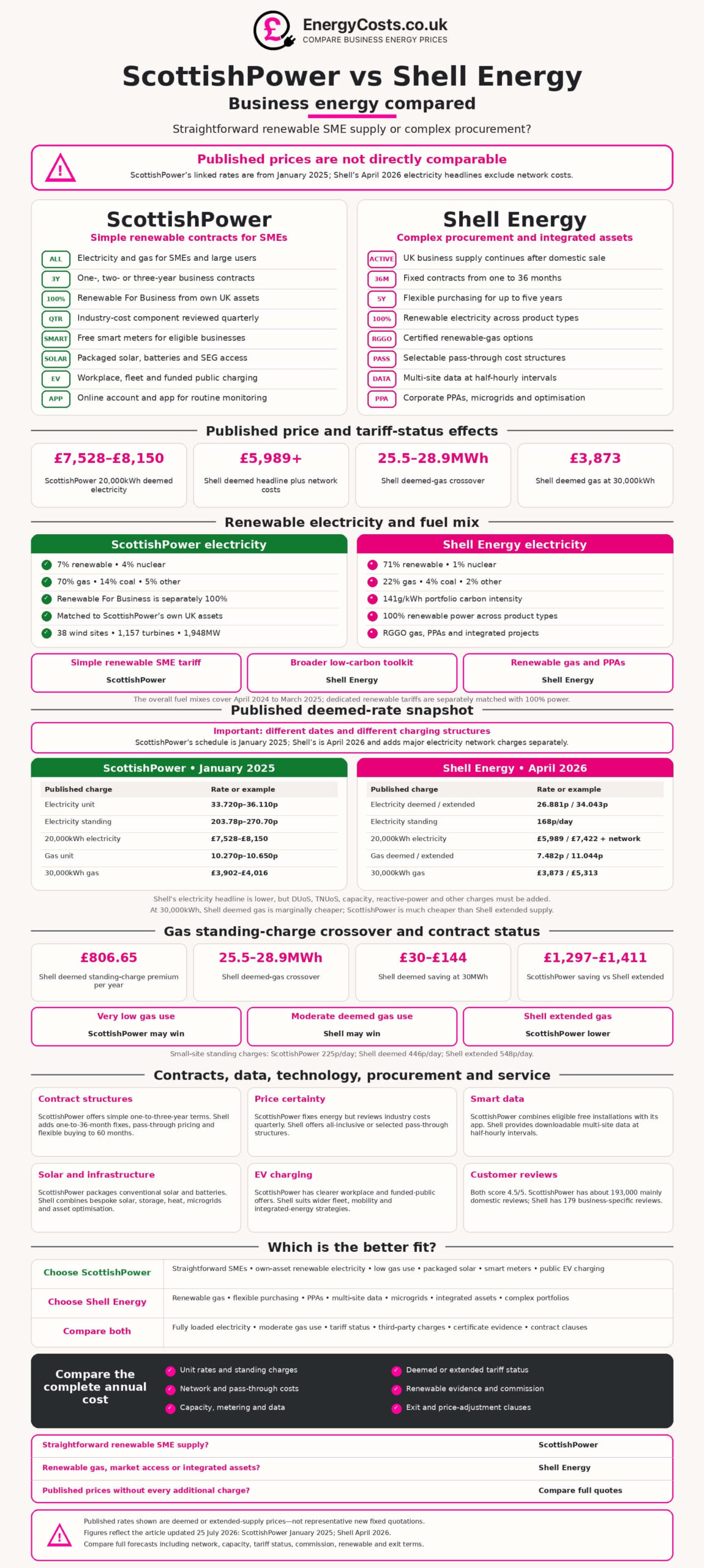
The price comparison requires considerable caution. Shell publishes deemed and extended-supply rates effective from 1 April 2026. ScottishPower’s website, however, still links to deemed price cards effective from 1 January 2025. The figures are therefore not from comparable periods and cannot establish which supplier would provide the cheaper current contract.
ScottishPower vs Shell Energy at a glance
| Comparison area | ScottishPower | Shell Energy |
|---|---|---|
| Business electricity | Yes | Yes |
| Business gas | Yes | Yes |
| Standard fixed terms | One, two or three years | One to 36 months |
| Large-user flexible terms | Limited details in its public SME proposition | 12 to 60 months |
| Renewable electricity | 100% renewable Renewable For Business tariff | 100% renewable options across fixed, pass-through and flexible products |
| Renewable gas | Not a central SME product | RGGO-backed renewable gas available |
| Treatment of industry costs | Reviewed quarterly on For Business tariffs | Fixed all-inclusive or selectable pass-through options |
| Flexible wholesale purchasing | Not prominently offered to SMEs | Flex Shape and Block and Index |
| Corporate PPAs | Renewable procurement support available | Corporate PPAs available |
| Published deemed electricity rate | 33.720p to 36.110p per kWh | 26.881p per kWh |
| Published electricity standing charge | 203.78p to 270.70p per day | 168p per day |
| Electricity pass-through costs | Not separately excluded from the published SME rates | DUoS and TNUoS charges passed through separately |
| Published deemed gas rate | 10.270p to 10.650p per kWh | 7.482p to 7.680p per kWh |
| Small-site gas standing charge | 225p per day | 446p per day |
| Smart-meter installation | Free for eligible businesses | Available for eligible businesses |
| Consumption data | App and online account | Up to half-hourly data through My Account |
| Commercial solar | Packaged solar and battery installations | Integrated solar, storage and microgrid projects |
| EV charging | Workplace, fleet and fully funded public charging | Workplace and wider fleet-mobility solutions |
| Trustpilot rating | 4.5 out of 5 | 4.5 out of 5 |
| Best suited to | SMEs wanting renewable electricity and green technology | Complex procurement, renewable gas and major energy users |
ScottishPower fixes the wholesale-energy element of its For Business contracts, while network, environmental and social costs remain variable and are reviewed quarterly. Shell offers both fixed all-inclusive contracts and products under which selected non-commodity charges are passed through.
Does Shell Energy still supply UK businesses?
Yes. Shell Energy remains an active UK business energy supplier.
Shell sold its UK household gas and electricity retail operation to Octopus Energy, but the commercial supply business was not included in the closure of the household brand. Shell Energy continues to offer gas, electricity, renewable procurement and energy-management services to businesses in Great Britain.
Businesses should therefore distinguish between:
- The former Shell Energy household operation, whose customers transferred to Octopus Energy
- Shell Energy UK’s continuing commercial gas and electricity business
Which is cheaper: ScottishPower or Shell Energy?
Neither supplier publishes fixed rates that apply to every business. A quotation normally depends on:
- Annual consumption
- Meter type and profile
- Electricity distribution region
- Agreed supply capacity
- Number of premises
- Contract length
- Contract start date
- Payment method
- Credit history
- Renewable-energy requirements
- Treatment of third-party charges
- Broker commission
Published deemed prices provide some useful context, but there are two important problems.
First, ScottishPower’s latest publicly linked complete deemed schedules remain dated 1 January 2025. Shell’s rates are effective from 1 April 2026.
Second, Shell’s electricity prices exclude several major network charges that are billed separately. ScottishPower’s headline prices therefore cannot be compared directly with Shell’s unit rate and standing charge alone.
ScottishPower vs Shell Energy electricity prices
The following figures apply to standard unrestricted non-half-hourly electricity meters.
| Supplier and tariff | Effective date | Unit rate | Standing charge |
|---|---|---|---|
| ScottishPower deemed | January 2025 | 33.720p to 36.110p per kWh | 203.78p to 270.70p per day |
| Shell deemed | April 2026 | 26.881p per kWh | 168p per day |
| Shell extended supply | April 2026 | 34.043p per kWh | 168p per day |
Prices exclude VAT and the Climate Change Levy.
Shell has the lowest headline unit rate and standing charge. However, it separately passes through Distribution Use of System capacity, reactive-power and fixed charges, along with Transmission Network Use of System charges. The complete Shell bill will consequently be higher than the figures produced from its unit rate and standing charge alone.
ScottishPower deemed electricity rates by region
| Electricity region | Unit rate | Standing charge |
|---|---|---|
| Eastern | 34.100p per kWh | 211.09p per day |
| East Midlands | 33.950p per kWh | 222.11p per day |
| London | 33.920p per kWh | 203.78p per day |
| Merseyside and North Wales | 35.810p per kWh | 270.70p per day |
| West Midlands | 33.720p per kWh | 229.27p per day |
| North East | 34.210p per kWh | 231.33p per day |
| North West | 35.210p per kWh | 217.02p per day |
| North Scotland | 36.110p per kWh | 231.95p per day |
| South Scotland | 34.140p per kWh | 242.15p per day |
| South East | 34.110p per kWh | 214.47p per day |
| Southern | 34.090p per kWh | 217.83p per day |
| South Wales | 34.370p per kWh | 228.72p per day |
| South West | 34.270p per kWh | 231.65p per day |
| Yorkshire | 33.950p per kWh | 231.98p per day |
These ScottishPower figures are the rates in the deemed electricity document currently linked from its business terms page, but the document is dated January 2025.
Example annual electricity cost
The following illustration assumes annual consumption of 20,000 kWh.
| Supplier and tariff | Headline annual cost |
|---|---|
| ScottishPower deemed – lowest-cost region | £7,528 |
| ScottishPower deemed – highest-cost region | £8,150 |
| Shell deemed | £5,989 plus network pass-through charges |
| Shell extended supply | £7,422 plus network pass-through charges |
Shell’s deemed headline cost is between approximately £1,539 and £2,161 below ScottishPower’s published annual cost. Its extended-supply headline cost is between approximately £106 and £728 lower.
Those differences are not the final savings because Shell’s separately charged distribution, transmission and other network costs must still be added. The ScottishPower rates also relate to a much earlier pricing period.
What is Shell extended supply?
Shell applies different rates depending on why a customer does not have a fixed contract.
A deemed tariff normally applies when a business moves into premises already supplied by Shell without first arranging a contract.
Extended-supply rates can apply when an existing Shell fixed contract ends and the business remains on supply without completing a renewal. Shell’s extended electricity rate is 34.043p per kWh, compared with 26.881p on its deemed tariff.
This distinction is significant. An existing Shell customer should not assume it will receive the lower deemed rate when its contract expires.
Electricity price winner
There is no reliable winner from the published electricity schedules.
Shell has substantially lower headline rates, but its network charges are passed through separately. ScottishPower’s complete deemed schedule is transparent by region, but the publicly linked figures are dated January 2025.
Businesses should compare fully loaded annual quotations showing:
- Commodity unit rates
- Daily standing charges
- DUoS charges
- TNUoS charges
- Capacity charges
- Reactive-power costs
- Metering and data charges
- Environmental levies
- Broker commission
ScottishPower vs Shell Energy gas prices
The gas comparison is more straightforward because Shell does not apply the same separately listed electricity network costs.
| Supplier and tariff | Annual consumption | Unit rate | Standing charge |
|---|---|---|---|
| ScottishPower deemed | Typical SME supply | 10.270p to 10.650p per kWh | 225p per day |
| Shell deemed | 1 to 73,200 kWh | 7.482p per kWh | 446p per day |
| Shell deemed | 73,201 to 732,000 kWh | 7.680p per kWh | 1,586p per day |
| Shell deemed | More than 732,000 kWh | 7.571p per kWh | 2,646p per day |
| Shell extended supply | 1 to 73,200 kWh | 11.044p per kWh | 548p per day |
| Shell extended supply | 73,201 to 732,000 kWh | 11.242p per kWh | 1,688p per day |
| Shell extended supply | More than 732,000 kWh | 11.133p per kWh | 2,747p per day |
Shell’s deemed unit rate is considerably lower than ScottishPower’s published rate, but its standing charge is nearly twice as high for the smallest consumption band. Shell’s standing charge then rises sharply when annual consumption exceeds 73,200 kWh.
ScottishPower deemed gas rates by region
| Gas region | Unit rate |
|---|---|
| Eastern | 10.270p per kWh |
| East Midlands | 10.310p per kWh |
| London | 10.470p per kWh |
| Merseyside and North Wales | 10.580p per kWh |
| West Midlands | 10.650p per kWh |
| North East | 10.450p per kWh |
| North West | 10.330p per kWh |
| North Scotland | 10.340p per kWh |
| South Scotland | 10.340p per kWh |
| South East | 10.390p per kWh |
| Southern | 10.500p per kWh |
| South Wales | 10.310p per kWh |
| South West | 10.650p per kWh |
| Yorkshire | 10.540p per kWh |
ScottishPower’s standing charge is 225p per day in every region under the currently linked January 2025 deemed schedule.
Example annual gas cost
The following illustration assumes annual consumption of 30,000 kWh.
| Supplier and tariff | Estimated annual cost |
|---|---|
| ScottishPower deemed – lowest-price region | £3,902 |
| ScottishPower deemed – highest-price region | £4,016 |
| Shell deemed | £3,873 |
| Shell extended supply | £5,313 |
Shell’s deemed tariff is approximately £30 to £144 cheaper at this consumption level.
ScottishPower’s published rate is approximately £1,297 to £1,411 cheaper than Shell’s extended-supply tariff.
These comparisons again use ScottishPower’s January 2025 price card against Shell’s April 2026 schedule. They illustrate how the tariff structures work but do not establish which supplier would provide the cheaper current fixed contract.
Gas crossover point
Shell’s small-site deemed standing charge costs £806.65 more per year than ScottishPower’s published standing charge.
Its lower unit rate begins to offset that difference when annual consumption reaches approximately:
- 25,500 kWh against ScottishPower’s highest regional unit rate
- 28,900 kWh against ScottishPower’s lowest regional unit rate
Below those levels, ScottishPower’s lower standing charge can produce the cheaper published total. Above them, Shell’s lower deemed unit rate begins to dominate.
This calculation does not apply to Shell extended supply, which has both a higher unit rate and a higher standing charge than ScottishPower’s published January 2025 schedule.
ScottishPower contract options
ScottishPower offers one, two and three-year business contracts.
Its current electricity proposition is Renewable For Business. Its standard gas contract is the For Business tariff.
How ScottishPower fixed contracts work
ScottishPower splits the tariff into two elements:
- Fixed energy costs: The wholesale-energy component is locked for the agreed contract term.
- Variable industry costs: Network, social and environmental costs can rise or fall.
The variable charges are reviewed quarterly, with revisions taking effect on 1 January, 1 April, 1 July or 1 October.
A ScottishPower contract should not therefore be interpreted as guaranteeing that the complete unit rate will remain unchanged.
The variable component can include costs connected with:
- Electricity and gas networks
- Environmental programmes
- Social obligations
- Capacity and balancing arrangements
- Other regulated industry charges
This structure can reduce the risk premium that might otherwise be built into a completely fixed price, but it also leaves the business exposed to rising third-party costs.
Shell Energy contract options
Shell provides three principal procurement routes.
Fixed all-inclusive contracts
Shell’s fixed-price terms range from one to 36 months.
The supplier offers a specific fixed all-inclusive SME plan to organisations spending less than £50,000 annually on energy, alongside tailored contracts for larger users. Customers can select renewable electricity, renewable gas and different billing or payment arrangements.
Shell describes the rate as agreed upfront, but it reserves the right to vary prices or pass on costs in circumstances including:
- Inaccurate information supplied by the customer
- Breaches of the agreement
- Changes to regulation or law
- Changes to metering or supply arrangements
- Changes to the calculation or structure of third-party charges
The product provides a high degree of certainty, but it is not immune from every possible industry or regulatory change.
Pass-through contracts
Shell’s pass-through contracts are primarily aimed at businesses spending more than £50,000 annually.
They allow the customer to fix the electricity commodity price while selecting which non-commodity charges are billed at prevailing rates. This can avoid some of the risk premium associated with fixing uncertain network and policy costs.
The disadvantage is that the total bill can change when distribution, transmission or environmental charges move.
Flexible purchasing
Shell’s flexible contracts are designed principally for electricity customers spending more than £1 million annually.
It offers two principal products:
| Shell flexible product | Contract term | Purchasing structure |
|---|---|---|
| Flex Shape | 12 to 36 months | Monthly, quarterly or seasonal block purchases |
| Block and Index | 12 to 60 months | Block purchasing with residual volumes settled against an index |
Flex Shape requires the relevant volume to be fully hedged before each block period begins. Block and Index provides hourly market access and allows the customer to choose when and how much electricity to hedge or leave floating. Both pass non-energy costs through and can include 100% renewable electricity.
Contract flexibility winner
Shell Energy
ScottishPower provides a straightforward structure for SMEs, but Shell offers a broader progression from short fixed contracts to pass-through pricing and direct wholesale-market purchasing.
Which supplier offers better price certainty?
The answer depends on the contract selected.
ScottishPower clearly states that its energy cost is fixed while industry charges remain variable and are reviewed quarterly.
Shell offers an all-inclusive fixed product, potentially giving stronger initial budget certainty. However, its contract allows changes in defined circumstances, including alterations to third-party charge structures or regulation.
Shell has the advantage where a suitable fixed all-inclusive quotation is available.
ScottishPower may appeal to businesses that prefer greater transparency over variable industry costs and do not want to pay the risk premium that can accompany fully fixed pricing.
The quotation should state precisely whether it fixes:
- Wholesale energy
- Distribution costs
- Transmission costs
- Balancing charges
- Capacity Market costs
- Renewable Obligation costs
- Contracts for Difference
- Metering and data costs
- New taxes or regulatory levies
Renewable electricity comparison
Both suppliers offer 100% renewable electricity, but their propositions differ.
ScottishPower renewable electricity
ScottishPower’s Renewable For Business tariff matches every unit used with renewable electricity generated from its own renewable resources in the UK.
The product is backed by Renewable Energy Guarantees of Origin and is available on one, two or three-year contracts. ScottishPower reports that its group has 38 UK onshore wind-farm sites containing 1,157 turbines with combined capacity of 1,948 MW.
This is a strong proposition for an SME that wants:
- Renewable electricity as its standard contracted product
- REGOs connected with the supplier’s own renewable generation
- Evidence for market-based Scope 2 reporting
- A relatively simple one to three-year agreement
Shell renewable electricity and gas
Shell offers 100% renewable electricity across fixed, pass-through and flexible products. Customers can select options connected with particular generation technologies or locations, subject to the product offered.
Shell also offers renewable gas certified through the Green Gas Certification Scheme. RGGOs match the gas used by the customer with an equivalent amount of biomethane injected into the network.
Shell’s renewable proposition is broader for businesses that need:
- Renewable electricity and gas
- A choice of generation technologies
- Tailored certificate arrangements
- A corporate PPA
- Biomethane procurement
- A combined energy and decarbonisation strategy
Fuel-mix comparison
The suppliers’ overall fuel mixes should not be confused with their dedicated renewable tariffs.
| Energy source | ScottishPower total mix | Shell Energy business mix |
|---|---|---|
| Renewables | 7% | 71% |
| Natural gas | 70% | 22% |
| Coal | 14% | 4% |
| Nuclear | 4% | 1% |
| Other fuels | 5% | 2% |
The disclosures cover 1 April 2024 to 31 March 2025. ScottishPower’s non-green tariffs had a mix dominated by gas, while its dedicated renewable products are matched with 100% renewable electricity. Shell reported portfolio carbon intensity of 141 grams of carbon dioxide per kWh.
Renewable-energy winner
ScottishPower has the stronger simple SME renewable-electricity story because its Renewable For Business product is linked to ScottishPower’s own UK renewable assets.
Shell has the broader overall low-carbon proposition because it offers renewable electricity, renewable gas, biomethane services, PPAs and integrated on-site energy projects. Its disclosed business fuel mix also contained a much higher proportion of renewable electricity.
Smart meters and energy monitoring
ScottishPower smart meters
ScottishPower offers eligible businesses free smart-meter installation. It says installation normally takes around one hour per meter and that appointments may be available outside normal working hours or at weekends.
Automated readings reduce estimated billing, while customers can use ScottishPower’s online account and app to monitor energy, enter readings, view bills and make payments.
Shell Energy smart-meter data
Shell customers with compatible smart or advanced meters can access consumption data free through My Account.
The platform provides:
- Up to 12 months of historical data by default
- Gas and electricity information
- Data at intervals as short as half an hour
- Graphs showing patterns and trends
- Downloadable data
- Information across several sites
- Access for authorised representatives
The service is available continuously online, although recently transferred accounts and complex meters may require assistance before the data appears correctly.
Energy-monitoring winner
Shell has the advantage for granular and multi-site data.
ScottishPower’s app is likely to be easier for a small business needing routine account management. Shell’s ability to display and export half-hourly gas and electricity data gives it the stronger analytical proposition.
Commercial solar and batteries
ScottishPower business solar
ScottishPower offers a clearly packaged commercial solar service covering:
- Solar panels
- Battery storage
- Preliminary proposals
- Site surveys
- Tailored system design
- Nationwide installation
- Distribution Network Operator applications
- Smart Export Guarantee access
Its typical installation package can include a 24-month installer warranty, a 12-year panel manufacturer warranty, an inverter warranty starting from five years and a 25-year performance warranty. ScottishPower gives a typical solar-system operating life of 25 to 30 years.
This proposition is likely to suit shops, offices, warehouses, hospitality businesses and manufacturers wanting a conventional rooftop installation.
Shell on-site energy solutions
Shell’s proposition is broader and more bespoke. It can include:
- Solar generation
- Battery storage
- Microgrids
- Low-carbon heating
- On-site gas generation
- Energy-efficiency systems
- Asset design and construction
- Operation and maintenance
- Fully funded project structures
Shell can also optimise grid-scale batteries and flexible-generation assets.
Solar winner
ScottishPower for a conventional SME installation.
Its public proposition provides clearer detail about surveys, warranties, DNO applications and export arrangements.
Shell for a large integrated energy project.
Its offering is better suited to businesses combining solar, batteries, heat, microgrids and asset optimisation within one programme.
Electric vehicle charging
ScottishPower offers:
- Workplace chargers
- Fleet charging
- Destination charging
- Fast, rapid and ultra-rapid equipment
- Fully funded public charging for eligible sites
Under its public charging model, ScottishPower can fund, install, own, operate and maintain the equipment under a ten-year land lease. The host business receives a share of charging revenue.
Shell offers business EV charging through its wider mobility and energy-solutions operation. Its services can be integrated with renewable electricity, fleet services, battery storage and on-site generation. Shell also supports alternative fuels, road-tolling and fleet-payment services.
EV charging winner
ScottishPower for a clearly defined workplace or public-charging project.
Shell for an integrated national or international fleet-energy strategy.
Large-business and multi-site services
Shell is the stronger supplier for organisations requiring active energy procurement.
Its large-customer proposition includes:
- Fixed all-inclusive contracts
- Pass-through products
- Flex Shape
- Block and Index
- Wholesale-market access
- Monthly, quarterly and seasonal purchases
- Group billing
- Aligned contract-end dates
- Renewable gas
- Corporate PPAs
- On-site generation and asset optimisation
Its most advanced flexible products are aimed at businesses spending more than £1 million annually on electricity.
ScottishPower states that it serves small, medium and large businesses, but its public tariff proposition centres primarily on one, two and three-year contracts with fixed energy costs and quarterly variable industry charges.
Large-business winner: Shell Energy
Customer-review comparison
| Supplier profile | TrustScore | Number of reviews |
|---|---|---|
| ScottishPower | 4.5 out of 5 | Approximately 193,000 |
| Shell Energy for Business Customers | 4.5 out of 5 | 179 |
Both suppliers currently have the same headline TrustScore, but the datasets are not directly comparable.
ScottishPower’s profile covers its wider customer base and is dominated by domestic experiences. It has an extremely large sample and actively invites reviews.
Shell’s profile relates specifically to business customers, making it more relevant to this comparison. However, 179 reviews is a small sample, and Trustpilot records only seven submissions during the most recent 12-month period shown.
Customer-review winner: Draw
Shell’s reviews are more relevant, while ScottishPower’s sample is far more statistically substantial.
ScottishPower advantages and disadvantages
Advantages of ScottishPower
- Straightforward one, two and three-year contracts
- Renewable For Business electricity tariff
- Renewable power matched with ScottishPower’s own UK assets
- Free smart-meter installations for eligible businesses
- App and online account management
- Commercial solar panels and batteries
- Smart Export Guarantee access
- Workplace, fleet and destination charging
- Fully funded public EV charging for suitable sites
- Strong overall Trustpilot score
- Clearly explained quarterly treatment of industry charges
Disadvantages of ScottishPower
- Publicly linked deemed rates are still dated January 2025
- The complete contracted price is not fully fixed
- Network, social and environmental charges are reviewed quarterly
- No prominent renewable-gas product for SMEs
- Public tariff information focuses on conventional fixed contracts
- Less extensive direct wholesale-market access than Shell
- Overall disclosed fuel mix contained only 7% renewables
- Trustpilot reviews are predominantly domestic
Shell Energy advantages and disadvantages
Advantages of Shell Energy
- Fixed terms from one to 36 months
- Flexible purchasing for up to 60 months
- Fixed all-inclusive and pass-through structures
- 100% renewable electricity available
- RGGO-backed renewable gas
- Corporate PPAs
- Lower published deemed electricity headline rates
- Lower deemed gas unit rates
- Half-hourly smart and advanced meter data
- Multi-site and group-billing options
- Solar, batteries, microgrids and low-carbon heat
- Advanced asset optimisation
- Business-specific Trustpilot profile
- Overall disclosed electricity mix contained 71% renewables
Disadvantages of Shell Energy
- Electricity network charges are passed through separately on deemed rates
- Headline electricity prices are not the complete cost
- High deemed gas standing charges
- Gas standing charges increase sharply with consumption
- Extended-supply rates are much more expensive than deemed rates
- Fixed prices can change in specified circumstances
- Flexible products may be unnecessarily complex for an SME
- Business Trustpilot profile has a small sample
- The sale of the domestic operation can cause brand confusion
Which supplier is best for different businesses?
| Business requirement | Better choice | Reason |
|---|---|---|
| Small office or shop | ScottishPower | Simple renewable SME contract |
| Business wanting its energy cost fully packaged | Shell | Fixed all-inclusive option available |
| Business comparing published electricity prices | Neither conclusively | Shell passes network charges through and ScottishPower’s rates are old |
| Very low gas consumption | ScottishPower may be cheaper | Lower published standing charge |
| Moderate deemed gas consumption | Shell may be cheaper | Lower unit rate begins to outweigh standing charge |
| Existing Shell customer after contract expiry | Compare alternatives urgently | Extended-supply rates are considerably higher |
| Renewable SME electricity | ScottishPower | Power matched with its own UK renewable assets |
| Renewable gas | Shell | RGGO-backed options |
| Detailed half-hourly consumption data | Shell | Downloadable multi-site data |
| Conventional commercial solar | ScottishPower | Clearly packaged end-to-end installation |
| Fully funded public EV charging | ScottishPower | Host model with revenue share |
| Integrated microgrid project | Shell | Broader on-site infrastructure capabilities |
| Flexible wholesale purchasing | Shell | Flex Shape and Block and Index |
| Five-year flexible contract | Shell | Block and Index runs for up to 60 months |
| Corporate PPA | Shell | Prominent tailored PPA proposition |
| Multi-site billing | Shell | Group billing and aligned end dates |
| Relevant business-only review profile | Shell | Reviews relate specifically to businesses |
| Largest review sample | ScottishPower | Approximately 193,000 reviews |
Final verdict: ScottishPower vs Shell Energy
ScottishPower is likely to be the better fit for a conventional small or medium-sized business.
Its one, two and three-year tariffs are relatively easy to understand, renewable electricity is matched with generation from its own UK assets, and it offers a strong supporting range of smart meters, solar panels, batteries and EV charging.
The principal drawback is that its contracted prices are only partly fixed. Network, social and environmental costs are reviewed quarterly and can change during the term.
Shell Energy is the stronger supplier for complex procurement and ambitious decarbonisation programmes.
Its fixed all-inclusive, pass-through and flexible-purchasing options provide more choice over how and when energy is bought. It also offers renewable gas, corporate PPAs, microgrids, battery optimisation and integrated on-site projects.
The price verdict is less clear:
- Shell has lower headline deemed electricity prices, but major network costs are added separately.
- ScottishPower’s publicly linked deemed rates are dated January 2025 and should not be treated as current quotations.
- Shell’s deemed gas can become cheaper at moderate consumption.
- ScottishPower has the lower small-site gas standing charge.
- Shell’s extended-supply rates are considerably less attractive than its deemed prices.
For an ordinary SME wanting straightforward renewable electricity, ScottishPower is the more accessible choice.
For a large, multi-site or energy-intensive organisation wanting renewable gas, market access or integrated energy infrastructure, Shell Energy has the stronger overall proposition.
The final decision should be based on live, fully loaded quotations showing unit rates, standing charges, network costs, capacity fees, broker commission, renewable certificates and every permitted price-adjustment clause.
FAQ
The published figures do not provide a reliable current answer. Shell has lower headline deemed electricity rates but passes network charges through separately. ScottishPower’s publicly linked deemed schedules remain dated January 2025.
Shell publishes a deemed rate of 26.881p per kWh and a 168p standing charge. ScottishPower’s linked regional rates range from 33.720p to 36.110p, but Shell adds significant network charges separately.
Shell has the lower deemed unit rate. ScottishPower has the lower standing charge. At 30,000 kWh, Shell’s deemed tariff is marginally cheaper using the published figures, while ScottishPower is much cheaper than Shell extended supply.
Extended supply normally applies when a Shell fixed contract expires and the business remains on supply without completing a renewal. It is different from the lower deemed tariff used for certain new occupiers.
Yes. ScottishPower offers one, two and three-year contracts. Shell’s fixed terms range from one to 36 months, while selected flexible products can run for as long as 60 months.
No. ScottishPower fixes the energy element, but relevant network, social and environmental costs remain variable and are reviewed every quarter.
Shell offers fixed all-inclusive contracts, but its terms allow price changes in certain circumstances, including changes to regulation, metering or the structure of third-party charges.
Both offer 100% renewable electricity. ScottishPower’s product is matched with electricity from its own UK renewable assets. Shell offers broader technology and location options and reported a higher renewable share across its overall fuel mix.
Yes. Shell offers renewable gas backed by Renewable Gas Guarantees of Origin, matching customer consumption with an equivalent quantity of biomethane placed into the network.
Yes. ScottishPower provides free installations for eligible businesses. Shell supports smart and advanced meters and provides free online access to consumption data at intervals as short as half an hour.
Yes. ScottishPower provides packaged commercial solar and battery installations. Shell delivers broader integrated projects involving solar, storage, microgrids, heat and energy-management systems.
ScottishPower has the clearer packaged service for workplaces, fleets and fully funded public charging. Shell is more suitable where charging forms part of a broader fleet or integrated energy strategy.
Shell is generally stronger for large businesses because it offers pass-through pricing, direct wholesale-market access, five-year flexible contracts, PPAs and integrated on-site infrastructure.
Both currently have a 4.5 Trustpilot score. Shell’s profile is business-specific but contains only 179 reviews. ScottishPower has approximately 193,000 reviews, although most relate to domestic customers.
Choose ScottishPower for a straightforward renewable SME contract, commercial solar or packaged EV charging. Consider Shell for renewable gas, pass-through pricing, flexible procurement, multi-site management or complex industrial energy projects.