
What is a DNO? A Distribution Network Operator, usually shortened to DNO, is the regulated company that owns, operates and maintains the regional electricity network carrying power to homes and businesses.
If a cable fails, a substation needs upgrading, a factory needs more electrical capacity or a commercial solar system needs permission to export, the DNO is likely to be involved.
It is not normally the company that sends the electricity bill.
For a UK business owner, the distinction matters because:
- Changing electricity supplier does not change the local DNO or the physical network
- A site may need DNO approval before adding major electrical load, generation or battery storage
- The available network capacity can determine whether a development is viable and when it can open
- The DNO’s Distribution Use of System charges form part of the electricity price, even when they are not itemised
- The DNO handles most local power cuts and external voltage problems
- Businesses may be entitled to payments when a DNO misses certain service standards
- Some businesses can earn revenue by helping the DNO manage local network constraints
Ofgem describes electricity distribution as the final stage of moving electricity from where it is generated to where it is used. DNOs do this through lower-voltage power lines, substations, transformers and control equipment.
They are regional monopolies, so a business can choose its supplier but cannot shop around for a different host DNO at the same address. Ofgem explains what it regulates here.
DNOs at a glance
| Question | Short answer |
|---|---|
| What does DNO stand for? | Distribution Network Operator |
| What does a DNO do? | Owns, operates, maintains and develops the regional electricity distribution network |
| Is a DNO the same as an electricity supplier? | No. The supplier buys and sells energy, manages the contract and sends bills |
| Can a business choose its DNO? | Usually no. The host DNO is determined by the site’s location |
| How many DNO licence areas are there in Great Britain? | 14, operated through six DNO groups for RIIO-ED2 reporting |
| Who covers Northern Ireland? | NIE Networks, under a separate regulatory framework |
| Who should a business call for a power cut in Great Britain? | 105, free from most landlines and mobile phones |
| Who should a business call in Northern Ireland? | NIE Networks on 03457 643 643 |
| Where is the DNO shown on a bill? | The distributor ID is part of the MPAN; the operator may also be named |
| Does the DNO charge a business directly? | Usually not for routine network use. The supplier pays DUoS and recovers it through the tariff, although connection and alteration work may be billed directly |
| When must a business contact the DNO? | For new or upgraded connections, service alterations, many generation and storage projects, network faults, persistent voltage issues and work near network assets |
Where the DNO fits into the electricity system
The electricity industry separates the physical network from the commercial supply contract.
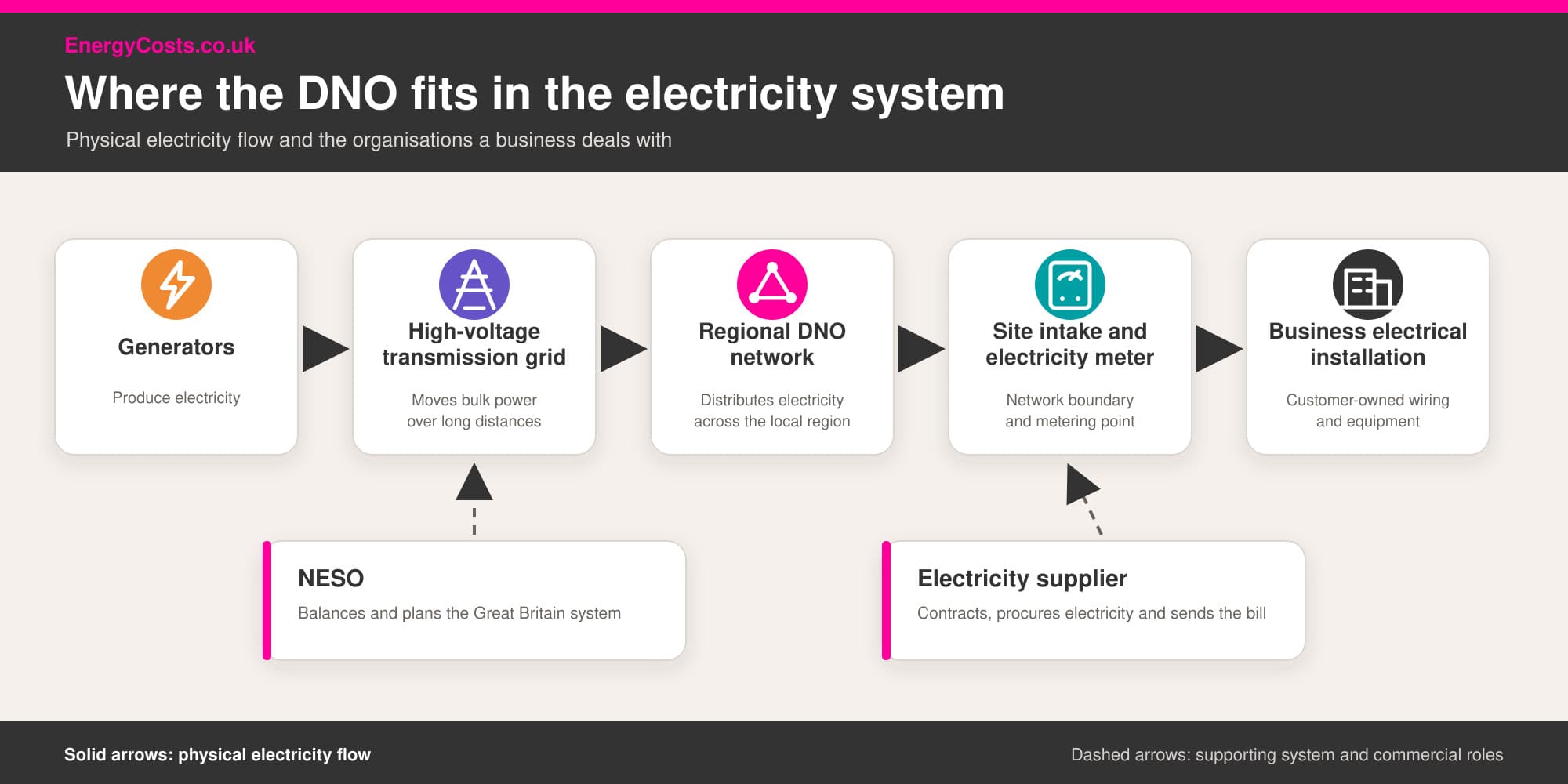
At a simplified level:
- Generators produce electricity.
- The transmission network moves large volumes over long distances, mainly at 275kV and 400kV. In Scotland, parts of the 132kV network are also classed as transmission.
- A DNO takes power from the transmission system and from generators connected directly to its own network.
- The DNO transforms and distributes that power through regional networks, generally at 132kV and below in England and Wales and at lower distribution voltages in Scotland.
- The electricity reaches the site intake, where ownership and responsibility pass from network assets to metering equipment and the customer’s installation according to the particular connection arrangement.
NESO, the National Energy System Operator, balances the electricity system in Great Britain and carries out strategic system planning. It does not replace the local DNO. Northern Ireland has separate market and system arrangements.
DNO, transmission owner, NESO and supplier compared
| Organisation | Main role | Typical reason a business contacts it |
|---|---|---|
| DNO or IDNO | Local and regional distribution wires, substations, connections and faults | Power cut, new connection, extra capacity, service alteration, generation approval or voltage complaint |
| Transmission owner | Owns the very high-voltage transmission assets in its region | Usually only relevant to exceptionally large, directly connected projects |
| NESO | Balances and plans the GB energy system and manages transmission connections | Large transmission connection, system services or strategic planning |
| Electricity supplier | Buys energy, contracts with the customer, registers the supply and bills it | Tariff, renewal, billing, switching, meter reading or account issue |
| Meter Operator, or MOP | Installs and maintains business metering under the relevant appointment | Half-hourly meter work, current transformers, communications or meter faults |
| Electrical contractor | Maintains the customer’s wiring and equipment after the network boundary | Distribution board, internal cable, protective device, earthing or machinery fault |
The boundary is not always a single obvious point. At a straightforward low-voltage site, the DNO normally owns the incoming service cable and cut-out or service head; the meter is part of the metering arrangement; and the business owns the installation after the agreed boundary.
At an HV site, business park or multi-occupied building, ownership can include customer transformers, private HV switchgear, an IDNO network or landlord-owned risers.
The connection agreement, single-line diagram and asset register take precedence over rules of thumb.
Map of UK Distribution Network Operator areas
The map below shows the 14 Great Britain licence areas and the single Northern Ireland network area. The numbered labels match the distributor IDs used in the table that follows.
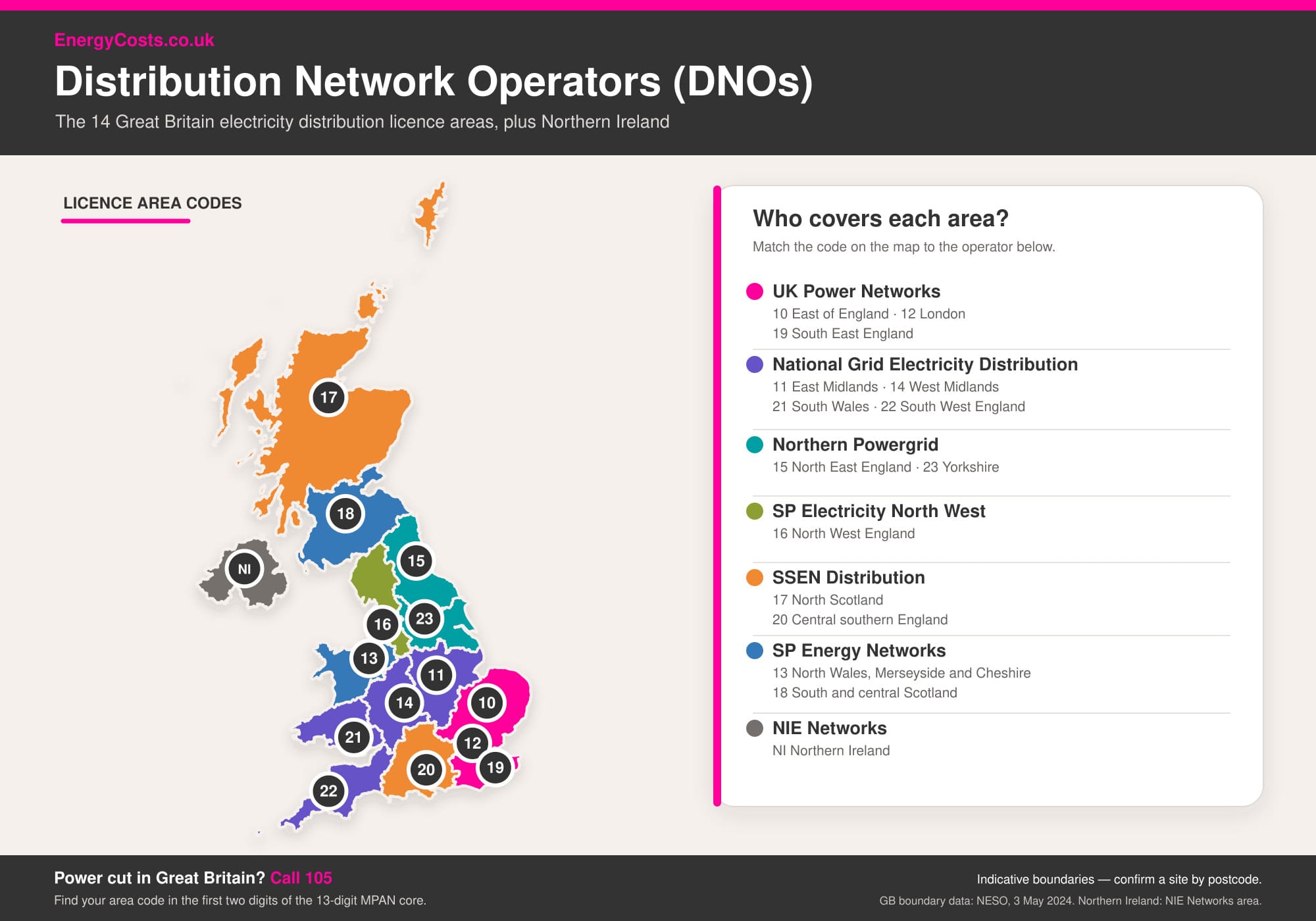
The Great Britain boundaries use NESO’s open DNO licence-area GIS data, dated 3 May 2024. NESO warns that the boundaries are approximate, can shift and may be unreliable around some rural borders. Northern Ireland uses an OSNI-derived open outline and is shown as one area because NIE Networks is its only DNO. The map should therefore be used for regional orientation, not to decide which operator serves a particular postcode.
Which DNO covers each part of the UK?
Ofgem’s latest RIIO-ED2 report lists 14 licensed DNO areas and six DNO groups. SP Electricity North West and SP Energy Networks now share ScottishPower group ownership, so some newer high-level material describes five corporate groups; they remain separate network businesses and contact points for customers. The licensed North West entity is still Electricity North West Limited. Ofgem explains the reporting position in its 2024/25 electricity distribution report.
| Distributor ID | Practical operator name | Licence area or region | Main website |
|---|---|---|---|
| 10 | UK Power Networks | East of England | ukpowernetworks.co.uk |
| 11 | National Grid Electricity Distribution | East Midlands | nationalgrid.co.uk |
| 12 | UK Power Networks | London | ukpowernetworks.co.uk |
| 13 | SP Energy Networks | North Wales, Merseyside and Cheshire | spenergynetworks.co.uk |
| 14 | National Grid Electricity Distribution | West Midlands | nationalgrid.co.uk |
| 15 | Northern Powergrid | North East England | northernpowergrid.com |
| 16 | SP Electricity North West | North West England | enwl.co.uk |
| 17 | SSEN Distribution | North Scotland | ssen.co.uk |
| 18 | SP Energy Networks | South and central Scotland | spenergynetworks.co.uk |
| 19 | UK Power Networks | South East England | ukpowernetworks.co.uk |
| 20 | SSEN Distribution | Central southern England | ssen.co.uk |
| 21 | National Grid Electricity Distribution | South Wales | nationalgrid.co.uk |
| 22 | National Grid Electricity Distribution | South West England | nationalgrid.co.uk |
| 23 | Northern Powergrid | Yorkshire | northernpowergrid.com |
| NI | NIE Networks | Northern Ireland | nienetworks.co.uk |
The Northern Ireland Utility Regulator confirms that NIE Networks is the only DNO in Northern Ireland. It is regulated separately from the Great Britain DNOs and also owns Northern Ireland’s transmission network. The GB RIIO-ED2 rules and compensation figures in this guide should not be assumed to apply in Northern Ireland.
How to find the DNO for a business premises
There are four reliable methods.
Use the postcode finder
The quickest route is the Energy Networks Association’s network operator finder. Enter the full site postcode and follow the link to the identified operator.
This is better than relying on a regional map, particularly near licence boundaries, on islands and in rural areas.
Check the MPAN on an electricity bill
The Meter Point Administration Number, or MPAN, identifies an electricity supply point in Great Britain. The lower 13 digits are called the MPAN core. Its first two digits are the distributor ID, which normally corresponds to codes 10 to 23 in the table above.
On the full 21-digit “S number” format, the distributor ID appears as digits nine and ten. EnergyCosts.co.uk has a separate guide explaining how to find and read an MPAN.
An MPAN is not the meter serial number. The MPAN identifies the supply point; the serial number identifies the physical meter. Multi-occupied buildings can have several MPANs at one postal address, so match each number to the correct unit and meter.
Call 105 in Great Britain
Calling 105 reaches the electricity network service in England, Scotland and Wales. It can identify the network operator as well as take a power-cut or network-safety report. The service is free from most landlines and mobiles. The ENA explains how the 105 service works. Northern Ireland uses NIE Networks’ number, 03457 643 643, instead.
Ask the landlord, developer or connection provider
For a new estate, retail park or commercial development, the immediate network may be owned by an IDNO rather than the regional DNO. Check the utility handover pack, connection agreement, energisation notice and site single-line diagram. The developer, managing agent or facilities team should also hold a meter-point schedule.
What a DNO is responsible for
A DNO’s core responsibilities include:
- Maintaining overhead lines, underground cables, transformers, substations and protection systems;
- Responding to faults, dangerous network equipment and local power cuts;
- Planning and reinforcing the regional network;
- Providing, modifying and disconnecting network connections;
- Allocating an MPAN for a new GB connection;
- Assessing the effect of large new loads and distributed generation;
- Investigating qualifying voltage complaints;
- Publishing connection and capacity information;
- Aetting regulated Distribution Use of System tariffs;
- Maintaining records of network assets and land rights;
- Giving notice of planned interruptions;
- Supporting customers who need additional help during an outage; and
- Procuring local flexibility where it is more efficient than immediate reinforcement.
What a DNO is not normally responsible for
| Issue | Usually contact |
|---|---|
| Incorrect unit rate, standing charge or invoice | Electricity supplier |
| Contract renewal, termination or change of tenancy | Electricity supplier or broker |
| Supplier switch | New and existing suppliers |
| Meter reading, smart-meter communications or most meter exchanges | Supplier and Meter Operator |
| Faulty wiring, distribution board or equipment inside the premises | Competent electrical contractor |
| Landlord’s private cable, riser or substation | Landlord, BNO, managing agent or private network operator |
| Gas leak | Gas emergency service, not the electricity DNO |
| Loss caused by an outage beyond a guaranteed-standard payment | Business insurer or legal adviser, subject to policy and liability |
A useful first check during an outage is whether neighbouring premises or street lighting are also affected. If the problem appears confined to one site, check the main switch and protective devices only if it is safe to do so. A competent contractor may be needed to establish whether the fault is in the customer installation, meter equipment, DNO cut-out or upstream network.
When a business should contact its DNO
| Situation | Why the DNO may be needed |
|---|---|
| Complete or partial power cut | To log and locate an external network fault |
| Damaged cable, low line, damaged pole or open substation | Immediate network-safety response |
| New commercial premises | To quote, build or approve the network connection |
| Larger machinery, electric process heat or data equipment | The existing import capacity may be insufficient |
| Fleet charging or rapid EV chargers | New load may require assessment, load management or reinforcement |
| Solar PV, wind, CHP, battery or vehicle-to-grid | Generation and export rules may require notification or advance approval |
| Heat pump or other low-carbon equipment | Installer must follow connect-and-notify or apply-before-connect rules |
| Moving the intake, cut-out or incoming cable | These are network assets, even if the meter is also moving |
| Temporary or permanent disconnection | The DNO or IDNO controls the network disconnection |
| Persistent high or low voltage, dips or flicker | The DNO investigates supply quality at the network boundary |
| Excavation, crane work or construction near cables or lines | Plans, safe clearances, shutdowns or diversions may be required |
| Network equipment on business land | Wayleave, easement, access or diversion issue |
| Critical medical or welfare needs at the site | Additional support registration and outage planning |
| Flexible demand, batteries or generation | The business may be able to provide paid local flexibility |
For life-threatening danger, fire or an immediate risk to the public, call 999 as well as the network operator. Stay well clear of fallen or damaged lines and never assume a line is dead.
DNOs, IDNOs, ICPs, BNOs and private networks
These abbreviations become important when a business moves into a new development or commissions a connection.
Independent Distribution Network Operator
An IDNO is a licensed network operator that owns and operates a local network embedded within a host DNO’s region. IDNOs are common on new housing estates, industrial parks, logistics developments and mixed-use schemes.
The IDNO may own the last section of network supplying the site, while the regional DNO remains upstream. The business still buys energy from a supplier. Ofgem regulates IDNOs, although their price-control arrangements differ from the regional DNO framework.
Practical consequences can include:
- the IDNO, rather than the host DNO, handling a local asset fault;
- an MPAN distributor code outside the familiar 10-to-23 regional range;
- two network operators being involved in a planned interruption or connection change; and
- the developer receiving an asset-adoption payment from an IDNO, which should be reflected transparently in the connection procurement.
Independent Connection Provider
An ICP is an accredited company that can design and build the contestable parts of a connection. Ofgem explains that a customer can choose an ICP or IDNO for work that is open to competition, while some non-contestable work must remain with the host DNO. Ofgem’s competition-in-connections guide explains the distinction.
Contestable work can include elements of design, cable laying, substations and construction. Non-contestable work can include activities that only the network owner can safely carry out on its live system. The exact split depends on the scheme.
For a material connection, compare:
- the DNO’s all-works offer
- the DNO’s non-contestable-only offer plus an ICP tender
- DNO adoption versus IDNO adoption
- programme risk and who coordinates interfaces
- asset-adoption value and how it is credited
- design-approval, inspection and energisation responsibilities
- warranties, defects and post-energisation ownership
The lowest construction quotation is not necessarily the lowest completed-project cost if interfaces or legal work delay energisation.
Building Network Operator
A BNO owns or operates the private distribution wiring between the public network intake and individual customer installations in a multi-occupied building. The BNO may be the freeholder, landlord, managing agent or another appointed organisation.
If one tenant loses power while the rest of the building remains on, the fault may sit on the BNO’s riser, lateral or distribution equipment rather than the public network. Businesses should know:
- who the BNO is;
- where the DNO or IDNO boundary ends;
- who maintains the landlord’s switchgear, risers and laterals;
- whether the tenant has a direct supplier MPAN or receives a private recharge; and
- who authorises additional load or EV charging.
Ofgem notes that public energy networks generally have no responsibility for wiring within multi-occupancy buildings. A lease should allocate maintenance, loss and upgrade costs clearly.
Private wire network
A private wire network is customer or landlord-owned infrastructure that distributes power within or between premises. It may sit behind one grid connection and may include on-site generation. The commercial, licensing, metering, tax and lease implications can be complex, particularly where electricity is resold to third parties. Obtain specialist legal and engineering advice before relying on a private-wire arrangement.
How electricity reaches a business
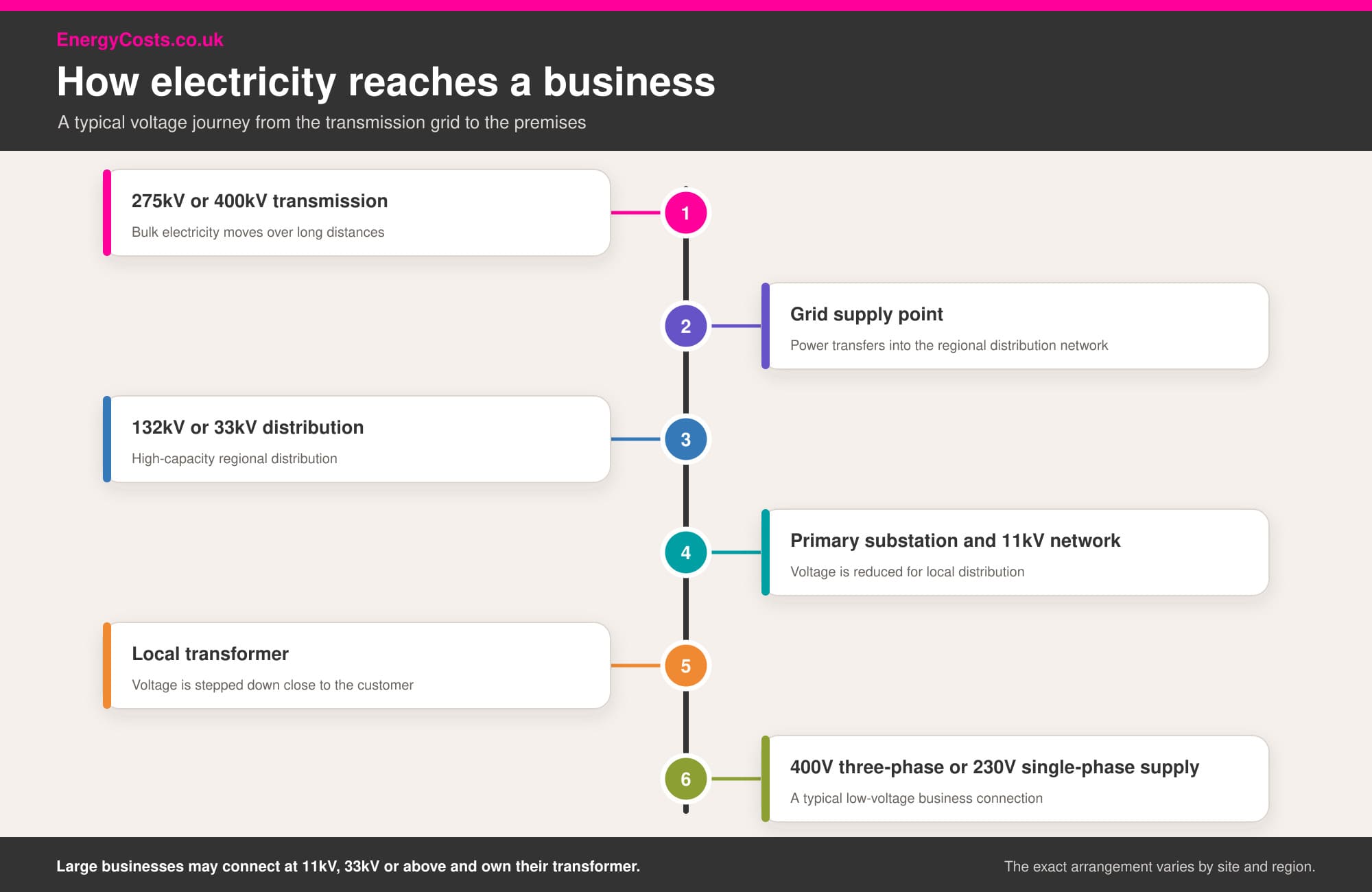
This is a typical hierarchy, not a rule for every site. A large factory may connect at 11kV, 33kV or above and own its transformer. A small shop will usually take a low-voltage supply. Distribution voltage classifications also differ between England and Wales, Scotland and Northern Ireland.
For low-voltage supplies in Great Britain, the declared phase-to-neutral voltage is 230V. The Electricity Safety, Quality and Continuity Regulations generally permit a variation of 10% above or 6% below that declared voltage, equivalent to about 216.2V to 253V. Regulation 27 sets the legal framework.
New business electricity connections
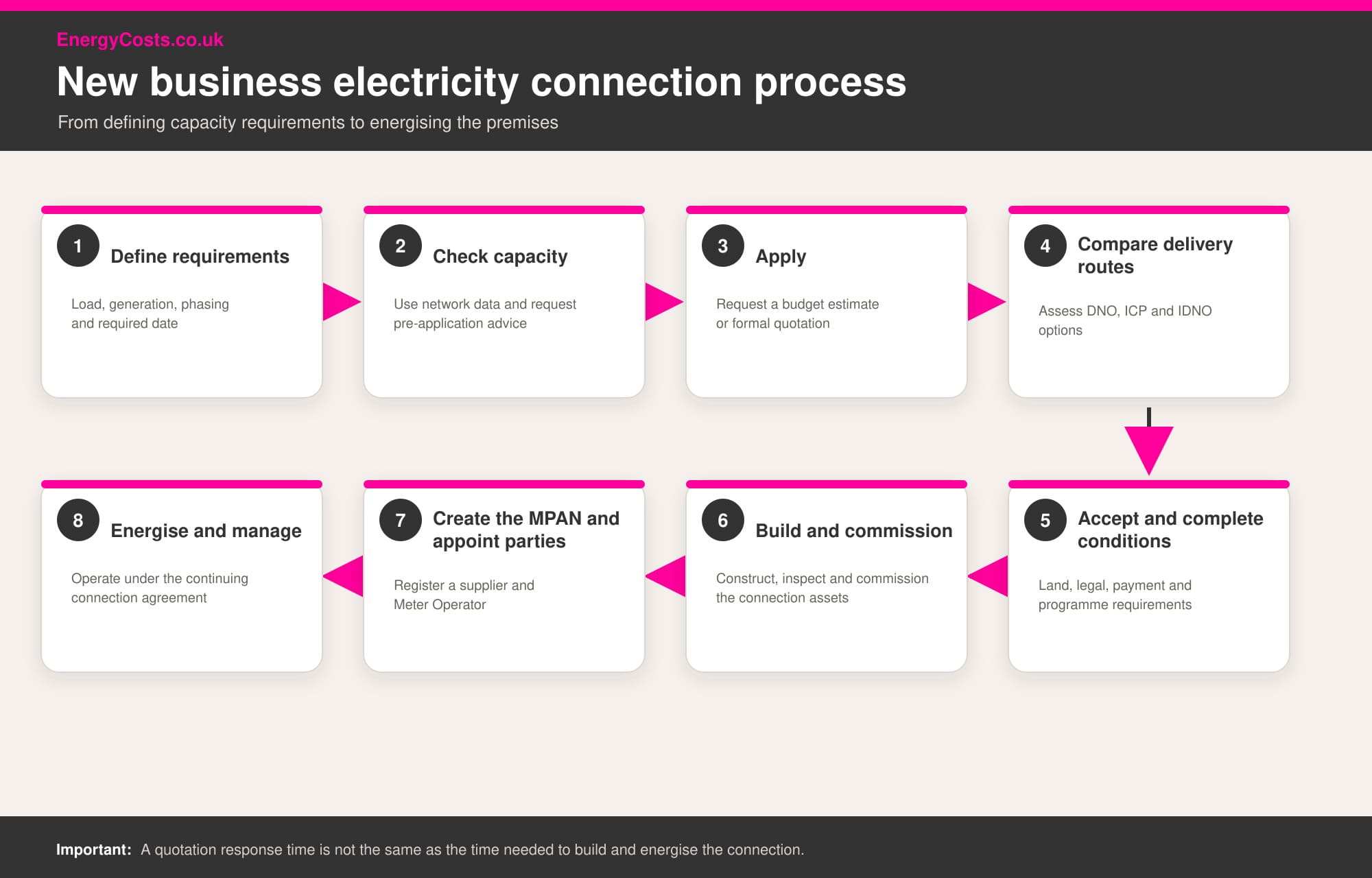
A connection project is not the same as arranging an electricity contract. The network must be physically ready, an MPAN must exist, a supplier must register it and suitable metering must be installed before the site can be energised for normal use.
The connection process
Information to prepare before applying
A credible application normally needs:
- the exact address, site plan and proposed intake location
- target energisation date and any phased opening dates
- maximum import capacity in kVA or MVA
- expected maximum demand in kW and operating profile
- single-phase or three-phase requirements
- major motors, welders, drives, furnaces or other disturbing loads
- proposed solar, CHP, generator, battery or vehicle-to-grid capacity
- maximum export capacity and any export-limitation scheme
- preferred connection voltage
- earthing and protection information where relevant
- a single-line electrical diagram
- land ownership, lease and access information
- planning status and highway constraints
- the applicant’s authority to accept costs and legal obligations
Do not size the connection from annual kWh consumption alone. Network design is driven by the highest coincident demand and the electrical characteristics of the equipment. A site can use relatively little energy over a year but still need a large connection for short peaks.
Budget estimate, feasibility study or formal quotation
A budget estimate is useful for an early business case but is not a reservation of capacity. A formal connection offer sets out the works, price, assumptions, validity period, programme and legal conditions. Larger or unusual schemes may justify a paid feasibility or option study before a formal application.
DNO capacity and “heat” maps are useful screening tools. The ENA provides links to each operator’s demand, generation and connections data. However, the maps are snapshots based on network models, connected projects and accepted offers. They do not reserve capacity or replace a formal offer.
2026/27 quotation service standards
Ofgem updates connection Guaranteed Standards of Performance each April. From 1 April 2026, the common metered quotation standards include:
| Request category | Standard response time | Payment if late from April 2026 |
|---|---|---|
| Budget estimate below 1MVA | 10 working days | £85 one-off |
| Budget estimate at or above 1MVA | 20 working days | £85 one-off |
| Single LV single-phase service quotation | 5 working days | £20 for each working day late |
| Qualifying small LV project quotation | 15 working days | £20 for each working day late |
| Other LV demand quotation | 25 working days | £85 for each working day late |
| HV demand quotation | 35 working days | £180 for each working day late |
| EHV demand quotation | 65 working days | £265 for each working day late |
These categories have detailed statutory definitions and exclusions. Separate licence standards apply to some larger connections. Most importantly, the quotation response time is not the time needed to build and energise the connection. Road permits, switchgear lead times, reinforcement, outages, land rights and customer works can add months or longer. The full current values are in Ofgem’s 2026/27 GSOP update.
What connection charges can include
There is no dependable national “average DNO connection cost”. A short low-voltage service and a new primary substation are fundamentally different projects. A quotation can include:
- design and assessment
- the dedicated cable or overhead line to the existing network
- switchgear, transformer and substation work
- network reinforcement where chargeable under the rules
- excavation, reinstatement and traffic management
- protection, communications, earthing and commissioning
- diversions of existing assets
- land, easement, wayleave and legal work
- inspection and adoption of contestable assets
- operational outages
- metering interfaces
- VAT
- security, cancellation or abortive-work provisions
Ask for a clear split between contestable and non-contestable work, sole-use connection assets and reinforcement. Also check whether the price is fixed, indexed, subject to remeasurement or capable of being revised after detailed design.
The current connection charging boundary
Ofgem’s Access Significant Code Review changed Great Britain’s distribution connection charging boundary from 1 April 2023. In broad terms:
- a demand customer still pays for the extension and sole-use assets needed to reach the existing network;
- demand connections generally no longer contribute to wider reinforcement in the same way as before;
- generation customers make a more limited reinforcement contribution under the revised voltage rule; and
- high-cost, exceptional or project-specific rules can still affect the final charge.
This is why “reinforcement is socialised” should not be interpreted as “the connection is free”. A commercial connection may still require substantial dedicated infrastructure, land and customer works. Ofgem’s Access SCR final decision contains the detailed policy.
Firm and flexible connections
Where network capacity is constrained, a DNO may offer a flexible, non-firm or actively managedconnection. This can reduce cost or bring forward energisation, but the DNO can curtail import or export under defined conditions.
Before accepting one, model:
- the expected annual curtailment volume and worst credible case
- whether curtailment is measured in hours, MWh or another limit
- the part of the load or generation that can be controller
- notice and communications arrangements
- whether the arrangement has an end date
- compensation, if any, for curtailment
- the cost and timing of becoming firm
- consequences of communications failure
- the impact on finance covenants, leases, warranties and revenue forecasts
A low-cost connection with material uncapped curtailment may be worse for a production site than a slower firm offer.
Maximum import capacity, kW, kVA and power factor
Larger sites often have an agreed or maximum import capacity, commonly called ASC or MIC, measured in kilovolt-amperes (kVA). It is the network capacity reserved for the connection and can affect DUoS charges.
Kilowatts measure real power doing useful work. kVA measures apparent power, which includes the effect of power factor:
kVA = kW ÷ power factor
For example, a site drawing 250kW at a power factor of 0.90 requires about:
250 ÷ 0.90 = 278kVA
That does not mean 278kVA is automatically the correct contracted capacity. An engineer must also consider motor starts, diversity, harmonic currents, future plant, temperature, EV charging and resilience.
If a business contracts for substantially more capacity than it needs, it can pay unnecessary capacity charges. If it exceeds the agreed level, excess-capacity charges can apply and the connection may need upgrading. Before reducing capacity:
- examine at least 12 months of half-hourly maximum-demand data
- adjust for closed periods and abnormal production
- add committed electrification and growth
- assess power factor and harmonics
- confirm whether short peaks are genuine or a data error
- ask the supplier how the capacity change will affect billing
- understand that surrendered capacity may not be available later without a new application and reinforcement
The EnergyCosts.co.uk DUoS guide explains capacity, excess-capacity and reactive-power charges in more detail.
Solar panels, batteries, generators and DNO approval
Equipment that can operate in parallel with the public network must comply with the relevant connection rules, even if the business expects to consume most of the electricity on site.
G98
Engineering Recommendation G98 covers fully type-tested microgeneration up to and including 16A per phase. At nominal voltage, that is 3.68kW on a single-phase supply or 11.04kW across a three-phase supply. The equipment can generally be installed and then notified to the DNO within the required period, provided all G98 conditions are satisfied.
G99
Engineering Recommendation G99 applies to generation outside G98, including larger solar, CHP, standby generation capable of parallel operation, batteries and vehicle-to-grid equipment. An application and DNO acceptance are normally required before installation or parallel operation.
The ENA’s commercial generation connection guidance sets out the G98 and G99 routes.
G100
Engineering Recommendation G100 covers export-limitation schemes. A business may have, for example, 500kW of solar and battery equipment but agree to limit export to a lower figure. The scheme must fail safely and meet the DNO’s approved design and commissioning requirements.
An export limit can make a constrained connection viable, but it does not remove the need to assess the total installed generating capacity under G98 or G99.
Common mistakes
- Treating battery storage as “not generation”.
- Adding new inverters without considering the aggregate capacity already installed.
- Assuming zero planned export means no DNO process.
- Ordering equipment before receiving a G99 offer.
- Confusing planning permission with network approval.
- Assuming an MCS certificate alone completes every DNO requirement.
- Operating standby generation in parallel without suitable protection.
- Failing to keep commissioning records and the final accepted single-line diagram.
Government guidance confirms that owners and installers of relevant devices at homes and small businesses must register them with the DNO. For a commercial project, make the installer or consultant contractually responsible for the correct application, witness testing and close-out evidence.
EV chargers, heat pumps and major new loads
The effect of a single low-power charger is different from a depot containing dozens of rapid chargers. Installers use ENA rules to decide whether equipment can be connected and notified or needs DNO assessment in advance.
A business should seek early DNO advice when:
- total site demand may exceed the existing capacity
- three-phase supply is required
- rapid or ultra-rapid charging is proposed
- several charge points can operate together
- vehicle-to-grid export is planned
- a heat pump has a high starting current
- electric boilers, process heat or induction equipment are being adder
- voltage-sensitive or harmonic-producing equipment is involved
- the site is on a constrained flexible connection
Load management can sometimes avoid or defer an upgrade. A charge-point controller might keep total import below the MIC, prioritise operational vehicles and reduce charging during expensive DUoS periods. The business case should compare:
- full reinforcement
- a smaller firm connection with smart load management
- a flexible connection
- on-site solar and storage
- staged deployment
- the operational cost of slower or constrained charging
Do not let a technology installer assume spare capacity from the fuse rating alone. Confirm the contractual capacity, measured peaks and DNO position.
How DNOs affect business electricity bills
The DNO normally bills the electricity supplier for using the regional network. The supplier then recovers the cost through the business tariff. This is called Distribution Use of System, or DUoS.
DUoS can appear:
- within the unit rate
- within the daily standing charge
- as a separate pass-through line
- as a capacity charge in p/kVA/day
- as an excess-capacity charge
- as a reactive-power charge
- through a later reconciliation
Smaller businesses may never see “DUoS” printed on a bill, but they still pay it. Larger half-hourly sites and customers on pass-through contracts tend to see more detail.
Why DUoS varies
Charges depend on factors including:
- DNO region
- connection voltage
- tariff and metering class
- time of consumption
- fixed and residual charging rules
- agreed capacity
- excess demand
- reactive energy
- losses and site-specific network arrangements
Some metered tariffs use red, amber and green time bands. Red periods are normally the most expensive network periods, amber is intermediate and green is lower-cost. Exact times and prices vary by DNO and tariff, so do not use an old generic “4pm to 7pm” rule without checking the current charging statement.
Ways a business may reduce DUoS exposure
- Reduce imported kWh through efficiency.
- Shift flexible processes away from high-cost periods where the tariff rewards it.
- Smooth demand peaks.
- Review the agreed capacity using half-hourly data.
- Avoid exceeding that capacity.
- Improve poor power factor where reactive charges apply.
- Use on-site solar to reduce imports.
- Use batteries or managed EV charging to reduce peaks.
- Compare fixed and pass-through contract treatment.
- Check that the correct MPAN, DNO region, voltage and tariff are being billed.
A small unit-rate movement can be material. A DUoS-related change of 0.5p/kWh adds £2,500 a year to a site consuming 500,000kWh.
EnergyCosts.co.uk also explains non-commodity electricity charges and the risks of a pass-through business energy contract.
Power cuts and network emergencies
In England, Scotland and Wales, call 105 to report a power cut or dangerous electricity network equipment. In Northern Ireland, contact NIE Networks on 03457 643 643.
What to do during a business power cut
- Treat alarms, emergency lighting and life-safety systems as the priority.
- Check whether the outage affects the whole premises and nearby properties.
- If safe, check the site’s main switch and protective indicators without opening sealed network equipment.
- Call 105, use the DNO’s outage map or contact NIE Networks in Northern Ireland.
- Record the outage start time and the DNO incident reference.
- Shut down or isolate sensitive processes in accordance with the site plan.
- Start approved backup systems using the documented changeover procedure.
- Protect cold-chain, IT, access control, fire systems, lifts and communications.
- Prepare for staged restoration and possible voltage disturbance when power returns.
- Record the restoration time, affected operations and evidence for insurance or compensation.
Never connect a portable generator in a way that can backfeed the public network. A generator connection needs suitable changeover, earthing and protection designed by a competent person. Parallel operation can trigger G99 requirements.
Business continuity measures
Guaranteed-standard payments are modest compared with the potential cost of lost production, spoiled stock or unavailable IT. A resilient business should consider:
- maximum tolerable downtime for each process;
- UPS coverage and runtime;
- safely connected standby generation;
- generator fuel, maintenance and load-bank testing;
- dual supplies where economically justified;
- battery storage designed for islanded operation, if permitted;
- manual procedures for payments, phones and access control;
- remote alarms using independent communications;
- supplier and contractor call-out arrangements;
- stock and temperature monitoring;
- outage insurance; and
- exercises that test the plan rather than merely documenting it.
The Priority Services Register is designed around people who need additional help, including those relying on medical equipment. A care provider or business serving vulnerable people should discuss this with its DNO. However, ENA guidance is explicit that registration does not guarantee power or faster restoration. It is not a substitute for business continuity.
DNO compensation for power cuts and service failures
Ofgem’s Guaranteed Standards of Performance set minimum service levels in Great Britain. From 1 April 2026, the principal non-domestic power-cut payments are:
| Failure under the GB standards | Non-domestic payment from April 2026 |
|---|---|
| Normal weather, fewer than 5,000 premises affected, supply not restored within 12 hours | £195, then £45 for each further 12 hours; no prescribed cap |
| Normal weather, 5,000 or more premises affected, supply not restored within 24 hours | £195, then £45 for each further 12 hours; £400 total cap |
| Category 1 severe weather, supply not restored within 24 hours | £90, then £45 for each further 6 hours; £2,235 cap |
| Category 2 severe weather, supply not restored within 48 hours | £90, then £45 for each further 6 hours; £2,235 cap |
| Rota disconnection lasting more than 24 hours | £195 |
| Four interruptions of at least three hours in the relevant regulatory year | £100 |
| Failure to attend a distributor-fuse issue within three hours on a working day or four hours on another day | £40 |
| Planned interruption without at least two days’ notice, or on a different day from the notice | £80 |
| Failure to meet specified voltage-complaint response standards | £40 |
| Failure to keep or offer a qualifying timed appointment | £40 |
| Failure to make a due guaranteed-standard payment within 10 working days | Additional £40 |
These figures come from Ofgem’s 2026/27 payment update. Detailed definitions, exclusions and claim rules apply. For example, the threshold changes during severe weather and the DNO may rely on a statutory exemption where circumstances meet the regulations.
Do not treat a guaranteed payment as compensation for the business’s actual loss. It is a standard payment, not business-interruption damages. Keep the incident number and timings, check the DNO’s current notice of rights and contact it promptly if a payment does not arrive.
Northern Ireland has its own guaranteed standards and complaints system. Ask NIE Networks or the Utility Regulator for the current NI rules rather than applying the GB table.
Voltage problems and power quality
Contact the DNO when a persistent supply problem appears to originate upstream of the customer installation, including:
- sustained high or low voltage;
- repeated voltage dips or swells;
- flicker affecting several circuits or neighbouring sites;
- suspected phase loss;
- repeated network fuse operation; or
- abnormal supply conditions at the agreed connection point.
First rule out internal causes with a competent electrical contractor. Loose connections, overloaded circuits, failing equipment, harmonics and poor power factor can all sit inside the business’s installation.
Under the current GB guaranteed standards, if the DNO can explain a voltage complaint without visiting, it should dispatch the explanation within five working days. If it cannot, it should offer an investigation visit within seven working days. A qualifying failure carries a £40 payment from April 2026.
For an intermittent industrial problem, useful evidence includes:
- time-stamped voltage and current measurements;
- affected phases;
- machinery operating at the time;
- power-factor and harmonic data;
- photos or alarm logs;
- reports from neighbouring premises; and
- the DNO incident reference.
A formal power-quality survey is often more persuasive than a statement that equipment “keeps tripping”.
Planned interruptions, maintenance and site works
DNOs sometimes need to switch off a supply for maintenance or reinforcement. In Great Britain, the guaranteed standard generally requires at least two days’ prior notice for a directly connected customer. A non-domestic customer may be due £80 if the DNO fails to give the required notice or interrupts supply on a different day, subject to the rules.
Keep the DNO’s contact details current, particularly for:
- unmanned sites;
- multi-let properties;
- landlords with a separate registered address;
- sites where the bill goes to a head office; and
- IDNO-connected developments where notices pass through more than one operator.
If the shutdown would create disproportionate risk, contact the DNO early. It may be possible to coordinate timing, although the business cannot assume a planned network outage will be cancelled.
Moving a meter or service
Moving the visible meter can involve several parties:
- the supplier authorises or coordinates the metering change;
- the MOP handles business metering;
- the DNO or IDNO moves the service cable, cut-out or current-transformer equipment it owns;
- the electrical contractor modifies the customer installation; and
- the landlord or BNO approves work on private building infrastructure.
Obtain a coordinated scope before starting building work. A new meter cupboard is useless if the DNO will not approve its access, ventilation, fire separation or cable route. The EnergyCosts.co.uk business meter installation guide explains the main roles.
Working near electricity cables and overhead lines
Business owners, developers and contractors must plan safely around network assets.
For excavation, HSE guidance identifies three core elements: plan the work, locate and identify buried services, and use safe excavation methods. HSG47 covers avoiding danger from underground services.
Before digging:
- obtain current utility plans;
- scan and mark the route using suitable locating equipment;
- use safe trial-hole and excavation techniques;
- assume plans are indicative rather than exact;
- establish who owns each cable;
- contact the DNO for advice or supervision where required; and
- brief everyone doing the work.
For cranes, tipper bodies, scaffolding, irrigation equipment, tree work or other activity near overhead lines, follow HSE GS6 guidance and agree controls with the network operator. Electricity can arc without direct contact.
Wayleaves, easements and DNO equipment on business land
A network operator may have cables, lines, substations or access routes on commercial land. The legal right may be:
- a wayleave agreement;
- an easement or servitude;
- a lease;
- a statutory right; or
- another property agreement.
ENA explains that a wayleave agreement allows a network operator to use a specific piece of land. An easement or servitude is normally a more permanent property right. The documents can govern access, maintenance, vegetation, building restrictions, payments and relocation.
When buying, leasing or redeveloping a site:
- obtain the title documents and all utility rights;
- plot network assets against the proposed development;
- check access and working-space requirements;
- identify restrictions on building or storing materials near the equipment;
- clarify who pays for a diversion;
- allow time for legal completion and outages; and
- use a property solicitor and utility surveyor for material issues.
Do not terminate a wayleave or obstruct access without specialist advice. A network operator may have statutory powers, and a requested diversion can be expensive even where land belongs to the business.
DNOs are becoming Distribution System Operators
The historic DNO model was largely “build and maintain”. The newer Distribution System Operator, or DSO, role adds active planning, network operation and local markets.
Ofgem’s DSO incentive is designed to make DNO licensees use their networks more efficiently and consider flexible alternatives to reinforcement. Ofgem’s DSO annual report explains the framework.
In practice, this can mean:
- better network-capacity data;
- flexible and actively managed connections;
- forecasting local demand and generation;
- procuring demand reduction or increased export in constrained areas;
- asking batteries or generators to change output;
- coordinating with NESO and other networks; and
- using smart control before committing to traditional reinforcement.
Can a business earn money from DNO flexibility?
Potentially. A flexibility provider makes a temporary change to consumption, generation or storage in response to a local network requirement. Suitable assets can include:
- battery storage;
- standby or on-site generation, subject to emissions and connection rules;
- refrigeration and cold storage;
- HVAC and heat systems;
- water pumping;
- industrial processes;
- EV charging fleets;
- solar and controllable export; and
- aggregated smaller sites.
The business can tender directly or use an aggregator. Before contracting, check:
- minimum availability and dispatch size;
- baseline methodology;
- metering and telemetry;
- response time and duration;
- availability and utilisation payments;
- testing requirements;
- non-delivery penalties;
- whether the service conflicts with normal operations;
- ability to stack DNO, wholesale and NESO revenues;
- supplier and balancing implications; and
- tax, warranty and degradation costs.
ENA defines a flexibility provider as a network user that temporarily changes how it consumes, generates or stores electricity. Its flexibility-services hub provides current market links.
Regulation and why DNO revenue is controlled
Because a regional DNO is a monopoly, Ofgem controls the revenue it can recover and the outputs it must deliver. The current Great Britain electricity distribution price control, RIIO-ED2, runs from 1 April 2023 to 31 March 2028. RIIO stands for Revenue = Incentives + Innovation + Outputs.
The next control, RIIO-ED3, is planned for 1 April 2028 to 31 March 2033. Ofgem’s network price-control page explains the current periods.
Price controls matter to businesses because they influence:
- allowed network investment;
- reliability and customer-service incentives;
- connection performance;
- DSO and flexibility activity;
- support for vulnerable customers;
- innovation funding; and
- the DUoS revenue recovered through electricity tariffs.
Northern Ireland’s NIE Networks is regulated by the Utility Regulator. Its RP7 price control runs from April 2025 to March 2031.
Complaining about a DNO
Start with the DNO’s formal complaints process. Provide:
- business name and site address;
- MPAN and connection reference;
- dates, times and incident numbers;
- the outcome required;
- quotations, emails, photographs and technical evidence;
- financial impact, clearly separated from any statutory payment; and
- the relevant guaranteed standard or connection-offer term.
Ask for a complaint reference and a written final response.
In Great Britain, the Energy Ombudsman can consider eligible disputes with network operators after the company has had eight weeks to resolve the complaint, or earlier if it issues a deadlock or final-response letter.
Its small-business eligibility extends to a business that:
- uses no more than 200,000kWh of electricity a year; or
- uses no more than 500,000kWh of gas a year; or
- has fewer than 50 full-time-equivalent employees and turnover of no more than £6.5 million or a balance-sheet total of no more than £5 million.
The Energy Ombudsman sets out the current business criteria and process. EnergyCosts.co.uk also explains what a deadlock letter means.
Larger businesses may need to use contractual escalation, a formal regulatory determination route where one exists, mediation or legal action. Ofgem does not generally investigate individual customer complaints simply because the customer is too large for the Ombudsman.
In Northern Ireland, complain to NIE Networks first and then contact the Consumer Council for Northern Ireland, which can investigate complaints for domestic and business users. Certain unresolved disputes can fall within the Utility Regulator’s determination powers.
DNO due diligence before leasing, buying or developing a site
Electricity capacity should be treated as property due diligence, not an item to resolve after exchange of contracts.
Documents to request
- every MPAN and meter serial number;
- 12 to 24 months of half-hourly consumption and maximum-demand data;
- electricity bills and DUoS or capacity schedules;
- the connection agreement and any variations;
- accepted DNO or IDNO offers;
- the site single-line diagram;
- asset ownership and maintenance records;
- HV inspection and test records;
- transformer ratings;
- generation G98 or G99 acceptance and commissioning records;
- G100 export-limitation settings;
- wayleaves, easements, leases and access plans;
- BNO and private-network agreements;
- outage and power-quality history; and
- planned DNO works or known reinforcement.
Questions to answer
- Who is the host DNO and is there an IDNO?
- Is the site directly metered or supplied through a private network?
- What are the MIC, maximum export capacity and connection voltage?
- What was the highest half-hourly demand in each season?
- Is the connection firm, flexible or subject to curtailment?
- How much spare capacity remains after committed projects?
- Who owns and maintains the transformer and HV switchgear?
- Are there recurring excess-capacity or reactive-power charges?
- Can the landlord or BNO approve the planned load?
- Will electrification trigger reinforcement or a new substation?
- Are network assets or land rights in conflict with redevelopment?
- Is a formal DNO offer in place, and when does it expire?
A landlord saying that a building has a “three-phase supply” does not prove that it has enough capacity for a bakery, data room, electric vehicle depot or manufacturing line. Obtain evidence.
EnergyCosts.co.uk has a separate checklist for setting up a new business energy supply when moving premises.
Practical DNO checklist for business owners
Keep on file now
- DNO or IDNO name and emergency number;
- MPAN for every meter;
- supplier and MOP contacts;
- MIC or ASC and maximum export capacity;
- connection voltage and firm or flexible status;
- one-line diagram and asset boundaries;
- outage and resilience plan;
- landlord, BNO and electrical-contractor contacts; and
- G98, G99 or G100 records.
Before expanding
- model the future maximum demand, not just annual kWh;
- inspect half-hourly peaks and power factor;
- check the DNO capacity map;
- obtain pre-application advice;
- request a budget estimate before committing capital;
- test flexible connection and load-management options;
- allow for land rights, permits and switchgear lead times; and
- make the required energisation date explicit in contracts.
Before signing a supply contract
- confirm the correct MPAN and DNO region;
- ask whether DUoS is fixed, forecast, passed through or reconciled;
- compare total annual cost, not only p/kWh;
- check capacity and excess-capacity treatment;
- review red, amber and green exposure where relevant; and
- understand the consequences of a meter or tariff-class change.
The physical network remains the same when a business switches supplier, but the way network costs are packaged can change. Compare current business electricity prices using the correct site and meter details.
DNO glossary
| Term | Meaning |
|---|---|
| ASC | Agreed Supply Capacity, usually in kVA |
| ANM | Active Network Management, used to control flexible connections |
| BNO | Building Network Operator |
| CDCM | Common Distribution Charging Methodology, used for many LV and HV tariffs |
| DNO | Distribution Network Operator |
| DSO | Distribution System Operator |
| DUoS | Distribution Use of System charge |
| EHV | Extra high voltage; the precise charging definition depends on the framework |
| G98 | Connection rules for qualifying type-tested microgeneration up to 16A per phase |
| G99 | Connection rules for generation outside G98 |
| G100 | Technical requirements for export-limitation schemes |
| HV | High voltage |
| ICP | Independent Connection Provider |
| IDNO | Independent Distribution Network Operator |
| LV | Low voltage |
| MEC | Maximum Export Capacity |
| MIC | Maximum Import Capacity |
| MOP | Meter Operator |
| MPAN | Meter Point Administration Number |
| NESO | National Energy System Operator for Great Britain |
| PoC | Point of Connection |
| RIIO | Revenue = Incentives + Innovation + Outputs |
FAQ
Often, although layouts vary. The distributor ID is embedded in the MPAN. The first two digits of the 13-digit MPAN core normally identify the regional DNO area.
Not by switching electricity supplier. The host DNO is determined by location. A new development may use an IDNO for its embedded network, but that is part of a connection and asset-adoption decision rather than an ordinary tariff switch.
No. The same local network normally delivers the electricity before and after a supplier switch. Reliability is primarily a network and site-installation issue, not a supplier-brand issue.
No. The supplier sets the commercial tariff. However, DNO DUoS charges are one of the costs built into or passed through under that tariff.
Business metering arrangements vary, but the DNO is not normally the party responsible for routine meter operation in Great Britain. The supplier and appointed Meter Operator should be checked. NIE Networks has broader metering functions in Northern Ireland.
Start with the supplier and MOP. If the incoming cable, cut-out, CT equipment or intake position must move, the DNO or IDNO will also be required. A landlord or BNO may control private building infrastructure.
Yes, through the relevant process. Qualifying G98 systems can normally be installed and then notified; G99 projects need advance application and acceptance. The total installed capacity, phase arrangement, existing devices and storage all matter.
The installer must follow the applicable ENA notification or application process. A commercial fleet depot or rapid-charging hub should normally engage the DNO early because its maximum demand can be substantial.
A DNO has statutory connection duties, but it can require a technically compliant design, payment and legal conditions. Capacity constraints can change the point of connection, price, programme or access offered. Some exceptionally large demand projects are also subject to evolving connections-reform arrangements.
No. It is a screening tool. Only a formal offer can confirm the proposed connection terms, and even that is subject to its assumptions, validity period and conditions.
The DNO guaranteed payment is not calculated from the business’s actual loss. Claims for stock, revenue or equipment damage depend on insurance, contract and legal liability. Keep evidence and notify the insurer promptly.
Yes, where the DSO procures local flexibility and the business or its aggregator can meet the technical and commercial requirements. Batteries, controllable load, EV charging and generation may qualify.
Final takeaways
A DNO is the physical-network counterpart to the business electricity supplier. It determines how a site connects, how much capacity it can import or export, who responds to local network faults and how regional distribution costs enter the bill.
The most important actions for a business are to:
- identify the correct DNO, IDNO and asset boundary
- keep MPAN, capacity and connection records
- involve the network early in expansion and low-carbon projects
- treat capacity as a due-diligence issue when acquiring premises
- understand how DUoS is priced in the supply contract
- maintain a realistic power-cut resilience plan
- use the guaranteed standards and complaints process when service falls short
The DNO cannot be changed through an ordinary supplier switch. The supplier and contract can. Once the site’s MPAN, consumption and capacity are correct, use EnergyCosts.co.uk to compare business electricity quotes on a like-for-like total-cost basis.