

Business energy costs have stabilised since the extreme volatility of 2021–2023, but the market remains sensitive to wholesale gas movements, global LNG availability, European storage levels, and domestic network charges. For UK firms planning budgets for 2026, the key concern is whether rates are likely to rise again — and the data suggests upward pressure is building in several areas, even if headline wholesale costs are lower than their peak.
Here is our breakdown to help businesses understand the trends shaping electricity and gas prices over the next 12 months.
Current business energy prices (Q3 2026 snapshot)
Business tariffs vary by contract type, credit score, region, and usage volume, but recent broker data indicates the following averages for fixed-rate quotes:
| Business size | Electricity (p/kWh) | Gas (p/kWh) | Standing charge (electricity) | Standing charge (gas) |
|---|---|---|---|---|
| Micro business | 28–34p | 7–9p | 55–75p/day | 25–40p/day |
| Small business | 26–32p | 6–8p | 50–70p/day | 22–35p/day |
| Medium business | 24–30p | 5–7p | 45–65p/day | 20–33p/day |
| Large business | 23–28p | 5–6p | 30–50p/day | 18–30p/day |
Typical 12-month fixed quotes in early 2026 were 15–25% higher than autumn 2025 for some sectors, largely due to rising non-commodity charges.
Are prices rising? Key indicators for 2026
Wholesale energy costs
Wholesale electricity and gas still make up the biggest share of a business bill. After falling sharply in 2024, UK wholesale gas has risen at multiple points in 2025 due to:
- Reduced LNG flows from the US and Qatar, following maintenance and geopolitical disruption.
- Colder-than-expected Q1 temperatures increasing demand.
- Lower renewable output in early 2025, especially offshore wind, increasing reliance on gas-fired generation.
Average day-ahead UK gas prices in 2025 ranged between 85–115p/therm, up from an average of around 75p/therm in 2024.
Network and non-commodity costs
Even when wholesale drops, non-commodity costs are rising. These include:
- Distribution Use of System (DUoS) charges
- Transmission Use of System (TNUoS) fees
- Balancing Services Use of System (BSUoS)
- Environmental levies such as Contracts for Difference (CfD) and Capacity Market costs
Non-commodity elements now make up 42–52% of an electricity bill depending on the business profile — up from around 29–35% in 2021.
These costs are scheduled to increase further in 2026 as the UK continues to expand grid infrastructure for electrification and renewables.
Standing charges
Standing charges have risen significantly since 2022 and are one of the most common complaints from SMEs. Reasons include:
- Higher network maintenance and grid reinforcement costs
- Supplier failure costs passed through the market
- Bad debt allowances for domestic and business customers
Many suppliers have lifted standing charges by 12–20% year on year, especially for micro and small firms.
Long-term contracts expiring
A large number of businesses locked into long, high-priced fixed contracts in 2022. Many of those contracts expire in 2025–2026. Although renewal prices today are lower than the 2022 peak, they may still be significantly higher than the business’ pre-crisis rates.
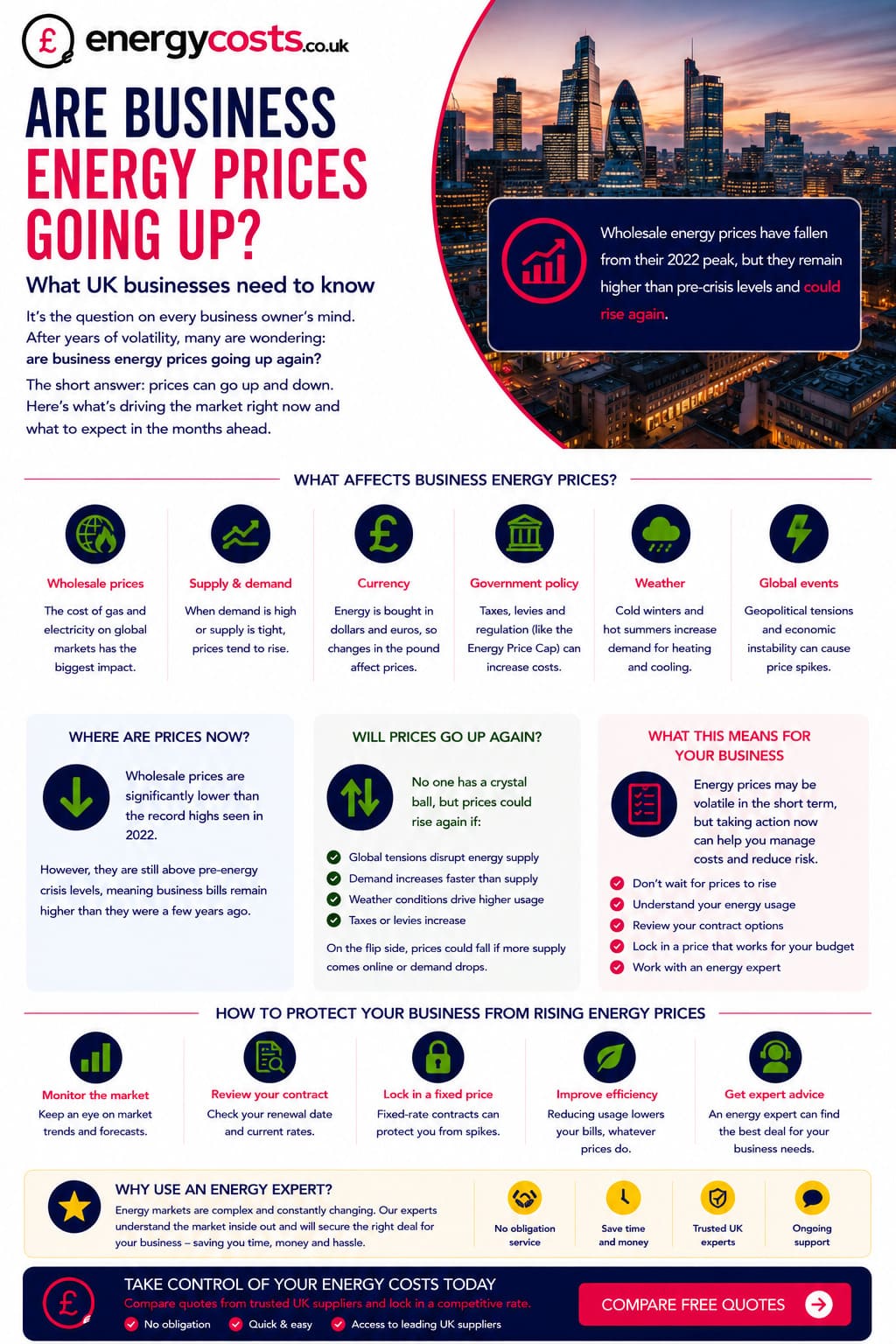
Price forecasts for 2026–2027
No broker or supplier can predict future movements with complete accuracy, but analysts expect the following trends:
1. Mild upward pressure through winter 2025/26
- Wholesale volatility driven by geopolitical risks
- Possible LNG supply issues
- Ongoing grid-related cost increases
Expected change: 2–7% increase in typical SME rates.
2. Standing charges likely to rise again in 2026
Forecast increases of 5–10%, driven by infrastructure investment and DUoS/TNUoS adjustments.
3. Gas prices could stabilise mid-2026
If European storage levels remain high and renewable output increases, wholesale gas may ease back to 70–90p/therm.
4. Electricity remains more expensive than pre-2021 levels
Due to structural factors including:
- Higher balancing costs
- Greater reliance on intermittent renewables
- Grid upgrade and connection investments
Even with improved supply conditions, electricity prices are unlikely to return to 2019 levels.
Sector-by-sector impact
| Sector | Typical impact | Notes |
|---|---|---|
| Hospitality | High | Energy-intensive cooking and heating; volatile winter costs. |
| Manufacturing | High | Gas-heavy processes; savings possible via flexible contracts. |
| Retail | Medium | Standing charge increases hit multi-site operators. |
| Office-based services | Low–medium | Consumption relatively stable; still affected by supplier standing charges. |
| Logistics | Medium | Mainly impacted through warehouse heating and EV charging. |
How to avoid paying more than necessary
Compare fixed and flexible tariffs
Some businesses benefit from flexible purchasing, especially those with large or predictable usage. SMEs may prefer fixed tariffs for budget stability, but comparing multiple suppliers is essential because quote ranges can differ by 10–15%.
Check the contract end date
Failing to switch in time can result in out-of-contract rates that are 30–70% more expensive.
Consider metering upgrades
Businesses with half-hourly or smart meters often receive more competitive tariffs because suppliers have better consumption data.
Review capacity charges
Large users can save by adjusting their authorised supply capacity if it has been set too high.
Improve load efficiency
Shifting high-use processes away from peak times can reduce peak DUoS charges.
Should UK businesses expect higher energy prices?
In short: yes — modest increases are more likely than not, especially over the winter period and further into 2026. While the volatility of the crisis years has eased, underlying structural and non-commodity costs continue to rise. Wholesale prices remain sensitive to global events, and standing charges show no sign of falling.
For businesses looking to control budgets, regularly comparing business energy prices and exploring contract options is the most effective way to mitigate increases.
FAQ
Most businesses are seeing slight increases, largely due to rising non-commodity charges and higher standing charges. Wholesale prices have also moved upwards at several points in 2025, particularly during colder periods and times of reduced LNG supply. Overall, many SMEs are paying 2–7% more than they were in late 2024.
Standing charges reflect network costs, supplier administration, system balancing, and the costs of past supplier failures. Grid reinforcement and DUoS/TNUoS adjustments have pushed standing charges up by 12–20% for many SMEs. These costs are expected to rise again in 2026 as investment in the UK grid accelerates.
Wholesale prices remain volatile rather than consistently rising. Gas in particular responds to global LNG supply, European storage levels, and weather patterns. Analysts expect short-term upward pressure but potential stabilisation later in 2026 if storage levels remain strong. Electricity, however, is expected to stay structurally more expensive due to balancing and infrastructure costs.
Fixed deals remain the safest way to gain budget certainty, especially for SMEs. While fixed rates have increased since 2024, the spread between suppliers can still be 10–15%, so shopping around remains essential. Larger users with predictable demand may save more through flexible purchasing strategies.
The UK energy system has shifted significantly. Balancing services, renewable subsidy schemes, capacity market obligations, network maintenance, and grid expansion now contribute 42–52% of electricity bills, depending on the business. These costs have grown steadily since 2021 and are expected to keep rising.
Electricity prices remain roughly 35–50% higher than typical 2019 business rates, while gas costs are around 20–30% higher. Although prices fell sharply from the 2022 peak, structural cost increases mean a return to pre-crisis pricing is unlikely.
Manufacturing, hospitality, cold storage, and logistics tend to experience the biggest impact due to the scale or timing of their energy use. Retail and office-based sectors are affected more by standing charges than by usage itself, especially where businesses operate many small premises.
Yes. Businesses can reduce costs by ensuring they are not on out-of-contract rates, comparing deals before each renewal, optimising authorised supply capacity, shifting energy use to cheaper periods, and installing smart or half-hourly meters. Multi-site operators can also benefit from group purchasing arrangements.
Most forecasts suggest modest additional increases, particularly in standing charges and non-commodity elements. Wholesale movements will depend heavily on global gas trends, but network-related costs are very likely to climb as the UK expands renewable generation and upgrades transmission infrastructure.
The ideal time is three to six months before your contract end date. This avoids early exit fees while allowing enough time to monitor the market and secure a competitive offer. Switching too late can lead to default or rollover rates that are 30–70% more expensive.