
EDF and E.ON are two of the largest energy groups serving UK businesses. Both provide electricity, gas, smart meters, renewable-energy options, commercial solar and electric vehicle charging, but their products are structured differently.
EDF offers small-business fixed contracts lasting between one and four years. Its options include conventional electricity, Fixed Renewable for businesses wanting UK renewable certificate backing, and a wider choice of renewable or nuclear-backed zero-carbon electricity for large organisations.
E.ON Next offers one-, two- and three-year fixed business contracts. Selected fixed tariffs include 100% renewable-backed electricity, while eligible SME customers receive access to E.ON Optimum, a digital platform for analysing consumption and comparing performance with similar properties.
Large businesses are served differently by the two groups. EDF provides its own fixed, partly fixed and flexible large-business contracts. Companies within the E.ON group are normally directed to npower Business Solutions, which offers fixed contracts lasting up to five years, flexible purchasing, generator services and Power Purchase Agreements.
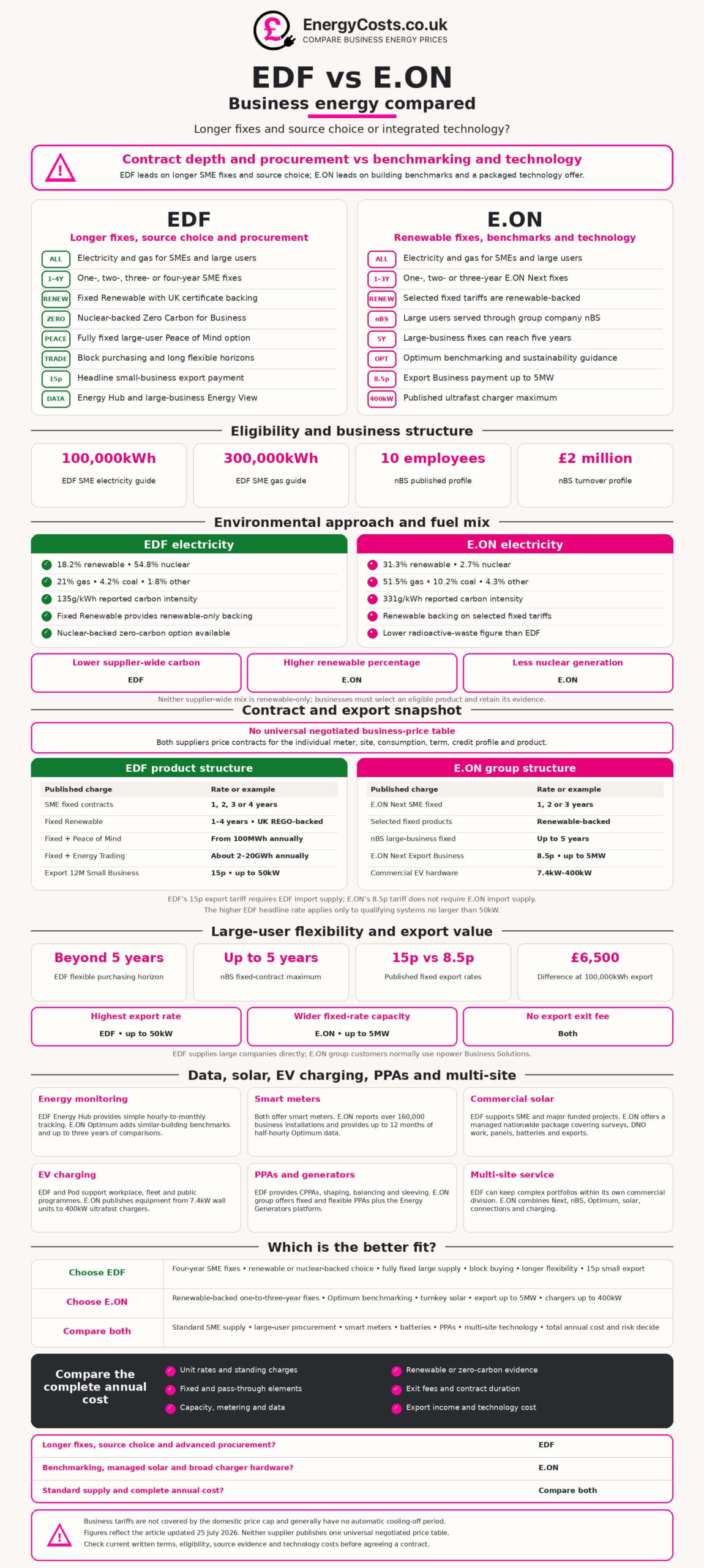
EDF may be the stronger choice for a company wanting a four-year SME contract, nuclear-backed zero-carbon electricity, sophisticated energy procurement or a higher published business export payment.
E.ON may be more suitable where the company wants a conventional renewable-backed fixed contract, free energy benchmarking, an integrated solar installation or commercial chargers ranging from small wall units to ultrafast fleet equipment.
Neither supplier is universally cheaper. Business rates depend on the premises, meter, postcode, consumption profile, credit assessment, contract dates and selected product.
EDF vs E.ON at a glance
| Feature | EDF Business | E.ON Next Business |
|---|---|---|
| Business electricity | Yes | Yes |
| Business gas | Yes | Yes |
| SME supply | Yes | Yes |
| Large-business service | EDF Large Business | npower Business Solutions within E.ON group |
| Standard national contract rates published | No | No |
| SME fixed terms | One, two, three or four years | One, two or three years |
| Renewable SME tariff | EDF Fixed Renewable | Renewable-backed selected fixed tariffs |
| Nuclear-backed zero-carbon option | Yes | Not a standard E.ON Next SME product |
| Variable SME tariff | Freedom for Business | Variable business plan after contract expiry |
| Large-business fixed contracts | Yes | Yes, through npower Business Solutions |
| Maximum large-business fixed term | Product-dependent | Up to five years through nBS |
| Flexible procurement | Yes | Yes, through nBS |
| Supplier-wide renewable share | 18.2% | 31.3% |
| Supplier-wide nuclear share | 54.8% | 2.7% |
| Supplier-wide gas and coal | 25.2% | 61.7% |
| Reported carbon intensity | 135g CO₂/kWh | 331g CO₂/kWh |
| Free SME analytics | EDF Energy Hub | E.ON Optimum |
| Smart business meters | Yes | Yes |
| Published business export rate | Up to 15p/kWh | 8.5p/kWh |
| Maximum capacity on headline export rate | 50kW | 5MW |
| Commercial solar | Yes | Yes |
| Commercial batteries | Yes | Yes |
| Commercial EV charging | Yes | Yes |
| Maximum advertised EV charger output | Project-dependent | Up to 400kW |
| Best suited to | Longer fixes, source choice and major procurement | Renewable-backed SME tariffs and installed technology |
EDF currently offers small-business fixed terms of up to four years, while E.ON Next promotes fixed tariffs lasting one, two or three years. Selected E.ON contracts include renewable-backed electricity, and EDF’s Fixed Renewable product offers renewable certificate backing over terms of one to four years.
Understanding the EDF business structure
EDF divides its commercial customers broadly between small-business and large-business services.
Its small-business route generally covers companies using up to:
- 100,000kWh of electricity annually; or
- approximately 300,000kWh of gas annually.
Larger or more technically complex users are directed towards EDF Large Business, which supports half-hourly meters, multi-site portfolios, fixed procurement, flexible purchasing, renewable electricity, nuclear-backed power and energy infrastructure.
EDF’s SME product range includes:
- Fixed for Business Online;
- Fixed Renewable;
- Fixed Advanced for compatible half-hourly or AMR meters;
- Freedom for Business variable pricing;
- business gas;
- smart meters;
- Energy Hub;
- solar export tariffs; and
- commercial solar and charging services.
The tariff-specific prices and eligibility conditions are provided in the customer’s contract pack rather than through one nationwide price table.
Understanding the E.ON business structure
E.ON Next primarily serves small and medium-sized businesses.
Its large-business route is npower Business Solutions, another part of the E.ON group. The published nBS eligibility profile includes organisations with substantial energy consumption, at least ten employees and annual turnover of at least £2 million.
E.ON Next provides SMEs with:
- one-, two- and three-year fixed tariffs;
- electricity, gas and dual-fuel contracts;
- selected tariffs with renewable-backed electricity;
- dedicated Energy Specialists;
- online account management;
- free smart meters where eligible;
- E.ON Optimum;
- solar panels and batteries;
- commercial EV charging; and
- new meter connections.
Large and corporate users can access fixed and flexible contracts, generator services, PPAs and wider net-zero technology through npower Business Solutions and other E.ON group operations.
Which businesses can apply?
Both suppliers can support ordinary SMEs such as:
- shops;
- offices;
- restaurants;
- cafés;
- hotels;
- workshops;
- charities;
- care providers;
- surgeries;
- schools;
- landlords; and
- small manufacturers.
Larger customers can include:
- factories;
- logistics companies;
- universities;
- hospitals;
- national retailers;
- data centres;
- property portfolios;
- transport operators; and
- major public-sector organisations.
Example suitability by company size
| Example business | Annual electricity use | Likely route |
|---|---|---|
| Independent shop | 12,000kWh | EDF SME or E.ON Next |
| Office | 50,000kWh | EDF SME or E.ON Next |
| Restaurant | 120,000kWh | EDF tailored route or E.ON group assessment |
| Hotel | 400,000kWh | EDF Large Business or npower Business Solutions |
| Manufacturer | 2GWh | Large-business contract from either group |
| National retailer | 10GWh | Fixed or flexible procurement |
| Renewable generator | Project-dependent | EDF PPA or nBS generator service |
| Business installing several rapid chargers | High site demand | Compare EDF and E.ON infrastructure proposals |
Supplier eligibility also depends on:
- meter type;
- half-hourly consumption;
- available electricity capacity;
- number of premises;
- creditworthiness;
- previous payment history; and
- whether the supplier’s systems support the meter configuration.
Which supplier is cheaper?
There is no universal EDF-versus-E.ON business price.
The quotation can vary according to:
- electricity MPAN or gas MPRN;
- distribution region;
- annual consumption;
- meter profile;
- half-hourly usage;
- available electricity capacity;
- residual charging band;
- number of locations;
- contract start date;
- contract term;
- payment method;
- credit risk;
- broker commission; and
- environmental-product selection.
The complete annual cost should be calculated as:
- Annual consumption × unit rate
- daily standing charge × 365
- capacity charges
- metering and data charges
- network and policy costs
- VAT and Climate Change Levy where applicable
− export income and other credits
Neither supplier publishes one national set of new-customer business prices. E.ON describes its prices as bespoke, while EDF places the agreed rates and tariff features in each customer’s contract documents.
How unit-rate differences affect annual costs
| Annual consumption | Value of 0.5p/kWh | Value of 1p/kWh | Value of 3p/kWh | Value of 5p/kWh |
|---|---|---|---|---|
| 10,000kWh | £50 | £100 | £300 | £500 |
| 25,000kWh | £125 | £250 | £750 | £1,250 |
| 50,000kWh | £250 | £500 | £1,500 | £2,500 |
| 100,000kWh | £500 | £1,000 | £3,000 | £5,000 |
| 250,000kWh | £1,250 | £2,500 | £7,500 | £12,500 |
| 1GWh | £5,000 | £10,000 | £30,000 | £50,000 |
| 10GWh | £50,000 | £100,000 | £300,000 | £500,000 |
A difference of only 1p/kWh changes annual expenditure by £10,000 for a company consuming 1GWh.
How standing charges affect costs
| Daily standing-charge difference | Annual difference per meter | Difference across ten meters |
|---|---|---|
| 25p | £91.25 | £912.50 |
| 50p | £182.50 | £1,825 |
| £1 | £365 | £3,650 |
| £2 | £730 | £7,300 |
| £5 | £1,825 | £18,250 |
Standing charges can be especially important for:
- low-consumption properties;
- seasonal businesses;
- vacant premises;
- landlords;
- multi-site companies; and
- organisations retaining inactive meters.
EDF fixed business tariffs
EDF offers small-business fixed contracts lasting between one and four years.
Its Fixed for Business Online tariff includes:
- fixed contract duration;
- fixed agreed prices, subject to the contract terms;
- Direct Debit discounts;
- online account management;
- a smart-meter requirement where applicable;
- exit fees; and
- transfer to Freedom for Business when the fixed term ends unless another agreement is made.
EDF says its available small-business prices are reviewed regularly, so the exact quote can change from week to week.
Advantages of EDF’s longer fixed terms
A four-year contract can provide:
- longer protection from wholesale-price increases;
- more predictable budgeting;
- fewer procurement exercises;
- stable unit and standing charges;
- easier financial forecasting; and
- less exposure to short-term geopolitical price shocks.
The disadvantage is that the business remains committed if market prices fall.
A company should also check the contract provisions allowing EDF to change charges where taxes, levies, network obligations or other supply-related costs change.
EDF Fixed Renewable
EDF’s Fixed Renewable product is available to small businesses over terms of one to four years.
The electricity is matched with UK Renewable Energy Guarantees of Origin, enabling the business to report zero market-based emissions for its purchased electricity.
It may suit companies that want:
- renewable-only certificate backing;
- no nuclear allocation to the chosen product;
- predictable prices;
- evidence for environmental reporting;
- stronger tender credentials; or
- a straightforward sustainability claim.
E.ON Next fixed business tariffs
E.ON Next offers bespoke fixed business contracts lasting one, two or three years.
Selected contracts provide 100% renewable-backed electricity using:
- E.ON renewable-generation assets;
- agreements with UK renewable generators; and
- renewable electricity certificates.
A smart meter is required where the business is eligible for one. Customers also receive dedicated Energy Specialists and online account access.
E.ON Next allows eligible customers to renew online when they are close to their contract end date. Customers can also contact the supplier to discuss renewal up to one year in advance, with prices generally capable of being agreed within the applicable renewal window.
EDF fixed tariffs versus E.ON fixed tariffs
| Requirement | EDF | E.ON Next |
|---|---|---|
| One-year fixed contract | Yes | Yes |
| Two-year fixed contract | Yes | Yes |
| Three-year fixed contract | Yes | Yes |
| Four-year SME contract | Yes | No standard E.ON Next option advertised |
| Renewable-backed electricity | Fixed Renewable | Selected fixed tariffs |
| Nuclear-backed option | Yes for qualifying EDF products | No standard SME equivalent promoted |
| Smart meter requirement | Applies to relevant products | Required where eligible |
| Dedicated support | Business energy specialists | Energy Specialists |
| Online account | Yes | Yes |
| Free analytics | Energy Hub | E.ON Optimum |
| Best for longest price certainty | EDF | — |
EDF has the advantage where the company specifically wants a four-year SME contract or a choice between renewable and nuclear-backed electricity.
E.ON may be preferable where a one-, two- or three-year renewable-backed tariff is sufficient and the business values its wider technology package.
What happens at contract expiry?
EDF normally sends renewal information before the fixed term ends. Where the customer does not select another fixed agreement or switch supplier, it can move onto Freedom for Business or another applicable variable arrangement.
E.ON Next states that customers who do not renew can move onto a variable business plan. If they choose to leave but remain supplied while the switch is completed, higher out-of-contract prices may apply.
Default and variable tariffs are normally less competitive than negotiated fixed deals.
A business should begin comparing options several months before expiry.
Can a business leave early?
EDF’s fixed tariffs can carry early termination fees. If a customer ends an EDF agreement before the scheduled date, extended-supply pricing may also apply while the premises remain with EDF.
E.ON Next describes its fixed business customers as contractually bound until the end date except in circumstances such as moving premises. The exact consequences of leaving early should be confirmed from the contract confirmation letter and current terms.
Neither supplier should be selected without checking:
- early termination liability;
- moving-premises provisions;
- debt-related restrictions;
- meter-change conditions; and
- what happens if consumption changes materially.
Large-business energy contracts
EDF and E.ON use different branding for larger users.
EDF supplies large companies directly through EDF Large Business.
E.ON group customers are generally handled by npower Business Solutions.
EDF large-business fixed contracts
EDF’s current fixed-product range includes:
Fixed + Peace of Mind
This product fixes:
- wholesale electricity costs;
- non-energy costs;
- EDF service costs; and
- eligible delivery and generation charges.
It supports non-half-hourly and half-hourly meters and is intended for businesses consuming more than 100MWh annually. Zero-carbon electricity options are available.
Fixed + Standard
This fixes wholesale electricity and EDF’s service charge.
Non-energy costs are forecast and can vary, meaning the opening price may be lower but the business retains exposure to changes in network and policy charges.
Fixed + Energy Trading
This allows the company to purchase electricity in blocks through EDF’s trading desk while EDF manages untraded volume.
It is aimed at electricity users consuming approximately 2,000MWh to 20,000MWh annually.
Standard Fixed Gas
EDF’s large-business gas contract fixes wholesale gas prices, while forecast non-energy charges may vary. It is promoted for businesses consuming more than 300MWh annually.
E.ON group large-business contracts
Npower Business Solutions offers fixed contracts lasting up to five years.
Its range includes products such as:
- Fixed Certainty;
- Fixed Commodity;
- MultiPurchase;
- flexible contracts;
- hybrid structures;
- renewable options; and
- mid-term electricity price reviews.
The customer can choose different approaches to paying non-commodity charges and can spread wholesale purchasing decisions over time.
Flexible procurement
EDF flexible contracts
EDF allows large businesses to choose:
- a purchasing horizon of one to three years;
- three to five years;
- or more than five years;
- block or full-volume purchases;
- fixed or variable third-party costs;
- different levels of trading support; and
- tailored reporting and monitoring.
This is suitable for organisations with internal procurement expertise or a defined energy-risk strategy.
E.ON group flexible contracts
Npower Business Solutions offers flexible contracts that spread purchasing decisions across the year.
The purpose is to reduce reliance on one fixing date while allowing the customer to respond to falling wholesale markets.
The wider product range also includes generator management, PPAs, metering, analytics and net-zero technology.
EDF versus E.ON for large users
| Requirement | Likely stronger fit |
|---|---|
| Fully fixed electricity and non-energy costs | EDF Fixed + Peace of Mind |
| Wholesale fixed with variable industry costs | Either group |
| Fixed term beyond four years | E.ON group through nBS |
| Block purchasing with EDF trading desk | EDF Fixed + Energy Trading |
| Flexible purchasing beyond five years | EDF |
| Mid-term price review | E.ON group |
| Renewable-generator management | E.ON group through nBS |
| Nuclear-backed zero-carbon electricity | EDF |
| Conventional renewable supply | Either |
| Multi-site fixed and flexible contracts | Either |
| Dual-fuel large-business arrangement | Either |
Comparing supplier-wide fuel mixes
The suppliers’ disclosed 2024/25 fuel mixes differ considerably.
| Source or impact | EDF | E.ON Next |
|---|---|---|
| Coal | 4.2% | 10.2% |
| Natural gas | 21% | 51.5% |
| Nuclear | 54.8% | 2.7% |
| Renewables | 18.2% | 31.3% |
| Other | 1.8% | 4.3% |
| Carbon emissions | 135g/kWh | 331g/kWh |
| Radioactive waste | 0.0038g/kWh | 0.0002g/kWh |
EDF’s supplier-wide electricity had the lower reported carbon intensity because more than half of its mix came from nuclear power.
E.ON Next had the higher renewable percentage but also a substantially larger gas and coal share.
Which supplier has greener electricity?
The answer depends on how the company defines greener.
| Environmental priority | Likely stronger fit |
|---|---|
| Lower supplier-wide carbon intensity | EDF |
| Higher supplier-wide renewable percentage | E.ON Next |
| Less natural gas | EDF |
| Less coal | EDF |
| Less nuclear power | E.ON Next |
| Renewable-only selected SME tariff | Either |
| Nuclear-backed zero-carbon product | EDF |
| Wider choice of source types | EDF |
| Lower radioactive-waste figure | E.ON Next |
| Renewable-backed conventional SME contract | Either |
Neither supplier’s overall company-wide fuel mix is renewable-only.
A business that requires 100% renewable electricity must select an eligible product and retain the associated certificate evidence.
EDF Zero Carbon for Business
EDF’s Zero Carbon for Business product is backed by nuclear generation.
EDF matches the customer’s estimated electricity use with electricity generated from nuclear power and supported by the necessary generator declarations.
This allows zero market-based carbon reporting, but the product is not renewable and has a higher radioactive-waste impact than a renewable-only tariff.
EDF renewable electricity
EDF also offers renewable electricity backed by certified wind, solar and other renewable generation.
Small businesses can select Fixed Renewable, while larger customers can combine renewable sourcing with fixed or flexible contracts.
This gives EDF a clear choice between:
- renewable electricity;
- nuclear-backed zero carbon; and
- other mixed-source supply.
E.ON renewable electricity
E.ON Next supplies renewable-backed electricity on selected fixed tariffs.
The backing can come from E.ON assets, contracts with UK generators and renewable certificates.
The claim applies to qualifying products rather than E.ON Next’s entire supplier-wide mix.
Comparing business gas
Both suppliers provide conventional business gas.
Neither E.ON Next nor EDF prominently advertises a standard SME product under which 100% of gas consumption is matched with UK renewable-gas certificates.
A company seeking lower-carbon gas should ask:
- whether biomethane certificates are available;
- what proportion is renewable;
- whether offsets are used;
- what standards apply;
- whether a premium is charged; and
- what reporting evidence is provided.
Gas burned at the premises still creates direct Scope 1 emissions, even where environmental certificates or offsets are purchased.
Smart meters
Both suppliers provide smart meters to eligible businesses.
EDF smart meters
EDF’s small-business smart meters provide:
- automatic meter readings;
- more accurate bills;
- hourly, daily, weekly and monthly consumption information;
- access to Energy Hub; and
- information that can help identify energy waste.
EDF’s current small-business terms can require customers without a smart meter to agree to installation. In some circumstances, a customer that refuses a compatible installation may be moved to a more expensive tariff.
E.ON smart meters
E.ON Next offers free commercial smart-meter installation where eligible, including upgrades for suitable three-phase meters.
The supplier says it has installed more than 160,000 smart meters in business premises.
Customers can use compatible meters to obtain automatic readings and access up to 12 months of half-hourly information through Optimum.
EDF Energy Hub versus E.ON Optimum
EDF Energy Hub
Energy Hub allows eligible smart-meter customers to:
- view hourly consumption;
- review daily, weekly and monthly use;
- identify high-consumption periods;
- monitor patterns;
- improve budgeting; and
- download meter information.
E.ON Optimum
Optimum allows eligible SME customers to:
- view energy use by meter;
- compare different time periods;
- compare performance with similar properties;
- review up to three years of year-on-year information;
- receive sustainability guidance; and
- access half-hourly data from compatible smart or AMR meters.
Which has the better monitoring service?
| Requirement | Likely stronger fit |
|---|---|
| Straightforward hourly usage tracking | EDF Energy Hub |
| Comparing with similar buildings | E.ON Optimum |
| Three-year year-on-year comparison | E.ON Optimum |
| Sustainability recommendations | E.ON Optimum |
| MyAccount integration | EDF |
| Half-hourly smart or AMR data | Both |
| Large-business procurement monitoring | EDF |
| Large-estate net-zero analysis | E.ON group |
E.ON Optimum has the stronger benchmarking proposition.
EDF Energy Hub provides a simple consumption view closely integrated with the small-business account.
Solar panels and batteries
Both groups provide commercial solar installations.
EDF solar
EDF supports SMEs through Contact Solar and larger organisations through EDF Business Solutions and specialist partners.
Services can include:
- site assessment;
- system design;
- rooftop solar;
- ground-mounted solar;
- battery storage;
- grid applications;
- monitoring;
- maintenance;
- capital purchase; and
- funded Power Purchase Agreements.
EDF says on-site solar can reduce dependence on grid electricity, while third-party estimates quoted in its SME guidance suggest that suitable systems can cut electricity bills substantially. Actual performance depends on system cost, generation and self-consumption.
E.ON solar
E.ON Next offers a fully managed business solar and battery service.
It covers:
- initial surveys;
- system design;
- Distribution Network Operator coordination;
- installation;
- solar panels;
- battery storage;
- export arrangements; and
- integration with E.ON energy and charging products.
E.ON describes the service as available across most of the UK through its certified installation network.
Which is better for commercial solar?
| Requirement | Likely stronger fit |
|---|---|
| Turnkey SME installation | E.ON |
| Nationwide managed service | E.ON |
| Existing EDF customer wanting export and installation | EDF |
| Large funded solar PPA | EDF or E.ON group |
| Ground-mounted commercial solar | Compare both |
| Solar linked with EV chargers | Both |
| Solar linked with battery optimisation | Both |
| Major public-sector solar project | EDF may have an advantage |
| One E.ON technology package | E.ON |
| Highest published export payment | EDF |
Solar export payments
EDF currently offers several small-business export products.
EDF Export 12M Small Business
Eligible EDF electricity customers can receive:
15p per exported kWh
The tariff:
- is fixed for one year;
- has no exit fee;
- applies to qualifying generation of up to 50kW;
- requires a compatible half-hourly export meter; and
- requires the business to buy its imported electricity from EDF.
EDF also offers Export Variable Value at 5.6p/kWh for eligible existing electricity customers, with broader capacity eligibility of up to 5MW.
E.ON Next Export Business
E.ON Next Export Business pays:
8.5p per exported kWh
The tariff:
- is fixed for 12 months;
- has no exit fee;
- is open to eligible new and existing SME or commercial customers;
- supports renewable installations up to 5MW; and
- requires a smart export meter and consent to half-hourly data collection.
It does not require the business to purchase imported electricity from E.ON Next.
Export-income comparison
| Annual export | EDF at 15p/kWh | E.ON at 8.5p/kWh | Difference |
|---|---|---|---|
| 5,000kWh | £750 | £425 | £325 |
| 10,000kWh | £1,500 | £850 | £650 |
| 25,000kWh | £3,750 | £2,125 | £1,625 |
| 50,000kWh | £7,500 | £4,250 | £3,250 |
| 100,000kWh | £15,000 | £8,500 | £6,500 |
EDF offers the higher headline payment, but its 15p tariff is limited to eligible systems of no more than 50kW and requires EDF import supply.
E.ON pays less per kWh but supports eligible systems up to 5MW and does not require E.ON to supply the imported electricity.
Which export tariff is better?
| Requirement | Likely stronger fit |
|---|---|
| Highest published fixed rate | EDF |
| System no larger than 50kW | EDF |
| Existing EDF import customer | EDF |
| System above 50kW | E.ON or EDF variable export |
| Capacity up to 5MW | E.ON |
| Export without changing import supplier | E.ON |
| No exit fee | Both |
| Simple 12-month fixed payment | Both |
Electric vehicle charging
Both suppliers offer business EV charging, but E.ON publishes a particularly broad hardware range.
EDF EV services
EDF and its partners provide:
- workplace charging;
- fleet-depot equipment;
- public-sector charging;
- site surveys;
- installation;
- charger management;
- solar and battery integration;
- electricity supply; and
- scalable infrastructure.
Pod, part of the EDF group, provides business charge-point installation and management services.
E.ON EV services
E.ON Next advertises:
| Charger category | Maximum output | Typical use |
|---|---|---|
| Residential-style commercial | 7.4kW | Small premises |
| Fast commercial | 22kW | Offices and overnight fleets |
| Rapid commercial | 50kW | Car parks and dealerships |
| Ultrafast commercial | 400kW | Taxi fleets and public charging |
Its quotations can include the charger, standard installation and a maintenance package.
Which is better for EV charging?
| EV requirement | Likely stronger fit |
|---|---|
| One small workplace charger | E.ON |
| 22kW overnight fleet charging | E.ON |
| 50kW public or dealership charging | E.ON |
| 400kW ultrafast charging | E.ON |
| EDF energy and Pod management package | EDF |
| Large public-sector programme | EDF |
| Solar, battery and EV package | Both |
| Major fleet-depot design | Compare both |
| Charger plus standard maintenance package | E.ON |
E.ON has the clearer published equipment range.
EDF may have an advantage for larger bespoke programmes requiring energy supply, charging management, flexibility and public-sector expertise.
Power Purchase Agreements and generation
EDF provides large businesses with:
- Corporate PPAs;
- renewable-generator sourcing;
- shaping and balancing;
- sleeving;
- settlement;
- renewable certificates; and
- integration into fixed or flexible supply contracts.
E.ON group generator services are provided largely through npower Business Solutions, which offers fixed and flexible PPAs and the Energy Generators digital portfolio platform.
The best supplier depends on:
- generator technology;
- PPA term;
- price indexation;
- production risk;
- balancing obligations;
- credit requirements;
- sleeving fees; and
- whether new renewable capacity is being supported.
Multi-site businesses
Both suppliers can support businesses with numerous premises.
EDF can combine:
- fixed or flexible procurement;
- half-hourly and non-half-hourly meters;
- renewable or nuclear-backed electricity;
- Energy View;
- smart-meter data;
- solar;
- EV charging; and
- dedicated account management.
The E.ON group can combine:
- E.ON Next SME supplies;
- npower Business Solutions large-business contracts;
- Optimum;
- advanced metering;
- solar;
- batteries;
- connections;
- EV charging; and
- generator services.
EDF may be simpler where the entire portfolio can remain under one commercial division.
E.ON may offer a broader technology package, although larger customers can interact with several E.ON group brands.
Contract and pricing risks
Business energy contracts are not protected by the domestic energy price cap.
Most commercial contracts also do not provide the same automatic cooling-off rights as household contracts.
Before agreeing an EDF or E.ON tariff, check:
- unit rates;
- standing charges;
- start and end dates;
- fixed and variable elements;
- network-cost treatment;
- metering charges;
- electricity-capacity costs;
- early termination liability;
- payment requirements;
- renewable certificates;
- nuclear content;
- broker commission;
- export eligibility;
- renewal procedure; and
- deemed or out-of-contract prices.
EDF advantages and disadvantages
Advantages
- Supplies SMEs and large organisations.
- SME fixed terms extend to four years.
- Fixed Renewable provides renewable-backed electricity.
- Offers nuclear-backed Zero Carbon for Business.
- Provides a choice of renewable, nuclear and mixed-source electricity.
- Extensive large-business fixed and flexible contract range.
- Fixed + Peace of Mind offers strong budget certainty.
- Fixed + Energy Trading supports block purchasing.
- Flexible purchasing horizons extend beyond five years.
- Energy Hub provides free consumption information.
- Offers commercial solar and batteries.
- Published small-business export rate reaches 15p/kWh.
- Provides large-scale EV charging and flexibility services.
- Strong CPPA and renewable procurement capability.
- Can support complex half-hourly and multi-site portfolios.
Disadvantages
- Negotiated business prices are not published.
- Supplier-wide renewable share is only 18.2%.
- Supplier-wide nuclear share is 54.8%.
- Supplier-wide electricity includes gas and coal.
- Renewable-only electricity must be selected explicitly.
- Four-year contracts can become uncompetitive if prices fall.
- Fixed tariff exit fees can apply.
- Some costs can change following new taxes, levies or obligations.
- The highest export rate is restricted to qualifying systems up to 50kW.
- The highest export rate requires EDF import supply.
- Large-business flexible products require procurement expertise.
- Its standard SME technology proposition is less consolidated than E.ON’s.
E.ON advantages and disadvantages
Advantages
- Supplies SMEs through E.ON Next.
- Offers one-, two- and three-year fixed tariffs.
- Selected fixed contracts include renewable-backed electricity.
- Dedicated Energy Specialists are available.
- Optimum is free to eligible SME customers.
- Optimum includes property benchmarking and sustainability guidance.
- Provides free smart meters where eligible.
- Supports suitable three-phase smart-meter upgrades.
- Offers fully managed commercial solar and batteries.
- Business export tariff supports installations up to 5MW.
- Export customers do not need E.ON import supply.
- Commercial chargers range from 7.4kW to 400kW.
- Large users can obtain contracts lasting up to five years through nBS.
- Strong PPA and generator-management services.
- Broad connections and net-zero infrastructure offering.
Disadvantages
- Standard business rates are not published.
- E.ON Next SME fixed terms are shorter than EDF’s maximum.
- Renewable backing applies only to selected fixed tariffs.
- Supplier-wide electricity contained 51.5% gas and 10.2% coal.
- Supplier-wide carbon intensity was 331g/kWh.
- No standard nuclear-backed zero-carbon SME option is prominently offered.
- Published business export rate is below EDF’s headline rate.
- Large customers may deal with several E.ON group brands.
- Fixed business customers can be bound until the contract end date.
- Advanced procurement through nBS can be complex.
- Ordinary business gas is not automatically renewable.
Which supplier is better for different businesses?
| Business or requirement | Likely better fit | Reason |
|---|---|---|
| SME wanting a one-year contract | Compare both | Both offer one-year fixes |
| SME wanting a four-year contract | EDF | Longer standard term |
| Business wanting a three-year renewable fix | Either | Both provide eligible options |
| Company wanting nuclear-backed zero carbon | EDF | Dedicated source option |
| Company wanting higher supplier-wide renewable share | E.ON | 31.3% compared with 18.2% |
| Company wanting lower supplier-wide emissions | EDF | 135g/kWh compared with 331g/kWh |
| Business wanting less nuclear in the total mix | E.ON | 2.7% compared with 54.8% |
| SME wanting building benchmarking | E.ON Optimum | Comparison with similar premises |
| SME wanting simple usage tracking | EDF Energy Hub | Hourly to monthly information |
| Large business seeking a fully fixed contract | EDF | Fixed + Peace of Mind |
| Large business seeking a five-year contract | E.ON group | nBS contracts reach five years |
| Company wanting staged energy purchasing | Either | Both support flexible procurement |
| Small solar exporter below 50kW | EDF | 15p/kWh |
| Solar exporter above 50kW | E.ON may suit | 8.5p/kWh up to 5MW |
| Generator not changing import supplier | E.ON | Import supply not required |
| SME wanting turnkey solar | E.ON | Fully managed service |
| Business needing ultrafast EV charging | E.ON | Equipment up to 400kW |
| Major public-sector EV programme | EDF | Extensive business and public-sector service |
| Renewable generator requiring a PPA | Compare both | Strong services from both groups |
| Complex multi-site business | Compare both | Different procurement and technology strengths |
Final verdict: EDF vs E.ON
EDF and E.ON are both credible business energy suppliers, but they have different advantages.
EDF is likely to be the better choice where the company wants:
- a fixed SME tariff lasting up to four years;
- renewable-only electricity;
- nuclear-backed zero-carbon electricity;
- a choice between several energy sources;
- extensive large-business fixed and flexible procurement;
- a fully fixed large-business contract;
- block purchasing;
- a higher export payment for a qualifying small installation;
- a major Corporate PPA; or
- an integrated energy supply and flexibility strategy.
E.ON is likely to be stronger where the business wants:
- a conventional one-, two- or three-year contract;
- selected renewable-backed fixed electricity;
- dedicated Energy Specialists;
- free consumption benchmarking;
- a fully managed commercial-solar installation;
- export payments without changing import supplier;
- a commercial generation system larger than 50kW;
- chargers ranging from 7.4kW to 400kW; or
- a broad package of solar, batteries, charging and connections.
The environmental comparison depends on the chosen measure.
EDF’s supplier-wide mix had:
- 18.2% renewable electricity;
- 54.8% nuclear power;
- 21% natural gas;
- 4.2% coal; and
- reported emissions of 135g/kWh.
E.ON Next’s supplier-wide mix had:
- 31.3% renewable electricity;
- 2.7% nuclear;
- 51.5% natural gas;
- 10.2% coal; and
- reported emissions of 331g/kWh.
EDF therefore had the lower-carbon overall mix, largely because of its nuclear generation.
E.ON had the higher renewable percentage and much lower nuclear share, but relied more heavily on gas and coal.
A fair financial comparison should require both suppliers to quote for:
- the same meter and postcode;
- identical annual consumption;
- the same contract start date;
- an equivalent contract term;
- all standing charges;
- capacity and metering costs;
- fixed and pass-through elements;
- equivalent renewable credentials;
- broker commission;
- export income;
- early termination liability;
- renewal and default pricing; and
- the complete projected annual cost.
For most companies, the decision can be summarised as follows:
- choose EDF for longer SME fixes, source choice, advanced procurement and the higher small-system export rate;
- choose E.ON for energy benchmarking, turnkey technology and broader commercial charger hardware;
- compare EDF Fixed Renewable with an eligible E.ON renewable-backed tariff where renewable electricity is required;
- compare EDF Large Business with npower Business Solutions where consumption exceeds SME thresholds; and
- select the supplier offering the lowest realistic total annual cost after standing charges, technology costs and export revenue have been included.
FAQ
It depends on the individual quotation. Neither supplier publishes one nationwide business price, so rates must be compared for the same meter, consumption and contract dates.
Yes. Both supply gas to SMEs and larger commercial organisations.
Yes. Both provide electricity to small businesses, multi-site companies and major energy users.
EDF. Its small-business fixed tariffs are available for up to four years, compared with one-, two- and three-year E.ON Next contracts.
Yes. EDF Fixed Renewable matches small-business consumption with UK renewable certificates.
Yes. Selected E.ON Next fixed business tariffs provide 100% renewable-backed electricity.
No. EDF’s supplier-wide renewable share was 18.2%. Renewable-only backing applies to selected products.
No. E.ON Next’s supplier-wide renewable share was 31.3%. The 100% renewable claim applies to selected fixed tariffs.
EDF. Its reported supplier-wide carbon intensity was 135g/kWh, compared with 331g/kWh for E.ON Next.
EDF. Nuclear generation represented 54.8% of its supplier-wide mix, compared with 2.7% for E.ON Next.
E.ON Next had the higher supplier-wide renewable percentage. Both offer product-specific renewable-backed contracts.
E.ON Optimum is stronger for benchmarking against similar buildings. EDF Energy Hub provides straightforward hourly, daily, weekly and monthly tracking.
EDF pays eligible existing electricity customers 15p/kWh through Export 12M Small Business. E.ON Next Export Business pays 8.5p/kWh.
E.ON. Its business export tariff supports eligible generation up to 5MW, while EDF’s 15p tariff is limited to 50kW.
E.ON has a clear fully managed SME installation service. EDF also provides SME and large-business solar, including funded commercial projects.
E.ON publishes a particularly broad charger range from 7.4kW to 400kW. EDF provides scalable workplace, fleet and public-sector charging through EDF and Pod.
Both are strong. EDF provides fixed and flexible contracts directly, while E.ON group customers generally use npower Business Solutions.