
Octopus Energy for Business and Shell Energy UK both supply gas and electricity to British businesses, but their strongest products target different parts of the market.
Octopus is particularly well suited to small and medium-sized businesses that want straightforward fixed pricing, innovative smart tariffs, zero-standing-charge options or strong customer service. Its Shape Shifters products reward organisations that can move electricity consumption outside the expensive 4pm to 7pm period, while its Panel Power export tariff pays businesses with solar panels a flat rate for surplus generation.
Shell Energy has a broader proposition for large, energy-intensive and multi-site organisations. In addition to conventional fixed contracts, it offers pass-through pricing, direct wholesale-market purchasing, renewable gas, corporate power purchase agreements and integrated energy infrastructure.
The overall verdict is:
- Octopus is likely to be the better choice for most small businesses. Its standard and no-standing-charge products are comparatively simple, its smart tariffs are among the most innovative available to SMEs, and it has the stronger business-specific customer-review score.
- Shell Energy is the stronger option for complex procurement. Its pass-through and flexible products provide large organisations with greater control over commodity and non-commodity costs.
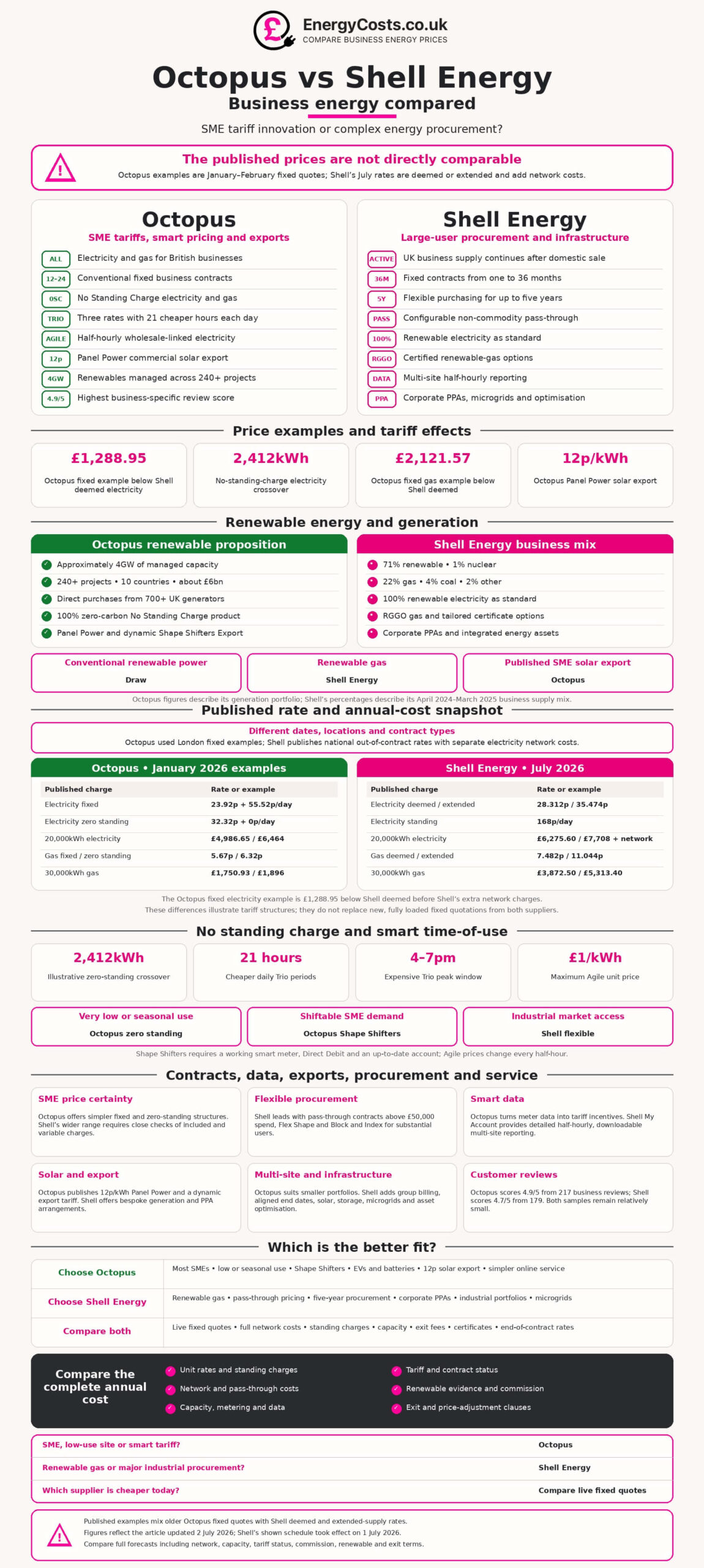
- Octopus appears cheaper in the available price examples, but its quoted rates are from January and February 2026, while Shell’s current deemed rates apply from July 2026. The figures are also fixed-contract prices versus out-of-contract rates, so they are not directly comparable.
Octopus vs Shell Energy at a glance
| Comparison area | Octopus Energy for Business | Shell Energy UK |
|---|---|---|
| Business electricity | Yes | Yes |
| Business gas | Yes | Yes |
| Domestic energy supply | Yes | No; former household customers transferred to Octopus |
| Conventional fixed contracts | Commonly 12 or 24 months | One to 36 months |
| Zero-standing-charge tariff | Electricity and gas options | No equivalent standard product prominently offered |
| Smart time-of-use tariff | Shape Shifters Trio and Agile | Flexible wholesale products for larger users |
| Flexible purchasing | Limited SME smart tariffs | Flex Shape and Block and Index |
| Pass-through contracts | Charges depend on the selected product | Customer can choose which non-commodity costs pass through |
| Renewable electricity | Green and zero-carbon electricity products | 100% renewable electricity as standard |
| Renewable gas | Not a prominent standard SME product | RGGO-backed renewable gas available |
| Corporate PPAs | Direct generator and traceable-energy options | Bespoke corporate PPAs |
| Business solar export | Panel Power pays 12p per kWh | Bespoke export and generation arrangements |
| Dynamic export tariff | Shape Shifters Export | No comparable public SME product |
| Published electricity example | 23.92p per kWh plus 55.52p daily | 28.312p deemed rate plus 168p daily and network charges |
| Published gas example | 5.67p per kWh plus 13.68p daily | 7.482p deemed rate plus 446p daily |
| Business Trustpilot score | 4.9 out of 5 | 4.7 out of 5 |
| Business Trustpilot reviews | 217 | 179 |
| Best suited to | SMEs, smart tariffs and solar exporters | Large users, renewable gas and complex procurement |
Octopus’s public business proposition emphasises direct sales, transparent tariffs and products for small, medium-sized and complex organisations. Shell’s range progresses from fixed contracts for smaller businesses to pass-through and flexible purchasing for major commercial and industrial customers.
Does Shell Energy still supply businesses?
Shell Energy continues to supply electricity, gas and related services to UK businesses.
The former Shell Energy household operation was sold to Octopus Energy, and its domestic customers were transferred to Octopus. That transaction did not close Shell Energy UK’s commercial supply business.
The Shell business operation remains active and offers fixed, flexible and pass-through gas and electricity contracts. This article therefore compares two separate active suppliers:
- Octopus Energy for Business
- Shell Energy UK’s commercial supply operation
Shell’s continued business offering includes renewable electricity, renewable gas, flexible wholesale purchasing and energy infrastructure.
Which is cheaper: Octopus or Shell Energy?
There is no universally applicable fixed rate from either supplier.
Business energy prices depend on:
- Annual electricity and gas consumption
- Meter profile and settlement type
- Electricity distribution region
- Agreed supply capacity
- Number of sites
- Contract start date
- Contract duration
- Payment method
- Credit history
- Load profile
- Renewable-energy requirements
- Treatment of network and policy costs
- Broker commission
Octopus requires a postcode and business information before displaying the tariffs available to a particular site. Its tariff page can include current and historical products, but it does not provide one simple national business price card.
Shell publishes national deemed and extended-supply schedules. However, the electricity rates exclude several distribution and transmission charges, which are added separately.
The available price examples must therefore be interpreted carefully.
Important pricing comparison warning
The Octopus figures used below are examples collected in January and February 2026:
- A January 2026 London fixed-tariff example
- A February 2026 quotation for a London business using 48,000 kWh annually
Shell’s current deemed and extended-supply rates took effect on 1 July 2026.
The comparison also places different contract types beside one another:
- Octopus fixed-contract examples
- Shell deemed and extended-supply prices
A deemed tariff normally applies when a business moves into premises without arranging a contract. Extended supply applies when a Shell fixed contract expires and the customer remains on supply without completing a renewal.
These rates are normally more expensive than a competitive fixed contract. The tables show the suppliers’ pricing structures, not the quotation either would necessarily offer today.
Octopus vs Shell Energy electricity prices
Published electricity examples
| Supplier and tariff | Price date | Unit rate | Standing charge |
|---|---|---|---|
| Octopus 12-month fixed example | January 2026 | 23.92p per kWh | 55.52p per day |
| Octopus Economy 7 day | January 2026 | 24.62p per kWh | 55.52p per day |
| Octopus Economy 7 night | January 2026 | 20.88p per kWh | 55.52p per day |
| Octopus No Standing Charge | January 2026 | 32.32p per kWh | 0p |
| Shell deemed | July 2026 | 28.312p per kWh | 168p per day |
| Shell extended supply | July 2026 | 35.474p per kWh | 168p per day |
The Octopus rates were published as examples for a London postcode and should not be treated as current nationwide prices. Octopus quotations vary according to the premises, meter and contract date.
Shell’s rates apply nationally to profile-class 01 to 08 non-half-hourly supplies, but the headline figures do not include all network costs.
Shell electricity pass-through charges
Shell’s deemed and extended electricity rates exclude:
- Distribution Use of System capacity charges
- Distribution fixed charges
- Reactive-power charges
- Transmission Network Use of System charges
These are charged at the prevailing rates applied by the relevant networks. Shell’s unit rate and standing charge are therefore not the complete electricity cost.
Octopus’s business terms state that charges can include wholesale energy, non-wholesale costs, standing charges, capacity charges and exceeded-capacity charges. The exact treatment depends on the supply summary for the selected tariff.
Example annual electricity cost
The following illustration assumes annual consumption of 20,000 kWh.
| Supplier and tariff | Unit cost | Standing charge | Headline annual total |
|---|---|---|---|
| Octopus fixed example | £4,784.00 | £202.65 | £4,986.65 |
| Octopus No Standing Charge | £6,464.00 | £0 | £6,464.00 |
| Shell deemed | £5,662.40 | £613.20 | £6,275.60 plus network charges |
| Shell extended supply | £7,094.80 | £613.20 | £7,708.00 plus network charges |
The Octopus standard fixed example is £1,288.95 below Shell’s deemed headline total and £2,721.35 below Shell extended supply.
The Octopus no-standing-charge example is £188.40 above Shell’s deemed headline total, before Shell’s network costs are added. It is £1,244 below Shell extended supply before those charges.
These differences do not establish the current saving because the Octopus prices are older fixed-contract examples, while Shell’s are current out-of-contract rates.
Separate 48,000 kWh quotation
A February 2026 price exercise for a London business consuming 48,000 kWh annually produced the following Octopus quotations:
| Octopus tariff | Unit rate | Standing charge |
|---|---|---|
| One-year fixed | 22.83p per kWh | 62.91p per day |
| Shape Shifters Agile | Indicative average of 20.5p per kWh | 58.24p per day |
| Shape Shifters Trio night | 18.9p per kWh | 48.9p per day |
| Shape Shifters Trio day | 20.5p per kWh | 48.9p per day |
| Shape Shifters Trio peak | 39.4p per kWh | 48.9p per day |
The Shape Shifters figures depend heavily on when the electricity is consumed. Agile rates change every half-hour, so a quoted average cannot predict the final bill.
Electricity price winner
Octopus appears more competitive in the available standard fixed-price examples.
Its January and February 2026 unit rates were below Shell’s current deemed and extended-supply rates. Its daily standing charges were also much lower.
However:
- Octopus’s examples are older.
- They relate to fixed contracts rather than deemed supply.
- Shell adds significant network charges separately.
- Octopus prices vary by postcode, meter and quotation date.
A business should compare a new Octopus quotation with a new Shell fixed quotation, not with Shell’s out-of-contract schedule.
Octopus vs Shell Energy gas prices
Octopus does not provide a simple current national business gas schedule on its public business page. A January 2026 London example showed the following prices:
| Supplier and tariff | Price date | Unit rate | Standing charge |
|---|---|---|---|
| Octopus fixed gas example | January 2026 | 5.67p per kWh | 13.68p per day |
| Octopus No Standing Charge gas | January 2026 | 6.32p per kWh | 0p |
| Shell deemed gas, band 1 | July 2026 | 7.482p per kWh | 446p per day |
| Shell extended gas, band 1 | July 2026 | 11.044p per kWh | 548p per day |
The Octopus rates were examples for a London postcode and are not necessarily still available. Shell’s rates apply to sites within the relevant annual-quantity bands.
Shell gas prices by consumption
| Shell tariff | Annual quantity | Unit rate | Standing charge |
|---|---|---|---|
| Deemed band 1 | 1–73,200 kWh | 7.482p per kWh | 446p per day |
| Deemed bands 2 and 3 | 73,201–732,000 kWh | 7.680p per kWh | 1,586p per day |
| Deemed band 4 and above | More than 732,000 kWh | 7.571p per kWh | 2,646p per day |
| Extended band 1 | 1–73,200 kWh | 11.044p per kWh | 548p per day |
| Extended bands 2 and 3 | 73,201–732,000 kWh | 11.242p per kWh | 1,688p per day |
| Extended band 4 and above | More than 732,000 kWh | 11.133p per kWh | 2,747p per day |
Shell’s standing charge increases sharply when a site moves into a higher consumption band. A business close to a threshold should check the annual quantity recorded for its meter.
Example annual gas cost
The following illustration assumes annual consumption of 30,000 kWh.
| Supplier and tariff | Unit cost | Standing charge | Estimated annual total |
|---|---|---|---|
| Octopus fixed example | £1,701.00 | £49.93 | £1,750.93 |
| Octopus No Standing Charge | £1,896.00 | £0 | £1,896.00 |
| Shell deemed | £2,244.60 | £1,627.90 | £3,872.50 |
| Shell extended supply | £3,313.20 | £2,000.20 | £5,313.40 |
The Octopus fixed example is £2,121.57 below Shell deemed supply and £3,562.47 below Shell extended supply.
The no-standing-charge example is £1,976.50 below Shell deemed supply and £3,417.40 below extended supply.
The apparent difference is large, but it remains an unsuitable direct tariff comparison: the Octopus figures are January fixed-price examples, whereas Shell’s July rates are intended for customers without an active fixed contract.
Gas price winner
Octopus has the stronger available price examples.
Its sample unit rates and standing charges were substantially below Shell’s deemed and extended rates.
Shell could still provide a competitive fixed quotation. Its published out-of-contract prices should not be assumed to represent the price available to a new customer agreeing a formal contract.
Octopus fixed business tariffs
Octopus offers conventional fixed business contracts, although the exact durations and prices displayed depend on the site.
Its current business documentation refers specifically to:
- 12-month fixed tariffs
- 24-month fixed tariffs
- No Standing Charge tariffs
- Standard variable and deemed supply
- Smart time-of-use products
Exit fees apply to 12-month fixed, 24-month fixed and No Standing Charge business tariffs agreed after 1 July 2024. The amount should be shown in the customer’s supply summary.
A fixed contract can protect the business from wholesale-price movements during the agreed term, but customers should still check:
- Whether the entire unit price is fixed
- Which network charges are included
- Capacity charges
- Metering costs
- Exit fees
- Volume tolerances
- Circumstances allowing the supplier to vary prices
Octopus No Standing Charge tariff
Octopus offers no-standing-charge contracts for eligible electricity and gas customers.
The electricity version is a 12-month fixed contract. Instead of charging a separate daily amount, Octopus incorporates the relevant fixed costs into the unit rate.
The tariff was originally made available to businesses in electricity consumption bands 2, 3 and 4. Octopus says it is most likely to benefit customers whose consumption sits towards the lower end of their band.
This structure can suit:
- Seasonal premises
- Community buildings
- Places of worship
- Small workshops
- Properties used only on selected days
- Sites with low consumption but high conventional standing charges
It will not automatically be cheaper. A high-use business may pay more because the unit rate includes costs that would otherwise appear in the standing charge.
Using the January example, the no-standing-charge electricity rate was 32.32p per kWh compared with 23.92p plus 55.52p per day on the standard contract. The mathematical crossover point is approximately 2,412 kWh annually:
- Below roughly 2,412 kWh, the no-standing-charge example is cheaper.
- Above roughly 2,412 kWh, the standard fixed example is cheaper.
The actual crossover point will change with each quotation.
Octopus Shape Shifters
Shape Shifters is Octopus’s distinctive smart electricity proposition for businesses.
It comes in two versions.
Shape Shifters Trio
Trio applies three predetermined unit rates:
- Night rate
- Day rate
- Peak rate
The expensive peak window runs from 4pm to 7pm. Octopus says businesses receive 21 hours of cheaper electricity each day, provided their usage is moved away from that peak.
Trio can suit businesses that can schedule:
- Electric vehicle charging
- Battery charging
- Refrigeration cycles
- Water heating
- Machinery
- Laundry
- Pumping
- Manufacturing processes
Because the time bands remain consistent, the business does not need to check a new wholesale-linked rate every day.
Shape Shifters Agile
Agile prices electricity in half-hourly periods in line with wholesale costs.
Customers receive the following day’s prices in advance and can schedule energy-intensive operations for cheaper periods. Octopus caps the Agile unit price at £1 per kWh.
Agile offers greater potential savings than Trio when wholesale prices are low or negative. It also exposes the business to greater volatility.
A business considering Agile should assess:
- How much consumption can genuinely be moved
- Whether staff can react to daily price signals
- Whether automated controls are available
- Exposure to expensive evening periods
- Battery capacity
- Operational disruption
- The financial effect of the £1-per-kWh maximum price
Shape Shifters eligibility
Both versions are 12-month products requiring the business to:
- Have a working smart meter
- Pay by Direct Debit
- Keep its account payments up to date
Exact prices vary according to the premises and meter arrangement.
Smart-tariff winner: Octopus
Shell offers much more advanced wholesale purchasing for major businesses, but it does not publish a comparable automated time-of-use product aimed at ordinary SMEs.
Shell fixed-price contracts
Shell’s fixed-price business contracts can last from one to 36 months.
The supplier tailors the quotation around expected consumption and offers renewable options and different payment arrangements. Shell promotes these contracts as providing budget certainty, but its terms allow prices to change in certain circumstances beyond its control.
Possible adjustments can arise from:
- Regulatory changes
- Changes to law
- Altered third-party charging structures
- Meter or supply changes
- Incorrect customer information
- Breaches of the contract
- Material changes in consumption
Businesses should review the contract data sheet to identify exactly which costs are guaranteed.
Shell pass-through contracts
Shell offers pass-through electricity contracts to businesses spending more than £50,000 annually on energy.
These products allow a customer to fix the commodity price while choosing which non-commodity costs are charged at prevailing rates. Potential pass-through categories include distribution and transmission costs.
Potential advantages include:
- Avoiding some supplier risk premiums
- Greater visibility over bill components
- Potential savings if network or policy charges fall
- More control over how third-party costs are treated
- Bespoke renewable options
- Flexible billing arrangements
Potential disadvantages include:
- Less predictable bills
- Exposure to increases in network charges
- More complicated invoices
- Greater internal procurement requirements
- A need to understand non-commodity cost forecasts
Pass-through winner: Shell Energy
Octopus’s business contracts can contain separate wholesale and non-wholesale charges, but Shell provides the more explicit and configurable pass-through proposition.
Shell flexible purchasing
Shell offers two principal flexible electricity structures.
Flex Shape
Flex Shape lets a business purchase expected electricity requirements in blocks while Shell manages the difference between the purchased volume and the actual shape of consumption.
The product offers:
- Electricity purchases aligned with business requirements
- An agreed shape fee
- Reduced exposure to non-commodity risk premiums
- 100% renewable electricity
- Options for non-half-hourly and half-hourly meters
Block and Index
Block and Index allows the business to buy blocks of electricity in advance while settling residual consumption against an agreed market index.
Its features include:
- Access to market pricing
- Control over the timing of purchases
- No volume-tolerance penalties under the promoted structure
- Renewable electricity options
- Greater exposure to wholesale-market movements
Shell’s advanced flexible contracts can extend to 60 months and are mainly intended for organisations with substantial electricity expenditure and procurement expertise.
Large-business procurement winner: Shell Energy
Octopus’s smart tariffs are innovative for smaller users, but Shell’s wholesale procurement products are more suitable for major industrial and commercial portfolios.
Which offers greater price certainty?
For a conventional SME, Octopus generally offers the simpler proposition.
A standard fixed Octopus quotation sets out the applicable unit rate, standing charge and any other charges in the supply summary. No-standing-charge customers can remove the separate daily fee entirely, although the corresponding unit rate is higher.
Shell offers fixed-price contracts, but its wider product range creates more possible cost structures:
- All-inclusive fixed pricing
- Pass-through network costs
- Flexible wholesale purchasing
- Deemed supply
- Extended supply
A business must identify which Shell product it is comparing and which charges can vary.
SME price-certainty winner: Octopus
Customised large-user pricing winner: Shell
Renewable electricity comparison
Both suppliers have substantial renewable-energy credentials.
Octopus renewable electricity
Octopus markets green and zero-carbon business tariffs and invests directly in renewable generation.
Octopus Energy Generation manages approximately 4 GW of renewable capacity across more than 240 large-scale projects in ten countries, with an estimated asset value of £6 billion. Octopus also purchases electricity directly from more than 700 UK renewable generators through power purchase agreements.
The No Standing Charge business tariff guarantees 100% zero-carbon electricity, while Octopus’s wider business proposition includes traceable and smart renewable products.
Octopus’s approach includes:
- Direct PPAs with renewable generators
- Octopus-owned and managed renewable assets
- Community energy agreements
- Time-of-use tariffs that encourage consumption when renewable output is abundant
- Export tariffs for commercial solar
- Generator-matching products
Shell renewable electricity
Shell supplies 100% renewable electricity as standard to business customers, supported by Renewable Energy Guarantees of Origin.
Customers can also request more specific generation-technology or location options, subject to the contract. Shell’s fixed, pass-through and flexible products can all incorporate renewable electricity.
Shell’s disclosed electricity mix for April 2024 to March 2025 was:
| Energy source | Shell Energy business mix |
|---|---|
| Renewables | 71% |
| Natural gas | 22% |
| Coal | 4% |
| Other fuels | 2% |
| Nuclear | 1% |
The portfolio-wide mix includes customers and products outside Shell’s dedicated 100% renewable arrangements. Shell evidences renewable supply through schemes including REGOs and the Green Gas Certification Scheme.
Renewable electricity winner
Draw for conventional renewable electricity.
Both suppliers can provide electricity matched with renewable generation. Shell’s standard business proposition makes its 100% renewable position particularly clear, while Octopus has stronger consumer-facing innovation and a substantial portfolio of renewable assets and direct generator contracts.
Renewable gas comparison
Shell has the clearer renewable-gas proposition.
Its products can be supported by Renewable Gas Guarantees of Origin under the Green Gas Certification Scheme. These certificates match business gas consumption with an equivalent quantity of biomethane injected into the gas network.
Octopus supplies conventional business gas and offers fixed and no-standing-charge options, but it does not promote an equivalent standard renewable-gas product as prominently within its SME range.
Renewable gas winner: Shell Energy
Business solar export tariffs
Octopus has a major advantage for businesses that already generate solar electricity.
Panel Power
Panel Power pays businesses and charities a flat 12p per kWh for electricity exported to the grid.
It can operate alongside an existing Octopus import tariff. Eligible businesses need a smart meter or another export-compatible meter.
At different annual export levels, the gross payment would be:
| Electricity exported | Annual Panel Power payment |
|---|---|
| 5,000 kWh | £600 |
| 10,000 kWh | £1,200 |
| 25,000 kWh | £3,000 |
| 50,000 kWh | £6,000 |
Shape Shifters Export
Shape Shifters Export applies half-hourly prices linked to wholesale market conditions.
It may be suitable for a business with battery storage because the organisation can export when prices are high rather than accepting the same price throughout the day.
The tariff creates both opportunity and risk:
- Exporting at expensive times can produce more than a flat tariff.
- Exporting during low or negative market prices can generate less.
- Battery losses and degradation must be considered.
- Automated controls may be required.
Shell can support commercial generation, PPAs and bespoke export arrangements, but it does not publish an equivalent universal 12p-per-kWh SME export tariff.
Solar-export winner: Octopus
Smart meters and energy monitoring
Octopus smart meters
Octopus can communicate with compatible Secure SMETS1 and SMETS2 meters. Where an incompatible SMETS1 meter cannot be enrolled in the national smart-meter network, Octopus says it may replace it without an additional charge.
Business smart-meter customers can use an online dashboard to monitor consumption, while a working smart meter is essential for Shape Shifters and other time-sensitive products.
The principal advantage is not merely automatic readings. Octopus uses half-hourly data to support:
- Time-of-use import tariffs
- Dynamic wholesale pricing
- Commercial solar export
- Battery optimisation
- Consumption shifting
- Automated charging
Shell smart meters and My Account
Shell gives smart and advanced-meter customers free access to half-hourly consumption data through My Account.
The portal can provide:
- Up to 12 months of historical data by default
- Half-hourly gas and electricity information
- Downloadable datasets
- Charts showing trends and consumption patterns
- Data across multiple business sites
- Access for authorised third parties
- Bespoke reports
- Invoice and contract information
Shell states that a smart meter is not legally required. Customers can select half-hourly, daily or monthly data collection, although daily collection is the default after installation.
Energy-data winner
Octopus for using data to reduce costs automatically.
Shape Shifters, Panel Power and dynamic export pricing turn smart-meter data into direct tariff incentives.
Shell for conventional multi-site reporting.
Its portal provides a detailed set of reporting, invoice, query and contract-management functions, particularly for organisations with several meters.
Multi-site business energy
Both suppliers support businesses with multiple premises.
Octopus offers dedicated multi-site services and promotes centralised management through its business platform. Its direct-sales model may suit smaller retail, hospitality or property portfolios that want one supplier without using a broker.
Shell’s multi-site strengths include:
- Group billing
- Aligned contract end dates
- Fixed and pass-through structures
- Flexible payment terms
- Multi-site consumption reporting
- Large-user procurement
- Integrated generation and infrastructure
Shell is likely to be the stronger choice for an energy-intensive national portfolio, while Octopus may provide the simpler service for a smaller group of sites.
Commercial solar, batteries and energy infrastructure
Octopus’s most clearly defined commercial proposition concerns tariffs for importing and exporting electricity rather than a universal packaged installation service for every business.
Its advantages include:
- Panel Power
- Shape Shifters Export
- Smart import tariffs
- Direct renewable-generator relationships
- Battery-friendly time-of-use pricing
- Wider Octopus solar and battery expertise
Shell offers more bespoke energy infrastructure for larger organisations, including:
- On-site solar generation
- Battery storage
- Microgrids
- Low-carbon heat
- Electric vehicle infrastructure
- Flexible generation
- Asset optimisation
- Operation and maintenance
- Route-to-market services
Shell is therefore likely to be more suitable for a major integrated energy project, while Octopus is especially attractive to a business that already has solar or storage and wants an innovative tariff.
Customer service comparison
Both companies have dedicated business Trustpilot profiles.
| Supplier | TrustScore | Reviews |
|---|---|---|
| Octopus Energy for Business | 4.9 out of 5 | 217 |
| Shell Energy for Business Customers | 4.7 out of 5 | 179 |
Octopus currently has the higher score and slightly larger business-specific sample. Its profile was claimed in May 2026 and uses a paid Trustpilot subscription. The company invites customers to review it and reportedly replies to 50% of negative reviews, generally within 48 hours.
Shell also invites business customers to review it and uses a paid profile. Its review volume is relatively low, with only seven reviews recorded in the previous 12 months at the time checked. Trustpilot states that Shell had not replied to negative reviews through the platform.
Both samples remain small compared with the suppliers’ total customer numbers. Review scores can also be affected by invitation methods, recent campaigns and the types of customers most likely to leave feedback.
Customer-review winner: Octopus
Its 4.9 score is higher and its profile has received much more recent review activity.
Octopus advantages and disadvantages
Advantages of Octopus
- Competitive published fixed-price examples
- 12 and 24-month fixed products
- Electricity and gas tariffs without standing charges
- Shape Shifters Trio
- Half-hourly Shape Shifters Agile pricing
- Smart-meter-led cost reduction
- Panel Power pays 12p per kWh
- Dynamic business export tariff
- Strong direct renewable-generator relationships
- Significant renewable-generation investments
- Simple online account management
- Dedicated multi-site service
- Highest relevant Trustpilot score
- Direct sales rather than a broker-led model
- Products designed specifically for SMEs
Disadvantages of Octopus
- Exact business prices require site details
- No simple national current rate card
- The available public price examples may become outdated quickly
- Smart products require a compatible working meter
- Agile prices can become expensive at peak times
- Fixed tariffs can include early exit fees
- No Standing Charge tariffs have higher unit rates
- Less extensive public information about fully flexible industrial procurement
- Renewable gas is not as prominent as Shell’s product
- Fewer bespoke infrastructure services for major industrial sites
Shell Energy advantages and disadvantages
Advantages of Shell Energy
- Fixed terms from one to 36 months
- Flexible contracts extending to five years
- Fixed, pass-through and indexed structures
- Flex Shape and Block and Index
- Choice over non-commodity pass-through costs
- 100% renewable electricity as standard
- Renewable gas supported by RGGOs
- Corporate PPAs
- Strong proposition for major energy users
- Multi-site and group-billing support
- Free half-hourly consumption data
- Bespoke reports through My Account
- Solar, batteries and microgrids
- Integrated commercial energy infrastructure
- Large international energy-trading capabilities
Disadvantages of Shell Energy
- High published gas standing charges
- Standing charges increase sharply by gas-consumption band
- Extended-supply rates are considerably higher than deemed rates
- Deemed electricity prices exclude major network costs
- Headline electricity rates are not the complete bill
- Procurement structures can be complicated for SMEs
- No standard zero-standing-charge product
- No flat published SME solar-export rate
- Lower business Trustpilot score
- Limited recent review activity
- The household-business sale can create brand confusion
Which supplier is best for different businesses?
| Business requirement | Better choice | Reason |
|---|---|---|
| Small office or shop | Octopus | Simpler tariffs and lower price examples |
| Very low-consumption premises | Octopus | No Standing Charge option |
| Seasonal business | Octopus | Zero-standing-charge gas and electricity |
| Business able to move consumption | Octopus | Shape Shifters |
| Business with electric vehicles | Octopus | Cheaper off-peak smart pricing |
| Business with battery storage | Octopus | Dynamic import and export products |
| Existing commercial solar panels | Octopus | Panel Power pays 12p per kWh |
| Straightforward 12-month contract | Octopus | Clear SME focus |
| Renewable electricity | Draw | Both provide renewable products |
| Renewable gas | Shell | RGGO-backed supply |
| Business spending more than £50,000 | Shell | Pass-through options |
| Major industrial electricity user | Shell | Flexible wholesale purchasing |
| Five-year procurement strategy | Shell | Block and Index can extend to 60 months |
| Corporate PPA | Shell | Bespoke large-user structures |
| Multi-site industrial portfolio | Shell | Group billing and sophisticated procurement |
| Integrated solar and microgrid project | Shell | Broader infrastructure services |
| Simple smart-meter dashboard | Octopus | Accessible SME platform |
| Complex multi-site reporting | Shell | Detailed reports and data exports |
| Highest customer-review score | Octopus | 4.9 compared with 4.7 |
Final verdict: Octopus vs Shell Energy
Octopus is the better overall business energy supplier for most small and medium-sized organisations.
Its available fixed-price examples are competitive, and its range includes options not commonly found among major suppliers:
- No Standing Charge electricity and gas
- Shape Shifters Trio
- Shape Shifters Agile
- Panel Power
- Shape Shifters Export
These products provide genuine choices for low-use premises, flexible businesses, electric vehicle fleets, battery owners and commercial solar generators.
Octopus also has the stronger relevant customer-review record, with a 4.9 TrustScore from 217 business reviews compared with Shell’s 4.7 from 179.
Shell Energy is the stronger supplier for large and complex energy users.
Its fixed, pass-through and flexible products allow an organisation to decide how much price certainty it wants and which non-commodity charges should remain variable. Renewable gas, corporate PPAs, microgrids and integrated infrastructure further strengthen its proposition for industrial and multi-site customers.
The published price evidence favours Octopus, but it is not a direct current comparison:
- Octopus’s examples are from January and February 2026.
- Shell’s rates apply from July 2026.
- Octopus’s figures are fixed-contract examples.
- Shell’s figures are deemed and extended-supply rates.
- Shell adds electricity network costs separately.
The practical conclusion is:
- Choose Octopus for an SME fixed contract, zero standing charges, smart time-of-use pricing or commercial solar export.
- Consider Shell for renewable gas, pass-through contracts, flexible wholesale purchasing, a corporate PPA or an integrated industrial energy project.
- Compare live fixed quotations before deciding which supplier is cheaper.
A complete comparison should include:
- Unit rates
- Standing charges
- Estimated annual cost
- Distribution charges
- Transmission charges
- Capacity costs
- Metering and data fees
- Contract duration
- Exit fees
- Volume tolerances
- Renewable certificates
- Broker commission
- Price-adjustment provisions
- End-of-contract rates
FAQ
Octopus has lower rates in the available fixed-price examples. Shell’s current published rates are for deemed and extended supply, and its electricity network charges are added separately. Live fixed quotations are required for a fair current comparison.
A January Octopus example charged 23.92p per kWh plus 55.52p daily. Shell’s July deemed rate is 28.312p plus 168p daily and separate network charges. The contracts and pricing dates differ.
The January Octopus example charged 5.67p per kWh plus 13.68p daily. Shell’s July deemed rate starts at 7.482p plus 446p daily. Shell may quote a lower fixed-contract price than its deemed schedule.
Most Octopus business tariffs include a daily standing charge. Eligible businesses can choose a No Standing Charge tariff where the fixed costs are incorporated into a higher unit rate.
Shell does not prominently offer an equivalent standard zero-standing-charge business product. Its fixed, deemed and extended-supply prices normally include daily charges or other site-specific costs.
Shape Shifters is a smart business electricity tariff. Trio uses fixed night, day and peak rates, while Agile changes prices every half-hour in line with wholesale costs.
A Shell pass-through contract fixes the electricity commodity price while billing selected network and policy costs at prevailing rates. It can reduce risk premiums but exposes the business to changing third-party charges.
Yes. Octopus offers green and zero-carbon business products, buys electricity from hundreds of UK renewable generators and manages a major international renewable-generation portfolio.
Yes. Shell states that business customers receive 100% renewable electricity as standard, backed by Renewable Energy Guarantees of Origin.
Shell has the stronger product. It offers renewable gas supported by Renewable Gas Guarantees of Origin through the Green Gas Certification Scheme.
Yes. Panel Power pays a flat 12p per kWh. Shape Shifters Export offers half-hourly wholesale-linked export prices.
Shell can arrange bespoke generation, export and PPA structures, but it does not publish an equivalent universal flat-rate SME export tariff.
Both support business smart meters. Octopus requires a working compatible meter for Shape Shifters. Shell provides smart and advanced-meter customers with free access to half-hourly data.
Shell is generally stronger for major users because it offers pass-through pricing, flexible wholesale purchasing, renewable gas, PPAs and integrated energy infrastructure.
Octopus Energy for Business has a Trustpilot score of 4.9 from 217 reviews. Shell Energy for Business Customers has 4.7 from 179 reviews. Both companies invite reviews.
Choose Octopus for SME pricing, no-standing-charge tariffs, smart time-of-use products or solar export. Consider Shell for renewable gas, flexible procurement, pass-through pricing or large industrial energy projects.