
Troo review summary
Troo, also trading as Troocost, is a UK business energy consultancy and broker based in Sunderland. It helps businesses compare and manage electricity, gas and water contracts, while also offering support with energy efficiency, renewable energy, energy compliance, contract support and net zero planning.
Troo is not just a business energy switching website. Its website describes the business as a consultancy that provides ongoing support and long-term value, rather than a quick transaction. It also says Troo supports businesses with contracts, compliance and efficiency, and manages billing issues, supplier queries and market changes through its Troo Assure service.
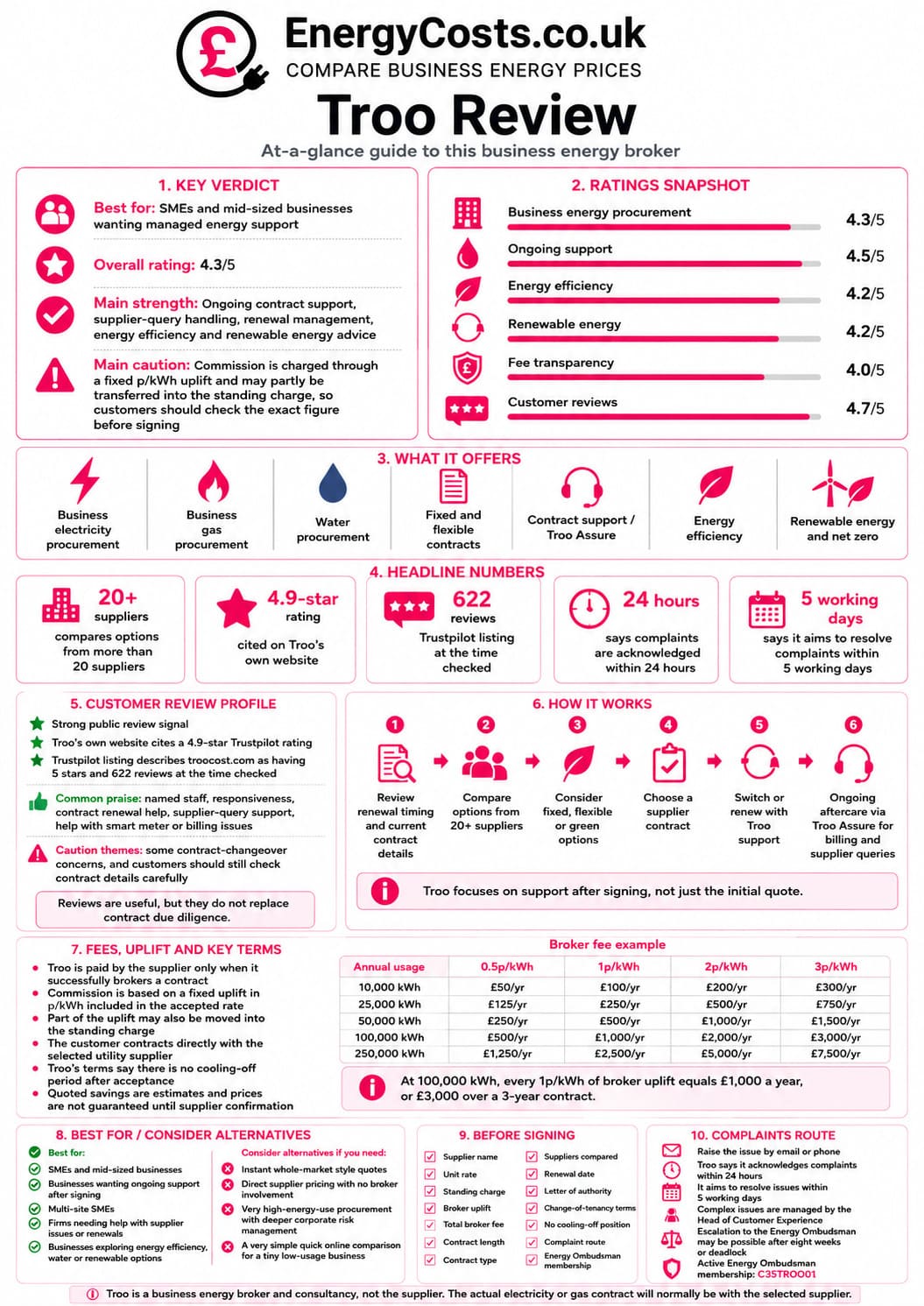
The company is likely to suit SMEs and mid-sized businesses that want a more supportive broker relationship than a simple online quote. Its main strengths are ongoing account support, contract management, supplier issue handling, energy efficiency and renewable energy advice.
The main caution is fee transparency: Troo’s terms say it earns commission through a fixed rate uplift in pence per kWh, which may also be transferred partly to the standing charge.
Quick verdict
| Category | Rating | Notes |
|---|---|---|
| Business energy procurement | 4.3/5 | Compares options from 20+ suppliers and supports fixed or flexible contracts |
| Ongoing support | 4.5/5 | Strong emphasis on contract support, billing issues and supplier queries |
| Energy efficiency | 4.2/5 | Covers audits, monitoring, LED lighting and voltage optimisation |
| Renewable energy | 4.2/5 | Supports solar, battery storage and other renewable options |
| Fee transparency | 4.0/5 | Terms explain p/kWh commission uplift, but customers must check the exact figure |
| Customer reviews | 4.7/5 | Strong Trustpilot signal, with Troo’s site citing a 4.9-star rating |
| Best for | SMEs wanting managed energy support | Particularly useful for businesses that want help after the contract is signed |
| Overall rating | 4.3/5 | A strong consultancy-style broker, provided uplift and contract terms are checked carefully |
What is Troo?
Troo Ltd is an active private limited company registered in England and Wales under company number 10293408. Companies House lists its registered office as 1 Azure Court, Doxford International Business Park, Sunderland, SR3 3BE, and shows that the company was incorporated on 25 July 2016. Companies House also shows that the company was previously called Costhaven Limited until 9 May 2017.
Troo should be understood as a business energy broker and consultancy, not as a licensed gas or electricity supplier. Its terms describe Troo Limited as a private limited company offering commercial utility supply brokerage services to businesses and other entities.
For customers, this distinction matters. Troo can help arrange and support energy contracts, but the actual electricity or gas supply contract is normally between the business and the selected utility supplier. Troo’s own terms state that, by entering into a utility contract, the customer is directly contracting with the utility supplier, not Troo.
What does Troo offer?
Troo’s service range includes energy procurement, water procurement, energy efficiency, renewable energy, energy compliance, contract support and net zero planning. Its homepage says it helps businesses secure contracts, improve efficiency, explore on-site generation and meet compliance needs.
| Service | What it means | Best suited to |
|---|---|---|
| Business electricity procurement | Comparing and arranging commercial electricity contracts | Shops, offices, hospitality, care, leisure and SMEs |
| Business gas procurement | Comparing and arranging commercial gas contracts | Restaurants, cafés, care homes, manufacturers and heated premises |
| Water procurement | Helping businesses review commercial water options | Businesses wanting several utilities managed together |
| Fixed energy contracts | Locking in rates for a defined period | Businesses wanting budget certainty |
| Flexible energy contracts | Buying energy in stages or using a more flexible structure | Higher-usage or risk-aware businesses |
| Multi-site contract alignment | Aligning contracts across multiple locations | Multi-site SMEs, hospitality groups, retailers and care groups |
| Green energy procurement | Reviewing renewable tariffs, PPAs and on-site generation | Businesses with sustainability targets |
| Contract support | Helping with supplier queries and billing issues | Businesses that want support after switching |
| Energy efficiency | Audits, monitoring, LED lighting and voltage optimisation | Businesses wanting to reduce usage |
| Renewable energy | Solar, battery storage and other generation options | Businesses wanting to reduce grid reliance |
| Energy compliance | Help understanding energy regulation and requirements | Larger or more complex organisations |
| Road to net zero | Planning and support for lower-carbon operations | Businesses with ESG or carbon targets |
Business energy procurement
Troo’s energy procurement page says it compares options from more than 20 suppliers, helps businesses choose between fixed and flexible contracts, aligns multi-site contracts, explores green energy options and provides ongoing support.
This makes Troo more suitable for businesses that want advice and support, not just a quick price comparison.
- Supplier comparison: Reduces the need to contact multiple suppliers directly
- Fixed contracts: Helps businesses secure predictable energy costs
- Flexible contracts: Gives higher-usage businesses more control over market timing
- Multi-site alignment: Reduces admin and can improve buying power
- Green energy options: Supports sustainability and carbon goals
- Renewal monitoring: Helps avoid out-of-contract or deemed rates
- Supplier issue support: Gives customers someone to contact when things go wrong
Troo’s procurement page also says business energy contracts usually last one to five years, and that customers should ideally start looking six to 12 months before their contract ends. It warns that letting a contract expire can result in expensive out-of-contract or deemed rates.
Energy contract support
One of Troo’s stronger selling points is support beyond the initial contract. Its website says Troo Assure proactively manages billing issues, supplier queries and market changes, while its procurement page says the company helps customers if supplier issues crop up and stays involved when contract renewals are approaching.
This may be useful for businesses that have previously struggled with:
- Supplier billing errors: Raising and tracking supplier queries
- Contract renewal dates: Monitoring renewals and avoiding expensive default rates
- Meter queries: Supporting communication with the supplier
- Estimated bills: Helping customers understand and challenge incorrect bills
- Multi-site admin: Keeping contract dates and supplier details organised
- Supplier contact delays: Acting as an intermediary where appropriate
- Green or flexible contract decisions: Explaining options before renewal
A broker’s aftercare can be as important as the initial quote. Many businesses only discover whether a broker is helpful when something goes wrong after the contract starts.
Energy efficiency services
Troo offers energy efficiency support. Its energy efficiency page says the company helps businesses identify inefficiencies with site audits and energy monitoring, recommend practical solutions, support installation, provide access to funding and offer ongoing advice.
Its listed energy efficiency services include voltage optimisation, LED lighting upgrades, energy monitoring systems and energy efficiency audits or surveys.
- Voltage optimisation: Reducing unnecessary voltage and equipment stress
- LED lighting: Replacing inefficient lighting with lower-energy alternatives
- Energy monitoring: Tracking usage in real time to identify waste
- Energy audits: Reviewing where energy is being lost or wasted
- Funding support: Helping customers assess whether upgrades can be made more affordable
- Ongoing advice: Checking whether changes are delivering results
This is useful because the cheapest energy contract is not always enough. For high-usage businesses, reducing consumption can be more valuable than shaving a small amount from the unit rate.
Renewable energy and net zero support
Troo also supports renewable energy and sustainability projects. Its homepage says it helps businesses explore on-site generation, including solar, battery storage and other renewable solutions.
Troo’s procurement page explains that renewable energy procurement can include green energy tariffs, Power Purchase Agreements and on-site generation such as solar panels.
- Green energy tariff: Supplier matches usage with renewable generation or certificates
- Power Purchase Agreement: Long-term purchase arrangement with a renewable generator
- On-site solar: Generating electricity at the business premises
- Battery storage: Storing electricity for later use or peak reduction
- Renewable feasibility support: Understanding whether a site is suitable
- Net zero planning: Linking energy decisions to carbon goals
This makes Troo relevant for businesses that want to reduce reliance on the grid or improve sustainability credentials, not just switch supplier.
Troo fees and commission
Troo’s terms explain how commission works. They define commission as a payment from the utility supplier to Troo via an increase to the customer unit rate or standing charge.
The terms also say Troo only receives commission from the utility supplier when it successfully brokers a utility contract. The commission is based on a fixed rate uplift, expressed in pence per kWh, included within the rate proposed and accepted by the customer, multiplied by the estimated units expected to be consumed. Troo may also transfer part of the uplift across the contract to the standing charge.
| Fee point | What Troo’s terms say | What the customer should ask |
|---|---|---|
| Commission method | Commission is paid through a p/kWh uplift or standing charge | What is the exact uplift? |
| Payment trigger | Troo receives commission when it successfully brokers a contract | Is commission included in every quote shown? |
| Calculation basis | Commission is uplift multiplied by estimated consumption | What is the total commission over the contract? |
| Standing charge transfer | Troo may move part of the uplift into the standing charge | How much of the standing charge is broker fee? |
| Supplier contract | Customer contracts directly with the utility supplier | Who is responsible for billing or supply issues? |
Example broker-fee calculation
Because Troo’s commission may be charged as a p/kWh uplift, businesses should convert the uplift into a cash figure before signing.
| Annual energy usage | 0.5p/kWh broker fee | 1p/kWh broker fee | 2p/kWh broker fee | 3p/kWh broker fee |
|---|---|---|---|---|
| 10,000 kWh | £50 per year | £100 per year | £200 per year | £300 per year |
| 25,000 kWh | £125 per year | £250 per year | £500 per year | £750 per year |
| 50,000 kWh | £250 per year | £500 per year | £1,000 per year | £1,500 per year |
| 100,000 kWh | £500 per year | £1,000 per year | £2,000 per year | £3,000 per year |
| 250,000 kWh | £1,250 per year | £2,500 per year | £5,000 per year | £7,500 per year |
| 500,000 kWh | £2,500 per year | £5,000 per year | £10,000 per year | £15,000 per year |
For a business using 100,000 kWh per year, every 1p/kWh of broker uplift costs £1,000 per year. Over a three-year contract, that becomes £3,000.
That does not automatically mean Troo is poor value. A good broker can save more than it costs through better procurement, renewal management, billing support and efficiency advice. However, the commission should be understood before the contract is accepted.
Important terms to check
Troo’s terms include several points businesses should read carefully. They state that Troo is not a business energy price comparison service, may not have access to every supplier or every available deal, and does not warrant that it will provide the cheapest deal available.
The terms also state that there is no cooling-off period after acceptance of the utility contract, that savings shown in quotes are estimates only, and that quoted prices are not guaranteed until confirmed by the utility supplier.
- Not a price comparison service: Troo may not access every supplier or every deal
- No cheapest-deal warranty: Customers should compare against other quotes
- No cooling-off period: Business energy contracts can be binding once accepted
- Indicative rates: Prices may change before supplier confirmation
- Estimated savings: Quoted savings are not guaranteed
- Customer contracts with supplier: The supplier remains responsible for energy supply
- Customer default clause: Troo may claim commission it would otherwise have received if customer default prevents the contract from starting
- Change-of-tenancy rules: Customers moving premises must provide written evidence in advance
- Liability cap: Troo’s liability is limited to the commission received for the relevant utility contract
Troo’s terms say that if customer default delays or prevents supply under the utility contract, the customer must pay Troo an amount equal to the commission Troo would otherwise have received. They also say a change of tenancy must be notified 30 days before the change, with supporting documents.
Broker fee transparency rules
Broker fee transparency has improved across the UK business energy market. Ofgem confirmed that, for contracts signed on or from 1 October 2024, the requirement for a contract’s principal terms to display broker fees was expanded from microbusiness customers to all non-domestic customers, and suppliers must make this information available upon request.
For a Troo customer, this means the broker fee should be checked before signing. Ask for the uplift in p/kWh, any standing charge element, the total estimated fee in pounds and the full contract cost across the agreed term.
Customer reviews
Troo has a strong public review signal. Its own website says it has a 4.9-star Trustpilot rating, while Trustpilot’s listing describes troocost.com as having 5 stars and 622 reviews at the time checked.
Recent Trustpilot review snippets frequently praise named staff, responsiveness, contract renewal help, supplier-query support and help resolving smart meter or billing issues. There are also some less positive examples, including a recent 3-star review describing problems with contract changeovers, though Troo publicly replied that it had worked with the customer and reached a resolution.
| Review signal | What it suggests | What to check |
|---|---|---|
| Strong Trustpilot rating | Many customers report positive experiences | Reviews do not replace contract due diligence |
| High praise for named staff | Account support appears to be a key strength | Service may depend on the adviser assigned |
| Positive comments on supplier queries | Useful for customers wanting aftercare | Confirm what support is included |
| Some contract-changeover concerns | Switching can still go wrong | Keep written records and check dates carefully |
| Troo replies to reviews | Shows visible engagement | Public replies are not the same as formal complaint resolution |
Overall, Troo’s review profile is positive, especially around service and responsiveness. However, customers should still check the contract, commission, standing charge, supplier, rates and renewal terms before signing.
Pros and cons
Pros
- Strong Trustpilot signal and positive service reviews
- Compares options from more than 20 suppliers
- Offers ongoing contract and supplier support
- Covers electricity, gas, water and green energy procurement
- Provides energy efficiency and renewable energy support
- Active Energy Ombudsman membership
- Good fit for businesses wanting more than a one-off switch
Cons
- Not a whole-market price comparison service
- Terms say Troo does not guarantee the cheapest deal
- Commission is included through a p/kWh uplift and possibly the standing charge
- Customers must ask for the exact uplift and total fee
- Business energy contracts usually have no cooling-off period
- Customer default clauses should be read carefully
- May be more involved than very small businesses need
Is Troo regulated?
Troo is not regulated by Ofgem in the same way as a licensed gas or electricity supplier. That is normal for business energy brokers. However, suppliers must disclose broker fees in principal terms for non-domestic contracts signed from 1 October 2024, and the wider broker market is moving towards stronger oversight.
Troo is registered with the Energy Ombudsman. The Energy Ombudsman lists Troo Ltd, trading as Troocost, with active membership, company number 10293408, start date 1 December 2022 and membership number C35TROO01.
Troo’s own terms also state that the company is registered with the Energy Ombudsman under membership number C35TROO01.
Complaints and dispute resolution
Troo publishes a complaints procedure. It says customers can raise a complaint by email or telephone, that Troo will acknowledge receipt within 24 hours, and that it aims to resolve issues within 5 working days. If a complaint is not resolved within that time, or is deemed complex, it is personally managed by the Head of Customer Experience.
Troo’s complaints page says that if a complaint reaches deadlock or is more than eight weeks old, the customer has the right to raise the issue with the Energy Ombudsman.
- Raise the issue: Email [email protected] or call 0808 164 2222
- Keep evidence: Save contracts, quotes, emails, bills, call notes and letters of authority
- Wait for acknowledgement: Troo says it acknowledges complaints within 24 hours
- Allow initial resolution: Troo says it aims to resolve issues within five working days
- Escalate complex issues: Troo says complex issues are managed by the Head of Customer Experience
- Use the Ombudsman if eligible: Escalation may be possible after eight weeks or deadlock
Who is Troo best for?
Troo is best suited to businesses that want practical support with energy contracts, renewals and supplier issues rather than only a quick online quote.
| Business type | Suitability | Why |
|---|---|---|
| Small offices | Medium to high | Useful if the business wants renewal and supplier-query support |
| Shops and salons | High | Standard SME contracts and renewal support are likely to fit well |
| Cafés and restaurants | High | Gas, electricity and water support can all be useful |
| Pubs and leisure venues | High | Energy contracts, efficiency and renewables may all matter |
| Care homes | Medium to high | Energy usage, billing and compliance can be significant |
| Farms and rural businesses | Medium to high | CLA Energy Services, powered by Troo, appears in Troo case studies and reviews |
| Multi-site SMEs | High | Contract alignment and ongoing support can reduce admin |
| Businesses with supplier issues | High | Troo emphasises billing and supplier-query support |
| Businesses exploring solar | Medium to high | Renewable energy and on-site generation support are available |
| Very large corporates | Medium | May also want to compare Inenco, Inspired PLC or Northern Gas and Power |
| Very small low-usage businesses | Medium | Simpler online brokers may be quicker |
Who might need an alternative?
Troo may not be the best fit for every company.
| Situation | Why another route may help |
|---|---|
| Need for instant whole-market quotes | A pure comparison platform may feel quicker |
| Preference for direct supplier pricing | Some businesses may want no broker involvement |
| Very high energy consumption | Large procurement consultants may offer deeper flexible procurement support |
| Need for formal corporate risk management | Inspired, Inenco or Northern Gas and Power may be better suited |
| Low need for ongoing support | Troo’s aftercare focus may be underused |
| Concern about p/kWh uplift | Compare against fixed-fee consultants or direct supplier quotes |
| Moving premises soon | Read the change-of-tenancy clauses carefully before signing |
Troo compared with other brokers
| Broker | Best for | How Troo compares |
|---|---|---|
| Bionic | SME energy and business essentials comparison | Troo appears more consultancy-led and service-led after signing |
| Love Energy Savings | Fast online energy comparison | Troo is less about instant switching and more about ongoing support |
| Utility Bidder | SME multi-utility comparison | Both cover broader utility needs, but Troo has a stronger energy support and efficiency message |
| Consultiv Utilities | SME energy, water, waste and communications | Both suit SMEs wanting wider support; compare commission and contract terms |
| Advantage Utilities | Bespoke energy and sustainability consultancy | Advantage may be stronger for larger consultancy projects; Troo may feel more SME-support focused |
| Auditel | Cost, procurement and carbon reduction | Auditel is broader across procurement categories, while Troo is more energy-focused |
| Northern Gas and Power | Larger energy procurement and management | NGP may be more suitable for complex, high-consumption procurement |
| Inenco | Large users, bureau and compliance | Inenco is more corporate utility-management focused |
| Inspired PLC | Corporate energy, ESG and risk | Inspired is more suitable for large-scale energy strategy and ESG work |
What to check before signing with Troo
Before signing a letter of authority or accepting a supplier contract arranged through Troo, ask for the following in writing:
- Supplier name: Confirms who will actually supply the energy
- Unit rate: Shows the p/kWh cost
- Standing charge: Important if part of the broker fee is moved into it
- Broker uplift: Troo’s terms say commission is based on a fixed p/kWh uplift
- Total broker fee: Converts the uplift into pounds over the contract term
- Contract length: Business contracts can last one to five years
- Contract type: Confirms whether the contract is fixed, flexible or pass-through
- Suppliers compared: Troo says it compares more than 20 suppliers, but ask which suppliers quoted for your business
- Renewal date: Helps avoid out-of-contract rates
- Letter of authority: Confirms what Troo can do on your behalf
- Change-of-tenancy terms: Important if you may move premises
- No cooling-off position: Business contracts can be binding once accepted
- Complaint route: Confirms how issues can be escalated
- Energy Ombudsman membership: Troo is listed as active under C35TROO01
Final verdict: Troo review
Troo is a strong option for SMEs and mid-sized businesses that want a business energy broker with a service-led approach. Its strengths are contract support, supplier-query handling, renewal management, energy efficiency, renewable energy advice, water procurement and a strong Trustpilot profile.
It is not, however, a guaranteed whole-market cheapest-price energy comparison service. Troo’s own terms say it may not have access to every supplier or deal, does not guarantee the cheapest available deal, and earns commission through a p/kWh uplift or standing charge mechanism.
For businesses that want ongoing support, Troo is worth comparing with Utility Bidder, Consultiv Utilities, Bionic and Love Energy Savings. For high-consumption, multi-site or complex procurement, it should also be compared with Northern Gas and Power, Inenco, Inspired PLC and Advantage Utilities.
FAQ
No. Troo is a business energy broker and consultancy, not a gas or electricity supplier. Troo’s terms say customers entering into a utility contract are directly contracting with the utility supplier, not Troo.
Yes. Troo Ltd is an active private limited company registered in England and Wales under company number 10293408. Companies House lists its registered office in Sunderland and shows it was incorporated on 25 July 2016.
Troo helps businesses with energy procurement, water procurement, energy efficiency, renewable energy, energy compliance, contract support and net zero planning. Its website says it helps businesses secure contracts, improve efficiency, explore on-site generation and meet compliance needs.
Troo’s terms say it receives commission from the utility supplier when it successfully brokers a utility contract. The commission is based on a fixed rate uplift in pence per kWh, included within the accepted rate and multiplied by estimated consumption.
Troo’s terms explain the commission model, but customers should ask for the exact uplift and total fee in writing. Ofgem rules require broker fees to be shown in principal terms for non-domestic contracts signed from 1 October 2024, and suppliers must make the information available on request.
Troo’s terms state that it is not a price comparison service and may not have access to every supplier or every available deal. The terms also say Troo does not warrant that it will provide the cheapest deal available.
Troo can be a good fit for small businesses that want managed support with energy contracts, renewals and supplier issues. Very small businesses wanting instant online quotes may still want to compare Troo with Bionic, Love Energy Savings or Utility Bidder.
Troo may suit multi-site or growing businesses because it offers contract alignment, supplier-query support, energy efficiency and renewable energy advice. Very large or energy-intensive organisations may also want to compare it with Inspired PLC, Inenco or Northern Gas and Power.
Troo has a strong Trustpilot signal. Troo’s own website cites a 4.9-star Trustpilot rating, while Trustpilot’s listing describes troocost.com as having 5 stars and 622 reviews at the time checked.
Yes. Troo’s complaints page says customers can complain by email or telephone, that complaints are acknowledged within 24 hours, and that Troo aims to resolve issues within 5 working days. Complaints reaching deadlock or more than eight weeks old can be raised with the Energy Ombudsman.
Yes. The Energy Ombudsman lists Troo Ltd, trading as Troocost, as an active member with membership number C35TROO01 and start date 1 December 2022.
Ask which suppliers were compared, what the unit rate and standing charge are, what broker uplift is included, whether any uplift has been moved into the standing charge, what the total broker fee is, when the contract starts, what happens if you move premises, and how complaints can be escalated.