
Find the cheapest business electricity rates per kWh in October 2026
Running a business involves managing several expenses, and one of the largest ongoing costs is electricity. Whether you operate a small start-up or a large enterprise, finding the best business electricity rates can significantly impact your bottom line. With energy prices fluctuating and suppliers offering different rates, how do you ensure you’re getting the best deal? That’s where our business electricity price comparison tool comes in.
At EnergyCosts.co.uk, we provide a quick and simple way for businesses to compare commercial electricity rates from a wide range of trusted suppliers. Our easy-to-use UK business electricity rates comparison system allows you to find competitive prices tailored to your business needs, helping you save time, money, and hassle.
Compare business electricity suppliers online
Electricity prices for businesses can vary widely based on factors such as region, industry, and size. The table below shows the average commercial electricity cost per kWh for different business sizes in the UK:
Average business electricity tariff prices: commercial rates per kWh
| Supplier | Unit rate PC 01–04 (p/kWh) | Standing charge PC 01–04 (p/day) | Unit rate PC 05–08 (p/kWh) | Standing charge PC 05–08 (p/day) | Estimated monthly cost (3,000 kWh) | Estimated annual cost (36,000 kWh) | Standing charge share (%) | Renewable electricity (%) | Best suited business type |
|---|---|---|---|---|---|---|---|---|---|
| Octopus Energy | 32.0 | 85 | 30.5 | 180 | 1,215 | 14,619 | 21% | 100 | Microbusinesses, offices |
| British Gas | 31.5 | 95 | 29.8 | 210 | 1,222 | 14,787 | 23% | 0 | Retail, hospitality |
| EDF Energy | 34.2 | 105 | 32.0 | 240 | 1,341 | 16,104 | 24% | 0 | SMEs, manufacturers |
| E.ON Next | 36.5 | 110 | 34.0 | 260 | 1,426 | 17,163 | 24% | 0 | Growing SMEs |
| SSE | 33.8 | 100 | 31.5 | 230 | 1,314 | 15,828 | 23% | 0 | Multi-site SMEs |
| Scottish Power | 34.5 | 115 | 32.2 | 250 | 1,378 | 16,575 | 25% | 0 | Shops, offices |
| Utilita | 31.0 | 90 | 29.0 | 200 | 1,200 | 14,424 | 23% | 0 | Small retail |
| OVO Energy | 33.0 | 95 | 31.0 | 220 | 1,275 | 15,354 | 23% | 0 | Offices, services |
| Opus Energy | 32.5 | 120 | 30.8 | 280 | 1,335 | 16,158 | 27% | 0 | Medium SMEs |
| TotalEnergies | 33.5 | 100 | 31.5 | 240 | 1,305 | 15,684 | 23% | 0 | Industrial SMEs |
| Yü Energy | 39.6 | 300 | 38.0 | 1,100 | 1,878 | 22,644 | 48% | 0 | High-risk / OOC sites |
| Drax | 35.9 | 200 | 33.5 | 450 | 1,677 | 20,214 | 36% | 0 | Larger SMEs |
| Crown Gas & Power | 34.0 | 130 | 32.0 | 300 | 1,409 | 16,980 | 28% | 0 | SMEs |
| Good Energy | 52.0 | 210 | 49.5 | 420 | 2,061 | 24,879 | 37% | 100 | ESG-focused businesses |
| Ecotricity | 34.0 | 70 | 34.0 | 350 | 1,230 | 14,885 | 17% | 100 | Sustainable SMEs |
| Utility Warehouse | 30.5 | 65 | 28.5 | 140 | 1,115 | 13,398 | 18% | 0 | Microbusinesses |
| United Gas & Power | 29.8 | 600 | 29.8 | 4,000 | 1,794 | 21,684 | 55% | 0 | OOC / legacy contracts |
| Ruby Energy | 46.2 | 300 | 42.7 | 500 | 1,926 | 23,256 | 47% | 0 | Distressed / OOC sites |
| SEFE Energy | 28.5 | 220 | 27.5 | 450 | 1,389 | 16,782 | 35% | 0 | Energy-intensive SMEs |
It’s important to note that these are average figures, and actual rates can vary based on your specific location, energy supplier, and contract terms.
That’s why using our online commercial electricity comparison website is so important: it helps you get the most accurate and competitive electric rates for your business.
Methodology used
- Profile class 01–04 (small business) used for cost calculations
- Electricity usage:
- Monthly: 3,000 kWh
- Annual: 36,000 kWh
- Costs shown exclude VAT and CCL
- Estimated monthly cost = (unit rate × 3,000 ÷ 100) + (standing charge × 30)
- Estimated annual cost = (unit rate × 36,000 ÷ 100) + (standing charge × 365)
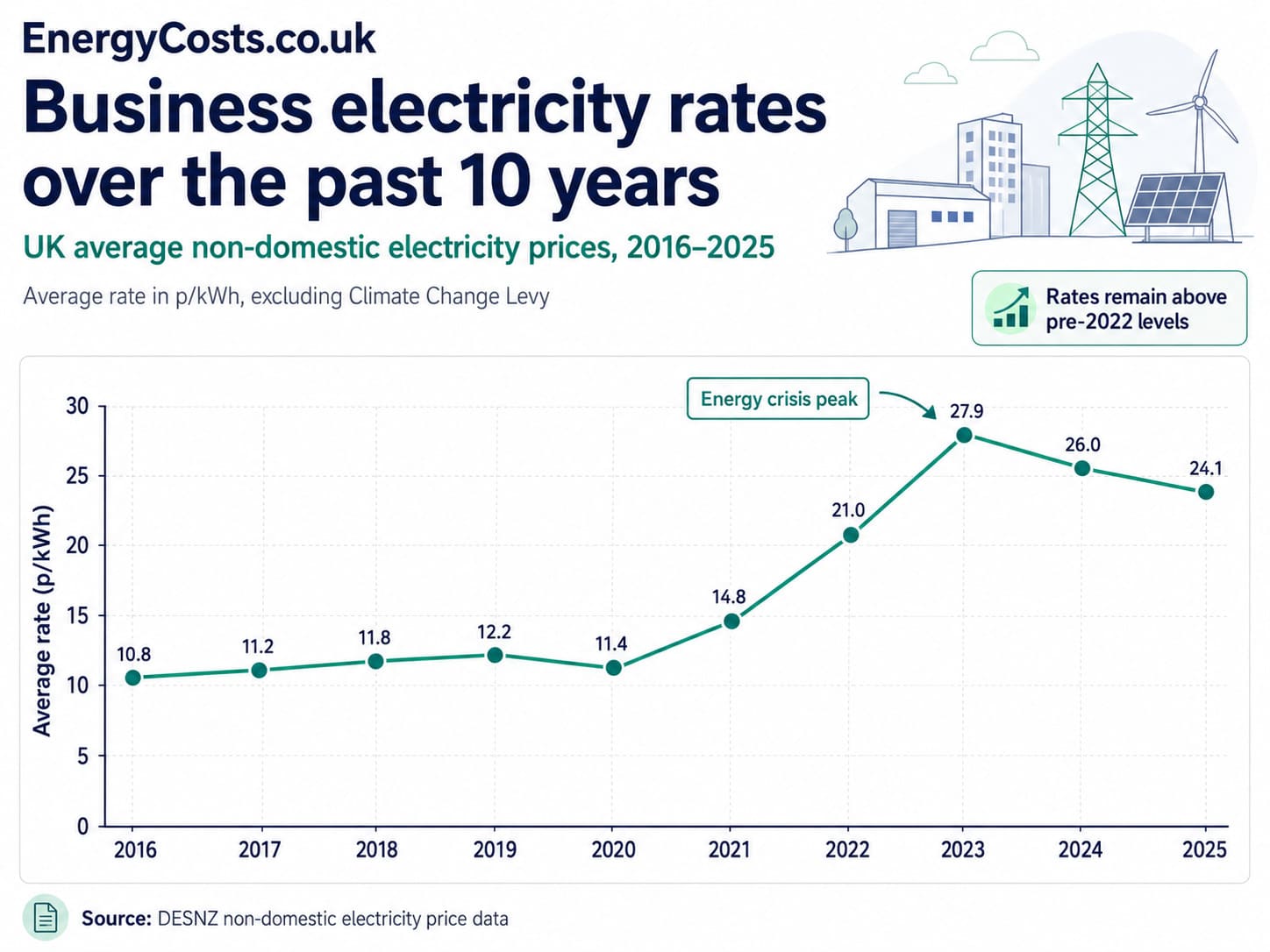
Average business electricity rates over the last 10 years
Understanding business electricity tariffs pricing
Business electricity tariffs are typically more complex than domestic rates, as they vary based on the size of the business, location, and electricity consumption.
Here are some factors that influence business electricity prices:
- Consumption volume: Businesses with higher electricity usage often benefit from lower rates per kilowatt-hour (kWh). However, smaller businesses may still find competitive tariffs if they compare carefully.
- Contract length: Business energy contracts can range from one to five years. Longer contracts may offer stability in terms of price, while shorter contracts provide flexibility.
- Fixed vs. variable rates: Fixed-rate tariffs lock in a price for the duration of the contract, offering protection from market fluctuations. Variable-rate tariffs, on the other hand, can change in response to market conditions, which may offer opportunities for savings but also poses risks if prices rise.
- Peak and off-peak rates: Some suppliers offer tariffs with different rates for peak and off-peak usage. This can be particularly useful for businesses that operate outside traditional working hours.
Why compare business electricity prices online?
Energy is one of the most significant costs for any business. Whether you’re a retail shop, office, or industrial factory, the electricity bills can add up quickly, especially if you’re not on the best tariff.
By regularly reviewing and comparing business electricity prices, you can:
- Reduce energy costs: Switching to a more competitive tariff could save your business thousands of pounds each year.
- Gain financial control: Knowing exactly how much your electricity will cost allows you to better manage your expenses.
- Avoid costly automatic renewals: Many businesses are automatically rolled over onto expensive standard tariffs at the end of their contract without realising it. Comparing rates in advance helps you avoid these higher charges.
- Access green energy options: More suppliers are offering renewable energy tariffs, which can help your business reduce its carbon footprint.
How our business electricity comparison website works
Our online business electricity tariff comparison tool is designed to make the process of finding the best deal as smooth and transparent as possible.
Here’s how it works:
- Enter your details: Start by providing basic information about your business, such as your postcode and current electricity consumption. This allows us to tailor the results to your business’s specific energy needs.
- Compare prices: You’ll receive a range of competitive quotes from various business energy suppliers. Each quote is clear, concise, and easy to compare, ensuring you can quickly identify the best deal for your business.
- Select and switch: Once you’ve found the ideal tariff, the switching process is straightforward. We’ll guide you through every step, ensuring minimal disruption to your business operations.
Benefits of switching your business electricity supplier
Switching energy suppliers may seem like a hassle, but the process is now smoother and quicker than ever. Here are some of the key benefits:
- Instant savings: By switching to a cheaper tariff, your business can start saving money from the moment the new contract takes effect.
- Better contract terms: When you compare prices, you also gain the opportunity to negotiate better contract terms, such as flexible payment options, better customer service, or even added incentives like energy audits.
- Access to greener energy: Many suppliers offer tariffs that are 100% renewable. If sustainability is important to your business, switching can help you align your energy usage with your environmental goals.
Our commitment to you
At EnergyCosts.co.uk, we’re dedicated to helping businesses of all sizes find the best possible electricity deals. We partner with a range of trusted commercial energy suppliers to ensure that you get competitive rates, flexible contracts, and a reliable supply. By using our commercial electricity comparison tool, you’re not just comparing prices—you’re getting access to expert advice, exceptional customer service, and a hassle-free switching process.
Start comparing now and save
Why wait? It only takes a minute to compare business electricity prices using our tool, and the savings could be substantial. Whether you’re looking to switch to a new supplier or renew your current contract, we’ve got you covered. Simply enter your details and let us do the hard work for you.
Start saving on your business electricity costs today by using our quick and easy commercial electricity price comparison tool.
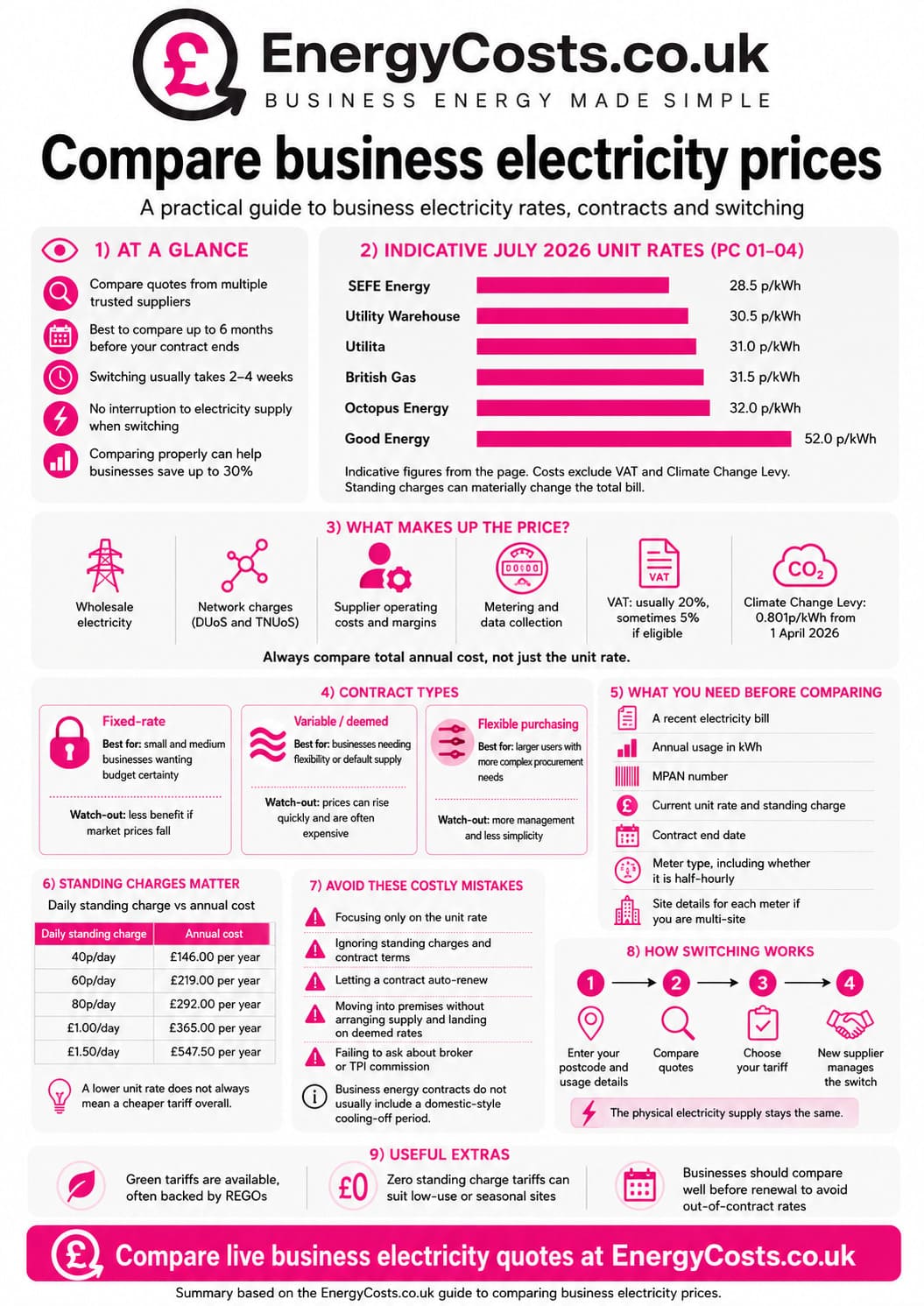
How commercial electricity pricing is actually calculated
Business electricity prices are made up of several separate cost components, not just the headline unit rate shown in quotes. Understanding how pricing works can help businesses spot better deals and avoid misleading comparisons.
The largest element of a business electricity quote is the wholesale cost of electricity, which fluctuates daily based on supply, demand, global energy markets and forward purchasing strategies used by suppliers. On top of this sit network charges, including Distribution Use of System (DUoS) and Transmission Network Use of System (TNUoS) fees, which cover the cost of maintaining the UK electricity grid.
Suppliers also include operational costs and margins, such as customer service, billing, metering, data collection and risk management. Additional charges may apply depending on meter type, data frequency and whether the supply is half-hourly.
Finally, VAT is applied, usually at 20% for most businesses, although some may qualify for the reduced 5% rate depending on usage and eligibility. When comparing quotes, it is important to look at the total cost rather than focusing on unit rates alone.
Business electricity contract types explained
Business electricity contracts differ significantly from domestic energy deals, and choosing the right contract type can have a major impact on long-term costs and flexibility.
- Fixed-rate contracts are the most common option for small and medium-sized businesses. These lock in a unit rate and standing charge for an agreed period, typically between one and five years, offering price certainty and protection against market volatility.
- Variable and deemed contracts apply when a business is not actively on a fixed deal. These tariffs are usually much more expensive and can change at short notice, making them one of the costliest ways to buy electricity.
- Flexible or basket purchasing contracts are generally used by larger, high-consumption businesses. Prices are bought in stages over time, spreading market risk and potentially reducing exposure to price spikes, but they require careful management and expertise.
Contract pricing is also affected by whether the supply is half-hourly or non-half-hourly, which determines how consumption data is recorded and billed.
Fixed vs flexible business electricity
The choice between fixed vs flexible business electricity depends on how much certainty or market exposure your business wants. Fixed-rate contracts lock in the unit rate and standing charge for the agreed period. Variable contracts can move up or down. Flexible purchasing arrangements are more common for larger users and can spread buying decisions across time rather than locking in all volume at once.
| Contract type | Best for | Main trade-off |
|---|---|---|
| Fixed-rate | Small and medium businesses wanting budget certainty | Less benefit if market prices fall |
| Variable | Businesses comfortable with price movement | Bills can rise quickly |
| Flexible purchasing | Larger users with more complex procurement needs | More management and less simplicity |
Large sites should also pay attention to pass-through costs electricity charges, because a quote can include more than the headline energy rate. Ofgem lists wholesale costs, network costs, taxes, government levies, third-party costs, bad debt, excess capacity charges and meter operator charges among the items that can be built into business energy billing.
Who this comparison works best for
Our business electricity comparison service is designed to support a wide range of UK businesses, from sole traders to multi-site operations.
It is particularly well suited to small businesses, such as offices, shops, cafés and professional services, that want straightforward pricing and clear cost savings. High-usage businesses, including warehouses, manufacturing sites and hospitality venues, can also benefit from tailored quotes that reflect their larger consumption levels.
Businesses with multiple premises or expanding operations can use comparisons to review contract alignment across sites and identify opportunities to reduce overall energy spend.
Even businesses currently tied into a contract can benefit by comparing prices in advance of contract renewal, helping them avoid rolling onto expensive deemed or out-of-contract rates.
When is the best time to compare business electricity?
Timing plays a crucial role in securing competitive business electricity prices. Most suppliers allow businesses to agree a new contract up to six months before the end of an existing deal, and this is often the best time to compare options.
If a contract expires without a new agreement in place, the business will usually be placed on a deemed or out-of-contract tariff, which can be significantly more expensive. Comparing early helps avoid this scenario.
Wholesale electricity prices also change throughout the year, influenced by seasonal demand, weather patterns and global markets. While it is impossible to perfectly time the market, comparing regularly ensures businesses are not paying more than necessary.
Typical business electricity costs by usage level
Business electricity costs vary widely depending on annual consumption, meter type, location and contract length. However, usage-based benchmarks can provide helpful context.
Low-usage businesses such as small offices or retail units may consume between 5,000 and 15,000 kWh per year, while medium-sized businesses often fall between 20,000 and 50,000 kWh. Larger operations, including manufacturing or distribution sites, can exceed 100,000 kWh annually.
As usage increases, unit rates often fall, but standing charges and network costs still play a role in total spend. Comparing quotes based on actual consumption rather than assumptions is the most reliable way to understand true costs.
Green and renewable business electricity options
Many UK businesses now consider renewable electricity as part of their sustainability strategy. Green business electricity tariffs are typically backed by Renewable Energy Guarantees of Origin (REGOs), which certify that electricity has been generated from renewable sources.
While some green tariffs cost slightly more than standard options, the price gap has narrowed significantly in recent years. In some cases, renewable tariffs are competitively priced with non-green alternatives.
What information do I need before comparing?
Having the right information to hand makes business electricity comparison quicker and more accurate.
Ideally, businesses should have a recent electricity bill, which shows annual consumption in kilowatt-hours, the MPAN number, current unit rates and standing charges. Knowing the contract end date is also important, as it affects which deals are available.
For larger or multi-site businesses, details of each meter and site will help ensure quotes reflect actual usage patterns rather than estimates.
Common mistakes businesses make when comparing electricity
- One of the most common mistakes is focusing solely on the unit rate while overlooking standing charges and contract terms. A lower unit price does not always mean a cheaper overall deal.
- Another frequent issue is allowing contracts to auto-renew without reviewing the market, which can lock businesses into above-average rates. Some businesses also remain on deemed tariffs without realising how costly they are.
- Choosing an inappropriate contract length can also be costly. Short contracts may offer flexibility but less price protection, while long contracts can limit the ability to benefit from falling prices.
What happens after you choose a tariff?
Once a business chooses a new electricity tariff, the switching process is usually straightforward. The new supplier handles the transfer, including liaising with the existing supplier and managing administrative steps.
There is no interruption to electricity supply, as the physical infrastructure remains the same. The switch typically completes within a few weeks, depending on meter type and contract start date.
The business will receive a final bill from the old supplier and begin billing with the new supplier once the contract goes live.
Business electricity standing charges explained
A business electricity standing charge is the fixed daily amount you pay to stay connected, even if you use no power at all. It helps cover the cost of running and maintaining the network, metering, meter readings, billing and customer service. That means the answer to how much is standing charge for business electricity is not just about the pence-per-day figure on your quote, but about how much that daily charge adds to your annual bill. Ofgem and suppliers also make clear that standing charges vary widely between tariffs, meter setups and business types.
When comparing quotes, it helps to translate the daily charge into a yearly cost. That gives you a clearer view of the average standing charge business electricity customers might end up paying over a full contract term.
| Daily standing charge | Approx. annual cost | Approx. 3-year cost |
|---|---|---|
| 40p/day | £146.00 | £438.00 |
| 60p/day | £219.00 | £657.00 |
| 80p/day | £292.00 | £876.00 |
| £1.00/day | £365.00 | £1,095.00 |
| £1.50/day | £547.50 | £1,642.50 |
A lower unit rate does not always mean a cheaper tariff. If your business uses relatively little electricity, a high standing charge can make up a surprisingly large share of the total bill. The strongest way to compare business electricity is to look at the full annual cost, not just the headline rate per kWh. (EDF)
Zero standing charge business electricity
Zero standing charge business electricity tariffs do exist, but they usually come with a higher unit rate. In practice, that means they tend to suit businesses with low or irregular usage better than firms with steady daily demand. Supplier guidance on no standing charge business electricity also highlights that these tariffs are often a stronger fit for seasonal businesses, premises that are closed several days a week, or sites that would otherwise pay a standing charge for long periods of very low consumption.
A zero standing charge tariff may be worth considering if you run:
- a seasonal business
- a storage unit or light-use workshop
- a site closed most weekends
- a business with long periods of zero or near-zero electricity use
A standard tariff with a standing charge is usually better value if you:
- trade every day
- run refrigeration, IT equipment or lighting continuously
- have electric heating or high daytime demand
- want the lowest possible unit rate rather than the lowest fixed cost
The key point is simple: zero standing charge business electricity can be cheaper for some low-usage businesses, but it is not automatically the cheapest commercial electricity option overall.
Deemed business electricity rates and out-of-contract business electricity rates
Deemed business electricity rates usually apply when you move into a new property and start using electricity before agreeing a contract, or when an old contract ends and there is no clear renewal arrangement in place. Ofgem says deemed contracts are usually among a supplier’s most expensive offers. Out-of-contract business electricity rates are different: they apply when your contract says what happens after the agreed term ends, but you do not recontract or switch in time.
| Situation | What usually happens |
|---|---|
| You move into new premises and use electricity before arranging supply | You are likely to go onto deemed business electricity rates |
| Your contract expires and has no clear post-end terms | You may be moved onto a deemed contract |
| Your contract expires and your terms set post-end pricing | You may pay out-of-contract business electricity rates |
Both deemed and out-of-contract tariffs are usually poor value compared with a negotiated fixed contract. That is why businesses should review quotes well before expiry and avoid letting the current agreement drift past the end date.
Business electricity when moving premises
Sorting out business electricity when moving premises should be one of the first admin tasks in any relocation. If you move in and start using power before agreeing terms, you can end up on a deemed tariff from day one. Ofgem’s guidance also makes clear that moving into a site, changing tenancy and setting up a new business energy contract are closely linked.
For change of tenancy business electricity, use this checklist:
- Take opening meter readings on the day you move in.
- Find out who currently supplies the site.
- Confirm the tenancy start date and supply address exactly.
- Ask for the current tariff status immediately.
- Arrange a new contract as quickly as possible to avoid deemed rates.
- Keep photos of the meter and the reading as evidence.
This simple process reduces billing disputes, speeds up switching and helps prevent the new occupier from overpaying during the first weeks in the property.
What is an MPAN and why does it matter?
If you are asking what is an MPAN, it is the number that identifies your electricity supply point. Ofgem explains that the MPAN appears on your bill and can also be obtained through your network operator. It matters because suppliers use it to identify the exact supply you want quoted, switched or renewed.
Having the right MPAN makes business electricity comparison more accurate because it helps suppliers identify:
- the exact site being quoted
- the current meter setup
- profile and settlement details
- whether the supply is non-half-hourly or half-hourly
If the first two digits of your supply number start with 05, 06, 07 or 08, your supplier is taking half-hourly readings. That can affect quote structure, billing detail and the way half-hourly business electricity rates are presented.
Business electricity VAT and Climate Change Levy electricity
Business electricity VAT is usually charged at 20% for most firms, although some businesses may qualify for the reduced 5% rate depending on eligibility and usage. On top of VAT, many businesses also pay Climate Change Levy electricitycharges. The main CCL rate for electricity from 1 April 2026 is £0.00801 per kWh, which is 0.801p per kWh.
That means a business using 20,000 kWh of electricity in a year would pay about £160.20 in Climate Change Levy before VAT is added. At 50,000 kWh, the CCL cost would be about £400.50. This is one reason why the cheapest-looking business electricity quote is not always the lowest final bill once taxes and levies are taken into account.
Unlike household default tariffs, commercial contracts are not protected by the domestic energy price cap in the same way. That makes comparing total cost, renewal timing and contract terms more important for business customers.
Business electricity renewal
A strong business electricity renewal strategy starts well before the contract ends. Ofgem says business contracts can run for up to five years, and many suppliers allow businesses to arrange a new deal months before expiry. If you do nothing, you may roll onto a more expensive deemed or out-of-contract tariff.
A practical renewal timeline looks like this:
| Timing before end date | What to do |
|---|---|
| 6 months | Start reviewing usage, meter type and current rates |
| 3–4 months | Request fresh quotes and compare fixed vs flexible business electricity options |
| 1–2 months | Confirm chosen supplier, terms and start date |
| Final weeks | Submit any required paperwork and avoid drifting onto out-of-contract rates |
Early renewal gives you more time to compare business electricity rates properly, challenge expensive standing charges and secure a tariff that fits your actual usage pattern.
Business energy broker and TPI commission
A business energy broker can help businesses source quotes, review tariffs and arrange a switch or renewal. Ofgem refers to brokers and switching sites as third party intermediaries, or TPIs. It also notes that suppliers are not obliged to supply every business, that there are relatively few published prices in the business market, and that there is no cooling-off period after a business energy contract is agreed, even if the agreement is made over the phone.
Before agreeing a broker-led contract, ask:
- which suppliers the broker works with
- whether any TPI commission or service fee is included in the bill
- whether fees are paid upfront or through the tariff
- whether the full contract and terms will be sent before agreement
- whether the tariff includes green electricity or only standard supply
Ofgem also says suppliers must provide details of service fees included in the bill if you ask for them. That makes transparency on broker charges an important part of any business electricity comparison.
Smart meter business electricity and meter types
Choosing the right tariff is easier when you understand your meter setup. A smart meter business electricity account can provide more accurate readings and make billing less reliant on estimates. Ofgem also notes that business bills and contract details vary depending on whether the site has a half-hourly meter, non-half-hourly meter or smart meter.
If your business uses a lot of electricity, has more complex operating hours or wants better visibility over usage patterns, a smart or half-hourly setup can make tariff comparison more precise. It can also help identify whether peak-time consumption is pushing up costs more than expected.
Related guides and next steps
Businesses comparing electricity often benefit from understanding the wider energy landscape. Related guides cover topics such as deemed contracts, half-hourly meters, VAT on business energy bills and ways to reduce electricity usage.
For businesses that also use gas, comparing both fuels together can provide a clearer picture of overall energy costs and potential savings.
FAQ – Business electricity costs
The average price for business electricity in the UK is approximately 16-19 pence per kWh, depending on your business size and consumption. For example, a micro business might pay around 18.5 pence per kWh, while larger businesses may secure rates as low as 15.5 pence per kWh.
You can reduce costs by switching to a cheaper tariff, improving energy efficiency, or installing energy-saving equipment. For example, energy-efficient lighting can reduce electricity consumption by up to 25%. Comparing tariffs using a price comparison tool can lead to savings of up to 30%.
Yes, business energy rates tend to be higher than domestic rates. While domestic users pay around 15-18 pence per kWh, business rates range from 16 to 19 pence per kWh, depending on the contract and consumption level.
The standing charge is a fixed daily fee that covers the cost of supplying electricity to your business. It typically ranges between 20-80 pence per day, depending on the supplier and the size of your business.
Longer contracts (3-5 years) often provide price stability, locking in rates to protect against market fluctuations. Shorter contracts (1-2 years) offer flexibility but might result in higher per-kWh prices. For example, a 5-year fixed contract might be 16 pence per kWh, while a 1-year deal could be 18 pence.
Peak rates apply during high-demand hours, while off-peak rates are lower and apply during periods of low demand, such as nights and weekends. Off-peak rates can be up to 50% cheaper, allowing businesses to save by shifting operations to off-peak hours where possible.
Switching suppliers can save businesses up to 30% on their electricity bills. For example, a small business consuming 20,000 kWh per year could save up to £1,000 annually by moving to a more competitive tariff.
Yes, many suppliers now offer 100% renewable energy tariffs. These tariffs typically cost around the same as conventional rates—around 17-19 pence per kWh—but allow businesses to reduce their carbon footprint and support sustainability goals without incurring extra costs.
You can switch, but early termination fees may apply, typically ranging from £100 to £500 depending on your contract size. It’s best to check the terms of your existing contract before switching to avoid penalties.
Businesses typically pay 20% VAT on their energy bills. However, small businesses and non-profit organisations may qualify for a reduced rate of 5%, potentially lowering their overall energy expenses significantly.
No, there won’t be any disruption to your electricity supply. The only thing that changes is your billing provider. The process is seamless, and your new supplier will handle the entire switch on your behalf.
The switching process typically takes 2-4 weeks, depending on your current contract’s terms and your new supplier. You’ll be notified at every stage to ensure everything goes smoothly
If you’re locked into a contract, you’ll need to check the terms for any early termination fees. However, you can still use our tool to find a better deal and set up a switch for when your current contract ends.
Our comparison tool is completely free to use. There are no hidden fees, and we’re transparent about all costs associated with switching energy suppliers.
If your business expands or moves to a new location, it’s important to review your electricity needs. You can use our tool to find a tariff that better suits your new requirements.
Latest updates to this page
6 October 2026
- Monthly data accuracy checks and updates
- Added links to internal resources
1 September 2026
- Monthly data accuracy checks and updates
6 August 2026
- Monthly data accuracy check and updates
30 July 2026
- Added links to new resources
17 July 2026
- Minor formatting updates and text tweaks
8 July 2026
- Updated the FAQ
3 July 2026
- Added 2 visualisation graphics
1 July 2026
- Updated rates and checked details for July 2026

4 thoughts on “Compare business electricity prices”
Comments are closed.