
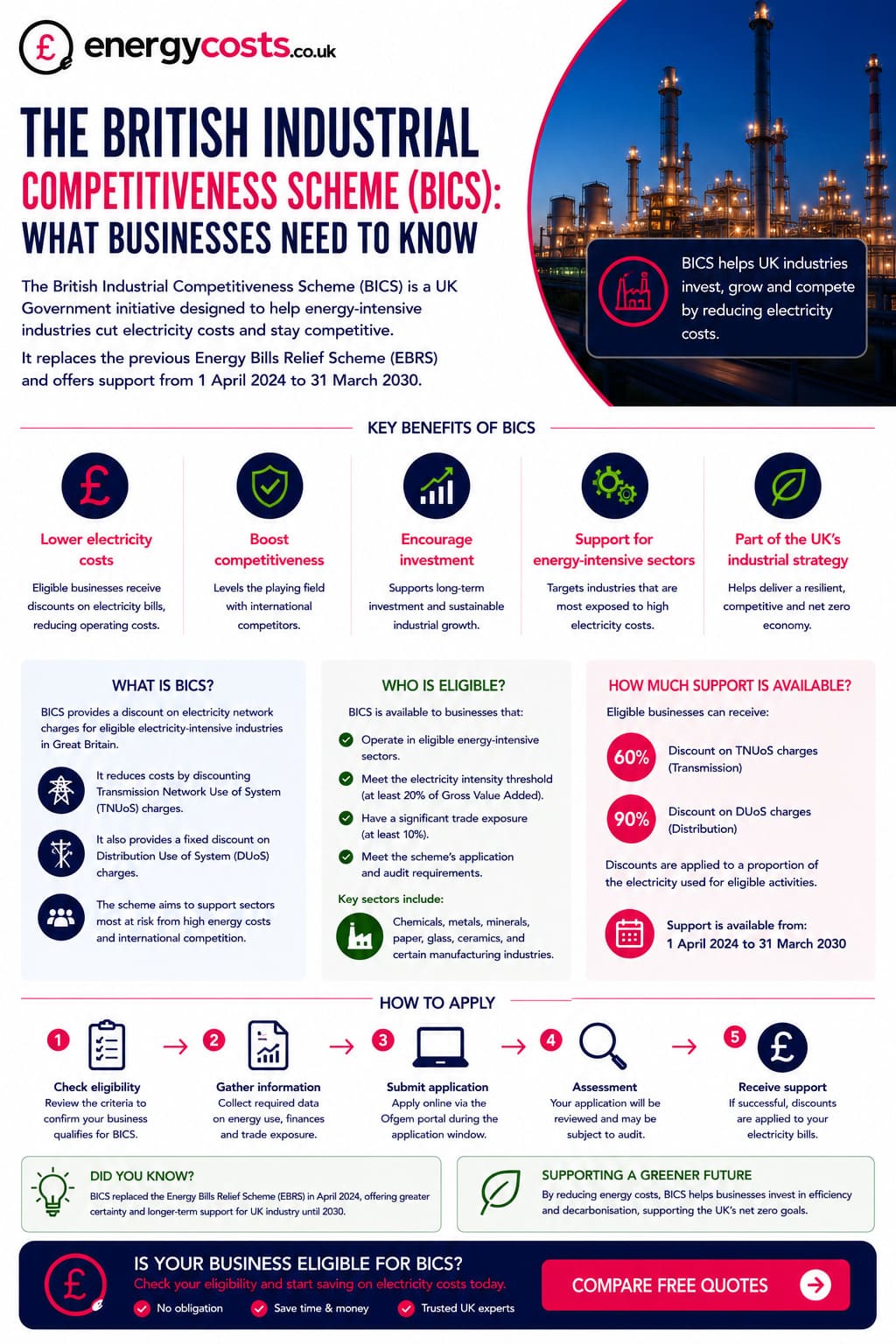
The British Industrial Competitiveness Scheme, usually shortened to BICS, is a UK Government scheme designed to cut electricity costs for eligible manufacturers.
The scheme is intended to help energy-intensive manufacturing businesses compete with overseas rivals by reducing some of the policy costs that are added to electricity bills.
From April 2027, eligible firms are expected to see electricity bills cut by up to 25%, with support worth around £35–£40 per MWh for qualifying electricity use.
Summary answer
| Question | Answer |
|---|---|
| What is BICS? | A Government scheme to reduce electricity costs for eligible manufacturing businesses |
| Who is it for? | Energy-intensive manufacturers in eligible frontier and foundational industries |
| When does it start? | April 2027 for RO and FiT exemptions; October 2027 for Capacity Market exemptions |
| How much could businesses save? | Around £35–£40/MWh, or up to 25% on eligible electricity costs |
| How many businesses could benefit? | More than 10,000 manufacturers |
| Is it for SMEs? | Yes, both SMEs and large businesses can be eligible |
| Is it UK-wide? | It covers Great Britain: England, Scotland and Wales, but not Northern Ireland |
| Does every manufacturer qualify? | No, eligibility depends on sector, products and eligible electricity use |
| Will other businesses pay more? | The Government says household and other business bills will not rise as a result |
Why has BICS been introduced?
BICS has been introduced because UK industrial electricity prices are high by international standards. For manufacturers, high electricity prices can make it harder to compete, invest, expand and retain production in the UK.
The Government says the scheme is a long-term intervention to address Britain’s industrial competitiveness challenge. It is aimed at key manufacturing “frontier” industries, as well as foundational manufacturing industries in their supply chains.
In practice, this means BICS is not a general energy bill discount for every business. It is a targeted scheme for manufacturers where electricity costs are seen as a significant barrier to growth and competitiveness.
What costs will BICS remove?
BICS will exempt eligible businesses from the indirect costs of three electricity schemes:
| Cost removed | What it means | Start date |
|---|---|---|
| Renewables Obligation | A scheme supporting older renewable electricity generation | April 2027 |
| Feed-in Tariff | A legacy scheme supporting small-scale renewable generation | April 2027 |
| Capacity Market | A scheme designed to ensure enough electricity capacity is available when needed | October 2027 |
These charges are usually part of the non-commodity cost stack on electricity bills. They are not the wholesale electricity price itself, but they are added to electricity costs and usually passed through to business customers by suppliers.
The Government says the exemptions are worth around £35–£40 per MWh for eligible businesses.
What are non-commodity charges?
Non-commodity charges are the parts of an electricity bill that are not the wholesale cost of the electricity itself.
They can include:
| Charge type | Example |
|---|---|
| Network charges | TNUoS and DUoS |
| Balancing charges | BSUoS |
| Policy costs | Renewables Obligation, Feed-in Tariff, Contracts for Difference |
| Security-of-supply costs | Capacity Market |
| Taxes and levies | Climate Change Levy |
BICS does not remove every non-commodity charge. It targets three specific electricity policy costs: RO, FiT and Capacity Market.
This means eligible businesses will still pay other electricity costs, including wholesale electricity, network charges, supplier costs, metering, VAT and other applicable charges.
Who qualifies for BICS?
Eligibility is targeted rather than universal. The Government says BICS is for manufacturing frontier industries within the Industrial Strategy’s growth sectors and foundational manufacturing industries that provide key inputs to those frontier industries, provided they meet the relevant electricity-intensity threshold.
Eligibility is based on two main code systems:
- SIC code: Used to identify whether the business is in an eligible manufacturing sector
- HS code: Used to confirm whether the business manufactures eligible products
Only businesses with both an eligible SIC code and an eligible HS code are expected to qualify.
Which sectors could benefit?
The Government has said sectors that could benefit include automotive and aerospace, steel producers, metal fabricators, pharmaceutical and medical supplies companies, recycling businesses, plastic producers, nuclear fuel processors, and cooling and ventilation equipment manufacturers.
The wider BICS framework is linked to manufacturing frontier and foundational industries, including areas such as:
| Category | Examples |
|---|---|
| Advanced manufacturing | Aerospace, automotive, batteries, space, advanced materials |
| Clean energy industries | Heat pumps, hydrogen, nuclear, wind, CCUS and greenhouse gas removal |
| Defence | Weapons, aerospace, maritime and autonomous systems-related manufacturing |
| Digital and technologies | Semiconductors, advanced connectivity, AI-related manufacturing, cyber-related manufacturing |
| Life sciences | Biopharma and MedTech manufacturing |
| Foundational manufacturing | Chemicals, composites, critical minerals, materials, steel and electricity-network components |
The Government’s Annex A list includes manufacturing frontier industries such as batteries, aerospace, automotive, semiconductors, medical instruments, electrical equipment and other specialised manufacturing activities, as well as foundational industries such as chemicals, glass, ceramics, cement, steel, aluminium, copper and recovery of sorted materials.
Do SMEs qualify for BICS?
Yes, SMEs can qualify. The scheme is not restricted to large manufacturers.
The Government says both large businesses and SMEs will be eligible, with support not prioritised by size. Instead, eligibility will depend on whether the business is in an eligible sector, manufactures eligible products and uses enough electricity for eligible manufacturing activity at the relevant site.
This is important because some smaller manufacturers may assume the scheme is only for very large energy-intensive industrial sites. That is not necessarily the case.
How will the discount be applied?
BICS support will be applied site by site. The level of exemption will depend on the proportion of electricity used for eligible manufacturing activity at that site.
| Eligible electricity use at site | BICS exemption level |
|---|---|
| Less than 25% | No exemption |
| 25% to less than 50% | 50% exemption |
| 50% or more | 100% exemption |
This means a business with several sites may not receive the same level of support at every location. A factory where most electricity is used for eligible manufacturing could receive a full exemption, while an office, warehouse or mixed-use site may receive a lower exemption or no exemption.
The Government says businesses will need to evidence both eligible SIC and HS codes.
How much could BICS save a business?
The Government estimates that BICS will be worth around £35–£40 per MWh for eligible businesses. Since 1MWh equals 1,000kWh, this is equivalent to around 3.5p–4p per kWh.
| Eligible annual electricity use | Saving at £35/MWh | Saving at £40/MWh |
|---|---|---|
| 50,000kWh | £1,750 | £2,000 |
| 100,000kWh | £3,500 | £4,000 |
| 250,000kWh | £8,750 | £10,000 |
| 500,000kWh | £17,500 | £20,000 |
| 1,000,000kWh | £35,000 | £40,000 |
| 5,000,000kWh | £175,000 | £200,000 |
| 10,000,000kWh | £350,000 | £400,000 |
These are simplified examples based on eligible electricity consumption. Actual savings will depend on the site’s eligible electricity use, exemption level, supplier billing method, contract structure and final scheme rules.
Example: partial exemption
A manufacturer uses 1,000,000kWh of electricity per year at a site.
Only 40% of that electricity is used for eligible manufacturing activity. That means the site falls into the 25% to less than 50% band and receives a 50% exemption.
| Item | Calculation | Result |
|---|---|---|
| Total annual electricity use | — | 1,000,000kWh |
| Eligible manufacturing share | 40% | 400,000kWh |
| Exemption level | 50% | 200,000kWh supported equivalent |
| Saving at £35/MWh | 200MWh × £35 | £7,000 |
| Saving at £40/MWh | 200MWh × £40 | £8,000 |
This is only an illustrative example. Final calculations may depend on supplier processes, Government guidance and evidence requirements.
Example: full exemption
A manufacturer uses 2,000,000kWh of electricity per year at a site.
Around 70% of the site’s electricity is used for eligible manufacturing activity. That means the site falls into the 50% or more band and could receive a 100% exemption on eligible support costs.
| Item | Calculation | Result |
|---|---|---|
| Total annual electricity use | — | 2,000,000kWh |
| Eligible manufacturing share | 70% | 1,400,000kWh |
| Exemption level | 100% | 1,400,000kWh supported equivalent |
| Saving at £35/MWh | 1,400MWh × £35 | £49,000 |
| Saving at £40/MWh | 1,400MWh × £40 | £56,000 |
For higher-usage manufacturers, BICS could therefore be worth tens or hundreds of thousands of pounds per year.
When will BICS start?
BICS will not fully start immediately.
| Date | What happens |
|---|---|
| April 2026 | Support is expected to be covered retrospectively through a one-off additional payment in 2027 for eligible firms |
| April 2027 | Renewables Obligation and Feed-in Tariff exemptions begin |
| October 2027 | Capacity Market exemption begins |
| Autumn 2026 | Legislation is expected to be in place |
| 2030 | The Government plans to formally review BICS |
The Government says a one-off additional payment in 2027 will cover the support eligible businesses would have received if BICS had been in operation from April 2026. Further details are expected separately.
Does BICS apply in Northern Ireland?
No, the current BICS consultation covers Great Britain, meaning England, Scotland and Wales. The Government says it does not apply to Northern Ireland.
Northern Ireland has a separate electricity market and different energy policy arrangements, so businesses there should not assume BICS will apply in the same way.
How is BICS different from the British Industry Supercharger?
BICS is separate from the British Industry Supercharger, although both are designed to reduce electricity costs for industry.
| Scheme | Who it helps | Main support |
|---|---|---|
| British Industrial Competitiveness Scheme | More than 10,000 eligible manufacturers | Exemption from RO, FiT and Capacity Market costs |
| British Industry Supercharger | Around 500 of the most energy-intensive businesses | Network charge discounts and other support for selected sectors |
The Government says the Supercharger took effect on 1 April 2026 and increased the discount on electricity network charges from 60% to 90% for sectors including steel, cement, glass and chemicals.
BICS is broader in business count, but it targets a specific set of policy costs rather than all electricity charges.
Does BICS mean electricity bills will fall for all businesses?
No. BICS is not a universal business energy support scheme.
It is aimed at eligible manufacturing businesses. Shops, offices, restaurants, cafés, hotels, care homes, farms, warehouses, professional services firms and many other SMEs will not automatically qualify unless they meet the manufacturing eligibility rules.
For non-eligible businesses, BICS may be relevant indirectly because it forms part of the wider debate about business electricity prices, non-commodity charges and industrial competitiveness. However, it will not reduce most ordinary business electricity bills.
Will other businesses pay for BICS?
The Government says households and other businesses not benefiting from BICS will see no increase in their energy bills as a result of the scheme. It says the support will be funded through a combination of changes within the energy system and Exchequer funding, with full details to be set out in Budget 2026.
This is an important point because electricity policy costs are often recovered through bills. If BICS removed costs from eligible manufacturers and simply shifted them to other users, it could increase costs for non-eligible businesses. The Government has said that will not happen, although the full funding details are still due.
What should manufacturers do now?
Manufacturers that may qualify should start preparing early. The support is not automatic for every business with high electricity use.
A sensible preparation checklist includes:
- Check SIC codes: Eligibility depends partly on whether the business is in an eligible manufacturing sector
- Identify HS codes: Businesses will need to evidence eligible products
- Map electricity use by site: Support is applied site by site
- Separate manufacturing and non-manufacturing loads: The exemption level depends on eligible electricity use
- Review MPANs and meters: Suppliers will need the correct site and meter information
- Check contract structure: Pass-through and fixed contracts may treat RO, FiT and Capacity Market costs differently
- Speak to the supplier: Exemptions are expected to be applied through bills
- Keep production evidence: Businesses may need to prove eligible manufacturing activity
- Track Government guidance: Delivery rules and application details are still being finalised
Manufacturers should be especially careful where a site has mixed uses, such as production, warehousing, office space, R&D, retail or distribution. The eligible share of electricity use may be central to the level of support.
How could BICS affect energy contracts?
BICS could affect contract decisions for eligible manufacturers, especially contracts that extend into 2027 and beyond.
Businesses should ask suppliers and brokers:
| Question | Why it matters |
|---|---|
| Are RO, FiT and Capacity Market costs included in the quoted rate? | These are the costs BICS is designed to remove |
| Will BICS savings be passed through automatically? | The business needs to know how the benefit will appear |
| How will the supplier treat retrospective support? | A one-off 2027 payment is expected for eligible firms |
| Does the contract include pass-through charges? | Some contracts may treat policy costs separately |
| Will the unit rate be adjusted after eligibility is confirmed? | Important for budget forecasts |
| What evidence will the supplier need? | Helps avoid delays in receiving support |
| Does the quote assume BICS eligibility? | Prevents misleading comparisons |
A business should be cautious if a supplier or broker quotes a very low future electricity price but does not explain how BICS has been treated.
What if a business is just outside the eligibility rules?
A manufacturer that does not qualify for BICS may still be able to reduce electricity costs through other routes, but it will not receive the BICS exemption unless it meets the final rules.
Possible alternatives include:
- comparing business electricity contracts before renewal
- reviewing pass-through exposure
- checking agreed supply capacity
- reducing peak demand
- improving power factor
- installing solar panels
- using battery storage
- applying for local energy efficiency grants
- reviewing Climate Change Levy eligibility
- investigating whether other industrial energy support schemes apply
BICS is valuable, but it is only one part of the business energy cost picture.
Advantages of BICS
- Reduces electricity policy costs: Cuts a real part of the electricity bill for eligible firms
- Supports manufacturing: Targets sectors where energy costs affect competitiveness
- Includes SMEs: Not restricted only to the largest industrial users
- Site-based support: Allows support to reflect actual eligible activity at each location
- Covers several major policy costs: RO, FiT and Capacity Market costs can be material bill components
- Backdated payment planned: Eligible firms should receive support covering the period from April 2026
- Could improve investment confidence: Lower power costs may help manufacturers plan expansion
Limitations of BICS
- Does not start fully until 2027: It does not immediately cut most 2026 bills
- Not all businesses qualify: It is targeted at eligible manufacturers only
- Not all manufacturers qualify: SIC, HS and electricity-use tests apply
- Does not remove all electricity costs: Businesses still pay wholesale, network and other charges
- Site-level rules may be complex: Mixed-use sites may need careful evidence
- Funding details are still developing: Full details are expected in Budget 2026
- Supplier implementation matters: Businesses will need clarity on how savings appear on bills
What is the British Industrial Competitiveness Scheme?
The British Industrial Competitiveness Scheme is a targeted electricity bill support scheme for eligible manufacturers in Great Britain. It is designed to reduce industrial electricity costs by exempting qualifying businesses from the indirect costs of the Renewables Obligation, Feed-in Tariff and Capacity Market.
For eligible businesses, the saving could be significant. The Government expects support to be worth around £35–£40/MWh, with electricity bills cut by up to 25% from April 2027. For a manufacturer using millions of kWh per year, that could mean tens or hundreds of thousands of pounds in annual savings.
However, BICS is not a general business energy discount. Many businesses will not qualify, and even eligible manufacturers will still need to pay other electricity costs, including wholesale energy, network charges, VAT, CCL and supplier charges.
The businesses most likely to benefit should start preparing now by checking SIC and HS codes, mapping site-level electricity use and asking suppliers how BICS will be reflected in future contracts.
FAQ
The British Industrial Competitiveness Scheme is a UK Government scheme that will reduce electricity costs for eligible manufacturing businesses by exempting them from certain electricity policy costs.
BICS stands for British Industrial Competitiveness Scheme.
BICS exemptions for the Renewables Obligation and Feed-in Tariff are expected to start from April 2027. Capacity Market exemptions are expected to start from October 2027.
The Government says BICS will be worth around £35–£40 per MWh for eligible businesses, with electricity bills cut by up to 25%.
Eligible businesses must be in qualifying manufacturing sectors and manufacture qualifying products. Eligibility is based on both SIC codes and HS codes, with support determined at site level.
Yes. The Government says both large businesses and SMEs can be eligible. Support is not prioritised by business size.
No. Not every manufacturer will qualify. Businesses need to meet the final eligibility criteria, including eligible sector and product codes.
No. The scheme covers Great Britain: England, Scotland and Wales. It does not apply to Northern Ireland.
BICS removes eligible indirect costs from the Renewables Obligation, Feed-in Tariff and Capacity Market.
Usually not. BICS is aimed at eligible manufacturers, not ordinary offices, shops, cafés, restaurants or other non-manufacturing SMEs.