
ENGIE and TotalEnergies are established UK business energy suppliers offering gas, electricity, renewable power, fixed contracts and sophisticated procurement services for large organisations.
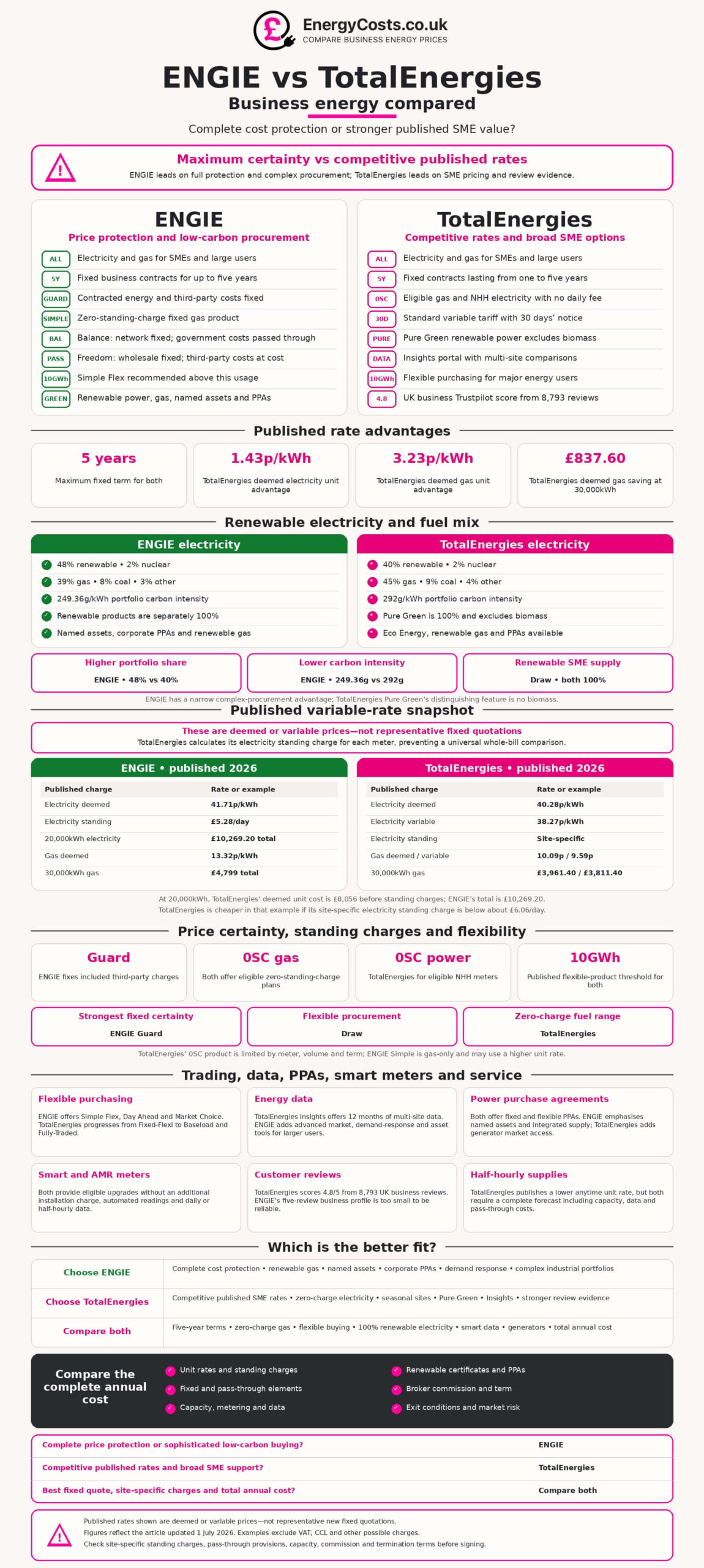
TotalEnergies is likely to be the stronger all-round choice for most small and medium-sized businesses. Its currently published deemed and variable gas rates are considerably lower than ENGIE’s, its electricity unit rates are also lower, and it has a dedicated UK business Trustpilot profile rated 4.8 out of 5.
ENGIE’s strengths lie in complete price protection, flexible purchasing and bespoke low-carbon procurement. Its Guard tariff can fix contracted rates, including third-party charges, for up to five years. ENGIE also offers corporate power purchase agreements, renewable gas, market trading and advanced energy-management services.
The best supplier ultimately depends on business size, consumption, meter type, appetite for market risk and environmental objectives.
ENGIE vs TotalEnergies at a glance
| Comparison area | ENGIE | TotalEnergies |
|---|---|---|
| Business electricity | Yes | Yes |
| Business gas | Yes | Yes |
| Small-business supply | Yes | Yes |
| Fixed contract length | Up to five years | One to five years |
| Fully fixed product | Guard | Fixed Price |
| Zero-standing-charge product | Simple gas tariff | Gas and non-half-hourly electricity |
| Flexible purchasing | Yes | Yes |
| 100% renewable electricity | Optional on fixed and flexible contracts | Pure Green and Eco Energy products |
| Renewable gas | Certified green-gas options | Renewable gas options available |
| Corporate PPAs | Yes | Yes |
| Current deemed electricity unit rate | 41.71p per kWh | 40.28p per kWh |
| Electricity standing charge | £5.28 per day | Calculated for each meter |
| Current deemed gas unit rate | 13.32p per kWh | 10.09p per kWh |
| Gas standing charge for a small site | £2.20 per day | £2.56 per day |
| Standard variable gas rate | Not directly comparable | 9.59p per kWh |
| Smart or AMR meters | Available | Available |
| Consumption platform | ENGIE online account and GEMs | TotalEnergies Insights |
| Published renewable share | 48% | 40% |
| Business Trustpilot evidence | Too limited for a reliable rating | 4.8 from approximately 8,800 reviews |
| Best suited to | Fully fixed costs and complex procurement | SMEs, competitive published rates and customer service |
ENGIE allows businesses to fix contracts for up to five years and offers Guard, Simple, Balance and Freedom products. TotalEnergies also offers contracts lasting up to five years, alongside SME fixed products, zero-standing-charge tariffs and several flexible plans for major energy users.
Which is cheaper: ENGIE or TotalEnergies?
Neither ENGIE nor TotalEnergies publishes a universal list of fixed-contract prices. A quotation is normally calculated using the business’s:
- Annual gas and electricity consumption
- Meter profile and settlement type
- Distribution region
- Contract start date
- Contract duration
- Payment method
- Credit history
- Number of premises
- Agreed electricity capacity
- Renewable-energy requirements
- Treatment of non-commodity charges
Their deemed and variable tariffs provide the clearest publicly available price comparison. Deemed rates normally apply when a business moves into premises without arranging a contract or continues consuming energy after a previous contract has ended.
These rates should not be treated as an indication of the fixed quotation either supplier will offer.
ENGIE vs TotalEnergies electricity prices
The following rates apply to a conventional unrestricted non-half-hourly electricity meter.
| Supplier and tariff | Unit rate | Daily standing charge |
|---|---|---|
| ENGIE deemed rate | 41.71p per kWh | £5.28 |
| TotalEnergies deemed rate | 40.28p per kWh | Site-specific |
| TotalEnergies standard variable rate | 38.27p per kWh | Site-specific |
ENGIE’s current non-half-hourly deemed rate has applied since 1 May 2026. TotalEnergies currently publishes a lower deemed single-rate price, although its daily charge is calculated separately for each electricity meter. TotalEnergies’ standard variable tariff, effective from 1 June 2026, has a still lower single-rate price and can be left after providing 30 days’ notice.
Prices exclude VAT, the Climate Change Levy and any other applicable taxes or separately passed-through costs.
Example annual electricity cost
For a business consuming 20,000 kWh annually, ENGIE’s deemed electricity price would produce the following estimated cost:
| ENGIE charge | Annual cost |
|---|---|
| 20,000 kWh at 41.71p | £8,342.00 |
| £5.28 standing charge for 365 days | £1,927.20 |
| Estimated annual total | £10,269.20 |
TotalEnergies’ deemed unit charge for the same consumption would be £8,056 before its site-specific standing charge.
TotalEnergies would be cheaper in this example provided its daily charge was below approximately £6.06. The supplier does not publish a universal standing charge, so the exact result must be taken from a quotation or bill.
Day and night rates
TotalEnergies also publishes separate non-half-hourly deemed rates for multi-rate meters:
| Period | TotalEnergies deemed rate |
|---|---|
| Day | 43.15p per kWh |
| Night | 29.85p per kWh |
| Single rate | 40.28p per kWh |
Its standard variable rates are:
| Period | TotalEnergies standard variable rate |
|---|---|
| Day | 40.99p per kWh |
| Night | 28.36p per kWh |
| Single rate | 38.27p per kWh |
A business with substantial overnight consumption may benefit from the lower night rate, but the total cost will also depend on the meter-specific standing charge.
Published electricity unit-rate winner: TotalEnergies
TotalEnergies has the lower single-rate unit price. A definitive comparison is not possible until its site-specific electricity standing charge is known.
ENGIE vs TotalEnergies gas prices
The difference between the suppliers is clearer for gas.
| Supplier and tariff | Unit rate | Daily standing charge |
|---|---|---|
| ENGIE deemed gas, up to 73,200 kWh | 13.32p per kWh | £2.20 |
| ENGIE deemed gas, 73,201–293,000 kWh | 13.32p per kWh | £5.39 |
| TotalEnergies deemed gas | 10.09p per kWh | £2.56 |
| TotalEnergies standard variable gas | 9.59p per kWh | £2.56 |
ENGIE applies the same 13.32p unit rate across its gas-consumption bands but increases the standing charge as annual quantity rises. TotalEnergies applies a 256p daily charge to sites consuming no more than 732,000 kWh, after which it may calculate a site-specific charge.
ENGIE gas standing charges by consumption
| Annual quantity | ENGIE standing charge |
|---|---|
| 1–73,200 kWh | £2.20 per day |
| 73,201–293,000 kWh | £5.39 per day |
| 293,001–732,000 kWh | £14.11 per day |
| 732,001–2,196,000 kWh | £32.84 per day |
| 2,196,001–5,860,000 kWh | £66.45 per day |
| 5,860,001–14,650,000 kWh | £131.02 per day |
Further bands apply to very large gas consumers.
Example annual gas cost
For a small business using 30,000 kWh annually:
| Supplier | Unit cost | Standing charge | Estimated annual total |
|---|---|---|---|
| ENGIE deemed | £3,996.00 | £803.00 | £4,799.00 |
| TotalEnergies deemed | £3,027.00 | £934.40 | £3,961.40 |
| TotalEnergies standard variable | £2,877.00 | £934.40 | £3,811.40 |
TotalEnergies’ deemed tariff would cost approximately £837.60 less per year than ENGIE’s at this consumption level.
Its standard variable tariff would cost approximately £987.60 less, although that is a different tariff category and should not be presented as an exact like-for-like comparison.
The advantage can become more pronounced for medium-sized users because ENGIE’s daily charge rises to £5.39 once annual quantity exceeds 73,200 kWh.
Published gas-price winner: TotalEnergies
Half-hourly electricity comparison
Larger electricity supplies are commonly settled half-hourly and can include capacity, metering and reactive-power costs.
| Supplier and tariff | Day or anytime rate | Night rate | Standing charge |
|---|---|---|---|
| ENGIE deemed, LV and lower HV bands | 40.47p | 26.45p | £27.85 per day |
| ENGIE deemed, higher HV bands | 40.47p | 26.45p | £510.31 per day |
| TotalEnergies deemed | 34.84p | Not separately stated | Site-specific |
| TotalEnergies standard variable | 33.10p | Not separately stated | Site-specific |
ENGIE’s half-hourly prices shown above have applied since 1 June 2026. It separately passes through applicable capacity, excess-capacity and reactive-power charges. TotalEnergies publishes a lower anytime unit rate but calculates the standing charge for each meter.
A half-hourly customer should compare a complete annual forecast containing:
- Day and night consumption
- Standing charges
- Agreed supply capacity
- Excess-capacity charges
- Reactive-power charges
- Meter operator costs
- Data collection and aggregation
- Distribution charges
- Transmission charges
- Balancing costs
- Broker commission
The supplier with the lowest unit rate will not necessarily produce the lowest complete bill.
ENGIE fixed contracts
ENGIE offers four principal fixed-product structures.
ENGIE Guard
Guard combines wholesale energy and applicable third-party charges into a fixed contracted rate. ENGIE says the price can be guaranteed for up to five years and that it absorbs changes to the costs included within the agreed rate.
Guard is available for standard or green electricity and gas contracts. It is likely to appeal to businesses that value budget certainty more than the possibility of benefiting from falling industry charges.
ENGIE Simple
Simple is a fixed gas product with no separate daily standing charge. The relevant costs are incorporated into one unit rate, meaning the business pays according to consumption.
This can make bills easier to understand and may suit seasonal or low-consumption gas sites. A no-standing-charge tariff is not automatically cheaper, because the corresponding unit rate may be higher.
ENGIE Balance
Balance fixes network charges while passing government scheme costs through at their applicable rates.
The product can avoid the risk premium a supplier may otherwise add when guaranteeing volatile policy costs, but the final billed price can change during the contract. It is available for standard and green electricity.
ENGIE Freedom
Freedom fixes the wholesale energy component while passing third-party charges through at cost.
It provides greater transparency and gives businesses an incentive to manage demand during expensive network periods. However, it offers less budget certainty than Guard.
TotalEnergies fixed contracts
TotalEnergies offers fixed-rate business gas and electricity contracts lasting between one and five years. Its SME proposition focuses on conventional fixed terms, while larger customers can select more sophisticated combinations of fixed and variable costs.
Zero-standing-charge tariff
TotalEnergies introduced a zero-standing-charge product for new and renewing customers in February 2026.
It is available for:
- Non-half-hourly electricity meters
- Gas sites consuming no more than 500,000 kWh
- Contracts ending within a maximum of three years
The business pays through the energy unit rate without a separate daily fee. TotalEnergies positions the tariff towards low-use, seasonal and intermittently occupied premises.
This gives TotalEnergies an advantage over ENGIE for businesses wanting zero-standing-charge electricity. ENGIE’s Simple product is restricted to gas.
Fixed Price
TotalEnergies’ large-business Fixed Price contract can last from a few months to five years. It provides a known energy unit price and protection from wholesale market increases.
Non Commodity Group Charges
This electricity product fixes the main price but allows selected non-commodity charges to be revised annually. Customers can choose which groups of charges are reset.
It offers a compromise between price security and avoiding the premiums associated with fixing every regulatory and network charge.
Which provides better fixed-price certainty?
ENGIE Guard is the clearest option for businesses wanting comprehensive price certainty.
ENGIE explicitly states that Guard includes third-party charges and that contracted rates remain consistent for up to five years. TotalEnergies offers conventional fixed pricing, but some of its specialist structures include annual revisions to selected non-commodity charges.
The actual contract wording should establish whether the price includes:
- Distribution Use of System charges
- Transmission Network Use of System charges
- Balancing charges
- Capacity Market costs
- Contracts for Difference costs
- Renewable Obligation costs
- Metering and data costs
- New taxes or government levies
A tariff described as fixed may still contain provisions allowing particular industry costs to be passed through.
Flexible purchasing comparison
Both suppliers have substantial propositions for organisations that do not want to purchase all their energy at one fixed price.
ENGIE flexible products
ENGIE’s flexible range includes:
- Simple Flex electricity
- Day Ahead gas
- Market Choice
- Fixed Price
- Tailored market purchasing
- Trading and risk-management support
Simple Flex is recommended for customers consuming more than 10 GWh annually. Monthly bills use a weighted average based on the customer’s transactions and actual volumes.
Day Ahead gas allows businesses to respond to short-term market prices and adjusts purchasing for differences between forecast and actual consumption.
Market Choice lets the customer select how actively it participates in purchasing, with an option linked to average day-ahead prices. ENGIE also provides live market tools, portfolio management and risk-management support.
TotalEnergies flexible products
TotalEnergies offers the following plans to organisations consuming more than 10 GWh annually:
- Fixed-Flexi
- Baseload
- Fully-Traded or Cashout
- Fixed Price
- Non Commodity Group Charges
Fixed-Flexi allows energy to be locked for an entire contract, individual years or particular months.
Baseload lets the business purchase forecast base consumption in stages, while TotalEnergies purchases any outstanding requirement through a predetermined mechanism.
Fully-Traded provides the highest level of market access. Customers can buy and sell volumes from monthly blocks down to individual half-hourly periods using TotalEnergies’ Energy Management Platform.
Flexible-contract winner
Draw
Both suppliers offer genuinely sophisticated trading and procurement options. ENGIE has extensive market-access, demand-response and portfolio-management capabilities, while TotalEnergies provides a particularly clear progression from Fixed-Flexi through Baseload to Fully-Traded.
The better option will depend on the business’s forecasting ability, internal procurement expertise and preferred trading framework.
Renewable electricity comparison
Both ENGIE and TotalEnergies can provide electricity matched with 100% renewable generation.
ENGIE renewable electricity
ENGIE offers renewable electricity as an option across its fixed and flexible contracts. Its 2024/25 disclosure reports that:
| Source | ENGIE overall power mix | ENGIE renewable products | ENGIE standard products |
|---|---|---|---|
| Renewables | 48% | 100% | 11.6% |
| Natural gas | 39% | 0% | 66% |
| Coal | 8% | 0% | 13% |
| Nuclear | 2% | 0% | 3% |
| Other | 3% | 0% | 6% |
ENGIE reports carbon intensity of zero for its renewable products under the market-based Scope 2 method. Its overall power mix produced 249.36 grams of carbon dioxide per kWh, while its standard products produced 426.71 grams.
ENGIE also offers UK Green Plus contracts linked to a named renewable asset and can sleeve power from a customer’s own corporate PPA into its supply agreement. Certified renewable-gas options and Renewable Gas Guarantees of Origin are available.
TotalEnergies renewable electricity
TotalEnergies’ Pure Green product uses electricity from wind, solar and hydro generation and specifically excludes biomass. The electricity is matched with Renewable Energy Guarantees of Origin, allowing customers to report zero market-based Scope 2 emissions in accordance with the relevant GHG Protocol approach.
Its overall 2024/25 fuel mix was:
| Source | TotalEnergies fuel mix |
|---|---|
| Natural gas | 45% |
| Renewables | 40% |
| Coal | 9% |
| Other fuels | 4% |
| Nuclear | 2% |
TotalEnergies reported portfolio carbon intensity of 292 grams of carbon dioxide per kWh.
It also offers Eco Energy products to smaller businesses, with renewable electricity backed by REGOs, as well as renewable gas and carbon-management options.
Renewable-energy winner
ENGIE has a narrow advantage for complex renewable procurement.
Both suppliers offer credible 100% renewable electricity products. TotalEnergies Pure Green has the useful distinction of excluding biomass, while ENGIE offers a wider combination of named-asset contracts, renewable gas, RGGOs and corporate PPA integration.
For a conventional SME renewable tariff, the comparison is effectively a draw.
Smart meters and energy monitoring
ENGIE smart meters
ENGIE offers smart-meter installation without an additional installation charge for eligible sites, subject to technical suitability. Its smart and AMR meters can send readings automatically and support daily or half-hourly consumption data.
Customers can access yearly, daily or half-hourly information through their online account, depending on the meter type. The account also supports invoices, transactions, payments and meter-reading history. Larger customers can access ENGIE energy-management and market tools, including GEMs.
TotalEnergies smart meters
TotalEnergies provides free upgrades to eligible businesses. Smart and AMR meters send readings remotely, reduce estimated billing and help identify changes in consumption.
Its enhanced AMR service can provide daily readings and half-hourly reports for larger organisations.
TotalEnergies Insights allows customers to:
- View and download consumption
- Access half-hourly graphs
- Compare usage patterns
- Review up to 12 months of historical data
- Examine consumption across several business sites
The portal was introduced in October 2024.
Energy-data winner
Draw
TotalEnergies Insights is a practical and clearly defined portal for SMEs and multi-site organisations. ENGIE provides comparable smart-meter data and adds more advanced analytics, market access and asset-optimisation services for larger users.
Power purchase agreements
ENGIE and TotalEnergies both work with businesses that purchase renewable electricity and generators that sell their output.
ENGIE offers fixed and flexible PPAs, short- and long-term arrangements, named-asset contracts and support for both small-scale and utility-grade generation. Its corporate agreements can match business consumption with particular renewable projects.
TotalEnergies offers electricity PPAs and gas purchasing agreements ranging from six-month fixed deals to five-year terms and flexible market-linked arrangements. Its procurement platform can provide renewable generators with wholesale-based pricing and access to day-ahead market opportunities.
PPA comparison: Draw
ENGIE may be particularly attractive where the organisation wants an integrated renewable supply, biomethane and energy-management strategy. TotalEnergies provides strong routes for generators wanting both fixed revenue and access to flexible market pricing.
Customer service comparison
ENGIE’s dedicated business sales team operates from 9am to 5pm Monday to Thursday and 8.30am to 4.30pm on Friday. It offers online account management and specialist account managers for tailored contracts.
TotalEnergies’ quotation line operates from 9am to 5pm Monday to Friday. Its SME and mid-market webchat is available from 8am to 5pm on weekdays and can handle account changes, meter readings, refunds, Direct Debit enquiries and electronic billing.
Both suppliers have formal complaints procedures. Eligible small and microbusiness customers can refer unresolved TotalEnergies complaints to the Energy Ombudsman after eight weeks or once a deadlock position has been reached. ENGIE operates a similar escalation process through its customer service and complaints teams.
Trustpilot ratings
| Profile | TrustScore | Number of reviews |
|---|---|---|
| TotalEnergies Gas & Power UK | 4.8 out of 5 | 8,793 |
| ENGIE UK & Ireland business profile | 2.5 out of 5 | 5 |
| Wider ENGIE.CO.UK profile | 1.0 out of 5 | 1,438 |
TotalEnergies’ profile relates specifically to its UK business gas and electricity operation. It is claimed by the company and uses a paid Trustpilot subscription. Recent reviews frequently discuss webchat, renewals and individual customer-service agents, although negative reviews still raise concerns about billing and delayed issue resolution.
The ENGIE UK & Ireland business profile has only five reviews and is unclaimed, making its 2.5 score statistically unhelpful. The much larger ENGIE.CO.UK profile appears to include substantial legacy activity and says the company has no history of requesting reviews. It should therefore not be treated as a representative measure of the service received by current business customers.
Customer-review winner: TotalEnergies
The gap is substantial, but the suppliers use Trustpilot differently and ENGIE does not have a sufficiently active, clearly representative business profile.
ENGIE advantages and disadvantages
Advantages of ENGIE
- Guard product fixes contracted third-party charges
- Contract terms of up to five years
- Zero-standing-charge gas option
- Fixed and flexible procurement
- Sophisticated trading and risk management
- Corporate PPAs and named-asset renewable products
- 100% renewable electricity available
- Certified renewable-gas options
- Advanced demand-response and asset-optimisation services
- Suitable for large and complex energy portfolios
- Overall fuel mix contained 48% renewable electricity in 2024/25
Disadvantages of ENGIE
- Higher published deemed electricity unit rate
- High £5.28 daily deemed electricity charge
- Higher published deemed gas unit rate
- Gas standing charges rise sharply with consumption
- Very limited reliable public customer-review evidence
- Advanced product range may be unnecessarily complex for a small business
- Standard renewable electricity is optional rather than automatically included with every contract
TotalEnergies advantages and disadvantages
Advantages of TotalEnergies
- Lower published deemed electricity unit rate
- Significantly lower published gas prices
- Standard variable tariff with 30-day notice
- Fixed contracts lasting up to five years
- Zero-standing-charge gas and electricity option
- Pure Green electricity excludes biomass
- Wide range of large-business procurement plans
- TotalEnergies Insights consumption portal
- Free smart-meter upgrades for eligible businesses
- Strong UK business-specific Trustpilot rating
- Products for SMEs, major users, public-sector customers and generators
- Flexible and fully traded contracts available
Disadvantages of TotalEnergies
- Electricity standing charges are not published universally
- Site-specific pricing makes simple electricity comparisons difficult
- Fully traded products require energy-market knowledge
- Its overall fuel mix contained slightly less renewable electricity than ENGIE’s
- Some large-business products allow selected non-commodity costs to be revised
- Zero-standing-charge product is subject to meter, volume and contract-length restrictions
- A high Trustpilot score does not guarantee that every billing or service issue will be handled quickly
Which supplier is best for different businesses?
| Business requirement | Better choice | Reason |
|---|---|---|
| Small business seeking competitive published gas rates | TotalEnergies | Lower unit rate |
| Conventional SME electricity account | TotalEnergies | Lower published unit rate, subject to standing charge |
| Complete fixed-price certainty | ENGIE | Guard fixes included third-party charges |
| Zero-standing-charge electricity | TotalEnergies | Available to eligible NHH customers |
| Zero-standing-charge gas | Compare both | Both offer suitable products |
| Seasonal business | TotalEnergies | Zero-standing-charge gas and electricity |
| Business wanting a five-year contract | Either | Both offer terms up to five years |
| Renewable SME electricity | Compare both | Both offer 100% renewable products |
| Renewable supply excluding biomass | TotalEnergies | Pure Green uses wind, solar and hydro |
| Renewable gas procurement | ENGIE | Strong green-gas and RGGO offering |
| Large industrial consumer | Compare both | Both provide flexible purchasing |
| Fully traded energy purchasing | TotalEnergies | Granular Fully-Traded product |
| Demand-side response | ENGIE | Broader asset-optimisation proposition |
| Named renewable asset or corporate PPA | ENGIE | Wide range of tailored structures |
| Customer-review record | TotalEnergies | Strong business-specific profile |
| Simple online consumption analysis | TotalEnergies | Insights provides 12 months of data |
| Advanced market and asset analytics | ENGIE | GEMs and specialist management tools |
Final verdict: ENGIE vs TotalEnergies
TotalEnergies is the better overall option for most UK small and medium-sized businesses.
Its currently published deemed electricity unit rate is below ENGIE’s, and its deemed gas price is substantially lower. It also offers fixed terms of up to five years, zero-standing-charge gas and electricity products, free eligible smart-meter upgrades and a well-defined online consumption portal.
TotalEnergies additionally has the much stronger public customer-review record. Its dedicated UK business profile is rated 4.8 out of 5 from approximately 8,800 reviews, whereas ENGIE does not have enough clearly representative business reviews to support a meaningful comparison.
ENGIE is particularly strong for organisations requiring complete cost protection or a sophisticated low-carbon procurement strategy.
Its Guard product provides a clearer commitment to fixing third-party charges, while its flexible contracts, risk management, demand response, renewable gas and corporate PPA services make it a credible option for large industrial and multi-site customers.
Based solely on currently published out-of-contract prices:
- TotalEnergies has the lower electricity unit rate.
- TotalEnergies has the lower gas price for most businesses.
- ENGIE publishes its electricity standing charge more transparently.
- TotalEnergies requires a site-specific electricity standing charge before a complete comparison can be made.
Businesses should obtain quotations from both suppliers and compare the total estimated annual cost. The comparison should include unit rates, standing charges, contract duration, pass-through provisions, broker commission, renewable certificates, capacity costs and early termination conditions.
FAQ
TotalEnergies currently publishes lower deemed electricity and gas unit rates. ENGIE’s electricity standing charge is publicly stated, while TotalEnergies calculates it for each meter. Current fixed quotations are needed to determine which supplier is cheaper for a particular business.
ENGIE’s overall 2024/25 electricity mix contained 48% renewables, compared with 40% for TotalEnergies. Both offer dedicated 100% renewable products. TotalEnergies Pure Green excludes biomass, while ENGIE provides wider renewable-gas and corporate PPA options.
Yes. ENGIE and TotalEnergies both provide business contracts lasting up to five years. ENGIE Guard includes contracted third-party charges, while TotalEnergies offers fixed, annually adjusted and flexible structures.
Most tariffs include standing charges. ENGIE offers a zero-standing-charge gas product, while TotalEnergies offers zero-standing-charge gas and non-half-hourly electricity contracts to eligible businesses.
TotalEnergies currently has the lower published gas rates. Its deemed rate is 10.09p per kWh, compared with ENGIE’s 13.32p. TotalEnergies’ standard variable gas rate is 9.59p per kWh.
TotalEnergies publishes a 40.28p deemed single rate, compared with ENGIE’s 41.71p. However, TotalEnergies applies a site-specific standing charge, so its total annual electricity cost cannot be confirmed from the unit rate alone.
Yes. Both suppliers market renewable-gas solutions. ENGIE also offers Renewable Gas Guarantees of Origin and can combine biomethane with renewable electricity in a tailored procurement arrangement.
Yes. Both offer smart or AMR meter installations to eligible business customers. Installations remain subject to the meter type, site configuration and technical survey requirements.
Both are credible large-business suppliers. ENGIE is particularly strong in risk management, demand response and bespoke renewable procurement. TotalEnergies offers Fixed-Flexi, Baseload and Fully-Traded plans with granular market access.
TotalEnergies has the stronger relevant rating, with 4.8 out of 5 from approximately 8,800 UK business reviews. ENGIE’s dedicated business profile contains only five reviews, which is too few for a reliable assessment.
Choose TotalEnergies for lower published rates, strong customer-review evidence, zero-standing-charge electricity or straightforward SME energy management. Consider ENGIE for fully fixed third-party charges, renewable gas, demand response or complex corporate procurement.