

Shell Energy and SSE Energy Solutions both supply gas and electricity to UK businesses, offering fixed contracts, renewable energy and sophisticated procurement services for large organisations.
SSE is likely to be the stronger all-round choice for small and medium-sized businesses that value complete price certainty, renewable electricity from identifiable UK assets and detailed energy-management tools. Its SSE Protect product fixes wholesale prices and existing non-commodity charges for up to three years, while SSE Clarity helps businesses analyse consumption across one or more sites.
Shell Energy is particularly competitive for organisations wanting a longer flexible contract, configurable pass-through pricing or integrated infrastructure such as solar, battery storage, microgrids and low-carbon heat. Its Block and Index product can run for up to five years and gives eligible large users hourly access to wholesale prices.
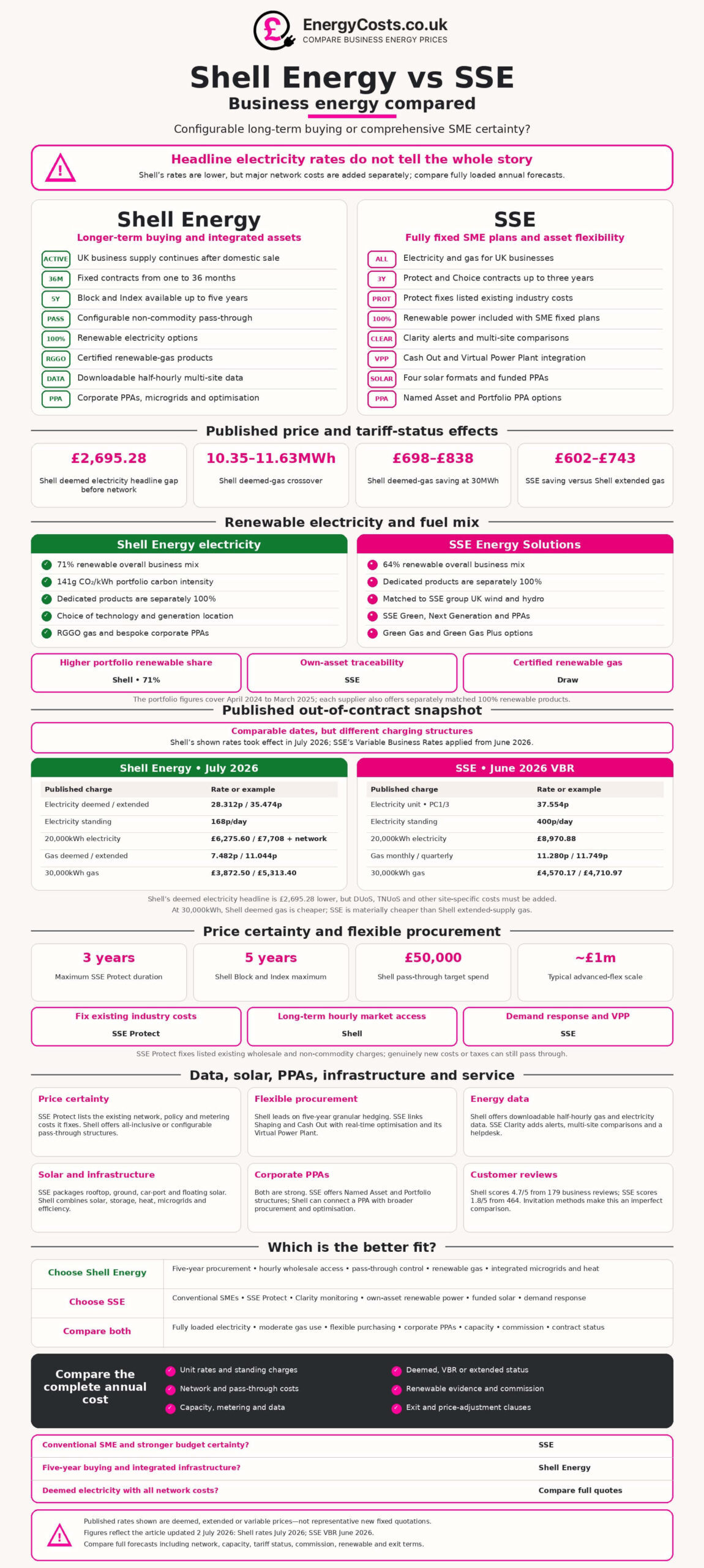
The published out-of-contract prices produce a mixed result:
- Shell has much lower headline deemed electricity rates, but important network costs are added separately.
- Shell’s deemed gas tariff is cheaper at moderate consumption.
- SSE is considerably cheaper than Shell’s extended-supply gas tariff.
- SSE’s electricity and gas tariffs have lower standing charges than Shell in some categories, but not all.
Shell Energy vs SSE at a glance
The comparison below uses Shell’s rates effective from 1 July 2026 and SSE’s Variable Business Rates effective from June 2026.
| Comparison area | Shell Energy | SSE Energy Solutions |
|---|---|---|
| Business electricity | Yes | Yes |
| Business gas | Yes | Yes |
| Fixed contract length | One to 36 months | Up to three years |
| Fully fixed product | Fixed all-inclusive contract | SSE Protect |
| Pass-through contract | Yes | SSE Choice and tailored large-user structures |
| Flexible purchasing | Flex Shape and Block and Index | SSE Shaping and SSE Cash Out |
| Maximum published flexible term | Five years | Bespoke contract terms |
| Renewable electricity | 100% renewable options | Included with SME fixed plans |
| Renewable gas | RGGO-backed products | SSE Green Gas and Green Gas Plus |
| Corporate PPAs | Yes | Yes |
| Deemed electricity rate | 28.312p per kWh | 37.554p per kWh |
| Electricity standing charge | 168p per day | 400p per day |
| Additional electricity costs | DUoS and TNUoS costs passed through | Included within published standard VBR structure |
| Deemed gas rate | 7.482p per kWh for band 1 | 11.280p to 11.749p per kWh for bands 1 and 2 |
| Gas standing charge | 446p per day for band 1 | 325p per day |
| Online energy data | Shell Energy My Account | SSE Clarity |
| Commercial solar | Solar, storage and integrated infrastructure | Rooftop, ground, car-port and floating solar |
| Business Trustpilot score | 4.7 out of 5 | 1.8 out of 5 |
| Best suited to | Pass-through pricing and complex infrastructure | Fully fixed prices and renewable SME supply |
Does Shell Energy still supply businesses?
Yes. Shell Energy UK continues to supply electricity, gas and low-carbon energy services to British businesses.
The sale of Shell’s former household retail operation did not end its commercial energy business. Shell’s current UK business website offers fixed, pass-through and flexible contracts, renewable electricity and gas, and large-scale energy solutions.
SSE Energy Solutions should similarly be distinguished from the former SSE domestic retail operation. SSE Energy Solutions supplies businesses, public-sector organisations and other non-domestic customers.
Which is cheaper: Shell Energy or SSE?
Neither supplier publishes fixed rates that apply to every business. A live quotation can depend on:
- Annual electricity and gas consumption
- Meter type and profile class
- Electricity distribution region
- Agreed supply capacity
- Contract duration and start date
- Payment terms
- Credit history
- Number of sites
- Renewable-energy requirements
- Treatment of non-commodity costs
- Broker commission
The most transparent public comparison therefore uses the suppliers’ deemed, variable and extended-supply rates.
A Shell deemed tariff normally applies when a business moves into premises already supplied by Shell without agreeing a contract. Shell extended supply applies when an existing fixed contract ends and the customer remains with Shell without renewing. SSE applies its Variable Business Rates where no fixed agreement is in place, including both new occupiers and customers whose contracts have expired.
These rates should not be treated as representative fixed-contract quotations. Both suppliers encourage affected businesses to arrange a formal contract.
Shell Energy vs SSE electricity prices
For a standard unrestricted non-half-hourly electricity meter, the published rates are:
| Supplier and tariff | Unit rate | Standing charge |
|---|---|---|
| Shell deemed | 28.312p per kWh | 168p per day |
| Shell extended supply | 35.474p per kWh | 168p per day |
| SSE Variable Business Rate, profile class 1 or 3 | 37.554p per kWh | 400p per day |
| SSE Variable Business Rate, profile classes 5 to 8 | 35.729p per kWh | 984.36p per day |
Prices exclude VAT and the Climate Change Levy. Shell’s figures are effective from 1 July 2026, while SSE’s have applied since June 2026.
Shell’s headline electricity prices are lower, but there is an important qualification. Shell adds Distribution Use of System capacity, fixed and reactive-power charges and Transmission Network Use of System charges at the prevailing rates. Its unit rate and standing charge therefore do not represent the complete annual bill.
SSE’s published Variable Business Rate structure does not carry the same explicit exclusion beside its standard non-half-hourly price. However, businesses should still examine the complete quotation or contract for capacity, metering, tax and other possible costs.
Example annual electricity cost
The following illustration assumes that a business uses 20,000 kWh annually through a profile-class 1 or 3 unrestricted meter.
| Supplier and tariff | Unit cost | Standing charge | Headline annual total |
|---|---|---|---|
| Shell deemed | £5,662.40 | £613.20 | £6,275.60 plus network charges |
| Shell extended supply | £7,094.80 | £613.20 | £7,708.00 plus network charges |
| SSE Variable Business Rate | £7,510.88 | £1,460.00 | £8,970.88 |
Before Shell’s passed-through network charges are added:
- Shell deemed supply is £2,695.28 below SSE.
- Shell extended supply is £1,262.88 below SSE.
This means Shell’s additional annual charges could total as much as £2,695 before its deemed tariff exceeded SSE’s published total in this example. For extended supply, the available margin is approximately £1,263.
That does not prove Shell is cheaper. DUoS and TNUoS costs vary according to region, meter, voltage, capacity and consumption profile. A fully loaded annual quotation is essential.
Day and night electricity rates
SSE publishes separate rates for non-half-hourly day and night meters:
| SSE tariff | Day rate | Night rate | Standing charge |
|---|---|---|---|
| Profile class 2 or 4 | 38.318p per kWh | 34.388p per kWh | 400p per day |
| Profile classes 5 to 8 | 36.867p per kWh | 32.090p per kWh | 984.36p per day |
SSE also publishes weekday, evening, weekend and off-peak structures for relevant meters. Shell’s public deemed schedule instead shows one non-half-hourly unit price for profile classes 01 to 08.
Electricity price verdict: Shell has the lower headline rates, but there is no definitive winner without Shell’s network charges.
Shell Energy vs SSE gas prices
Shell separates deemed and extended-supply gas customers into three annual-consumption bands. SSE applies one standard structure to EUC bands 1 and 2, with different rates according to billing frequency.
| Supplier and tariff | Annual consumption | Unit rate | Standing charge |
|---|---|---|---|
| Shell deemed | 1 to 73,200 kWh | 7.482p per kWh | 446p per day |
| Shell deemed | 73,201 to 732,000 kWh | 7.680p per kWh | 1,586p per day |
| Shell extended | 1 to 73,200 kWh | 11.044p per kWh | 548p per day |
| Shell extended | 73,201 to 732,000 kWh | 11.242p per kWh | 1,688p per day |
| SSE monthly billing | Bands 1 and 2 | 11.280p per kWh | 325p per day |
| SSE quarterly billing | Bands 1 and 2 | 11.749p per kWh | 325p per day |
| SSE band 3 | 293,001 to 732,000 kWh | 10.735p per kWh | 962p per day |
Shell has a much lower deemed unit rate but a higher daily charge. Shell extended supply has both a relatively high unit rate and a substantially higher standing charge than SSE’s bands 1 and 2.
Example annual gas cost
For annual gas consumption of 30,000 kWh:
| Supplier and tariff | Unit cost | Standing charge | Annual total |
|---|---|---|---|
| Shell deemed | £2,244.60 | £1,627.90 | £3,872.50 |
| Shell extended supply | £3,313.20 | £2,000.20 | £5,313.40 |
| SSE monthly billing | £3,383.92 | £1,186.25 | £4,570.17 |
| SSE quarterly billing | £3,524.72 | £1,186.25 | £4,710.97 |
At this consumption level:
- Shell deemed supply is approximately £698 cheaper than SSE monthly billing.
- Shell deemed supply is approximately £838 cheaper than SSE quarterly billing.
- SSE monthly billing is approximately £743 cheaper than Shell extended supply.
- SSE quarterly billing is approximately £602 cheaper than Shell extended supply.
Gas crossover point
Shell’s deemed standing charge costs £441.65 more per year than SSE’s bands 1 and 2 charge.
Shell’s lower unit rate offsets that difference at approximately:
- 11,629 kWh annually compared with SSE’s monthly-billed rate
- 10,350 kWh annually compared with SSE’s quarterly-billed rate
Below these approximate levels, SSE’s lower standing charge can make it cheaper. Above them, Shell’s lower deemed unit rate becomes more important.
This calculation applies only to Shell’s band 1 deemed tariff. It does not apply to Shell extended supply or to sites crossing into a higher consumption band.
Gas price verdict: Shell is stronger on deemed supply at moderate consumption; SSE is considerably better than Shell extended supply.
Half-hourly electricity comparison
The suppliers structure their half-hourly tariffs differently.
| Supplier and tariff | Unit rate | Standing charge | Capacity costs |
|---|---|---|---|
| Shell deemed half-hourly | 27.919p per kWh | 217p per day | Passed through |
| Shell extended half-hourly | 35.081p per kWh | 217p per day | Passed through |
| SSE unrestricted LV/LVS, measurement class C or E | 33.669p per kWh | £23.98 per day | 158p per kVA per month |
| SSE unrestricted LV/LVS, measurement class F or G | 31.547p per kWh | £18.36 per day | Depends on supply |
Shell passes availability, distribution, transmission, fixed and reactive-power costs through separately. SSE publishes different prices according to measurement class, voltage and tariff type, with capacity charges added where relevant.
A half-hourly business should compare an annual forecast containing:
- Unit charges
- Standing charges
- Agreed capacity
- Excess-capacity charges
- Reactive power
- DUoS and TNUoS costs
- Meter operator charges
- Data collection and aggregation
- Balancing and policy costs
- Broker commission
There is no reliable half-hourly winner without a specific meter, region, voltage and consumption profile.
Shell Energy contract options
Shell fixed all-inclusive contracts
Shell’s fixed-price contracts can last from one month to 36 months. The supplier offers aligned end dates for multi-site gas and electricity contracts, individual or group billing and payment terms of 14, 21 or 30 days.
Shell describes the price as fixed for the contract term, but its terms allow prices or costs to change in certain circumstances. These include changes to regulation, law, metering, supply arrangements or the structure and calculation of third-party charges.
The fixed product can include:
- Renewable electricity
- Renewable gas
- A choice of generation technology
- Carbon-offset options
- Multi-site billing
- Flexible payment arrangements
Shell pass-through contracts
Shell’s pass-through product is aimed at businesses spending more than £50,000 annually on energy.
It allows the business to fix the electricity commodity cost while selecting which non-commodity costs, including distribution and transmission charges, are billed at prevailing rates.
Potential benefits include:
- Greater transparency
- Avoiding some supplier risk premiums
- Potential savings if third-party costs fall
- Tailored renewable options
- Flexible payment terms
The trade-off is weaker budget certainty. The total bill can increase when network, regulatory or policy costs rise.
Shell flexible purchasing
Shell offers two flexible electricity products to businesses typically spending more than £1 million annually.
| Product | Contract length | Purchasing method |
|---|---|---|
| Flex Shape | 12 to 36 months | Monthly, quarterly or seasonal blocks |
| Block and Index | 12 to 60 months | Block purchases plus indexed residual volumes |
Flex Shape fixes an agreed shape fee and requires energy to be hedged before each block period. Block and Index gives the customer hourly wholesale-market access and lets it choose how much energy to hedge or leave floating. Both structures pass non-energy costs through and can include 100% renewable electricity.
SSE contract options
SSE Protect
SSE Protect is the supplier’s strongest product for budget certainty.
It fixes wholesale unit prices, standing charges and existing non-commodity costs for up to three years. Included electricity costs cover DUoS, TNUoS, BSUoS, Renewable Obligation, Contracts for Difference, Capacity Market and Feed-in Tariff charges. Existing gas transportation and metering costs are also fixed.
SSE reserves the right to pass through genuinely new costs or taxes outside its control, but Protect otherwise provides broader explicit price protection than Shell’s standard fixed-contract wording.
SSE Choice
SSE Choice fixes wholesale energy prices for up to three years but allows non-commodity costs to change if the supplier’s forecasts differ from actual industry charges.
It is presented as SSE’s lower-cost fixed option and includes 100% renewable electricity, with optional renewable gas.
SSE Shaping
SSE Shaping fixes the cost of the customer’s usage profile while allowing it to buy wholesale baseload power in monthly, quarterly or seasonal increments.
Eligible businesses can access live prices and trade using SSE FlexSee. The product is aimed at major retailers, corporations, universities, councils, government departments, data centres and organisations with more than 1 MW of tradeable load or around £1 million in annual energy spending.
SSE Cash Out
SSE Cash Out combines real-time usage information with the following day’s half-hourly electricity prices. It is designed for businesses that can adjust demand, on-site generation or storage in response to market conditions.
Customers can also combine the product with SSE’s Virtual Power Plant to participate in flexibility services and potentially earn revenue from controllable energy assets.
Which provides better price certainty?
SSE Protect is the stronger published product for comprehensive price certainty.
Its documentation explicitly lists the existing wholesale, network, policy and metering costs that are fixed. Shell’s all-inclusive product can provide substantial certainty, but Shell retains wider rights to vary prices following changes to third-party charging structures, regulation, metering or supply arrangements.
Shell may be preferable where a business wants greater control over which charges remain variable. SSE is preferable where the priority is shielding the budget from changes to existing non-commodity costs.
Flexible purchasing comparison
Both suppliers provide credible flexible procurement for major energy users.
Shell offers the longer clearly published maximum term, with Block and Index available for up to 60 months. It also gives suitable customers hourly wholesale-market access and freedom to choose how much volume is hedged.
SSE provides a broader connection between procurement and operational flexibility. Its Shaping and Cash Out products can be combined with real-time forecasting, SSE FlexSee, on-site generation and demand-side response through the SSE Virtual Power Plant.
Flexible contract verdict:
- Shell for longer contracts and granular wholesale hedging.
- SSE for demand response, real-time optimisation and energy-asset integration.
Renewable electricity comparison
Both suppliers offer electricity matched with 100% renewable generation, but their sourcing propositions differ.
Shell’s renewable electricity is backed by Renewable Energy Guarantees of Origin and can be selected by generation technology and location. Sources can include wind, solar and biomass. Shell also offers renewable gas backed through the Green Gas Certification Scheme.
SSE includes 100% renewable electricity with its fixed SME plans. The electricity is matched with REGOs from wind and hydro assets wholly or partly owned by SSE Renewables. Larger businesses can choose SSE Green, SSE Next Generation or a corporate PPA linked to a wind, solar or hydro asset.
Fuel-mix comparison
The suppliers’ total disclosed fuel mixes for April 2024 to March 2025 were:
| Measure | Shell Energy | SSE Energy Solutions |
|---|---|---|
| Renewable share | 71% | 64% |
| Carbon intensity | 141g CO₂ per kWh | Not stated in the same webpage text |
| Dedicated renewable products | 100% renewable | 100% renewable |
Shell’s overall supply portfolio had the higher disclosed renewable percentage. SSE’s dedicated renewable products offer stronger direct traceability to assets within the SSE group.
Renewable electricity verdict:
- SSE for electricity traced to its own UK wind and hydro assets.
- Shell for broader technology selection and the higher overall renewable fuel-mix share.
Renewable gas comparison
Both suppliers offer renewable-gas products.
Shell’s renewable gas is supported by Renewable Gas Guarantees of Origin. Each certificate matches gas consumed by the customer with an equivalent quantity of biomethane injected into the network.
SSE offers SSE Green Gas and Green Gas Plus alongside its fixed and flexible plans. These can be combined with SSE Protect, SSE Choice, SSE Shaping or SSE Cash Out, subject to the customer’s requirements.
Renewable gas verdict: Draw.
Shell describes the RGGO certification mechanism more explicitly, while SSE makes renewable gas available across a broad selection of fixed and flexible plans.
Smart meters and energy monitoring
Shell Energy My Account
Shell gives smart and advanced-meter customers free access to consumption information through My Account.
Customers can view, download and track gas and electricity consumption, with up to 12 months of historical information available by default. Data can be shown in intervals as short as 30 minutes and exported for analysis in other software.
Shell does not require every customer to have a smart meter. Customers can select half-hourly, daily or monthly collection, although daily collection is the default after installation.
SSE Clarity
SSE Clarity is free with SSE energy plans for customers with compatible smart or AMR meters.
It allows businesses to:
- Track consumption in charts and tables
- Set email alerts for unusual energy use
- Compare several sites
- Organise data by time, site, supply or energy type
- Identify possible waste
- Access a dedicated helpdesk
SSE offers standard smart-meter installation at no additional cost for eligible businesses.
Energy-management winner: SSE
Shell provides useful downloadable half-hourly data, but SSE Clarity offers the stronger packaged combination of alerts, multi-site comparisons and ongoing support.
Commercial solar and battery storage
Shell’s on-site energy solutions can include solar generation, batteries, microgrids, low-carbon heat, energy-management systems and on-site gas generation. Projects can cover design, construction, operation, maintenance and funding.
SSE offers:
- Rooftop solar
- Ground-mounted solar
- Solar car ports
- Floating solar
- Battery storage
- Private-wire generation
- Fully funded power purchase agreements
Under an SSE solar PPA, SSE can finance, install, own, operate and maintain the system while the customer buys the power generated at an agreed price.
Commercial solar verdict:
- SSE for clearly defined commercial solar formats and funded PPAs.
- Shell for an integrated project combining solar with heat, microgrids and broader efficiency measures.
Corporate power purchase agreements
Shell provides bespoke corporate PPAs that can support long-term renewable procurement and the development of new generating assets. Its broader operation can also combine energy supply with market access, asset optimisation and renewable certificates.
SSE offers two primary CPPA structures:
- SSE Named Asset
- SSE Portfolio PPA
These can link a business’s renewable electricity supply with wind, solar or hydro generation and support sustainability reporting and cost management.
CPPA verdict: Draw.
SSE has a particularly strong connection with its UK renewable-generation portfolio. Shell may appeal where the PPA is part of a wider international procurement or infrastructure strategy.
Customer service comparison
SSE’s business customer-service and new-customer telephone lines operate from 9am to 5pm, Monday to Friday. Customers can also use an online contact form and formal complaints process.
Shell provides telephone, email and online account support through UK-based business energy specialists. Its account portal covers invoices, contract details, energy data and account enquiries.
Trustpilot ratings
The relevant business-specific Trustpilot profiles currently show:
| Supplier | TrustScore | Reviews |
|---|---|---|
| Shell Energy for Business Customers | 4.7 out of 5 | 179 |
| SSE Energy Solutions | 1.8 out of 5 | 464 |
Shell’s profile reports that 86% of reviews are five-star. However, Shell invites customers to leave reviews and only seven reviews were recorded during the latest 12-month period shown.
SSE has no history of inviting reviews, and Trustpilot warns that its submissions may not be representative. The profile reports that 82% of reviews are one-star, with recent criticism frequently concerning billing, account administration and communication. SSE reportedly replies to 98% of negative reviews.
Customer-review winner: Shell Energy
The difference is substantial, although Shell’s small and selectively invited sample means the scores should not be treated as a controlled customer-satisfaction study.
Shell Energy advantages and disadvantages
Advantages of Shell Energy
- Lower headline deemed electricity rates
- Low deemed gas unit rate
- Fixed contracts from one to 36 months
- Flexible contracts lasting up to five years
- Configurable pass-through pricing
- Hourly wholesale-market access
- 100% renewable electricity options
- Renewable gas backed by RGGOs
- Higher overall disclosed renewable share
- Multi-site billing and aligned contract dates
- Half-hourly gas and electricity data
- Solar, batteries, heat and microgrids
- Strong business-specific Trustpilot score
Disadvantages of Shell Energy
- Electricity network costs are added separately
- Headline deemed electricity rates are not the complete bill
- High gas standing charges
- Standing charges increase sharply with gas consumption
- Extended-supply rates are significantly higher
- Fixed prices can change in defined circumstances
- Complex products may be unsuitable for a small business
- Small Trustpilot sample with limited recent activity
- No equivalent to SSE Protect’s detailed list of fixed industry charges
SSE advantages and disadvantages
Advantages of SSE
- SSE Protect fixes existing non-commodity charges
- Contracts lasting up to three years
- Renewable electricity included with SME fixed plans
- Electricity sourced from SSE group wind and hydro assets
- Optional renewable gas
- SSE Choice offers a lower-cost fixed structure
- SSE Clarity energy-management platform
- Free eligible smart-meter installation
- Flexible wholesale purchasing
- Real-time consumption optimisation
- Demand-side response and Virtual Power Plant
- Corporate PPAs
- Extensive commercial solar options
- Fully funded solar PPAs
Disadvantages of SSE
- High published electricity standing charges
- Higher headline deemed electricity unit rate
- Higher deemed gas unit rate than Shell
- Very low business Trustpilot score
- Customer-service telephone support is limited to weekday office hours
- SSE Choice permits changes to non-commodity costs
- Complex flexible products are primarily suitable for major users
- Contract terms do not have Shell’s clearly published five-year flexible maximum
Which supplier is best for different businesses?
| Business requirement | Better choice | Reason |
|---|---|---|
| Small office or shop | SSE | Clear SME plans and SSE Clarity |
| Complete price certainty | SSE | Protect fixes existing non-commodity costs |
| Lowest headline deemed electricity rate | Shell | 28.312p compared with 37.554p |
| Fully loaded deemed electricity comparison | Compare both | Shell adds network costs separately |
| Low-consumption gas site | SSE may be cheaper | Lower standing charge |
| Moderate-consumption deemed gas site | Shell | Lower unit rate |
| Existing Shell customer after expiry | SSE may be cheaper | Shell extended rates are high |
| Renewable SME electricity | SSE | Included and traced to SSE group assets |
| Highest overall renewable fuel-mix share | Shell | 71% compared with SSE’s 64% |
| Renewable gas | Compare both | Both offer certified options |
| Multi-site energy monitoring | SSE | Clarity includes comparisons and alerts |
| Downloadable half-hourly data | Shell | Free gas and electricity data exports |
| Three-year fully fixed agreement | SSE | SSE Protect |
| Five-year flexible procurement | Shell | Block and Index |
| Demand-side response | SSE | Virtual Power Plant integration |
| Hourly wholesale-market access | Shell | Block and Index |
| Commercial solar PPA | SSE | Clearly defined funded model |
| Integrated microgrid and heat project | Shell | Broader infrastructure proposition |
| Customer-review score | Shell | 4.7 compared with SSE’s 1.8 |
Final verdict: SSE vs Shell Energy
SSE is the better all-round option for many small and medium-sized businesses.
SSE Protect is a major differentiator. It explicitly fixes existing wholesale and non-commodity costs, including important distribution, transmission, balancing and environmental charges. SSE also includes renewable electricity with its SME fixed plans and provides free access to SSE Clarity.
SSE is particularly suitable for businesses that prioritise:
- Complete budget certainty
- Renewable electricity from identifiable UK assets
- Multi-site consumption monitoring
- Commercial solar PPAs
- Demand-side response
- Integration with flexible energy assets
Shell Energy is the stronger choice for configurable and longer-term procurement.
Its pass-through products let businesses choose which third-party charges remain variable, while Block and Index provides hourly market access for as long as five years. Shell also has a broad proposition covering renewable gas, solar, batteries, microgrids and low-carbon heat.
Shell is particularly suitable for:
- Large energy users
- Five-year purchasing strategies
- Renewable gas
- Wholesale-market access
- Multi-site group billing
- Integrated energy infrastructure
- Businesses comfortable managing variable third-party costs
The published price evidence does not produce one universal winner.
Shell has lower headline deemed electricity prices, but significant network charges must be added. Shell’s deemed gas tariff can be cheaper at moderate consumption, while SSE is substantially cheaper than Shell extended supply.
For a conventional SME fixed contract, SSE offers the clearer combination of budget certainty, renewable electricity and energy monitoring.
For a major user seeking control over wholesale buying and pass-through costs, Shell Energy offers the more configurable long-term procurement proposition.
FAQ
Shell has lower headline deemed electricity and gas unit rates. However, Shell passes important electricity network charges through separately and has higher gas standing charges. Live fixed quotations are required for a fair comparison.
Shell publishes a 28.312p deemed rate with a 168p daily charge. SSE publishes 37.554p with a 400p charge for profile classes 1 and 3. Shell adds DUoS and TNUoS costs separately.
Shell’s deemed unit rate is lower, while SSE has the lower standing charge. At 30,000 kWh, Shell deemed supply is cheaper, but SSE costs less than Shell extended supply.
Shell extended supply applies when a fixed contract ends and the business remains supplied by Shell without agreeing a renewal. Its rates are higher than Shell’s deemed prices.
Yes. Shell offers terms from one to 36 months. SSE Protect and SSE Choice provide fixed contracts lasting up to three years.
SSE Protect provides the clearer comprehensive guarantee because it fixes listed wholesale and existing non-commodity charges. Shell can vary prices following certain regulatory, metering and third-party cost changes.
Yes. Shell offers REGO-backed renewable electricity. SSE includes renewable electricity with SME fixed plans, matched with REGOs from SSE group wind and hydro assets.
Yes. Shell offers RGGO-backed renewable gas. SSE offers SSE Green Gas and Green Gas Plus alongside relevant fixed and flexible contracts.
Both install or support business smart meters. SSE has the stronger packaged analytics platform through SSE Clarity, while Shell offers downloadable half-hourly gas and electricity data through My Account.
Yes. Shell develops integrated solar, battery and microgrid projects. SSE offers rooftop, ground-mounted, car-port and floating solar, including fully funded PPAs.
Both are strong. Shell offers five-year Block and Index contracts with hourly wholesale access. SSE combines flexible procurement with demand response, forecasting and its Virtual Power Plant.
Shell’s business Trustpilot profile scores 4.7 from 179 reviews. SSE Energy Solutions scores 1.8 from 464 reviews. The suppliers use different review-invitation methods, so the figures are not directly comparable.
Choose SSE for fully fixed costs, renewable SME electricity, SSE Clarity or a commercial solar PPA. Consider Shell for five-year flexible purchasing, renewable gas, pass-through pricing or an integrated industrial energy project.